 Experience

Last verified · Next check due
On this page
Short answer: Most Western visitors buy a Zimbabwe visa on arrival or online, but no official 2026 fee is in our sources; the KAZA Univisa costs US$50 for 30 days in Zimbabwe and Zambia. Park fees are low: US$58 per entry at Victoria Falls, US$12–24 a day in Hwange and US$24 in Mana Pools (ZimParks Tariff 2026). Game is best July to October, and most Mana Pools camps close December to March. Checked 10 October 2026.
Key facts
- The ZimParks Tariff 2026 is the current schedule: international adults pay US$58 per entry at the Victoria Falls rainforest, US$24 a day in Hwange as day visitors (US$12 if they sleep inside) and US$24 a day in Mana Pools (ZimParks Tariff 2026, PDF). The tariff year ends on 31 December 2026.
- Parks, visas and activities are paid in US dollars. Bring small notes: card withdrawals can fail, change is scarce and torn notes are refused (UK FCDO).
- Hwange Main Camp is 200 km, up to 3 hours by road from Victoria Falls; Mana Pools is 388 km, 7–8 hours from Harare, with a 4x4 (a safari booking site’s Hwange and Mana Pools pages).
- Mana Pools has no rhino and has never had giraffe, but 58% of one safari operator’s travellers there saw wild dog, and you may walk there without a guide, with a permit (that operator’s Mana Pools guide; Zimbabwe Field Guide).
- Published 2026 trips cost about US$151–1,788 per person per day, from overland camping to top-end fly-in safaris (operators’ published prices, read 8 October 2026; see our Zimbabwe safari cost page).
- This page answers 35 questions drawn from 41 Zimbabwe forum threads on TripAdvisor (37), 4x4community.co.za (3) and Namibia-Forum (1), collected on 8 October 2026; Victoria Falls visits are the most-asked theme, then transfers and flights.
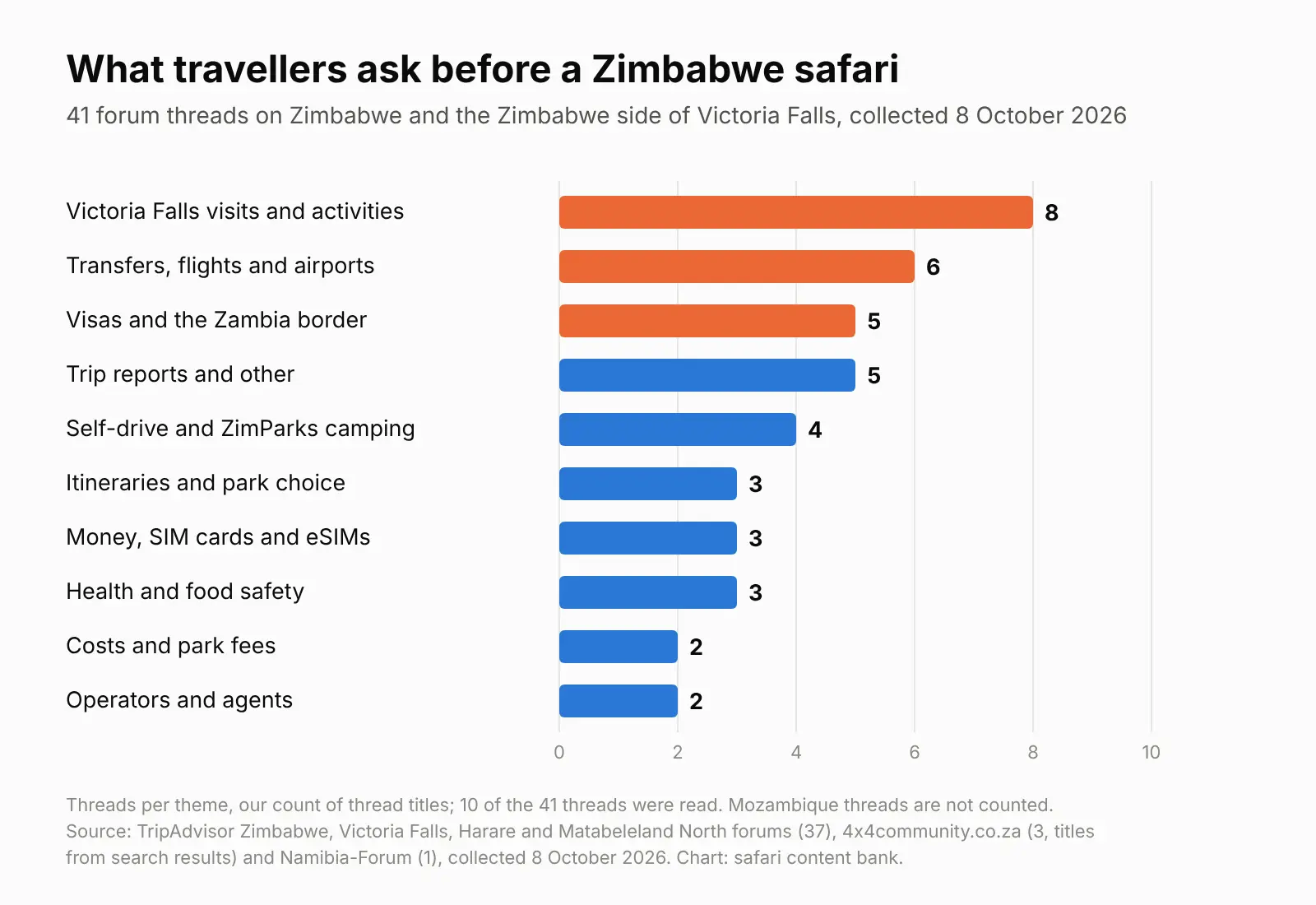 Thread titles on the TripAdvisor Zimbabwe, Victoria Falls, Harare and Matabeleland North forums (37), 4x4community.co.za (3, titles from search results) and Namibia-Forum (1), collected 8 October 2026. Our count by theme. Chart: safari content bank.
Visa, entry and money
Do I need a visa for Zimbabwe in 2026?
Most Western visitors do, and buy it on arrival or as an e-visa; we do not print the fee, because no official 2026 figure is in our sources (UK FCDO, Zimbabwe entry requirements, updated 15 July 2026; evisa.gov.zw). Your passport must be valid for six months beyond arrival, with three blank pages (FCDO). Pay in US dollars, in small notes. If your trip also takes in Zambia or a Chobe day trip, compare the fee with the KAZA Univisa below. Entry costs sit with the rest of the budget on our Zimbabwe safari cost page.
Is the KAZA Univisa worth buying?
Yes, if your passport needs a Zimbabwe visa and you will leave Zimbabwe and come back: the Univisa costs US$50, lasts 30 days and covers Zimbabwe and Zambia with unlimited crossings, plus day trips into Botswana through Kazungula (UK FCDO; a Victoria Falls booking site, updated 27 June 2025). A night in Botswana voids it, it cannot be extended, and you can buy up to three a year. In Zimbabwe it is issued at Victoria Falls, Harare and Bulawayo airports, the Victoria Falls Bridge and Kazungula (UK FCDO). A traveller who visited in August 2026 paid US$50 in cash for it (TripAdvisor, “Back from Victoria Falls – some info”, traveller report). UK and US passport holders need no visa for Zambia, so for them it pays only when a single-entry Zimbabwe visa would not be enough. The full rules are on Victoria Falls: Zimbabwe or Zambia side.
Do I need a yellow fever certificate for Zimbabwe?
Only if you arrive from a country with yellow fever risk; flying in from Europe or North America, you do not (UK FCDO, updated 15 July 2026). If you change planes in a risk country such as Kenya (Nairobi) or Ethiopia (Addis Ababa), ask your airline whether the stop counts. Kenya is a risk country, so a Victoria Falls trip after a Kenya safari needs the card: on the TripAdvisor Zimbabwe forum, one reply warned that without it “you dont get to board the plane” (TripAdvisor, traveller report). An August 2026 visitor saw certificates checked at the Victoria Falls airport health desk (traveller report, linked above). Every route is on our yellow fever certificate page.
Should I bring US dollars, and will my card work?
Bring US dollars in small, clean notes: tourists pay for accommodation and tourism services in US dollars, and Zimbabwe Gold (ZiG), introduced in April 2024, is for local use (Wild Zambezi, money). The UK FCDO warns that card withdrawals can fail for lack of cash, that change is scarce and that torn or old notes are refused (FCDO). Declare US$10,000 or more on arrival; leaving with more than US$2,000 in cash is illegal (FCDO). Lodges and larger businesses in tourist centres take cards on point-of-sale machines (FCDO). In August 2026 a traveller’s European fintech card was refused in Victoria Falls shops and restaurants (TripAdvisor, traveller report). Since 1 January 2026 foreign visitors pay 15.5% VAT on tourism services (Tourism Update, 6 Oct 2026, a single press source).
Victoria Falls
How much does it cost to enter Victoria Falls in 2026?
US$58 per international adult per entry at the main gate of the rainforest on the Zimbabwe side; the VIP gate costs US$174 and moonlight (lunar rainbow) viewing US$116 (ZimParks Tariff 2026, PDF). SADC residents pay US$35 and Zimbabweans US$7. The fee is charged per entry, not per stay. On the TripAdvisor Victoria Falls forum, one couple who paid the earlier US$50 each called it overpriced for an hour’s walk, and replies pointed out that the fee applies only inside the gate: the hotels, the Lookout Cafe and the bridge walk need no ticket (TripAdvisor, “Victoria Falls Park Fee – Need Urgent Explanation”, traveller reports). Game drives are in Zambezi National Park, a separate ticket whose 2026 fee is not in our sources. Town, seasons and activities are on our Victoria Falls page.
Is the Zimbabwe or the Zambia side of the Falls better?
For the view, Zimbabwe: its rainforest path faces the Main Falls from 16 viewpoints, and that side flows all year (a booking site run by Zimbabwe-based operators). Zambia is the side for Devil’s Pool and Livingstone Island, and in October and November its Eastern Cataract can shrink to “small rivulets, in places no water at all” (a safari agent’s guide to the Falls). No official Zambian Falls gate fee is confirmed. Victoria Falls town is under 1 km from the rainforest entrance; Livingstone is about 10–11 km from the Falls (one safari operator’s Livingstone guide). The full comparison is on Victoria Falls: Zimbabwe or Zambia side.
When is the best time to see Victoria Falls?
June to August, for the best balance of volume and visibility; from February to May there is the most water and the most spray, and November has the least water (a safari agent’s guide to the Falls; Wikipedia). The Zambezi’s mean flow is about 3,000 m³ a second in April against about 300 in November (Wikipedia). In April one safari operator describes the Falls as “often obscured by spray” (its Mana Pools guide). The lunar rainbow appears around the full moon in high-water months, and Zimbabwe sells a separate moonlight ticket for it. For the Falls plus a safari, July to October is Hwange’s best period; the month chart below puts the two together.
Will I see the Falls from a sunset cruise, and what do activities cost?
No: on the TripAdvisor Victoria Falls forum in 2026, replies said the Falls cannot be seen from the boats, that Zambezi cruises are for scenery and that Chobe’s river is the one for wildlife (TripAdvisor, “River safari – from Livingston, VR or Kasane?”, traveller reports). One booking agent’s 2026 list prices a standard sunset cruise at US$59–80 plus a US$12 river fee, a full day’s white-water rafting at US$161–173 plus a US$12 parks fee, a 12–13-minute helicopter flight at US$173 plus US$20 fuel and an US$18 parks fee, and a Zambezi National Park game drive at US$79–163 plus US$18 (read 9 October 2026). Rafting is from age 15 (one safari operator’s age-limits guide). Activity operators took “the biggest shock” from the 2026 VAT change (Tourism Update, 6 Oct 2026). The full list is on Victoria Falls safari cost.
Can I visit Chobe in Botswana from Victoria Falls?
Yes, as a day trip: Chobe National Park’s Sedudu Gate is 80 km from Victoria Falls, just over an hour by road plus the Kazungula Road border, which is open 06:00–20:00 (Chobe day trip from Victoria Falls). A booking agent lists the day trip at US$249 per person with transfers (2026). Coming back is a second entry into Zimbabwe, so a single-entry Zimbabwe visa is not enough; the Univisa or a visa allowing more than one entry covers it. Mack Air flies Victoria Falls to Kasane in 20 minutes (Mack Air). Two TripAdvisor threads in 2026 asked how to split five nights between the Falls and Chobe; their replies are not in our sources. The park itself is on our Chobe National Park page.
Parks: where to go and what you will see
Which parks should I choose for a first Zimbabwe safari?
Victoria Falls plus Hwange is the commonest pairing, and Mana Pools is the usual addition for walking and canoeing. Of 99 published trips that include Zimbabwe in our sources, 14 are built on Hwange and Victoria Falls, 7 add Mana Pools and 5 add Matobo; 53 start at Victoria Falls (listings read 8 October 2026; our count).
| Park | Size | Known for | Best months | Conservation fee, international adult per day (2026) |
|---|---|---|---|---|
| Victoria Falls Rainforest | Victoria Falls National Park, 23 km² | The Main Falls face-on; lunar rainbow | June–August | US$58 per entry |
| Hwange | About 14,650 km² | Elephant at pumped waterholes; sable, roan, wild dog | July–October | US$24 day visitor; US$12 staying overnight |
| Mana Pools | 2,196 km² | Walking (unguided with a permit), canoeing, floodplain elephant; no rhino, no giraffe | June–October; camps closed December–March | US$24 |
| Matusadona (Lake Kariba) | Not stated: sources disagree | Lakeshore game, boats; wild dog and black rhino returned in 2026 | May–September | US$24 |
| Gonarezhou | 5,053 km² | Chilojo Cliffs, self-drive wilderness, elephant | Camping April–September; waterholes best September–November; closed 10 January–1 March | US$30 day visitor; US$20 staying overnight |
| Matobo | 424 km² | Granite hills, rock art, rhino tracking on foot | Not stated in our sources | US$18 day visitor; US$10 staying overnight |
Fees: ZimParks Tariff 2026 (PDF), as on our Zimbabwe safari cost page; the conservation-fee table does not say whether VAT is included. Sizes: Wikipedia, Victoria Falls; a safari booking site’s Hwange and Mana Pools pages; Wikipedia, Gonarezhou and Matobo. Seasons: one safari operator’s Hwange and Mana Pools guides (names and links kept in our editor notes); African Parks / Visit Matusadona; Gonarezhou Conservation Trust visitor FAQ (page last modified November 2022). Read 8–10 October 2026.
The parks in more depth: Hwange National Park, Hwange safari cost and Victoria Falls. We have no Mana Pools, Gonarezhou or Matobo page yet.
Can I see the Big Five in Zimbabwe?
Four of them easily in Hwange and Mana Pools, but not rhino: Hwange’s rhino are “very scarce” and Mana Pools has none, because its black rhino were removed after poaching in the 1990s (a safari booking site’s Hwange page; one safari operator’s Mana Pools guide). Zimbabwe held 784 black and 536 white rhino at the end of 2024 (IUCN SSC and TRAFFIC report to CITES CoP20, PDF). Travellers see them in two places our sources name: Matobo National Park near Bulawayo, where tracking on foot with a guide is the main activity (Wikipedia, Matobo), and the Victoria Falls Private Game Reserve, which holds black rhino and, since September 2026, white rhino and sells a US$600 “Rhino Guardian” drive (Tourism Update, 30 Sep 2026). In Mana Pools, 90% of that operator’s travellers saw lion, 84% buffalo and 36% leopard. Africa’s rhino parks are compared on where to see rhino.
Where am I most likely to see wild dogs in Zimbabwe?
Mana Pools, where 58% of one safari operator’s travellers saw them; in Gonarezhou the figure is 22% (its Mana Pools and Gonarezhou guides). Hwange holds “one of the larger surviving populations” in Africa but publishes no sighting rate (Wikipedia); Painted Dog Conservation’s visitor centre is at Dete, beside the Main Camp gate, and takes visitors with advance notice (the same operator). In February 2026 African Parks moved 20 wild dogs into Matusadona, where they had been locally extinct for years (African Parks, Matusadona). Africa’s best areas are compared on where to see wild dogs.
Is Gonarezhou worth the trip?
Yes, for self-drivers who want wilderness and the Chilojo Cliffs, but plan around its closure from 10 January to 1 March and its sand-river crossings. Gonarezhou is Zimbabwe’s second-largest park at 5,053 km², on the Mozambique border, and part of the Great Limpopo Transfrontier Park (Wikipedia). The Gonarezhou Conservation Trust, a partnership of ZimParks and the Frankfurt Zoological Society, has run it since 1 March 2017 under a 20-year agreement. One safari operator’s travellers saw elephant and buffalo on every trip, leopard on 44%, lion on 33% and wild dog on 22%, and the operator warns that the elephants are wary after past persecution (its Gonarezhou guide). The ZimParks fee is US$30 a day for day visitors and US$20 if you stay (2026). There is no direct road from Kruger: the route runs through Mozambique via the Pafuri and Sango borders, with two sand river crossings (Gonarezhou Conservation Trust FAQ, last modified November 2022). There is no fuel in the park; Chiredzi is the last town.
Is Lake Kariba and Matusadona worth adding?
For a water-based safari with boats, walks and drives in one park, yes; Matusadona is on Lake Kariba’s southern shore and charges US$24 a day (ZimParks Tariff 2026). African Parks has managed it with ZimParks since November 2019 under a 20-year agreement, its first in Zimbabwe, and returned wild dogs in February 2026 and black rhino in June 2026 (African Parks). Lion, leopard, elephant, buffalo and hippo live there, and the park stays open in the rains, December to April (Visit Matusadona). Day visitors enter at Tashinga harbour (Visit Matusadona, day visitors). Mack Air serves Kariba Airport, and Kariba is 560 km, about 6.5 hours, by road from Victoria Falls. Do not swim in the lake: Wild Zambezi warns of crocodiles and bilharzia (Wild Zambezi). African Parks’ own Matusadona rate card is not in our sources.
Hwange
Can I do Hwange as a day trip from Victoria Falls?
You can, but it is poor value: Main Camp is 200 km, up to 3 hours each way, and day visitors pay US$24 a day against US$12 for guests who sleep inside the park (a safari booking site; ZimParks Tariff 2026). A foreign-registered car adds US$10 a day, or US$3 if you stay. On the TripAdvisor Zimbabwe forum in 2026, replies called the day trip poor value because vehicle and per-person fees both apply (TripAdvisor, “Hwange – suitable safari and costs?”, traveller reports). Hwange is about 14,650 km², most of its waterholes are pumped, and in the dry season elephant and other large herbivores gather at them (Hwange National Park).
Where should I stay in Hwange, and are night drives allowed?
Stay inside the park or on a private concession: camps are listed at US$445–1,250 per person per night for 2026, ZimParks campsites cost US$23 a site, and night drives are allowed only on the private concessions (Hwange National Park; a safari booking site). Bomani Tented Lodge is listed at US$445–670, Camp Hwange at US$550–1,080 and Verney’s Camp at US$838–1,250 (a booking agent’s listings: Bomani, Camp Hwange, Verney’s, 2026). Ivory Lodge, Khulu Bush Camp and Sable Valley are outside the park on Dete Vlei. On the TripAdvisor Zimbabwe forum in 2026, a group of four asked whether US$2,600 per person for five nights was realistic; replies said yes, pointed to green-season 4-for-3 offers that may not recur, and called one lodge basic and dated (traveller reports, thread linked above). At 2026 listed rates five nights at Bomani cost US$2,225 from November to April and US$3,350 from May to October (our sums).
Hwange or Chobe for four or five days?
Pick one rather than splitting the time: replies on the TripAdvisor Matabeleland North forum in August 2026 said overnight stays beat day trips for dawn and dusk, and that Hwange is quieter and needs no border crossing from Victoria Falls (TripAdvisor, “Chobe vs Hwange for 5 days”, traveller reports). Chobe adds river cruises; its last published park fee is P270 a day (2022), against Hwange’s US$12–24 (Chobe National Park). Hwange’s scenery is not its draw: a safari booking site’s expert reviewers rate it 3.29 out of 5, against 4.57 for its wildlife. Side by side: Chobe vs Hwange.
Can I catch a morning flight at Victoria Falls on the day I leave a Hwange camp?
Often not: camp vehicles cannot move inside the park before it opens, and one forum reply put The Hide to Victoria Falls Airport at 3.5–4 hours. Replies on the TripAdvisor Zimbabwe forum in September 2026 advised a later flight, leaving the camp the evening before, or a charter, which one reply priced at about US$1,200 (TripAdvisor, “Need advice: The Hide (Hwange) → Victoria Falls Airport”, traveller reports). Mack Air flies to Hwange’s airstrips from Victoria Falls but publishes no fares (Mack Air).
Mana Pools, walking and canoeing
When is Mana Pools open, and when is it best?
Its camps open from about April to November and most close from December to March, when the floodplain’s black-cotton soil is impassable; June to October is best, August to September the peak, and October passes 40°C (one safari operator’s Mana Pools guide). On the ZimParks side the park closes from about mid-December to the end of February (Zimbabwe Field Guide). The park covers 2,196 km² of Zambezi floodplain, Faidherbia albida woodland and old river pools, with Zimbabwe’s largest concentration of hippo and Nile crocodile (Zimbabwe Field Guide). Kanga Camp is listed at US$630–930 per person per night in 2026 and Ruckomechi at US$1,508 from 1 June to 19 November 2026 (a booking agent’s listings, as on our Zimbabwe safari cost page).
Can I walk without a guide in Mana Pools?
Yes, with a permit: unguided walking is legal in Mana Pools, after a period when it was banned (Zimbabwe Field Guide). We have no official 2026 figure for the permit fee, so ask ZimParks before you go. Guided walks are led by Zimbabwe professional guides (walking safaris). Collect your entry permit at Marongora, the Zambezi Valley headquarters, before you drive down the escarpment, or you will be sent back; keep the fee receipt, because you need it to leave (Zimbabwe Field Guide). Without serious bush experience, walk with a guide.
Can I canoe on the Zambezi from Zimbabwe?
Yes, in and around Mana Pools, on half-day to multi-day trips; motorboats are banned in the park except on Ruckomechi’s private concession to the west (one safari operator’s Mana Pools guide). Our sources hold no published 2026 canoe-trail price or minimum age for Zimbabwe; rafting below the Falls is from age 15.
Can I drive myself to Mana Pools?
Yes, with a 4x4: Mana Pools is 388 km, 7–8 hours from Harare, there is no fuel in the park, and Karoi is the last town for supplies (a safari booking site; Zimbabwe Field Guide). ZimParks charges SADC and international campers US$35 per person per night for ordinary camping, US$120 for a Nyamepi site for six and US$355 for Chitake 1 and 3B (ZimParks Tariff 2026). German self-drivers who camped there in 2026 reported campsites at about US$100 a night with no working toilets or water, and about 10 hours for some 300 km of potholed road south of Lake Kariba (Namibia-Forum, “Zimbabwe 2028”, traveller reports). Light aircraft fly to the Mana Pools strips from Harare and Kariba (Mack Air).
When to go
What are the best months for a Zimbabwe safari?
July to October in Hwange and June to October in Mana Pools: August is rated the very best month in Hwange and September the most popular, and late July and early August nights can fall to freezing (one safari operator’s Hwange guide). October is the hottest month, above 40°C in the Zambezi Valley (the same operator’s Mana Pools guide). Peak rates follow the dry season: Camp Hwange is listed at US$1,080 a night from July to October against US$550 from January to March (2026, a safari agent’s listing). A traveller in Hwange in 2026 wrote “it was freezing at night” (TripAdvisor, thread linked above); pack warm layers (safari packing list). Other countries by month are on best time for a safari.
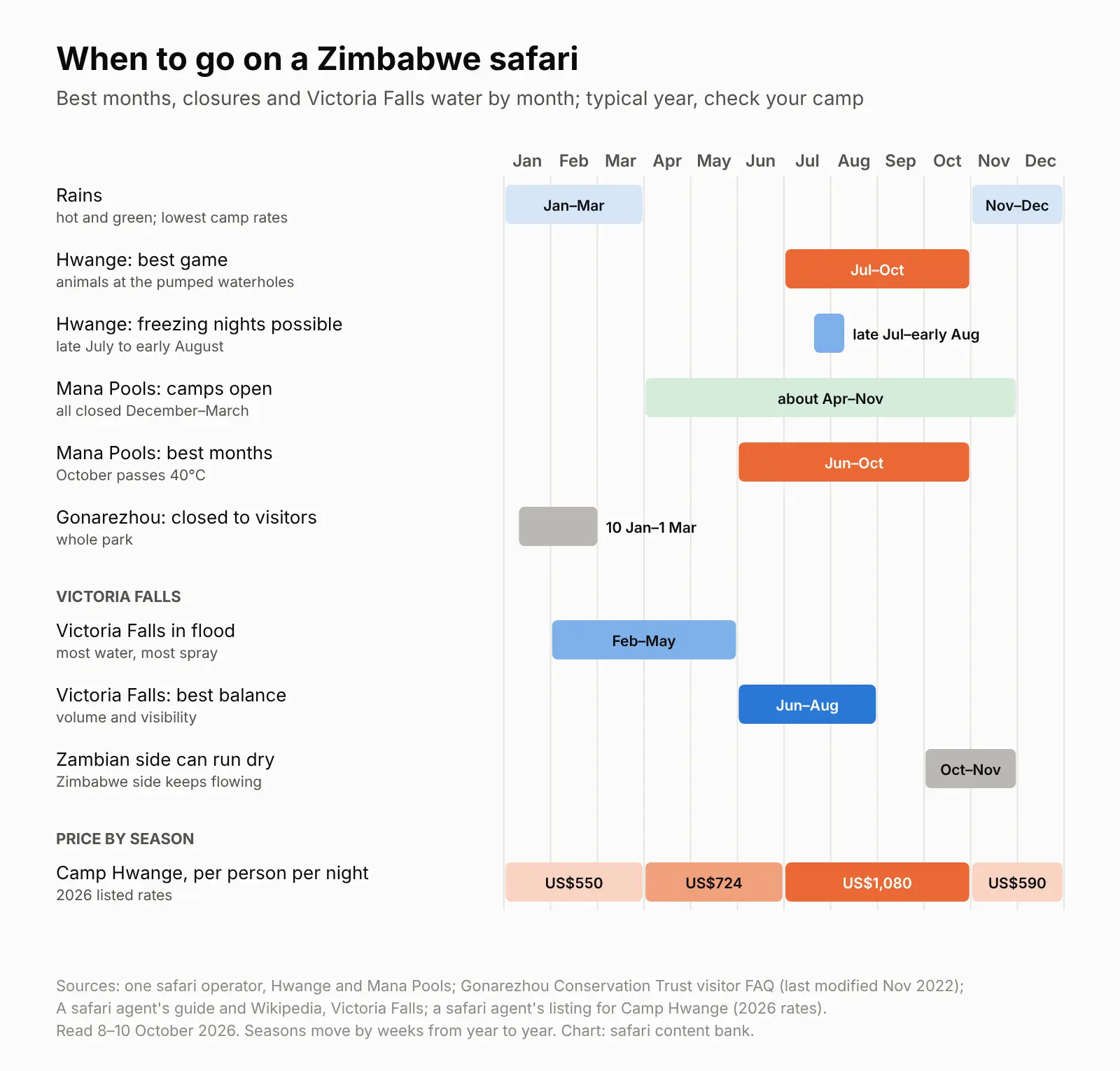 Sources: one safari operator’s Hwange and Mana Pools guides; Gonarezhou Conservation Trust FAQ; a safari agent’s guide to the Falls and Wikipedia (Victoria Falls); a safari agent’s listing for Camp Hwange (2026). Read 8–10 October 2026. Typical year: check your camp. Chart: safari content bank.
Is the green season worth it?
For lower rates and birds in Hwange, yes; for Mana Pools and Gonarezhou, no, because Mana’s camps close from December to March and Gonarezhou closes to visitors from 10 January to 1 March. Camp Hwange drops from US$1,080 to US$550 a night and Bomani from US$670 to US$445 (2026, Zimbabwe safari cost). Game disperses in the rains, and one safari operator advises avoiding January to March in Hwange; some remote camps close in December (its Hwange guide). Another safari operator lists Hwange’s Somalisa as charging no single supplement from 1 January to 31 March and in December. The Falls are in flood from February to May. More on travelling in the rains: green-season safaris.
Getting there and around
Which airport should I fly into?
Victoria Falls (VFA) for the Falls and Hwange; Harare for Mana Pools by road; Livingstone (LVI) in Zambia is about 45 minutes from VFA by road (one safari operator’s Livingstone guide). Our sources hold no current airline list for either Falls airport. TripAdvisor threads in 2026 asked about Air Zimbabwe flights from Harare to London and the best way from Kigali to Victoria Falls; their replies are not in our sources. Fly-in safaris connect the parks by light aircraft: Mack Air flies from Victoria Falls to Hwange’s airstrips and from Harare and Kariba to Mana Pools (Mack Air).
How long are the drives between Zimbabwe’s parks?
Hwange is 3 hours from Victoria Falls, but Mana Pools, Kariba and Harare are 6.5–9 hours away by road, which is why most Mana Pools trips fly.
| Route | By road | By air | Source |
|---|---|---|---|
| Victoria Falls → Hwange Main Camp | 200 km, up to 3 h on tar; deeper camps 3–6 h, 4x4 especially November–March | Mack Air to Hwange strips; fares not published | A safari booking site; one safari operator; Mack Air |
| Victoria Falls → Kasane (Chobe) | 80 km to Sedudu Gate, just over 1 h plus the border | Mack Air daily, 20 min | A safari booking site; Mack Air |
| Harare → Mana Pools | 388 km, 7–8 h; 4x4 essential; no fuel in the park | Mack Air from Harare and Kariba | A safari booking site; Mack Air |
| Victoria Falls → Kariba | 560 km, about 6.5 h | Mack Air serves Kariba Airport | driverabroad.com; Mack Air |
| Victoria Falls → Harare | 860 km, about 9 h; avoid driving at night | — | driverabroad.com |
| Pretoria → Victoria Falls | Rovos Rail, 3 nights, about 1,400 km, with a Hwange game drive | — | Rovos Rail |
Sources: a safari booking site’s getting-there pages for Hwange, Mana Pools and Chobe; one safari operator’s Hwange guide (names and links kept in our editor notes); Mack Air destinations; driverabroad.com (undated page); Rovos Rail. Read 9–10 October 2026. Light aircraft allow 20 kg per person including hand luggage, in soft bags (Mack Air).
Can I self-drive Zimbabwe’s parks?
Yes: Hwange’s main roads take a normal car, Mana Pools and Gonarezhou need a 4x4, and the UK FCDO advises against driving at night (a safari booking site; FCDO). A foreign-registered car pays US$10 a day in Hwange, Mana Pools and Matobo, or US$3 if you stay inside; Hwange camping costs US$23 a site for up to three people (ZimParks Tariff 2026). Two adults sleeping inside Hwange with a foreign car pay US$27 a day in fees (2 × US$12 + US$3), plus US$23 for a campsite (our sums; see self-drive safari cost). ZimParks takes bookings 12 months ahead, payable in US dollars (Wild Zambezi, first published 2017). In Gonarezhou, travel with two vehicles in remote areas (Gonarezhou Conservation Trust FAQ). “Zim Parks first time” and “Gonarezhou advice” were asked on 4x4community.co.za; we could not open those threads.
Costs, money and planning
How much does a Zimbabwe safari cost?
About US$151 per person per day on an overland camping trip, US$211–572 on road-based trips around Victoria Falls, Hwange and Matobo, and US$733–1,788 on fly-in safaris, the top end with Mana Pools (operators’ published 2026 prices, read 8 October 2026). Camps cost US$445–1,583 per person per night, and Singita Pamushana in the south-east lowveld US$2,395–3,150 per adult (2026). Park fees are a small share: a week covering the Falls, Hwange and Mana Pools costs one international adult US$166 in conservation fees if you sleep inside Hwange, or US$202 if you drive in from outside (our sums from the ZimParks Tariff 2026). The full price ladder is on our Zimbabwe safari cost page and Hwange safari cost.
What are Zimbabwe’s park fees in 2026?
ZimParks charges international adults a daily conservation fee per park, lower in some parks if you sleep inside, under its 2026 tariff, the current schedule. It published the tariff in February 2026, when VAT took the Victoria Falls VIP gate from US$150 to US$174 and moonlight viewing from US$100 to US$116 (ATTA, 13 Feb 2026). The conservation-fee table does not say whether VAT is included, so we print the amounts as published. Private-concession camps bill park and community fees their own way: Camp Hwange’s 2025 card adds US$20 park fee and US$10 community fee per person per night (Zimbabwe safari cost).
The official fee lines, with the date and the authority’s own source:
| Fee | Amount | In force from | Source |
|---|---|---|---|
| Hwange National Park, Main Camp (row as labelled in the ZimParks 2026 tariff), international adult, conservation fee per day | USD 24 day visitor; USD 12 if staying overnight in the park (SADC USD 18 / 10; local USD 5 / 3) | ZimParks Tariff 2026 (tariff year 2026, published February 2026); the conservation-fee table does not say whether VAT is included; Robins, Sinamatella and Kazuma Pan are not listed separately in our sources | ZimParks De-Gazetted Tariff 2026 |
| Mana Pools National Park, Sapi and Chewore, international adult, conservation fee per day | USD 24, day visitor or staying overnight (SADC USD 18; local USD 8) | ZimParks Tariff 2026 (tariff year 2026, published February 2026); the conservation-fee table does not say whether VAT is included | ZimParks De-Gazetted Tariff 2026 |
| Victoria Falls Rainforest (Zimbabwe), main gate, international adult, per entry | USD 58 (SADC USD 35; local USD 7) | ZimParks Tariff 2026 (tariff year 2026, published February 2026); the fee table does not say whether VAT is included | ZimParks De-Gazetted Tariff 2026 |
| Victoria Falls Rainforest (Zimbabwe), VIP gate and moonlight (lunar rainbow) viewing, international adult | VIP gate USD 174 (SADC USD 87; local USD 30); moonlight viewing USD 116 (SADC USD 81; local USD 15) | ZimParks Tariff 2026 (tariff year 2026, published February 2026) | ZimParks De-Gazetted Tariff 2026 |
| Matobo National Park, international adult, conservation fee per day | USD 18 day visitor; USD 10 if staying overnight (SADC USD 14 / 7; local USD 4 / 2) | ZimParks Tariff 2026 (tariff year 2026, published February 2026) | ZimParks De-Gazetted Tariff 2026 |
| Foreign-registered car, pickup or 4x4, per vehicle per day (Hwange, Mana Pools, Zambezi, Matobo, Chizarira, Kariba, Nyanga, Chewore) | USD 10 day visitor; USD 3 if staying overnight (locally registered USD 5 / 2) | ZimParks Tariff 2026 (tariff year 2026, published February 2026) | ZimParks De-Gazetted Tariff 2026 |
| Mana Pools National Park camping, SADC and international visitors | Ordinary or bush camping USD 35 per person per night; Nyamepi site (6 people) USD 120; exclusive site USD 235; Chitake 1 and 3B USD 355; Chitake 2 and Baobab USD 235 per site per night | ZimParks Tariff 2026 (tariff year 2026, published February 2026) | ZimParks De-Gazetted Tariff 2026 |
| Hwange National Park camping, SADC and international visitors | USD 23 per site per night (up to 3 people); bush camp USD 35 per person per night | ZimParks Tariff 2026 (tariff year 2026, published February 2026) | ZimParks De-Gazetted Tariff 2026 |
How many days should I plan?
Published Zimbabwe trips cluster at 3–9 days, and the forum advice is to give each park nights rather than day trips. Of 85 trips that include Zimbabwe with a US-dollar price in our sources, the commonest lengths are 9 days (14 listings), 5 days (13), 3 days (12) and 7 days (11) (listings read 8 October 2026; our count; many combine Zimbabwe with Botswana or South Africa). Allow two nights at Victoria Falls, three if you cross to Zambia or add Chobe (one safari operator’s Livingstone guide). On the TripAdvisor Zimbabwe forum in 2026, a traveller planning one operator for four countries in 21 nights was told to drop a country (TripAdvisor, traveller reports). More on trip length: how many days for a safari.
How much should I tip in Zimbabwe?
We hold no checked figure for tipping in Zimbabwe, so we print none. The only tipping amounts in our sources are an aggregator’s and an unsourced estimate. Our safari tipping guide gives sourced amounts for other countries but not for Zimbabwe. Tips are paid in US dollars like everything else; ask your camp or operator what it suggests before you travel.
Is it normal for a Zimbabwe operator’s bank to be abroad?
Replies on the TripAdvisor Zimbabwe forum in 2026 said offshore accounts, for example in Mauritius, are normal for Zimbabwe and Zambia operators (TripAdvisor, “African based Zimbabwe safari/booking agent?”, traveller reports). That is a traveller view, not an official one, and the same thread had one client who found an operator’s communication disorganised. Before you pay a company in full, see how to check a safari operator’s licence.
Health and safety
Do I need malaria tablets for Zimbabwe?
Wild Zambezi, a Zimbabwe travel site, says malaria is present in the low-lying areas, naming Victoria Falls, Kariba and the Zambezi Valley, with the highest risk from November to May (Wild Zambezi, safety and health). We could not read an official malaria source for Zimbabwe, so this page has no official malaria detail. Whether you take tablets, and which, is a decision for a travel clinic; this page gives no medical advice. A typhoid-vaccine question was asked on the TripAdvisor Victoria Falls forum in 2026; its replies are not in our sources.
Is Zimbabwe safe for a safari?
The UK FCDO advises against travel to no part of Zimbabwe; it warns of crime in towns, political gatherings, poor driving standards and power cuts, and advises against driving at night (FCDO, safety and security, updated 7 October 2026). The US State Department rates Zimbabwe Level 2, “Exercise Increased Caution”, in an advisory issued on 27 June 2023 (travel.state.gov). In the parks, the risks are animals: walk with a guide unless you have the experience and the permit, and keep well back from Gonarezhou’s wary elephants.
Can I swim in Lake Kariba or the Zambezi?
No: Wild Zambezi advises against it because of crocodiles and bilharzia (Wild Zambezi). Mana Pools has Zimbabwe’s largest concentration of Nile crocodile (Zimbabwe Field Guide). Devil’s Pool, on the lip of the Falls, is reached only from the Zambian side, at low water, on a guided trip (Victoria Falls: Zimbabwe or Zambia side).
Common mistakes in Zimbabwe safari answers
| What you’ll often read | What is correct |
|---|---|
| “Victoria Falls entry is US$30” or “US$50” | US$58 per international adult per entry under the ZimParks Tariff 2026. |
| “Hwange costs US$20 a day” | The 2023 figure. In 2026 it is US$24 for day visitors and US$12 if you sleep inside. |
| “Hwange is an easy day trip from Victoria Falls” | Main Camp is 200 km, up to 3 hours each way, and day visitors pay double the overnight fee. |
| “Mana Pools is open all year” | Most camps close December–March; the ZimParks side closes from about mid-December to the end of February. |
| “Mana Pools has rhino and giraffe” | Neither: its black rhino were removed after 1990s poaching, and giraffe never occurred there. |
| “A single-entry Zimbabwe visa is fine for a Chobe day” | Coming back is a second entry. Use the Univisa or a visa allowing more than one entry. |
| “The Univisa covers a night in Chobe” | Day trips only. A night in Botswana voids it. |
| “Zimbabwe uses ZiG now, so bring cards” | Tourists pay in US dollars; ZiG is for local use. Carry small, clean notes. |
| “The Falls ticket covers Zambezi National Park” | Separate tickets for separate parks. |
| “Hwange has 1,000 lions” | An aggregator figure; no research survey in our sources supports it. |
| “You can drive from Kruger straight into Gonarezhou” | Not directly: the route runs through Mozambique via Pafuri and Sango. |
| “The Zambian side is as good in October” | In October and November the Eastern Cataract can be bare rock; the Zimbabwe side keeps flowing. |
Sources
- Entry and money: UK FCDO, Zimbabwe entry requirements (updated 15 Jul 2026) and safety and security (updated 7 Oct 2026); evisa.gov.zw; Tourism Update; UK FCDO; a Victoria Falls booking site’s KAZA Univisa page (27 Jun 2025); Wild Zambezi, money; Tourism Update, Zimbabwe tourism adjusts after VAT shock, 6 Oct 2026; US State Department, Zimbabwe travel advisory (issued 27 Jun 2023)
- Fees: ZimParks, De-Gazetted Tariff 2026 (PDF), tariff year 2026, published February 2026, checked 10 Oct 2026, as on our Zimbabwe safari cost page; ATTA, ZimParks lifts Victoria Falls entry fees as VAT takes effect, 13 Feb 2026
- Parks and wildlife: one safari operator’s Hwange, Mana Pools, Gonarezhou and Livingstone and Victoria Falls guides (read Oct 2026) and a safari booking site’s Hwange and Mana Pools pages (names and links kept in our editor notes); Zimbabwe Field Guide, Mana Pools; African Parks, Matusadona; Visit Matusadona; Wikipedia, Hwange, Gonarezhou, Matobo and Victoria Falls (secondary); Gonarezhou Conservation Trust visitor FAQ (last modified Nov 2022); IUCN SSC and TRAFFIC rhino report to CITES CoP20 (PDF); Tourism Update, white rhinos reintroduced at Vic Falls reserve, 30 Sep 2026; a safari agent’s guide to the Falls, read October 2026
- Health: Wild Zambezi, safety and health; one safari operator’s age-limits guide
- Travel: Mack Air, read 9 Oct 2026; a safari booking site’s getting-there pages for Hwange, Mana Pools and Chobe; driverabroad.com; Rovos Rail; Wild Zambezi, ZimParks bookings (2017)
- Prices: lodge rates as on our Zimbabwe safari cost page and Hwange page (a safari agent’s listings, read 8 Oct 2026; Wild Expeditions Africa 2025 card; Singita 2026 rack rates); another safari operator’s single-supplement list; Victoria Falls activities: a booking agent’s list, read 9 Oct 2026; tour operators’ published 2026 package prices and trip lengths (our count of listings read 8 Oct 2026; names kept in our editor notes)
- Traveller reports (opinion and experience, not official findings): TripAdvisor Zimbabwe, Victoria Falls, Harare and Matabeleland North forums; Namibia-Forum; 4x4community.co.za (titles only); threads linked in each answer, collected 8 October 2026
- How we source and date fees: our method
Answers checked against the content bank on 10 October 2026. Forum lines are travellers’ reports, not official findings. We will update this page when ZimParks publishes its 2027 tariff, when Zimbabwe’s visa fees are confirmed by an official source, when camps publish their 2027 rates and seasons, and once we have read an official malaria source for Zimbabwe.
More photos from Zimbabwe
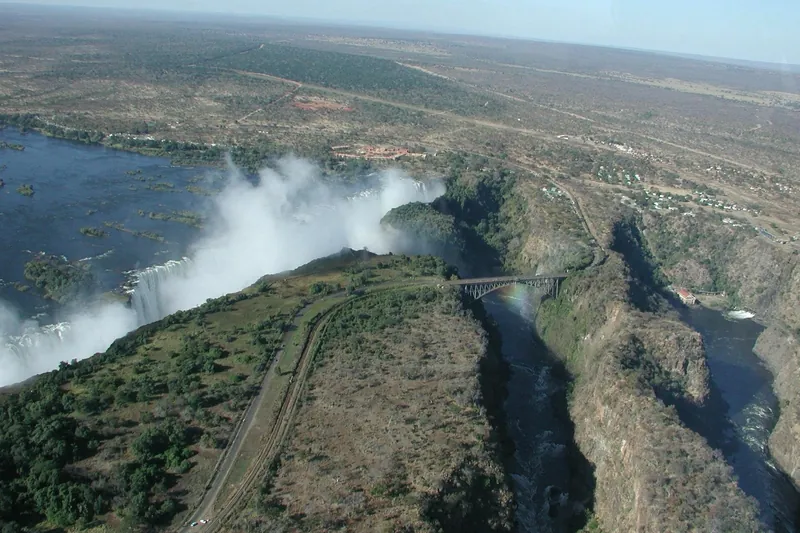
Victoria Falls seen from a helicopter. John Walker, Wikimedia Commons, Public domain 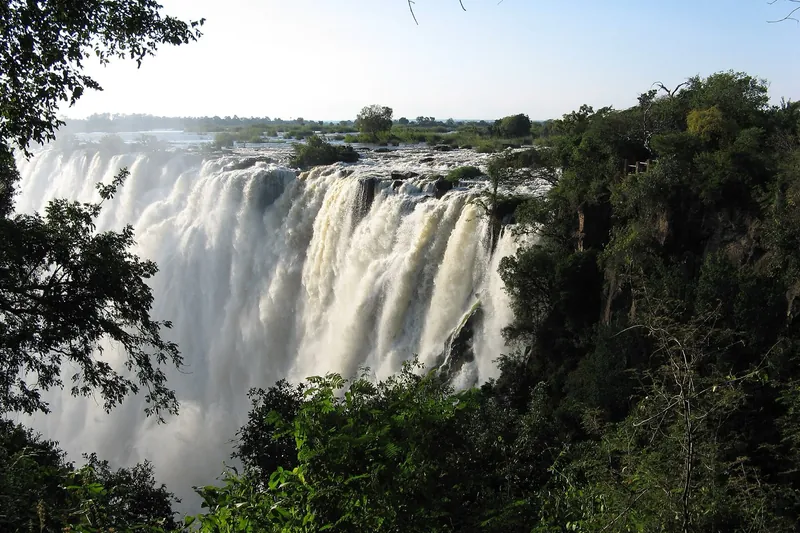
Victoria Falls from the Zambian side. Someone35, Wikimedia Commons, CC BY-SA 3.0, cropped 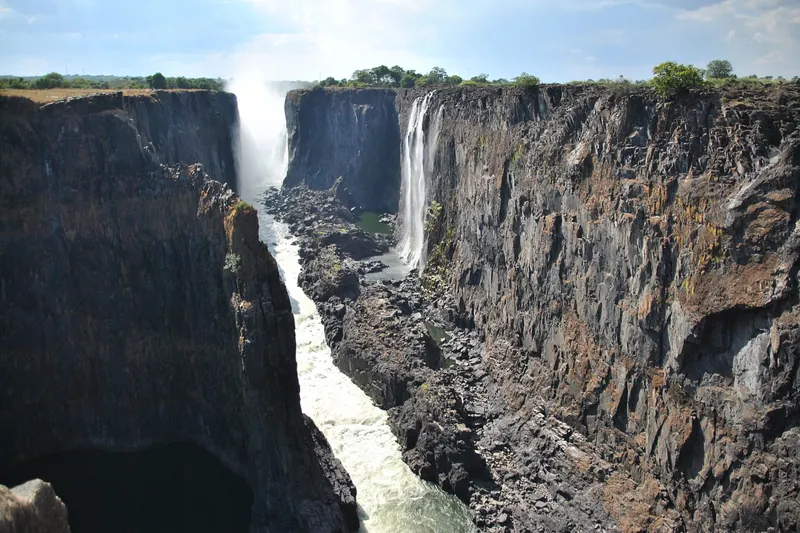
The Victoria Falls gorge and a narrow fall from Zambia. diego_cue, Wikimedia Commons, CC BY-SA 3.0, cropped


Photos by visitors and photographers, used under their free licences. Click a name to see the original.