 Experience

Last verified · Next check due
On this page
Short answer: Yes, in most safari countries. Trophy hunting is legal in Tanzania, Botswana, Namibia, Zambia, Zimbabwe and South Africa, often on land next to national parks and photographic concessions; Kenya has banned it since 1977. Botswana suspended hunting in 2014 and lifted the suspension in 2019. No fences separate many hunting and photographic areas, so animals cross between them. No public list shows which camps border hunting land: ask the camp in writing. Checked 10 October 2026.
Key facts
- Kenya prohibits hunting of game animals under regulations made in 1977 (the Wildlife (Conservation and Management) (Prohibition on Hunting of Game Animals) Regulations, 1977).
- Botswana suspended hunting in 2014 and lifted the suspension in 2019; hunting now runs on a permit and quota system, and community trusts can issue licences and take the revenue (Al Jazeera, 11 December 2025; US Country Commercial Guide).
- Botswana’s elephant quota was 400 in 2024 and 410 in 2025, but 195 and 210 elephants were actually hunted; the 2026 draft quota is 430 (The Ngami Times, 19 January 2026).
- In Tanzania, hunting is licensed by TAWA in game reserves and other hunting blocks; the Selous Game Reserve south of Nyerere National Park is one. In 2013, researchers put Tanzania’s hunting blocks at 34–49% of the country’s lion range (Lindsey et al., PLOS ONE).
- Namibia’s communal conservancies earned N$48,986,405 from conservation hunting in 2023, against N$111,167,250 from tourism (NACSO and MEFT).
- No source we hold lists which photographic camps border a hunting block, and hunting companies change names, a TripAdvisor Tanzania thread warns (traveller report).
Where is trophy hunting legal?
In six of the main safari countries; in Kenya it is banned. The table gives the status our sources support and where hunting land sits relative to the photographic areas. We hold no current status source for Uganda or Rwanda, so they are left out.
| Country | Hunting legal? | Where hunting land sits, as far as our sources show | Source |
|---|---|---|---|
| Kenya | No. Hunting of game animals prohibited since 1977 | — | Wildlife (Conservation and Management) (Prohibition on Hunting of Game Animals) Regulations, 1977, as listed on ECOLEX; Business Daily on the 2013 Act keeping the ban |
| Tanzania | Yes, licensed by TAWA | Game reserves such as the Selous Game Reserve south of Nyerere National Park; a forum answer names concessions bordering the Serengeti and Tarangire | Our Nyerere page; TripAdvisor Tanzania forum (traveller report) |
| Botswana | Yes, since the 2019 lifting of the 2014 suspension | Some of the numbered blocks (Controlled Hunting Areas) outside the parks; photographic concessions sit in the same block system | Al Jazeera, 11 Dec 2025; DWNP concession map, via Africa Geographic |
| Namibia | Yes, including in communal conservancies | Conservancies sign concessions for lodges, campsites, hunting and traversing rights on the same land | NACSO |
| Zambia | Yes | Game Management Areas, the buffer zones around national parks | A Zambia Wildlife Authority presentation, via a web search on 24 Oct 2026 |
| Zimbabwe | Yes | Communal land, where CAMPFIRE communities earned most of their wildlife income from sport hunting, and private conservancies such as Bubye Valley, funded by US$1.38 million of trophy fees in 2015 | World Bank, 2008; IUCN briefing paper, 2016 |
| South Africa | Yes | Not mapped in our sources. South Africa set leopard hunting quotas in 2026; the captive-bred (“canned”) lion debate is on our ethical wildlife activities page | Africa Geographic, c. Oct 2026 (headline); IUCN briefing paper, 2016 |
Read 8–10 October 2026, with the Kenya and Zambia rows checked in a web search on 24 October 2026. National status only; quotas, seasons and blocks change yearly.
- Kenya’s ban is under pressure in law but still in force on what we read. Business Daily reported that the 2013 Wildlife Conservation and Management Act kept the ban on sport hunting while allowing culling and cropping on game ranches; an amendment bill adding “consumptive utilisation” was in public consultation in 2025. We hold no source saying it has passed.
- “Controlled Hunting Area” in Botswana is an administrative label. A camp “in NG25” is telling you which numbered block it leases; photographic concessions sit in those blocks too. The concession map’s legend marks photographic blocks as “Maximize Benefits through Non-Consumptive Utilisation” (DWNP map, via Africa Geographic). More on the system: private concession vs national park.
Where hunting land borders photographic areas
Often, and usually without a fence: national parks in southern and East Africa are ringed by game reserves, Game Management Areas, conservancies and concessions, and in several countries some of that land is hunted. We found no source that maps which photographic camps sit next to a hunting block, so the table shows the patterns our sources describe, not a list of camps.
| Pattern | Example from our sources | What it means for you | Source |
|---|---|---|---|
| A national park beside a hunting reserve | Nyerere National Park (photographic, TANAPA) and the Selous Game Reserve to the south (hunting, TAWA) | The photographic camps are inside the park | Our Nyerere page |
| Hunting concessions on the edge of a famous park | Concessions bordering the Serengeti and Tarangire, per a forum answer | Ask where your camp’s land ends and what lies beyond it | TripAdvisor Tanzania forum (traveller report) |
| Hunting and photographic blocks in one concession system, with no fences | Botswana’s numbered blocks around the Okavango and Chobe | Animals move freely between them | Botswana concession notes in our source bank; DWNP map |
| Hunting and lodges on the same conservancy | Namibia’s communal conservancies | The lodge you stay at may share its conservancy with a hunting concession | NACSO |
| Buffer zones around the parks | In Zambia, Game Management Areas border the parks; Chongwe and Royal Zambezi sit in the Chiawa GMA, just outside Lower Zambezi National Park | Ask whether hunting takes place in your camp’s GMA | Our Lower Zambezi page |
| Former hunting land turned photographic | Selinda in Botswana: “Selinda was a hunting concession for decades”, says co-founder Dereck Joubert; hunting stopped when Great Plains took it over | A camp’s history can be the reverse of the worry | Hotel Designs, 16 Dec 2020 |
Read 8–10 October 2026. Patterns, not a register: no government in our sources publishes which photographic concessions border hunting blocks.
- Animals cross the line. CITES guidance on lion exports (2024) flags populations shared across borders and land types, naming KAZA, Greater Limpopo and Greater Mapungubwe, as needing joint quotas (CITES AC33, PDF).
- Research animals have been shot. In September 2026, Africa Geographic reported that two collared research elephants were shot by trophy hunters in Botswana on consecutive days (headline as indexed in our source bank).
- What we cannot tell you: we hold no study that measures how hunting next door changes animal behaviour at photographic camps, so we make no claim about shyer animals or fewer sightings.
What it means for a photographic traveller
Mainly a question to ask before you book: we hold no evidence on sightings either way. In Namibia’s conservancies the same land can carry a lodge and a hunting concession; elsewhere the hunting area is usually the neighbouring block, reserve or GMA.
| Question to ask the camp, in writing | Why |
|---|---|
| Is any of your concession, or the land next to it, hunted? In which months? | Hunting and photographic land can share a boundary with no fence |
| Does the owner of the camp or the concession run hunting anywhere? | A TripAdvisor Tanzania thread says the overlap between photo and hunting businesses “is mostly lodge ownership” (traveller report) |
| Who licenses your operation? | TAWA licenses hunting in Tanzania; TANAPA runs the national parks. See check a safari operator’s licence |
| Does your conservancy or concession earn hunting income? | In Namibia and Botswana, communities may earn from both |
Questions drawn from the sources above. We name no hunting operators.
- Hunting companies change names, so an operator search is unreliable, a TripAdvisor Tanzania thread warns; the same thread’s answer is that TAWA licenses them (TripAdvisor, “Hunting Affiliations”, traveller report).
- A national park is the simplest way to be sure your own camp’s land is not hunted: hunting is not licensed in Nyerere National Park, for example, only in the game reserve to the south (Nyerere). The trade-off between parks and private land is on private concession vs national park.
- Captive-bred lion hunting is a separate issue, tied to cub petting and lion walks: see ethical wildlife activities.
Botswana: quotas against what was actually hunted
Botswana sets an elephant quota each year, and in 2024 and 2025 hunters took about half of it. The government and its critics agree on these numbers and disagree on what they mean.
| Year | Elephant quota | Actually hunted | Source |
|---|---|---|---|
| 2024 | 400 | 195 | The Ngami Times, 19 Jan 2026 |
| 2025 | 410 | 210 | The Ngami Times, 19 Jan 2026 |
| 2026 | 430 (draft) | — | The Ngami Times, 19 Jan 2026; Al Jazeera, 11 Dec 2025 |
Elephant population about 130,000 at the 2022 survey, as quoted by ministry officials (The Ngami Times, 19 January 2026).
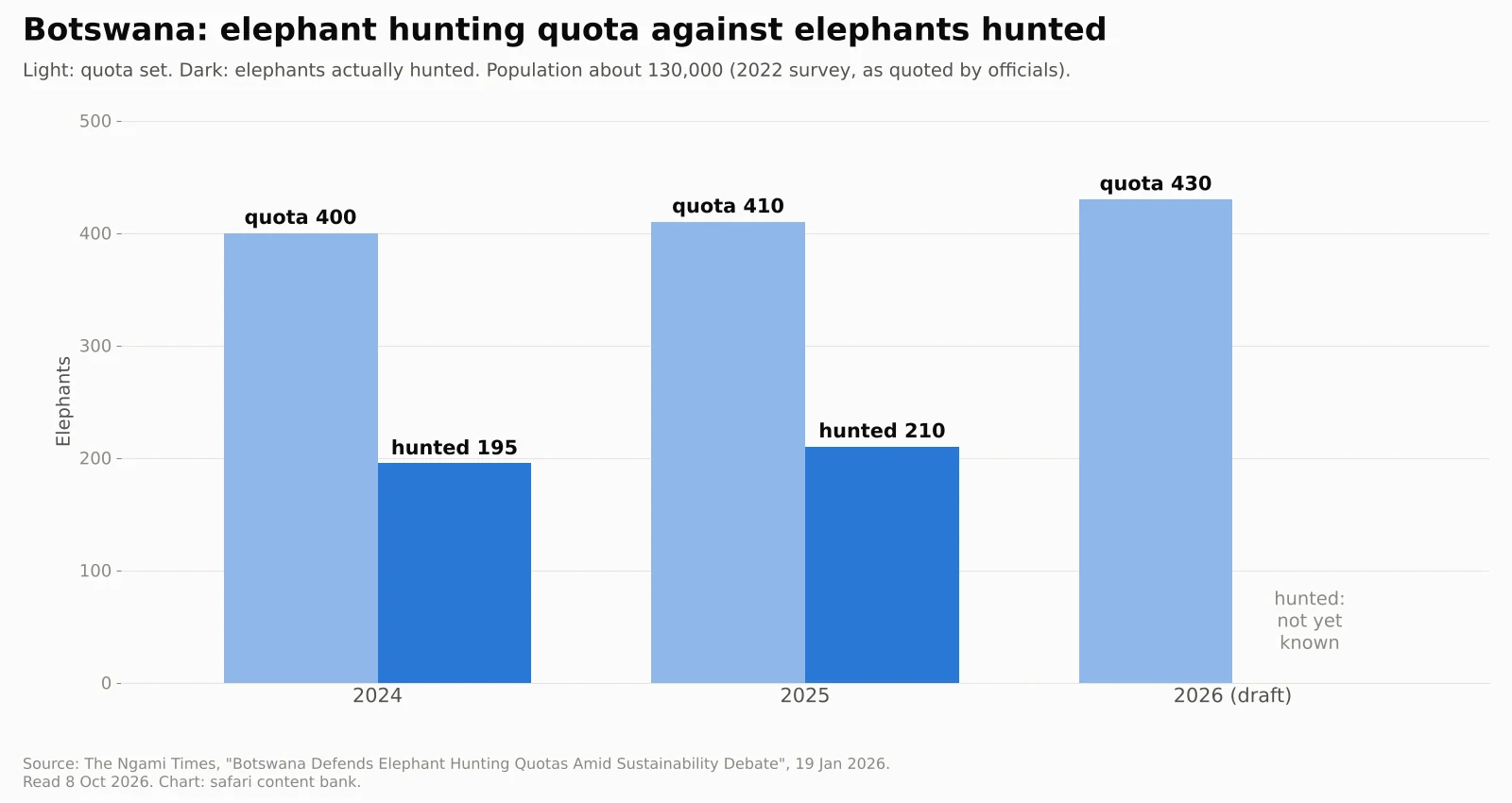 The Ngami Times, “Botswana Defends Elephant Hunting Quotas Amid Sustainability Debate”, 19 January 2026. Read 8 October 2026. Chart: safari content bank.
- The government’s view: “The allocation of a quota does not mean the quota is fully reached” (Permanent Secretary Modukanele, The Ngami Times).
- Elephants Without Borders’ view: cut the quota to 0.2% of the population, about 280 a year, to protect mature bulls; its review found quota and harvest closely matched in 1996–2013 (The Ngami Times, 1 December 2025).
- Money: Botswana earned US$4.1 million from hunting licence sales in 2024, against US$2.7 million in 2023, the environment minister told Al Jazeera; community trusts’ hunting revenue was P88 million in 2025 (The Ngami Times).
The two positions, stated fairly
Both sides have evidence; the research we hold says outcomes depend on the place and how well hunting is governed, and supports neither blanket claim.
| The case for regulated hunting | The case against | |
|---|---|---|
| Land | Pays for wildlife land larger than the parks: Tanzania leased about 210,000 km² for hunting, earning about US$16.3 million in 2014/15 (IUCN, 2016) | Lions were hunted across about 16% of their African range, and some quotas were set too high (Lindsey et al., 2013) |
| Communities | Namibia’s conservancies earned N$48,986,405 from hunting in 2023; CAMPFIRE in Zimbabwe paid communities more than US$20 million in 1989–2001, 89% of it from sport hunting (World Bank, 2008) | IUCN lists corruption in revenue sharing, unsustainable quotas and weak enforcement among the failures (IUCN, 2016) |
| Animals | “Revenue from legal hunting helps maintain large areas of wildlife habitat” (Amy Dickman, University of Oxford, to Al Jazeera) | “Trophy hunters target individual animals they regard as ‘trophies’” (Will Travers, Born Free, to Al Jazeera); 8.5% of lion trophies were under 4 years old (Lindsey et al., 2013) |
| Science | CITES (2024): unsustainable lion hunting is linked to declines in some areas, with a net positive effect in others | IUCN’s lion assessment lists “poorly regulated trophy hunting” among threats, after prey loss, conflict killing and habitat loss |
Sources as named in each cell, read 8–9 October 2026. Quotes as reported.
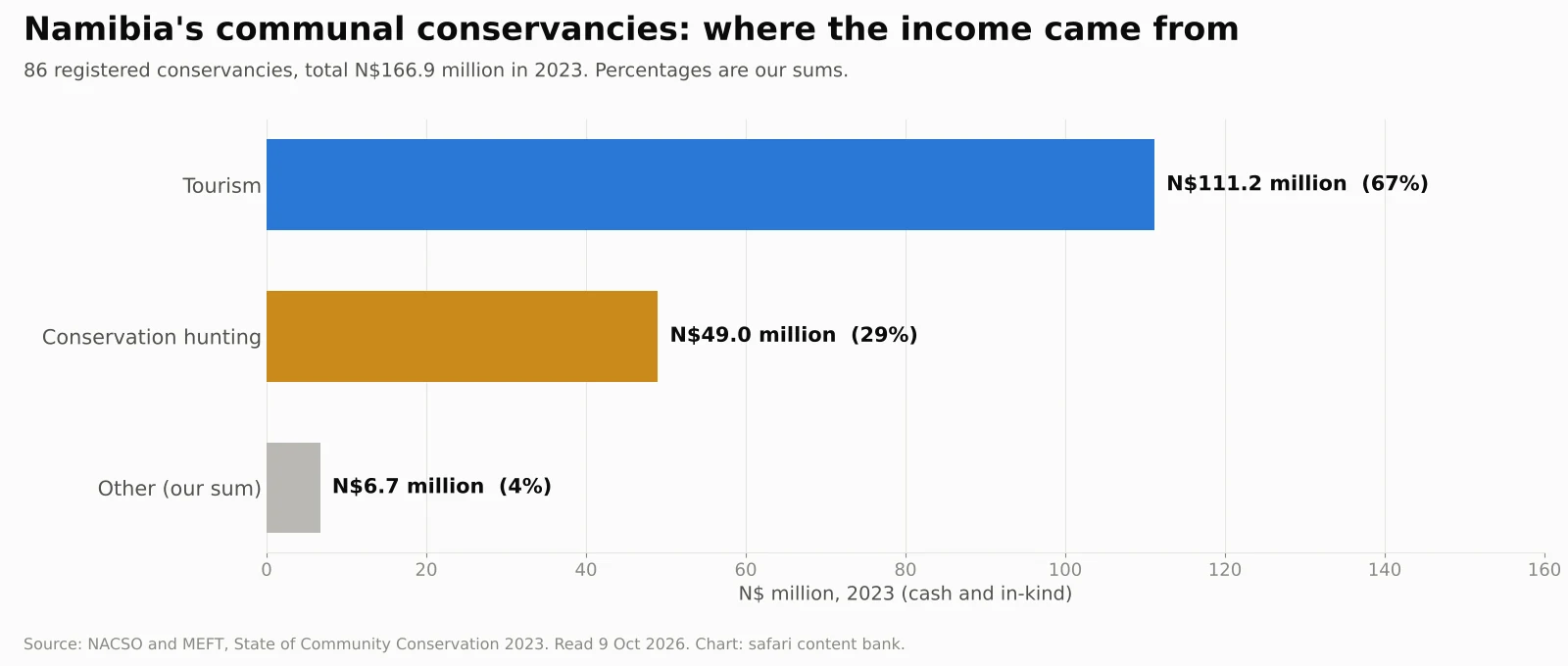 NACSO and MEFT, State of Community Conservation 2023 (PDF). Read 9 October 2026. Chart: safari content bank.
- Photographic tourism is the larger earner where it works: tourism was about two-thirds of Namibia’s conservancy income in 2023 (our sum). The IUCN paper adds that in 2013 only 12% of Namibia’s conservancies could rely on tourism alone.
- More on where your fees go: conservation safari.
Common mistakes about hunting and photo safaris
| What you’ll often read | What our sources say |
|---|---|
| “Botswana banned hunting” | It suspended hunting in 2014 and lifted the suspension in 2019; the 2026 draft elephant quota is 430. |
| “Botswana will hunt 430 elephants in 2026” | That is the draft quota. In 2024 and 2025 hunters took 195 and 210 against quotas of 400 and 410. |
| “Nyerere is the Selous, where hunting happens” | Nyerere National Park has been photographic since 2019; hunting is licensed in the Selous Game Reserve to the south. |
| “An NG concession is a hunting area” | NG numbers are administrative blocks; photographic concessions carry them too. |
| “Kenya allows hunting on private ranches” | Hunting of game animals has been prohibited since 1977; the 2013 Act allows culling and cropping, not sport hunting, as reported. |
| “Hunting makes animals near photo camps shy” | We hold no study that measures this, so we make no claim either way. |
Frequently asked questions
Is trophy hunting legal in Africa? In most of the main safari countries, yes: Tanzania, Botswana, Namibia, Zambia, Zimbabwe and South Africa allow regulated trophy hunting. Kenya has prohibited hunting of game animals since 1977. Each country sets its own quotas and seasons.
Does Botswana allow hunting? Yes. Botswana suspended hunting in 2014 and lifted the suspension in 2019; it now runs a permit and quota system. The elephant quota was 410 in 2025, when 210 were hunted, and the 2026 draft quota is 430 (The Ngami Times, 19 January 2026).
Is there hunting near the Serengeti or Nyerere? Around Nyerere, hunting takes place in the Selous Game Reserve to the south, a TAWA hunting reserve; the photographic camps are inside the national park. A TripAdvisor forum answer says hunting concessions border the Serengeti and Tarangire; we hold no official map of them.
How can I tell if my safari camp is near a hunting area? Ask the camp in writing whether its concession, or the land next to it, is hunted and in which months, and whether its owner runs hunting anywhere. No government in our sources publishes a list, and hunting companies change names.
Will hunting nearby affect what I see? We hold no study that measures it, so we can’t say. What our sources do show is that many hunting and photographic areas are unfenced, so the same animals use both: in September 2026 two collared research elephants were reported shot by trophy hunters in Botswana.
Does hunting money support conservation? Sometimes, and the evidence depends on the place. Namibia’s conservancies earned N$48,986,405 from hunting in 2023, just under a third of their income; the IUCN also lists corruption, weak enforcement and unsustainable quotas among hunting’s failures.
Sources
- Law and policy: Kenya, Wildlife (Conservation and Management) (Prohibition on Hunting of Game Animals) Regulations, 1977, as listed on ECOLEX, and Business Daily on the 2013 Act (web search, 24 October 2026); Al Jazeera, 11 Dec 2025; The Ngami Times, “Botswana Defends Elephant Hunting Quotas” (19 Jan 2026) and “Limit Elephant Hunting Quota” (1 Dec 2025); DWNP Controlled Hunting Areas map, via Africa Geographic (PDF); Africa Geographic, Sept 2026 (headline)
- Research and reports: Lindsey et al. 2013, PLOS ONE; IUCN briefing paper, April 2016 (PDF); CITES AC33 lion guidance, 2024 (PDF); IUCN lion Red List assessment (PDF); World Bank, 2008 (CAMPFIRE); NACSO and MEFT, State of Community Conservation 2023 (PDF); NACSO; all read 8–9 October 2026
- Camps: Hotel Designs, 16 Dec 2020 (Selinda)
- Traveller forums, traveller reports not facts: TripAdvisor Tanzania, “Hunting Affiliations”
- More: Nyerere, private concession vs national park, ethical wildlife activities, conservation safari, check a safari operator’s licence
Checked 8–10 October 2026; Kenya and Zambia status rechecked in a web search on 24 October 2026. We will update this page when Botswana finalises its 2026 quota, when Kenya’s amendment bill is decided, and when we find an official map of hunting blocks next to photographic concessions.