 Experience

Last verified · Next check due
On this page
- Hwange vs Mana Pools at a glance (2026)
- Park fees: the same tariff, different rules
- What a night costs in each park
- Which park has better wildlife?
- Walking, canoeing and night-drive rules
- Getting there: Victoria Falls for Hwange, Harare or a light aircraft for Mana Pools
- When to go: seasons and camp closures
- How many days in each park
- Who each park suits
- Combining Hwange and Mana Pools
- Common mistakes in Hwange vs Mana Pools comparisons
- Frequently asked questions
- Sources
Short answer: Choose Hwange for elephant at pumped waterholes, a road trip from Victoria Falls (200 km, up to 3 hours) and camps that stay open in the rains. Choose Mana Pools for walking (unguided with a permit) and canoeing on the Zambezi; most visitors fly in, and most camps close December–March. Hwange charges US$12 a day if you sleep inside, US$24 if not; Mana Pools US$24 either way (ZimParks Tariff 2026). Camps: US$445–1,250 against US$630–1,583 a night.
Key facts
- The two parks share one tariff but not one rule: sleeping inside Hwange halves its conservation fee to US$12 per international adult per day, while Mana Pools charges US$24 a day whether or not you sleep in the park (ZimParks Tariff 2026, PDF).
- Hwange is the road park, Mana Pools the fly-in park: Hwange Main Camp is 200 km, up to 3 hours on tar from Victoria Falls; Mana Pools is 388 km and 7–8 hours from Harare by 4x4, so most visitors arrive by light aircraft (a safari booking site’s getting-there pages; Mack Air).
- Mana Pools is the walking and canoeing park: you walk with Zimbabwe professional guides or, with a permit, on your own, and canoe trips run from half a day to several days (Zimbabwe Field Guide; one safari operator’s Mana Pools guide). Hwange’s walks are on its private concessions.
- Night drives are a private-concession activity: in Hwange they are allowed only on the private concessions; in Mana Pools our sources name only Ruckomechi, on its private concession in the west (a safari booking site; one safari operator).
- Mana Pools has a short season: most camps open from about April to November and close from December to March. Hwange’s camps publish rates all year, although some remote camps close in December (one safari operator).
- Mana Pools is losing share inside Zimbabwe: one safari agency reports its Mana Pools bed nights down about 34% and its Hwange bed nights up about 21% between FY2024 and FY2026 (Tourism Update, 5 Oct 2026).
Hwange vs Mana Pools at a glance (2026)
Hwange is Zimbabwe’s largest park, on Kalahari sand, a 3-hour drive from Victoria Falls; Mana Pools is a much smaller park on the Zambezi floodplain in the north, opposite Zambia’s Lower Zambezi National Park. Hwange is nearly seven times the size of Mana Pools (our arithmetic: 14,650 ÷ 2,196).
| Hwange National Park | Mana Pools National Park | Source | |
|---|---|---|---|
| Size | About 14,650 km², Zimbabwe’s largest park | 2,196 km², inside an unfenced 10,500 km² Parks estate | Wikipedia; Zimbabwe Field Guide |
| Landscape | Kalahari sand, teak woodland, grassy vleis and pans; stony hills and dams in the north | Zambezi floodplain terraces with albida woodland and old river pools; mopane and jesse bush inland | One safari operator’s park guides |
| Gateway | Victoria Falls: Main Camp 200 km, up to 3 hours by tar | Harare: 388 km, 7–8 hours by 4x4; most visitors fly in | A safari booking site’s getting-there pages |
| Park fee, international adult | US$12 a day sleeping inside; US$24 as a day visitor | US$24 a day either way | ZimParks Tariff 2026 |
| Signature | Game drives and waterhole viewing at pumped pans | Walking, guided or unguided with a permit; canoeing | Our Hwange and Mana Pools pages |
| Night drives | Private concessions only | Ruckomechi’s private concession, the only one named in our sources | A safari booking site; one safari operator |
| Camps open | Rates published all year; some remote camps close in December | About April to November; most closed December–March | One safari operator; camps’ rate seasons |
| Best months | July–October | June–October | One safari operator’s park guides |
| Camp rates, per person per night | US$445–1,250 (2026) | US$630–1,583 (2026–27) | A safari agent’s listings; owner’s card |
| ZimParks camping | US$23 per site (up to 3 people); bush camp US$35 per person | US$35 per person; whole sites US$120–355 | ZimParks Tariff 2026 |
Fees and rates as on our Hwange, Hwange safari cost, Mana Pools and Zimbabwe safari cost pages, checked 8–10 October 2026. Hwange’s size: Wikipedia and a safari booking site.
Park fees: the same tariff, different rules
ZimParks charges international adults US$24 a day in both parks, but Hwange drops to US$12 if you sleep inside it; Mana Pools has no lower overnight rate. SADC residents pay US$18 a day in both (US$10 staying inside Hwange). ZimParks published the tariff in February 2026 for the 2026 tariff year; the conservation-fee table does not say whether VAT is included.
The official fee lines, with the date each took effect and the source:
| Fee | Amount | In force from | Source |
|---|---|---|---|
| Hwange National Park, Main Camp (row as labelled in the ZimParks 2026 tariff), international adult, conservation fee per day | USD 24 day visitor; USD 12 if staying overnight in the park (SADC USD 18 / 10; local USD 5 / 3) | ZimParks Tariff 2026 (tariff year 2026, published February 2026); the conservation-fee table does not say whether VAT is included; Robins, Sinamatella and Kazuma Pan are not listed separately in our sources | ZimParks De-Gazetted Tariff 2026 |
| Mana Pools National Park, Sapi and Chewore, international adult, conservation fee per day | USD 24, day visitor or staying overnight (SADC USD 18; local USD 8) | ZimParks Tariff 2026 (tariff year 2026, published February 2026); the conservation-fee table does not say whether VAT is included | ZimParks De-Gazetted Tariff 2026 |
| Foreign-registered car, pickup or 4x4, per vehicle per day (Hwange, Mana Pools, Zambezi, Matobo, Chizarira, Kariba, Nyanga, Chewore) | USD 10 day visitor; USD 3 if staying overnight (locally registered USD 5 / 2) | ZimParks Tariff 2026 (tariff year 2026, published February 2026) | ZimParks De-Gazetted Tariff 2026 |
| Hwange National Park camping, SADC and international visitors | USD 23 per site per night (up to 3 people); bush camp USD 35 per person per night | ZimParks Tariff 2026 (tariff year 2026, published February 2026) | ZimParks De-Gazetted Tariff 2026 |
| Mana Pools National Park camping, SADC and international visitors | Ordinary or bush camping USD 35 per person per night; Nyamepi site (6 people) USD 120; exclusive site USD 235; Chitake 1 and 3B USD 355; Chitake 2 and Baobab USD 235 per site per night | ZimParks Tariff 2026 (tariff year 2026, published February 2026) | ZimParks De-Gazetted Tariff 2026 |
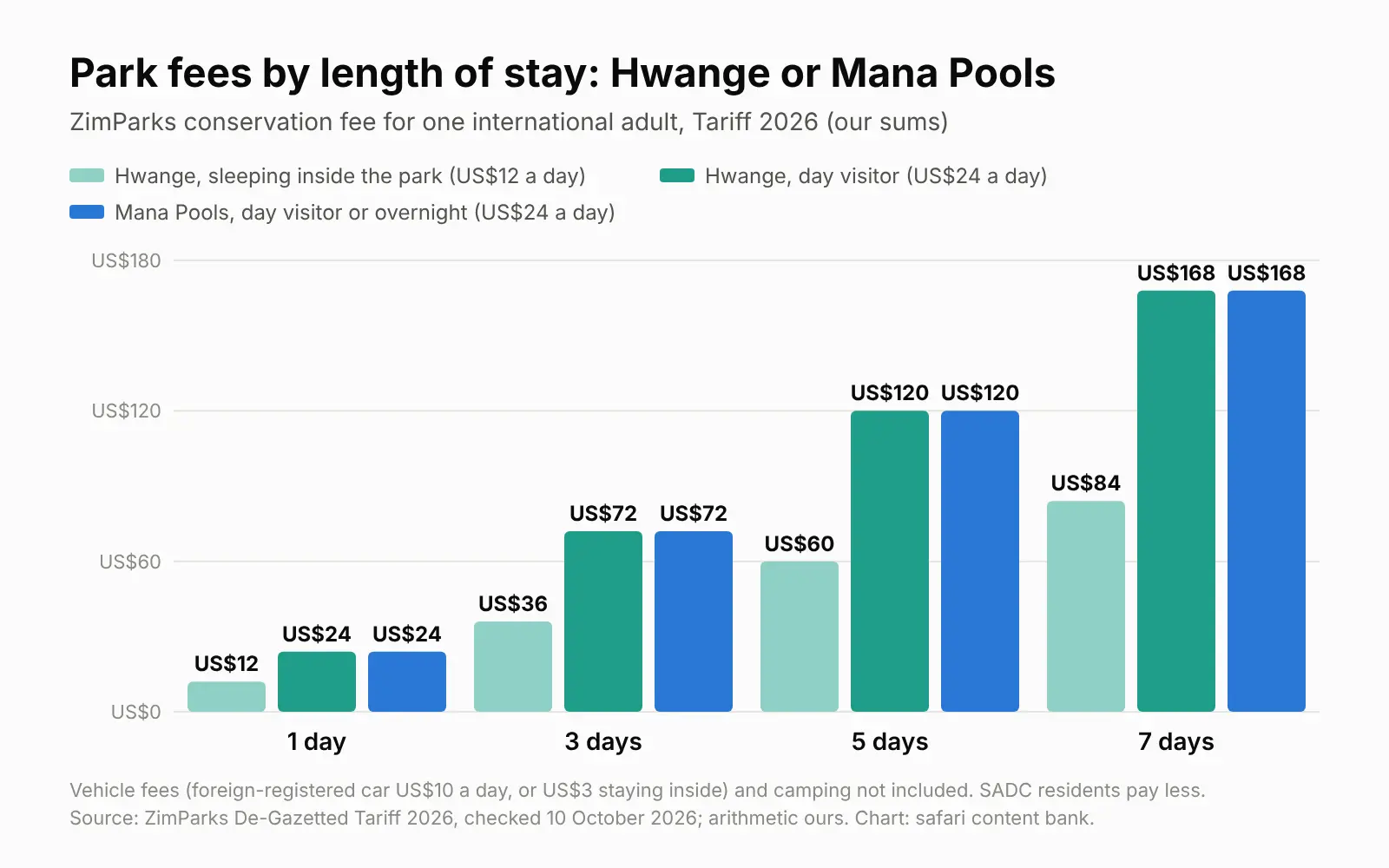 Our sums from the ZimParks De-Gazetted Tariff 2026, checked 10 October 2026. Vehicle and camping fees not included. Chart: safari content bank.
- Three days cost one international adult US$36 in Hwange if they sleep inside, and US$72 in Mana Pools (our sums: 3 × US$12; 3 × US$24). Driving into Hwange each day from outside costs US$72, the same as Mana Pools.
- Two adults with a foreign-registered car, sleeping inside, pay US$81 for three days in Hwange and US$153 in Mana Pools (our sums: 2 × US$36 + 3 × US$3; 2 × US$72 + 3 × US$3).
- Quotes of US$20 are out of date: both parks charged day visitors US$20 a day in the 2023 tariff, and ZimParks raised its fees in February 2026 when VAT was applied to park fees (ATTA, 13 Feb 2026).
- Private camps bill park fees their own way. Camp Hwange’s 2025 card adds a US$20 park fee and a US$10 community fee per person a night; Verney’s Camp’s listing includes levies (Hwange safari cost). Ask each Mana Pools camp what its rate includes.
- In Mana Pools, collect your entry permit at Marongora before you drive down the escarpment and keep the receipt: you need it to leave the park (Zimbabwe Field Guide).
How we date fees: our method.
What a night costs in each park
Hwange’s camps start lower: US$445 a night at Bomani Tented Lodge on the park boundary, against US$630 at Kanga Camp, the cheapest Mana Pools camp with a rate in our sources. At the top, Ruckomechi in Mana Pools (US$1,508 in the 2026 season) costs more than any Hwange camp in our sources.
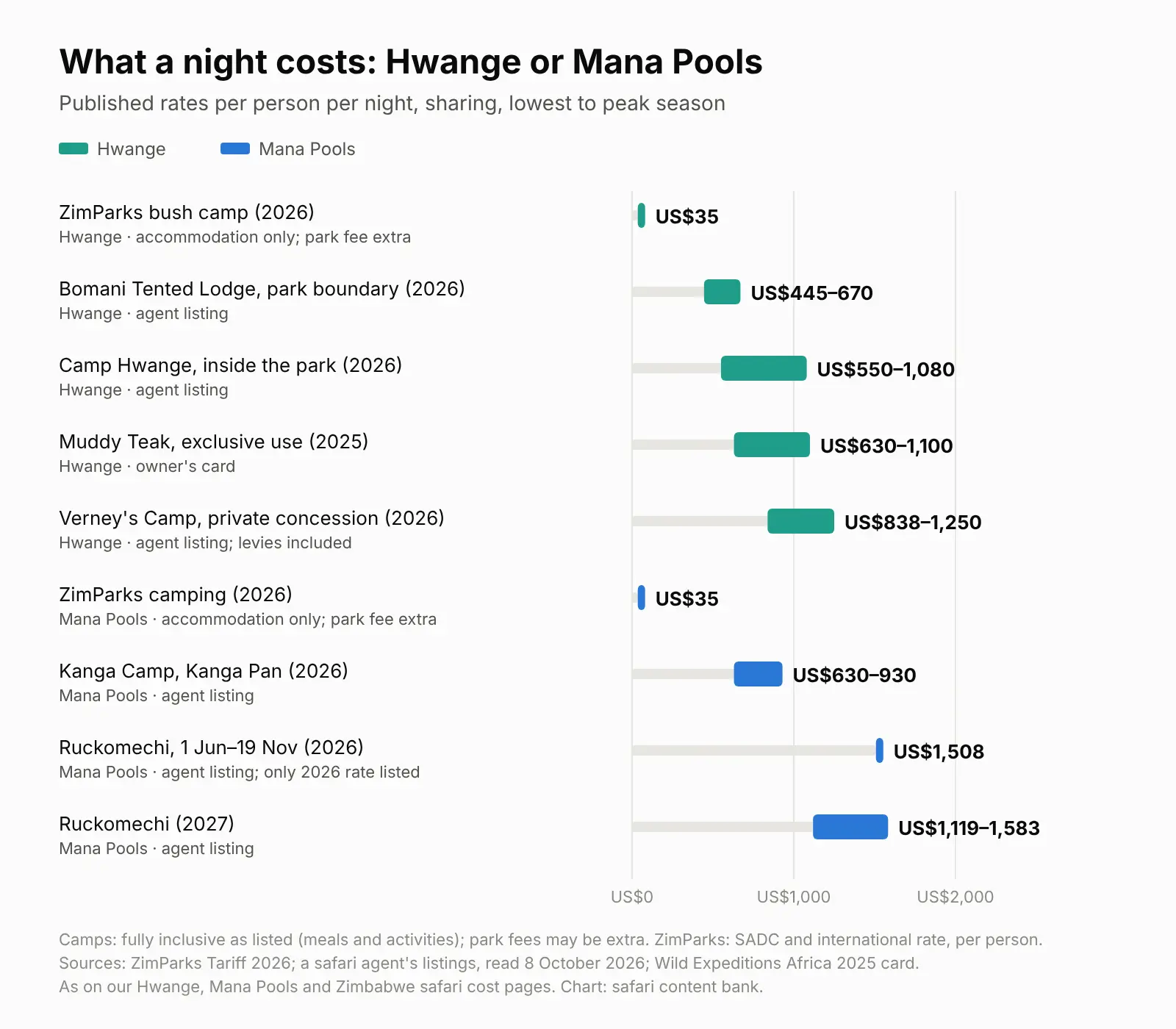 Per person sharing, fully inclusive as listed; park fees may be extra. Sources: ZimParks Tariff 2026; a safari agent’s listings, read 8 October 2026; Wild Expeditions Africa’s 2025 card. Chart: safari content bank.
| Where you sleep | Hwange | Mana Pools | Source |
|---|---|---|---|
| ZimParks camping | US$23 per site (up to 3 people); bush camp US$35 per person | US$35 per person; Nyamepi site for 6 US$120; exclusive sites US$235–355 | ZimParks 2026 |
| ZimParks chalets and lodges | US$50–200 per unit on the 2023 tariff; no 2026 rate in our sources | US$130–200 per unit on the 2023 tariff; no 2026 rate in our sources | ZimParks 2023 (PDF) |
| Mid-range | Bomani Tented Lodge, park boundary: US$445 (Jan–Apr, Nov–Dec) → US$670 (May–Oct) | No camp with a published rate in our sources | A safari agent’s listing |
| Upper mid-range | Camp Hwange, inside the park: US$550 (Jan–Mar) → US$1,080 (Jul–Oct); Muddy Teak, exclusive use: US$630–1,100 (2025) | Kanga Camp, inland on Kanga Pan: US$630 (Apr–May, Nov) → US$930 (Jun–Oct) | A safari agent’s listings; Wild Expeditions Africa 2025 (PDF) |
| Top of our sources | Verney’s Camp, private concession: US$838 (Apr–May, Nov–10 Jan) → US$1,250 (Jun–Oct), levies included | Ruckomechi, private concession: US$1,508 (1 Jun–19 Nov 2026); 2027: US$1,119–1,583 | A safari agent’s listings |
Per person sharing, 2026 unless stated. Camp rates are a safari agent’s listings, read 8 October 2026, except Muddy Teak (owner’s 2025 card). ZimParks rates are accommodation only; the park fee is extra.
- Many camps publish no rate in our sources: in Hwange, Linkwasha, Little Makalolo, the Somalisa camps, The Hide and Nehimba; in Mana Pools, Vundu, Little Ruckomechi, Chikwenya, Nyamatusi, John’s Camp, Ingwe Pan and Tembo Plains.
- Hwange has a cheap way to sleep inside the park; Mana Pools charges more for it. Two people sharing a Hwange campsite pay US$11.50 each a night; Mana Pools charges US$35 a person (our sum: US$23 ÷ 2; ZimParks 2026).
- Solo travellers and children: supplements and child rates are set by each camp; see single supplements and child rates.
Worked example: three nights at an upper mid-range camp
Three nights cost US$1,650–3,276 per person at Camp Hwange, US$2,514–3,750 at Verney’s Camp and US$1,890–2,862 at Kanga Camp in Mana Pools, lowest to peak season, with the ZimParks fee added where the rate may not include it (our sums, two sharing).
| Per person sharing | Camp Hwange (Hwange) | Verney’s Camp (Hwange) | Kanga Camp (Mana Pools) |
|---|---|---|---|
| Camp, 3 nights, lowest season | US$1,650 (3 × US$550) | US$2,514 (3 × US$838) | US$1,890 (3 × US$630) |
| Camp, 3 nights, peak | US$3,240 (3 × US$1,080) | US$3,750 (3 × US$1,250) | US$2,790 (3 × US$930) |
| ZimParks fee, 3 days, if not in the rate | US$0–36 (3 × US$12) | Included | US$0–72 (3 × US$24) |
| Total, lowest season → peak | US$1,650–1,686 → 3,240–3,276 | US$2,514 → 3,750 | US$1,890–1,962 → 2,790–2,862 |
Lowest season: Camp Hwange January–March; Verney’s April–May and November–10 January; Kanga April–May and November. Peak: Camp Hwange July–October; Verney’s and Kanga June–October. Camp Hwange’s owner card (2025) adds US$30 a night in park and community fees rather than the ZimParks figure. Not included: flights or road transfers, drinks outside the rate, tips. Sources: a safari agent’s listings, read 8 October 2026; ZimParks Tariff 2026. Arithmetic: ours.
- Getting there is the hidden cost of Mana Pools. Mack Air publishes no seat rates, so we cannot total the flights; see the packages under “Combining” below. Full Hwange budgets: Hwange safari cost; Mana Pools and the rest of the country: Zimbabwe safari cost.
Which park has better wildlife?
Hwange is the elephant-and-waterhole park, with sable, roan and Kalahari species Mana Pools lacks; Mana Pools has the best published wild dog odds of Zimbabwe’s parks in our sources and the country’s largest concentration of hippo and crocodile. One safari operator publishes sighting rates for Mana Pools; no comparable figures are published for Hwange.
| Animal | Hwange | Mana Pools | Source |
|---|---|---|---|
| Elephant | Large dry-season gatherings at pumped pans; Zimbabwe’s share of the KAZA area, which includes Hwange, held 65,028 in the 2022 survey | Seen by 100%; bulls stand on their hind legs to reach albida pods | KAZA; one safari operator; Zimbabwe Field Guide |
| Wild dog | One of Africa’s larger surviving populations; no published sighting rate | Seen by 58% | Wikipedia; one safari operator |
| Lion | No published sighting rate | Seen by 90% | One safari operator |
| Leopard | No published sighting rate | Seen by 36% | One safari operator |
| Giraffe | Common | None: never occurred | One safari operator |
| Sable and roan | Hwange specialities | Not in our sighting figures | One safari operator |
| Gemsbok and brown hyena | Zimbabwe’s only protected area with both | None | Wikipedia; one safari operator |
| Hippo and crocodile | Not a feature in our sources | Zimbabwe’s largest concentration of both; hippo seen by 95% | Zimbabwe Field Guide; one safari operator |
Mana Pools figures: share of one safari operator’s travellers who saw each animal at least once on their trip, read 8 October 2026; best-case, per trip, not per drive, and the operator does not publish its sample sizes. Hwange descriptions: Wikipedia and one safari operator’s Hwange guide, as on our Hwange page.
- Hwange’s water is mostly pumped. Beyond a few seeps the park has almost no natural year-round surface water, so in the dry season large herbivores gather at borehole-fed pans; Mandavu and Masuma dams in the north hold water all year (Wikipedia; one safari operator). See where to see elephants.
- Mana Pools’ elephant numbers have fallen: the Middle Zambezi Valley population dropped from about 18,000 to about 11,500 by the 2014 national aerial survey (Zimbabwe Field Guide).
- For wild dog, Mana Pools is the surer bet, and Hwange’s Painted Dog Conservation visitor centre at Dete, beside the Main Camp gate, takes visitors with advance notice (one safari operator); see where to see wild dogs.
- Mana Pools has four of the Big Five but no rhino: its black rhino were removed after poaching in the 1990s (one safari operator). Zimbabwe held 1,320 rhino at the end of 2024 (IUCN); see where to see rhino.
- Ignore “1,000 lions in Hwange”: it is an aggregator figure, and no research survey in our sources supports it.
Walking, canoeing and night-drive rules
Mana Pools lets you walk with a guide or, with a permit, without one, and canoe on the Zambezi; Hwange’s walks and night drives happen on its private concessions.
| Activity | Hwange | Mana Pools |
|---|---|---|
| Guided walks | On private concessions, e.g. Wilderness’s Linkwasha and Little Makalolo, with Zimbabwe professional guides; walking in the public park is not in our sources | With Zimbabwe professional guides; walking is the park’s main activity |
| Walking without a guide | Not in our sources | Allowed with a permit; banned for a period after abuse by visitors, then reinstated under a permit system; no official 2026 permit fee in our sources |
| Canoeing | Not offered in our sources | Half-day to multi-day trips in two-person Canadian-style canoes; multi-day trips sleep on islands and beaches; some fitness, no experience needed |
| Motorboats | – | Banned in the park except on Ruckomechi’s private concession in the west |
| Night drives | Private concessions only; none in the public park | Ruckomechi, on its private concession; no other night drives in our sources |
| Self-drive | Main roads take a normal car; minor roads need high clearance, deeper areas a 4x4, especially November–March | 4x4 essential; no fuel in the park; roads largely closed to vehicles November–March and hard in April |
| Minimum ages | Not in our sources | No minimum age for walking or canoeing in our sources |
| Drones | Need a permit | Need a permit |
Sources: a safari booking site’s Hwange and Mana Pools pages; Wilderness journal, 17 Jul 2026; Zimbabwe Field Guide; one safari operator’s Mana Pools guide and canoeing guide; 4x4afrika.com, 19 Jan 2026. Read 8–10 October 2026.
- Unguided walking is for the experienced. The Zimbabwe Field Guide, which reports the permit system, advises against walking on your own without serious bush experience. Ask ZimParks for the current permit fee before you go.
- Mana Pools camp rules: carry all rubbish out, buy firewood at Nyamepi instead of collecting it, and lock food away from baboons and hyena (Zimbabwe Field Guide).
- Hwange walks follow old elephant paths, say one camp operator’s guides on its private Hwange concessions: dry-month walks bring big-game encounters, green-season walks colour and insects.
- Across the river, Zambia’s Lower Zambezi also runs guided canoe trips; compare it with South Luangwa on South Luangwa vs Lower Zambezi. Where else to walk: walking safaris and what they cost.
Getting there: Victoria Falls for Hwange, Harare or a light aircraft for Mana Pools
Hwange is a 3-hour drive from Victoria Falls; Mana Pools is a 7–8-hour 4x4 drive from Harare, so most visitors fly in. Mack Air flies to both parks’ airstrips but does not publish seat rates online.
| Route | By road | By air | Source |
|---|---|---|---|
| Victoria Falls → Hwange | Main Camp 200 km, up to 3 hours on tar; camps deeper in 3–6 hours | Mack Air from Victoria Falls to eight Hwange strips, among them Hwange Main, Linkwasha, Manga and Shumba | A safari booking site; one safari operator; Mack Air |
| Harare → Mana Pools | 388 km, 7–8 hours; collect the permit at Marongora; last supplies at Karoi | Mack Air from Harare and Kariba to Mana Main, Mana West, Chikwenya and Dandawa | A safari booking site; Zimbabwe Field Guide; Mack Air |
| Hwange → Mana Pools | Via Kariba: Victoria Falls to Kariba is 560 km, about 6.5 hours, then on to Mana Pools | Light aircraft, the usual way | driverabroad.com; Mack Air |
Read 9–10 October 2026. Mack Air allows 20 kg per person including hand luggage, in soft bags up to 70 × 42 × 30 cm.
- Hwange is not a day trip from Victoria Falls: allow up to 3 hours each way to Main Camp, and day visitors pay twice the overnight fee (US$24 against US$12).
- Leaving a Hwange camp for a flight: camp vehicles cannot move inside the park before it opens, and one forum reply put The Hide to Victoria Falls Airport at 3.5–4 hours; replies advised a later flight or a night in Victoria Falls first (TripAdvisor, Sept 2026, traveller reports).
- Driving to Mana Pools: fill up at Makuti or Chirundu, because there is no fuel in the park, and do not drive at night; the UK FCDO advises against driving after dark in Zimbabwe (FCDO).
- Visas: both parks are in Zimbabwe; see our Zimbabwe visa page. If you cross from Zambia at Chirundu or Kariba, note that the KAZA Univisa is not issued there (Wild Zambezi, 2014). For the Falls themselves: Victoria Falls and which side to stay on.
When to go: seasons and camp closures
Both parks peak in the dry season, but Hwange stays open through the rains at its lowest rates, while Mana Pools’ camps close from December to March. Hwange’s best game runs July–October; Mana Pools’ June–October.
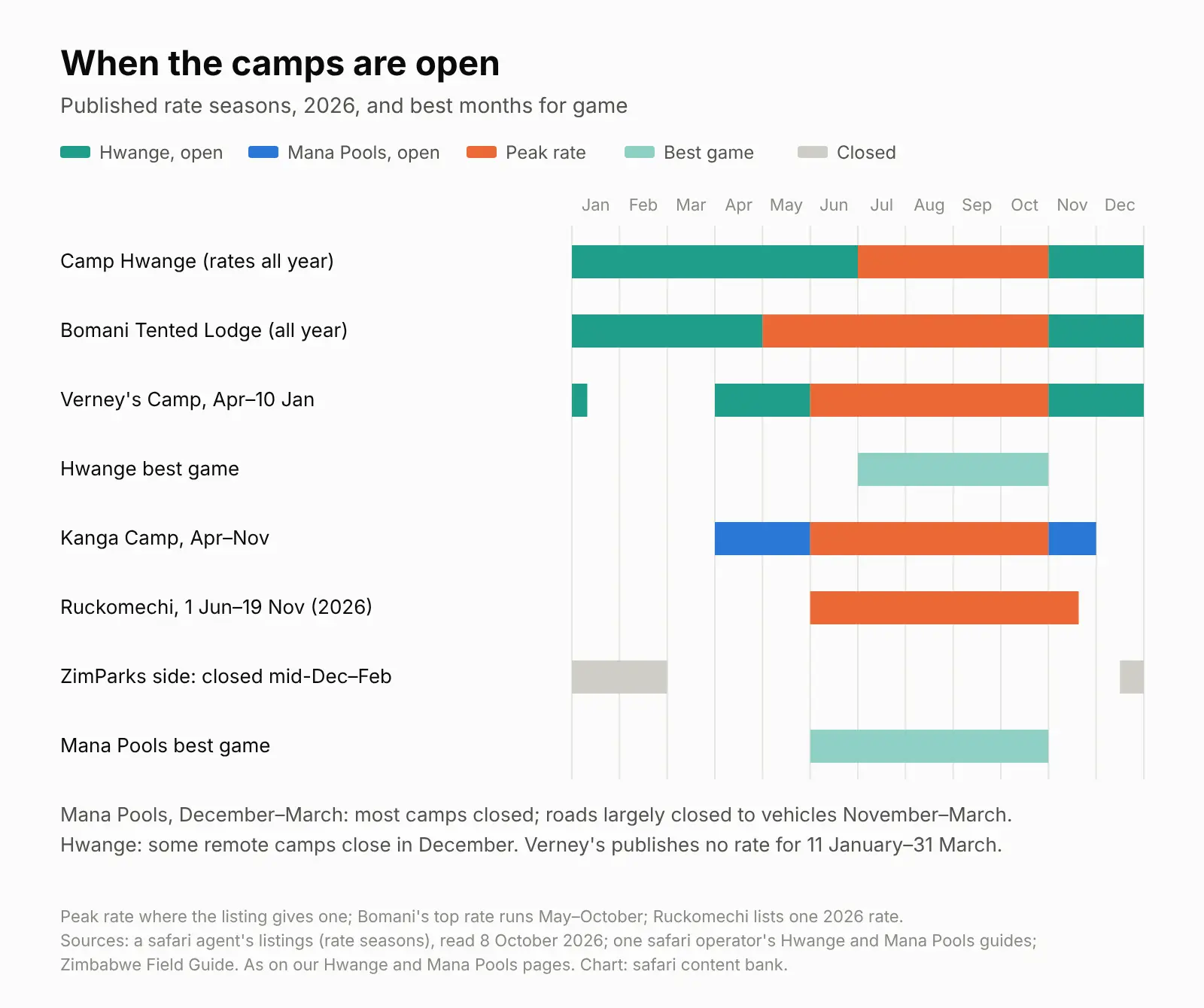 Sources: a safari agent’s listings (camp rate seasons), read 8 October 2026; one safari operator’s Hwange and Mana Pools guides; Zimbabwe Field Guide. Check your camp’s dates. Chart: safari content bank.
| Months | Hwange | Mana Pools |
|---|---|---|
| January–March | Rains; lowest rates (Camp Hwange US$550); game disperses, and one safari operator advises avoiding January–March | Camps closed; ZimParks side closed from about mid-December to the end of February; roads largely closed to vehicles |
| April–May | Camp Hwange US$724 (April–June); Verney’s US$838 | Camps reopen from about April (Kanga US$630); roads still hard in April |
| June | High season begins; Verney’s peak rate (US$1,250) from June | Best season starts; Kanga’s peak rate (US$930) and Ruckomechi (US$1,508) from 1 June |
| July–August | Best at the waterholes; August rated “the very best” month; nights can fall to freezing in late July and early August | August–September are the peak months; haze and dust from August spoil photographs |
| September–October | September the most popular and can book a year ahead; October very hot | October passes 40°C |
| November–December | Rains from November; Camp Hwange US$590; some remote camps close in December | Kanga US$630 in November; some camps close by mid-November; Ruckomechi’s 2026 rate runs to 19 November; closed in December |
Typical year. Sources: one safari operator’s Hwange and Mana Pools guides; a safari booking site’s Mana Pools getting-there page; Zimbabwe Field Guide; a safari agent’s listings for 2026 rates. Read 8–9 October 2026. More months: best time for a safari and green-season safaris. Cold mornings: safari packing list.
How many days in each park
Published trips give Hwange 3–6 days on its own, Mana Pools 5 days from Chirundu, and both parks with Victoria Falls 7–10 days. Overnight stays beat day trips in both: in Hwange the day-visitor fee doubles, and Mana Pools is 7–8 hours by road from Harare.
| Trip | What it fits | Published example |
|---|---|---|
| 3 days | Hwange by road from Victoria Falls | 3-day private trip from Victoria Falls, US$633 per person (one operator) |
| 5–6 days | Hwange alone, two camps by air; or Mana Pools alone from Chirundu | Hwange fly-in, 6 days, US$4,400–6,420; Mana Pools shared, 5 days, US$1,760–2,090 |
| 7 days | Victoria Falls, Hwange and Mana Pools, ending in Harare | US$5,460–9,830 (private luxury, one operator) |
| 9–10 days | Both parks with Victoria Falls, all flown | US$9,730–13,100 (9 days); US$17,280–17,880 (10 days, top end) |
Tour operators’ published 2026 prices per person, usually based on two travellers, read 8 October 2026; operators not named. Ask what each price includes.
- Hwange plus the Falls is the commonest shape: of 99 published trips that include Zimbabwe in our sources, 14 are built on Hwange and Victoria Falls and 7 add Mana Pools (our count, as on Zimbabwe safari questions).
- With four or five days, pick one park: forum regulars weighing Hwange against Chobe advised one park rather than splitting the time, because overnight stays give you the dawn and dusk drives (TripAdvisor, Aug 2026, traveller reports).
- Mana Pools needs its season: with camps open only from about April to November, a combined trip has to fall in those months. More on trip length: how many days for a safari.
Who each park suits
Choose Hwange for elephant, a road trip from Victoria Falls, all-year opening and lower prices; choose Mana Pools for walking, canoeing and wild dog; combine them on a week or more by air.
| If you… | Pick | Why |
|---|---|---|
| Want to walk, even without a guide | Mana Pools | Guided walks, or unguided with a permit; Hwange’s walks are on private concessions |
| Want to canoe | Mana Pools | Half-day to multi-day trips on the Zambezi |
| Want big elephant herds at water | Hwange | Dry-season gatherings at pumped pans |
| Want wild dog | Mana Pools | Seen by 58% of one operator’s travellers; Hwange publishes no rate |
| Want giraffe, sable or Kalahari species | Hwange | Mana Pools has no giraffe; Hwange is Zimbabwe’s only protected area with gemsbok and brown hyena |
| Are travelling December–March | Hwange | Its camps publish green-season rates; Mana Pools’ camps are closed |
| Are coming from Victoria Falls without flying | Hwange | 200 km, up to 3 hours by tar |
| Want the cheapest bed inside a park | Hwange | A ZimParks campsite costs US$23 for up to three people and the park fee halves to US$12 |
| Want game drives above all | Hwange | A safari booking site notes that Mana Pools’ limited road network frustrates visitors who come for drives rather than walks |
Combining Hwange and Mana Pools
The usual route runs Victoria Falls → Hwange → Mana Pools → Harare, or the reverse, with light-aircraft legs; adding Mana Pools raises the daily cost by about 35–50%.
| Published trip | Price per person | Per day (our sums) |
|---|---|---|
| 6 days, fly-in, Hwange only | US$4,400–6,420 | US$733–1,070 |
| 7 days, private luxury, Victoria Falls–Hwange–Mana Pools–Harare | US$5,460–9,830 | US$780–1,404 |
| 9 days, fly-in, Harare–Mana Pools–Hwange–Victoria Falls | US$9,730–13,100 | US$1,081–1,456 |
| 10 days, top-end fly-in, Victoria Falls–Hwange–Mana Pools | US$17,280–17,880 | US$1,728–1,788 |
Tour operators’ published prices, read 8 October 2026, as on our Mana Pools and Zimbabwe safari cost pages; one operator sells the 6-day, 9-day and 10-day trips. Names and links kept in our editor notes.
- The 35–50% comes from one operator’s prices: its 6-day Hwange fly-in costs US$733–1,070 a day, its 9-day trip adding Mana Pools US$1,081–1,456 (our sums, as on the Mana Pools page).
- Park fees stay small: three days in each park cost one international adult US$108, sleeping inside Hwange (our sum: 3 × US$12 + 3 × US$24); with a Victoria Falls rainforest entry (US$58) the week comes to US$166 (Zimbabwe safari cost).
- Why Mana Pools sells less: Tourism Update’s 5 October 2026 report on the agency’s figures cites charter-only access, an April–November season and a trade that finds it hard to sell, and operators recommend packaging it with Victoria Falls and Hwange (Tourism Update).
- Before paying a deposit, check the operator’s licence. Zimbabwe against its neighbours: Zambia vs Zimbabwe and Botswana vs Zimbabwe.
Common mistakes in Hwange vs Mana Pools comparisons
| What you’ll often read | What is correct |
|---|---|
| “Sleep inside and the fee halves, in both parks” | Only in Hwange (US$12 against US$24). Mana Pools charges US$24 a day either way (ZimParks 2026). |
| “Hwange and Mana Pools cost US$20 a day” | Those are 2023 figures. In 2026: Hwange US$24 for day visitors and US$12 staying inside; Mana Pools US$24. |
| “Mana Pools is open all year, like Hwange” | Most Mana Pools camps close December–March, and the ZimParks side closes from about mid-December to the end of February. |
| “You can walk anywhere in Mana Pools on your own” | Only with a permit, and the source that reports it advises against it without serious bush experience. |
| “Hwange is an easy day trip from Victoria Falls” | Main Camp is 200 km, up to 3 hours each way, and day visitors pay double the overnight fee. |
| “Drive straight to Mana Pools’ gate” | Collect your entry permit at Marongora first, or you will be sent back; and carry fuel. |
| “Both parks have giraffe” | Mana Pools has none: giraffe never occurred there. Hwange has them. |
| “Buy the KAZA Univisa at Chirundu or Kariba” | It is not issued there (Wild Zambezi, 2014). |
Frequently asked questions
Is Hwange or Mana Pools better for a first safari? Hwange, for most people: it is 200 km by road from Victoria Falls, its camps run from US$445 a night (2026) with ZimParks camping from US$23 a site, its camps publish rates all year, and game drives and waterhole viewing are its focus. Mana Pools suits a safari built around walking and canoeing, between about April and November.
Do Hwange and Mana Pools charge the same park fee? For day visitors, yes: US$24 per international adult per day in each (ZimParks Tariff 2026). If you sleep inside Hwange the fee drops to US$12; Mana Pools stays at US$24. SADC residents pay US$18 in both, or US$10 staying inside Hwange.
Which park is cheaper? Hwange. Its cheapest listed camp, Bomani Tented Lodge, costs US$445–670 a night against US$630–930 at Kanga Camp in Mana Pools (2026), it can be reached by road, and its park fee halves if you sleep inside. Adding Mana Pools by air raised one operator’s daily price by about 35–50%.
Can I walk without a guide in Hwange or Mana Pools? In Mana Pools, yes, with a permit; unguided walking was banned for a period after abuse by visitors, then reinstated (Zimbabwe Field Guide). We hold no official 2026 permit fee. In Hwange, walks in our sources are guided, on the private concessions.
Can I visit either park in the rainy season? Hwange, yes: camps publish rates from January to March (Camp Hwange US$550 a night), though game disperses and one safari operator advises avoiding those months. Mana Pools, no: most camps close from December to March, and roads are largely closed to vehicles from November to March.
How do I get from Hwange to Mana Pools? Usually by light aircraft; Mack Air serves both parks’ airstrips but publishes no fares. By road, Victoria Falls to Kariba is 560 km, about 6.5 hours, before the last leg to Mana Pools; you need a 4x4 and a permit from Marongora.
Which park is better for wild dogs? Mana Pools: 58% of one safari operator’s travellers there saw wild dog. Hwange holds one of Africa’s larger surviving populations but publishes no sighting rate; Painted Dog Conservation’s visitor centre is at Dete, beside the Main Camp gate.
How many days do I need for both parks? A week at least: the published trips that combine Victoria Falls, Hwange and Mana Pools run 7–10 days, from US$5,460 per person (operators’ 2026 prices). Hwange alone works in 3 days by road from Victoria Falls.
Sources
- Fees: ZimParks, De-Gazetted Tariff 2026 (PDF), tariff year 2026, published February 2026, checked 10 Oct 2026, as on our Hwange, Mana Pools and Zimbabwe safari cost pages; 2023 tariff (PDF) (chalets and lodges only); ATTA, 13 Feb 2026
- Camps: a safari agent’s listings for Bomani Tented Lodge, Camp Hwange, Verney’s Camp, Kanga Camp and Ruckomechi, read 8 Oct 2026 (name and links kept in our editor notes); Wild Expeditions Africa, 2025 rates (PDF)
- Parks and wildlife: Zimbabwe Field Guide, Mana Pools, read 8 Oct 2026; Wikipedia, Hwange (secondary); KAZA elephant survey 2022; Wilderness journal, 17 Jul 2026; 4x4afrika.com, 19 Jan 2026; one safari operator’s Hwange, Mana Pools and canoeing guides and Mana Pools sighting figures, and a safari booking site’s Hwange and Mana Pools pages, read 8–9 Oct 2026 (names and links kept in our editor notes)
- Travel: Mack Air, read 9 Oct 2026; a safari booking site’s getting-there pages; driverabroad.com (undated page); UK FCDO; Wild Zambezi, borders (2014)
- News: Tourism Update, “Mana Pools struggles to capture growth”, 5 Oct 2026
- Traveller reports (forum posts, not fact): TripAdvisor, The Hide to Victoria Falls Airport (Sept 2026) and Chobe vs Hwange for 5 days (Aug 2026)
- Tour operators’ published 2026 package prices, read 8 Oct 2026 (names and links kept in our editor notes)
More: Hwange National Park, Mana Pools National Park, Hwange safari cost, Zimbabwe safari cost, Zimbabwe safari questions, Zimbabwe and walking safaris.
Fees, camp rates and package prices checked 8–10 October 2026 on our Zimbabwe cost and park pages; this page was compiled on 21 October 2026. We will update it when ZimParks publishes its 2027 tariff (the 2026 tariff year ends on 31 December 2026), when camps move to 2027 rates and when Mana Pools camps publish their 2027 open dates.
Ask for a quote
Tell us your dates and we send you a priced itinerary. Free, no obligation.
- Free quote, no obligation
- Trips run by licensed local operators