 Experience

Last verified · Next check due
On this page
- Botswana vs Zimbabwe at a glance (2026)
- Which is cheaper, Botswana or Zimbabwe?
- Park fees: Botswana’s DWNP vs Zimbabwe’s ZimParks
- Chobe or Hwange: the two parks next to Victoria Falls
- The headline areas: Okavango, Moremi and Chobe vs Hwange, Mana Pools and Matobo
- Night drives, walking, off-road driving and boats
- When to go: seasons, the flood and the Falls
- Wildlife: wild dogs, leopard, elephant and rhino
- Getting there and combining the two
- Visas, entry, money and health
- Which should you choose?
- Common mistakes in Botswana vs Zimbabwe comparisons
- Frequently asked questions
- Sources
Short answer: Choose Botswana for the Okavango Delta’s water, mokoro trips and the best published wild dog odds; choose Zimbabwe for Victoria Falls with Hwange by road, and Mana Pools on foot. Budget trips overlap: US$189–270 a day in Botswana, US$211–308 in Zimbabwe. Fly-in trips cost US$1,290–1,630 a day in the Okavango against US$733–1,456 in Zimbabwe. Gate fees: Hwange US$12–24 a day (ZimParks Tariff 2026); Chobe and Moremi P270 (last published schedule, 2022).
Key facts
- At the budget end the two cost about the same; with flights included Zimbabwe costs less. Botswana-only camping trips cost US$189–270 per person per day with park fees included, Victoria Falls and Hwange road trips US$211–308; fly-in packages cost US$1,290–1,630 a day in the Okavango Delta and US$733–1,456 in Zimbabwe (operators’ published prices, our sums as on the cost pages).
- No official current Botswana park fee is published. The last published DWNP schedule (1 April 2022, via Tourism Update) sets P270 in Chobe and Moremi and P190 in other parks. In February 2026 the government news agency BOPA described the existing non-resident fee as P380. A P500 rise was announced on 24 February 2026, then reported postponed. Confirm the fee with DWNP or your operator.
- Zimbabwe’s fees are a current 2026 tariff: Hwange charges an international adult US$24 a day as a day visitor and US$12 sleeping inside the park, Mana Pools US$24 and the Victoria Falls rainforest US$58 per entry (ZimParks Tariff 2026, tariff year ending 31 December 2026).
- Night drives are prohibited in Botswana’s national parks and game reserves and, in Hwange, allowed only on private concessions. In both countries night drives happen on private land; Zimbabwe’s Mana Pools National Park also allows walking, guided or, with a permit, without a guide.
- Chobe and Hwange are the two parks closest to Victoria Falls: Chobe’s Sedudu Gate is 80 km away plus a border, Hwange Main Camp 200 km, up to 3 hours by road. A Chobe day trip is listed at US$249; Hwange is not a day trip.
- British citizens need no visa for Botswana (90 days); most Western visitors buy a Zimbabwe visa on arrival or online, and we print no Zimbabwe fee because no official 2026 figure is in our sources. The KAZA Univisa (US$50) covers day trips into Botswana, but a night in Botswana voids it.
Botswana vs Zimbabwe at a glance (2026)
Botswana is a fly-in country built around the Okavango Delta, with its best land leased to a few camps; Zimbabwe is built around Victoria Falls, with Hwange by road and Mana Pools by air.
| Botswana | Zimbabwe | Source | |
|---|---|---|---|
| Headline areas | Okavango Delta, Moremi Game Reserve, Chobe National Park; the Kalahari pans | Hwange, Mana Pools, Matobo; Victoria Falls | Botswana hub; Zimbabwe safari questions |
| Usual start | Maun (Delta) or Kasane (Chobe) | Victoria Falls Airport, then Hwange by road (200 km, up to 3 hours) | Cost pages |
| Cheapest guided trip, per person per day | US$189–270, Botswana-only camping trips, park fees included | About US$151, overland camping truck; US$211–308, Victoria Falls and Hwange | Operators’ published prices |
| Camp, per person per night | US$530–1,315 (entry to classic fly-in camps), levy extra; top camps far higher | US$445–1,583 (2026–27); up to US$3,150 at Singita Pamushana | Rate cards, below |
| Flagship park fee, adult | Chobe and Moremi P270 a day (last published schedule, 1 April 2022; no official current tariff) | Hwange US$24 day visitor, US$12 staying inside; Mana Pools US$24 (ZimParks Tariff 2026) | Tourism Update; ZimParks |
| Night drives | Prohibited in the parks and reserves; allowed on concessions | Hwange: private concessions only | Botswana Tourism; Hwange |
| Walking | Not in Moremi or Chobe National Park; usually offered on concessions | Mana Pools, guided or unguided with a permit; Hwange’s private concessions | Night drives and walking in Botswana; Zimbabwe safari questions |
| Water activities | Mokoro and boats in the Delta; Chobe river cruises | Canoeing in Mana Pools; Zambezi cruises at Victoria Falls | Okavango and Zimbabwe pages |
| Best months | June–October; zebra on the pans December–March | July–October in Hwange; June–October in Mana Pools | Best time for a safari |
| Visa, UK passport | None, 90 days | Visa on arrival or e-visa; fee not printed | UK FCDO |
| Currency of fees | Park fees in pula (P, BWP); camps in US dollars | US dollars for parks, visas and activities | Cost pages |
Fees and prices as on our Botswana safari cost, Chobe safari cost, Hwange safari cost, Zimbabwe safari cost and Victoria Falls safari cost pages, checked there 9–10 October 2026. Non-resident or international adult. We print each fee in the currency it is published in and do not convert pula.
Which is cheaper, Botswana or Zimbabwe?
At the budget end the two overlap; with light-aircraft flights included, Zimbabwe costs less, and at the top Botswana’s camps cost up to about 1.7 times Zimbabwe’s dearest (our arithmetic: US$5,345 against US$3,150). Zimbabwe stays cheaper because most of its trips run by road between Victoria Falls, Hwange and Matobo; most Okavango camps can be reached only by air.
| Tier, per person | Botswana | Zimbabwe | Source |
|---|---|---|---|
| Cheapest guided trip, per day | US$189–270, Botswana-only camping trips, park fees included; Chobe camping from Kasane US$214 | About US$151, overland camping truck (ends in South Africa); US$211–308, Victoria Falls and Hwange | Operators’ published prices, read September–October 2026 |
| Private or shared trip by road, per day | About US$710 a night, a fully serviced mobile safari with park fees and private campsites (basis not stated) | US$403–482 shared Hwange trips; US$418–572 private, Victoria Falls, Hwange and Matobo | Operators’ published prices |
| Lodge reached by road, per night | US$273–550, Kasane lodges outside Chobe National Park, a game drive and river cruise included | US$445–670, Bomani Tented Lodge on the Hwange boundary | Chobe safari cost; a safari agent’s listing for Bomani |
| Classic camp, per night | US$530–1,315, entry to classic fly-in camps; camp levy extra | US$550–1,250: Camp Hwange US$550–1,080, Kanga Camp (Mana Pools) US$630–930, Verney’s Camp (Hwange) US$838–1,250 | Camps’ 2024–2026 rate cards and agent listings |
| Top camps in our sources, per night | US$995–5,345, premium private-concession to top fly-in camps | Ruckomechi (Mana Pools) US$1,119–1,583 (2027); Singita Pamushana (Malilangwe) US$2,395–3,150 | Camps’ 2026–27 rate cards |
| Fly-in package with internal flights, per day | US$1,290–1,630 (Okavango, 7 days, 1 listing); US$2,151–4,989 premium and top tier | US$733–1,070 Hwange only; US$1,081–1,456 with Mana Pools | Operators’ published packages, our sums as on the cost pages |
| Added per night outside the rate | Camp levies US$20–100; park fees often included | Camp Hwange’s 2025 card: US$20 park fee + US$10 community fee; most listings do not say | Rate cards |
| Flights | Light-aircraft seat US$220–594 per sector, plus US$20–25 departure tax per leg | Mack Air flies Victoria Falls to Hwange’s strips; fares not published | Botswana rate cards (2024); Mack Air |
Per person sharing, low to peak season, without international flights. Tour operators’ packages are shown as unnamed ranges; camp rates, levies and flights as on our Botswana safari cost, Chobe safari cost, Hwange safari cost, Zimbabwe safari cost, Namibia vs Botswana and fly-in safari cost pages. Two of the Botswana operators do not say whether their price is per person. The Zimbabwe camp rates are a booking agent’s listings. Compare quotes line by line.
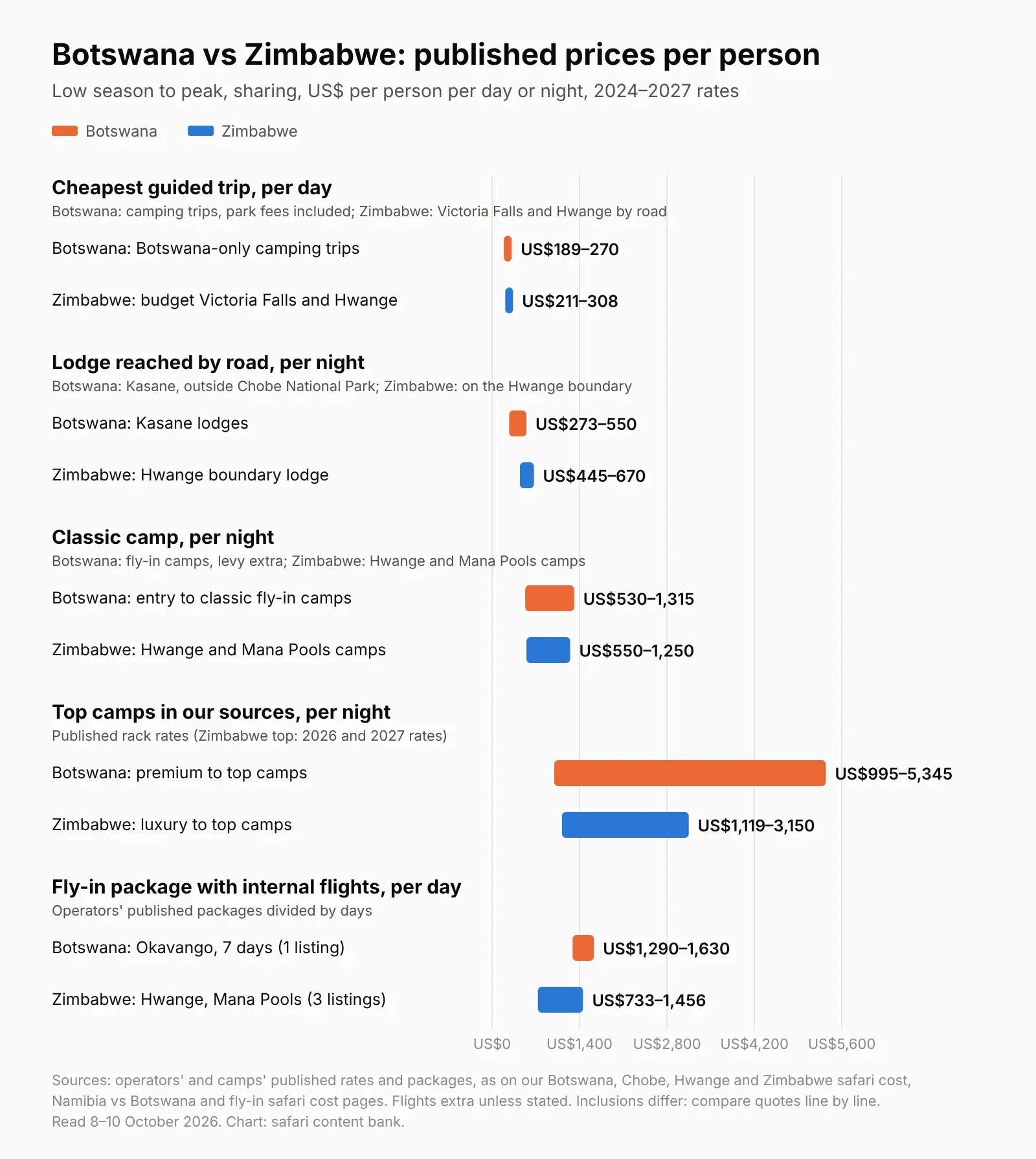 Published 2024–2027 rates and packages per person, sharing, read 8–10 October 2026. Operators not named. Sources: operators’ published prices; camps’ rate cards and agent listings as on our Botswana, Chobe, Hwange and Zimbabwe cost pages. Chart: safari content bank.
Why Botswana costs more with flights and at the top
Botswana limits the beds in its best wildlife areas, and most Delta camps can be reached only by light aircraft. The prime land outside the national parks is divided into concessions, each leased to one operator or community trust with a limited number of beds; the government calls this the high-value, low-volume model (The Ngami Times, 7 Sep 2026). A Botswana light-aircraft seat costs US$220–594 a sector. In Zimbabwe, Hwange Main Camp is 200 km from Victoria Falls by tar road, so most budget and mid-range trips never fly (Zimbabwe safari cost).
- Adding Mana Pools is what pushes a Zimbabwe trip past US$1,000 a day. One operator’s 9-day Harare–Mana Pools–Hwange–Victoria Falls safari costs US$1,081–1,456 per person per day, against US$418–491 for the same operator’s 8-day road trip (Zimbabwe safari cost).
- The road option exists in both countries. Three nights at the two Kasane lodges in our sources cost US$819–1,650 per person; three nights at Bomani on the Hwange boundary US$1,335–2,010 (the cost pages’ sums).
- Zimbabwe has charged 15.5% VAT on tourism services for foreign visitors since 1 January 2026, which also raised activity and transfer prices (Tourism Update, 6 Oct 2026, a single press source).
Seasonal swings
Both countries’ camps charge their top rates in the dry season, which ends in October, and green season saves most at the fly-in and Hwange camps. Machaba Camp in Botswana falls from US$1,315 to US$718 a night in January–March (2026); Camp Hwange falls from US$1,080 in July–October to US$550 in January–March (2026). Kasane’s lodges barely move: Chobe Safari Lodge charges US$500 from January to March and US$550 the rest of 2026 (Botswana safari cost; Hwange safari cost; Chobe safari cost).
Park fees: Botswana’s DWNP vs Zimbabwe’s ZimParks
Chobe and Moremi charge P270 per non-resident per day under the last published DWNP schedule (1 April 2022), and no official current tariff is published; Hwange charges an international adult US$24 a day as a day visitor and US$12 sleeping inside, and Mana Pools US$24, under the ZimParks Tariff 2026, the current schedule. One is set in pula and the other in US dollars; we do not convert.
| Botswana (Department of Wildlife and National Parks, DWNP) | Zimbabwe (Zimbabwe Parks and Wildlife Management Authority, ZimParks) | |
|---|---|---|
| Flagship parks, adult per day | Chobe, Moremi: P270 (SADC residents P205; Botswana citizens and residents P30) | Hwange: US$24 day visitor, US$12 staying overnight in the park; Mana Pools: US$24 either way |
| Other parks | Central Kalahari, Khutse, Nxai Pan, Makgadikgadi P190 (SADC residents P145; citizens and residents P20) | Matobo US$18 day visitor, US$10 staying overnight; Gonarezhou US$30 / US$20 |
| Victoria Falls | – | Rainforest main gate US$58 per entry (VIP gate US$174; moonlight viewing US$116) |
| Self-drivers | Same park fee; campsites paid separately to the concessionaires, about US$40–50 per person a night in Chobe and Moremi; foreign-registered car BWP 40 road-safety levy at the border | Foreign-registered car US$10 a day, US$3 staying overnight; Hwange campsite US$23 per site (up to 3 people); Mana Pools camping US$35 per person |
| What camps add | Park fees often in the rate; camp levies US$20–100 a night | Camp Hwange’s 2025 card: US$20 park fee + US$10 community fee a night; each camp bills its own way |
| Children | Under 8 free; older children pay half (sources differ on the upper age) | Not printed on our cost pages |
| Status of the schedule | Last published schedule: 1 April 2022. BOPA called the existing non-resident fee P380 (Feb 2026); a P500 rise was announced, then reported postponed. Confirm with DWNP or your operator | ZimParks Tariff 2026 (tariff year 2026, published February 2026); the conservation-fee table does not say whether VAT is included |
Sources: DWNP schedule of 1 April 2022 via Tourism Update, 23 Feb 2022; Botswana Daily News (BOPA), 24 Feb 2026; Gabz FM, 5 May 2026; ZimParks De-Gazetted Tariff 2026 (PDF); campsites, children and camp levies from the Botswana, Zimbabwe and Hwange cost pages. Checked 9–10 October 2026.
Three days in Chobe or Moremi cost P810 at the last published fee (our sum: 3 × P270); three days in Hwange cost US$36 if you sleep inside the park and US$72 as a day visitor, and three days in Mana Pools US$72 (our sums: 3 × US$12, 3 × US$24). In both countries the fee is a small share of a camp night. In February 2026 Botswana’s tourism minister argued that its fees “remain among the lowest in the region” (Botswana Daily News, 24 Feb 2026). Fee detail: Botswana park fees, Chobe park fees and Zimbabwe safari cost.
- Botswana: the P500 rise was reported postponed by two years (Gabz FM, 5 May 2026). No government source we have read confirms the postponement, and pages that show P500 as the current fee are quoting the proposal.
- Zimbabwe: the February 2026 rise came with VAT. ZimParks raised the Victoria Falls VIP gate from US$150 to US$174 and moonlight viewing from US$100 to US$116 “with immediate effect” (ATTA, 13 Feb 2026). In 2023 Hwange and Mana Pools charged US$20 a day; quotes of that figure are out of date.
- Sleeping inside Hwange halves its fee; Botswana’s DWNP schedule has no lower overnight rate. Its fee is one rate per person per day, and vehicle-days count both the arrival and the departure day (Chobe park fees).
How we date fees: our method.
The official fee lines, with the date each took effect and the source:
| Fee | Amount | In force from | Source |
|---|---|---|---|
| Chobe National Park and Moremi Game Reserve (DWNP), non-resident adult, per person per day | BWP 270 (SADC residents BWP 205; Botswana citizens and residents BWP 30) | Last published DWNP schedule, 1 April 2022 (via Tourism Update). In Feb 2026 the government news agency BOPA called the existing non-resident fee P380; a P500 rise was announced, then reported postponed. No official current tariff: confirm with DWNP or your operator | Tourism Update, 23 Feb 2022 (DWNP fee schedule) |
| Other DWNP parks and reserves (Central Kalahari Game Reserve, Khutse, Nxai Pan, Makgadikgadi Pans), non-resident adult, per person per day | BWP 190 (SADC residents BWP 145; Botswana citizens and residents BWP 20) | Last published DWNP schedule, 1 April 2022 (via Tourism Update). In Feb 2026 the government news agency BOPA called the existing non-resident fee P380; a P500 rise was announced, then reported postponed. No official current tariff: confirm with DWNP or your operator | Tourism Update, 23 Feb 2022 (DWNP fee schedule) |
| National Road Safety Fund levy, foreign-registered vehicle entering Botswana | BWP 40, valid to 31 December of the year paid | Last published on the BURS motor-vehicle clearance page (undated) | Botswana Unified Revenue Service (BURS) |
| Hwange National Park, Main Camp (row as labelled in the ZimParks 2026 tariff), international adult, conservation fee per day | USD 24 day visitor; USD 12 if staying overnight in the park (SADC USD 18 / 10; local USD 5 / 3) | ZimParks Tariff 2026 (tariff year 2026, published February 2026); the conservation-fee table does not say whether VAT is included; Robins, Sinamatella and Kazuma Pan are not listed separately in our sources | ZimParks De-Gazetted Tariff 2026 |
| Mana Pools National Park, Sapi and Chewore, international adult, conservation fee per day | USD 24, day visitor or staying overnight (SADC USD 18; local USD 8) | ZimParks Tariff 2026 (tariff year 2026, published February 2026); the conservation-fee table does not say whether VAT is included | ZimParks De-Gazetted Tariff 2026 |
| Victoria Falls Rainforest (Zimbabwe), main gate, international adult, per entry | USD 58 (SADC USD 35; local USD 7) | ZimParks Tariff 2026 (tariff year 2026, published February 2026); the fee table does not say whether VAT is included | ZimParks De-Gazetted Tariff 2026 |
| Victoria Falls Rainforest (Zimbabwe), VIP gate and moonlight (lunar rainbow) viewing, international adult | VIP gate USD 174 (SADC USD 87; local USD 30); moonlight viewing USD 116 (SADC USD 81; local USD 15) | ZimParks Tariff 2026 (tariff year 2026, published February 2026) | ZimParks De-Gazetted Tariff 2026 |
| Foreign-registered car, pickup or 4x4, per vehicle per day (Hwange, Mana Pools, Zambezi, Matobo, Chizarira, Kariba, Nyanga, Chewore) | USD 10 day visitor; USD 3 if staying overnight (locally registered USD 5 / 2) | ZimParks Tariff 2026 (tariff year 2026, published February 2026) | ZimParks De-Gazetted Tariff 2026 |
| Hwange National Park camping, SADC and international visitors | USD 23 per site per night (up to 3 people); bush camp USD 35 per person per night | ZimParks Tariff 2026 (tariff year 2026, published February 2026) | ZimParks De-Gazetted Tariff 2026 |
| Mana Pools National Park camping, SADC and international visitors | Ordinary or bush camping USD 35 per person per night; Nyamepi site (6 people) USD 120; exclusive site USD 235; Chitake 1 and 3B USD 355; Chitake 2 and Baobab USD 235 per site per night | ZimParks Tariff 2026 (tariff year 2026, published February 2026) | ZimParks De-Gazetted Tariff 2026 |
Chobe or Hwange: the two parks next to Victoria Falls
Chobe is the shorter drive, with river cruises and a Botswana border; Hwange is the bigger drive, with waterhole viewing, no border from Victoria Falls and a fee that halves if you sleep inside.
| Chobe National Park (Botswana) | Hwange National Park (Zimbabwe) | |
|---|---|---|
| From Victoria Falls | 80 km to Sedudu Gate, just over 1 hour, plus the Kazungula Road border (06:00–20:00) | 200 km to Main Camp, up to 3 hours on tar; deeper camps 3–6 hours |
| Day trip? | Yes: listed at US$249 per person with transfers (booking agent, 2026) | Not a day trip: day visitors pay twice the overnight fee |
| Park fee, adult per day | P270 (last published schedule, 2022) | US$12 sleeping inside, US$24 day visitor (ZimParks Tariff 2026) |
| Cheapest lodge by road | Kasane lodges US$273–550 a night, with a game drive and river cruise | Bomani Tented Lodge, park boundary, US$445–670 a night |
| Inside the park | Chobe Game Lodge, riverfront, US$942–1,406 (2024 card); Savuti lodges US$645–1,160 | Camp Hwange US$550–1,080; Verney’s Camp US$838–1,250 (2026) |
| What you watch | Elephant and buffalo on the river; boat cruises from Kasane | Game at mostly pumped waterholes in the dry season |
| Night drives | Not in the park; allowed on the Linyanti concessions next to it | Only on Hwange’s private concessions |
| Sightings, one safari operator’s travellers | Elephant 99%, buffalo 91%, leopard 59%, wild dog 23% | No comparable rate published |
Sources: Chobe day trip from Victoria Falls; Chobe safari cost; Hwange safari cost; Hwange hub; Botswana Tourism, Ports of Entry; a safari booking site’s getting-there guides (name and links kept in our editor notes). Read 9–10 October 2026.
- On the TripAdvisor Matabeleland North forum in August 2026, replies to a traveller weighing Chobe and Hwange for five days said overnight stays beat day trips for dawn and dusk, and that Hwange is quieter and needs no border crossing from Victoria Falls (TripAdvisor, “Chobe vs Hwange for 5 days”, traveller reports).
- A Chobe day trip and the Univisa come to US$299 per person (US$249 + US$50, our sum, as on the Chobe safari cost page), plus the park fee if it is not included; our sources do not say whether it is.
- Chobe Game Lodge is the only permanent lodge inside the park on the riverfront; the cheaper beds are in Kasane town, outside it (Chobe).
See also: Chobe vs Hwange.
The headline areas: Okavango, Moremi and Chobe vs Hwange, Mana Pools and Matobo
Botswana’s headline areas are a delta, a game reserve inside it and a river-front national park; Zimbabwe’s are a big waterhole park, a Zambezi floodplain park for walking and canoeing, and a granite-hills park near Bulawayo.
| Area | Country | What the land is | Known for | Gate fee, adult per day | Best months |
|---|---|---|---|---|---|
| Okavango Delta | Botswana | Floodplain of about 6,000–8,000 km² at low water and about 15,000 km² at high water; mostly private and community concessions | Mokoro, boats, fly-in camps | Concession camps usually include it | Highest water about May–August; boats on seasonal floodplains late May–September |
| Moremi Game Reserve | Botswana | DWNP game reserve, just under 5,000 km², about 70% delta | Leopard (76%) and wild dog (65%) of one operator’s travellers | P270 (last published) | June–October, as game gathers at water |
| Chobe National Park | Botswana | DWNP national park; riverfront by Kasane, plus Savuti | Elephant, buffalo, river cruises, road access | P270 (last published) | June–October, when game crowds the river |
| Hwange | Zimbabwe | National park, about 14,650 km²; private concessions inside | Elephant at pumped waterholes; 200 km from Victoria Falls | US$24 day visitor; US$12 staying overnight (ZimParks 2026) | July–October; some remote camps close in December |
| Mana Pools | Zimbabwe | National park, 2,196 km², Zambezi floodplain | Walking (unguided with a permit), canoeing, wild dog (58% of one operator’s travellers); no giraffe | US$24 (ZimParks 2026) | June–October; camps open about April to November, closed December–March |
| Matobo | Zimbabwe | National park, 424 km²; UNESCO World Heritage Site (Matobo Hills, 2003) | Granite hills, more than 3,000 registered rock-art sites; 30–35 km from Bulawayo | US$18 day visitor; US$10 staying overnight (ZimParks 2026) | Not stated in our sources |
Fees: DWNP schedule of 1 April 2022 via Tourism Update, the last published, no official current tariff; ZimParks Tariff 2026 (PDF). Delta area: IntechOpen review. Moremi size: Wikipedia, as on our Moremi page. Hwange and Mana Pools sizes: a safari booking site; Matobo: Wikipedia (secondary). Sighting shares: one safari operator’s traveller surveys, per trip, not population data (name and links kept in our editor notes). Read 8–10 October 2026.
- Moremi is not the whole Delta. It is one state reserve; most of the Delta is concession land with different rules (Okavango Delta; Moremi).
- Mana Pools is reached by air or a long 4x4 drive: 388 km, 7–8 hours from Harare, with no fuel in the park. Collect your entry permit at Marongora before you drive down the escarpment, and keep the receipt to leave (Zimbabwe safari questions).
- Hwange’s game viewing is waterhole viewing. Most of its waterholes are pumped, so in the dry season elephant and other large herbivores gather at them (Hwange).
- Zimbabwe’s share of the Kavango-Zambezi (KAZA) conservation area, which includes Hwange, held 65,028 elephants in the 2022 aerial survey (Hwange). We print no Chobe-only or Botswana count: the figures in circulation disagree, and the Chobe number most often quoted cites no survey (Chobe).
See also: Hwange vs Mana Pools.
Night drives, walking, off-road driving and boats
In both countries the extra activities follow the land: Botswana prohibits night drives and off-road driving in its national parks and reserves and allows them on concessions; Zimbabwe allows night drives in Hwange only on private concessions, while Mana Pools is the walking and canoeing park.
| Botswana: Chobe, Moremi and other parks | Botswana: private and community concessions | Zimbabwe: Hwange | Zimbabwe: Mana Pools | |
|---|---|---|---|---|
| Night drives | Prohibited | Allowed | Private concessions only; not in the public park | Not in our sources |
| Walking | Not in Moremi; not in Chobe National Park | Usually offered; no specialist walking licence required | On private concessions, for example Wilderness’s camps, with Zimbabwe professional guides | Guided walks; unguided with a permit |
| Off-road driving | Prohibited | Allowed, “in moderation” | Not in our sources | Not in our sources |
| Boats | Chobe river cruises from Kasane; mokoro and boats in the Delta | Mokoro and boats, about late May–September on seasonal floodplains, all year on permanent water | – | Canoe trips, half-day to multi-day; motorboats banned in the park except on Ruckomechi’s concession |
| Self-drive | Possible in a 4x4 (US$170–300 a day from Maun); campsites booked up to a year ahead | Camp guests only, except the Khwai community concession | Main roads take a normal car; deeper areas need a 4x4, especially November–March | 4x4 essential; no fuel in the park |
Sources: Botswana Tourism, game viewing (parks and concessions); one safari operator’s Moremi, Chobe, Hwange and Mana Pools guides (name and links kept in our editor notes); a safari booking site’s Hwange page; Zimbabwe Field Guide, Mana Pools; Wilderness journal, July 2026. Every Botswana area is on night drives, walking and off-road driving in Botswana; Zimbabwe’s on Zimbabwe safari questions. Read 8–10 October 2026.
- Botswana Tourism states the rule outright: in the national parks and reserves, “off-roading and night driving [are] prohibited”, while “private concession areas outside the parks and reserves provide opportunities for off-road driving and night drives” (Botswana Tourism).
- The rule follows the land, not the price. Mombo, for example, is inside Moremi Game Reserve, where Botswana Tourism says off-roading and night driving are prohibited. Check any camp’s activity list for your dates.
- Without serious bush experience, walk with a guide in Mana Pools even though the permit allows otherwise; we have no official 2026 figure for the permit fee (Zimbabwe safari questions).
- Botswana’s national guiding regulations “don’t require specialist walking qualifications” (one safari operator), so ask who leads a walk there and whether the guide is armed. Every walking area in Africa: walking safaris.
- The UK FCDO advises against driving at night anywhere in Zimbabwe (FCDO); in Botswana, light aircraft do not fly at night, and Maun’s port of entry closes at 16:30 on Botswana Tourism’s list.
When to go: seasons, the flood and the Falls
June to October is the main season in both countries; Botswana’s draw in those months is the Okavango flood, Zimbabwe’s is game at Hwange’s waterholes and the Mana Pools season. Outside it, Botswana’s camps sell their lowest rates in January to March, Hwange stays open at its lowest rates, and Mana Pools closes.
| Months | Botswana | Zimbabwe |
|---|---|---|
| January–March | Rains; zebra at Nxai Pan and the Makgadikgadi; Delta water low; lowest camp rates (Machaba US$718) | Rains; Hwange open at its lowest rates (Camp Hwange US$550), game dispersed; Mana Pools camps closed; Victoria Falls in flood from February |
| April–May | Flood rising; boating resumes late May | Mana Pools camps open from about April; Camp Hwange US$724 (April–June); Falls at their highest, most spray |
| June | Highest water in most of the Delta; game starting to gather at water | Mana Pools’ best season starts (June–October); best balance of water and view at the Falls, June–August |
| July–September | Highest water to about August; peak camp rates | Hwange’s best months, August the very best; Camp Hwange US$1,080 (July–October); nights can fall to freezing late July–early August |
| October | Hottest month, above 40°C at times; water falling | Hottest month, above 40°C in the Zambezi Valley; the Zambian side of the Falls can run dry, the Zimbabwe side keeps flowing |
| November–December | Rains start in November; Delta water lowest; zebra back on the pans from December | Rains from November; some remote Hwange camps close in December; Mana Pools closes for December–March |
Typical year, not a forecast. Botswana: IntechOpen review; two camp operators’ seasonal guides; one operator’s Okavango flood guide; Africa Geographic; Machaba 2026. Zimbabwe: one safari operator’s Hwange and Mana Pools guides; a safari agent’s listing for Camp Hwange (2026); a safari agent’s guide to Victoria Falls. As on our Botswana vs Zambia and Zimbabwe safari questions pages. Read 8–10 October 2026.
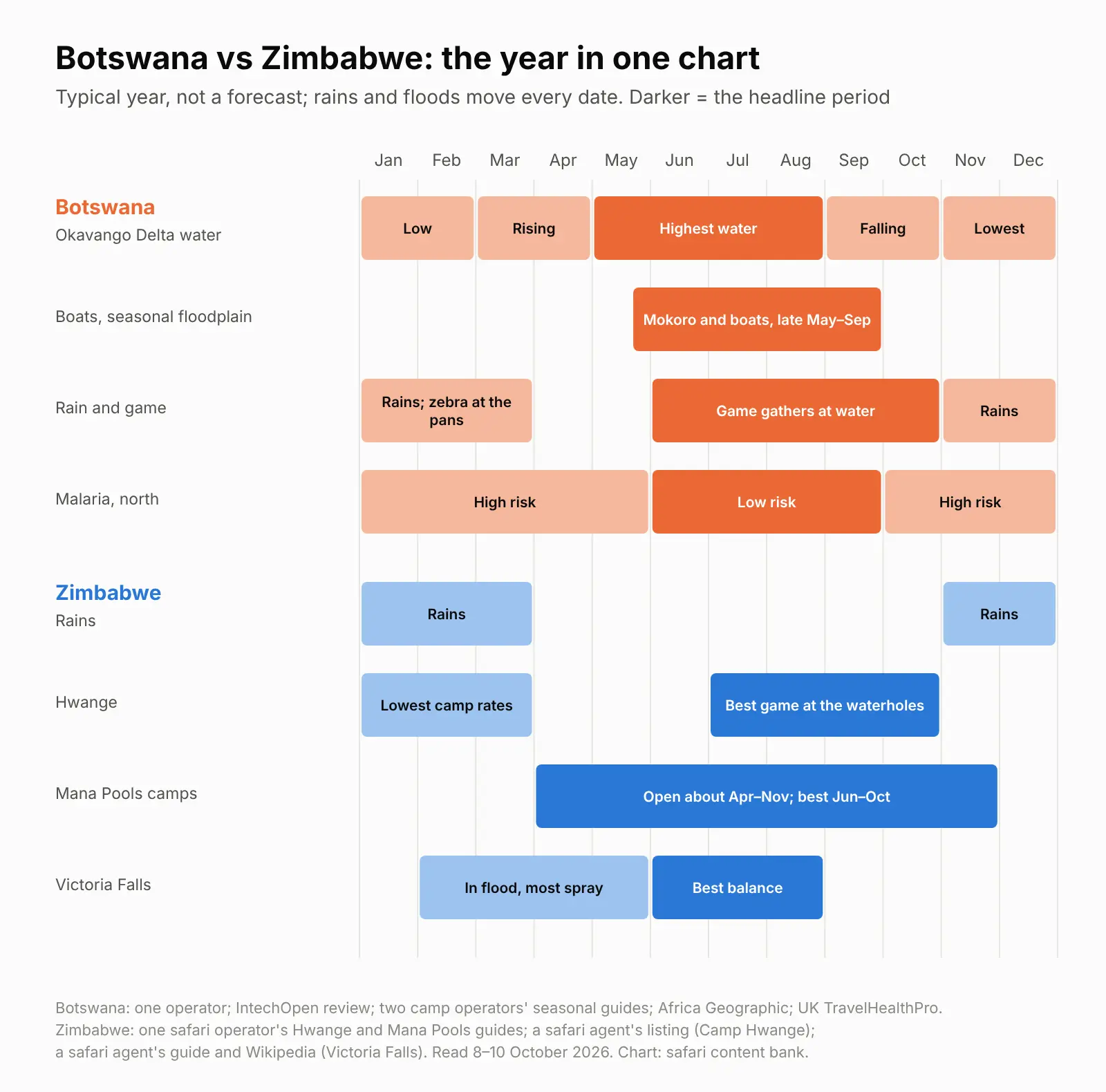 Typical year. Sources: one operator’s flood guide; IntechOpen review; two camp operators’ seasonal guides; Africa Geographic; UK TravelHealthPro; one safari operator’s Hwange and Mana Pools guides; a safari agent’s listings (Camp Hwange); a safari agent’s guide and Wikipedia (Victoria Falls). Read 8–10 October 2026. Chart: safari content bank.
- The Delta floods in Botswana’s dry season. The water is rain that fell on the Angolan highlands, and the flooded area roughly doubles each year. Month by month: Okavango flood calendar.
- Green season is a Hwange season, not a Mana Pools one. One safari operator advises avoiding January to March in Hwange because game disperses; Mana Pools’ camps are shut then. See green-season safari.
- For the Falls plus a safari, June to August gives the best balance of water and view at the Falls, and July to October is Hwange’s best period (Zimbabwe safari questions); which side to see is on Victoria Falls: Zimbabwe or Zambia side.
Wildlife: wild dogs, leopard, elephant and rhino
Botswana’s Moremi has the best published wild dog and leopard odds of the areas on this page; Zimbabwe’s Mana Pools comes close on wild dog; neither country’s headline areas are sold on rhino.
| Botswana | Zimbabwe | Source | |
|---|---|---|---|
| Wild dog, share of one operator’s travellers who saw them | Moremi 65%; Okavango Delta 61%; Kwando-Linyanti 49%; Chobe 23%; all Botswana 50% | Mana Pools 58%; Hwange holds “one of the larger surviving populations” but publishes no rate | Where to see wild dogs |
| Leopard | Moremi 76%; Chobe 59% | Mana Pools 36% | One operator’s traveller surveys |
| Lion | Moremi 91%; Chobe 91% | Mana Pools 90% | same |
| Elephant | Chobe 99%; no national count printed | Zimbabwe’s KAZA area 65,028 (2022 aerial survey) | Chobe; Hwange |
| Rhino in the country (end of 2024) | 345 (25 black, 320 white) | 1,320 (784 black, 536 white) | IUCN, as on where to see rhino |
Sighting shares are one operator’s traveller reports per trip (Botswana read September 2026, Mana Pools 8 October 2026), not population data. We do not publish where in either country rhino are found.
- The same operator’s surveys cover both countries, so the odds compare like for like: for wild dog, Moremi (65%) beats Mana Pools (58%); for leopard, Moremi (76%) beats Mana Pools (36%); lion is level at 90–91%.
- Painted Dog Conservation’s visitor centre is at Dete, beside Hwange’s Main Camp gate, and takes visitors with advance notice (one safari operator).
- Zimbabwe holds almost four times Botswana’s rhino (our arithmetic: 1,320 against 345), but neither country is a quick rhino trip; the countries are compared on where to see rhino.
Getting there and combining the two
Botswana’s Delta camps are reached by light aircraft from Maun and Chobe by road from Kasane; Zimbabwe’s safaris start at Victoria Falls Airport, with Hwange by road. Kasane, 80 km from Victoria Falls, is where the two meet.
| Botswana | Zimbabwe | Source | |
|---|---|---|---|
| Gateways | Maun (Delta, Moremi, Khwai); Kasane (Chobe) | Victoria Falls Airport (VFA); Harare for Mana Pools by road | Botswana bush flights; Zimbabwe safari questions |
| Routes in | Into Maun: Ethiopian Airlines from Addis Ababa; Proflight Zambia from Livingstone and Lusaka; FlyNamibia from Windhoek until 30 November 2026. No non-stop flight from Europe | Our sources hold no current airline list for Victoria Falls Airport | Tourism Update, 24 Jun 2026; Proflight |
| Flight to the flagship area | Light-aircraft seat US$220–594 per sector; Moremi Air Maun → Kasane US$495 (2024); departure tax US$20–25 per leg | Mack Air from Victoria Falls to Hwange’s strips and from Harare and Kariba to Mana Pools; fares not published | Kwando and Desert & Delta 2024 rate cards; Mack Air |
| By road | Kasane lodges by road; Maun → Kasane 600 km, about 7 hours; no road to the inner Delta camps | Victoria Falls → Hwange Main Camp 200 km, up to 3 hours; Harare → Mana Pools 388 km, 7–8 hours, 4x4 essential | A safari booking site’s getting-there guides |
| Luggage on light aircraft | 20 kg per person in a soft bag, hand luggage included | 20 kg including hand luggage, soft bags (Mack Air) | Botswana bush flights; Mack Air |
| Between the two | Victoria Falls → Kasane by Mack Air, 20 minutes, daily; fare not published | Kazungula Road border, Zimbabwe–Botswana, open 06:00–20:00 | Chobe day trip from Victoria Falls |
Fares are the latest in our sources: Botswana 2024 rate cards; Mack Air publishes none. Read 9–10 October 2026.
- There is no Victoria Falls–Maun flight in our sources; in June 2026 the trade was still asking for one. From Victoria Falls, go to Kasane by road or on the Mack Air hop, then fly on to Maun or the Delta (Botswana bush flights).
- A common shape: Victoria Falls, Hwange by road, then Chobe and on to the Delta. Fly into Maun and out of Kasane, or the reverse, to save the US$495 Maun–Kasane sector. Allow two nights at Victoria Falls, three if you cross to the other side or add Chobe (one safari operator’s Livingstone guide).
- A night in Botswana voids the KAZA Univisa. If your passport needs a Zimbabwe visa, plan the order of countries before you buy it; coming back from Botswana is a second entry into Zimbabwe.
- Self-drivers crossing into Botswana pay the BWP 40 road-safety levy for a foreign-registered car, and a rental needs the owner’s written permission to cross (Botswana self-drive).
- Other pairings: Botswana against Zambia on Botswana vs Zambia, Zambia against Zimbabwe on Zambia vs Zimbabwe, and Botswana against Namibia on Namibia vs Botswana.
See also: Victoria Falls and safari.
Visas, entry, money and health
British citizens need no visa for Botswana, which publishes no official list of exempt nationalities; Zimbabwe sells most Western visitors a visa on arrival or online, at a fee we cannot confirm from an official 2026 source. Neither country charges a border levy in our sources.
| Botswana | Zimbabwe | Source | |
|---|---|---|---|
| Visa | British citizens visa-free, 90 days; “citizens of most European and Commonwealth countries do not require a visa”; no official list names the US | Visa on arrival or e-visa for most Western visitors; fee not confirmed by an official 2026 source | Botswana visa; UK FCDO, Zimbabwe (updated 15 Jul 2026) |
| Applying, where a visa is needed | eVisa at evisa.gov.bw, 7–14 days; the government’s tourist-visa page lists no fee | evisa.gov.zw, or on arrival | gov.bw |
| KAZA Univisa | Not issued by Botswana; covers day trips into Botswana through Kazungula, and a night in Botswana voids it | US$50, 30 days, Zimbabwe and Zambia; issued at Victoria Falls, Harare and Bulawayo airports, the Victoria Falls Bridge and Kazungula | A safari agent’s guide, 7 Jan 2026; UK FCDO |
| Border levy | None. The US$30 Tourism Development Levy Bill was withdrawn on 11 December 2017 | None in our sources | Inside Travel |
| Passport | Valid 6 months, with 3 blank pages (UK FCDO) | Valid 6 months beyond arrival, with 3 blank pages | UK FCDO |
| Children’s documents | Full (unabridged) birth certificate naming both parents, plus an affidavit from any parent not travelling | Not stated in our sources | BOPA via AllAfrica, 24 Dec 2025 |
| Money | Park fees in pula; camp rates in US dollars | US dollars for parks, visas and activities; bring small, clean notes; declare US$10,000 or more; leaving with more than US$2,000 in cash is illegal | Cost pages; UK FCDO |
| Yellow fever certificate | Only if arriving from, or transiting through, a risk country | Only if arriving from a risk country | Yellow fever and safaris |
| Malaria | North (Delta, Chobe) high risk October–May, low June–September | No official source read; Wild Zambezi, a Zimbabwe travel site, names Victoria Falls, Kariba and the Zambezi Valley, highest risk November–May | TravelHealthPro; Wild Zambezi |
Check the official pages the week you travel: evisa.gov.bw and evisa.gov.zw. Which malaria tablets to take, if any, is a decision for a travel clinic. Checked 9–11 October 2026.
- For a passport that needs a Zimbabwe visa, the Univisa pays when you leave Zimbabwe and come back, for example on a Chobe day trip. For a Kasane stay, plan a visa that allows re-entry to Zimbabwe (Chobe day trip from Victoria Falls).
- The Univisa does not replace a Botswana visa. None of our sources says it lets a traveller who needs a Botswana visa enter Botswana without one (Botswana visa).
- US citizens: our Botswana visa page found no official list that names the US; for Zimbabwe, the UK FCDO page covers British passports only.
Which should you choose?
Choose Botswana for water, wild dogs and the most exclusive concessions; choose Zimbabwe for Victoria Falls with a safari by road, walking in Mana Pools and lower prices once flights are added.
| If you… | Pick | Why |
|---|---|---|
| Want mokoro and boat safaris in a delta | Botswana | Seasonal floodplains run boats about late May–September; permanent water all year |
| Want the Falls plus a safari without flying | Zimbabwe | Hwange is 200 km, up to 3 hours by road from Victoria Falls; Chobe is a day trip from there too |
| Want to walk, or canoe the Zambezi | Zimbabwe (Mana Pools) | Guided or unguided with a permit; canoe trips half-day to multi-day; dry season only |
| Want the best published odds of wild dog and leopard | Botswana (Moremi) | Wild dog 65% and leopard 76% of one operator’s groups, against 58% and 36% in Mana Pools |
| Travel on a budget | Either | Botswana-only camping US$189–270 a day; Victoria Falls and Hwange US$211–308; overland trips from about US$151 |
| Want a fly-in safari for less | Zimbabwe | US$733–1,456 a day, against US$1,290–1,630 for the Okavango package in our sources |
| Want the most exclusive concessions | Botswana | Capped beds on leased concessions; top camps up to US$5,345 a night |
| Travel in January–March | Botswana, or Hwange | Lowest camp rates in both; zebra on Botswana’s pans; Mana Pools camps are closed |
| Want a current, published park fee | Zimbabwe | ZimParks Tariff 2026 is current; Botswana has no official current tariff |
Whichever you choose, check that the operator holds a current licence: see how to check a safari operator is licensed.
Common mistakes in Botswana vs Zimbabwe comparisons
| What you’ll often read | What is correct |
|---|---|
| “Zimbabwe is half the price of Botswana” | Not at the budget end. Botswana-only camping trips cost US$189–270 a day, Victoria Falls and Hwange trips US$211–308. The gap opens with flights: US$733–1,456 a day fly-in in Zimbabwe, US$1,290–1,630 in the Okavango. |
| “Botswana park fees are P500 from April 2026” | The P500 rise was announced, then reported postponed. No official current tariff is published: the last published schedule (1 April 2022) gives P270 Chobe and Moremi, P190 other parks, and the government news agency called the existing non-resident fee P380 in February 2026. Confirm with DWNP or your operator. |
| “Hwange and Mana Pools cost US$20 a day” | Those are 2023 figures. In 2026 Hwange is US$24 for day visitors, US$12 staying inside; Mana Pools US$24. |
| “Night drives are allowed in Chobe and Hwange” | Not in either public park. Botswana allows them on concessions, such as the Linyanti; Hwange only on its private concessions. |
| “Do Hwange as a day trip from Victoria Falls, like Chobe” | Chobe’s gate is 80 km away; Hwange Main Camp is 200 km, up to 3 hours each way, and day visitors pay double the overnight fee. |
| “The Univisa covers a night in Chobe” | Day trips only. A night in Botswana voids it. |
| “Mana Pools is open all year” | Most camps close December–March; the floodplain is impassable in the rains. |
| “Victoria Falls entry is US$50” | US$58 per international adult per entry under the ZimParks Tariff 2026. |
| “There’s a flight from Victoria Falls to Maun” | Not in our sources. Go to Kasane by road or on the Mack Air hop, then fly on. |
Frequently asked questions
Is Botswana or Zimbabwe better for a safari? It depends on the trip. Botswana is better for the Okavango Delta’s water, mokoro trips and the best published wild dog and leopard odds (65% and 76% of one operator’s Moremi travellers). Zimbabwe is better for Victoria Falls with a safari by road (Hwange, 200 km away), for walking and canoeing in Mana Pools and for lower fly-in prices.
Is Botswana or Zimbabwe cheaper? At the budget end they overlap: Botswana-only camping trips cost US$189–270 per person per day with park fees included, Victoria Falls and Hwange trips US$211–308, and Zimbabwe overland trips start at about US$151. With flights included Zimbabwe is cheaper: fly-in packages cost US$733–1,456 a day against US$1,290–1,630 for the Okavango package in our sources. Botswana’s top camps reach US$5,345 a night, Zimbabwe’s US$3,150.
What are the park fees in Botswana and Zimbabwe? Botswana’s last published DWNP schedule (1 April 2022) charges P270 per non-resident adult per day in Chobe and Moremi and P190 in other parks; in February 2026 the government news agency called the existing non-resident fee P380, and a P500 rise was announced, then reported postponed. No official current Botswana tariff is published, so confirm with DWNP or your operator. Under the ZimParks Tariff 2026, Hwange charges US$24 for day visitors and US$12 if you sleep inside, Mana Pools US$24 and the Victoria Falls rainforest US$58 per entry.
Should I add Chobe or Hwange to Victoria Falls? Chobe if you have one day: Sedudu Gate is 80 km away and a day trip is listed at US$249 with transfers. Hwange if you can stay: Main Camp is 200 km, up to 3 hours each way, sleeping inside halves the fee to US$12 a day, and the shortest published Hwange packages are 3 days from Victoria Falls, from US$633. Travellers on the TripAdvisor forum in August 2026 favoured overnight stays over day trips (traveller reports).
Can you do night drives and walking safaris in Botswana and Zimbabwe? In both, mainly on private land. Botswana prohibits night drives and off-road driving in its national parks and reserves and allows them on concessions (Botswana Tourism); Moremi allows no walking safaris. Hwange allows night drives only on its private concessions, and Mana Pools allows guided walks and, with a permit, walking without a guide.
Do I need a visa for Botswana or Zimbabwe? Not for Botswana with a UK passport (90 days); Botswana says citizens of “most European and Commonwealth countries” need none but publishes no official list. Most Western visitors buy a Zimbabwe visa on arrival or online; we print no fee because no official 2026 figure is in our sources. The KAZA Univisa (US$50, 30 days) covers Zimbabwe and Zambia plus day trips into Botswana; a night in Botswana voids it.
Can I combine Botswana and Zimbabwe on one trip? Yes, through Victoria Falls and Kasane: Chobe’s gate is 80 km from Victoria Falls, and the Kazungula Road border is open 06:00–20:00. A common shape is Hwange by road from Victoria Falls, then Chobe, then a flight from Kasane to Maun for the Delta (US$495 on Moremi Air’s 2024 card). There is no Victoria Falls–Maun flight in our sources.
When is the best time to go to Botswana or Zimbabwe? June to October in both. Botswana’s Delta water is highest from about May to August, and game gathers at the remaining water to October; Hwange’s best months are July to October and Mana Pools’ June to October. October passes 40°C in both, and most Mana Pools camps close from December to March.
Sources
- Botswana fees: DWNP schedule of 1 April 2022 via Tourism Update, 23 Feb 2022; Botswana Daily News (BOPA), 24 Feb 2026; Gabz FM, 5 May 2026; BURS
- Zimbabwe fees: ZimParks, De-Gazetted Tariff 2026 (PDF), tariff year 2026, published February 2026, checked 10 Oct 2026, as on our Zimbabwe safari cost page; ATTA, ZimParks lifts Victoria Falls entry fees as VAT takes effect, 13 Feb 2026; Tourism Update, Zimbabwe tourism adjusts after VAT shock, 6 Oct 2026
- Rules: Botswana Tourism, game viewing; The Ngami Times, 7 Sep 2026; Zimbabwe Field Guide, Mana Pools; Wilderness journal, July 2026; one safari operator’s Moremi, Chobe, Hwange, Mana Pools and walking guides, and a safari booking site’s Hwange page (names and links kept in our editor notes)
- Botswana camp and lodge rates: Kwando 2024; Desert & Delta 2024; Machaba 2026; Natural Selection 2026; Great Plains 2025; Wilderness; Chobe Safari Lodge; Sun Destinations, Chobe Mopani Forest Lodge (PDF)
- Zimbabwe camp rates: a booking agent’s listings for Bomani, Camp Hwange, Verney’s Camp, Kanga Camp and Ruckomechi, read 8 Oct 2026; Wild Expeditions Africa 2025 (PDF); Singita Malilangwe 2026 (PDF)
- Packages: tour operators’ published 2026 package prices and a booking agent’s Chobe day-trip price, shown as unnamed ranges (names and links kept in our editor notes)
- Parks and wildlife: IntechOpen review; Wikipedia, Moremi and Matobo (secondary); KAZA elephant survey 2022, as on our Hwange page; IUCN rhino figures for end-2024, as on our rhino page; one safari operator’s traveller sighting surveys
- Seasons and flood: two camp operators’ seasonal guides; Africa Geographic; a safari agent’s guide to Victoria Falls, read 17 October 2026; one operator’s Okavango flood guide and Hwange and Mana Pools guides
- Travel: Tourism Update, 24 Jun 2026; Proflight; Mack Air, read 9 Oct 2026; Botswana Tourism, Ports of Entry; a safari booking site’s getting-there guides (name and links kept in our editor notes)
- Entry, money and health: Botswana Tourism, Entry Formalities; gov.bw tourist visa; Inside Travel, Dec 2017; BOPA via AllAfrica, 24 Dec 2025; UK FCDO, Botswana, Zimbabwe entry requirements and Zimbabwe safety and security; a safari agent’s guide, 7 Jan 2026; TravelHealthPro, Botswana; Wild Zambezi, safety and health
- Traveller reports (opinion and experience, not official findings): TripAdvisor Matabeleland North forum, “Chobe vs Hwange for 5 days”
- How we source and date fees: our method
More: Botswana safaris, Okavango Delta, Moremi, Chobe, Hwange, Victoria Falls, Zimbabwe safari questions. Fees and prices are as on our cost pages, checked there 9–10 October 2026, and we will update this page when DWNP publishes a new fee schedule, an official current tariff or a start date for the increase reported postponed, when ZimParks publishes its 2027 tariff (the 2026 tariff year ends on 31 December 2026), when an official source confirms Zimbabwe’s visa fees, and when camps move to 2027 rates on 1 January 2027.