 Experience

Last verified · Next check due
On this page
- Tsavo vs Masai Mara at a glance (2026)
- Wildlife and game density
- Size and crowds
- Park and conservancy fees: KWS against Narok County
- Best months for Tsavo and the Masai Mara
- Getting there: Nairobi–Mombasa road and SGR, or a Mara airstrip
- What each costs per day
- Combining either park with the beach
- How many days in Tsavo or the Mara?
- Which should you choose?
- Common mistakes in Tsavo vs Masai Mara comparisons
- Frequently asked questions
- Sources
Short answer: Choose the Maasai Mara National Reserve for the wildebeest herds, usually there from late July to October, and for big cats. Choose Tsavo East and Tsavo West for space and the beach: Tsavo East is about 3 hours from Mombasa by road, and the two parks cover about 15 times the Mara reserve (our sum). Each Tsavo park charges US$80 per non-resident adult per 24 hours all year; the Mara US$100 a day January–June and US$200 July–December.
Key facts
- The Mara reserve fee doubles on 1 July; Tsavo’s never changes. The Mara charges US$100 per non-resident adult per day from 1 January and US$200 from 1 July under Narok County’s last published schedule (FY2025/26, expired 30 June 2026); press reports (The Kenya Times, 6 Aug 2026, secondary) say US$200 still applies for July–December 2026. Each Tsavo park charges US$80 per 24 hours in every month under Kenya Wildlife Service (KWS) Legal Notice 160 of 2025.
- Tsavo is two parks with two tickets; the Mara is one reserve ringed by conservancies. Tsavo East (about 13,747 km²) and Tsavo West (about 9,065 km²) are divided by the A109 Nairobi–Mombasa highway and the railway (KWS, Tsavo East; KWS, Tsavo West). The Mara reserve covers about 1,500 km², with 24 conservancies of about 450,000 acres around it (Mara Conservancy; MMWCA).
- The tickets work differently. A Mara ticket covers one calendar day, 06:00–18:00, and “will not carry overnight” (Mara Conservancy); a KWS ticket is “valid for a period not exceeding twenty-four hours”.
- The Mara has the published cat numbers: 21.5 lions per 100 km² in the Greater Maasai Mara, a density, not a count (GMME plan 2023–2032, PDF). Tsavo has the elephants: 14,964 in the Tsavo ecosystem in the 2021 census (The Standard, Feb 2025). No lion density for Tsavo is in our sources.
- Both reach the beach, in different ways. Tsavo East is about 3 hours by road from Mombasa or Watamu, or 2 hours from Mombasa to Voi by SGR train; the Mara has a daily flight to the coast, 11:30 → 13:45, for US$420 + US$35 fuel surcharge one way (Mombasa Air Safari 2026).
- June–September is dry at Voi in Tsavo East (5–15 mm of rain a month); no month is dry in the Mara, where July’s 60 mm is the lowest (Climates to Travel, aggregator).
Tsavo vs Masai Mara at a glance (2026)
The Mara is a compact, county-run reserve built around the migration and big cats; Tsavo is two very large Kenya Wildlife Service parks between Nairobi and the coast.
| Tsavo East and Tsavo West | Masai Mara | Source | |
|---|---|---|---|
| Who runs it | Kenya Wildlife Service (KWS) | Narok County; the western 510 km² Mara Triangle run by the not-for-profit Mara Conservancy since 12 June 2001 | KWS park pages; Mara Conservancy |
| Area | Tsavo East about 13,747 km², Tsavo West about 9,065 km²: about 22,800 km² together (our sum) | Reserve about 1,500 km²; 24 conservancies, about 450,000 acres (about 1,821 km²) | KWS; Mara Conservancy; MMWCA |
| Park fee, non-resident adult | US$80 per 24 hours in each park, all year | US$100 a day (Jan–Jun), US$200 a day (Jul–Dec); conservancies US$130 a night on camps’ 2026 sheets | KWS LN 160/2025; Narok County FY2025/26 |
| Child | US$40 (under 18); 5 and under free | US$50 (9–17); under 9 free | same |
| Known for | Red-dusted elephants, about 12 big-tusked bulls, the Galana River, Mzima Springs and lava flows | Wildebeest herds and river crossings, usually late July to October; big cats | Tsavo Trust, 3 Apr 2026; KWS; Mara Conservancy |
| From Nairobi | Mtito Andei Gate 233–240 km by road, no published time; SGR train to Mtito Andei or Voi | 275 km, about 5.5 h by road; about 1 h by air from Wilson, US$200 + US$20 | KWS; one operator’s travel-times page; Mombasa Air Safari 2026 |
| From Mombasa | Tsavo East about 3 h by road, about 2 h by train to Voi | By air only in practice: coast → Mara US$295 + US$35 | Travel-times page; Seat61; Mombasa Air Safari 2026 |
| Driest months | June–September at Voi, 5–15 mm | None dry; July lowest, 60 mm | Climates to Travel (aggregator) |
| Visitors | Not published in our sources | 213,000 to the reserve in 2025 (420,000 in 2023) | Kenya Economic Survey 2026, via Business Daily |
| Self-drive | Allowed; vehicle with under 6 seats KSh 600 a day | Private vehicles banned from reserve game drives since 3 June 2024 | KWS; Kenyans.co.ke |
| Walks and night drives | KWS walking safaris, US$50 per person per day; no KWS night-drive list names Tsavo | Sold in the conservancies, not in the reserve | KWS LN 160/2025; camps’ 2026 rate sheets |
Fees as on our Tsavo safari cost, Masai Mara park fees and Kenya park fees pages, read 9–10 October 2026; drive times from one operator’s Kenya travel-times page (name kept in our editor notes). Park detail: Tsavo East and West and the Masai Mara.
Wildlife and game density
Go to the Mara for the herds and big cats, at the densities its management plan publishes; go to Tsavo for elephants in large numbers, the big-tusked bulls and wild country with fewer people, where game takes more finding.
| What you want to see | Tsavo East and West | Masai Mara | Source |
|---|---|---|---|
| Wildebeest herds | Not in our Tsavo sources | Usually in the Mara from mid or late July to October, most animals in August–September; crossings on the Mara and Sand rivers | A camp operator’s migration guide; Mara Conservancy |
| Lion | No density in our sources; KWS recalls the “man-eating lions of Tsavo” of 1898 | 21.5 lions per 100 km² in the Greater Maasai Mara (a density, not a count) | GMME plan (PDF); KWS, Tsavo West |
| Cheetah | No density in our sources | 0.66–1.39 adults per 100 km² | GMME plan |
| Elephants | 14,964 in the Tsavo ecosystem, 2021 census; a new census ran in February 2025, result not in our sources | No count in our Mara sources | The Standard, Feb 2025 |
| Big tuskers (tusks reaching the ground) | About 12 monitored in the Tsavo Conservation Area | Not in our Mara sources | Tsavo Trust, 3 Apr 2026 |
| Birds | Tsavo West: over 600 recorded species | Not counted in our sources | KWS, Tsavo West |
| Scenery | Galana River, Yatta Plateau, Lugard Falls (East); Shetani Lava Flow, Mzima Springs, Lake Jipe (West) | Open grass plains and the Mara River, with the western Mara Triangle | KWS park pages; a safari operator’s Tsavo East guide; Mara Conservancy |
Read 8–10 October 2026. Migration guide: a camp operator, unnamed (name kept in our editor notes). “Not in our sources” is not “absent”. The Tsavo elephant figure is a census estimate for a far larger area than the Mara, so the two parks’ numbers do not measure density.
- Travellers rate the Mara’s cats higher than most Kenyan parks. TripAdvisor Mara forum travellers (August 2026) rated the Mara’s cat viewing “great” (TripAdvisor, traveller reports). Every lion park we cover: where to see lions.
- Tsavo East is the easier of the two Tsavo parks for game. A Routard forum regular wrote in December 2024 that there is “sans doute une plus grande chance de voir une faune plus diverse à Tsavo est” (probably a better chance of more varied wildlife in Tsavo East), naming the red elephants and cats; a reviewer the same month found it “Pretty sparse with animals” (Routard; reviews on a safari booking site, traveller reports).
- Tsavo West has denser bush and lower animal density, the same Routard regular wrote, and its Ngulia track is a dead end, so drives repeat (as on our Tsavo page). In the dry months Tsavo East’s game gathers on the Galana River, at Aruba Dam and below Mudanda Rock.
- No one can book a river crossing. The Mara Conservancy says crossings “happen frequently during the migration but are difficult to predict”. Month by month: where the Great Migration is each month. Elephant parks compared: where to see elephants.
Size and crowds
The two Tsavo parks together are about 15 times the Mara reserve, and about 7 times the reserve and its conservancies combined (our sums from 22,812, 1,500 and 1,821 km²). The Mara packs its visitors into a small area; Tsavo spreads its out, with long drives between sightings.
| Tsavo East and West | Masai Mara reserve | |
|---|---|---|
| Area | about 22,800 km² (our sum) | about 1,500 km² (+ about 1,821 km² of conservancies) |
| Visitors, 2023 | Not published in our sources | 420,000 |
| Visitors, 2024 | Not published in our sources | 343,000 |
| Visitors, 2025 | Not published in our sources | 213,000 |
| Vehicles at a sighting | No report in our sources | 20 to 40 at a single sighting in reviews from 2019 to 2026; county limit five |
| Off-road driving | Banned; 40 km/h limit | Banned, except to approach big cats on nearby open ground, no closer than 25 m |
Visitors: Kenya Economic Survey 2026 (KNBS), via Business Daily and The Standard, 1 May 2026; the Mara figure is the reserve only, and the Survey names Tsavo among the “most preferred” parks without a number. Vehicles: reviews on a safari booking site (traveller reports); the five-vehicle rule via Business Daily. Rules: Mara Conservancy; KWS park pages.
- Quieter corners of the Mara: forum travellers found the Mara Triangle and the Keekorok area quieter, and advise a conservancy if vehicle numbers bother you (TripAdvisor, traveller reports). The full comparison: Masai Mara reserve or a private conservancy.
- Most of Tsavo East is empty. Most visits stay south of the Galana River; the north is vast, with little infrastructure (one operator’s guide, as on our Tsavo page).
- The Mara’s visitor numbers fell by about half from 2023 to 2025 (our sum, 420,000 to 213,000); operators quoted in the press blame the fee rise.
Park and conservancy fees: KWS against Narok County
From July to December a Mara reserve day costs an adult US$200, two and a half times a Tsavo day at US$80; from January to June it is US$100 against US$80. Tsavo has no high or low season, but visiting both Tsavo parks means two tickets.
| Fee per non-resident (2026) | Tsavo East or Tsavo West (KWS) | Masai Mara reserve (Narok County) |
|---|---|---|
| Adult, 1 Jan–30 Jun | US$80 per 24 hours | US$100 a day |
| Adult, 1 Jul–31 Dec | US$80 per 24 hours | US$200 a day |
| Child | US$40 (under 18), 5 and under free | US$50 (9–17), under 9 free |
| What one ticket covers | Up to 24 hours | One calendar day, 06:00–18:00; “will not carry overnight” |
| Area outside the park | Taita Hills sanctuary: no 2026 fee found | Conservancies US$130 a night (Mara North, Olare Motorogi, Naboisho, Ol Kinyei on camps’ sheets; US$150 for Mara North on Offbeat’s) |
| Packages | Tsavo West + Amboseli US$150; Tsavo East + Tsavo West + Amboseli US$215; validity not published | None |
| Camping | KWS public campsite US$20 per adult per night | Not in our sources |
| Walking safari | US$50 per person per day, park fee not included | Sold by conservancy camps |
| Other | Vehicle under 6 seats KSh 600 a day | Some reserve camps add a community fee: US$50 per guest per night at Governors’ |
| 3 days in the park, one adult (our sums) | US$240, all year | US$300 (Jan–Jun), US$600 (Jul–Dec) |
Sources: KWS Fees Regulations 2025, Legal Notice 160 of 2025 (PDF), in force 1 October 2025 per the KWS press release of 29 September 2025; Narok County fee schedule FY2025/26 (PDF), the last published (July–December 2026 per The Kenya Times, 6 Aug 2026, secondary); Governors’ Camp; camps’ 2026 rate sheets (Kicheche, Porini, Offbeat). Amounts as printed on our Tsavo safari cost, Masai Mara park fees, Masai Mara safari cost and Kenya park fees pages, read 9–10 October 2026.
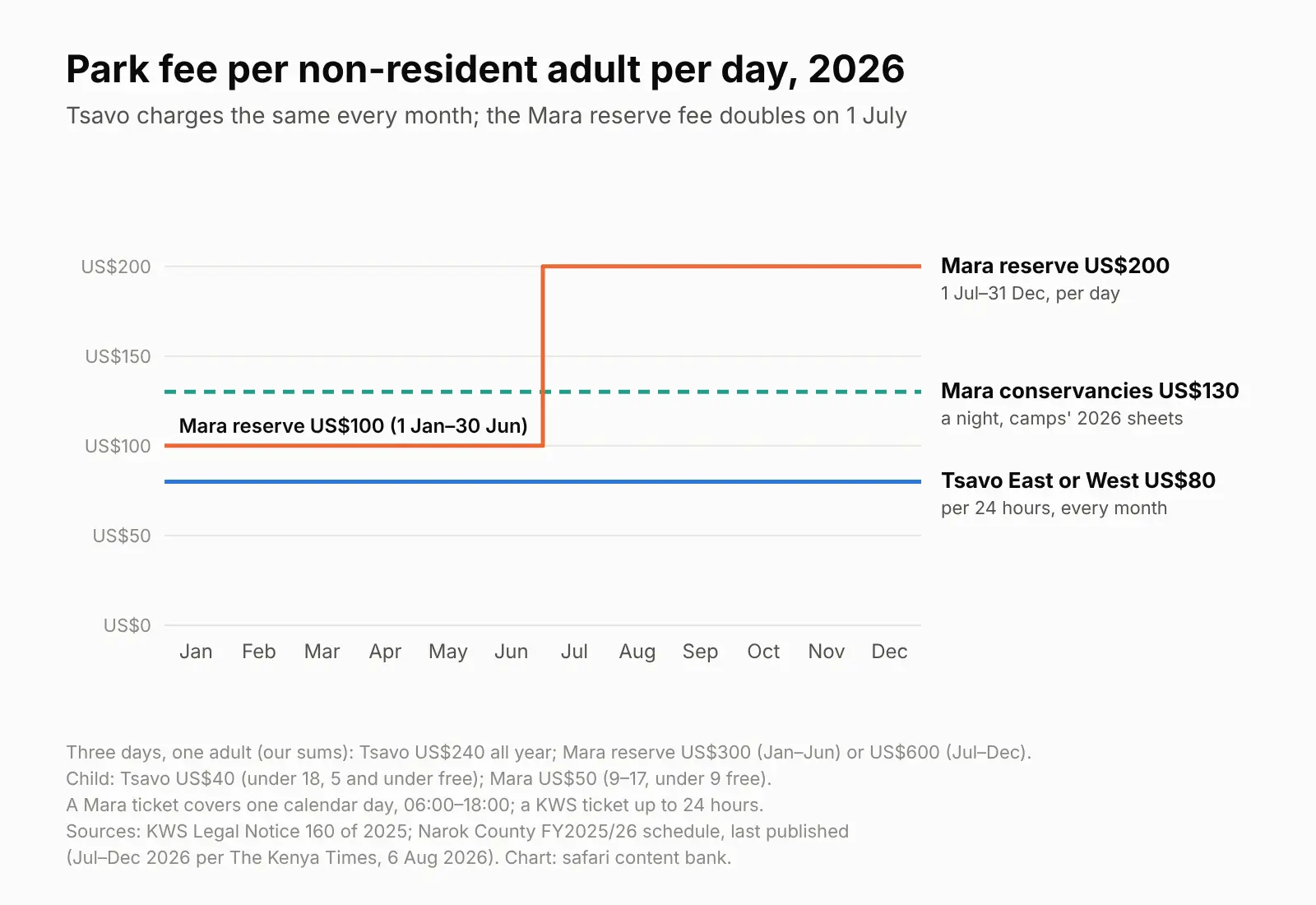 KWS Legal Notice 160 of 2025; Narok County FY2025/26 schedule, the last published (July–December 2026 per The Kenya Times, 6 Aug 2026, secondary); conservancy fee from camps’ 2026 rate sheets. Our sums. Chart: safari content bank.
- A Tsavo ticket lasts up to 24 hours, “valid for a period not exceeding twenty-four hours”: two nights inside, leaving within 48 hours of entering, is two tickets, US$160 per adult (our sum).
- A game drive on the day you leave the Mara needs that day’s ticket too. Three nights in a reserve camp with a drive on the way out is four tickets: US$400 (Jan–Jun) or US$800 (Jul–Dec) (our sums). The Mara rate is the same whether you sleep inside or outside the reserve.
- From July to December a Mara conservancy night costs less in fees than a reserve day: US$130 against US$200 per adult, and you pay the reserve fee only on days you drive in.
- Bring a card or M-Pesa, not cash. KWS fees are paid through KWSPay, which adds facilitation charges (Kenyans.co.ke, 1 Nov 2025); the Mara Triangle’s gates take no cash either, only M-Pesa or card (Mara Conservancy).
- KWS does not publish how many days a package ticket covers, so do not count on the package saving until KWS confirms it.
The official fee lines, with the date each took effect and the source:
| Fee | Amount | In force from | Source |
|---|---|---|---|
| Nairobi, Tsavo East and Tsavo West National Parks (KWS), non-resident adult, per 24 hours | USD 80 (child under 18, 5 and under free, USD 40) | Legal Notice 160 of 2025, gazetted 22 Sep 2025, which states no start date; in force 1 Oct 2025 per the KWS press release of 29 Sep 2025 | KWS Fees Regulations 2025 (LN 160/2025) |
| Maasai Mara National Reserve, non-resident adult, per day (12-hour ticket, 06:00–18:00), 1 Jan–30 Jun | USD 100 | Since 1 Jan 2024; Narok County FY2025/26 schedule, the last published | Narok County fee schedule FY2025/26 |
| Maasai Mara National Reserve, non-resident adult, per day (12-hour ticket, 06:00–18:00), 1 Jul–31 Dec | USD 200 | Since 1 Jul 2024; Narok County FY2025/26 schedule, the last published, expired 30 Jun 2026 (no 2026/27 schedule as of 9 Oct 2026); The Kenya Times (6 Aug 2026, secondary) reports US$200 still applies for Jul–Dec 2026 | Narok County fee schedule FY2025/26 |
| Maasai Mara National Reserve, non-resident child 9–17 or student, per day (under 9 free) | USD 50, all year | Narok County FY2025/26 schedule, the last published | Narok County fee schedule FY2025/26 |
| Walking safari, Tsavo East, Tsavo West, Meru and Kora (KWS), per person per day | USD 50, park fee not included; groups of up to 10 | Legal Notice 160 of 2025, gazetted 22 Sep 2025, which states no start date; in force 1 Oct 2025 per the KWS press release of 29 Sep 2025 | KWS Fees Regulations 2025 (LN 160/2025) |
| Public campsite, KWS parks other than Amboseli and Lake Nakuru (Tsavo East and West included), non-resident adult, per night | USD 20 (child USD 15) | Legal Notice 160 of 2025, gazetted 22 Sep 2025, which states no start date; in force 1 Oct 2025 per the KWS press release of 29 Sep 2025 | KWS Fees Regulations 2025 (LN 160/2025) |
| Vehicle with under 6 seats, KWS parks, per day | KSh 600 | Legal Notice 160 of 2025, gazetted 22 Sep 2025, which states no start date; in force 1 Oct 2025 per the KWS press release of 29 Sep 2025 | KWS Fees Regulations 2025 (LN 160/2025) |
Best months for Tsavo and the Masai Mara
July to October is the Mara’s season for the herds, when Tsavo is also dry; January–February is one of Tsavo’s best times and falls in the Mara’s lower-fee months, with the Loita herd but no river crossings. April is wet at both, and one operator says to avoid Tsavo in April–May.
| Month | Mara herds (usual pattern) | Mara reserve fee, adult per day | Rain, Masai Mara | Rain, Voi (Tsavo East) | Tsavo, one operator’s rating |
|---|---|---|---|---|---|
| Jan | Southern Serengeti; Loita herd moves into Ol Kinyei | US$100 | 95 mm | 35 mm | Best |
| Feb | Southern Serengeti; Loita herd calves | US$100 | 100 mm | 30 mm | Best |
| Mar | Southern Serengeti; Loita calving | US$100 | 145 mm | 80 mm | – |
| Apr | Southern Serengeti, long rains | US$100 | 210 mm | 100 mm | Avoid |
| May | Moving towards the Western Corridor | US$100 | 155 mm | 30 mm | Avoid |
| Jun | Western Corridor; usually not in the Mara yet | US$100 | 95 mm | 5 mm | – |
| Jul | In the Mara from mid or late month | US$200 | 60 mm | 5 mm | – |
| Aug | Mara full; crossings mostly south to north | US$200 | 80 mm | 10 mm | – |
| Sep | Most animals in the Mara; crossings both ways | US$200 | 95 mm | 15 mm | Best |
| Oct | The tail crosses back into Tanzania | US$200 | 100 mm | 25 mm | Best (West), very good (East) |
| Nov | Central Serengeti; short rains | US$200 | 155 mm | 105 mm | – |
| Dec | Spreading south towards Ndutu | US$200 | 115 mm | 120 mm | – |
Herds: a camp operator’s migration guide, whose timing “all depends on the rains”; Loita herd: a Kenyan camp operator’s Loita migration page (names kept in our editor notes). Rain: Climates to Travel (aggregator), Masai Mara station at 1,600 m and Voi station at 550–580 m; no station inside Tsavo West is in our sources. Mara fee: Narok County FY2025/26 (last published; July–December 2026 per The Kenya Times, 6 Aug 2026). Tsavo’s fee is US$80 in every month. Tsavo ratings: one safari operator’s park guides, as on our Tsavo page. Read 8–10 October 2026.
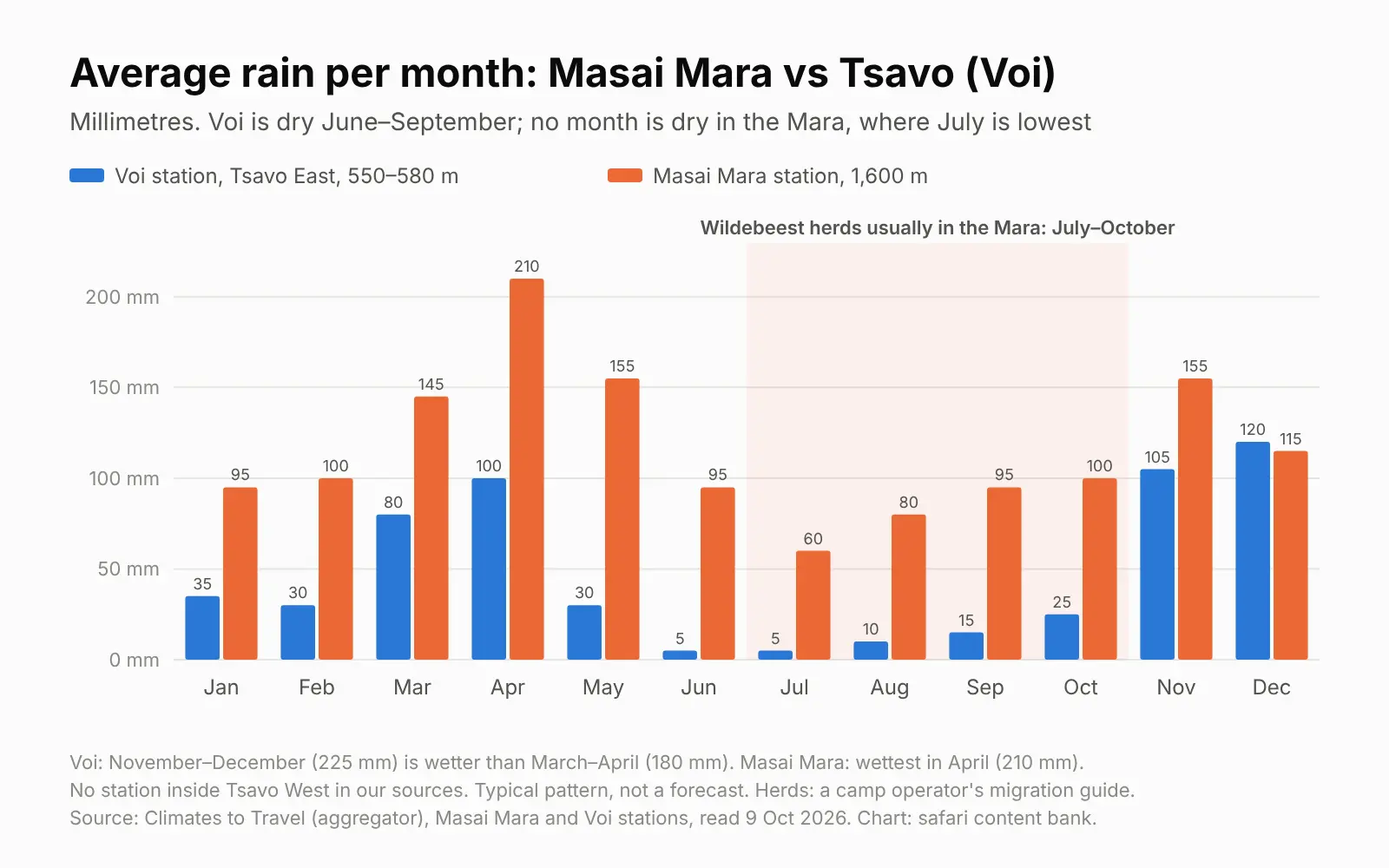 Typical pattern, not a forecast. Climates to Travel (aggregator), Masai Mara and Voi stations, read 9 October 2026; herd months from a camp operator’s migration guide. Chart: safari content bank.
- Tsavo is hotter, the Mara colder at night: Voi reaches 28–34 °C by day with lows of 18–21 °C; the Mara’s lows are 11–13 °C in every month (Climates to Travel).
- At Voi the short rains are the heavier ones: November–December brings 225 mm, March–April 180 mm (our sums), the reverse of the Mara, where April is wettest.
- Book the Mara’s river months early: travellers on the TripAdvisor Mara forum report that reserve camps near the river book up to a year ahead for mid-July to early September (TripAdvisor, traveller reports).
- Dust is what turns Tsavo’s elephants red, so the dry months are the dustiest; heavy rain can wash out the Tsavo River bridge in Tsavo West (one operator’s guide, as on our Tsavo page).
Getting there: Nairobi–Mombasa road and SGR, or a Mara airstrip
Tsavo sits on the Nairobi–Mombasa road and railway; the Mara is reached by a 5.5-hour road from Nairobi or a light aircraft to one of its airstrips. Mara flights leave from Nairobi’s Wilson Airport, not the international airport.
| Route | Distance | Time | Fare per person, one way (2026) | Source |
|---|---|---|---|---|
| Mombasa → Tsavo East | 150 km | about 3 h | – | One operator’s travel-times page |
| Watamu → Tsavo East; Diani → Tsavo East | 115 km; 210 km | about 3 h; about 4 h 15 | – | A self-drive operator’s route; travel-times page |
| Mombasa → Tsavo West | 250 km | about 5 h | – | Travel-times page |
| SGR train, Mombasa → Voi (Tsavo East) | – | about 2 h | No fare to Voi found; Nairobi–Mombasa economy KSh 1,500 | Seat61; The Kenya Times, 31 Mar 2026 (secondary) |
| Nairobi → Tsavo East or West (Mtito Andei Gate) | 233 km (East); 240 km (West) | No published time | – | KWS park pages |
| Nairobi → Masai Mara (tarmac to Sekenani Gate) | 275 km | about 5.5 h; 5.5–6 h to Sekenani or Talek, about 6.5 h to Musiara or Oloololo | – | Travel-times page; The Kenya Times, 20 Aug 2026 |
| Wilson → Masai Mara, scheduled flight | – | about 1 h, leaves 10:00 and 14:15 | US$200 + US$20 fuel surcharge | Mombasa Air Safari 2026 |
| Coast → Tsavo West (Finch Hattons strip) | – | 07:30 → 09:00 | No fare published; minimum 4 passengers | same |
| Tsavo West → Masai Mara, scheduled flight | – | arrives 10:30 | US$310 + US$20 | same |
| Coast → Masai Mara, scheduled flight | – | 07:30 → 10:30, via Amboseli or Tsavo West | US$295 + US$35 | same |
Read 9 October 2026. Mombasa Air Safari’s times are “approximate; reconfirm 24 h before”. Road times are as published, with no stops or traffic added; the travel-times page and the self-drive route are operators’ (names kept in our editor notes).
- The Mara has many airstrips; book the one your camp names. AirKenya lists nine Mara strips, among them Ol Kiombo, Keekorok, Musiara and Serena, and one flight can stop at several, so your strip may come later than the nominal hour (AirKenya). Strip by strip: Nairobi to the Masai Mara.
- Tsavo’s airstrips are Voi and Ithumba (Tsavo East) and Kilaguni and Finch Hattons (Tsavo West); Mombasa Air Safari’s coast service to Tsavo West uses the Finch Hattons strip (as on our Tsavo page).
- The 08:00 Madaraka Express from Nairobi stops at Mtito Andei (Tsavo West) and Voi (Tsavo East) (Seat61, updated 6 June 2026). The station is not the park: you still need a vehicle for the gate and game drives. On 9 October 2026 the Kenya Railways booking site showed a “halted until further notice” banner, so confirm the train runs.
- The A109 carries heavy trucks and roadworks (a self-drive operator’s route). The Mara road is tarmac from Narok to Sekenani Gate, finished by June 2021 (Tourism Update).
- Pack light for the Mara: Safarilink and AirKenya allow 15 kg per person including hand luggage, in soft bags (Safarilink; AirKenya).
What each costs per day
A Tsavo day costs from about US$100 per adult camping with the park fee, before a vehicle and food; a Mara day from about US$157 on a budget group safari in January–June, or about US$257 in July–December. All figures are copied from our cost pages, which show every sum.
| Per person, 2026 (our sums on the cost pages) | Tsavo | Masai Mara |
|---|---|---|
| Budget, per day with fees | KWS campsite + park fee US$100–115, before a vehicle and food | 3-day group safari from Nairobi about US$157–160 (Jan–Jun), about US$257–260 (Jul–Dec) |
| Lodge or camp, per day with fees | Sarova Taita Hills, outside the parks, with a park day and half a private vehicle US$246.50–276.50 | Mara Serena, Mara Triangle, about US$352–695, plus a vehicle |
| Classic lodge or camp inside | Kilaguni Serena (Tsavo West), an extra day on one operator’s package, fees included, US$490–605 | Governors’ Camp, game drives included, US$603–1,248 |
| Top end | Finch Hattons (Tsavo West) US$990–1,600, or US$1,070–1,680 if the park fee is extra | Kicheche Mara North US$755–1,125; Wilderness Mara, fees included, US$1,324–2,028 |
| Three nights by road, before tips | Sarova Taita Hills from Mombasa, one day in each park, two sharing a private vehicle: US$719.50–839.50 | Camp outside the gate from Nairobi, two sharing a private vehicle: US$885–1,005 (February), US$1,185–1,305 (August) |
Sources and sums: Tsavo safari cost and Masai Mara safari cost, read 8–10 October 2026. The vehicle is a Land Cruiser with driver-guide at US$120–180 a day before fuel (a safari price aggregator’s market range, as on our Kenya safari cost page). Lodge rates are 2026–27 published rates, per person sharing, low to peak; agent listings are secondary. The three-night examples are not like for like: the Tsavo one sleeps outside the parks, the Mara one at a budget camp outside the gate. We found no verified lodge rate inside Tsavo East.
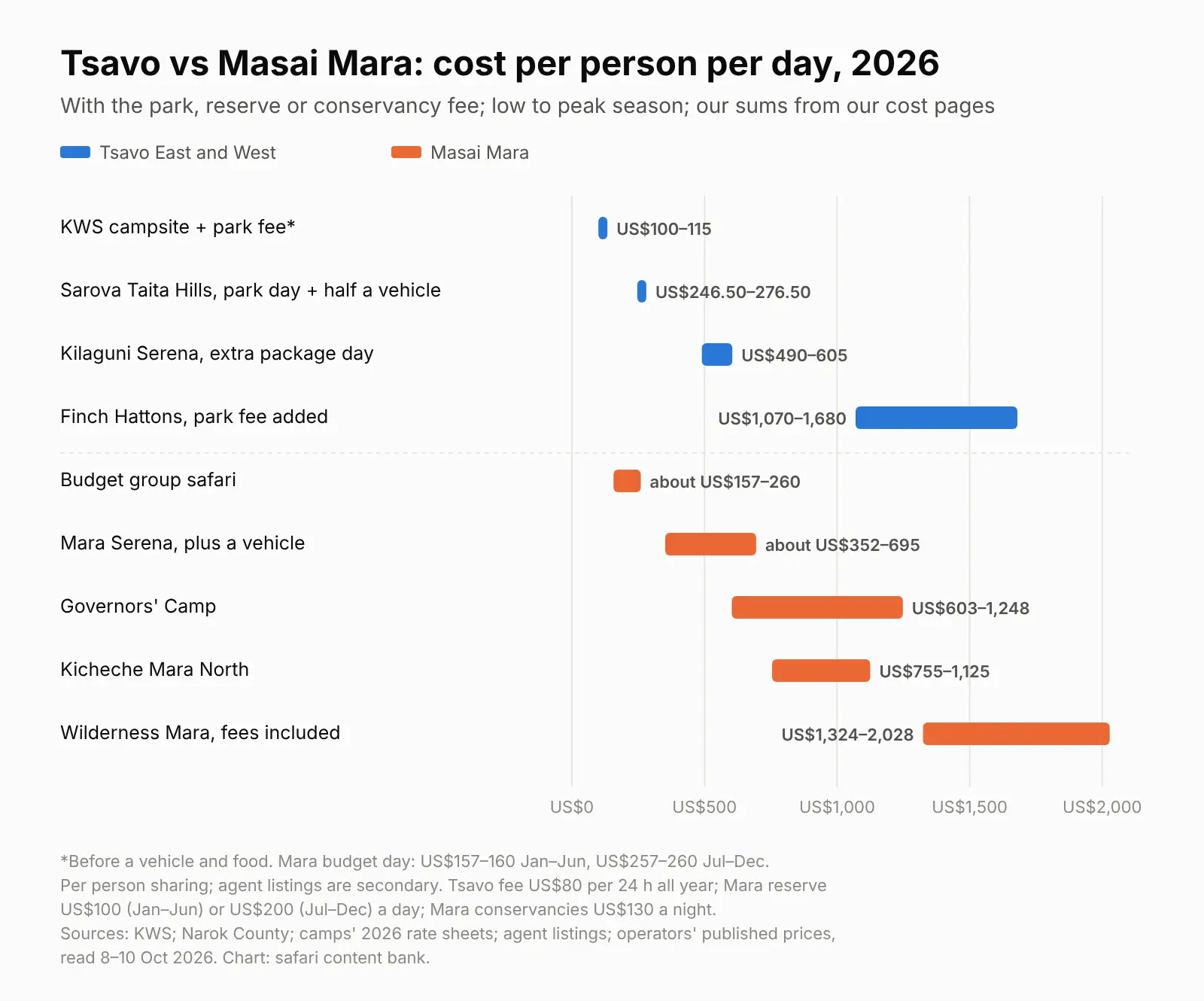 Our sums of KWS and Narok County fees, camps’ 2026 rate sheets, agent listings and operators’ published prices, per adult sharing, as on our Tsavo and Masai Mara cost pages; read 8–10 October 2026. Chart: safari content bank.
- In the Mara, the fee drives the budget price. From July to December a budget group day costs about US$57–60 in tour price and US$200 in reserve fee. In Tsavo the fee is 29–32% of a Taita Hills lodge day (as on our Tsavo safari cost page).
- Tsavo’s prices do not jump on 1 July; the Mara’s do. At Governors’ Camp, beds plus fees go from US$773 per person in June to US$1,248 in July (as on our Masai Mara safari cost page). In Tsavo only bed rates move, such as Finch Hattons’ US$1,100 or US$1,600 in 2027.
On top, per person: Kenya’s eTA US$30 and a government-scheme travel health policy, up to US$44 (eCitizen), required for arrivals since 5 October 2026 (U.S. Embassy Nairobi) (Kenya visitor insurance). Before paying a deposit, check the operator’s Kenya licence.
Combining either park with the beach
For a beach holiday with a short safari, Tsavo East by road; for the migration and the beach, fly from the Mara straight to the coast. Flights, beaches and best months for both halves are on Kenya safari and beach.
| Plan | How | Time | Price per person | Source |
|---|---|---|---|---|
| Coast → Tsavo East → coast | Road from Mombasa, Watamu or Diani, with a night in or near the park | about 3 h each way (4 h 15 from Diani) | Two adults’ park fees for a day US$160 plus a vehicle at US$120–180 before fuel (our sum) | Travel-times page; our Tsavo safari cost page |
| Coast → Tsavo East by train | SGR, Mombasa → Voi, then a vehicle | about 2 h | No fare to Voi found | Seat61 |
| Scheduled 4-day trip from Mombasa | Tsavo East, Amboseli and Taita Hills, shared vehicle of up to 6 | 4 days | £1,010, park fees included, before seasonal supplements | One operator’s published price, read 8 October 2026 |
| Mara → coast | Scheduled flight to Ukunda (Diani), Mombasa or Malindi | 11:30 → 13:45 | US$420 + US$35 | Mombasa Air Safari 2026 |
| Coast → Mara → coast | Scheduled flights, return | – | US$550 + US$70 | same |
| Both parks and the beach, by road | Masai Mara, Lake Naivasha, Amboseli, Tsavo West, Taita Hills, then a beach hotel | 8 days | from £1,795, park fees included | One operator’s published price, as on our Kenya safari and beach page |
Read 8–9 October 2026. Malindi flights need at least 4 passengers. GBP prices are shown as published, not converted. Operator names kept in our editor notes.
Park fees for both, one adult (our sums): two Tsavo East tickets (US$160) plus three days in the Mara reserve come to US$460 from January to June and US$760 from July to December; with three nights in a Mara conservancy instead (US$390), US$550 in any month.
- From the coast, give Tsavo two days with a night in or near the park. A German forum regular told a solo traveller in Diani that a day trip leaves “keine Zeit im Park” (no time in the park) (HolidayCheck, Feb 2024, traveller report); the gates close at 18:00.
- Joining Tsavo West to the Mara by air: Mombasa Air Safari flies Tsavo West → Mara for US$310 + US$20 one way, but the coast → Finch Hattons leg needs at least 4 passengers. Tsavo with Amboseli instead: Amboseli vs Tsavo; the Mara with Amboseli: Masai Mara vs Amboseli.
How many days in Tsavo or the Mara?
Two or three nights in Tsavo with a beach holiday; three or four in the Mara, where the median Mara-only trip in our dataset is 4 days. A day trip works for neither, except at a stretch for Tsavo East from Mombasa or Watamu.
| Plan | Nights | Park fees, one adult (our sums) | Source for the length |
|---|---|---|---|
| Tsavo East only, from the coast | 2 | US$160 | HolidayCheck and Routard regulars advise against a day trip |
| Tsavo East and West | 3 or more | US$240 or more | Our Tsavo page: the two parks are about 2 hours apart |
| Tsavo with a beach holiday | 2–3 days of safari | US$160–240 | A Routard regular suggests 2–3 days in Tsavo with the coast (Routard, May 2025) |
| Masai Mara only | 3–4 | US$300–400 (Jan–Jun), US$600–800 (Jul–Dec) for 3 nights: 3 or 4 day tickets, depending on a drive on the last day | Our Kenya safari and beach page: most published trips give the Mara 3–4 days |
| Mara, then Tsavo or the beach | 5 or more | US$460 (Jan–Jun) or US$760 (Jul–Dec) for 3 Mara + 2 Tsavo days | The combinations above |
Fees per non-resident adult: each Tsavo park US$80 per 24 hours; Mara reserve US$100 or US$200 per calendar day. In a Mara conservancy, swap the reserve days for US$130 a night. Forum advice is traveller opinion, not an official rule.
- One day per park “n’a pas de valeur” (has no value), a Routard reply said in September 2026 (Routard, traveller report).
- How long published Kenya trips run: how many days for a safari.
Which should you choose?
Choose the Mara for the migration herds, big cats and conservancies with night drives; choose Tsavo for space, a fee that never doubles, walking safaris and an easy road or train from the coast.
| If you… | Pick | Why |
|---|---|---|
| Travel late July to October and want the herds | Masai Mara | Herds usually in the Mara then; crossings are in the reserve |
| Want big cats | Masai Mara | 21.5 lions per 100 km² (management plan); no Tsavo density published |
| Are staying on the coast and want a short safari | Tsavo East | About 3 h from Mombasa or Watamu by road, 2 h to Voi by train |
| Want elephants and big-tusked bulls | Tsavo | 14,964 in the ecosystem (2021 census); about 12 big tuskers monitored |
| Want space and few people | Tsavo | About 22,800 km² for two parks; Mara reviews describe 20–40 vehicles at a sighting |
| Travel July–December on a fee budget | Tsavo | US$80 per 24 hours against US$200 a day in the Mara reserve |
| Travel January–June | Either | Mara US$100 a day, Tsavo US$80; the Loita herd calves in the Mara conservancies in February–March |
| Want to self-drive | Tsavo | Allowed in KWS parks; private vehicles are banned from Mara reserve game drives |
| Want a walking safari | Tsavo, or a Mara conservancy | KWS sells walks in Tsavo at US$50 a day; in the Mara only conservancy camps do |
| Want night drives or fewer vehicles at the cats | A Mara conservancy | Sold by conservancy camps; no KWS night-drive list names Tsavo |
| Want the herds and the beach | Masai Mara, by air | Daily flight to the coast, 11:30 → 13:45, US$420 + US$35 |
| Have 7 days or more | Both | Mara by air, then Tsavo and the coast; or an 8-day road trip through both |
Wider choices: Kenya vs Tanzania, Serengeti vs Masai Mara, Laikipia vs Masai Mara, Samburu vs Masai Mara and the Kenya safari hub.
Common mistakes in Tsavo vs Masai Mara comparisons
| What you’ll often read | What is correct |
|---|---|
| “The Mara fee is US$200 all year” | US$100 from 1 January to 30 June, US$200 from 1 July to 31 December, per non-resident adult per day. |
| “Tsavo costs US$52” | US$80 per non-resident adult per 24 hours since 1 October 2025, with no seasons (KWS Legal Notice 160 of 2025). |
| “One ticket covers Tsavo East and West” | Two parks, two tickets; only the KWS package tickets span parks, and their validity is not published. |
| “A Mara ticket lasts 24 hours, like Tsavo’s” | One calendar day, 06:00–18:00; it does not carry overnight. A KWS ticket lasts up to 24 hours. |
| “You can see the migration in Tsavo” | None of our Tsavo sources mentions the wildebeest herds; they are usually in the Mara from late July to October. |
| “The Mara is too far from the beach” | A daily flight leaves the Mara at 11:30 and lands on the coast at 13:45, US$420 + US$35. |
| “Tsavo East is an easy day trip from Diani” | It is about 4 h 15 each way, and the gates close at 18:00. Plan two days. |
| “Children under 12 pay the child rate” | Tsavo: under 18 (5 and under free). Mara: 9–17 (under 9 free). |
Frequently asked questions
Is Tsavo or the Masai Mara better for a first safari? The Mara, for most first-timers: it has the herds from late July to October and the big cats, at 21.5 lions per 100 km² in its management plan, and it is about 1 hour by air from Nairobi. Tsavo East is the better first safari from the coast, about 3 hours from Mombasa by road. Plan at least two nights in either.
Is Tsavo cheaper than the Masai Mara? In park fees, yes: US$80 per adult per 24 hours in each Tsavo park, against US$100 (January–June) or US$200 (July–December) per day in the Mara reserve. A KWS campsite day with the fee is about US$100 in Tsavo; a budget Mara group day with the fee is about US$157–260 (our sums).
Can you see the Great Migration in Tsavo? No: none of our Tsavo sources mentions the wildebeest herds. They are usually in the Masai Mara from mid or late July to October, with most animals there in August and September, and the smaller Loita herd calves in the Mara’s Ol Kinyei conservancy in February–March.
Can I combine Tsavo and the Masai Mara with the beach? Yes, most easily by air. Mombasa Air Safari flies Tsavo West to the Mara for US$310 plus US$20, and the Mara to the coast daily, 11:30 to 13:45, for US$420 plus US$35 (2026). By road, one operator’s 8-day trip runs through the Mara, Amboseli and Tsavo West to a beach hotel from £1,795.
Which is closer to Mombasa and the beach? Tsavo East: about 3 hours by road from Mombasa or Watamu, 4 h 15 from Diani, or about 2 hours from Mombasa to Voi by SGR train. The Mara is not a road trip from the coast; a scheduled flight from the coast reaches it at 10:30 for US$295 plus US$35.
When is the best time to visit Tsavo and the Masai Mara? July to October for the Mara’s herds, when Voi in Tsavo East is also dry (5–25 mm of rain a month), but the Mara fee is US$200 a day then. January–February is one of Tsavo’s best times and the Mara fee is US$100 then, but there are no river crossings. April is wet at both (210 mm in the Mara, 100 mm at Voi); Tsavo’s fee is US$80 in every month.
Which is more crowded, Tsavo or the Masai Mara? The Mara: its reserve had 213,000 visitors in 2025 in about 1,500 km², and reviewers describe 20 to 40 vehicles at a sighting. Our sources give no visitor number for Tsavo, but its two parks cover about 22,800 km². If Mara vehicles bother you, forum travellers advise a conservancy.
Sources
- Fees: Kenya Wildlife Service, Fees Regulations 2025, Legal Notice 160 of 2025 (PDF) and press release, 29 Sep 2025; Narok County, Maasai Mara fee schedule FY2025/26 (PDF), the last published, expired 30 June 2026; for July–December 2026, The Kenya Times, 6 Aug 2026 (press, secondary); KWSPay via Kenyans.co.ke, 1 Nov 2025
- Park bodies: KWS park pages for Tsavo East and Tsavo West; Mara Conservancy, conservation fees, history, wildebeest migration; MMWCA; Narok County, GMME Management Plan 2023–2032 (PDF), and its sighting rules via Business Daily; Kenyans.co.ke, Mara self-drive ban
- Wildlife and visitors: Tsavo Trust, 3 Apr 2026; The Standard, Feb 2025; Kenya Economic Survey 2026 via Business Daily and The Standard, 1 May 2026; a camp operator’s migration guide, a Kenyan camp operator’s Loita migration page and a safari operator’s Tsavo guides (names kept in our editor notes)
- Camps, 2026: Governors’ community fee; Kicheche; Porini; Offbeat; lodge, package and vehicle prices as on our Tsavo safari cost, Masai Mara safari cost and Kenya safari cost pages (agent and operator names kept in our editor notes)
- Travel and climate: Mombasa Air Safari 2026 schedule; AirKenya, Maasai Mara destinations; Safarilink and AirKenya baggage rules; Seat61, updated 6 Jun 2026; The Kenya Times, 31 Mar 2026 and 20 Aug 2026 (secondary); Tourism Update; one operator’s Kenya travel-times page and a self-drive operator’s route (names kept in our editor notes); Climates to Travel (aggregator), read 9 Oct 2026
- Traveller reports (opinion and experience, not official findings): a safari booking site’s Tsavo East and Masai Mara reviews; TripAdvisor on Mara cats, Mara crowds and booking a Mara camp; Routard on Tsavo East or West, Tsavo with the beach and one day per park; HolidayCheck on a Tsavo day trip
- Our own pages for the detail: Tsavo East and West, Masai Mara, Masai Mara park fees, Kenya park fees, Kenya safari and beach, Masai Mara reserve or a private conservancy, Amboseli vs Tsavo, Masai Mara vs Amboseli, Kenya visitor insurance
Fees and prices as on our Tsavo, Masai Mara and Kenya pages, checked 9–10 October 2026; page written 24 October 2026. We will update this page when Narok County publishes a 2026/27 Mara schedule, when KWS changes its fees or publishes package-ticket validity, when Kenya Railways confirms the SGR service, and when a 2025 Tsavo elephant census result is published.
Ask for a quote
Tell us your dates and we send you a priced itinerary. Free, no obligation.
- Free quote, no obligation
- Trips run by licensed local operators