 Experience

Last verified · Next check due
On this page
Short answer: Most visitors need an eTA, US$30 plus card charges, approved online before they fly, and since 5 October 2026 arrivals have also needed a government health policy, up to US$44 (eCitizen). The Masai Mara reserve charges US$100 per adult per day from January to June and US$200 from July to December; Mara conservancies charge US$130 a night. Operators suggest tipping US$10–20 per guest per day. Malaria risk runs all year in every safari area. Checked 10 October 2026.
Key facts
- Kenya has had no visa on arrival since January 2024. Every non-exempt traveller, including infants, needs an approved electronic travel authorisation (eTA) before boarding.
- A Masai Mara ticket lasts 12 hours, 06:00–18:00, and does not carry overnight. You pay for every calendar day you are in the reserve, wherever you sleep.
- The Mara Triangle is part of the Maasai Mara National Reserve, not an extra park. It charges the same fee and takes no cash.
- The Mara lost almost half its visitors in two years: 420,000 in 2023, 343,000 in 2024 and 213,000 in 2025, while Amboseli rose to 295,000 (Economic Survey 2026, via Business Daily).
- This page answers 42 of the 311 questions travellers asked on English, French, German and Italian forums in 2025–26, grouped under eight themes; the most-asked theme is the eTA.
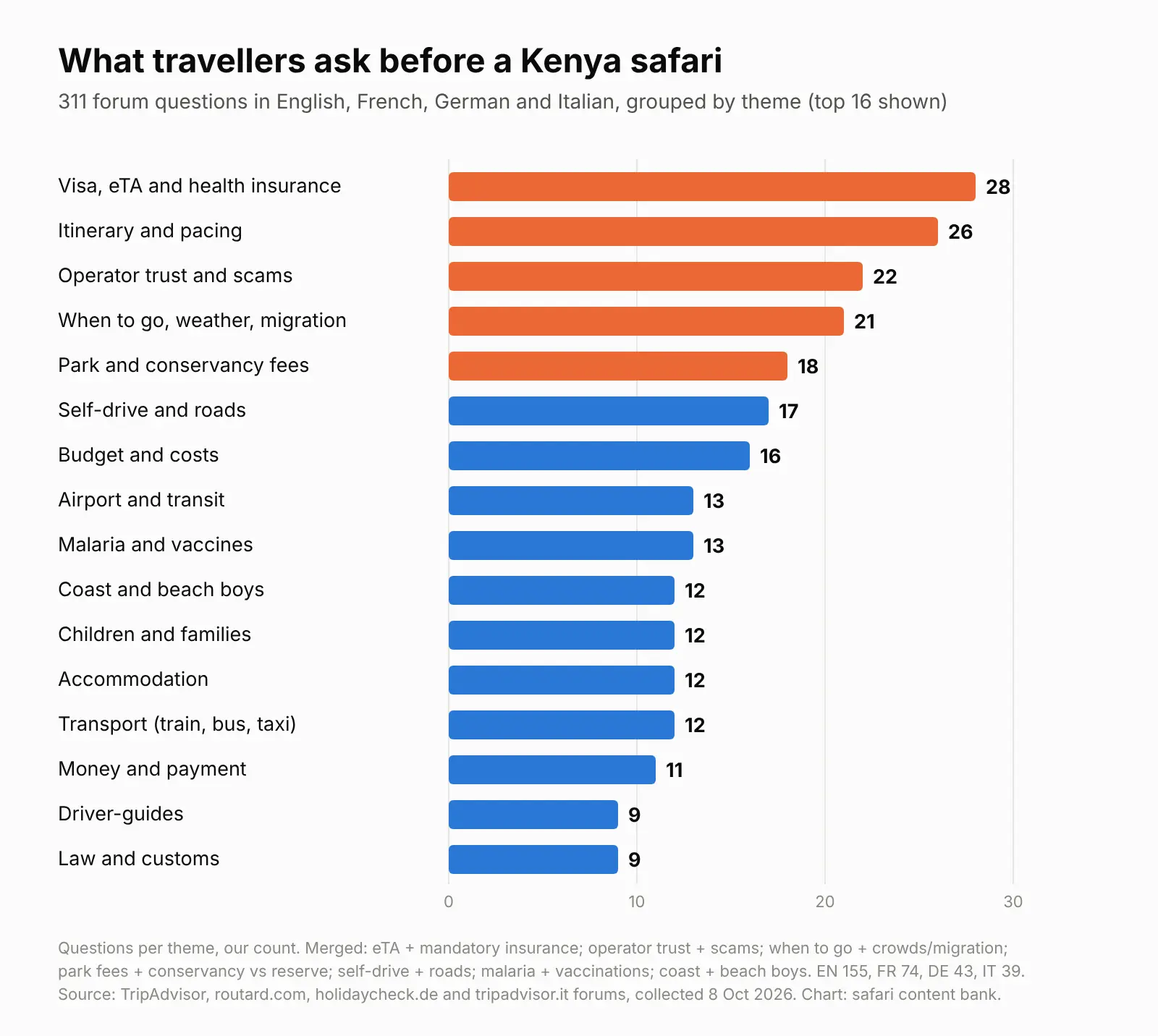 Questions collected on TripAdvisor, routard.com, holidaycheck.de and tripadvisor.it on 8 October 2026 (EN 155, FR 74, DE 43, IT 39). Our count by theme. Chart: safari content bank.
Entry: the eTA and the new health insurance
Can I still get a visa on arrival in Kenya?
No. Kenya abolished visas on 5 January 2024 and replaced them with an electronic travel authorisation (eTA), which you apply for online before you travel (Cliffe Dekker Hofmeyr, 5 Feb 2024). The UK FCDO says “you must apply online for electronic travel authorisation in advance of travel” (FCDO entry requirements, read 9 Oct 2026). Answers on older forum threads that quote US$50 or €40 at the airport counter date from before 2024. Since January 2025, African nationals except those of Somalia and Libya, and East African Community citizens, need no eTA (Citizen Digital, 22 Jan 2025).
How much does the Kenya eTA cost, and where do I apply?
US$30 plus card charges, on the official portal etakenya.go.ke. The fee comes from the Kenya Civil Aviation Authority’s schedule AIC 14/25, effective 1 January 2025, which also lists a US$100 expedited service and a US$185 five-year multiple-entry eTA for US citizens (KCAA AIC 14/25, PDF). Travellers on the TripAdvisor Kenya forum report paying a look-alike site US$129 and getting nothing, and paying a third-party agency nearly AUD 500 for the same US$30 document (TripAdvisor, “Reliable third party for visa”, 2026).
Why does the eTA portal reject my card or my photo?
Card verification and photo checks are the two failures travellers report most, and both usually clear on a second try with a different card or a better photo. In a 28-reply thread, forum members report that a Visa debit card went through where two credit cards failed, and advise retrying on another network (TripAdvisor, “Problem Paying for ETA”); another thread advises applying one person at a time rather than as a group and clearing cookies between attempts (TripAdvisor, “eTA – Let’s verify your card”). On the French Routard forum, a photo rejected again and again was accepted when taken with a proper camera against a plain background (Routard, Aug 2026). If the status shows “approved” but no PDF arrives, members say not to re-apply; email is the only delivery channel (TripAdvisor, “Eta not received by email”).
When should I apply for the eTA?
About two to four weeks before you fly: early enough for processing, late enough that it does not expire. Standard processing is three working days and you must enter Kenya within 90 days of issue (Kenya Embassy Bangkok); the FCDO says the local authorities recommend applying at least 2 weeks ahead (FCDO). A traveller who applied too early found the eTA ran out while she was in Tanzania, before her return to Kenya (TripAdvisor, “Kenya ETA Expires Before I Re-Enter Kenya”, 2026).
Do I need to buy Kenya’s new health insurance, and is my own policy accepted?
Yes, and no, your own policy is not accepted in its place. Since 5 October 2026 visitors arriving in Kenya have needed a government-scheme travel health policy (U.S. Embassy Nairobi), up to US$44 per person, valid 90 days with multiple entries (eCitizen). The rule comes from Gazette Notice No. 11492 of July 2026 under the Social Health Insurance Act 2023; the High Court suspended it on 24 August 2026 (Kenyans.co.ke, 25 Aug 2026), and the challenge was reported dismissed in early October (VisasNews, 7 Oct 2026). Buy it in the eTA application or on the eCitizen insurance portal. Keep your own travel insurance as well: forum members point out the Kenyan policy has no option for pre-existing conditions (TripAdvisor, Sept 2026).
Does my child need an eTA?
Yes. Every child, including infants, needs their own eTA, and the fee schedule shows no child discount (Cliffe Dekker Hofmeyr, 5 Feb 2024; AIC 14/25). Families may apply as a group, with the parent or guardian responsible for each child’s application (Kenya Embassy Bangkok). The US State Department advises carrying each child’s birth certificate, and a notarised consent letter if one parent travels alone (US State Department, Kenya, 30 Jul 2026).
Can I go to Tanzania and come back to Kenya on the same eTA?
Yes. A single-entry eTA “remains valid for more than one entry” after a temporary trip to another East African Community state such as Tanzania or Uganda (Kenya Embassy Bangkok). Tanzania needs its own visa, and the US$100 East African Tourist Visa covers Kenya, Uganda and Rwanda, not Tanzania (Uganda Immigration; Rwanda Embassy The Hague). Going south, carry a yellow fever certificate: Tanzania requires one from travellers arriving from Kenya, including transits of more than 12 hours (WHO country list, 2022 rev. Jan 2023, PDF). Routes, fees and the migration months for both countries are compared on our Kenya vs Tanzania page.
Masai Mara and park fees
How much is the Masai Mara entry fee in 2026?
US$100 per non-resident adult per day from 1 January to 30 June, and US$200 from 1 July to 31 December, under Narok County’s last published schedule (FY2025/26). Children aged 9–17 and students pay US$50 all year, and children 8 and under are free (Narok County fee schedule FY2025/26, PDF). The US$100 / US$200 split started on 1 January / 1 July 2024 (a Mara camp operator’s park-fee notice). If you booked months ahead, you pay the fee in force on the day you enter, as French forum regulars remind each other (Routard, Nov 2023).
The official fee lines for the Mara and the other main parks, with the date each took effect and the source:
| Fee | Amount | In force from | Source |
|---|---|---|---|
| Maasai Mara National Reserve, non-resident adult, per day (12-hour ticket, 06:00–18:00), 1 Jan–30 Jun | USD 100 | Since 1 Jan 2024; Narok County FY2025/26 schedule, the last published | Narok County fee schedule FY2025/26 |
| Maasai Mara National Reserve, non-resident adult, per day (12-hour ticket, 06:00–18:00), 1 Jul–31 Dec | USD 200 | Since 1 Jul 2024; Narok County FY2025/26 schedule, the last published (no 2026/27 schedule as of 9 Oct 2026) | Narok County fee schedule FY2025/26 |
| Maasai Mara National Reserve, non-resident child 9–17 or student, per day (under 9 free) | USD 50, all year | Narok County FY2025/26 schedule, the last published | Narok County fee schedule FY2025/26 |
| Amboseli and Lake Nakuru National Parks (KWS), non-resident adult, per 24 hours | USD 90 (child under 18, 5 and under free, USD 45) | 1 Oct 2025 (Legal Notice 160 of 2025) | KWS Fees Regulations 2025 (LN 160/2025) |
| Nairobi, Tsavo East and Tsavo West National Parks (KWS), non-resident adult, per 24 hours | USD 80 (child under 18, 5 and under free, USD 40) | 1 Oct 2025 (Legal Notice 160 of 2025) | KWS Fees Regulations 2025 (LN 160/2025) |
| Meru, Kora and Aberdare National Parks (KWS), non-resident adult, per 24 hours | USD 70 (child under 18, 5 and under free, USD 40) | 1 Oct 2025 (Legal Notice 160 of 2025) | KWS Fees Regulations 2025 (LN 160/2025) |
| Samburu National Reserve (Samburu County), non-resident adult, per day | USD 85 (child USD 50) | Samburu County Finance Act 2025, published 22 Dec 2025 | Samburu County Finance Act 2025 |
| Ol Pejeta Conservancy, non-resident adult, per day (24 hours for overnight guests) | USD 110, VAT included (child 3–11 USD 55) | 2026 tariff | Ol Pejeta Conservancy Tariff Guide 2026 |
Why did I pay a full day’s Mara fee for an afternoon drive?
Because the ticket is valid for 12 hours, 06:00–18:00, and “will not carry overnight” (Mara Conservancy fee page, read 9 Oct 2026). A noon arrival buys the same calendar-day ticket as a dawn start, so a two-night stay can need three tickets if you are still in the reserve on the morning you leave. Operators give different morning cut-off times, so ask yours. Sleeping outside the reserve does not save the fee: the Mara Conservancy’s table is headed “Non-Residents (Accommodated Inside & Outside the Park) – Per Day” (same page).
Is the Mara Triangle an extra fee on top of the Masai Mara?
No. The Mara Triangle is the western third of the Maasai Mara National Reserve, about 510 km², run for Narok County by the not-for-profit Mara Conservancy (Mara Conservancy, history). It charges the same per-person fees as the rest of the reserve, takes no cash, and accepts M-Pesa or card at Oloololo Gate, Purungat Bridge and Serena airstrip (Mara Conservancy fee page). Whether a ticket bought on one side lets you drive the other side for the day has been answered three ways on the forums, so confirm it with the gate before you plan a crossing.
What is the difference between the reserve fee, a conservancy fee and a community fee?
They are three separate charges, and camps quote the one that applies to them. The reserve fee is the Narok County ticket above. Mara conservancies such as Mara North, Olare Motorogi, Naboisho and Ol Kinyei charge US$130 per adult per night in 2026 (Kicheche 2026 rack rates, PDF; Porini 2026, PDF), payable even on free nights (Kicheche). Governors’ Camp, inside the reserve, adds a US$50 per guest per night community fee to its rate (Governors’ 2026 rate sheet, PDF). The full fee stack is set out on our Kenya safari cost page.
Can I pay park fees in cash at the gate?
No, not in Kenya Wildlife Service (KWS) parks, at Ol Pejeta or in the Mara Triangle. Since 1 November 2025 KWS fees are paid through KWSPay by M-Pesa, card or bank transfer, with dollar fees converted at a monthly rate “in addition to facilitation charges” (Kenyans.co.ke, 1 Nov 2025), so the amount charged can be above the gazetted fee. Ol Pejeta says its gates are “CASHLESS” (Ol Pejeta Tariff Guide 2026, PDF). Travellers buying Nairobi National Park tickets report the payment platform failing for whole days, so buy the ticket the day before or let your operator do it (TripAdvisor, “Nairobi National Park ticket payment”).
Do KWS park fees still have a high and a low season?
No. Since 1 October 2025 KWS charges one fee all year, valid for up to 24 hours: US$90 per adult for Amboseli and Lake Nakuru, US$80 for Nairobi, Tsavo East and Tsavo West, and US$70 for Meru and Aberdare (KWS Fees Regulations 2025, Legal Notice 160 of 2025, PDF). Children under 18 pay US$40–45; children 5 and under are free. Only the Masai Mara, which is run by Narok County rather than KWS, still has seasons.
Reserve, conservancies and crowds
Should I stay inside the Mara reserve or in a conservancy?
Stay in a conservancy for fewer vehicles, night drives and walks; stay in the reserve to be close to the Mara River crossings. Most Mara conservancy camps include day and night drives and bush walks in their rate, while night drives are not sold inside the reserve (Kenya safari cost page; Kicheche 2026). A Nairobi-based operator on the TripAdvisor forum puts it as little difference in landscape but fewer vehicles, off-road driving, night drives and walking in the conservancies (TripAdvisor, “Reserve vs. private conservancy”, Aug 2026). From a conservancy camp you pay the reserve fee as well only on days you drive into the reserve, which is US$200 per adult from July to December.
How crowded is the Masai Mara?
In peak season on the main (Narok) side, expect to share big-cat sightings with many vehicles. Reviewers on a safari booking site describe “25 safari jeeps around one single leopard” (February 2026) and being “surrounded by 20–30 vehicles” (August 2025). Forum members name the Mara Triangle, a conservancy, or January–February as the quieter options (TripAdvisor, “Masai Mara crowds”). In the Triangle, when more than five vehicles wait at an animal, the rest must hold back (Mara Conservancy, park rules).
How far ahead do I need to book a Mara camp for the migration?
Up to a year ahead for the camps inside the reserve near the river in mid-July to early September, according to experienced members of the TripAdvisor Maasai Mara forum (TripAdvisor, “Booking a camp?!?”). The same thread found camps outside the reserve and in the conservancies still had space three months out. Members also say booking through an operator should not cost more than booking direct.
Is Nairobi National Park worth a visit if I’m doing a longer safari?
Yes, for rhino, and because it fills an arrival or departure day. Forum regulars point out that black and white rhino are hard to see in the Mara and absent from Amboseli, and that a visit to the Sheldrick elephant orphanage inside the park needs a park ticket too (TripAdvisor, Aug 2026). The park costs US$80 per adult per 24 hours (KWS, LN 160/2025). The Sheldrick nursery charges US$20 per adult in cash and is booked by email at least two business days ahead (Sheldrick Wildlife Trust).
Where am I most likely to see rhino in Kenya?
At Ol Pejeta, Lake Nakuru and Nairobi National Park, not in the Mara or Amboseli. Ol Pejeta Conservancy says it holds eastern black rhino, southern white rhino and the last northern white rhinos (Ol Pejeta, rhinos, undated). KWS describes Lake Nakuru as home to “one of the country’s largest populations of black rhinos, and white rhinos” (KWS, Lake Nakuru). A reviewer at a Mara camp wrote that they “never saw a Leopard or a Rhino which was disappointing as this was one of the promises made” (a safari booking site’s traveller reviews, April 2024). Which to add to the Mara: Lake Nakuru vs Amboseli.
When to go and the migration
When is the Great Migration in the Masai Mara?
The wildebeest herds are usually in the Mara from about July to October, with river crossings that nobody can schedule. The Mara Conservancy says the migration “usually starts somewhere in June-July and goes on until November” and that crossings “are difficult to predict” (Mara Conservancy, wildebeest migration); one Mara camp operator says “we cannot guarantee the timing” (a Mara camp operator’s migration page). For the rest of the year the herds are in Tanzania. Where they are in each month is on our Great Migration month-by-month guide.
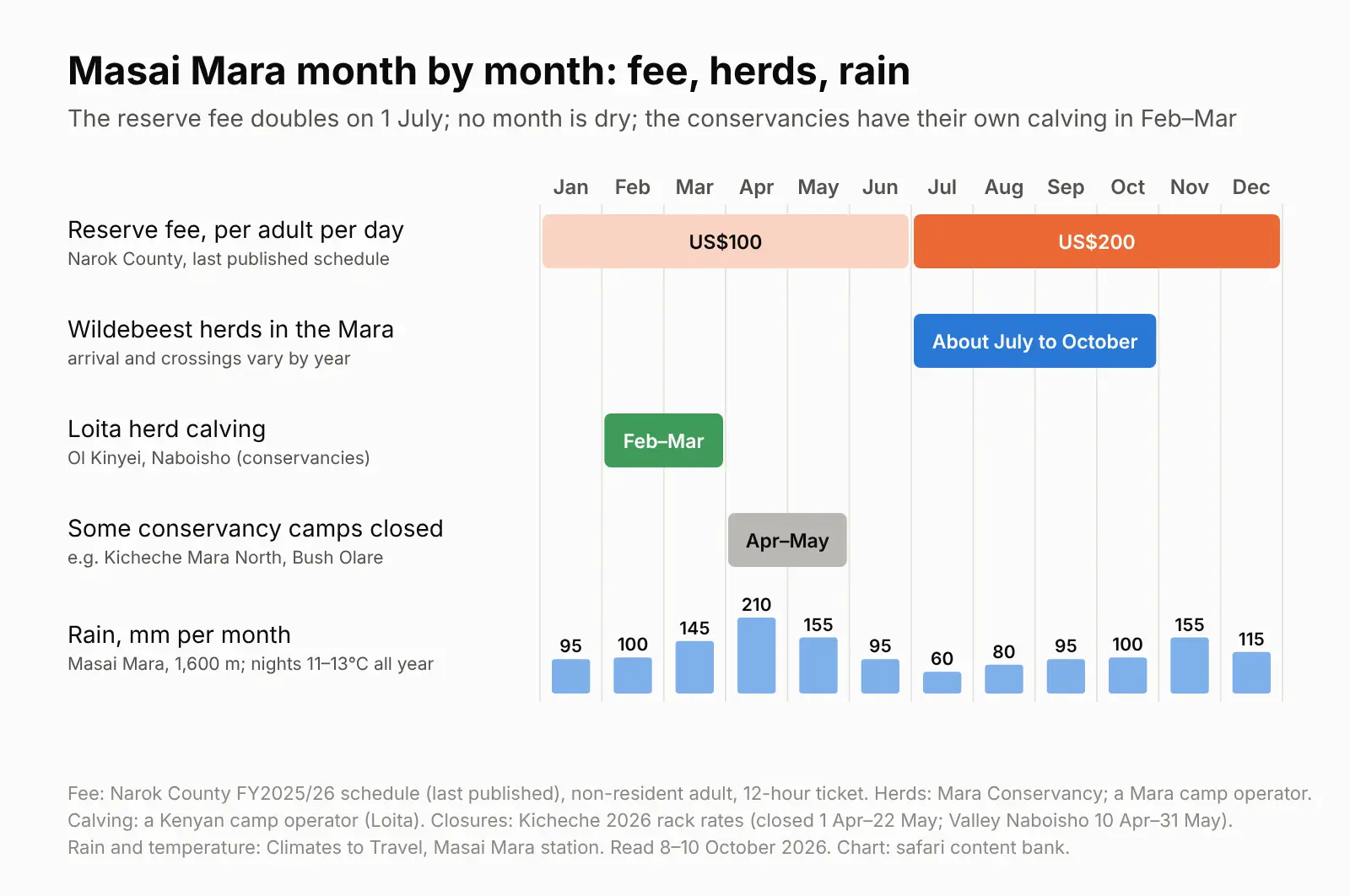 Sources: Narok County FY2025/26 schedule (fee); Mara Conservancy and a Mara camp operator (herds); a Kenyan camp operator (Loita calving); Kicheche 2026 rack rates (closures); Climates to Travel, Masai Mara station (rain). Read 8–10 October 2026. Chart: safari content bank.
Is the Mara worth visiting outside the migration?
Yes. The Mara’s lions, leopards and cheetahs are resident, and January to June costs half the reserve fee. French forum regulars call late November to early December “une bonne période pour éviter l’abondance de touristes” (Routard, 2026), and a destination expert on the English forum suggests January–February for the same park at US$100 and far fewer vehicles (TripAdvisor, “Increased Game Park admission fees”). The conservancies also have their own smaller migration: the resident Loita wildebeest move into Ol Kinyei by January and calve in February and March (a Kenyan camp operator’s Loita migration page).
When is the rainy season in Kenya?
The long rains peak in April and the short rains come in November, but no month in the Mara is dry. At the Masai Mara station, April averages 210 mm and November 155 mm, and the driest month, July, still gets 60 mm (Climates to Travel). Many conservancy camps close in the long rains: Kicheche Mara North and Kicheche Bush close from 1 April to 22 May (Kicheche 2026). Camp rates are lowest in April–May: Governors’ Camp charges US$453 per person per night then, against US$998 in July–October (Governors’ 2026).
How cold does it get on safari in Kenya?
Colder than most people pack for: night lows in the Mara are 11–13°C in every month (Climates to Travel). For July, a forum regular warns that “temperatures can get down to single figures (centigrade), particularly night/early mornings – there’s no heating” (TripAdvisor, “Clothing and packing for safaris”, 2026). Bring a fleece and a windproof layer for the 06:00 drive; khaki is not required, but neutral colours and closed shoes are the usual advice.
Will I see Kilimanjaro from Amboseli?
Often not: the mountain is regularly in cloud, so plan on early mornings and luck. Two reviewers on a safari booking site in 2025–26 wrote that Kilimanjaro “was in clouds, so missed the main goal of our visit”. Amboseli’s other draw does not depend on weather: the Amboseli Trust for Elephants counted 2,065 elephants at the end of 2025 (Born Free, 23 May 2026). Amboseli against the Mara: Masai Mara vs Amboseli.
Planning the route: driving, flights and the train
How many nights should I spend in each park?
Two to three nights per park, and fewer parks rather than more. The French forum’s most experienced members repeat “il faut en FAIRE PEU (de réserves) mais le FAIRE BIEN !!” and recommend three or four days per reserve; one 12-stop circuit was judged to have “autant de temps de route, que de temps en vrai safari” (Routard, “Conseils sur circuit au Kenya en juin”). German package travellers describe roughly six hours of driving a day on an 8-day round trip (HolidayCheck forum). Cutting a park usually gives more game viewing than adding one.
How long are the drives between Kenya’s parks?
Half a day or more per leg: Nairobi to the Mara’s Sekenani Gate is 5.5–6 hours on tarmac (The Kenya Times, 20 Aug 2026), and Nairobi to Ol Pejeta about 220 km or 4–4.5 hours (Ol Pejeta FAQs). Travellers give Nairobi to Samburu as 6–7 hours (Routard), Amboseli to Naivasha about 6 hours, and Amboseli to Ol Pejeta about 8 (TripAdvisor, “10 day / 9 night safari”). The Mara is in the west, Amboseli and Tsavo in the south-east and Samburu in the north, which is why circuits that include all of them spend so long on the road.
Can I self-drive a safari in Kenya?
Yes, legally, but few visitors do, and forum regulars advise first-timers against it. Self-drivers book KWS park entry and campsites on KWSPay before arrival (a self-drive operator’s guide), and Ol Pejeta’s roads are marked, with a 4x4 “strongly recommended during the rainy season” (Ol Pejeta FAQs). Experienced members cite Nairobi traffic, long hours and police checks, and the rule they all repeat is never to drive at night (TripAdvisor, “Driving in Kenya”; Routard, Aug 2026). A French traveller who rented a car was billed US$400 for a damaged grille despite verbal assurances (Routard).
Is hiring a driver the same as having a guide?
No, and travellers who booked a cheap driver say so in their reviews. “Es ist eine Illusion, einen Fahrer zu finden, der euch einfach so durch die Parks karrt und alles kennt”, a German forum regular writes (HolidayCheck, “Kenia – Fahrer buchen?”); reviewers on a safari booking site describe a “guide [who] was a driver more than a guide”. A 2025 quote posted on the TripAdvisor forum for a Land Cruiser with driver-guide was US$220 a day including fuel and the driver’s park fees, with guests’ park fees extra (TripAdvisor). Conservancy camps with resident guides are the forum’s alternative.
How much does a flight to the Masai Mara cost, and what can I bring?
US$200 plus a US$20 fuel surcharge one way from Nairobi Wilson to the Mara on Mombasa Air Safari’s 2026 schedule (Mombasa Air Safari). AirKenya allows 15 kg per person in soft bags, hand luggage included, and charges US$5 per kg over (AirKenya 2025 presentation, PDF). An older traveller on the forum paid extra on every internal flight for a hard suitcase, and members advise a soft duffel (TripAdvisor, “Luggage”, Sept 2026). Hard cases are not banned in Kenya; they are a problem on light aircraft and in safari vehicles.
Will I pay for an empty seat if I fly to the Mara alone?
Possibly: scheduled bush flights need a minimum of two passengers, so a solo booker may be charged for the second seat or moved to a later flight. An operator on the TripAdvisor thread says it is rarely enforced, because someone else usually books and the extra charge is refunded (TripAdvisor, “Flight with less than 2 pax”, Aug 2026). Ask the airline or your operator before you pay.
How do I get from Nairobi to the coast?
By the Madaraka Express train to Mombasa: KSh 1,500 in economy or KSh 4,500 in first class, one way, with no cash taken at the terminus (The Kenya Times, 31 Mar 2026; Seat61). Travellers report that the Kenya Railways booking site asks for a Kenyan phone number and opens sales 30 days ahead, and that Diani shuttle companies or hotels will book for you (Routard, Jan 2026). To reach the Mara from the coast you fly.
Costs, tips and money
How much does a Kenya safari cost?
From about US$57–60 per person per day on a budget Mara group safari, before park fees, to US$584–995 per person per night at a Mara conservancy camp with game drives included (operators’ 2026 prices, read 9 October 2026). One operator sells a 3-day, 2-night Mara group safari for US$170–180 with “park fees NOT included”, and Kicheche Mara North charges US$625–995 per night (Kicheche 2026). The full price ladder, fees and extras are on our Kenya safari cost page.
Can Kenya be done on a shoestring?
Not in the Mara: the fees alone are the floor. Two adults in the reserve in August pay US$400 a day in reserve fees (our sum: 2 × US$200) before a vehicle, guide or bed. “AU MOINS la moitié de la somme demandée est constituée des DROITS d’entrée dans les réserves”, a French forum regular wrote (Routard), and a shoestring Mara plan built on a bus to Narok was taken apart line by line on the English forum (TripAdvisor, “DIY Shoestring budget”). The cheaper choices are the Mara between January and June (US$100), the KWS parks at US$70–90 a day, and a shared vehicle.
How much should I tip on a Kenya safari?
Operators suggest US$10–20 per guest per day for the guide and US$5–15 for the camp staff box (a camp operator’s tipping guide, June 2026). One tour operator suggests US$20 (KSh 2,000) per room or tent per day at a safari camp, half to the guide and half to the staff box. Tip per day at the end of the stay, not per game drive, as forum regulars correct new posters (TripAdvisor, “Tipping”). A camp operator asks for US dollar notes from “Series 2009 or newer”.
Do I need dollars, shillings or M-Pesa?
Shillings or M-Pesa for day-to-day spending, small dollar notes for tips, and a card or M-Pesa for park gates. A foreigner can register a Safaricom SIM with a passport (SIM-Card Registration Regulations, LN 163/2015), and Safaricom sells Jambo tourist bundles at KES 2,000 for 12 GB plus calls, or 22 GB data only (Safaricom FAQ). Travellers report the Safaricom shop in the arrivals hall at Nairobi’s airport sets up M-Pesa with your passport, and that M-Pesa does not work across the border in Tanzania (TripAdvisor, “M-Pesa … KE and TZ”, June 2026). Mobile coverage in remote parks is limited whatever the provider, German forum members add (HolidayCheck, “eSIM Kauf”).
How do I check that a Kenyan safari operator is genuine?
Check the company’s licence with the Tourism Regulatory Authority (TRA) and look for it in the Kenya Association of Tour Operators (KATO) member list, the two checks the TripAdvisor Kenya forum recommends (TripAdvisor, “Trusted Tour Operators”, Aug 2026). Five French travellers in 2023 described one guide’s unbooked hotels and undelivered trips, with losses of €400 to €2,100 (Routard). A deposit of 30–50% is normal, French regulars say (Routard, 2026). Our guide to checking a safari operator’s licence shows how to search the register.
Is a balloon flight over the Mara worth it?
Travellers who went call it a different view worth having if you have several ground drives anyway; it costs US$495 per person and replaces an early game drive. Governors’ Balloon Safaris charges US$495 for ages 8 and over, with a champagne breakfast (Reserveport booking page, undated), and you also need a reserve ticket for that day. Forum members weighed it in a thread that began with a travel consultant calling it a waste of money (TripAdvisor, “Hot Air Balloon Masai Mara – Worth it?”).
Health and safety
Do I need a yellow fever vaccination for Kenya?
Only as an entry rule if you arrive from a country with yellow fever risk; a certificate is required from travellers aged 1 and over coming from such a country (WHO country list, PDF; FCDO). Arriving from Europe or North America, you do not need one to enter. WHO still recommends the vaccine for most of Kenya, including the safari areas, from 9 months of age; it is “generally not recommended” for Nairobi, Mombasa and the coastal counties of Kilifi, Kwale and Lamu (same WHO list). If you go on to Tanzania, it requires the certificate from arrivals from Kenya, so ask a travel clinic.
Do I need malaria tablets, also on the coast?
Yes. WHO says malaria risk “exists throughout the year in the entire country”, and CDC recommends tablets everywhere below 2,500 m, including game parks and the coast, with only central Nairobi at low risk (WHO country list; CDC, Kenya). CDC lists atovaquone-proguanil, doxycycline, mefloquine and tafenoquine. There is no malaria vaccine for travellers, and homeopathic or Artemisia “prophylaxis”, asked about on the Italian and French forums, is not on the list. Which tablet to take is a decision for a travel clinic.
Is a Kenya safari safe?
The measurable risks are malaria, roads and paperwork, not animals or crime inside the parks. Travellers’ safety advice is about Nairobi and the coast after dark: no walking at night, valuables out of sight, Uber or a known taxi (TripAdvisor, “Safe?” (Nairobi)). As of 11 November 2026 Kenya had 9 confirmed Ebola cases in one cluster, none since 20 October, with one patient still in treatment on 10 November, so the outbreak cannot be declared over before the second half of December 2026, and Kenya restricts no travellers itself (ECDC, 28 Oct 2026; Kenyans.co.ke, 6 Nov 2026; Healthcare MEA, 10 Nov 2026). As of 31 October, arrivals at JKIA from ten countries got enhanced screening (Daily Nation, 23 Oct 2026; Kenyans.co.ke); the US has rated Kenya Level 3 since 19 October. The evidence, risk by risk, is on our page Is a Kenya safari safe?
What am I not allowed to bring into Kenya?
Drones without prior approval from the Kenya Civil Aviation Authority, and single-use plastic carrier bags. The FCDO says importing or exporting a drone without KCAA approval is illegal (FCDO). German forum members point out that Kenya’s ban on single-use plastic bags, in force since 28 August 2017, also applies to visitors’ luggage (HolidayCheck); French regulars add that plastic bottles are not banned (Routard).
Children and the coast
How old should children be for a Kenya safari?
There is no national minimum age; camps set their own, and the forums disagree by language. Kicheche’s Mara North camp charges child fees from age 3, its Bush and Valley camps take children from 7 (Kicheche 2026), and Porini says its camps are “not suitable for children under 8 years” (Porini). French regulars advise against safaris below about ten: “Les enfants de cet âge ne comprennent pas ce qu’ils ont devant les yeux” (Routard, 2024), while English-forum families plan Mara trips with children from 5 (TripAdvisor, Aug 2026). Children 8 and under enter the Mara free; KWS charges from age 5.
Where on the Kenyan coast are beach boys less of a problem?
Nowhere is free of them, but travellers name Galu, Tiwi, Msambweni, Shimoni, Watamu, Kilifi and Shela on Lamu as calmer than Mombasa’s north coast, central Diani and Malindi (TripAdvisor, “Beach Boys”; TripAdvisor, “Best beaches”). “Beach boys can’t be totally avoided in any of those places”, one reply says, and some resorts post guards at the loungers. Residents’ technique: greet first, say “not now”, smile, and keep walking.
Common mistakes in Kenya safari answers
| What you’ll often read | What is correct |
|---|---|
| “Kenya visa on arrival, US$50” | No visa since January 2024. The eTA costs US$30 plus card charges and must be approved before you fly. |
| “Your normal travel insurance covers Kenya’s new rule” | Since 5 October 2026 arrivals need a government-scheme policy, up to US$44 (eCitizen); your own policy is not accepted in its place. |
| “Apply for the eTA as early as possible” | You must enter within 90 days of issue; an early eTA can expire before a return from Tanzania. |
| “The Masai Mara costs US$200 a day all year” | US$100 from January to June, US$200 from July to December, per non-resident adult. |
| “A Mara ticket lasts 24 hours” | 12 hours, 06:00–18:00, and it does not carry overnight. |
| “The Mara Triangle is an extra fee” | The Triangle is part of the reserve, with the same fee. |
| “The conservancy fee is the park fee” | Three charges: reserve ticket, conservancy fee (US$130 a night) and, at some camps, a community fee (US$50 at Governors’). |
| “The Mara is only worth it in the migration” | The cats are resident; January–June costs half, and the Loita herd calves in the conservancies in February–March. |
| “Nairobi and the coast are malaria-free” | Risk is all year in the entire country; only central Nairobi is low risk. |
| “You tip per game drive” | Per guest per day, at the end: US$10–20 for the guide. |
| “Pay the park fee in cash at the gate” | KWS parks, Ol Pejeta and the Mara Triangle are cashless. |
| “The East African Tourist Visa covers Kenya and Tanzania” | It covers Kenya, Uganda and Rwanda, not Tanzania. |
Sources
- Entry: KCAA AIC 14/25 (PDF), eTA fee schedule effective 1 Jan 2025; Kenya eTA portal; Kenya Embassy Bangkok, eTA; UK FCDO, Kenya entry requirements, read 9 Oct 2026; US State Department, Kenya; Cliffe Dekker Hofmeyr, 5 Feb 2024; Citizen Digital, 22 Jan 2025
- Insurance rule: U.S. Embassy Nairobi; eCitizen insurance portal; Kenyans.co.ke, 25 Aug 2026; VisasNews, 6 Oct 2026 and 7 Oct 2026
- Park fees and rules: Narok County fee schedule FY2025/26 (PDF); Mara Conservancy fees, history, park rules, wildebeest migration; KWS Fees Regulations 2025, LN 160/2025 (PDF); Kenyans.co.ke, 1 Nov 2025 (KWSPay); Samburu County Finance Act 2025; Ol Pejeta Tariff Guide 2026 (PDF); a Mara camp operator’s park-fee notice
- Camps and prices: Kicheche 2026, Porini 2026, Governors’ 2026, one operator’s published package price (name and link kept in our editor notes); Mombasa Air Safari 2026 schedule; AirKenya 2025 presentation (PDF); Reserveport (balloon); Sheldrick Wildlife Trust; The Kenya Times, 31 Mar 2026 and Seat61 (train)
- Wildlife and seasons: a Kenyan camp operator’s Loita migration page; a Mara camp operator’s migration page; Climates to Travel, Kenya; Ol Pejeta, rhinos and FAQs; KWS, Lake Nakuru; Born Free, 23 May 2026; Business Daily, Mara visitor numbers (Economic Survey 2026)
- Health: WHO country list, 2022 rev. Jan 2023 (PDF); CDC, Kenya
- Money and phones: a camp operator’s tipping guide; one tour operator’s tipping guide; Safaricom, Jambo tourist bundles; LN 163/2015; The Kenya Times, 20 Aug 2026 (Nairobi–Mara road); a self-drive operator’s guide
- Traveller reports (opinion and experience, not official findings): TripAdvisor Kenya, Maasai Mara, Nairobi and Coast forums; routard.com Forum Kenya; holidaycheck.de Forum Kenia; a safari booking site’s user reviews; threads linked in each answer, collected 8 October 2026
Answers checked against the content bank on 10 October 2026. We will update this page when Kenya confirms the health-insurance price and rules officially, when Narok County publishes a 2026/27 Mara fee schedule, when KWS changes its fees, and when camps move to 2027 rates on 1 January 2027.
More photos from Kenya
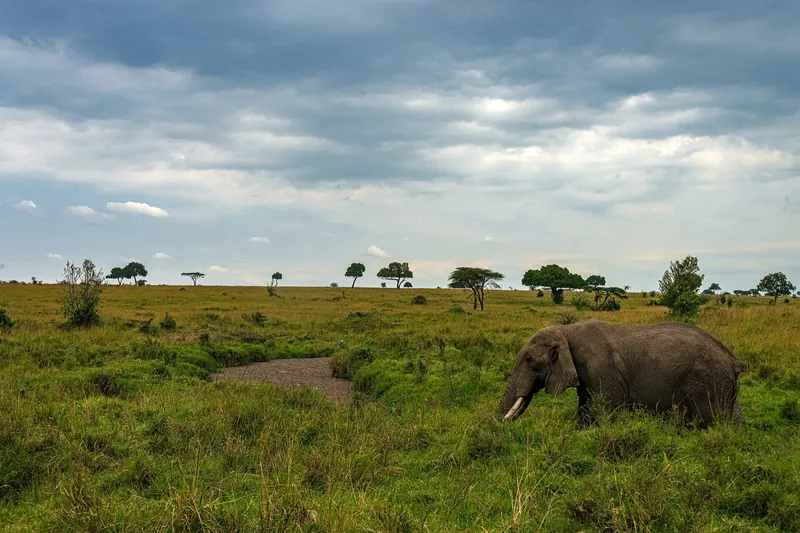
Elephant grazing on the Masai Mara grassland. Daniel Case, Wikimedia Commons, CC BY-SA 4.0, cropped 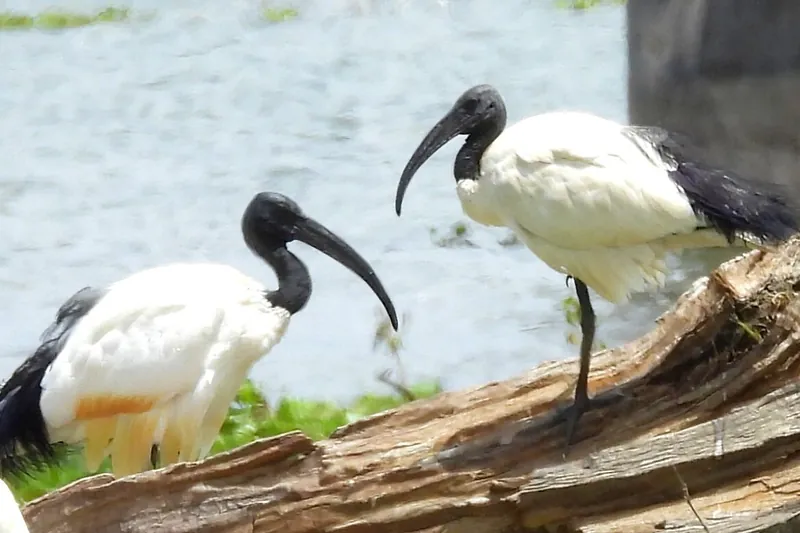
African sacred ibis in the Lake Nakuru area. Sri Srikumar, iNaturalist, CC0 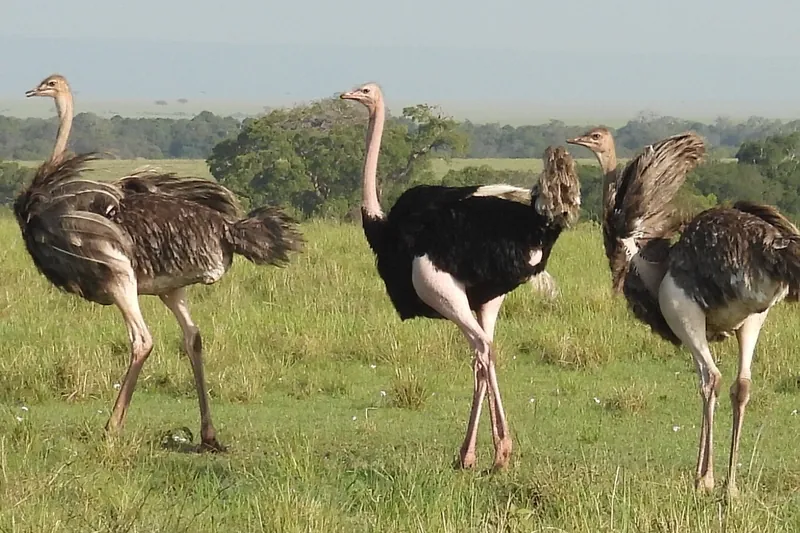
Ostrich in the Masai Mara area. Sri Srikumar, iNaturalist, CC0

Photos by visitors and photographers, used under their free licences. Click a name to see the original.