 Experience

Last verified · Next check due
On this page
- Accessible safari options at a glance (2026)
- Accessible rooms and lodges our sources name
- Safari vehicles: which is easier to board
- Self-drive: Kruger and Etosha compared
- Bush flights and boats: the limits
- Gorilla trekking with limited mobility
- Seniors: what changes with age
- Health and insurance
- Which accessible safari should you choose?
- Common mistakes about accessible safaris
- Frequently asked questions
- Sources
Short answer: Yes, if you plan around the hard parts: game drives are seated, but light aircraft, mokoro and gorilla treks are not built for wheelchairs. The simplest trips in our sources go by road: Kruger in a normal hire car, or Etosha, 4–6 hours on tar from Windhoek, where Okaukuejo has a disabled-access Bush Chalet. Named accessible rooms are few: 2 at Samburu Sopa Lodge, 4 planned at Ngorongoro Explorer Lodge (June 2027). Checked 10 October 2026.
Key facts
- Our sources name accessible rooms at only a handful of properties: Samburu Sopa Lodge (Kenya, 2 interconnecting wheelchair-accessible rooms of 60), Okaukuejo in Etosha (a “Bush Chalet, disabled access” unit), Gondwana’s The Delight Swakopmund (1 wheelchair-accessible twin of 54 rooms) and Elewana’s Ngorongoro Explorer Lodge (4 accessible rooms of 84, opening June 2027).
- Our sources hold no SANParks list of accessible units in Kruger, and nothing on accessible rooms in Botswana’s camps; the Botswana research file marks accessibility as unresearched.
- A Kruger self-drive needs no 4x4: SANParks says all access roads to the 9 entrance gates are tarred, and you stay in your car except at designated spots, so the whole game drive happens from your own seat.
- Light aircraft allow 15 kg per person in Kenya and Uganda and 20 kg in Tanzania (Auric Air) and Botswana, hand luggage included, in soft bags. Our sources say nothing about carrying a wheelchair on them; two Mara carriers sell a freight seat for up to 75 kg.
- No upper age limit applies to gorilla trekking (a safari magazine’s guide to age limits), and in Rwanda rangers allocate gorilla families by fitness on the morning (Visit Rwanda).
- Kenya and Tanzania now require a government visitor policy (US$44, plus fees in Kenya) that your own insurance does not replace; AMREF’s annual evacuation plan is priced by age, up to 85.
Accessible safari options at a glance (2026)
Road-reachable parks with tarred approaches and in-park rest camps are the easiest options in our sources; fly-in camps, water camps and gorilla treks are the hardest. The table sets out what our sources say for each option, and where they say nothing.
| Option | Getting there | Vehicle | Accessible rooms named in our sources | Main limit | Source |
|---|---|---|---|---|---|
| Kruger self-drive (South Africa) | Johannesburg to Kruger 406 km, about 4 hours; access roads to all 9 gates tarred | Your own hire car; a 4x4 is needed only for SANParks’ 4x4 trails | None in our sources | Malaria risk area; you may not leave the car except at designated spots | SANParks; one travel-times page |
| Etosha self-drive (Namibia) | Windhoek to Okaukuejo 414–435 km, all tar, 4–6 hours | 2WD car fine on the main gravel roads in the dry season | Okaukuejo: “Bush Chalet, disabled access” | Gravel inside the park; 4x4 recommended in the wet season | Etosha self-drive guide; NWR booking agents |
| Pilanesberg and Addo self-drive (South Africa, malaria-free) | Pilanesberg about 220 km from O.R. Tambo; Addo about 30 minutes from Gqeberha | Sedan on tar and good gravel (Pilanesberg); tarred loops (Addo) | None in our sources | Nothing on accessible units in our sources | Our malaria-free safari page |
| Madikwe and other lodge-only reserves | About 4.5 hours by road from Johannesburg, or about 1 hour on FedAir’s shuttle | Lodge vehicles only, no self-drive | None in our sources | You depend on the lodge’s vehicle and its step height | A booking agent’s site; FedAir |
| Masai Mara (Kenya) | 5.5–6.5 hours by road from Nairobi, or about 1 hour by air from Wilson | Closed pop-top 4x4 or minibus (operators) | None in our sources | Flights: 15 kg in soft bags, hand luggage included | Safarilink; AirKenya |
| Samburu (Kenya) | Samburu Sopa Lodge is 45 minutes from Kalama airstrip | Closed pop-top 4x4 (operators) | Samburu Sopa Lodge: 2 interconnecting wheelchair-accessible rooms | Our sources hold no 2026 rate for the lodge | Sopa Lodges factsheet 2025 |
| Ngorongoro and the Serengeti (Tanzania) | Arusha to Seronera 7–7.5 hours by road | Closed pop-top 4x4 (operators) | Ngorongoro Explorer Lodge: 4 accessible rooms, opening June 2027 | Not open until June 2027 | Tourism Update, 2 Oct 2026 |
| Okavango Delta (Botswana) | Light aircraft from Maun or Kasane to the camp’s airstrip | Open game viewers; mokoro and boats at water camps | None in our sources | 20 kg soft-bag limit; mokoro access not covered by our sources | Our Botswana bush flights page |
| Chobe riverfront (Botswana) | Road-accessible lodges at Kasane | Open game viewers; 3-hour river cruises | None in our sources | Boat boarding not covered by our sources | Our Chobe and Botswana safari cost pages |
| Gorillas, Rwanda or Uganda | Kigali to Kinigi 105 km, 2–3 hours; Kampala to Bwindi 8–10 hours by road | On foot, with porters for hire | Not applicable | Treks of 30 minutes to a full day on steep, muddy ground | Visit Rwanda; UWA |
Read 8–10 October 2026. “None in our sources” means we found no named accessible room or unit, not that none exists: ask the property directly.
Accessible rooms and lodges our sources name
We found named accessible rooms or areas at five properties, and a disabled-access unit type at one state rest camp; that is the whole list. One safari operator’s accessibility guide (February 2026) advises checking every “accessible” claim directly with the property, and we found no independent audit of any of these rooms.
| Property | Where | What our source lists | Source and date |
|---|---|---|---|
| Okaukuejo (NWR) | Etosha National Park, Namibia, 17 km from Andersson Gate | A “Bush Chalet, disabled access” unit, sleeps 2: N$2,530 per person sharing a night with breakfast, July–October (high season), park fees extra | Two NWR booking agents’ 2026–27 price lists, which agree on the figure |
| Samburu Sopa Lodge | Samburu National Reserve, Kenya | 60 rooms, 2 interconnecting wheelchair-accessible | Sopa Lodges factsheet 2025 (PDF) |
| Ngorongoro Explorer Lodge (Elewana) | Eastern Ngorongoro crater rim, about 15 minutes from the crater gate, Tanzania | 84 rooms, 4 accessible; opening June 2027 | Tourism Update, 2 Oct 2026 |
| The Desert Grace (Gondwana Collection) | 60 km north of Sesriem on the C19, near Sossusvlei, Namibia | “Wheelchair-accessible areas”; no accessible room count given | Gondwana fact sheet (PDF), 2026 |
| The Delight Swakopmund (Gondwana Collection) | Central Swakopmund, Namibia (a town hotel, not a safari camp) | 54 rooms, 1 wheelchair-accessible twin | Gondwana fact sheet (PDF), updated April 2025 |
Read 8–10 October 2026. Okaukuejo’s rate is NWR’s as published by two booking agents, not by NWR itself; our Etosha page has the other Okaukuejo, Halali and Namutoni rates.
- Kruger: our sources hold no SANParks accessibility information. They list 12 main rest camps, each with fuel, a shop and a restaurant or cafeteria, but say nothing on which units are step-free. Ask SANParks before you book.
- Halali and Namutoni (Etosha): the NWR price lists in our sources show no disabled-access unit type at either camp.
- Botswana: the Botswana research file in our sources marks accessibility for travellers with limited mobility as unresearched. On the TripAdvisor Botswana forum, a reply on room allocation says camps allocate tents themselves, “prioritising mobility needs”, and that a specific tent is nearly impossible to guarantee (traveller report).
- Specialist trips exist: one French operator lists an 8-day wheelchair-accessible Tanzania safari from €3,990 per person (read 8 October 2026), and two Kenyan operators that are KATO members advertise wheelchair-accessible vehicles or accessible travel, one “since 2006”. Check any operator’s licence first: how to check a safari operator’s licence.
What to ask the lodge before you book
One safari operator’s accessibility guide recommends verifying each claim with the property. These questions follow its list:
- A step-free route from the vehicle to the room, the main area and the pool.
- Door widths, a roll-in shower, grab rails and bed height.
- The distance and surface between the room and the main area: sand, boardwalk or gravel.
- The vehicle: a lift or ramp, or an assisted transfer; tie-downs; who assists.
- Power for medical devices overnight; the guide notes that many camps run on solar power and inverters.
- The nearest clinic, the evacuation plan, and whether the airstrip can take the evacuation aircraft.
- The escort policy after dark in unfenced camps.
Safari vehicles: which is easier to board
Closed pop-top 4x4s, the norm in Kenya and Tanzania, are easier to board than the open game viewers used at Botswana’s lodges and South Africa’s private reserves, which have a higher step (one safari operator’s vehicle guide, 2026). Vehicle types and rules are on our safari vehicles page.
| Vehicle | Where you get it | For limited mobility | Source |
|---|---|---|---|
| Closed 4x4 or minibus with a pop-up roof | Kenya and Tanzania national parks | Easier to board, says one safari operator | One safari operator’s vehicle guide |
| Open game viewer (open-sided 4x4, 6–9 seats, tiered benches) | Botswana lodges, South African private reserves, Zambia, Zimbabwe, Namibia | Higher step to climb in | Botswana Tourism; the same operator |
| Adapted vehicle with a ramp or hydraulic lift | Through specialist operators | Wheelchair users can stay seated in their chair on the drive | One safari operator’s accessibility guide (February 2026) |
| Your own hire car | Kruger, Etosha, Pilanesberg, Addo | You set the pace and the stops; no transfers between vehicles | SANParks; our Etosha page |
- Our sources hold no price for an adapted vehicle. A private standard vehicle costs US$385–935 a day or night on 2026 camp rate cards (our safari vehicles page); ask any operator for a photograph of the actual vehicle.
- Shorter drives are an option. One safari operator’s accessibility guide says “a focused 90-minute drive can be as rewarding as a longer one” and recommends rest days.
- You do not have to walk. On the TripAdvisor Zambia forum, replies to a couple with bad knees said only a minority of guests walk, put the share at 10–20%, and full-board rates cover two activities a day of your choice (traveller reports; our Zambia safari questions page).
Self-drive: Kruger and Etosha compared
Both parks are built for an ordinary car and have rest camps inside, so you can spend the day in your own seat and sleep where you stop; Kruger’s roads to the gates are tarred, Etosha’s in-park roads are mostly gravel. Full guides: Kruger self-drive and Etosha.
| Kruger (South Africa) | Etosha (Namibia) | |
|---|---|---|
| From the city | Johannesburg 406 km, about 4 hours (gate not named); gates 411–600 km from Johannesburg | Windhoek to Okaukuejo 414–435 km, all tar, 4–6 hours |
| Car | Normal 2WD hire car; SANParks keeps only vehicles over 4,000 kg, buses and over 25 seats to tar | 2WD fine on the main gravel roads in the dry season; 4x4 recommended in the wet season |
| Getting out of the car | Only at designated spots | Only in camps and at marked picnic and toilet stops |
| Camps inside | 12 main rest camps with fuel, a shop and a restaurant or cafeteria | Okaukuejo, Halali and Namutoni, with pumps and shops (NWR) |
| Named accessible unit | None in our sources | Okaukuejo “Bush Chalet, disabled access” |
| Wildlife without driving | Not covered by our sources | Floodlit waterholes at Okaukuejo and Halali for guests sleeping in those camps |
| Gate hours | 05:30 or 06:00 to 17:30–18:30, by month; latecomers refused at entrance gates | Sunrise to sunset; Okaukuejo 06:10–07:30 to 18:25–19:40, by month; be in a camp or out of the park by sunset |
| Park fee, foreign adult | R692 (R602 until 31 Oct 2026), per day | N$280 per adult plus N$60 per car (Government Notice 115 of 2026) |
| Malaria | Risk area: UK TravelHealthPro recommends tablets September–May | Not covered on this page; see safari malaria risk |
Sources: SANParks gates, rules and camps pages, read 8–9 October 2026; Etosha self-drive guide and gate times (a safari agent’s Etosha guide); NWR rates via booking agents; one travel-times page for Johannesburg–Kruger. All as on our Kruger self-drive and Etosha pages.
| Fee | Amount | In force from | Source |
|---|---|---|---|
| Kruger National Park daily conservation fee, international adult (12+), per day | ZAR 602 | 1 Nov 2025 to 31 Oct 2026 (SANParks 2025/26 schedule) | SANParks daily conservation fees 2025/26 |
| Kruger National Park daily conservation fee, international adult (12+), per day | ZAR 692 | 1 Nov 2026 to 31 Oct 2027 (SANParks 2026/27 schedule, already published) | SANParks daily conservation fees 2026/27 |
| Tier 1 parks (Etosha, Namib-Naukluft including Sossusvlei, Skeleton Coast, Ai-Ais/Fish River Canyon, Waterberg Plateau, Cape Cross, Dorob, Tsau //Khaeb), foreign adult 16+, per person | NAD 280 (NAD 140 park entrance + NAD 140 conservation fee) | 1 Apr 2026 (Government Notice 115 of 2026; the notice prices fees per person with no period; MEFT's 2021 schedule made fees valid for 24 hours from entry); was NAD 150 under the 2021 schedule | Government Gazette 8877 (Government Notice 115 of 2026), hosted by the Legal Assistance Centre |
| Vehicle up to 10 seats, most national parks (N$50 at Sandwich Harbour), per vehicle | NAD 60 | 1 Apr 2026 (Government Notice 115 of 2026; the notice states no period; MEFT's 2021 schedule made fees valid for 24 hours from entry); was NAD 50 | Government Gazette 8877 (Government Notice 115 of 2026), hosted by the Legal Assistance Centre |
| Uganda: gorilla tracking permit, Bwindi Impenetrable and Mgahinga Gorilla NPs, foreign non-resident, per person per trek (guide and that day's park entry included) | USD 800 (foreign resident USD 700; rest of Africa USD 500; East African citizens UGX 300,000) | Since 1 Jul 2024 (UWA tariff 2024–26); confirmed unchanged from 1 Jan 2027 by UWA letter TDO 93/04 of 26 Feb 2026 | UWA letter TDO 93/04, 26 Feb 2026 |
| Rwanda: mountain gorilla tracking permit, Volcanoes NP, international visitor, per person per day | USD 1,500 | Current RDB price, checked 9 Oct 2026 | Visit Rwanda (Rwanda Development Board) |
- Our sources say nothing about hire cars with hand controls in South Africa or Namibia. Ask the hire company directly.
- Kruger’s late-arrival rule is strict: latecomers are refused at the entrance gates, and late entry is for emergencies only, with proof, until 21:00 (SANParks). Plan short legs.
- Etosha’s camps are far apart: Okaukuejo to Halali is about 70 km and 1 h 45 at game-viewing pace, Okaukuejo to Namutoni about 140 km and 3 h 15 (our Namibia self-drive distances page).
- Malaria-free and self-drive: Pilanesberg (sedan on tar and good gravel) and Addo (tarred loops) are the self-drive options on our malaria-free safari page; Madikwe and Welgevonden are lodge-only.
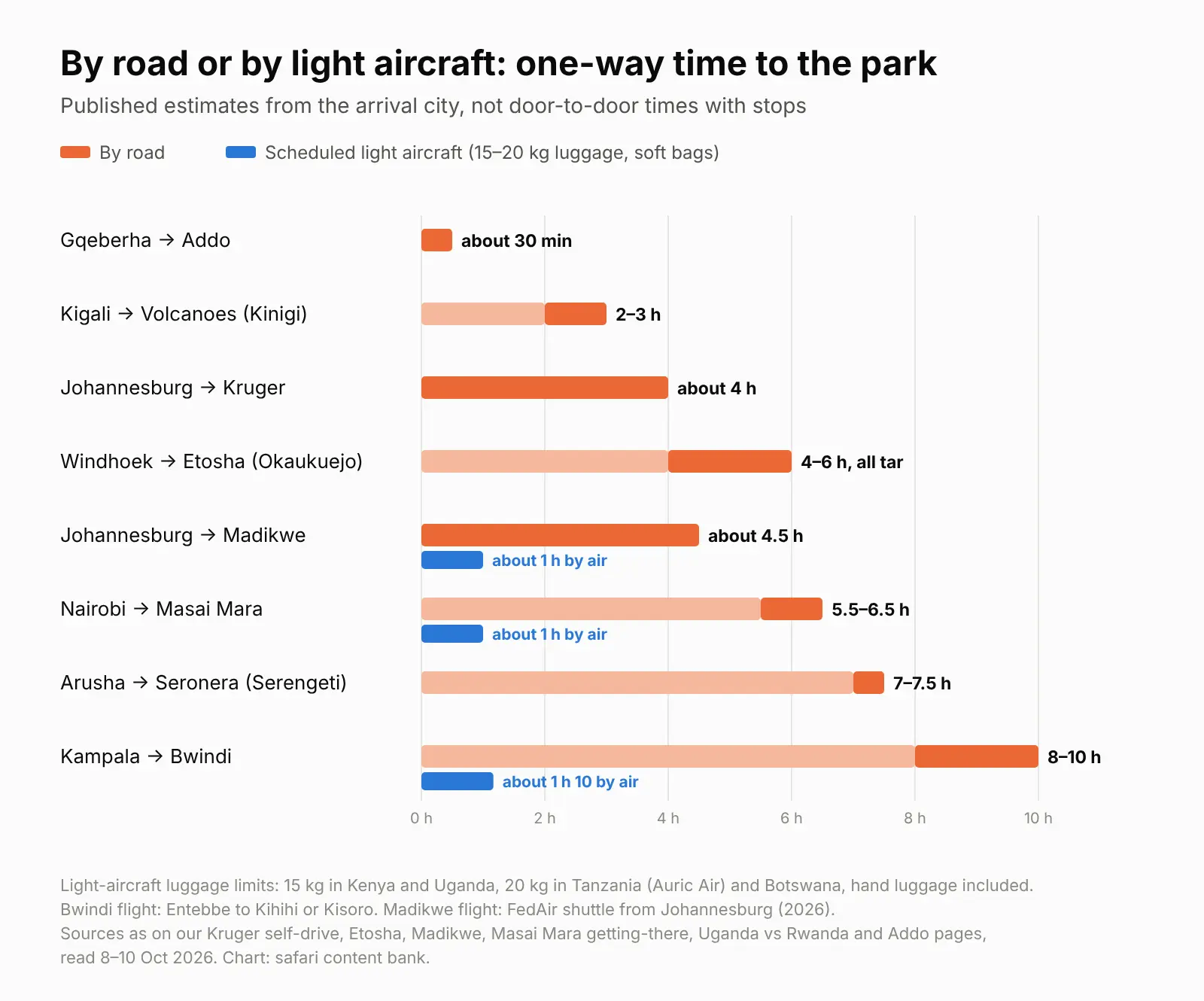 Times as published on our Kruger self-drive, Etosha, Madikwe, Masai Mara getting-there, Uganda vs Rwanda and Addo pages, read 8–10 October 2026. Chart: safari content bank.
Bush flights and boats: the limits
A light aircraft cuts a 4.5–10 hour road transfer to about an hour, but our sources describe narrow aisles, high steps, no toilet on board and a 15–20 kg soft-bag limit; a road transfer is the alternative where one exists. One safari operator’s accessibility guide recommends road transfers in accessible vehicles for guests with limited mobility.
| Limit | What our sources say | Source |
|---|---|---|
| Aircraft | Cessna Caravans and Airvans on Botswana’s delta airstrips; caravans seat about 12 with no toilet on board | Ker & Downey Botswana; one travel company’s bush-plane guide (Tanzania) |
| Boarding | Narrow aisles, high steps and little room for mobility aids | One safari operator’s accessibility guide (February 2026) |
| Luggage, Kenya and Uganda | 15 kg per person, hand luggage included, soft bags (Safarilink, AirKenya, Aerolink) | Carriers’ baggage pages, via our fly-in safari cost page |
| Luggage, Tanzania and Botswana | 20 kg per person, hand luggage included, soft bags (Auric Air; Botswana carriers) | Carriers’ baggage pages; our Botswana bush flights page |
| Extra weight | Safarilink: a freight seat at the adult fare carries 75 kg more; AirKenya: a freight seat carries up to 75 kg | Safarilink and AirKenya baggage pages |
| Wheelchairs and medical equipment | Nothing in our sources on whether a folding wheelchair or mobility scooter counts towards the limit | None |
| Excess in Botswana | Kwando: 50% of the seat rate for up to 15 kg extra; Desert & Delta couriers excess bags for US$65 a suitcase (2024) | Our Botswana bush flights page |
Carriers’ pages read 9–10 October 2026.
Boats are the other gap in our sources. Here is what they do and do not cover:
- Chobe river cruises run for three hours from Kasane, and both Kasane lodges on our Chobe page include one in the rate. Road-accessible Chobe riverfront lodges cost US$459–590 per person a night with game drives included, and need no light aircraft (our Botswana safari cost page).
- Chobe’s houseboats moor on the Namibian bank: guests clear Botswana immigration at Kasane, then transfer by boat (a tour operator, via our Chobe page).
- A water camp’s day in the Okavango Delta is spent in a mokoro or a boat (our water vs land camps page). Our sources say nothing about getting in and out of a mokoro or a motorboat with limited mobility; a land camp, where the day is spent in a vehicle, avoids the question.
Gorilla trekking with limited mobility
Gorilla trekking is the hardest safari activity in our sources: treks run from 30 minutes to a full day on steep, muddy ground at 1,160–4,000 m, and our sources describe no option for travellers who cannot walk. Details are on our gorilla trekking day page.
| Rwanda (Volcanoes NP) | Uganda (Bwindi) | |
|---|---|---|
| Trek length | 30 minutes to 4+ hours (Visit Rwanda) | “A few hours to a full day” (UWA); 2–8 hours (one operator’s gorilla guide) |
| Altitude | 2,500–4,000 m on the Virunga volcanoes | 1,160–2,607 m of steep forest on ridges and valleys |
| Who picks the family | Rangers allocate families on the morning, by fitness | The permit names the sector; Nkuringo has the steepest treks (UWA) |
| Porter | About US$10 (one operator’s gorilla guide) | About US$20 plus a tip (one tour operator’s trip notes) |
| Age | 15 and over; no upper age limit (a safari magazine’s guide) | 15 and over; no upper age limit (same guide) |
| Permit | US$1,500 (RDB, checked 9 Oct 2026) | US$800, US$600 in April, May and November (UWA) |
| From the city | Kigali to Kinigi 105 km, 2–3 hours | Kampala to Bwindi 8–10 hours by road, or about 1 h 10 by air from Entebbe |
Sources: Visit Rwanda (RDB); UWA tariff 2024–26 and brochures; one operator’s gorilla guide; one tour operator’s trip notes; a safari magazine’s guide to age limits; all as on our gorilla pages, checked 9 October 2026.
- Our sources describe no carried-chair or stretcher service for trekkers who cannot walk. None is mentioned by UWA or RDB.
- For less mobile trekkers, our Uganda or Rwanda page points to Rwanda, or to Uganda with a porter and an easier sector, because Rwanda’s treks run 30 minutes to 4+ hours and families are allocated by fitness. An easier family is not guaranteed.
- Permits and refunds: see gorilla permit prices.
Seniors: what changes with age
No safari rule in our sources sets an upper age; what changes with age is the yellow fever advice from 60, the price of AMREF’s annual evacuation plan from 70, and how much heat, cold and long days you want.
| Topic | What our sources say | Source |
|---|---|---|
| Upper age limit | None for gorilla trekking; we found none for game drives | A safari magazine’s guide to age limits |
| Yellow fever vaccine, 60 and over | UK guidance says travellers aged 60 or over should not receive it for travel to low-exposure areas only | UK TravelHealthPro, Kenya page |
| Yellow fever certificate | Asked only of travellers arriving from a risk country; Kenya and Uganda are risk countries, so Kenya then Tanzania needs it | WHO country list, via our yellow fever page |
| Evacuation cover by age | AMREF Maisha Diamond annual plan: US$280 under 70, US$320 aged 70–80, US$400 aged 80–85 | flydoc.org, page modified 8 May 2026 |
| Short-stay evacuation cover | AMREF Maisha Tourist, 15–30 days: US$16–80 (US$10–80 through a KATO, TATO or AUTO member operator); no age bands shown | Same |
| Malaria tablets | Interactions with your other medicines are a question for a doctor; Kruger is a malaria risk area | UK TravelHealthPro |
Read 8–10 October 2026. This is not medical advice: a travel clinic decides on vaccines and tablets.
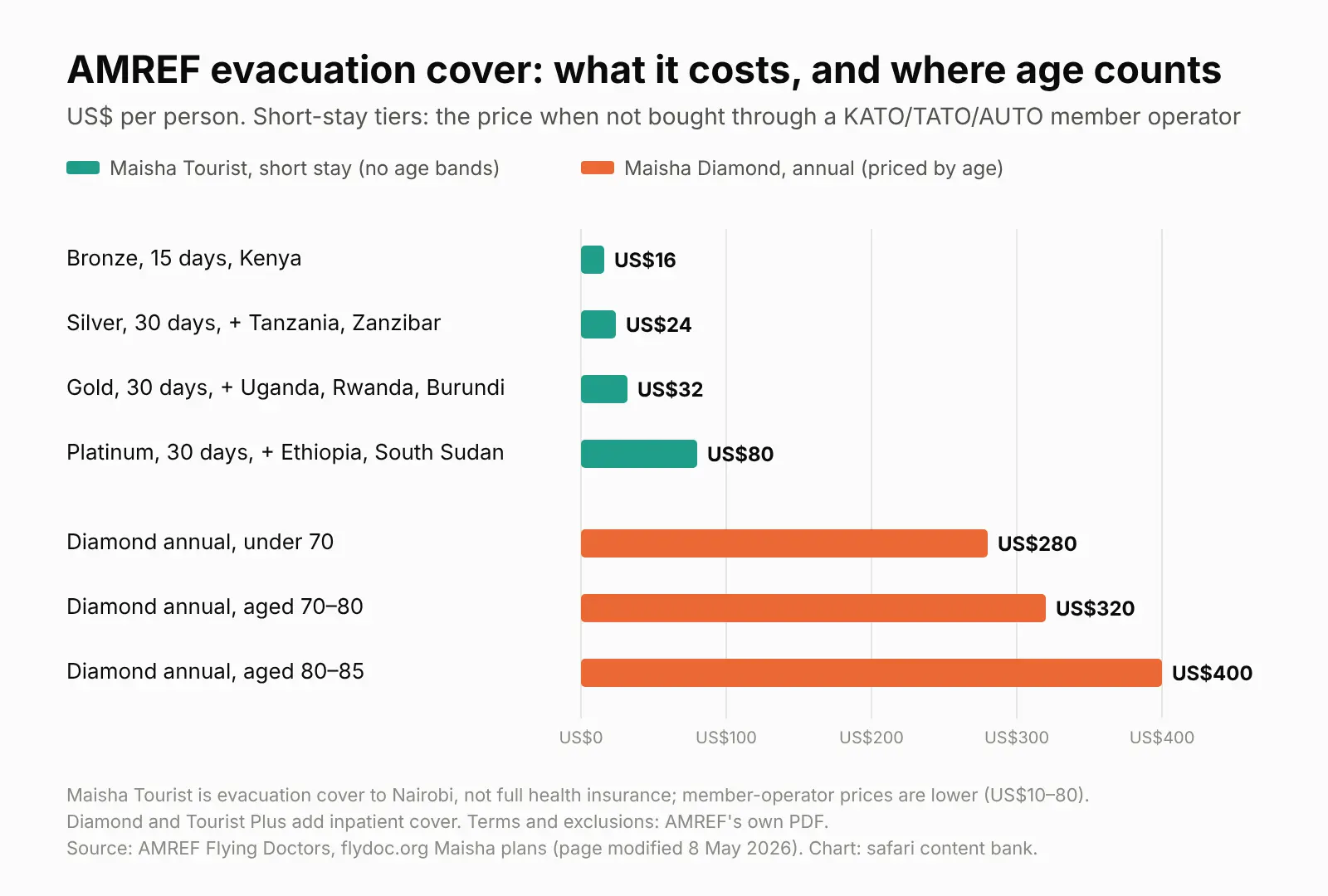 Source: AMREF Flying Doctors, Maisha plans (flydoc.org, page modified 8 May 2026). Chart: safari content bank.
Heat, cold and long days by season
Southern Africa’s dry winter (about May to August) brings cold dawns on open vehicles; October is the hottest month. Month by month: best time for a safari.
| Months | Southern Africa (Kruger, Etosha, Botswana) | East Africa (Masai Mara) | Source |
|---|---|---|---|
| May–August | Dry winter; Etosha lows of 8 °C in June and July; travellers report 7–12 °C on open vehicles on Botswana winter mornings; Kruger gates open 06:00–17:30 (11.5 hours) in May–July | Long rains ease in May (Mara 155 mm); July is the driest month (Mara 60 mm) | Our Etosha, Kruger self-drive, safari vehicles and best-time pages; TripAdvisor (traveller report) |
| September–October | Peak game on the remaining water; October is the hottest month, above 40 °C at times in Botswana, with 33 °C highs at Tsumeb (Etosha); Kruger malaria tablets advised from September | September: most animals in the Mara; October: short rains start | Our best-time page; UK TravelHealthPro |
| November–April | Rains; Kruger gates 05:30–18:30 in November–February; Kruger malaria tablets advised to May | November short rains (Mara 155 mm); April the wettest month (Mara 210 mm) | Our best-time and Kruger self-drive pages; UK TravelHealthPro |
Health and insurance
Kenya and Tanzania now make every foreign visitor buy a government policy, which your own insurance does not replace; elsewhere, some camps require comprehensive travel and medical insurance, and medical evacuation is the cover to check first.
| Item | What applies | Source |
|---|---|---|
| Kenya visitor policy | Required for arrivals since 5 October 2026 (U.S. Embassy Nairobi), up to US$44 per person (eCitizen), valid 90 days; your own insurance is not accepted in its place | U.S. Embassy Nairobi; eCitizen, as on our Kenya visitor insurance page |
| Tanzania visitor policy | US$44 per adult, valid 92 days (Government Notice 256 of 2026); needed “even if” you have your own policy (UK FCDO, 20 Oct 2026); it covers emergency medical treatment, evacuation, repatriation and luggage, not trip cancellation | UK FCDO; Clyde & Co, as on our Tanzania visitor insurance page |
| Your own policy | Still needed for cancellation; Great Plains, for one, requires “fully comprehensive travel and medical insurance” | Great Plains 2025 published rates, via our how to book a safari page |
| Evacuation in East Africa | AMREF Flying Doctors’ Maisha Tourist: evacuation flights to Nairobi, a 24-hour helpline and ground ambulance in Kenya; Tourist Plus adds inpatient cover up to US$200,000 | flydoc.org, as on our Is Kenya safe? page |
| Kenya park fees | KWS’s 2025 fee regulations list “persons with disability” among the categories exempt from entry fees; our sources do not say whether that covers foreign visitors or what proof the gate asks for | KWS Legal Notice 160 of 2025, as summarised in our sources |
| Medicines | Carry medication in its original containers with the prescriptions; some insurers sell add-ons for damage to equipment | One safari operator’s accessibility guide (February 2026) |
Status as of 10 October 2026. Kenya’s insurance price is from its eCitizen insurance portal; check the eTA portal. Our sources hold no evacuation-scheme details for Botswana, Namibia, South Africa, Zambia or Zimbabwe that we could verify.
- Ask whether evacuation cover is already in the safari price. AMREF gives KATO, TATO and AUTO member operators a lower rate (our Kenya safety page).
- Ask about pre-existing conditions before you buy. One safari operator’s accessibility guide advises confirming medical-evacuation cover, especially with a pre-existing condition.
Which accessible safari should you choose?
Choose by what you cannot do: if you cannot board a light aircraft, stay on road-reachable parks; if you cannot walk far, skip gorillas and water camps; if you want your own pace, self-drive Kruger or Etosha.
| If you… | Consider | Why |
|---|---|---|
| Use a wheelchair full-time | Kruger or Etosha by car, or an operator with an adapted vehicle | Tarred approach roads, rest camps inside, game viewing from your own seat; Okaukuejo lists a disabled-access chalet |
| Can transfer but not climb a high step | Kenya or Tanzania in a closed pop-top vehicle | Easier to board than open vehicles, says one safari operator |
| Want an accessible room you can name today | Samburu Sopa Lodge (Kenya) or Okaukuejo (Etosha) | The only safari properties in our sources with named accessible rooms open now |
| Cannot fly in a light aircraft | Kruger, Etosha, Pilanesberg, Addo, Madikwe by road, or the Chobe riverfront from Kasane | No small plane needed |
| Want to avoid malaria tablets | Pilanesberg or Addo (self-drive), Madikwe (lodge-only) | Outside malaria risk areas, per our malaria-free safari page |
| Are over 60 and going to East Africa | Discuss yellow fever with a travel clinic early | UK guidance advises against the vaccine at 60+ for low-exposure travel only |
| Want gorillas but walk slowly | Rwanda, with a porter, and tell the rangers honestly | Families are allocated by fitness; treks 30 minutes to 4+ hours |
Common mistakes about accessible safaris
| Mistake | Correction |
|---|---|
| “The website says accessible, so the camp is step-free” | Our sources name accessible rooms at only a handful of properties, and one safari operator’s guide says to verify every claim with the property: route, door widths, shower, distances. |
| “The wheelchair will go on the bush plane” | Light aircraft allow 15–20 kg per person, hand luggage included, in soft bags, and our sources say nothing about wheelchairs. Ask the carrier; Safarilink and AirKenya sell a freight seat for up to 75 kg. |
| “Kruger needs a 4x4 or a guided tour” | A normal hire car is enough: SANParks says all access roads to the gates are tarred. |
| “My own travel insurance covers Kenya and Tanzania” | Both countries now require their government policy (US$44, plus fees in Kenya), and your own policy is not accepted in its place. Keep your own for cancellation. |
| “Open vehicles are easiest because there are no doors” | Open game viewers have a higher step; closed pop-tops are easier to board, says one safari operator. |
| “There’s an age limit for gorilla trekking” | There is no upper age limit, only the minimum of 15; the terrain is the real limit. |
| “Everyone over 60 needs the yellow fever jab for East Africa” | The certificate is asked only of travellers arriving from a risk country, and UK guidance says travellers aged 60 or over should not receive the vaccine for low-exposure travel only. A travel clinic decides. |
| “Kruger is malaria-free” | Kruger is in a malaria risk area; UK TravelHealthPro recommends tablets there from September to May. |
Frequently asked questions
Can a wheelchair user go on safari? Yes. Game drives are seated, and a self-drive in Kruger or Etosha keeps you in your own car all day. Okaukuejo in Etosha lists a “Bush Chalet, disabled access”, and Samburu Sopa Lodge in Kenya has 2 wheelchair-accessible rooms. Light aircraft, mokoro trips and gorilla treks are the hard parts.
What is the most accessible safari destination? In our sources, South Africa and Namibia by road: Kruger has tarred access roads to all 9 gates, and Windhoek to Etosha is 4–6 hours on tar. One safari operator’s accessibility guide calls South Africa the continent’s leader in accessible tourism infrastructure; that is its view, not an audit.
Are there wheelchair-accessible rooms in Kruger? Our sources hold no SANParks information on accessible units in Kruger, so we cannot name any. Kruger has 12 main rest camps with fuel, a shop and a restaurant or cafeteria. Ask SANParks before you book.
Can I take a wheelchair on a bush flight? Our sources do not say. Light aircraft allow 15 kg per person in Kenya and Uganda and 20 kg in Tanzania and Botswana, hand luggage included, in soft bags. Safarilink and AirKenya sell a freight seat for up to 75 kg; ask the carrier before you book, or travel by road.
Is there an age limit for a safari? Not an upper one in our sources. Gorilla trekking has a minimum age of 15 and no upper limit, according to a safari magazine’s guide. AMREF’s annual Diamond evacuation plan is sold up to age 85, at US$400 for ages 80–85.
Should seniors get the yellow fever vaccine? That is for a travel clinic to decide. UK TravelHealthPro says travellers aged 60 or over should not receive it for low-exposure travel only, and a certificate is asked only of travellers arriving from a risk country. Kenya is one, so Kenya then Tanzania needs the certificate.
What insurance do I need for an accessible safari? Kenya and Tanzania require their government visitor policies (US$44, plus fees in Kenya), which your own insurance does not replace. Keep your own policy for cancellation, and check its medical-evacuation cover, especially with a pre-existing condition. AMREF’s Maisha Tourist covers evacuation to Nairobi from US$16 for 15 days in Kenya.
Sources
- Accessible rooms: Sopa Lodges factsheet 2025 (PDF); Tourism Update, 2 Oct 2026; Gondwana Collection fact sheets, The Desert Grace (PDF) and The Delight Swakopmund (PDF); NWR Okaukuejo 2026–27 rates as published by two NWR booking agents (names in our editor notes)
- Parks and self-drive: SANParks, Kruger entrance gates, vital information and camps; a safari agent’s Etosha guide, read September 2026; Government Notice 115 of 2026 (PDF); SANParks daily conservation fees 2025/26 (PDF) and 2026/27 (PDF); one travel-times page for Johannesburg–Kruger; all as on our Kruger self-drive, Etosha and malaria-free pages
- Flights and boats: Safarilink baggage; AirKenya baggage policy; Aerolink 2025 (PDF); Auric Air, Botswana carriers and camp rate cards as on our fly-in safari cost and Botswana bush flights pages; one travel company’s bush-plane guide (Tanzania); a tour operator’s Chobe houseboats page
- Gorillas: Visit Rwanda, gorilla tracking; UWA, Conservation Tariff July 2024–June 2026 (PDF) and letter TDO 93/04, 26 Feb 2026 (PDF); one operator’s gorilla guide; one tour operator’s trip notes; a safari magazine’s guide to age limits
- Health and insurance: UK TravelHealthPro, Kenya and South Africa; WHO country list, International Travel and Health 2022 (PDF); AMREF Flying Doctors, Maisha plans, page modified 8 May 2026; Kenya eTA portal, etakenya.go.ke; UK FCDO and Clyde & Co on Tanzania’s insurance, as on our Tanzania visitor insurance page; KWS Legal Notice 160 of 2025 (PDF)
- Vehicles and accessibility advice: one safari operator’s accessibility guide (February 2026); one safari operator’s vehicle guide (2026); Botswana Tourism, game drives; specialist operators in France and Kenya (names in our editor notes)
- Traveller reports (not fact): TripAdvisor Botswana forum, tent allocation; Zambia forum, “First and likely only Safari”; Botswana winter mobile safari
- More: First safari, Family safaris, Safari vehicles, Kruger self-drive, Etosha, Gorilla trekking day, Yellow fever certificate rules, Safari malaria risk
Accessibility details, fees and insurance rules checked against our sources 8–10 October 2026; SANParks fees checked 1 November 2026. We will recheck this page by 21 November 2026, and sooner when Kruger’s 2026/27 fees start on 1 November 2026, when Ngorongoro Explorer Lodge opens (June 2027), when Kenya publishes an official insurance price, or when we obtain SANParks’ or NWR’s own accessibility information.