 Experience

Last verified · Next check due
On this page
- Which vehicle will you get, by where you go?
- Pop-top, open vehicle or minibus: what is the difference?
- Official rules: open vehicles, off-road driving and vehicles at a sighting
- How many people per vehicle, and is a window seat guaranteed?
- What does a private vehicle cost?
- Does the vehicle matter?
- Common mistakes about safari vehicles
- Frequently asked questions
- Sources
Short answer: Where you go decides the vehicle, not what you book. In Kenya and Tanzania you will usually ride in a closed 4x4 Land Cruiser or minibus with a pop-up roof; at Botswana’s lodges and in South Africa’s private reserves, in an open-sided 4x4, which Botswana Tourism says seats six or nine. The Masai Mara reserve allows five vehicles at a sighting. A private vehicle costs US$385–935 a day or night on 2026 camp rate cards. Checked 10 October 2026.
Key facts
- Botswana Tourism states the Southern African norm: “All the lodges use open-sided 4x4 vehicles with seating for either six or nine people” (Botswana Tourism). In Kenya and Tanzania, operators describe closed pop-top Land Cruisers as the norm (Operator A; Operator B).
- We found no official text banning open vehicles in Tanzania. TANAPA’s last published tariff (2023/24) prices them instead: “Open vehicles will be charged 50% extra.” Operators say the Ngorongoro Crater requires closed vehicles; the NCAA guidelines we hold say only “Only 4×4 vehicles up to 3,500 Kgs of tare weight are allowed in the Ngorongoro Crater floor.”
- No Mara conservancy publishes a vehicle limit per sighting. The reserve’s rule is five vehicles at an animal, with any others waiting 100 m away.
- Off-road driving and night drives depend on the land, not the vehicle. Botswana Tourism: in the national parks and reserves, “off-roading and night driving [are] prohibited”; in Kruger, private cars may not drive off-road or at night.
- A window seat is guaranteed only where the operator writes it down. Operator C’s Kenya scheduled safaris list a “Shared safari vehicle with up to 6 passengers” and a “Guaranteed window seat”; the other operators in this guide publish a maximum per vehicle and no seat promise.
- A private vehicle is priced per vehicle: US$385–512 a day at Governors’ Camp in the Masai Mara and US$725–935 a night at Natural Selection’s Botswana camps (2026 rate cards).
Which vehicle will you get, by where you go?
The vehicle follows the land: national parks on public roads in East Africa get closed pop-tops; private reserves and concessions in Southern Africa get open vehicles, and their own rules on driving off-road.
| Where | Usual vehicle | Open-sided vehicles | Off-road driving | Vehicles at one sighting | Source |
|---|---|---|---|---|---|
| Maasai Mara National Reserve (Kenya) | Closed 4x4 or minibus with pop-up roof (operators) | No official rule found | Prohibited, except to approach big cats on nearby open ground, no closer than 25 m | Five; others stop and wait at least 100 m away | Business Daily on Narok County’s management plan |
| Mara conservancies (Kenya) | Camp 4x4s; Porini Lion Camp uses “off-road (4×4) safari vehicles” | Used in Kenyan conservancies, per operators | Practised | No published cap for any Mara conservancy | Porini factsheet; Operator A |
| Ol Pejeta and Lewa (Laikipia, Kenya) | Not stated in our sources | Not stated | Not stated | Ol Pejeta: six, for a maximum of 10 minutes per vehicle; Lewa: two | OPC Tariff Guide 2026; Lewa Code of Conduct |
| KWS national parks (Amboseli, Lake Nakuru) | Closed pop-top (operators) | Not allowed, says Operator A; no KWS text found | “Strictly prohibited” (Amboseli) | No published cap found | KWS rules on our Amboseli page; Operator A |
| Serengeti National Park (Tanzania) | Closed pop-top Land Cruiser (operators) | Priced, not banned: “Open vehicles will be charged 50% extra” (TANAPA, last published tariff, 2023/24) | No official text in our sources | No published cap in our sources | TANAPA 2023/24 (PDF) |
| Ngorongoro Crater (Tanzania) | Closed 4x4; operators say closed vehicles are required | NCAA guidelines: “Only 4×4 vehicles up to 3,500 Kgs of tare weight”; no open-vehicle rule in the text we hold | No off-road driving unless the Conservation Commissioner authorises it | None published | NCAA guidelines; Operator H, flying or driving |
| Kruger National Park (South Africa) | Your own car; SANParks guided drives | No rule found for private cars | Not allowed in private vehicles | No published limit in our sources | SANParks rules |
| Sabi Sand, Timbavati (Greater Kruger) | Open lodge vehicles with a guide and tracker | Normal | Lodge vehicles, per operators | No published rule in our sources | Sabi Sand vs Timbavati |
| Chobe, Moremi (Botswana) | Open-sided lodge 4x4s; self-drivers’ own cars | Normal | Prohibited | No published count | Botswana Tourism |
| Private concessions (Botswana: Khwai, Selinda, Linyanti, Kwara, Vumbura) | Open-sided 4x4, six or nine seats | Normal | Allowed, “in moderation” | Guests of camps on that lease only | Botswana Tourism |
| Gorongosa National Park (Mozambique) | Park’s guided vehicles; no self-drive | Children under 10 not on open vehicles (closed vehicle at a surcharge) | Not stated | Not stated | Gorongosa park fees and rules |
Official rules as published by Narok County (via Business Daily), Ol Pejeta, Lewa, KWS, TANAPA, NCAA, SANParks, Botswana Tourism and Gorongosa; “operators” means Operator A, Operator B and Operator H, sellers of safaris. Read 8–10 October 2026. Gorongosa’s rule is the only official open-vehicle restriction we found. Operators are labelled A–G; their names and links are kept in our editor notes.
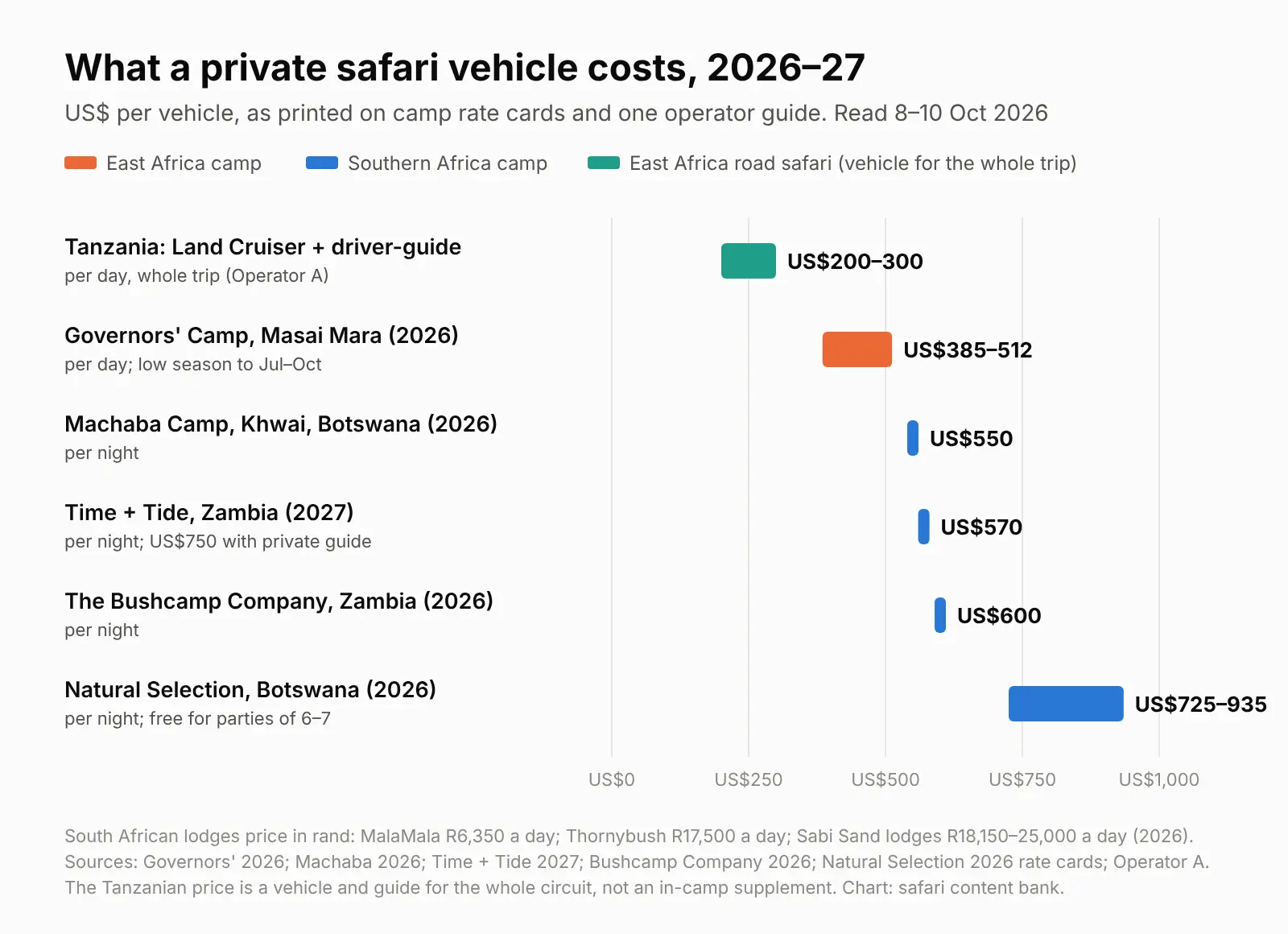 Published prices per vehicle, read 8–10 October 2026. Sources: Governors’ 2026; Machaba 2026; Time + Tide 2027; Bushcamp Company 2026; Natural Selection 2026 rate cards; Operator A. Chart: safari content bank.
Pop-top, open vehicle or minibus: what is the difference?
A pop-top is a closed 4x4 whose roof lifts so you stand to look out; an open vehicle has no sides and tiered bench seats; a minibus is a pop-top van without four-wheel drive. The seat counts and trade-offs below are what two safari sellers publish, not official specifications.
| Vehicle | Seats and layout | Where you meet it | Good | Less good |
|---|---|---|---|---|
| Pop-top (closed) Land Cruiser | 6–7 guests plus driver-guide; enclosed sides, big windows, roof hatch lifts so you stand to view | Tanzania, Kenya, Uganda, Rwanda | Protection on long road transfers; standing view for photographers | Side-window tops can sit below a tall person’s eye line |
| Extended Land Cruiser | Stretched chassis, six guests, larger windows, more legroom | Tanzania and Kenya private safaris | More legroom for all-day drives | Premium price |
| Safari minibus (Toyota HiAce) | Nine seats, seven carried so everyone has a window; pop-up roof | Kenya; some Tanzanian budget operators | Cheapest | No four-wheel drive, low clearance |
| Open game viewer (open-sided 4x4) | 6–8 guests on tiered “theatre” benches; often a canvas sunshade roof; no doors | Botswana, South Africa, Zambia, Zimbabwe, Namibia; Kenyan conservancies | All-round views; photography at eye level | Exposed to cold, dust and rain; higher step to climb in |
| Photographic vehicle | 3–4 guests; bean-bag or clamp mounts; sides or doors removed | Kenya, Tanzania, South Africa, Botswana | A full row per photographer | Cost |
Sources: Operator A, safari vehicles glossary (2026 guide, dated 5 August); Operator B, safari vehicles (updated 21 January 2026). Both are safari sellers. Read 9 October 2026.
- In East Africa’s private areas, vehicles are often a middle form: a canvas roof with roll-down side flaps (Operator B).
- Operator A puts the minibus at about US$100 a day less than a Land Cruiser. That is an operator’s figure, not a published tariff.
- South African lodge vehicles often carry a tracker on a seat over the front bumper, who reads tracks for the guide (Operator A; Operator B). Sabi Sand and Timbavati drives use a guide and tracker, per our Sabi Sand vs Timbavati page.
Official rules: open vehicles, off-road driving and vehicles at a sighting
Open vehicles are rarely the subject of a written rule; off-road driving and sighting limits are, and they change at the boundary between public parks and private land.
Open vehicles: what the authorities actually say
The only official texts on open vehicles we found are TANAPA’s surcharge and Gorongosa’s age rule; the “Tanzania bans open vehicles” line comes from operators.
- TANAPA charges open vehicles more, not nothing. Its last published tariff (2023/24) prices vehicle entry by weight and says: “Open vehicles will be charged 50% extra” (TANAPA 2023/24 (PDF)). For a Tanzanian-registered Land Cruiser (2,001–3,000 kg), that is TZS 52,500 + VAT per entry instead of TZS 35,000 + VAT; for a foreign-registered one, US$225 + VAT instead of US$150 + VAT (our sums: × 1.5).
- Ngorongoro: operators say closed vehicles only; the NCAA text we hold sets a weight limit. Operator H says Ngorongoro requires closed vehicles (flying or driving guide); Operator A says Tanzania bans open-sided vehicles in the crater and on public roads between parks. The NCAA guidelines say: “Only 4×4 vehicles up to 3,500 Kgs of tare weight are allowed in the Ngorongoro Crater floor” (NCAA). Operator B gives safety as the reason, including cheetahs jumping onto open vehicles.
- Kenya’s national parks: an operator’s statement, no KWS text. Operator A says Kenya allows open vehicles in private conservancies but not in national parks such as Amboseli or Lake Nakuru. KWS’s 2025 fee regulations price vehicles by seats (KSh 600 a day under 6 seats) and say nothing about open sides.
- Gorongosa (Mozambique) has the one written restriction we found: children under 10 do not ride in open vehicles, and a closed vehicle costs extra (Gorongosa).
- Safari vehicles change at the Kenya–Tanzania border. Tanzanian-plated safari vehicles are “currently banned” in Kenyan parks such as the Mara (Operator I), so a Nairobi–Arusha trip swaps vehicle and guide at Namanga.
The vehicle fees on Kenyan and Tanzanian lines, with the date each took effect and the authority’s own source:
| Fee | Amount | In force from | Source |
|---|---|---|---|
| Ngorongoro Crater descent (crater service fee), per vehicle | USD 295 (NCAA's page does not say whether VAT is included) | Undated official page, read 9 Oct 2026 | NCAA |
| Vehicle entry, 2,001–3,000 kg tare (a safari Land Cruiser), per entry | Tanzanian-registered TZS 35,000 + VAT; foreign-registered USD 150 + VAT | 1 Jul 2023 (2023/24 tariff, last published) | TANAPA Tariffs 2023/24 |
| Vehicle with under 6 seats, KWS parks, per day | KSh 600 | 1 Oct 2025 (Legal Notice 160 of 2025) | KWS Fees Regulations 2025 (LN 160/2025) |
Off-road driving and night drives
National parks keep vehicles on the tracks; private reserves, conservancies and concessions let camp vehicles leave them. The wording below is each authority’s.
| Where | Rule | Source |
|---|---|---|
| Masai Mara reserve | Vehicles “must stay on the tracks at all times. Off-road driving is prohibited, except to approach big cats which are sighted on nearby open ground”; no nearer than 25 m | Narok County’s management plan, via Business Daily |
| Masai Mara reserve, private cars | Narok County’s memo of 3 June 2024 banned “the usage of private vehicles for game drives”; we found no 2026 statement on how it is applied | Kenyans.co.ke |
| Amboseli (KWS) | 40 km/h at most, off-road driving “strictly prohibited”, wildlife viewed from at least 20 m | KWS, on our Amboseli page |
| Ngorongoro Conservation Area | No off-road driving unless the Conservation Commissioner authorises it; driving 06:00–18:00, descent closes at 16:00 | NCAA guidelines |
| Botswana’s parks and reserves | “Off-roading and night driving [are] prohibited”; private concessions “provide opportunities for off-road driving and night drives”, done “in moderation” | Botswana Tourism |
| Kruger National Park | Stay in your vehicle except at designated spots; no part of your body out of a window or sunroof; off-road and night driving not allowed in private vehicles | SANParks |
| Etosha (Namibia) | Stay in your vehicle except in camps and at marked picnic and toilet stops. No off-road driving, walking, night driving or spotlighting | Our Etosha page |
Read 8–10 October 2026. Night drives are not allowed in the Serengeti, Ngorongoro or Botswana’s national parks; Botswana’s area-by-area rules are on where night drives, walking and off-road driving are allowed in Botswana.
- A camp inside a park or reserve works under park rules whatever it charges; a camp on a concession can drive off-road, at night and walk.
- Both Greater Kruger reserves are closed to self-drive game viewing. You drive or are transferred to your lodge; game viewing is on the lodge’s vehicles (Sabi Sand access).
- Off-road driving and night drives are banned for private cars in Kruger National Park but are sold as part of a private-reserve lodge stay (Kruger self-drive).
How many vehicles at a sighting?
Only the Masai Mara reserve and two Laikipia conservancies publish a cap in our sources; for the Serengeti, Kruger, Sabi Sand, Timbavati, Chobe and Moremi we found none.
- Five vehicles at a sighting in the Mara reserve. “If there are already five cars near the animals”, the next vehicle stops and waits at least 100 metres away (Business Daily, on the county plan). The Mara Triangle’s own rules also limit viewing time once more than five vehicles are waiting (Mara Conservancy park rules).
- Elsewhere in Kenya, conservancies do publish caps. Ol Pejeta allows a “Maximum of 6 vehicles … around wildlife sighting for a maximum of 10 minutes per vehicle” (OPC Tariff Guide 2026); Lewa allows “Strictly a maximum of two vehicles viewing an animal at any one time” (Lewa Code of Conduct). Both are in Laikipia, not the Mara.
- What travellers report is higher than the rule. Reviews of the Mara reserve on a safari booking site, from 2019 to 2026, describe 20 to 40 vehicles at a single sighting; a reviewer at Ndutu (Ngorongoro Conservation Area) wrote it “was common to see 15–20 vehicles at a single sighting” in March 2026 (TripAdvisor). Traveller reports, not counts.
- Fewer vehicles on a concession is a land rule, not a promise. On Botswana’s private concessions only guests of the camps on that lease drive the land (Botswana Tourism); compare the reserve and the conservancies on Masai Mara reserve or a conservancy.
How many people per vehicle, and is a window seat guaranteed?
Shared safaris publish a maximum of four to seven guests per vehicle; only one operator in our sources guarantees a window seat in writing.
| Operator, trip | Country | Vehicle | Guests per vehicle, as published | Window seat |
|---|---|---|---|---|
| Operator C, Kenya scheduled safari (weekly) | Kenya | “Shared safari vehicle” | Up to 6 | “Guaranteed window seat” |
| Operator D, 3-day Masai Mara group joining safari | Kenya | Shared 4x4 Land Cruiser | Max 6 | Not stated |
| Operator E, 3- to 7-day group safaris from Arusha | Tanzania | 4x4 vehicle | 4–7 | Not stated |
| Operator F, Tanzania migration and Ngorongoro Crater trip | Tanzania | Not stated | 6 (max 12 travellers) | Not stated |
| Operator F, Kenya migration photo trip | Kenya | Not stated | Max 4 (max 8 travellers) | Not stated |
| Botswana lodges (Botswana Tourism) | Botswana | Open-sided 4x4 | 6 or 9 seats | Not stated |
| Operator G | Botswana | Modified game-drive vehicles | 4 photographers | Not stated |
Operators’ own trip pages as captured in October 2026: Operator C, Kenya scheduled safari; Operator D; Operator E; Operator F, Tanzania and Kenya photo; Operator G; Botswana Tourism. These are each operator’s published figures, not regulations.
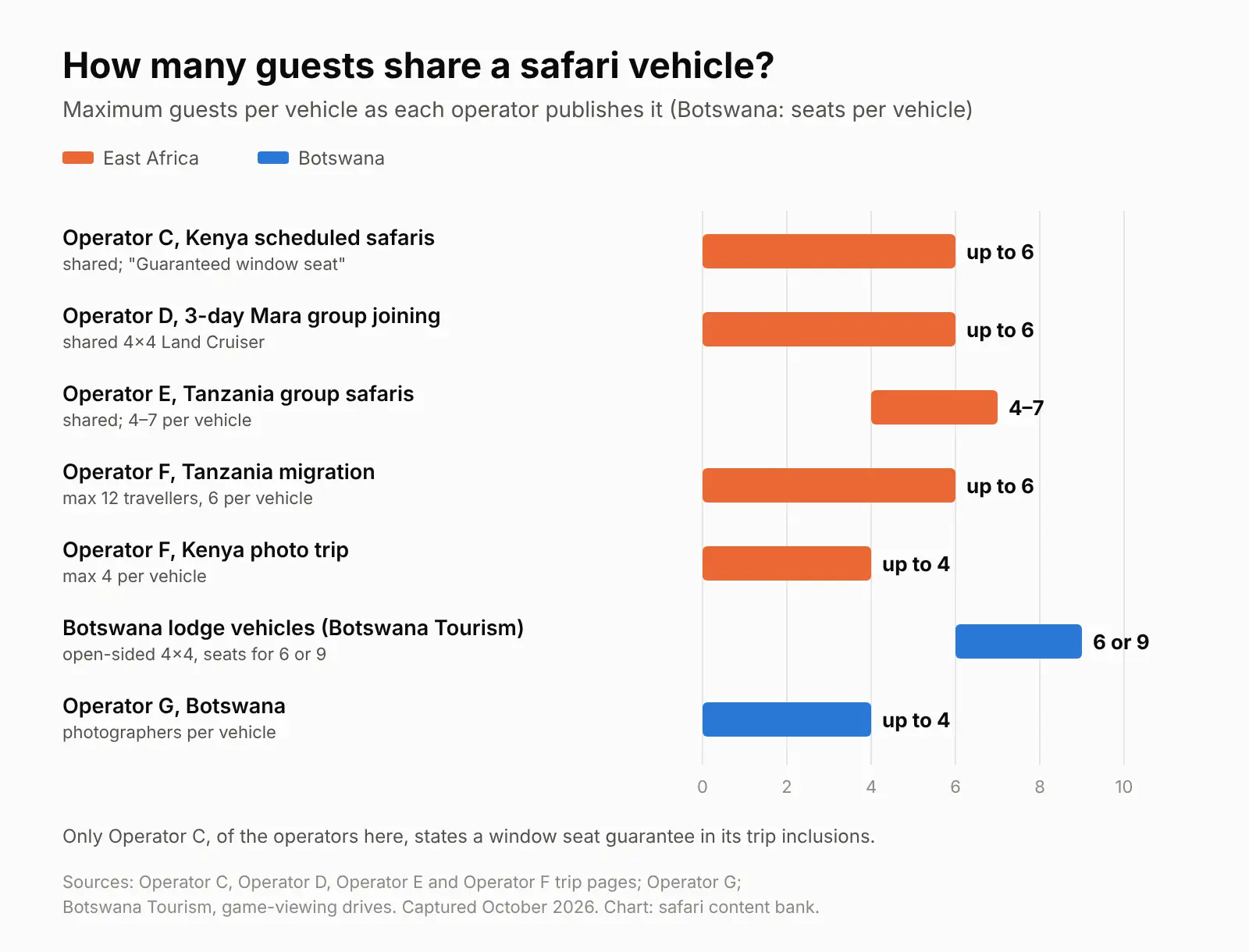 Operators’ published maximums, captured October 2026. Sources: Operator C; Operator D; Operator E; Operator F; Operator G; Botswana Tourism. Chart: safari content bank.
- “Window seat” means something different in each vehicle. In a pop-top, six or seven guests can each have a side window; in a nine-seat Botswana vehicle, the middle seat of a row is not beside the open side. Ask whether the middle seat is sold.
- Operator A says reputable operators cap shared vehicles at six so everyone has a window or outside seat. That is a seller’s standard, not a rule.
- Travellers name smaller caps on forums: Kwara (Botswana) at 4 guests to a vehicle with a scout as well as a guide (TripAdvisor, Botswana forum) and Offbeat’s Mara camps at 4 (TripAdvisor, Mara forum). Traveller reports; neither camp’s own figure is in our sources.
What does a private vehicle cost?
On published rate cards a private vehicle costs US$385–935 a day or night at camps in East and Southern Africa, and R6,350–25,000 a day at South African lodges; on an East African road safari the vehicle is private by default.
| Camp or operator (country) | Private vehicle price | Year | Notes | Source |
|---|---|---|---|---|
| Governors’ Camp, Masai Mara (Kenya) | US$385 a day (Jan–Jun, Nov–15 Dec); US$512 (Jul–Oct, 16–31 Dec) | 2026 | Up to 6 guests; optional | Governors’ 2026 (PDF) |
| Machaba Camp, Khwai (Botswana) | US$550 a night | 2026 | Required for under-6s | Machaba 2026 |
| Natural Selection, Okavango camps (Botswana) | US$725–935 per vehicle per night | 2026 | Mandatory for children 9 or younger; free for parties of 6–7 | NS 2026 (PDF) |
| Natural Selection (Namibia) | NAD 600 per person per night | 2025 | Supplement per person, not per vehicle | NS Namibia 2025 (PDF) |
| Kwando (Botswana) | US$150–210 per empty seat (Kwara US$300–440) | 2024 | Required under 12 | Kwando 2024 (PDF) |
| Time + Tide (Zambia) | US$570 a night; US$750 with a private guide | 2027 | Optional | Time + Tide 2027 (PDF) |
| The Bushcamp Company, South Luangwa (Zambia) | US$600 a night | 2026 | Optional | Bushcamp Company 2026 rates (PDF) |
| MalaMala Camp (South Africa) | R6,350 a day | 2026 | Under-6s on drives only in a private vehicle | A safari seller’s survey |
| Thornybush Game Lodge (South Africa) | R17,500 a day | 2026 | Under-6s not on shared drives | Thornybush 2026 (PDF) |
| Sabi Sand lodges (Dulini, Londolozi, Sabi Sabi) | R18,150–25,000 a day | 2026 | Exclusive-use vehicle supplements | A safari seller’s survey |
| Singita Sweni and Ebony (South Africa) | R22,050 a day; free for parties of 4+ | 2026 | Required for parties with under-10s | A safari seller’s survey |
| Tswalu (South Africa) | Included in every booking (vehicle, guide and tracker) | 2026 | Tswalu rates |
Published rate cards as linked, read 8–10 October 2026; figures from a safari seller’s survey come from 2026 rate cards. The same figures appear on our single supplements and child rates and family safari pages.
East Africa by road: the vehicle is yours anyway
On a Kenyan or Tanzanian road safari you usually pay for the whole vehicle and driver-guide, so “private” is the default and sharing is the discount.
| Item | Price | Source |
|---|---|---|
| Tanzania: private Land Cruiser + driver-guide | US$200–300 per vehicle per day, the same for 2 or 6 people | Operator A |
| Kenya: Land Cruiser with driver-guide from Nairobi, market range | US$120–180 per day, before fuel | A safari price aggregator, Aug 2026 |
| Kenya: self-drive Land Cruiser, 6 seats, pop-top, 3–6 days’ hire | €129 a day (Mar–May), €149 shoulder, €159 (Jul–Sep); unlimited mileage | Operator I, car rental (year not stated on the page) |
| Ngorongoro Crater descent | US$295 per vehicle per descent (NCAA’s page does not say whether VAT is included) | NCAA |
Prices as on our Tanzania safari cost and Kenya safari cost pages, read 9 October 2026.
- Per-vehicle charges fall on one person when you travel alone. The crater fee is US$295 for one person, US$147.50 each for two and US$49.17 each for six (our sums).
- A private vehicle does not always let a younger child in. At Londolozi a private Land Rover (R25,000 a night) does not admit under-6s; at Savanna a vehicle (R18,950 a day) does not waive the 8+ rule; at Makanyi a vehicle (R62,000 a night) does not waive 12+ (a safari seller’s survey of 2026 rate cards).
Does the vehicle matter?
It matters most for photographers, tall or less mobile travellers and winter trips in Southern Africa; for most first safaris, how many people share it and where it may drive matter more than its sides.
| If you… | What to know | Source |
|---|---|---|
| Photograph seriously | A full row each, mounts and off-road positioning are the difference; photographic vehicles take 3–4 guests (Operator A); Operator G caps at 4 | Operator A; Operator G |
| Are tall | Pop-top side windows can sit below a tall person’s eye line; Operator A cites a 6’5” traveller who had to crouch | Operator A (traveller report) |
| Have stiff knees or limited mobility | Pop-tops are easier to board; open vehicles have a higher step | Operator A |
| Travel June–August in Southern Africa | Winter mornings on open vehicles are cold: travellers report 7–12 °C in Botswana | TripAdvisor (traveller report) |
| Spend long days on the road | Closed vehicles protect you on long road transfers; Operator A calls open vehicles unsuitable for them | Operator A |
| Want night drives or off-road | Choose the land, not the vehicle: conservancies, private reserves and concessions | Botswana Tourism; Narok County plan |
- Ask for a photograph of the actual vehicle. A Botswana forum thread calls it the most under-checked item in a booking (TripAdvisor, traveller report).
- Seven questions to put to the operator. Make, model and year, open or closed; maximum guests and whether a window seat is guaranteed; whether the same vehicle and guide stay throughout; whether the guide drives and there is a tracker; fridge, charging and spare wheels; whether night drives, off-road driving and walking are possible where you stay; and what a private vehicle costs and whether it changes the minimum age for children (the first five follow Operator A’s list).
See also: Photography safari and Accessible safari.
Common mistakes about safari vehicles
| What you’ll often read | What is correct |
|---|---|
| “Open vehicles are banned in Tanzania” | No official ban in the texts we hold. TANAPA’s last published tariff (2023/24) says “Open vehicles will be charged 50% extra”. The closed-vehicle rule for Ngorongoro is stated by operators; the NCAA guidelines we hold set a 4×4 and 3,500 kg tare limit. |
| “Conservancies allow only two to five vehicles per sighting” | No Mara conservancy publishes a cap. The five-vehicle rule is the reserve’s. Lewa (two) and Ol Pejeta (six) are in Laikipia. |
| “A window seat is always guaranteed” | Only where the operator writes it down. Operator C does; the other operators in our table publish a maximum per vehicle and no seat promise. |
| “An open vehicle means off-road driving” | The land decides. Lodge vehicles in Chobe and Moremi are open-sided, and off-roading is still prohibited there (Botswana Tourism). |
| “Luxury means a private vehicle” | At most luxury camps you share the camp’s vehicles with other guests. An exclusive vehicle is an extra: US$385–512 a day at Governors’ Camp. |
| “Book a private vehicle and any age is fine” | Not everywhere: at Londolozi, Savanna and Makanyi a private vehicle does not lower the minimum age of 6, 8 or 12 (a safari seller’s survey, 2026). |
| “The Ngorongoro crater fee is per person” | It is US$295 per vehicle per descent. |
Frequently asked questions
Will I get an open or a closed safari vehicle? It depends on the country and the land. Kenyan and Tanzanian road safaris use closed 4x4s or minibuses with a pop-up roof, according to operators. Botswana Tourism says its lodges use open-sided 4x4s with six or nine seats, and South Africa’s private reserves drive open lodge vehicles with a guide and tracker.
Are open safari vehicles banned in Tanzania? We found no official ban. TANAPA’s last published tariff (2023/24) says “Open vehicles will be charged 50% extra” on vehicle entry. Operators such as Operator H and Operator A say the Ngorongoro Crater requires closed vehicles; the NCAA guidelines we hold allow “Only 4×4 vehicles up to 3,500 Kgs of tare weight” on the crater floor.
How many vehicles are allowed at a sighting? Five in the Masai Mara reserve; any further vehicle waits at least 100 metres away, under Narok County’s management plan. No Mara conservancy publishes its own limit. In Laikipia, Ol Pejeta allows six vehicles for 10 minutes each and Lewa two; for the Serengeti, Kruger, Chobe and Moremi we found no published cap.
How many people share a safari vehicle? Shared trips in our sources publish four to seven guests per vehicle: up to 6 with Operator C and Operator D in Kenya, 4–7 with Operator E in Tanzania. Botswana Tourism says lodge vehicles seat six or nine. Photographic operators cap lower: Operator G at four photographers.
Is a window seat guaranteed on safari? Only if the operator says so in writing. Operator C’s Kenya scheduled safaris list a “Guaranteed window seat” with up to 6 passengers; the other operators we checked publish a maximum per vehicle and no seat promise. In a nine-seat open vehicle, ask whether the middle seat is sold.
How much does a private safari vehicle cost? On 2026 rate cards, US$385–512 a day at Governors’ Camp in the Masai Mara, US$550 a night at Machaba and US$725–935 a night at Natural Selection’s Botswana camps; Time + Tide charges US$570 a night (2027). South African lodges charge R6,350–25,000 a day. In Tanzania a Land Cruiser with driver-guide costs about US$200–300 per vehicle per day for the whole trip (Operator A).
Can a private vehicle drive off-road or at night in a national park? No. Off-road and night driving are not allowed in private vehicles in Kruger, and Botswana Tourism says “off-roading and night driving [are] prohibited” in Botswana’s parks and reserves. In the Mara reserve, vehicles leave the tracks only to approach big cats on nearby open ground, no closer than 25 m.
Sources
- Rules: Narok County’s Greater Maasai Mara Ecosystem Management Plan, as reported by Business Daily; Mara Conservancy park rules; Kenyans.co.ke on private vehicles; OPC Tariff Guide 2026; Lewa Code of Conduct; NCAA visitor guidelines; Botswana Tourism, game viewing; SANParks rules; Sabi Sand access; Gorongosa park fees and rules
- Fees: TANAPA, Tariffs 2023/24 (PDF), the last published tariff; NCAA, tariffs; Kenya Wildlife Service, Fees Regulations 2025, Legal Notice 160 of 2025 (PDF)
- Vehicle types, named as sellers: Operator A, safari vehicles glossary; Operator B, safari vehicles; Operator H, flying or driving; Operator I, driving in Tanzania
- Guests per vehicle: Operator C; Operator D; Operator E; Operator F, Tanzania and Kenya; Operator G
- Private vehicles: rate cards of Governors’ Camp 2026, Machaba 2026, Natural Selection 2026, Kwando 2024, Time + Tide 2027, Bushcamp Company 2026, Thornybush 2026 and Tswalu; a safari seller’s survey of child policies in Kruger and Sabi Sands (2026 rate cards); Operator A, Tanzania safari cost; a safari price aggregator; Operator I, Kenya car rental
- Traveller reports, not facts: a safari booking site’s Mara reviews; TripAdvisor threads as linked in each section
Rules and prices checked 8–10 October 2026. We will update this page when TANAPA publishes a new tariff, when NCAA or KWS publish a written rule on open vehicles, when any Mara conservancy publishes a sighting limit, and when camps issue 2027 rate cards.