 Experience

Last verified · Next check due
On this page
- Kenya safari risks at a glance (October 2026)
- What do the UK and US governments advise for Kenya?
- Is it safe around wildlife in Kenya’s parks?
- How dangerous are Kenya’s roads for safari travellers?
- Where is crime a risk on a Kenya safari?
- Health: malaria, yellow fever, Ebola and medical evacuation
- Scams and money
- Solo, women and LGBT travellers
- What changed in 2025–2026
- Common mistakes about Kenya safari safety
- Frequently asked questions
- Sources
Short answer: The risks you can measure on a Kenya safari are malaria, roads and paperwork, not animals or crime in the parks. Malaria risk runs all year in every safari area (WHO). Since 5 October 2026 arrivals have needed a government health policy, up to US$44 (eCitizen). As of 11 November 2026 Kenya had 9 confirmed Ebola cases in one cluster, none since 20 October (ECDC), and no travel restrictions of its own; the US has rated Kenya Level 3 since 19 October.
Key facts
- Kenya has required a government travel health policy for arrivals since 5 October 2026 (U.S. Embassy Nairobi), up to US$44 per person (eCitizen); your own travel insurance is not accepted in its place.
- Malaria risk exists all year in the entire country, mainly P. falciparum, with low risk only in Nairobi and in highlands above 2,500 m (WHO country list, 2022 edition).
- A yellow fever certificate is required only from travellers aged 1 or over arriving from a country with yellow fever risk (WHO); WHO recommends the vaccine for most of Kenya from 9 months of age.
- As of 11 November 2026 Kenya had 9 confirmed Ebola cases and 2 deaths, all in one cluster of known contacts, and the last case was reported on 20 October (ECDC, 28 Oct 2026); Kenya itself has imposed no travel restrictions, and arrivals at JKIA from ten countries get enhanced screening.
- Kenya Wildlife Service (KWS) parks require you to stay in your vehicle outside designated areas, keep 20 m from wildlife and drive at 40 km/h or less, with gates open 06:00–18:00.
- No traveller report in our 2024–26 review set describes an animal attack or a crime inside a park; the safety advice travellers give is about Nairobi and the coast after dark.
Kenya safari risks at a glance (October 2026)
Most of the measurable risk sits outside the parks: on the road, in the mosquito season that never ends, and in the paperwork. Each row gives the evidence, the place it applies and the source with its date.
| Risk | What the evidence shows | Where it applies | Source and date |
|---|---|---|---|
| Official travel advice | The FCDO and US State Department both publish Kenya pages with areas they advise against; the US raised Kenya to Level 3, “Reconsider Travel”, on 19 Oct 2026 “due to health risks”; on 6 Nov 2026 the FCDO added advice against all but essential travel to Moyale town on the Ethiopian border and up to 5 km around it | Country-wide map on each page; Moyale and its border crossing | FCDO Kenya, updated 6 Nov 2026; Citizen Digital, 7 Nov 2026; US State Department, Kenya advisory, 19 Oct 2026 |
| Malaria | Risk all year, mainly P. falciparum; tablets recommended: atovaquone/proguanil, doxycycline or mefloquine | Whole country; low in Nairobi and above 2,500 m | WHO country list (2022, rev. Jan 2023); TravelHealthPro Kenya, read 8 Oct 2026 |
| Ebola | 9 confirmed cases and 2 deaths, all in one cluster (Bundibugyo virus), the last reported on 20 Oct 2026; six patients recovered by 6 Nov 2026; no travel restrictions of Kenya’s own, but Saudi Arabia, Kuwait and Madagascar restrict travellers who were in Kenya in the previous 21 days; enhanced screening at JKIA for arrivals from ten countries | One cluster; point of entry; onward travel | Ministry of Health; Daily Nation, 23 Oct 2026; ECDC, 23 Oct 2026; ECDC, 28 Oct 2026; Kenyans.co.ke, 6 Nov 2026; HapaKenya, 2 Nov 2026 |
| Wildlife | Park rules: stay in the vehicle, 20 m minimum distance, 40 km/h, no off-road driving | KWS national parks | KWS Amboseli page, read 8 Oct 2026 |
| Roads | Experienced drivers on the forums say never drive at night; most visitors are driven, not self-driving | Inter-park roads, Nairobi traffic | TripAdvisor, “Driving in Kenya”; Routard, Aug 2026 |
| Street crime | Advice is consistent: no walking after dark, valuables out of sight, use Uber, Little or yellow taxis | Nairobi; Diani and the coast after dark | TripAdvisor, “Safe?” (Nairobi) |
| Scams | Look-alike eTA sites charged US$129 and nearly AUD 500 for a US$30 document; some operators took deposits and failed to deliver | Online, before you travel | TripAdvisor, “Reliable third party for visa”; a safari booking site’s 1-star reviews |
| Medical evacuation | AMREF Flying Doctors sells 15–30-day evacuation cover from US$10 to US$80 | Kenya and East Africa | AMREF Flying Doctors (flydoc.org), page modified 8 May 2026 |
Official pages and traveller sources as linked, read 8–10 October 2026. Forum and review lines are travellers’ reports, not official findings.
What do the UK and US governments advise for Kenya?
Both governments publish area-by-area advice for Kenya; the UK FCDO page was last updated on 6 November 2026, and the US State Department raised Kenya to Level 3, “Reconsider Travel”, on 19 October 2026 “due to health risks”. The UK FCDO page (updated 6 November 2026, when it added advice against all but essential travel to Moyale town on the Ethiopian border and up to 5 km around it, including the border crossing, after fighting in Ethiopia spilled across the border) lists the areas it advises against (UK FCDO; Citizen Digital, 7 Nov 2026). The FCDO does not advise against travel to Kenya as a whole. Apart from Moyale, neither page’s list of advised-against areas is reproduced here: our source bank recorded their entry and health sections on 9 October 2026, not their safety maps, and we do not print advice we have not read. Open both pages before you book, and again the week you travel.
- What the entry pages say (read 9 October 2026): an eTA is required before travel, the local authorities recommend applying at least 2 weeks ahead, and passports need 6 months’ validity and 2 blank pages (FCDO entry requirements).
- Neither page mentioned the new visitor health insurance when the bank read them on 9 October 2026, although the eTA portal already required it.
- Check your policy wording against the advice. If the FCDO or the State Department advises against travel to a place on your route, ask your insurer whether you are still covered there, and ask your operator what its contract says about a government travel warning.
Is it safe around wildlife in Kenya’s parks?
Yes, if you follow the park rules: stay in the vehicle outside designated areas, keep your distance and let the driver-guide decide when anyone gets out. The rules are short and published.
| Where | Rule | Source |
|---|---|---|
| KWS national parks (Amboseli, Tsavo, Nakuru, Meru and others) | Gates 06:00–18:00; “Remain in your vehicle unless in designated areas”; maximum 40 km/h; off-road driving “strictly prohibited”; view wildlife from at least 20 m; no feeding; “Visitors enter the park at their own risk” | KWS park page, read 8 Oct 2026 |
| Maasai Mara National Reserve (Narok County) | Off-road driving prohibited except to approach big cats on nearby open ground, no nearer than 25 m; if five vehicles are already at a sighting, wait at least 100 m away | Greater Maasai Mara Ecosystem Management Plan 2023–2032, via Business Daily |
| Mara Triangle (Mara Conservancy) | 50 km/h on graded roads, 30 km/h on other tracks; fines paid on the spot; not paying can mean a six-month ban | Mara Triangle park rules |
| Walking safaris in KWS parks | Sold in Tsavo East, Tsavo West, Meru and Kora, at US$50 per person per day with a ranger, group of 10 or fewer, plus the park fee | KWS Legal Notice 160 of 2025 |
- Night drives are not sold inside the Mara reserve. Mara conservancies sell night drives and guided walks, which is part of what their US$130 nightly fee buys (see the Kenya safari cost page).
- The Mara ticket runs 06:00–18:00, so vehicles are out of the reserve, or in camp, after dark (Mara Conservancy fee page).
- Animal incidents are rare in the record we read. An 81-reply French forum thread on whether safari vehicles need grilles ends with the regulars’ verdict that incidents happen about “once every ten years” and that the road to the park is the real risk (Routard, last post Jan 2026). No review on a safari booking site or forum thread in the set we read reports an animal incident.
- Fresh water carries bilharzia. Do not wade, swim or bathe in lakes and rivers; chlorinated pools and the sea are safe (TravelHealthPro).
How dangerous are Kenya’s roads for safari travellers?
The road between parks is the risk travellers and residents name most often, and the advice is the same everywhere: do not drive at night. We found no official road-casualty figure for tourists in our sources, so we don’t print one.
- Most visitors are driven. Self-drive is legal but a minority choice; French forum regulars cite Nairobi traffic, aggressive overtaking, speed bumps and night driving as reasons (Routard, “Safari sans agence au Kenya”). One regular wrote: “Je déconseille formellement de conduire soi-même au Kenya” (Routard, Aug 2026).
- “Never at night.” An experienced local driver on the English forum says a competent defensive driver can manage outside the cities, but never after dark (TripAdvisor). Kenya has no published rule banning tourists from the roads after dark in the sources we read; Tanzania’s operators apply one (see Is a Tanzania safari safe?).
- The Mara road is tarmac to Sekenani Gate (Mara Conservancy). Nairobi to Sekenani takes 5.5–6 hours; the western gates, Musiara and Oloololo, take about 6.5 hours (The Kenya Times, 20 Aug 2026).
- Vehicle condition is an operator question. French and German forum threads describe budget operators’ vans with worn tyres and faulty brakes (Routard; HolidayCheck). Check the operator’s licence first (how to check a safari operator’s licence).
Where is crime a risk on a Kenya safari?
In Nairobi and on the coast after dark, not in the parks. Forum residents and regulars give the same short list, and no traveller account we read reports a crime inside a park or camp.
| Place | What residents and regulars advise | Source |
|---|---|---|
| Nairobi | “Generally safe for visitors”; keep valuables out of sight; don’t walk after dark; no earbuds or phone-staring in the street; yellow airport taxis have fixed fares; Uber and Little are popular | TripAdvisor, “Safe?” |
| Nairobi airport layovers | At night stay in a hotel or lounge; nothing is open and walking is discouraged | TripAdvisor, 12-hour layover |
| Diani beach | Safe by day; persistent selling on the main beachfront, especially on days one and two; tuk-tuk or taxi after dark | TripAdvisor, “Safety of area” |
| The coast (“beach boys”) | Hassle is heaviest on Mombasa’s north coast, central Diani and Malindi; calmer at Galu, Tiwi, Msambweni, Shimoni, Watamu, Shela (Lamu) and Kilifi. A nuisance, not a safety finding | TripAdvisor, “Best beaches” |
- Uber is not the risky option. A Nairobi destination expert on TripAdvisor uses it “all the time”; a hotel transfer buys vetting and waiting time, not safety (TripAdvisor).
- Protests are a city matter in the reports we have. A French traveller back from Kenya in 2026 reported “très très nombreux contrôles de police” and violent riots; the thread’s regulars say demonstrations stay mostly urban (Routard, Aug 2026). Check the FCDO page for current events before you travel.
Health: malaria, yellow fever, Ebola and medical evacuation
Malaria is the health risk that applies to every Kenya safari; the yellow fever certificate applies only if you arrive from a risk country; Ebola cases are in one cluster, with screening at entry. Health rules change, so see a travel clinic and check the official pages before you go.
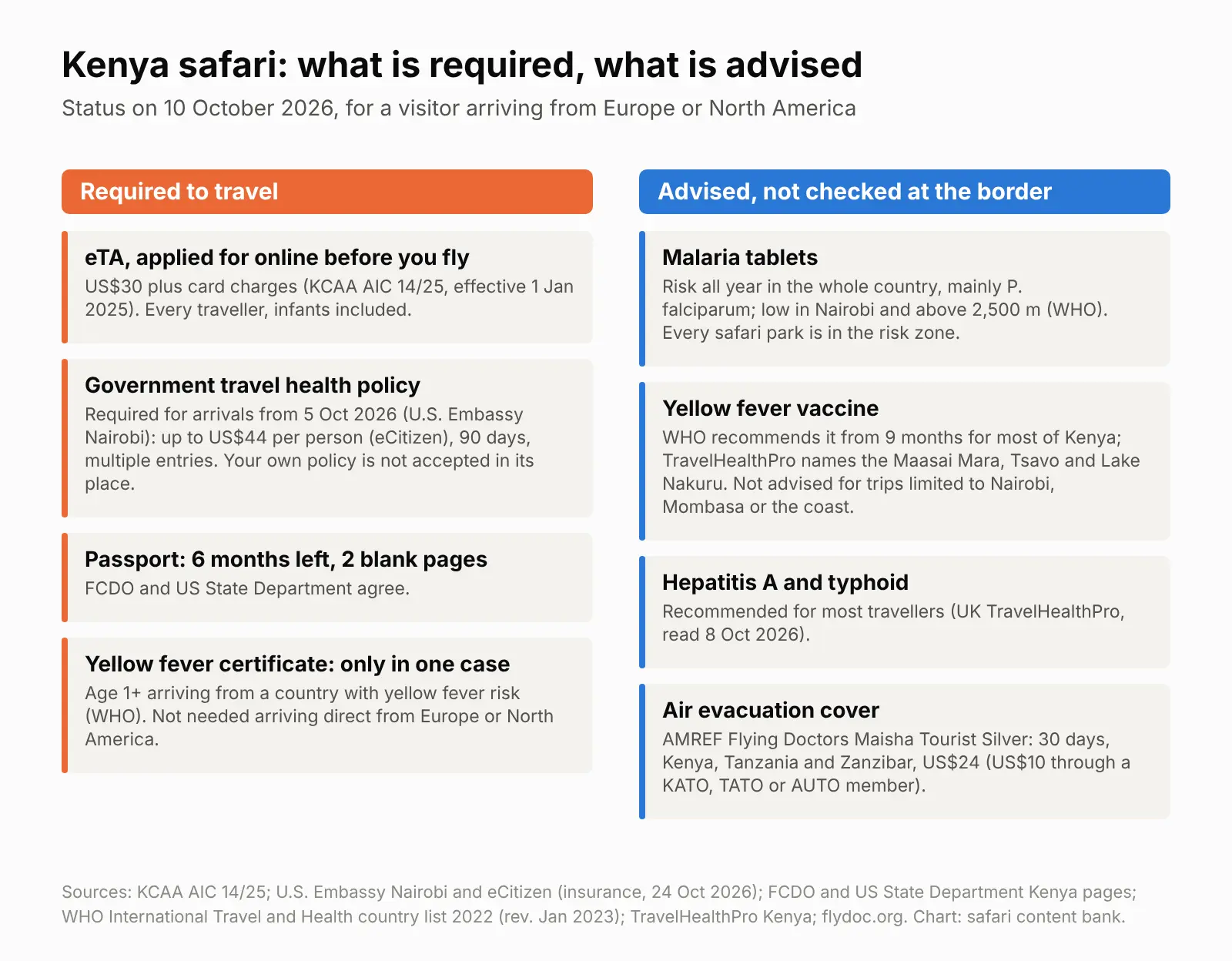 Status on 10 October 2026. Sources: KCAA AIC 14/25; U.S. Embassy Nairobi and eCitizen (insurance, 24 Oct 2026); FCDO and US State Department; WHO country list 2022 (rev. Jan 2023); TravelHealthPro Kenya; flydoc.org. Chart: safari content bank.
Malaria
WHO: “risk due predominantly to P. falciparum exists throughout the year in the entire country”; risk is low in Nairobi and in highlands above 2,500 m (WHO country list, 2022 edition, rev. Jan 2023). Every safari park is in the risk zone, and so is the coast.
| Tablet (UK guidance) | Start | After leaving |
|---|---|---|
| Atovaquone/proguanil | 1–2 days before, daily | 7 days |
| Doxycycline | 1–2 days before, daily | 4 weeks; not for under-12s |
| Mefloquine | 2–3 weeks before, weekly | 4 weeks |
Source: TravelHealthPro Kenya, read 8 Oct 2026. Children’s doses are weight-based. Avoid bites day and night: repellent, long sleeves in the evening, nets.
Yellow fever
A certificate is required only from travellers aged 1 year or over arriving from a country with yellow fever risk (WHO; the FCDO and US State Department say the same). Arriving direct from Europe or North America, you need no certificate.
- WHO recommends the vaccine for all travellers aged 9 months or over except for trips limited to the former North Eastern Province, the coastal counties of Kilifi, Kwale, Lamu, Malindi and Tana River, and the cities of Nairobi and Mombasa. TravelHealthPro names Tsavo East and West, the Maasai Mara and Lake Nakuru as transmission-risk areas.
- Travellers aged 60 or over should not receive it for low-exposure travel only (TravelHealthPro).
- Going on to Tanzania? Carry the card. Kenya is a yellow fever risk country, so Tanzania asks arrivals from Kenya for the certificate, including after a transit of more than 12 hours (WHO, Tanzania entry). Planning both countries: see Kenya vs Tanzania. Arriving in Kenya from Uganda also needs one, even though Uganda stopped requiring it on 2 October 2026 (Uganda immigration notice).
- Certificates are valid for life (WHO, from 11 July 2016).
Ebola
Kenya confirmed its first imported case of Ebola disease (Bundibugyo virus) on 6 October 2026. It has 9 confirmed cases and 2 deaths, all in one cluster of known contacts, and the last case was reported on 20 October (Ministry of Health; ECDC, 28 Oct 2026). The first 20 contacts left quarantine on 26 October after 21 days without symptoms (WHO Africa, 26 Oct 2026) and 46 more on 3 November. Six patients had recovered by 6 November and one was still in treatment on 10 November; 66 contacts have completed 21 days of monitoring and the last 52 were due to finish on 11 November (Kenya News Agency, 3 Nov 2026; Kenyans.co.ke, 6 Nov 2026; Healthcare MEA, 10 Nov 2026). The 42-day countdown to declaring the outbreak over starts only when the last patient leaves treatment, so the end cannot come before the second half of December 2026. The ministry reported no evidence of community spread. The wider epidemic is centred in DR Congo. Kenya has imposed no travel or trade restrictions, and WHO advises against them (ECDC, 23 Oct 2026). Other countries can still restrict people who were in Kenya. Since 30 October 2026 Saudi Arabia has refused entry to anyone who has been in Kenya in the previous 21 days, including travellers arriving through a third country, has stopped issuing visas to travellers from Kenya and has suspended its citizens’ travel to Kenya; the ban was still in force on 10 November, and Kenya and Africa CDC have asked for a review (Saudi Gazette, 30 Oct 2026; Asharq Al-Awsat, 30 Oct 2026, both reporting the Saudi authorities). Kuwait has told airlines not to board passengers from Kenya until 21 days after they left, reportedly including people who connect elsewhere (HapaKenya, 2 Nov 2026; Nation, November 2026). Since 1 November Madagascar has restricted or quarantined travellers who were in or passed through Kenya in the previous 21 days; reports differ on exactly who is affected (Pulse Kenya, 2 Nov 2026; The Kenya Times, 2 Nov 2026). These are press reports, checked 11 November 2026. If your trip continues to one of them within 21 days of leaving Kenya, check with your airline before you book. Since 7 October, arrivals at Nairobi’s JKIA from ten countries, including Uganda, Tanzania and DR Congo, have had enhanced screening and a health declaration (Kenyans.co.ke, 7 Oct 2026). The US rates Kenya Level 3, “Reconsider Travel”, since 19 October 2026 (State Department). Since 11:59 pm US Eastern time on 3 November 2026, everyone boarding an international flight to the United States, US citizens and airline crew included, must sign a statement that they have not been in DR Congo, even to change planes, in the 21 days before the flight; anyone who has been there is not allowed to board, and the order runs to 18 December 2026 unless amended (US CDC attestation order, issued 22 October 2026 and amended 28 October 2026; Federal Register 2026-22211, 30 October 2026; checked 11 November 2026). If your trip did not include DR Congo, you only need to sign the attestation your airline asks for. This is the fastest-moving item on the page; follow your own government’s travel and health advice the week you fly. Status as of 11 November 2026; JKIA screening as of 31 October 2026.
Insurance and medical evacuation
Since 5 October 2026, visitors arriving in Kenya have needed a government-scheme travel health policy (U.S. Embassy Nairobi), up to US$44 per person, valid 90 days with multiple entries (eCitizen). Buy it in the eTA application or on the eCitizen insurance portal. The rule comes from Gazette Notice No. 11492 of July 2026 under the Social Health Insurance Act 2023. The High Court suspended it on 24 August 2026 (Kenyans.co.ke, 25 Aug 2026), and the challenge was reported dismissed in early October (VisasNews, 6 Oct 2026; VisasNews, 7 Oct 2026). Your own travel insurance is not accepted in its place under the current guidance. Buy only through the official eTA portal or eCitizen before you apply. Full details: Kenya visitor insurance.
AMREF Flying Doctors, based in Nairobi, sells short-stay evacuation cover called Maisha Tourist. It is an evacuation subscription, not full health insurance (flydoc.org, page modified 8 May 2026):
| AMREF Maisha Tourist tier | Days | Countries | Price (via a KATO/TATO/AUTO member operator) | Price (others) |
|---|---|---|---|---|
| Bronze | 15 | Kenya | US$10 | US$16 |
| Silver | 30 | Kenya, Tanzania, Zanzibar | US$10 | US$24 |
| Gold | 30 | + Uganda, Rwanda, Burundi | US$24 | US$32 |
| Platinum | 30 | + Ethiopia, South Sudan | US$80 | US$80 |
- What it covers: unlimited evacuation flights to Nairobi during the cover period, a 24-hour medical helpline and unlimited ground ambulance within Kenya. Emergency number: +254 20 699 2299. The terms and exclusions are in AMREF’s own PDF; read them before you buy.
- Tourist Plus adds inpatient cover up to US$200,000, hospitalisation in Nairobi and transfer to South Africa if needed: Bronze Plus US$35, Silver Plus US$50, Gold Plus US$60, Platinum Plus US$100.
- Ask your operator whether it is already in your safari price. AMREF gives operators that are KATO, TATO or AUTO members a lower rate.
Scams and money
The scams that cost Kenya visitors the most money in 2024–26 happened online, before the trip: look-alike eTA sites and operators that took deposits and failed to deliver.
- Apply for the eTA only at etakenya.go.ke. The fee is US$30 plus card charges (KCAA AIC 14/25, effective 1 January 2025). One traveller paid US$129 to a look-alike site and got nothing; another paid “nearly $500 aud” to a reseller (TripAdvisor).
- Don’t apply too early. An immigration email quoted on the forum says the eTA is “valid starting from the date of approval till after 3 months” (TripAdvisor).
- Operator failures are individual cases, but costly. A safari booking site’s rare 1-star Kenya reviews are almost all operator failures, including “we have lost our money $4,500 USD” (Jan 2024); five French accounts from 2023 describe losses of €400–2,100 with one guide (Routard). Check the Tourism Regulatory Authority register and KATO membership first: how to check a safari operator’s licence.
- Requests to “sponsor” someone met on safari: the German forum’s verdict is “Hände weg!” (hands off); give through a registered organisation (HolidayCheck).
Money: park gates are cashless, camps want small, recent US dollar notes.
- KWS parks have taken no cash since 1 November 2025. Fees go through KWSPay (M-Pesa, card, bank transfer), with facilitation charges added (Kenyans.co.ke, 1 Nov 2025). The Mara Triangle takes no cash either (Mara Conservancy).
- Card terminals and portals fail at times. A backpacker in August 2026 reported terminals rejecting cards at park entrances, and the Nairobi National Park eCitizen portal “had failed for almost the whole day” (TripAdvisor). Carry a second card.
- US dollar notes should be series 2009 or newer, in small denominations; older notes are often refused (a camp operator’s tipping guide).
- M-Pesa does not work across the border in Tanzania (TripAdvisor).
Solo, women and LGBT travellers
For solo and women travellers the sourced advice is about towns and logistics, not camps; for LGBT travellers we have no sourced facts to print.
- Women travelling alone: forum veterans answer “in camps yes; normal city caution” (TripAdvisor, “Safari Advice”). The town rules in the crime table apply to everyone.
- Solo on a bush flight: scheduled light aircraft need two passengers; a solo booker may be charged for the empty seat or moved to a later flight, though an operator says this is rare (TripAdvisor).
- Travelling alone by public transport: matatus are “gérables” but crowded; regulars say don’t travel at night, and matatus don’t serve park gates (Routard).
- LGBT travellers: our sources hold no official statement on Kenya’s laws or on LGBT travellers’ experience. Check the FCDO Kenya page and the US State Department page before you book; we will add sourced facts here when we have them.
What changed in 2025–2026
Three things changed for safari visitors: entry now needs a health policy as well as the eTA, park fees went cashless, and Ebola cases brought screening at entry.
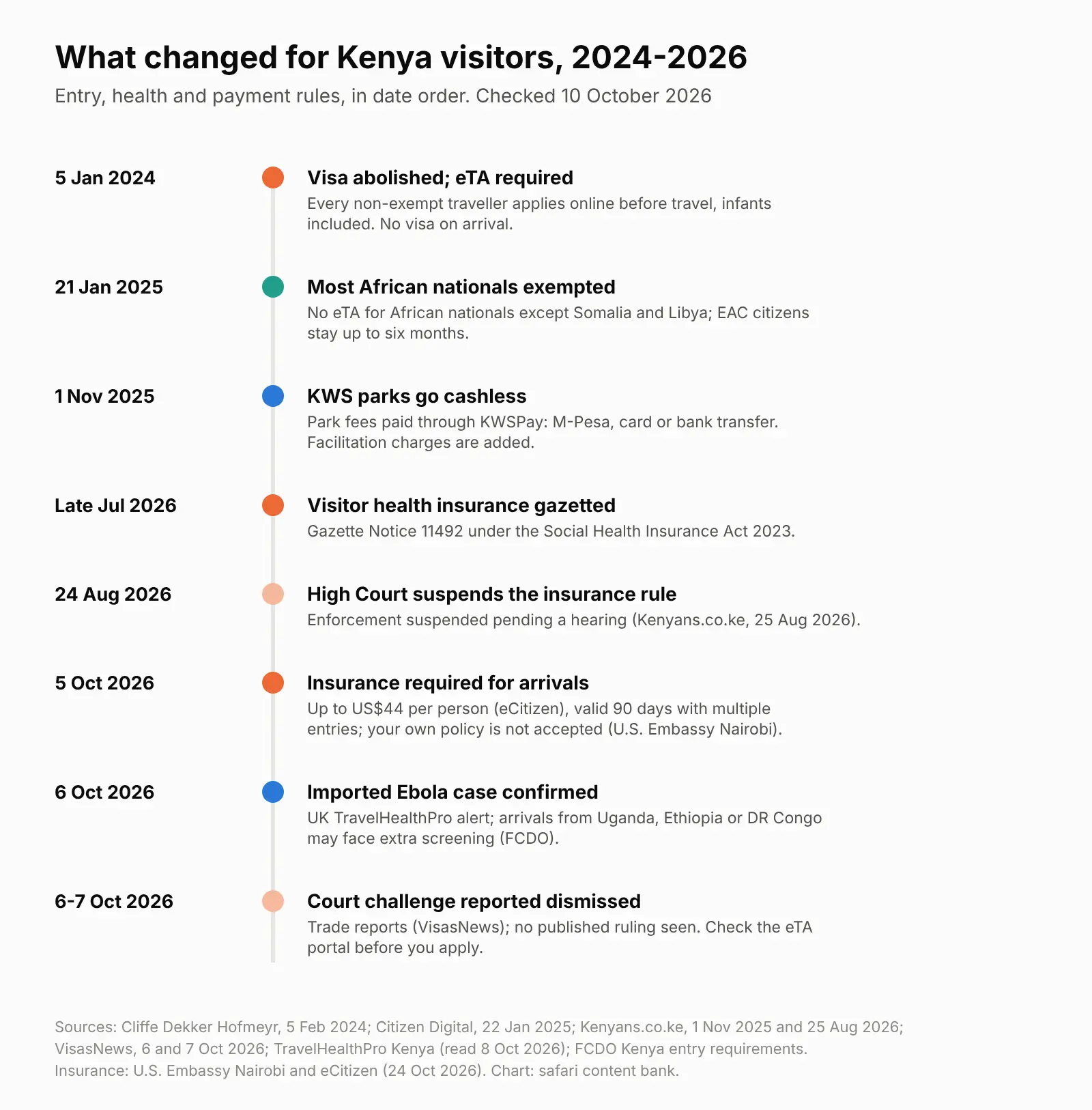 Sources: Cliffe Dekker Hofmeyr (5 Feb 2024); Citizen Digital (22 Jan 2025); Kenyans.co.ke (1 Nov 2025, 25 Aug 2026); VisasNews (6–7 Oct 2026); U.S. Embassy Nairobi and eCitizen (insurance, 24 Oct 2026); TravelHealthPro Kenya (read 8 Oct 2026); FCDO. Checked 10 October 2026. Chart: safari content bank.
- 21 January 2025: African nationals except those of Somalia and Libya no longer need an eTA (Citizen Digital, 22 Jan 2025).
- 1 November 2025: KWS park fees became cashless through KWSPay.
- Late July to 7 October 2026: the visitor health insurance went from gazette notice to court suspension (24 August) to enforcement for arrivals (5 October) to a reported dismissal of the challenge (6–7 October).
- 6–23 October 2026: Kenya’s first imported Ebola case (6 October), enhanced screening at JKIA (from 7 October), and 9 confirmed cases with 2 deaths in one cluster by 23 October (Ministry of Health). The US raised Kenya to Level 3 on 19 October.
Common mistakes about Kenya safari safety
| What you’ll often read | What is correct |
|---|---|
| “The insurance rule was suspended by the court” | True from 24 August 2026; out of date: the policy has applied to arrivals since 5 October 2026 (U.S. Embassy Nairobi), and the challenge was reported dismissed on 6 and 7 October. |
| “Your normal travel insurance satisfies Kenya’s rule” | Your own policy is not accepted in its place under the current guidance (Malaysian High Commission, Nairobi; KCAA circular). |
| “You need a yellow fever vaccine to enter Kenya” | The certificate is required only if you arrive from a yellow fever risk country (WHO). The vaccine is recommended for most of Kenya, but it is not an entry condition from Europe or North America. |
| “Nairobi and the coast are malaria-free” | Only Nairobi and highlands above 2,500 m are low-risk (WHO). The coast and every safari park are in the risk zone all year. |
| “You can get a visa on arrival” | Kenya abolished visas in January 2024. The eTA is applied for online before travel. |
| “Any eTA website will do” | Only etakenya.go.ke is official; resellers have charged travellers US$129 to nearly AUD 500 for a US$30 document. |
| “Safari vehicles need protective grilles” | Kenyan safari vehicles run without them; forum regulars put animal incidents at about once every ten years and call the road the real risk. |
Frequently asked questions
Is it safe to go on a Kenya safari in 2026? The risks we can document for a guided safari are malaria, road travel between parks, and new entry paperwork, not animals or crime inside the parks. Malaria risk exists all year across Kenya, and since 5 October 2026 arrivals have needed a government health policy, up to US$44 (eCitizen). The US has rated Kenya Level 3, “Reconsider Travel”, since 19 October 2026 because of health risks; check the FCDO and US State Department pages for areas they advise against.
Is the Masai Mara safe? No traveller account in our 2024–26 review set reports a crime or an animal incident inside the reserve. The reserve rules keep vehicles on tracks except to approach big cats, no nearer than 25 m, and the ticket runs 06:00–18:00. Malaria tablets are recommended: the Mara is in the year-round risk zone (WHO).
Is Nairobi safe for tourists? Residents and regulars on the TripAdvisor Nairobi forum call it generally safe for visitors, with rules: don’t walk after dark, keep valuables out of sight, and use Uber, Little or yellow airport taxis. For a night layover, stay in a hotel or lounge.
Do I need malaria tablets for a Kenya safari? Yes. WHO says malaria risk, mainly P. falciparum, exists all year in the entire country, with low risk only in Nairobi and above 2,500 m. UK guidance lists atovaquone/proguanil, doxycycline or mefloquine; a travel clinic chooses the drug.
Do I need a yellow fever vaccine for Kenya? Not to enter from Europe or North America: the certificate is required only from travellers aged 1 or over arriving from a yellow fever risk country. WHO recommends the vaccine for most of Kenya, including the safari areas TravelHealthPro names (Maasai Mara, Tsavo, Lake Nakuru). If you continue to Tanzania, Tanzania will ask for the certificate because you are arriving from Kenya.
Is there Ebola in Kenya? As of 11 November 2026 Kenya had 9 confirmed cases and 2 deaths, all in one cluster of known contacts, with no evidence of community spread (Ministry of Health) and no new case since 20 October (ECDC, 28 Oct 2026); six patients had recovered by 6 November, and the outbreak cannot be declared over before the second half of December. Kenya has imposed no travel restrictions, and arrivals at JKIA from ten countries get enhanced screening; Saudi Arabia, though, has refused entry since 30 October 2026 to anyone who was in Kenya in the previous 21 days, Kuwait tells airlines not to board passengers from Kenya until 21 days after they left, and Madagascar has restricted or quarantined such travellers since 1 November (press reports, checked 11 November 2026). Check the official health pages the week you travel; this item changes fastest.
Can I self-drive a safari in Kenya? Yes, it is legal, but few visitors do it and forum regulars advise against it for first-timers because of Nairobi traffic and night driving. If you do, never drive after dark, and check the current Narok County rules before driving into the Mara.
Does a flying-doctor membership replace the new insurance? No. The government policy is bought in the eTA application or on the eCitizen portal, and other cover is not accepted in its place. AMREF’s Maisha Tourist is a separate evacuation subscription, from US$16 for 15 days in Kenya (US$10 through a member operator).
Sources
- UK FCDO, Kenya travel advice (updated 6 Nov 2026: Moyale; Citizen Digital, 7 Nov 2026) and entry requirements, read 9 Oct 2026
- US State Department, Kenya country information (30 Jul 2026) and Kenya travel advisory (Level 3, 19 Oct 2026)
- Ebola, read 24 Oct 2026: Kenya Ministry of Health; Daily Nation, 23 Oct 2026; ECDC, 23 Oct 2026; Kenyans.co.ke, 7 Oct 2026; update checked 31 Oct 2026: ECDC, 28 Oct 2026; WHO Africa, 26 Oct 2026; Kenyans.co.ke, 30 Oct 2026; Citizen Digital, 30 Oct 2026; Saudi entry ban: Saudi Gazette, 30 Oct 2026, Asharq Al-Awsat, 30 Oct 2026; update checked 11 Nov 2026: Kenya News Agency, 3 Nov 2026; Kenyans.co.ke, 6 Nov 2026; Healthcare MEA, 10 Nov 2026; Kuwait and Madagascar: HapaKenya, 2 Nov 2026, Nation, November 2026, Pulse Kenya, 2 Nov 2026, The Kenya Times, 2 Nov 2026; US entry: US CDC attestation order, amended 28 Oct 2026; Federal Register 2026-22211, 30 Oct 2026
- WHO, International Travel and Health country list, 2022 edition (rev. Jan 2023)
- UK NaTHNaC, TravelHealthPro Kenya, read 8 Oct 2026
- Kenya Civil Aviation Authority, AIC 14/25 (PDF); eTA portal
- Insurance rule: U.S. Embassy Nairobi; eCitizen insurance portal; Kenyans.co.ke, 25 Aug 2026; VisasNews, 6 Oct 2026 and 7 Oct 2026
- Kenya Wildlife Service, park page and safety guidelines; Legal Notice 160 of 2025 (PDF)
- Mara Conservancy, park rules and fees; Business Daily on the Greater Maasai Mara Management Plan
- AMREF Flying Doctors, Maisha plans, page modified 8 May 2026
- Traveller reports: TripAdvisor Kenya and Nairobi forums, Routard, HolidayCheck and a safari booking site’s traveller reviews, as linked in each section, read October 2026
Checked 10 October 2026. We will update this page when the FCDO or US State Department changes its Kenya advice, when Kenya publishes the insurance price or a court ruling, and when the Ebola alert changes.
More photos from Kenya
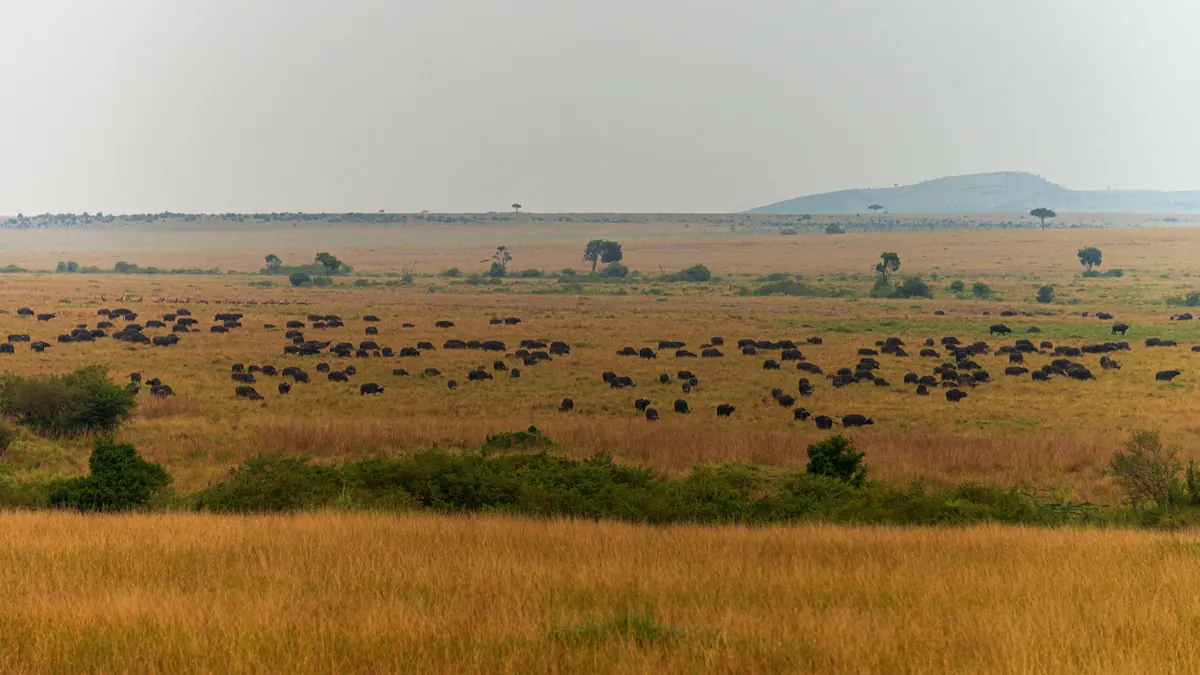
Buffalo herd on the misty savanna at dawn, seen from a balloon. Daniel Case, Wikimedia Commons, CC BY-SA 4.0, cropped 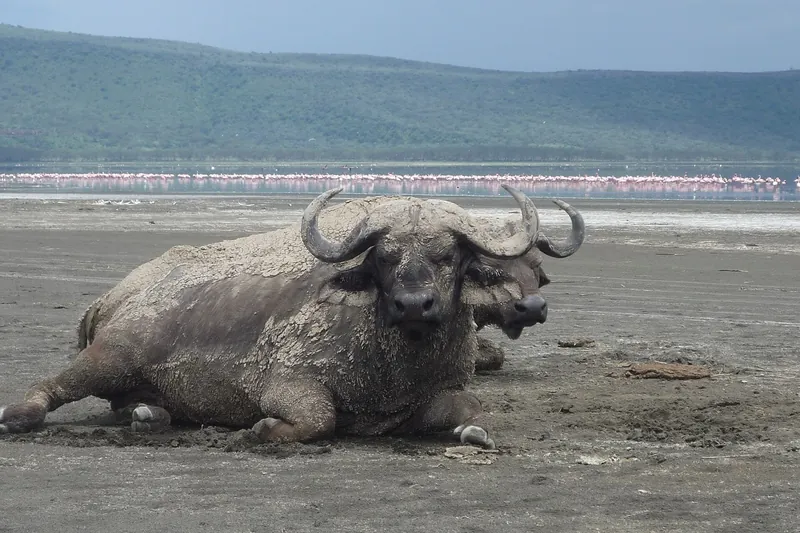
Buffalo resting on the shore of Lake Nakuru. Lmwangi, Wikimedia Commons, CC BY-SA 3.0, cropped 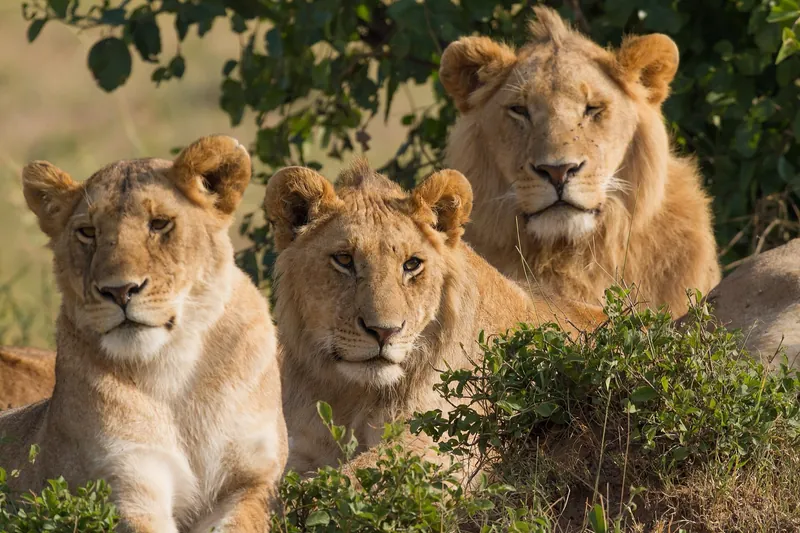
Three lions resting together in the Masai Mara. Benh LIEU SONG, Wikimedia Commons, CC BY-SA 3.0, cropped


Photos by visitors and photographers, used under their free licences. Click a name to see the original.