 Experience

Last verified · Next check due
On this page
- Etosha vs Chobe at a glance (2026)
- Wildlife: waterholes or the river
- Park fees: Etosha vs Chobe
- Self-drive and road access
- Rest camps in Etosha vs Kasane lodges
- Cost per day
- Best months
- Malaria on an Etosha–Chobe trip
- How to combine them: the Caprivi route
- Which to choose
- Common mistakes in Etosha vs Chobe comparisons
- Frequently asked questions
- Sources
Short answer: Choose Etosha (Namibia) to drive yourself in an ordinary car and watch game gather at waterholes from May to October; it charges N$280 per foreign adult plus N$60 per car. Choose Chobe (Botswana) for elephants seen from a boat and Kasane lodges at US$273–550 a night with a drive and cruise; its last published fee is P270 a day (2022). Both are at their best June–October, and the Caprivi (Zambezi Region) links them by road.
Key facts
- Etosha is the self-drive park; Chobe is the boat-and-lodge park. A 2WD car is fine on Etosha’s main gravel roads in the dry season (a safari agent’s Etosha guide, read September 2026); in Chobe a high-clearance 4x4 is needed on every park leg, and only the A33 transit road from Ngoma to Kasane is tar (Botswana self-drive).
- Etosha’s fee is current; Chobe’s is not. Etosha charges N$280 per foreign adult plus N$60 per car since 1 April 2026 (Government Notice 115 of 2026); the notice states no time period, so we count one fee per park day, as MEFT’s 2021 schedule did. Chobe’s last published DWNP schedule (1 April 2022) charges P270 per non-resident adult per day; in February 2026 the government news agency BOPA called the existing fee P380, and a P500 rise was announced, then reported postponed. Confirm it with DWNP or your operator.
- Chobe has buffalo; Etosha does not. Cape buffalo are kept out of Etosha by veterinary policy (a safari agent’s Etosha guide, read September 2026); 91% of one safari operator’s Chobe travellers saw buffalo and 99% elephant (Chobe).
- The usual link is the Caprivi. Etosha’s Namutoni camp to Rundu is 415 km on tar, and Kongola to Kasane via the Ngoma border 250 km, the last 65 km on the A33 through Chobe National Park (Namibia self-drive distances; Namibian rental car across borders).
- Neither area is malaria-free. Swiss TPH says not to treat Etosha as malaria-free; it rates the Zambezi Region high risk all year, and UK TravelHealthPro rates northern Botswana, Chobe included, high risk from October to May (Safari malaria risk).
Etosha vs Chobe at a glance (2026)
Etosha is a fenced waterhole park you can drive in an ordinary car, with state rest camps inside; Chobe’s riverfront is a river park next to Kasane town, watched from boats and lodge vehicles, with almost all the beds outside it. Both charge their top lodge and camp rates from July to October.
| Etosha National Park (Namibia) | Chobe National Park (Botswana) | Source | |
|---|---|---|---|
| Park fee, foreign adult | N$280 per person since 1 Apr 2026, plus N$60 per car; no time period stated | P270 per non-resident adult per day (last published DWNP schedule, 1 April 2022); no official current tariff | Etosha park fees; Chobe park fees |
| Two adults, one day | N$620 with a car, one fee per park day (our sum) | P540, plus a daily vehicle fee with no official published amount (our sum) | same |
| How you watch game | From your car, parked at waterholes along the pan’s edge | Three-hour river cruises from Kasane and game drives on the riverfront track | Etosha; Chobe |
| Vehicle | 2WD on the main gravel roads in the dry season; 4x4 recommended in the wet season and needed for Dolomite Camp | High-clearance 4x4 on every park leg; the A33 from Ngoma to Kasane is tar | A safari agent’s Etosha guide, read September 2026; Botswana self-drive |
| Gates | Sunrise to sunset; Okaukuejo opens 06:10–07:30 and closes 18:25–19:40, by month | April–September 06:00–18:30; October–March 05:30–19:00 (a booking agent’s site, not DWNP) | A safari agent’s Etosha guide, read September 2026; Botswana self-drive |
| Beds inside the park | 6 NWR camps: camping N$460–560 per person, rooms N$1,400–2,380 with breakfast | Ihaha campsite US$40 per person; lodges US$645–1,406 (Savuti and Chobe Game Lodge) | Etosha; Chobe |
| Beds outside | Gondwana’s lodges N$1,980–3,383 per person, B&B, one rate all year | Kasane lodges US$273–550 per person, with a game drive and a river cruise | same |
| Big Five | Four: no Cape buffalo | Buffalo seen by 91%, lion 91%, leopard 59% of one operator’s travellers | A safari agent’s Etosha guide, read September 2026; Chobe |
| Night drives | Only NWR’s guided night drives, about N$620 per person | None in the park, Savuti included | Etosha; Botswana Tourism |
| Best months | May–October; peak September–October | June–October, when game crowds the river | Etosha; Chobe |
| Malaria | Not malaria-free (Swiss TPH) | Northern Botswana high risk October–May, low June–September (TravelHealthPro) | Safari malaria risk |
| Gateway | Windhoek → Okaukuejo 414–435 km on tar | Victoria Falls → Sedudu Gate 80 km, plus the border; Kasane is 6 km from the gate | Namibia self-drive distances; Chobe |
Fees as on our Etosha park fees and Chobe park fees pages: Government Notice 115 of 2026 re-read 9 October 2026; the Chobe fee entries checked 10 October 2026. Camp and lodge rates as on our Etosha and Chobe pages, read September–October 2026; NWR rates are published by booking agents, not by NWR itself. We print each price in its own currency and convert neither pula nor N$ into US dollars.
Wildlife: waterholes or the river
In Etosha the game comes to a few waterholes and you wait in your car; on the Chobe riverfront it comes to the river, and you watch from a boat or a lodge vehicle. Chobe adds buffalo and hippo; Etosha adds desert species and floodlit waterholes at night for camp guests.
| Etosha | Chobe riverfront | Source | |
|---|---|---|---|
| Where the game is | At waterholes along the southern and eastern edge of the Etosha Pan, a 4,760 km² salt flat; most perennial waterholes are fed by boreholes | Along the Chobe River between Kasane and Ngoma, especially in the dry season | Etosha; Chobe |
| Elephant | Rated abundant (a safari booking site’s ratings) | Seen by 99% of one safari operator’s travellers | same |
| Buffalo | None: kept out by veterinary policy | Seen by 91% | A safari agent’s Etosha guide, read September 2026; Chobe |
| Lion | Rated occasional | Seen by 91% | same |
| Leopard and cheetah | Both rated very rare | Leopard 59%, cheetah 14% | same |
| Wild dog | Not in our sighting ratings | 23%; 49% in the Kwando-Linyanti next door | Chobe |
| Hippo | Not a feature in our sources | Seen by 89% | Chobe |
| Specialities | Black-faced impala, Damara dik-dik, Hartmann’s mountain zebra in the west; 114 mammal species | Sable 49% and roan 40%; more than 20,000 zebra on the Chobe and Zambezi floodplains from June to early November | Etosha; Chobe; Africa Geographic |
| At night | Floodlit waterholes at Okaukuejo and Halali for guests sleeping inside | No night drives in the park; allowed on the Linyanti concessions | Etosha; Chobe |
Etosha ratings: a safari booking site’s sighting scale (abundant to very rare), read September 2026. Chobe percentages: share of one safari operator’s travellers who saw each animal at least once on their trip, read September 2026. The two measures are not comparable figure for figure. We publish no rhino locations or local counts, and we print no Chobe elephant count: the figures in circulation disagree.
- Etosha is fully fenced and has no migration (Etosha); Chobe’s herds move to the river as the bush dries out, and month guides list large elephant herds arriving in April and huge buffalo and elephant herds in August (Chobe).
- Waiting pays in Etosha: wildlife typically arrives at a waterhole after 20–40 minutes (one tour seller’s waterhole guide, as on our Etosha page).
- On the Chobe, take the afternoon cruise: forum regulars recommend the three-hour cruise from about 15:00, when elephants come down to drink. More rivers and prices: boat safaris.
- For predators, Chobe’s best areas are away from the riverfront: Savuti, about 160 km of park track from the river, is known for resident lion, cheetah and hyena (Botswana Tourism).
Park fees: Etosha vs Chobe
For two adults, Etosha costs N$620 a park day with a car; Chobe costs P540 a day at the last published rate, plus a daily vehicle fee with no official published amount (our sums). Most Chobe lodge rates already include the park fee; Etosha’s NWR camps never do.
| Etosha (MEFT, Government Notice 115 of 2026) | Chobe (DWNP, last published schedule) | |
|---|---|---|
| Foreign adult | N$280 (N$140 park entrance + N$140 conservation fee), since 1 Apr 2026; was N$150 | P270 per non-resident per day (1 April 2022); BOPA called the existing fee P380 in February 2026; P500 announced, then reported postponed |
| Child | N$180 aged 9–15; under 9 free | Under 8 free; older children pay half, P135 at the last published rate (our arithmetic); upper age 15 or 17, sources differ |
| Car | N$60 per vehicle up to 10 seats | Daily vehicle fee, arrival and departure days both counted; no official current amount, so we print none. A foreign-registered car pays a BWP 40 Road Safety Fund levy at the border |
| Period | The notice prices fees per person and states no period; we count one fee per park day, as MEFT’s 2021 schedule did | Per person per day |
| In the bed rate? | No: NWR rates exclude park fees, paid at the gate | Yes at most lodges (Chobe Safari Lodge, Camp Savuti, Chobe Game Lodge); campers pay DWNP after the campsite |
| 2 adults, 3 days | N$1,860 with a car (our sum) | P1,620 before vehicle fees (our sum) |
Sources: Government Notice 115 of 2026, Government Gazette 8877 (PDF), hosted by the Legal Assistance Centre, re-read 9 October 2026; Tourism Update, 23 Feb 2022 (DWNP schedule); Botswana Daily News (BOPA, 24 Feb 2026); Gabz FM, 5 May 2026; BURS. All as on our Etosha park fees and Chobe park fees pages, checked 10 October 2026. Pula and N$ are not converted.
The official fee lines, with the date each took effect and the source:
| Fee | Amount | In force from | Source |
|---|---|---|---|
| Tier 1 parks (Etosha, Namib-Naukluft including Sossusvlei, Skeleton Coast, Ai-Ais/Fish River Canyon, Waterberg Plateau, Cape Cross, Dorob, Tsau //Khaeb), foreign adult 16+, per person | NAD 280 (NAD 140 park entrance + NAD 140 conservation fee) | 1 Apr 2026 (Government Notice 115 of 2026; the notice prices fees per person with no period; MEFT's 2021 schedule made fees valid for 24 hours from entry); was NAD 150 under the 2021 schedule | Government Gazette 8877 (Government Notice 115 of 2026), hosted by the Legal Assistance Centre |
| Tier 1 parks, foreign child 9–15, per person (under 9 free) | NAD 180 | 1 Apr 2026 (Government Notice 115 of 2026; the notice prices fees per person with no period; MEFT's 2021 schedule made fees valid for 24 hours from entry); was NAD 100 for foreign children up to 16 under the 2021 schedule | Government Gazette 8877 (Government Notice 115 of 2026), hosted by the Legal Assistance Centre |
| Vehicle up to 10 seats, most national parks (N$50 at Sandwich Harbour), per vehicle | NAD 60 | 1 Apr 2026 (Government Notice 115 of 2026; the notice states no period; MEFT's 2021 schedule made fees valid for 24 hours from entry); was NAD 50 | Government Gazette 8877 (Government Notice 115 of 2026), hosted by the Legal Assistance Centre |
| Chobe National Park and Moremi Game Reserve (DWNP), non-resident adult, per person per day | BWP 270 (SADC residents BWP 205; Botswana citizens and residents BWP 30) | Last published DWNP schedule, 1 April 2022 (via Tourism Update). In Feb 2026 the government news agency BOPA called the existing non-resident fee P380; a P500 rise was announced, then reported postponed. No official current tariff: confirm with DWNP or your operator | Tourism Update, 23 Feb 2022 (DWNP fee schedule) |
| National Road Safety Fund levy, foreign-registered vehicle entering Botswana | BWP 40, valid to 31 December of the year paid | Last published on the BURS motor-vehicle clearance page (undated) | Botswana Unified Revenue Service (BURS) |
- Sleeping outside does not save the fee in either park. Etosha’s day visitors pay the same N$280 and N$60 at the gate; Chobe’s day visitors pay the park fee at the gate, say forum regulars (Chobe park fees).
- Fees are a small part of the bill in both. At July–October prices, park fees are 6–11% of a self-driver’s Etosha day (Etosha safari cost); in Chobe they are already inside most lodge rates (Chobe safari cost).
- On a 3-night Chobe self-drive, the park fee is P1,080 per adult at P270 (4 days, arrival and departure day both counted), P1,520 at P380 and P2,000 at P500 (our sums, as on Chobe safari cost).
Self-drive and road access
Etosha is the easy self-drive: tar from Windhoek, gravel park roads a 2WD car handles in the dry season, and no booking needed for day entry. Chobe’s riverfront needs a high-clearance 4x4, a campsite booked and paid before the park fee, and a border if you come from Namibia or Zimbabwe.
| Etosha | Chobe | Source | |
|---|---|---|---|
| Getting to the gate | Windhoek → Okaukuejo (Andersson Gate) 414–435 km on tar, 4–6 h | Kasane is 6 km from Sedudu Gate; from Namibia, the Ngoma border (07:00–18:00) then 65 km of the A33 through the park | Namibia self-drive distances; Chobe |
| Vehicle | 2WD on the main gravel roads in the dry season | High-clearance 4x4 on every park leg | Etosha; Botswana self-drive |
| Speed and rules | 60 km/h, 40 km/h near waterholes; stay in your car; no off-road or night driving | No night driving and no off-road driving in the park | A safari agent’s Etosha guide, read September 2026; Botswana Tourism |
| Day entry | No booking: pay at the gate | Pay at the gate (forum regulars); only an overnight stay needs a booked campsite | Etosha park fees; Chobe park fees |
| Camping inside | NWR camps at Okaukuejo, Halali, Namutoni and Olifantsrus; booked through NWR | Ihaha (Kwalate Safaris) US$40, Savuti and Linyanti US$50 per person, unfenced; book every campsite up to a year ahead, then pay DWNP | Etosha; Botswana self-drive |
| Fuel | Pumps and shops at Okaukuejo, Halali and Namutoni; travellers report stock-outs | No fuel at the campsites; fill up in Kasane | Etosha; Botswana self-drive |
| Published 4x4 hire, per vehicle per day | Rooftop-tent 4x4 N$2,910–3,880 (Namibia2Go, 2026, zero excess included) | In Kasane: Britz from ZAR 1,360 (minimum 5 days), Bushlore from ZAR 2,660 (minimum 8 days) | Etosha safari cost; Chobe safari cost |
Read September–October 2026, as on the pages linked. Chobe gate hours come from a commercial site run by a booking agent, not DWNP.
- The Ngoma–Kasane road is inside Chobe National Park: it runs along the river, so expect wildlife on the road (Botswana self-drive). Our sources do not say whether DWNP charges a park fee for the transit; ask at the gate.
- Kasane is not a drive-up camping base. If you plan to sleep in Chobe, arrive with every campsite confirmed and paid (Botswana self-drive). Etosha’s camps also fill up: forum regulars advise booking them 6–12 months ahead for July–September.
- A Namibian 2WD can reach Kasane on tar via Ngoma, and Kasane lodges run the game drives and cruises; whether your rental may cross is up to the rental company (see the combining section).
Rest camps in Etosha vs Kasane lodges
In Etosha the cheap beds are inside the park, at the state’s rest camps; at Chobe they are outside it, in Kasane, and come with a guided drive and a river cruise. Inside Chobe National Park beds are few and dear.
| Where you sleep | Etosha, per person a night | Chobe, per person a night | What is included |
|---|---|---|---|
| Camping | NWR inside the park N$460–560; Gondwana’s campsite outside N$341 | Ihaha, riverfront, US$40, last published; P10 levy and park fee extra | Etosha: pitch only, park fee extra. Chobe: pitch only |
| Budget room or lodge | Halali room N$1,400–1,690, Okaukuejo N$1,900–2,380, B&B (NWR 2026–27) | Chobe Mopani Forest Lodge, Kasane, US$273–294 (by room, 2026–27) | Etosha: breakfast, park fee extra. Mopani: meals, a Chobe drive and a sunset cruise |
| Mid-range | Gondwana’s Etosha Safari Camp N$1,980 and Etosha Safari Lodge N$3,383, B&B, flat all year | Chobe Safari Lodge, Kasane, US$500 (Jan–Mar) → US$550 (Apr–Dec 2026) | Chobe Safari Lodge: meals, a game drive and a boat cruise each night, park fees |
| Inside the park, top end | Dolomite bush chalet N$3,180–4,320 DBB; Okaukuejo Premier Waterhole Chalet N$3,960–5,930 B&B | Chobe Game Lodge US$942–1,406 (2024 card), the only permanent lodge inside the park on the riverfront | Chobe Game Lodge: fully inclusive with park fees |
| Boundary reserve or Namibian bank | Etosha Mountain Lodge N$7,325–10,795, fully inclusive with park entry, + N$650 reserve fee | Chobe Savanna Lodge, Namibian bank, US$459–590 (2024), park fees and levies included | |
| Houseboat | — | Chobe Princess R10,896–13,432 (2026–27), moored on the Namibian bank | Levy R150–165 a night extra |
Per person sharing, low → top season. Rates as on our Etosha, Etosha safari cost, Chobe and Chobe safari cost pages: NWR 2026–27 via booking agents; Gondwana valid 1 November 2026 to 31 October 2027; Natural Selection 2026; Sun Destinations, Chobe Safari Lodge, Desert & Delta 2024 and Zambezi Queen Collection rate cards. Read September–October 2026.
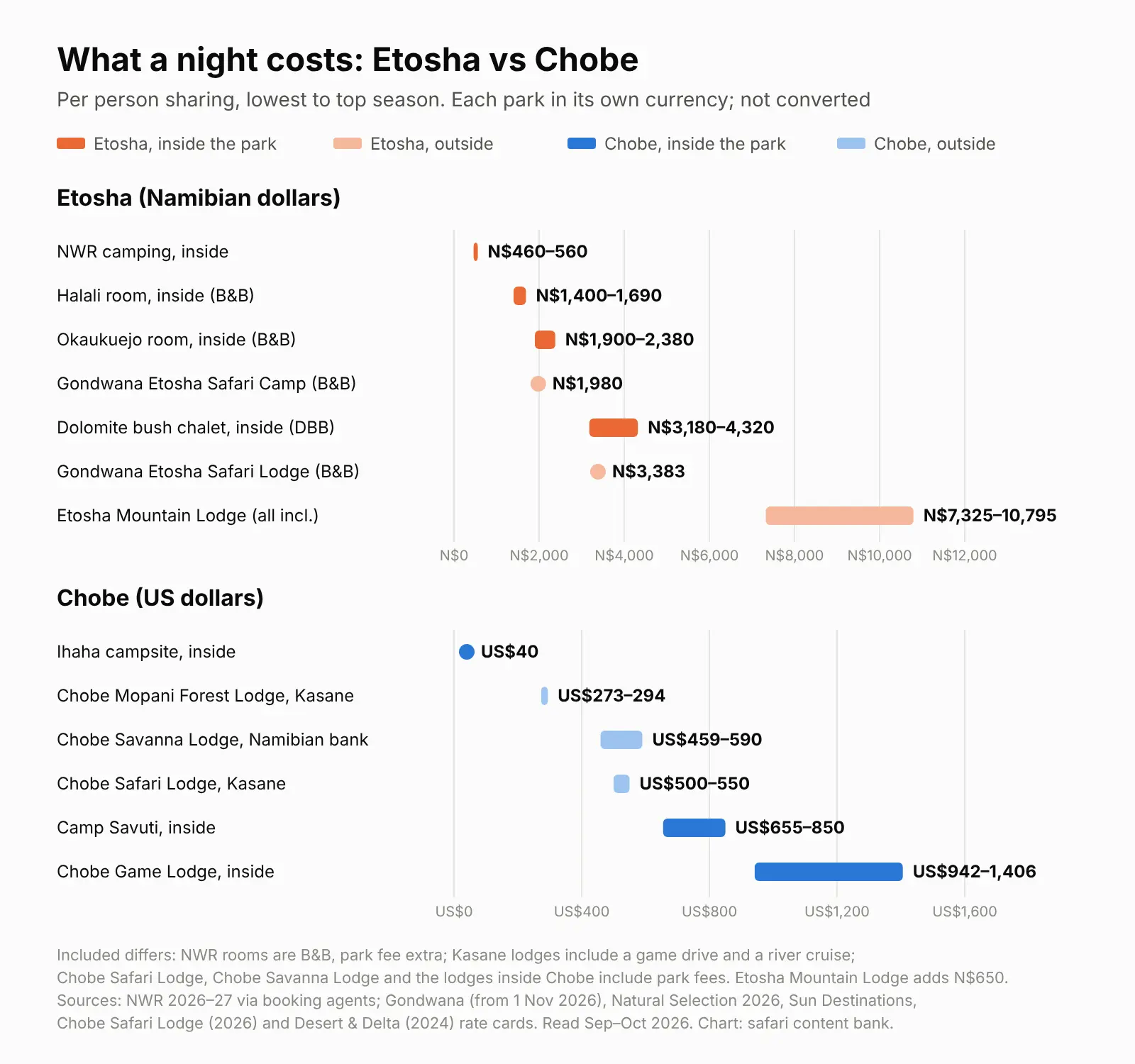 Per person sharing; what each rate includes differs (see the table). Sources: NWR 2026–27 via booking agents; Gondwana, Natural Selection, Sun Destinations, Chobe Safari Lodge and Desert & Delta rate cards (2024–2027). Read September–October 2026. Chart: safari content bank.
- Only guests sleeping inside Etosha can watch the floodlit waterholes at Okaukuejo and Halali at night (Etosha).
- Kasane barely changes price with the season (Chobe Safari Lodge US$500 to US$550; Chobe Mopani Forest Lodge one rate all year); NWR camp rates inside Etosha rise 21–50% from July to October (Etosha safari cost; Chobe safari cost).
Three nights in each, two people
| Two people, 3 nights | Etosha | Chobe |
|---|---|---|
| Camping | Okaukuejo, July–October: N$5,220 for two, with N$1,860 in park fees and a car; the 4x4 is extra | Ihaha: US$120 + P30 levy + P1,080 park fee per person (4 days), so US$240 + P60 + P2,160 for two; vehicle fees and the 4x4 extra |
| Budget room or lodge | Halali room, July–October: N$12,000 for two, park fees included | Chobe Mopani Forest Lodge: US$1,638–1,764 for two, a drive and a cruise a day |
| Mid-range | Okaukuejo room, July–October: N$16,140 for two, park fees included | Chobe Safari Lodge, April–December: US$3,300 for two, with a game drive, a river cruise and park fees each night |
Our sums, as on our Etosha (three nights for two with a car, high season) and Chobe safari cost pages; Chobe Mopani Forest Lodge is 2 × US$819–882. Fuel, drinks and tips extra.
Cost per day
A self-drive couple camping in Etosha spends about N$2,225–2,810 per person a day, car and park fees included; at Chobe, Kasane lodge packages start at about US$214–225 per person a day, and a self-drive costs about US$170–200 plus P280 (our sums from published prices). We do not convert between currencies.
| Style | Etosha, per person per day | Chobe, per person per day |
|---|---|---|
| Self-drive, camping | N$2,225–2,810: half a rooftop-tent 4x4, NWR camping and N$310 in park fees | About US$170–200 plus P280 for two sharing: a Maun supplier’s 4x4 at US$260–300 a day, campsites US$40–50, park fee P270 |
| Self-drive, room or lodge | N$2,948–3,790 in an Okaukuejo room; N$4,431–4,793 at a Gondwana lodge outside | Kasane lodge with a drive and a cruise: US$273–550 a night, before the car |
| Short budget trip | 3-day unguided shuttle safari from Windhoek US$615–633 (one operator’s listing): about US$205–211 a day | 3-day camping trip from Kasane US$641 (US$214 a day); 4-day Kasane lodge break US$900 (US$225 a day), park fees included (operators’ listings) |
| Fully inclusive | Etosha Mountain Lodge N$7,975–11,445 + car | Inside the park US$645–1,406 a night; fly-in via the Linyanti US$1,064–1,576 a day |
Our sums, as on our Etosha safari cost and Chobe safari cost pages; rental prices read 3 September 2026, package prices captured 3–9 September 2026, lodge rates read September–October 2026. “N$310 park fees” is N$280 per adult plus half the N$60 car fee. Package prices are operators’ published “from” prices; operators are not named.
- In Etosha the car is the big line: about two-thirds of a camping self-drive day (Etosha safari cost).
- At Chobe the bed is the big line: in the worked examples on Chobe safari cost, the lodge rate is 93–97% of the total, and it already carries the park fee, the game drive and the river cruise.
- Whole-country budgets: Namibia vs Botswana compares the two countries’ costs.
Best months
June to October suits both: Etosha’s game is at the waterholes from May, peaking in September and October, and Chobe’s game crowds the river from June. The rains run from about November to April in Etosha and November to March in Chobe, when game disperses and rates are lowest.
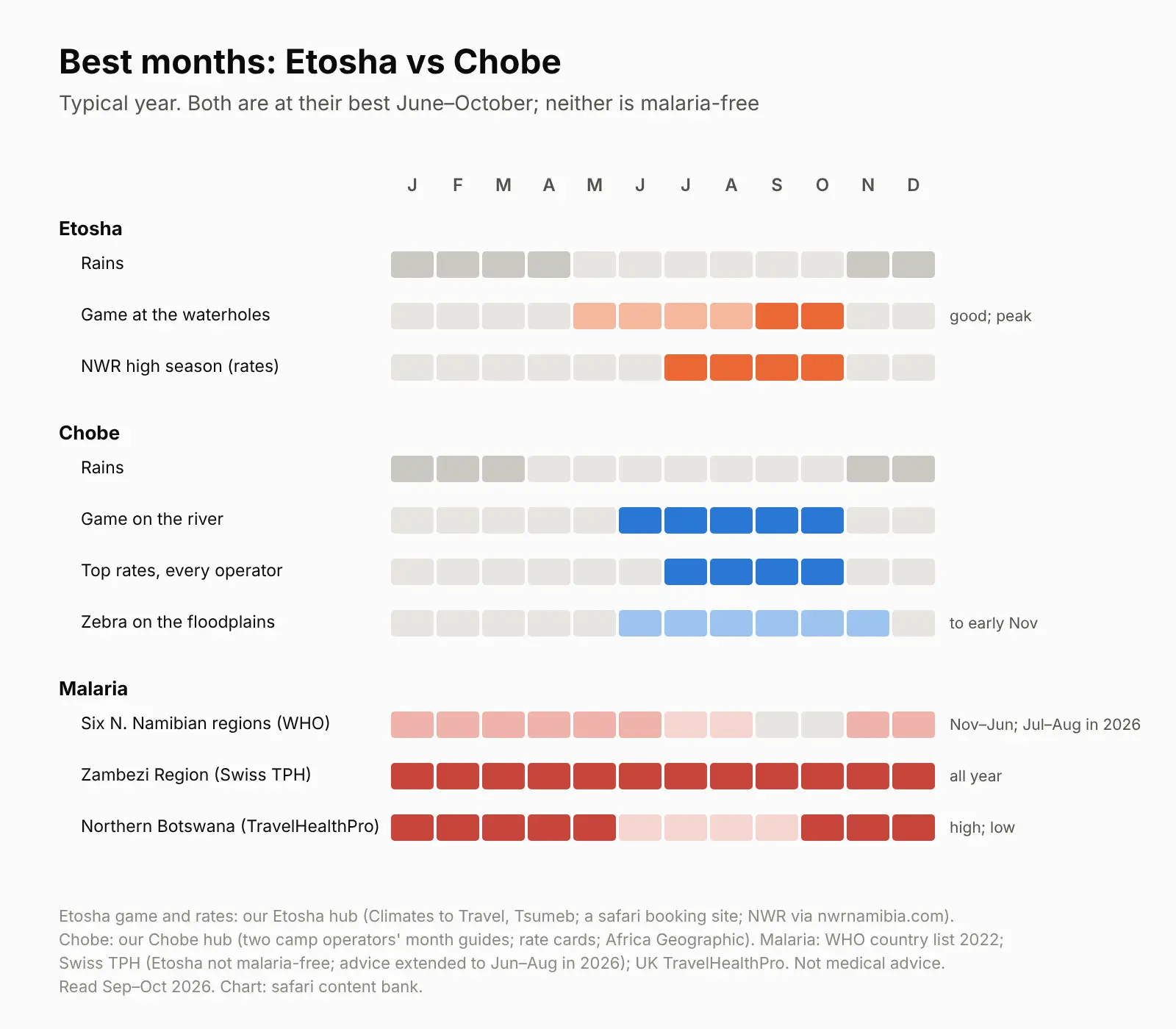 Typical year, not a forecast. Sources: our Etosha and Chobe pages (Climates to Travel, Tsumeb; a safari booking site’s ratings; NWR rates from a booking agent’s listing; two camp operators’ Botswana month guides; operators’ rate cards; Africa Geographic); WHO country list 2022; Swiss TPH; UK TravelHealthPro. Read September–October 2026. Chart: safari content bank.
| Months | Etosha | Chobe |
|---|---|---|
| January–March | Poorest game viewing; 80–140 mm of rain a month at Tsumeb; NWR low season | Rains; lowest rates (Chobe Safari Lodge US$500, Chobe Game Lodge US$942) |
| April–May | Game returning to the waterholes; NWR low season until June | Rains over; month guides list large elephant herds arriving in April |
| June | Good; cold dawns, 8 °C lows at Tsumeb | Dry season; game on the river; zebra on the floodplains; Chobe Game Lodge’s peak rate |
| July–August | Very good; NWR high season | Every operator in our sources at its top rate; huge buffalo and elephant herds in August |
| September–October | Peak; Tsumeb averages 33 °C highs in October | Dry; October is the hottest month and can pass 40 °C |
| November–December | Game disperses as the rain starts; NWR low season | Rains start; lowest rates from mid-November; zebra leave for Nxai Pan from early December |
Sources as on our Etosha and Chobe pages, read September–October 2026.
- May and June are Etosha’s value months: NWR and the rental firms are still on low-season rates, and game is already returning to the waterholes (Etosha safari cost).
- Kasane’s lodges change little by season, so the riverfront’s dry-season peak costs little more than its green season.
Malaria on an Etosha–Chobe trip
Neither park is malaria-free, and the road between them crosses the Zambezi Region, which Swiss TPH rates high risk all year. Whether you need tablets, and which, is a question for a travel clinic.
| Area | What the source says | Source (read September–October 2026) |
|---|---|---|
| Etosha | At the edge of the seasonal zone; do not treat it as malaria-free. In 2026 advice was extended to cover June–August in Namibia’s seasonal-risk regions | HealthyTravel / Swiss TPH, Namibia |
| Northern Namibia | Six regions, Oshikoto and Otjozondjupa among them, November–June; along the Kunene, Zambezi and Okavango rivers all year | WHO country list 2022 (PDF) |
| Zambezi Region (Caprivi) | Year-round high-risk zone, with eastern Kavango East, northern Kavango West and eastern Ohangwena | Swiss TPH |
| Chobe and northern Botswana | High risk October–May, low June–September; WHO lists the Chobe district from November to May/June | TravelHealthPro, Botswana; WHO |
This is what the sources say, not medical advice. More: Safari malaria risk, Namibia safari questions and Botswana safari questions.
- A dry-season trip does not take you out of the advice: Chobe is rated low risk from June to September, but the Caprivi between the parks is rated high risk all year.
How to combine them: the Caprivi route
By road, drive east from Etosha’s Namutoni camp to Rundu, along the Caprivi (Zambezi Region) on tar, cross at Ngoma Bridge and follow the A33 through Chobe National Park to Kasane. The published legs add up to about 915 km from Namutoni to Kasane, plus the Rundu–Okavango leg, which our sources do not measure (our sum).
| Leg | Distance | Road | Source |
|---|---|---|---|
| Windhoek → Okaukuejo (Etosha, Andersson Gate) | 414–435 km | Tar, 4–6 h | Namibia self-drive distances |
| Okaukuejo → Namutoni (across Etosha) | about 140 km | Park gravel, about 3 h 15 at game-viewing pace | same; a safari agent’s Etosha guide, read September 2026 |
| Namutoni → Rundu | 415 km | Tar (B8) | same (a travel booking site’s distance table) |
| Rundu → the Okavango at Ngepi Camp | Not in our sources | — | — |
| Ngepi Camp → Kongola | 250 km | Tar | One operator’s 16-day self-drive itinerary, as on Namibian rental car across borders |
| Kongola → Kasane, via Ngoma | 250 km | Tar; the last 65 km on the A33 through Chobe National Park | same; Wikipedia, A33 |
| Chobe (Sedudu Gate) → Victoria Falls | 80 km | Just over 1 hour plus the Kazungula Road border (06:00–20:00) | Chobe |
Distances as published; read 3 September–10 October 2026. The 915 km is our sum of the Namutoni–Rundu, Ngepi–Kongola and Kongola–Kasane legs. Windhoek → Rundu direct is 700 km on tar (a travel booking site’s distance table).
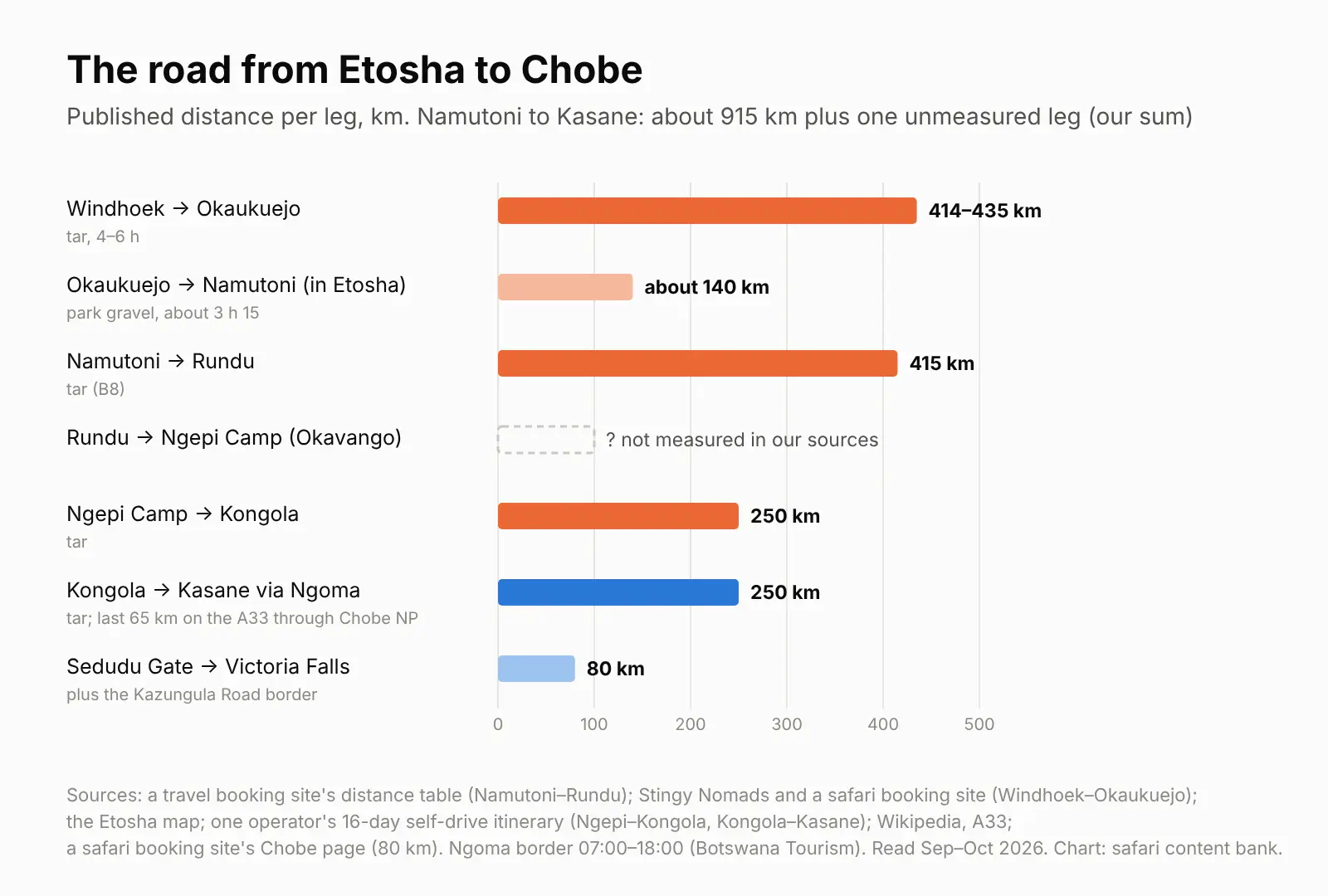 Sources: a travel booking site’s distance table; the Etosha map; one operator’s 16-day self-drive itinerary; Wikipedia, A33; a safari booking site’s Chobe getting-there page. Our sum. Chart: safari content bank.
Borders, rental cars and visas
| Step | What you need | Source |
|---|---|---|
| Before you collect the car | The rental company’s cross-border letter: from nothing to ZAR 1,000 by company; a 2026 market survey found R1,250–2,000 at the big brands’ safari arms | Namibian rental car across borders |
| Ngoma Bridge border | Open 07:00–18:00 on the Botswana side; arrive with time to clear the A33 through the park before dark | Botswana Tourism, Ports of Entry |
| Entering Botswana | BWP 40 Road Safety Fund levy, valid to 31 December; a foreign car may stay 14 days on a temporary import permit; road permit and insurance charged at the border, no official amount published | BURS |
| Veterinary fences | Raw meat may not be carried between Katima Mulilo and Rundu, or Rundu and Grootfontein; cooked food may cross | Tracks4Africa |
| One-way rental | One Namibian rental company lists one-way drops at Kasane, Maun and Victoria Falls; none in our sources publishes the fee | Namibian rental car across borders |
| Visas | Namibia: N$1,600 on arrival for UK, US and German citizens aged 12 and over. Botswana: none for British citizens for 90 days; US citizens are not covered by name in our sources | Namibia visa; Botswana visa |
Read 9–11 October 2026, as on the pages linked.
- Plan nights on the way. Namutoni to Kasane is a long tar drive on its own; the published 16-day itinerary in our sources stops at Kongola and on the Okavango at Ngepi Camp.
- By air, there is no shortcut in our sources: we found no scheduled Windhoek–Kasane flight. FlyNamibia flies Windhoek–Maun four days a week until 30 November 2026 (Botswana bush flights), and Kasane is a 20-minute Mack Air hop from Victoria Falls (Chobe).
- Ending at Victoria Falls? A night in Botswana voids the KAZA Univisa; see Chobe day trip from Victoria Falls and Chobe vs Hwange.
- How long in each: forum regulars put Etosha’s practical minimum at two nights, three to cover more than one section (Etosha), and favour two nights in Kasane over a day trip (Chobe).
Which to choose
Choose Etosha for a self-drive in an ordinary car, waterhole viewing and the cheaper beds inside a park; choose Chobe for boats, buffalo and hippo, lodges that bundle the activities, or a short add-on to Victoria Falls. With time for the long Caprivi drive and a cross-border rental, you can do both.
| If you… | Pick | Why |
|---|---|---|
| Want to drive yourself in a 2WD | Etosha | Main gravel roads are fine in the dry season; Chobe’s park legs need a high-clearance 4x4 |
| Want elephants from a boat | Chobe | Three-hour river cruises from Kasane; Kasane lodges include one |
| Want buffalo | Chobe | Buffalo seen by 91%; Etosha has none |
| Want to sit at a waterhole, including after dark | Etosha | Floodlit waterholes at Okaukuejo and Halali for guests sleeping inside |
| Want the cheapest bed inside a park | Etosha | NWR camping N$460–560 per person; Chobe’s inside beds start at US$645 a lodge night, or US$40 camping in a 4x4 |
| Want guided activities in one price | Chobe, in Kasane | US$273–550 a night with a game drive and a river cruise |
| Are already in Victoria Falls | Chobe | Sedudu Gate is 80 km away; a day trip is listed at US$249 |
| Are on Namibia’s classic loop | Etosha | It sits on the Windhoek–Sossusvlei–Swakopmund–Etosha loop; see Namibia vs Botswana |
| Want to keep malaria risk lowest | Etosha in the dry season, without the Caprivi | Neither park is malaria-free, but the Zambezi Region is rated high risk all year |
| Have time for the Caprivi drive and a cross-border rental | Both, via the Caprivi | 24 of 124 published Botswana products include Namibia, usually via the Caprivi to Chobe |
More on each park: Etosha National Park, Chobe National Park, Etosha safari cost and Chobe safari cost. Other pairings: Etosha vs Kruger, Moremi vs Chobe.
Common mistakes in Etosha vs Chobe comparisons
| What you’ll often read | What is correct |
|---|---|
| “Etosha has the Big Five” | Four. Cape buffalo are kept out of Etosha by veterinary policy; Chobe has them. |
| “Etosha costs N$150 a day” | N$280 per foreign adult since 1 April 2026, plus N$60 per car. Government Notice 115 of 2026 states no time period. |
| “Chobe costs P500 a day from April 2026” | Reported postponed. The last published DWNP schedule (1 April 2022) gives P270; BOPA (24 Feb 2026) called the existing fee P380. Confirm with DWNP or your operator. |
| “A 2WD is fine for Chobe like Etosha” | Only on the tar. Chobe’s park legs need a high-clearance 4x4; the A33 transit road and Kasane are tar. |
| “The Ngoma–Kasane road is outside the park” | It runs 65 km through Chobe National Park along the river. |
| “Kasane lodges are in Chobe National Park” | They are in town, outside it. Chobe Game Lodge is the only permanent lodge inside the park on the riverfront. |
| “Any Namibian rental can drive into Botswana” | Only with the rental company’s cross-border letter; Botswana adds a BWP 40 levy and a 14-day limit on the temporary import permit. |
| “The dry season is malaria-free on this route” | No. The Zambezi Region is rated high risk all year (Swiss TPH), and Etosha is not malaria-free. |
| “Chobe houseboats are in Botswana” | They moor on the Namibian bank; guests clear Botswana immigration at Kasane. |
| “You can book Chobe campsites at the gate” | No drive-up camping. Book and pay every campsite first, then DWNP. |
Frequently asked questions
Is Etosha or Chobe better for a first safari? For a self-drive, Etosha: a 2WD car is fine on its main roads in the dry season, day entry needs no booking, and game comes to the waterholes from May to October. For a guided first safari, Chobe: Kasane lodges at US$273–550 a night include a game drive and a river cruise, and 99% of one safari operator’s Chobe travellers saw elephant.
Which is cheaper, Etosha or Chobe? For self-drivers, Etosha: camping inside costs N$460–560 per person, and a camping self-drive day about N$2,225–2,810 per person with the 4x4 and park fees (our sum). For lodge travellers, Kasane is good value: US$273–550 a night with activities and, at Chobe Safari Lodge, park fees included. We do not convert between currencies.
What are the park fees for Etosha and Chobe in 2026? Etosha charges N$280 per foreign adult plus N$60 per car since 1 April 2026 (Government Notice 115 of 2026); the notice states no time period, so we count one fee per park day. Chobe’s last published fee is P270 per non-resident adult per day (DWNP, 1 April 2022); BOPA called the existing fee P380 in February 2026, and a P500 rise was reported postponed. Confirm it with DWNP or your operator.
Can I drive from Etosha to Chobe? Yes, on tar: from Namutoni to Rundu (415 km), along the Caprivi to Kongola, across the Ngoma border (07:00–18:00) and 65 km on the A33 through Chobe to Kasane. The published legs add up to about 915 km plus the Rundu–Okavango leg, which our sources do not measure. Your rental company must give you a cross-border letter.
Do I need a 4x4 for Etosha or Chobe? Not for Etosha’s main gravel roads in the dry season; a 4x4 is recommended in the wet season and needed for Dolomite Camp. For Chobe, yes on every park leg: only the A33 transit road and Kasane are tar. Without a 4x4, stay in Kasane and take the lodge’s drives and cruises.
When is the best time to visit both? June to October. Etosha’s game is at the waterholes from May to October, peaking in September and October; Chobe’s crowds the river from June to October. Every Chobe operator in our sources charges its top rate from July to October, and NWR’s high season in Etosha is July to October.
Do I need malaria tablets for Etosha and Chobe? Ask a travel clinic: neither is malaria-free. Swiss TPH says not to treat Etosha as malaria-free and rates the Zambezi Region, which the road between the parks crosses, high risk all year. UK TravelHealthPro rates northern Botswana, Chobe included, high risk from October to May and low from June to September.
Can I fly between Etosha and Chobe? Not directly in our sources: we found no scheduled Windhoek–Kasane flight. FlyNamibia flies Windhoek–Maun four days a week until 30 November 2026, and Mack Air flies Victoria Falls–Kasane daily in 20 minutes. Most travellers link the two parks by road through the Caprivi.
Sources
- Fees: Government Notice 115 of 2026, Government Gazette 8877 (PDF), hosted by the Legal Assistance Centre, re-read 9 Oct 2026; MEFT, Park Entrance and Conservation Fees, 2021 schedule (PDF); Tourism Update, 23 Feb 2022 (DWNP schedule, 1 April 2022); Botswana Daily News (BOPA, 24 Feb 2026); Gabz FM, 5 May 2026; BURS; all as on our Etosha park fees and Chobe park fees pages, checked 10 Oct 2026
- Camps and rates: NWR 2026–27 rates via booking agent NWR rates from a booking agent’s listing; Gondwana Collection; Natural Selection 2026 (PDF); Sun Destinations, Chobe Mopani Forest Lodge (PDF) and Camp Savuti (PDF); Chobe Safari Lodge; Desert & Delta 2024 (PDF); Zambezi Queen Collection; Chobe Holdings, Integrated Report 2026; read September–October 2026
- Parks, roads and rules: a safari agent’s Etosha guide, read September 2026; Botswana Tourism, game viewing and Ports of Entry; Wikipedia, A33; Tracks4Africa, veterinary fences; Africa Geographic, zebra; as on our Etosha, Chobe, Botswana self-drive and Namibia self-drive distances pages
- Health: HealthyTravel / Swiss TPH, Namibia; WHO country list 2022 (PDF); TravelHealthPro, Botswana; as on our Safari malaria risk page, read 8–10 Oct 2026
- Borders, rental and visas: as on our Namibian rental car across borders, Namibia visa and Botswana visa pages, read 9–11 Oct 2026; Namibia2Go 2026 rack rates; Britz terms (PDF); Bushlore
- Tour operators’ and listing sites’ published 2026 package prices, sighting ratings and figures, waterhole guide, campsite sheet, distance table and self-drive itinerary, read September–October 2026 (names and links kept in our editor notes)
- Traveller reports: TripAdvisor Etosha forum and Chobe river cruises and Kasane nights
More: Etosha National Park, Chobe National Park, Etosha safari cost, Chobe safari cost, Namibia vs Botswana, boat safaris and Botswana self-drive.
Fees, rates and package prices checked 10 October 2026 on our Etosha, Chobe, cost and fee pages; this page was compiled on 24 October 2026. We will update it when DWNP publishes a current Chobe tariff, when MEFT publishes a new fee notice, and when NWR, the Kasane lodges and the rental companies publish 2027 rates.
Ask for a quote
Tell us your dates and we send you a priced itinerary. Free, no obligation.
- Free quote, no obligation
- Trips run by licensed local operators