 Experience

Last verified · Next check due
On this page
- Who needs an eTA for Kenya, by nationality
- Kenya eTA fees, effective 1 January 2025
- How to apply for the Kenya eTA, step by step
- How long does the Kenya eTA take?
- Passport validity and blank pages
- Travelling with children
- Arriving by land
- East Africa Tourist Visa or Kenya eTA?
- Other entry conditions: health policy, Ebola screening and yellow fever
- What changed in 2024–2026
- Common mistakes about Kenya’s entry rules
- Frequently asked questions
- Sources
Short answer: US, UK and other non-African visitors need no visa for Kenya, but an approved Electronic Travel Authorisation (eTA) before travelling, by air or land. It costs US$30 plus card charges at etakenya.go.ke and takes 3 working days. Infants need one too. EAC citizens and African nationals except Somalia and Libya are exempt. Since 5 October 2026 most visitors, non-EAC Africans included, also need Kenyan health insurance, up to US$44 on eCitizen. eTA checked 11 October 2026; insurance 24 October.
Key facts
- Kenya replaced visas with the eTA on 5 January 2024; there is no visa on arrival, at airports or land borders (UK FCDO; law-firm alert, 5 Feb 2024).
- The standard eTA costs US$30 plus card charges, under the fee schedule effective 1 January 2025 (KCAA AIC 14/25, PDF).
- Processing takes 3 working days, and you must enter Kenya within 90 days of issue (Kenya Embassy Bangkok).
- Every child, including infants, needs their own eTA, and the fee schedule shows no child discount (Cliffe Dekker Hofmeyr; AIC 14/25).
- Since 5 October 2026 most visitors, non-EAC Africans included, have also needed a Kenyan government travel health policy (U.S. Embassy in Nairobi; KCAA circular via People Daily). Kenya’s eCitizen insurance portal prices it at up to US$44 per person as of 24 October 2026, and your own insurance is not accepted in its place under current guidance (Malaysian High Commission; Kenya visitor insurance).
Who needs an eTA for Kenya, by nationality
Everyone needs an approved eTA except East African Community (EAC) citizens, African nationals other than Somalia and Libya, bilateral-agreement countries and diplomats on duty (AIC 14/25; Citizen Digital, 22 Jan 2025).
| Passport | eTA needed? | How | Fee | Maximum stay |
|---|---|---|---|---|
| United Kingdom | Yes | Online at etakenya.go.ke | US$30 | 90 days, extendable to 180 |
| United States | Yes | Online | US$30, or US$185 for a 5-year multiple-entry eTA | 90 days, extendable to 180 |
| EU, Canadian, Australian and other non-African passports | Yes, under the general rule, unless your country has a bilateral eTA-free agreement (no list published) | Online | US$30 | 90 days, extendable to 180 |
| EAC citizens | No | No eTA, and exempt from the health policy | US$0 | 6 months |
| Other African nationals, including SADC (e.g. South Africa) | No, since January 2025; Somalia and Libya were left out of the exemption | No eTA, but the health policy is required: buy it on the eCitizen insurance portal | None | 2 months |
Checked 9 October 2026. Fees: AIC 14/25, plus card charges. Requirement: FCDO and US State Department; other passports: AIC 14/25 and Citizen Digital. Stay: Kenya Embassy Bangkok; exempt stays: Citizen Digital. Not published or not settled: no official page we read names EU, Canadian or Australian passports, and no list of “bilateral agreement” states exists. It is also unclear whether Somali citizens can use the EAC exemption. Health policy, as of 24 October 2026: EAC citizens are exempt, other African nationals must buy it on the eCitizen insurance portal (KCAA circular via People Daily; Fragomen, law-firm alert), and how land borders check it is not yet clear (Kenya visitor insurance).
Kenya eTA fees, effective 1 January 2025
The standard eTA costs US$30, excluding payment charges. Park fees are separate: Kenya park fees and Kenya safari cost.
| Fee | Amount | In force from | Source |
|---|---|---|---|
| Standard eTA, single entry | US$30, excluding payment charges | 1 January 2025 (schedule AIC 14/25, published 23 October 2025) | Kenya Civil Aviation Authority, AIC 14/25 |
| US citizens, 5-year multiple-entry eTA (optional) | US$185 | 1 January 2025 (schedule AIC 14/25, published 23 October 2025) | Kenya Civil Aviation Authority, AIC 14/25 |
| 1-year multiple-entry eTA | US$300 | 1 January 2025 (schedule AIC 14/25, published 23 October 2025) | Kenya Civil Aviation Authority, AIC 14/25 |
| East African Tourist eTA (Kenya, Uganda, Rwanda; not Tanzania) | US$100 | 1 January 2025 (schedule AIC 14/25, published 23 October 2025) | Kenya Civil Aviation Authority, AIC 14/25 |
| Transit eTA | US$20 | 1 January 2025 (schedule AIC 14/25, published 23 October 2025) | Kenya Civil Aviation Authority, AIC 14/25 |
| Expedited service | US$100 | 1 January 2025 (schedule AIC 14/25, published 23 October 2025) | Kenya Civil Aviation Authority, AIC 14/25 |
| API-PNR fee, collected in your air ticket, not on the eTA portal | US$4.95 per passenger per international segment, inbound and outbound | Published 23 October 2025 in AIC 14/25; carriers to integrate by 1 December 2025 | Kenya Civil Aviation Authority, AIC 14/25 |
| EAC citizens, bilateral-agreement countries, diplomats on duty | US$0 | 1 January 2025 (schedule AIC 14/25, published 23 October 2025) | Kenya Civil Aviation Authority, AIC 14/25 |
How to apply for the Kenya eTA, step by step
Apply only on etakenya.go.ke, the official portal, at least 2 weeks before you fly; you must then enter Kenya within 90 days of issue.
- Prepare a photo or selfie, itinerary, hotel booking and, if arriving from an endemic country, a yellow fever certificate (Kenya Embassy Bangkok).
- Buy the government health policy, up to US$44 per person, when the application asks for it, or separately on the eCitizen insurance portal, which gives that price. If your eTA was approved before you bought a policy, you still need one before you arrive (U.S. Embassy).
- Pay US$30 by card. Travellers report cards being rejected at payment (TripAdvisor, traveller reports; card and photo fixes).
- Receive the eTA by email as a PDF with a QR code (traveller reports).
Look-alike sites charge more: travellers report paying US$129 for nothing, and nearly AUD 500 to an agency (TripAdvisor, traveller reports).
How long does the Kenya eTA take?
Standard processing is 3 working days, and the authorities recommend applying at least 2 weeks before departure (Kenya Embassy Bangkok; FCDO). Some applications take longer (law-firm alert). The expedited service, up to 72 hours, costs US$100 (Citizen Digital; AIC 14/25). An eTA applied for too early can lapse during a Tanzania side trip (TripAdvisor, traveller report). Without one you may be “denied boarding or penalty fee on arrival”, the portal warns.
Passport validity and blank pages
Your passport must be valid for 6 months from arrival and have 2 blank pages (FCDO; US State Department, 30 July 2026).
Travelling with children
Every child, including infants, needs their own eTA at US$30; a parent or guardian applies, and families may apply as a group (Cliffe Dekker Hofmeyr; Kenya Embassy Bangkok). The health policy has no family or group option: each traveller needs an individual policy, and eCitizen says each child aged 3 or over needs their own; for children under 3 it is optional (Kenyan inbound travel health insurance FAQ, hosted by ATTA, 13 Oct 2026). Kenya has published no child premium (trade reports of test purchases say US$22). The US State Department advises carrying each child’s birth certificate and, if one parent travels alone, a notarised consent letter, which “may be required”. No source shows a Kenyan unabridged birth certificate rule like South Africa’s.
Arriving by land
Kenya has no visa on arrival at land borders: get the eTA before you reach Namanga, Isebania–Sirari, Taveta–Holili or Lunga Lunga–Horohoro (eTA portal). The health policy applies at land and sea borders too (Malaysian High Commission), though how land borders check it is not yet clear. A single-entry eTA “remains valid for more than one entry” after a temporary trip to an EAC partner state such as Tanzania (Kenya Embassy Bangkok). The health policy is valid 90 days and can be used for several entries while valid; a new one is needed after it expires (Malaysian High Commission; eCitizen). Tanzania’s own visa costs US$50, or US$100 for US citizens (e-visa guidelines; Tanzania visa). See Kenya–Tanzania border crossings; Masai Mara to Serengeti.
East Africa Tourist Visa or Kenya eTA?
The East Africa Tourist Visa costs US$100 and covers Kenya, Uganda and Rwanda only, not Tanzania. No official page we found explains how it works with Kenya’s eTA (etakenya.go.ke). It lasts 90 days with multiple entries, cannot be extended, lapses when you leave the three countries and is issued by the first one you enter (Uganda Immigration; Rwanda Embassy, The Hague). Kenya’s fee schedule lists an “East African Tourist eTA” at US$100 (AIC 14/25). Bought separately, Kenya’s eTA (US$30), Uganda’s single-entry visa (US$50) and Rwanda’s visa (free for a 30-day visit for citizens of Commonwealth, African Union and Francophonie states, otherwise at most US$50) come to US$80 to US$130 (our sum; Uganda High Commission; Rwanda Immigration).
Other entry conditions: health policy, Ebola screening and yellow fever
Since 5 October 2026, non-Kenyans arriving for stays under 12 months must hold a Kenyan government travel health policy, priced at up to US$44 per person on Kenya’s eCitizen portal. The start date comes from the U.S. Embassy in Nairobi, the eCitizen insurance portal, the Malaysian High Commission in Nairobi and a Kenya Civil Aviation Authority (KCAA) circular of 9 October 2026, as reported by People Daily; the circular says the date applies whenever the ticket was bought. Your own travel insurance is not accepted in its place under current guidance (Malaysian High Commission; KCAA circular), which supersedes the Ministry of Health’s clarification of 7 August 2026 that had allowed compliant home-country policies to be uploaded: see Kenya visitor insurance.
- Who is exempt: Kenyan citizens, holders of valid Kenyan residence status, citizens of EAC partner states, asylum seekers, holders of diplomatic, official or service passports, transit passengers who do not enter Kenya, and crew under conditions such as employer-provided cover (Kenyan Embassy in Abu Dhabi advisory of 22 October 2026, via Kenyans.co.ke; KCAA circular; U.S. Embassy). Being eTA-exempt does not exempt you: African nationals from outside the EAC must buy the policy on the eCitizen insurance portal (KCAA circular; Fragomen, 9 Oct 2026, law-firm alert; Malaysian High Commission).
- Price, as of 24 October 2026: up to US$44 per person on eCitizen; the Malaysian High Commission gives about US$44 plus system charges. We found no tariff published by the Ministry of Health or the Insurance Regulatory Authority, and the fee schedule AIC 14/25 lists the cover as “pro-rated” with no amount. Trade reports of test purchases give totals of US$52 per adult on 6 and 7 October (VisasNews, 7 Oct 2026) and about US$48 in mid-October, made up of the US$44 premium, a US$1 access fee and a payment-gateway fee (VisasNews).
- How to buy: in the eTA application, which asks for it before the eTA can be completed (VisasNews, 6 Oct 2026, trade report), or separately on the eCitizen insurance portal. If your eTA was approved before you bought a policy, you still need one before you arrive (U.S. Embassy).
- Checks: airlines have been asked to check cover before boarding, and immigration officers check it again on arrival; travellers without it may be refused entry (U.S. Embassy; KCAA circular). The rule also applies at land and sea borders (Malaysian High Commission).
- Validity: 90 days, usable for several entries while valid; a new policy is needed after it expires, as it is not annual cover (Malaysian High Commission; eCitizen; KCAA circular).
- Court: the High Court at Marsabit (Justice Francis Rayola Olel) dismissed a petition against Gazette Notice No. 11492 of 30 July 2026 and found the notice lawfully issued under the Social Health Insurance Act, as reported on 6 and 7 October 2026 (Daily Nation; Eastleigh Voice, 7 Oct 2026). The judgment is not on Kenya Law as of 24 October 2026.
- Ebola screening: since 7 October 2026, arrivals at Nairobi’s Jomo Kenyatta International Airport (JKIA) from ten countries (DR Congo, Uganda, Tanzania, Rwanda, Burundi, Ethiopia, South Sudan, Angola, Zambia and the Central African Republic) go through Gate 16 for enhanced screening and fill in a health declaration on their health status and any treatment or medication in the past month (Kenyans.co.ke, 7 Oct 2026; Capital FM); they also fill in a digital surveillance form before boarding and show its QR code to port health officers on arrival (Daily Nation, 16 Oct 2026). Kenya has imposed no entry bans or other travel restrictions (ECDC, 23 Oct 2026), but since 30 October 2026 Saudi Arabia has refused entry to anyone who has been in Kenya in the previous 21 days, Kuwait has told airlines not to board passengers from Kenya until 21 days after they left, and since 1 November Madagascar has restricted or quarantined travellers who were in Kenya in the previous 21 days (press reports: Saudi Gazette, 30 Oct 2026; Asharq Al-Awsat, 30 Oct 2026; HapaKenya, 2 Nov 2026; Pulse Kenya, 2 Nov 2026; checked 11 November 2026). If your trip continues to one of them within 21 days of leaving Kenya, check with your airline before you book. Kenya has nine confirmed cases and two deaths, all in one cluster of known contacts; the last case was reported on 20 October (Daily Nation, 23 Oct 2026; ECDC, 28 Oct 2026). Six patients had recovered by 6 November and one was still in treatment on 10 November; 66 contacts have completed 21 days of monitoring, the first 20 on 26 October (WHO Africa, 26 Oct 2026), and the last 52 were due to finish on 11 November (Kenya News Agency, 3 Nov 2026; Kenyans.co.ke, 6 Nov 2026; Healthcare MEA, 10 Nov 2026). The 42-day countdown to declaring the outbreak over starts only when the last patient leaves treatment, so the end cannot come before the second half of December 2026 (checked 11 November 2026).
- Yellow fever: a certificate is needed only if you are aged 1 or over and arrive from a risk country (WHO, PDF), Uganda included, though Uganda dropped its own rule on 2 October 2026 (notice). See yellow fever rules by country; health risks: Is a Kenya safari safe?
What changed in 2024–2026
The rules changed in January 2024, January 2025 and October 2026.
| Date | Change |
|---|---|
| 5 Jan 2024 | Visa abolished; eTA required, US$30 (e-visa was US$50) |
| 1 Jan 2025 | Current eTA fee schedule in force |
| 21 Jan 2025 | Cabinet exempts African nationals except Somalia and Libya |
| 23 Oct 2025 | US$4.95 API-PNR fee per international segment published |
| 30 Jul 2026 | Health insurance gazetted, Gazette Notice No. 11492 |
| 24 Aug 2026 | High Court suspends the insurance rule |
| 5 Oct 2026 | Health insurance required for arrivals |
| 6–7 Oct 2026 | High Court at Marsabit reported dismissing the petition; judgment not on Kenya Law |
Sources: Cliffe Dekker Hofmeyr (law-firm alert); AIC 14/25; Citizen Digital; Kenyans.co.ke; U.S. Embassy, eCitizen and Malaysian High Commission (start date); Daily Nation and Eastleigh Voice (notice date and ruling); VisasNews (trade reports).
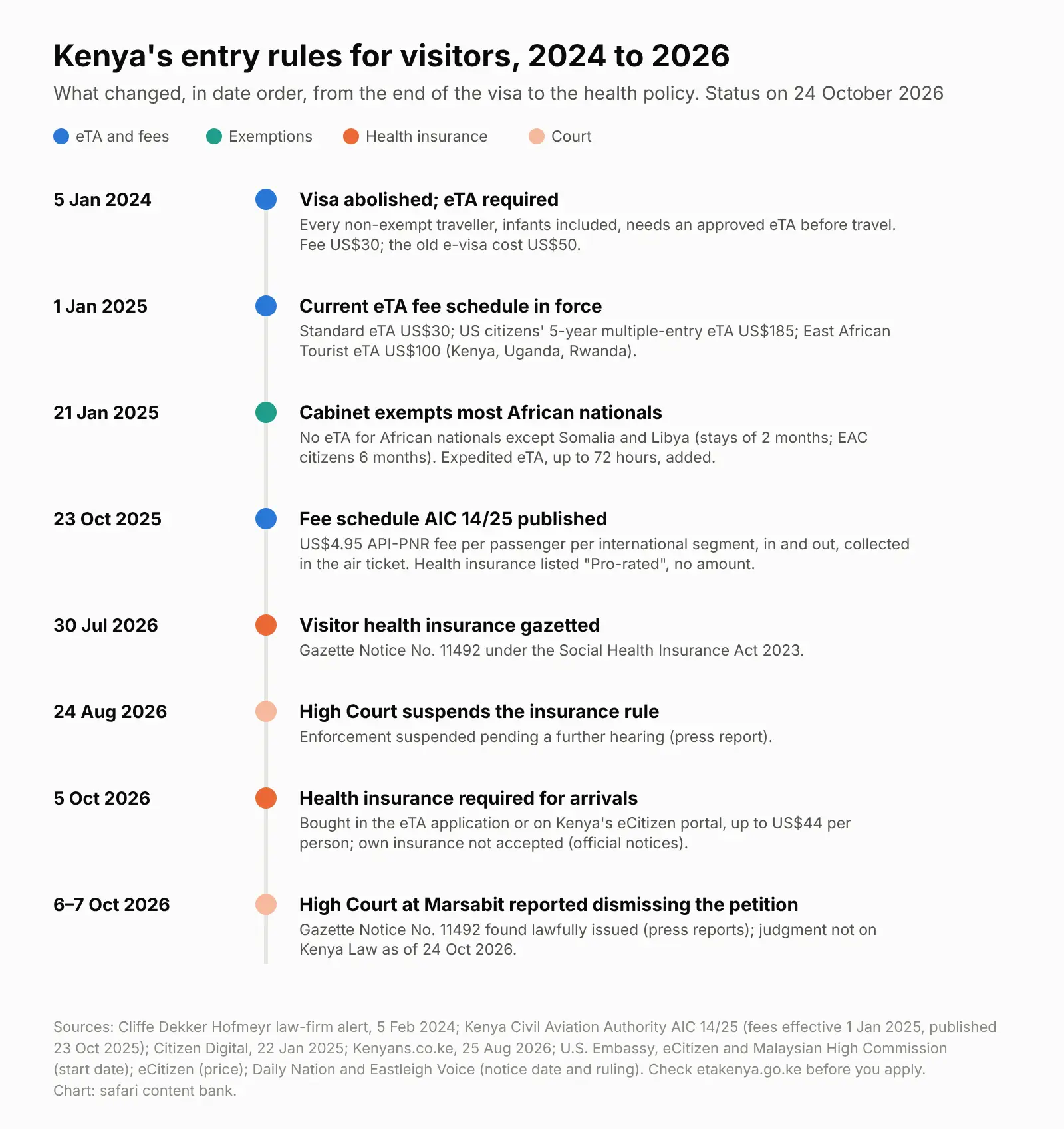 Status as of 24 October 2026; sources as above. Chart: safari content bank.
Common mistakes about Kenya’s entry rules
| What you’ll often read | What is correct |
|---|---|
| “Visa on arrival, US$50” | No visa since 5 January 2024, at airports or land borders. |
| “ETA or e-visa” (a Korean-language Google AI Overview, 9 October 2026) | There is no e-visa: the eTA replaced it on 5 January 2024. |
| “The eTA costs US$30, full stop” | Add card charges, the health policy (up to US$44 per person on eCitizen; about US$48 with fees in trade test purchases, as of 24 October 2026) and US$4.95 per international flight segment into or out of Kenya, collected in your ticket. |
| “Africans need an eTA” or “Africans were exempted in August 2026” | No eTA since the Cabinet decision of 21 January 2025, except Somalia and Libya (Citizen Digital). The August 2026 date comes from a trade report. |
| “The East Africa Tourist Visa covers Tanzania” | It covers Kenya, Uganda and Rwanda only. |
| “The insurance rule was suspended by the court” | Out of date: the policy has been required since 5 October 2026, and the High Court at Marsabit dismissed the petition, as reported on 6 and 7 October 2026. |
Frequently asked questions
Can I get a visa on arrival in Kenya? No. Kenya abolished visas on 5 January 2024, and the eTA must be approved before you travel, by air or land. Answers quoting US$50 or €40 at the counter predate 2024.
How much does the Kenya eTA cost? US$30 plus card charges; US citizens can choose a US$185 five-year multiple-entry eTA. The health policy, up to US$44 per person on Kenya’s eCitizen portal, is a separate payment, made in the eTA application or on the eCitizen insurance portal; trade test purchases came to about US$48 with fees in mid-October 2026 (trade reports).
How long does the Kenya eTA take? Standard processing is 3 working days, and the authorities recommend applying at least 2 weeks before departure. Do not apply months ahead: you must enter within 90 days of issue.
Can I go back into Kenya on the same eTA after visiting Tanzania? Yes, within its validity: a single-entry eTA stays valid for re-entry after a temporary trip to another EAC state such as Tanzania (Kenya Embassy Bangkok). The health policy is valid 90 days and can cover several entries while valid; buy a new one if it expires before you return (Malaysian High Commission). Tanzania needs its own visa: see Tanzania visa.
Does the East Africa Tourist Visa replace the Kenya eTA? Not confirmed: no official page we found says how the East Africa Tourist Visa works with Kenya’s eTA, so check etakenya.go.ke before you buy one. Kenya’s fee schedule lists an “East African Tourist eTA” at US$100, and Uganda’s and Rwanda’s immigration pages describe the visa as US$100 for 90 days with multiple entries in Kenya, Uganda and Rwanda. It does not cover Tanzania.
Sources
- Official: KCAA AIC 14/25 (PDF); eTA portal; eCitizen insurance portal; U.S. Embassy in Nairobi; Malaysian High Commission in Nairobi, about 15 Oct 2026; Kenya Embassy Bangkok; UK FCDO, updated 6 Nov 2026 (Ebola screening information added on 28 Oct 2026); US State Department, 30 Jul 2026, and its Kenya travel advisory, Level 3, “Reconsider Travel”, due to health risks, 19 Oct 2026; WHO (PDF); WHO Africa, 26 Oct 2026; ECDC, 23 Oct 2026, and 28 Oct 2026; immigration pages of Uganda, Rwanda and Tanzania
- Press and trade: Citizen Digital (eTA exemption); Cliffe Dekker Hofmeyr (law-firm alert); Fragomen (law-firm alert, 9 Oct 2026); People Daily (KCAA circular of 9 Oct 2026); Kenyans.co.ke (suspension, JKIA screening, 7 Oct 2026, Abu Dhabi embassy advisory, 22 Oct 2026, Ebola recoveries, 6 Nov 2026); Kenya News Agency, 3 Nov 2026; Healthcare MEA, 10 Nov 2026; Capital FM; Daily Nation (court ruling, surveillance form, 16 Oct 2026, cases, 23 Oct 2026); Eastleigh Voice, 7 Oct 2026; Saudi Gazette and Asharq Al-Awsat, 30 Oct 2026 (Saudi entry ban); HapaKenya and Pulse Kenya, 2 Nov 2026 (Kuwait and Madagascar rules); Kenyan inbound travel health insurance FAQ (PDF), hosted by ATTA, 13 Oct 2026; VisasNews (6 Oct, 7 Oct 2026, mid-October) (trade reports)
- Traveller reports: TripAdvisor Kenya forum threads, linked above
eTA details checked 11 October 2026; health policy and court details checked 11 November 2026 (price as of 24 October 2026); Ebola case and entry-ban details checked 11 November 2026; JKIA screening details as of 31 October 2026. Kenya’s entry rules changed in 2024, 2025 and October 2026: confirm on the official eTA portal, etakenya.go.ke, not a third-party site, before you apply. We update this page when Kenya publishes an official insurance tariff, the full court judgment or a new fee schedule.
More photos from Kenya
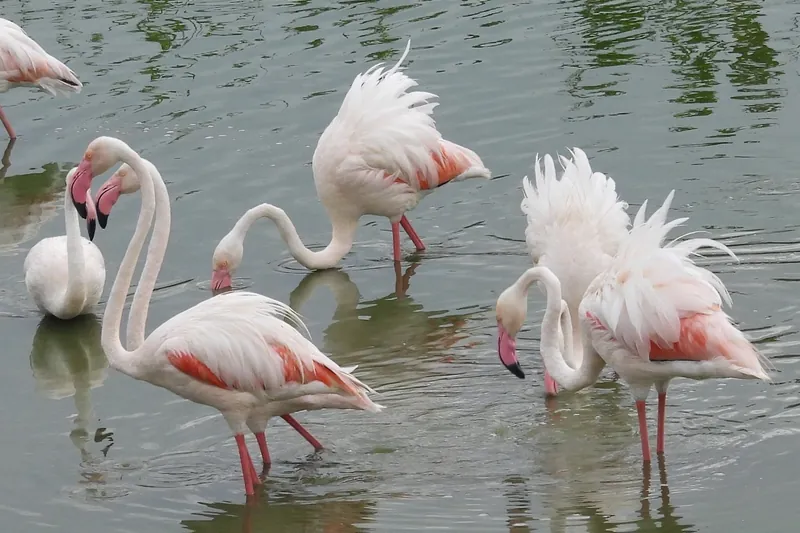
Greater flamingos wading in the Lake Nakuru area. Sri Srikumar, iNaturalist, CC0 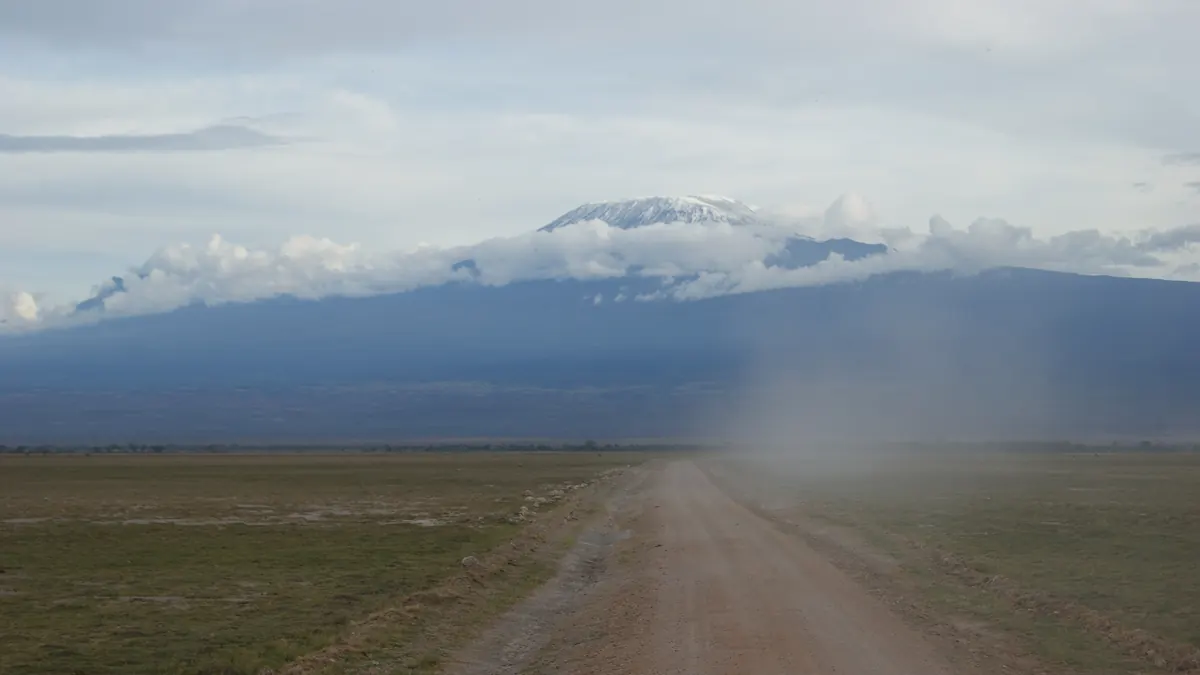
Dirt road across Amboseli with snow-capped Kilimanjaro behind the clouds. Lafleursauvage, Wikimedia Commons, CC BY-SA 4.0, cropped 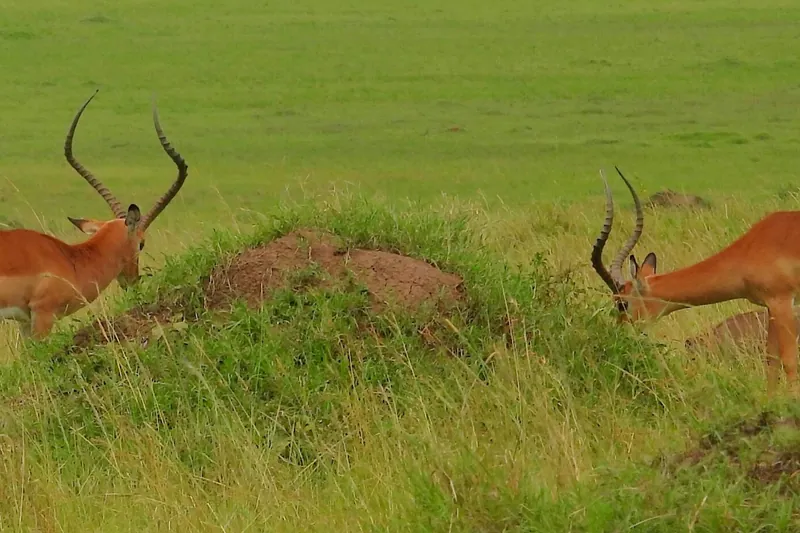
Impala in the Masai Mara area. Sri Srikumar, iNaturalist, CC0

Photos by visitors and photographers, used under their free licences. Click a name to see the original.