 Experience

Last verified · Next check due
On this page
Short answer: It depends on what you want to see and what you can spend. Operators’ published 2026 safaris cost about US$138–373 per person per day on a budget, US$311–1,090 mid-range and US$578–3,085 at luxury level. On some trips park fees and permits are 47–78% of the price (our sums). One operator’s Botswana traveller groups saw elephant (95%), lion (91%) and leopard (66%). Green-season travel, self-driving and sharing a vehicle cut the cost.
Key facts
- A safari is priced by the day, and the range is wide: budget trips list at US$138–373 per person per day in eight of the nine countries we cover, and Kenya’s cheapest Masai Mara group safari at US$57–60 before a park fee of US$100–200 a day (budget vs luxury safari cost).
- On the cheapest trips most of your money goes to the park: park fees are 77–78% of a Masai Mara budget day from July to December and 70–73% of a Kruger camping day before the car (our sums, as on the cheapest safari in Africa).
- Part of the fee reaches the people living next to the parks: Rwanda says 10% of gorilla permit revenue goes to community projects, and the Uganda Wildlife Authority says 20% of park entry fees go to the communities around each park.
- Sighting odds are published for few places. The best figures in our sources are one operator’s traveller reports from Botswana and Zambia; the Serengeti, the Masai Mara and Kruger publish no sighting rate.
- Kruger’s fee is R692 (R602 until 31 Oct 2026), per international adult per day (SANParks).
- The cheapest months are the rainy ones: at Governors’ Camp in the Masai Mara a bed costs US$453 a night in April–May against US$998 in July–October (2026 rate sheet).
What a safari costs in 2026
Most published safaris cost between about US$140 and US$1,100 per person per day; luxury camps charge more, and Mombo in Botswana charges up to US$5,345 per person a night in peak season. All prices are per person, sharing, land only, without international flights. The country-by-country figures are on safari cost per day by country; this page only summarises them.
| Level | Per person per day (2026) | What you usually get | Detail |
|---|---|---|---|
| Budget | US$138–373; Kenya’s Masai Mara group safari US$57–60 before the Mara fee | Tents or simple lodges, a vehicle shared with other travellers, day game drives on park roads | Cheapest safari in Africa |
| Mid-range | US$311–1,090 | Lodges or tented camps, a vehicle and driver-guide for your party | Budget vs luxury |
| Luxury | US$578–3,085; Mombo (Botswana) US$3,062–5,345 a night | Small camps, often fly-in or on private land, with the camp’s guides; night drives and walks where the land owner allows them | Luxury safari |
Operators’ and lodges’ published prices as on our budget vs luxury page, read 3–10 October 2026. Ranges run from low to peak season or across the operators listed.
What a typical trip costs in total
A short budget trip costs a few hundred dollars per person and a week at mid-range or luxury level several thousand. The examples below are all printed on our cost pages; trip lengths are the medians on how many days for a safari.
| Trip | Typical length | Published price or our sum | Source page |
|---|---|---|---|
| Masai Mara group safari (Kenya), shared vehicle | 3 days (Mara-only trips: median 4) | US$170–180 per person, “park fees NOT included”; US$157–160 a day January–June and US$257–260 July–December with the reserve fee (our sums) | Cheapest safari in Africa |
| Tanzania northern circuit, private, two people, park fees included | 7 days (median 7–8) | US$2,843 per person at 3-star level in low season; US$6,114 at 5-star level in peak season (one operator’s published 2026 prices) | Budget vs luxury |
| Kruger camping self-drive (South Africa), two adults | 7 days | R11,476–12,736 for campsite and park fees; R22,746–24,006 with a camp-ready 4x4 at its “from” rate, before fuel (our sums) | Self-drive safari cost |
| Namibia camping self-drive, two people | 10 days (packaged self-drives: median 15) | N$47,800–59,700 in all with a rooftop-tent 4x4, diesel, park fees and campsites (our sum, low to high season) | Self-drive safari cost |
| Rwanda gorilla safari | 6 days | US$6,540 (one operator’s published price), of which two gorilla permits and a golden monkey permit are US$3,100 | Safari cost per day by country |
Rand and Namibian dollars are not converted: our cost pages give no dated exchange rate for them. Prices read 3 September–10 October 2026.
What the money pays for
Beds are the largest line on most lodge safaris; on the cheapest trips and on gorilla trips, park fees and permits are the largest. The government fee is the same whatever you pay for your bed: Serengeti entry is US$82.60 per adult per day at every level (last published tariff, 2023/24).
| Trip | Largest cost line | Share of the price (our sums) | Source page |
|---|---|---|---|
| Masai Mara budget group safari, July–December | Mara reserve fee, US$200 per adult per day | 77–78% park fees | Cheapest safari in Africa |
| Kruger camping day, two sharing, before the car | Daily conservation fee | 70–73% park fees | Cheapest safari in Africa |
| 6-day Rwanda gorilla safari (US$6,540) | Two gorilla permits and a golden monkey permit, US$3,100 | 47% permits | Safari cost per day by country |
| 7-night lodge safari, South Luangwa (Zambia) | Beds | About 85% beds | Zambia safari cost |
| Etosha camping self-drive with a rented 4x4, two people | The car | 11–14% park fees | Cheapest safari in Africa |
Shares as printed on the linked pages, built from published operator prices and official fees read 3 September–10 October 2026.
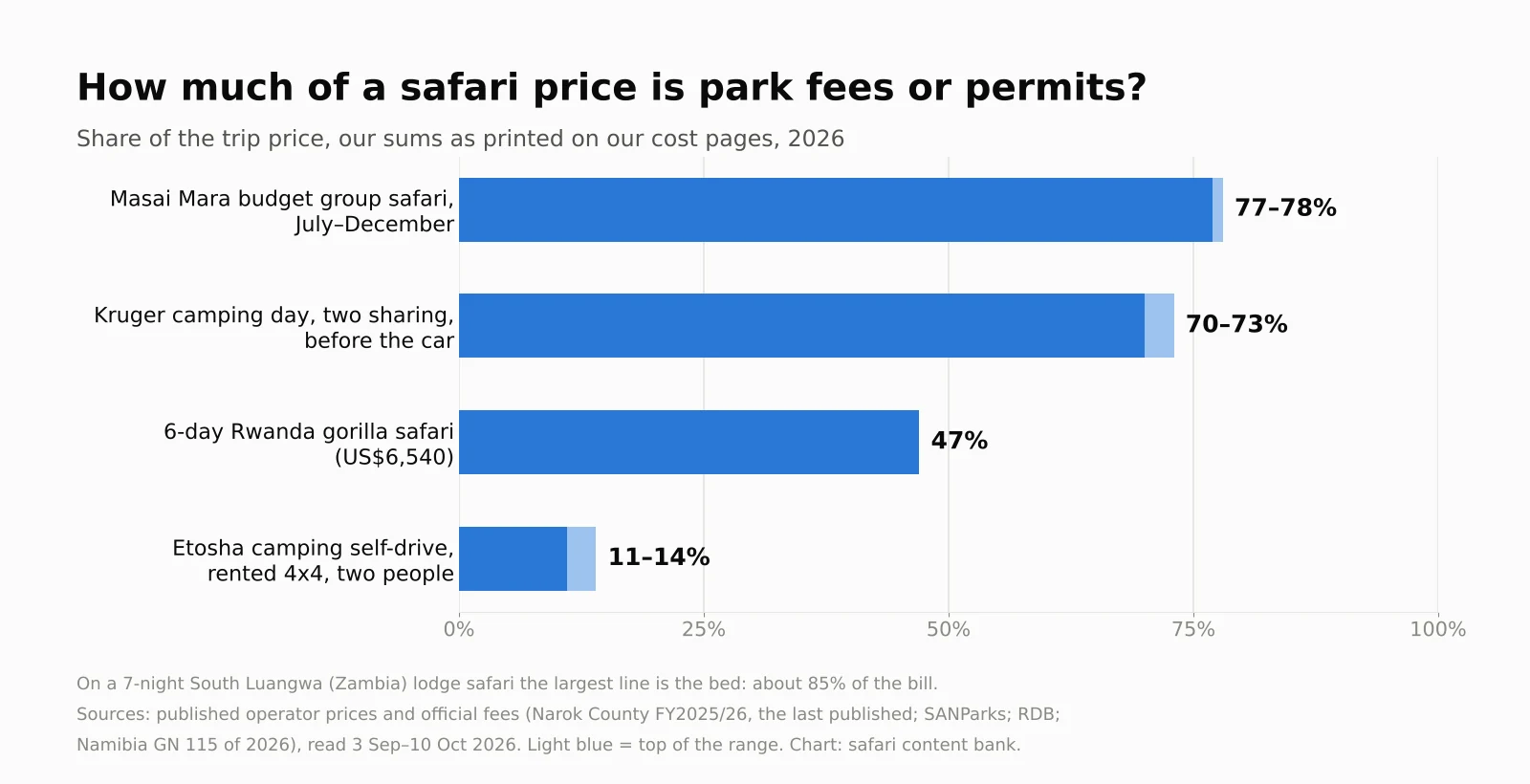 Our sums from published operator prices and official fees (Narok County FY2025/26, the last published; SANParks; RDB; Namibia’s Government Notice 115 of 2026), as printed on our cost pages, read 3 September–10 October 2026. Chart: safari content bank.
The rest of the bill is the vehicle and guide (a private Land Cruiser with driver-guide costs US$200–300 a day per vehicle in Tanzania), flights between camps (a Botswana light-aircraft sector costs US$220–594 per person) and tips, which tipping guides put at US$10–20 per guest per day for the guide in Kenya and Tanzania (safari tipping).
The official fee lines, with the date each took effect and the authority’s own source:
| Fee | Amount | In force from | Source |
|---|---|---|---|
| Maasai Mara National Reserve, non-resident adult, per day (12-hour ticket, 06:00–18:00), 1 Jan–30 Jun | USD 100 | Since 1 Jan 2024; Narok County FY2025/26 schedule, the last published | Narok County fee schedule FY2025/26 |
| Maasai Mara National Reserve, non-resident adult, per day (12-hour ticket, 06:00–18:00), 1 Jul–31 Dec | USD 200 | Since 1 Jul 2024; Narok County FY2025/26 schedule, the last published, expired 30 Jun 2026 (no 2026/27 schedule as of 9 Oct 2026); The Kenya Times (6 Aug 2026, secondary) reports US$200 still applies for Jul–Dec 2026 | Narok County fee schedule FY2025/26 |
| Serengeti and Nyerere National Parks, non-East African adult, entry per day, 16 May–14 Mar | USD 70 + 18% VAT = USD 82.60 | 1 Jul 2023 (2023/24 tariff, last published) | TANAPA Tariffs 2023/24 |
| Serengeti and Nyerere National Parks, non-East African adult, entry per day, 15 Mar–15 May | USD 60 + 18% VAT = USD 70.80 | 1 Jul 2023 (2023/24 tariff, last published) | TANAPA Tariffs 2023/24 |
| Serengeti and Nyerere, concession fee per person per night inside the park | Jul–Sep USD 60 + VAT = USD 70.80; Oct–Jun USD 50 + VAT = USD 59 | 1 Jul 2023 (2023/24 tariff, last published) | TANAPA Tariffs 2023/24 |
| Ngorongoro Crater descent (crater service fee), per vehicle | USD 295 (NCAA's page does not say whether VAT is included) | Undated official page, read 9 Oct 2026 | NCAA |
| Kruger National Park daily conservation fee, international adult (12+), per day | ZAR 602 | 1 Nov 2025 to 31 Oct 2026 (SANParks 2025/26 schedule) | SANParks daily conservation fees 2025/26 |
| Kruger National Park daily conservation fee, international adult (12+), per day | ZAR 692 | 1 Nov 2026 to 31 Oct 2027 (SANParks 2026/27 schedule, already published) | SANParks daily conservation fees 2026/27 |
| Tier 1 parks (Etosha, Namib-Naukluft including Sossusvlei, Skeleton Coast, Ai-Ais/Fish River Canyon, Waterberg Plateau, Cape Cross, Dorob, Tsau //Khaeb), foreign adult 16+, per person | NAD 280 (NAD 140 park entrance + NAD 140 conservation fee) | 1 Apr 2026 (Government Notice 115 of 2026; the notice prices fees per person with no period; MEFT's 2021 schedule made fees valid for 24 hours from entry); was NAD 150 under the 2021 schedule | Government Gazette 8877 (Government Notice 115 of 2026), hosted by the Legal Assistance Centre |
| Vehicle up to 10 seats, most national parks (N$50 at Sandwich Harbour), per vehicle | NAD 60 | 1 Apr 2026 (Government Notice 115 of 2026; the notice states no period; MEFT's 2021 schedule made fees valid for 24 hours from entry); was NAD 50 | Government Gazette 8877 (Government Notice 115 of 2026), hosted by the Legal Assistance Centre |
| Uganda: gorilla tracking permit, Bwindi Impenetrable and Mgahinga Gorilla NPs, foreign non-resident, per person per trek (guide and that day's park entry included) | USD 800 (foreign resident USD 700; rest of Africa USD 500; East African citizens UGX 300,000) | Since 1 Jul 2024 (UWA tariff 2024–26); confirmed unchanged from 1 Jan 2027 by UWA letter TDO 93/04 of 26 Feb 2026 | UWA letter TDO 93/04, 26 Feb 2026 |
| Uganda: gorilla tracking permit in April, May and November (low season), foreign non-resident, per person per trek; cannot be rescheduled | USD 600 (foreign resident USD 500) | Immediate effect from the UWA letter of 26 Feb 2026 | UWA letter TDO 93/04, 26 Feb 2026 |
| Uganda: park entry, Queen Elizabeth, Bwindi, Mgahinga, Kibale, Kidepo Valley and Lake Mburo NPs, foreign non-resident adult, per 24 hours | USD 40 (child USD 20) | 1 Jul 2024 (UWA Conservation Tariff July 2024–June 2026, the last published park-entry rates; the 2026/27 letter does not cover park entry) | UWA Conservation Tariff July 2024–June 2026 |
| Rwanda: mountain gorilla tracking permit, Volcanoes NP, international visitor, per person per day | USD 1,500 | Current RDB price, checked 9 Oct 2026 | Visit Rwanda (Rwanda Development Board) |
Where conservation and community levies go
Governments publish two revenue shares for local communities; private levies are named on rate cards, but the camp pages we read publish no accounts for them.
| Fee or levy | What the official source says | Our sum or note | Source |
|---|---|---|---|
| Rwanda gorilla permit, US$1,500 | 10% of permit revenue goes to community projects such as schools, health centres and roads | US$150 per trekker (our sum) | Visit Rwanda (RDB) |
| Uganda park entry, US$40 per 24 hours | 20% of park entry fees go to the communities around each park | About US$8 per visitor a day on the US$40 entry fee (our sum) | UWA Bwindi brochure (PDF) |
| SANParks bookings (Kruger) | A 1% community fund is added to accommodation and activity bookings, on top of the daily conservation fee | Charged at booking | SANParks rates and fees |
| Masai Mara conservancies (Kenya) | 24 conservancies cover about 450,000 acres leased from over 15,000 landowners | Camps charge a conservancy fee of US$130 per adult per night (Kicheche and Porini, 2026) | MMWCA; Mara reserve or conservancy |
| Namibia’s communal conservancies | 86 registered conservancies earned N$166,855,933 in 2023, of which tourism N$111,167,250 and conservation hunting N$48,986,405 | Tourism was about two-thirds (our sum) | NACSO and MEFT, 2023 (PDF) |
| Botswana camp levies | Camp levies of US$20–100 per person per night, often extra to the rate | Kwando to Great Plains (rate cards) | Botswana safari cost |
| Greater Kruger reserve levies | Timbavati’s levy is R660 per adult per night and Sabi Sabi’s R450 (2026) | Paid per night on top of the lodge rate | Sabi Sand or Timbavati |
Official pages read 8–10 October 2026; rate cards as dated on the linked pages. A levy’s name says what it is for; ask the camp whether it publishes a report on how the money is spent.
What you are likely to see
Measured sighting rates exist for few areas, and the best come from one operator’s own travellers on multi-day trips, so read them as a best case. That operator’s Botswana figures cover 11,679 sightings from 1,356 traveller groups since May 2018 (read September 2026). The share is of groups that saw the animal at least once on their trip, not on one drive.
| Animal | Seen by (one operator’s traveller groups) | Area | More |
|---|---|---|---|
| Elephant | 95% | Botswana, all areas | Where to see elephants |
| Lion | 91% in Botswana; 96% in Lower Zambezi | Botswana, all areas; Zambia | Where to see lions |
| Buffalo | 82% | Botswana, all areas | Where to see buffalo |
| Leopard | 66% in Botswana; 83% in South Luangwa and 88% in Lower Zambezi | Botswana, all areas; Zambia | Where to see leopards |
| Rhino | Not printed here | Rhino are the animal most often missing or scarce in parks without all five | Where to see rhino |
One safari operator’s traveller reports: Botswana pages read September 2026, Zambia pages read 8 October 2026. The operator sells these trips and its travellers chose its routes and seasons; no comparable rate is published for the Serengeti, the Masai Mara or Kruger.
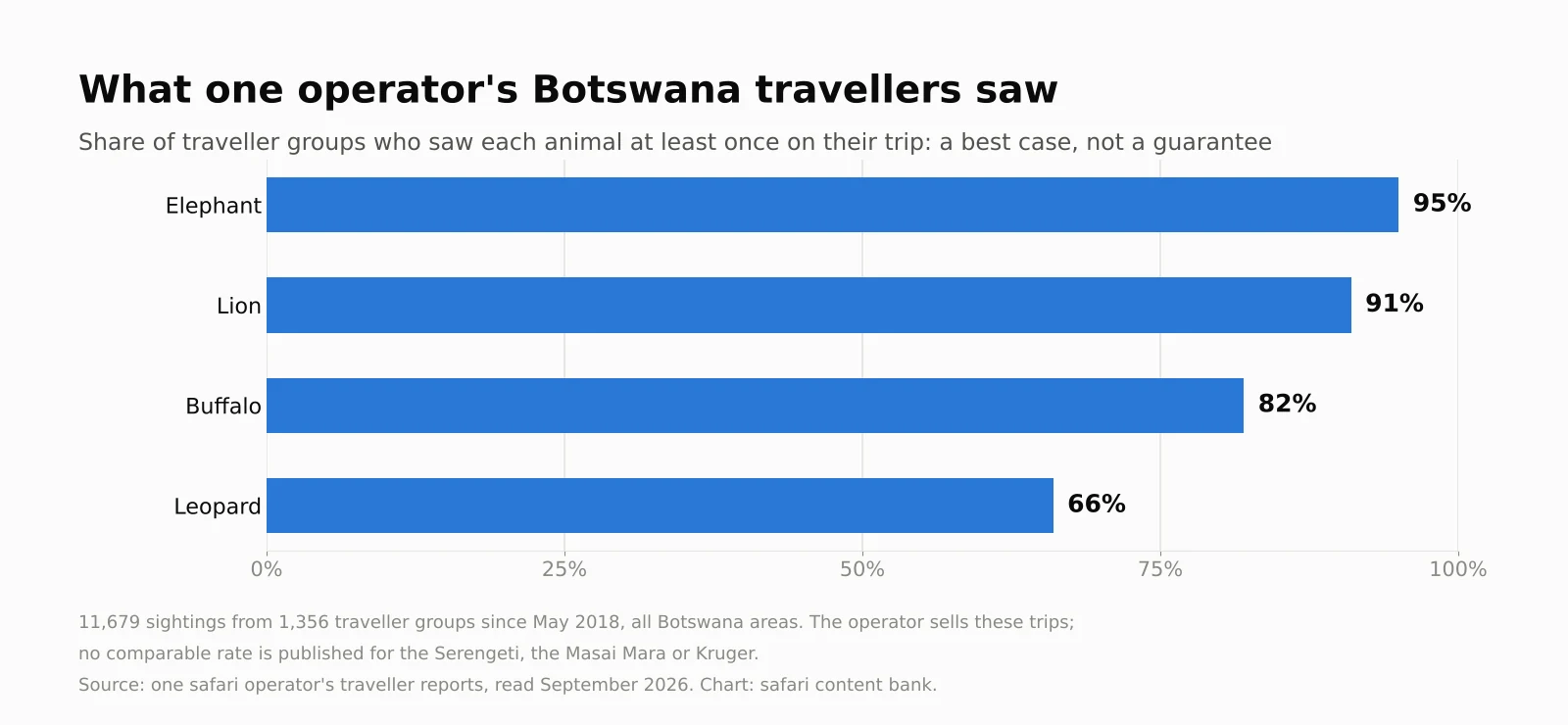 One safari operator’s traveller reports for Botswana, read September 2026. Chart: safari content bank.
- Sightings depend on season and place more than on price. Forum regulars correct the idea that “luxury means better game viewing” (TripAdvisor, traveller reports); park fees and park rules are the same at every price level.
- Night drives and off-road driving depend on the land, not the price. They are not allowed in the Serengeti, Ngorongoro or Botswana’s national parks; private reserves and concessions run them (where to see the Big Five).
- The wildebeest herds move. They are in the Mara about July–October and calve in the southern Serengeti January–March (Great Migration month by month).
What travellers report
We found no recent official survey of safari travellers’ satisfaction. The nearest is Namibia’s Tourist Exit Survey 2012–2013 (6,500 interviews at borders, all visitors including business travellers), in which 86% said they would “Definitely” recommend Namibia to friends and family. Wildlife was among the best experiences named, and the survey was not about safaris alone (MET, PDF).
Forum regulars’ most common regrets are about price, weather and pace rather than the wildlife (TripAdvisor, traveller reports, 2026):
- Cost: one family called a US$15,000 quote “eye-watering”; regulars advise asking for an itemised quote.
- Weather: June mornings on open vehicles in Botswana are “very, very cold”, and a wet spell can cut sightings in the green season.
- Pace: Botswana regulars reckon a 2-2-2-1 camp plan loses about a third of game-viewing time to transfers (first safari).
Who a safari suits, and who might prefer an alternative
A safari suits people who want to see large animals in the wild and accept early starts, many hours in a vehicle and a high daily price; if one of those is a problem, a different season, style or country usually fixes it.
| If you… | Consider | Why |
|---|---|---|
| Want the classic big-game safari and have a week | Kenya, Tanzania or Botswana | See best country for a safari and first safari |
| Have a tight budget | Green season, or Kenya January–June | Bed rates up to 55% below peak at the camps we checked; the Mara fee is US$100 a day January–June, not US$200 (green-season safari) |
| Like to travel independently | Self-drive in Kruger or Namibia | An ordinary hire car works in Kruger; Namibia’s parks are the usual self-drive (self-drive safari cost) |
| Travel with young children, or want to avoid malaria tablets | South Africa’s malaria-free reserves | Madikwe, Pilanesberg, the Waterberg and the Eastern Cape reserves are outside the malaria area; Kruger is not (malaria-free safaris) |
| Have only 3–4 days | Masai Mara or Kruger | Published trips to each have a median of 4 days (how many days) |
| Travel alone | A group safari, or camps with no single supplement | Published single supplements run 24–50% of the sharing rate (solo safari) |
| Most want gorillas | Uganda or Rwanda | Permit US$800 (US$600 in April, May and November) in Uganda, US$1,500 in Rwanda (Uganda or Rwanda) |
| Dislike long drives or early starts | A single park, fewer moves, or a fly-in camp | Kruger’s gates open at 05:30 or 06:00; Botswana regulars reckon a 2-2-2-1 camp plan loses about a third of game-viewing time to transfers |
| Have limited mobility | Ask about vehicles and camp layout first | See accessible safari and safari for seniors |
Sources as on the linked pages, read 3–10 October 2026.
Ways to cut the cost
Season, self-drive and a fuller vehicle cut more than any discount. The full list, with every rate, is on safari cost per day by country.
- Travel in the green season. Governors’ Camp costs US$453 a night in April–May against US$998 in July–October; Serengeti entry is US$70.80 instead of US$82.60 from 15 March to 15 May (last published tariff, 2023/24). See green-season safari.
- Time the fees. The Mara reserve is US$100 a day from January to June; Uganda’s gorilla permit is US$600 in April, May and November; Rwanda takes 30% off the permit from November to May with two nights in Akagera or Nyungwe.
- Fill the vehicle. A private Tanzanian vehicle with driver-guide costs US$200–300 a day whether two or six ride in it, and the Ngorongoro Crater fee is US$295 per vehicle per descent (NCAA’s page does not say whether VAT is included). See private vs group safari cost.
- Drive yourself in Kruger or Namibia: Etosha charges N$280 per foreign adult plus N$60 per vehicle (Etosha park fees).
- Choose fewer parks and stay longer in each. Most camps that set a minimum stay ask for 2 nights.
- Check what “park fees” means in every quote. Kenya’s cheapest trip leaves them out; Tanzania’s group camping includes them.
Before you pay a deposit, check that the operator is licensed: how to check a safari operator is licensed.
Common mistakes
| What people often assume | What is correct |
|---|---|
| “A luxury safari shows you more animals” | Park fees and park rules are the same at every price level; night drives and off-road driving depend on the land, not the price. |
| “The budget price includes park fees” | Kenya’s cheapest published Mara safari says “park fees NOT included”; from July to December the Mara fee is 77–78% of a budget day (our sums). |
| “You are guaranteed the Big Five” | No park publishes a guarantee. The best rates in our sources are one operator’s traveller reports, and rhino are the animal most often missing or scarce. |
| “Kruger costs R602 a day” (with no date) | That was the 2025/26 rate, which ended on 31 October 2026. Since 1 November 2026: R692 per international adult per day. |
| “The green season is a washout” | Forum regulars call it a weather gamble, not automatically worse; some camps close, and beds cost up to 55% less at the camps we checked. |
| “Conservation levies are all audited” | The camp pages we read publish no accounts for their levies; the published government shares are Rwanda’s 10% of permit revenue and Uganda’s 20% of entry fees. |
| “More parks means more animals” | Every move costs viewing time; Kenya forum regulars advise 2–3 nights per park and fewer parks. |
Frequently asked questions
Is an African safari worth the money? It depends on what you want and what you can spend. Published 2026 safaris cost about US$138–373 per person per day on a budget, US$311–1,090 mid-range and US$578–3,085 at luxury level. If seeing elephant, lion and leopard in the wild matters to you, one operator’s Botswana traveller groups saw them on 95%, 91% and 66% of trips, but no trip is guaranteed.
How much does a safari cost per day? About US$138–373 per person per day on a budget in eight of the nine countries we cover, US$311–1,090 mid-range and US$578–3,085 luxury. Kenya’s cheapest Masai Mara group safari lists at US$57–60 a day before the reserve fee of US$100–200 a day. Country by country: safari cost per day by country.
Why is a safari so expensive? Park fees, beds in remote places, vehicles and flights. On the cheapest trips park fees are most of the price: 77–78% of a Masai Mara budget day from July to December (our sums). On lodge safaris beds are the largest line: about 85% of a 7-night South Luangwa lodge safari.
How much of my safari money goes to conservation and local communities? Rwanda says 10% of gorilla permit revenue goes to community projects (US$150 of a US$1,500 permit, our sum), and the Uganda Wildlife Authority says 20% of park entry fees go to the communities around each park. In Kenya, the Mara conservancies lease land from over 15,000 landowners. Private levies are named on rate cards, but the camp pages we read publish no accounts for them.
Am I guaranteed to see the Big Five? No. The best published rates are one operator’s traveller reports: in Botswana 95% of its groups saw elephant, 91% lion, 82% buffalo and 66% leopard, read as a best case. Rhino are the animal most often missing or scarce; see where to see the Big Five.
What is the cheapest way to do a safari? A short group safari or a self-drive. Counting park fees, a 3-day Masai Mara group safari costs about US$157–160 a day from January to June (our sum), and two people camping in Kruger pay R946 each a day for the campsite and park fee before car hire from 1 November 2026 (R856 until 31 October 2026; campsite at the October 2026 price, and SANParks had not published its 2026/27 accommodation tariff when we checked on 1 November 2026). See the cheapest safari in Africa.
Is a safari worth it with young children? It can be, with the right place. South Africa’s Madikwe, Pilanesberg, Waterberg and Eastern Cape reserves are outside the malaria area. No law sets a minimum age for a game drive; each lodge sets its own, from all ages to 16. See family safari and safari age limits.
How many days do I need for a safari to be worth it? Three to four days for one park near an airport, about a week for a circuit. Published Mara-only and Kruger itineraries have a median of 4 days, Tanzania’s northern circuit 7–8 and Botswana’s Okavango Delta and Chobe 10 (how many days for a safari).
Sources
- Prices and trip lengths, copied from our pages: safari cost per day by country, budget vs luxury safari cost, cheapest safari in Africa, self-drive safari cost, private vs group safari cost, green-season safari and how many days for a safari; operators’ and lodges’ published 2026 prices read 3 September–10 October 2026 (operator names kept in our editor notes); Governors’ Camp 2026 rate sheet (PDF); Wilderness, Mombo
- Park fees, copied from our cost pages, checked 9–10 October 2026: Narok County, Maasai Mara fee schedule FY2025/26 (PDF), the last published; TANAPA, Tariffs 2023/24 (PDF), the last published tariff; NCAA, tariffs; SANParks, daily conservation fees 2025/26 (PDF) and 2026/27 (PDF); Government Gazette 8877 (Namibia GN 115 of 2026); UWA, letter TDO 93/04 (PDF) and Conservation Tariff July 2024–June 2026 (PDF); Visit Rwanda (RDB)
- Community shares and levies: Visit Rwanda (RDB), read 9 October 2026; UWA, Bwindi brochure (PDF); SANParks, rates and fees; MMWCA, read 9 October 2026; NACSO and MEFT, State of Community Conservation 2023 (PDF); camp rate cards as linked on our Botswana and Kenya cost pages and Sabi Sand or Timbavati
- Sighting rates: one safari operator’s traveller reports, Botswana pages read September 2026 and Zambia pages read 8 October 2026, as on our Big Five, leopard and lion pages
- Survey: Ministry of Environment and Tourism, Namibia Tourist Exit Survey 2012–2013 (PDF), published April 2013
- Traveller reports (not fact): TripAdvisor forum threads on cost, weather and pacing, read September–October 2026, as linked on our country question pages
Fees and prices checked against our cost pages 9–10 October 2026. We will update this page after Kruger’s fee change on 1 November 2026, when Narok County publishes a 2026/27 Mara schedule and when TANAPA publishes a new tariff.