 Experience

Last verified · Next check due
On this page
- Where to see buffalo: parks, odds, counts and fees (2026)
- Cape buffalo and the Big Five
- Botswana: Chobe, the Delta and the Linyanti
- Zambia, Zimbabwe and Malawi: the Luangwa, the Zambezi and Gonarezhou
- Uganda and Tanzania: Kidepo, Murchison and the Serengeti
- South Africa and Namibia: Kruger, Addo and the Zambezi Region
- Forest buffalo: the small red buffalo of Central Africa
- Walking near buffalo: where it is allowed, and the rules
- Which buffalo trip to choose
- When is the best time to see buffalo?
- How many buffalo are left, and their IUCN status
- Common mistakes about seeing buffalo
- Frequently asked questions
- Sources
Short answer: Go to river parks in the dry season. One safari operator’s travellers saw buffalo on 100% of trips to Zimbabwe’s Gonarezhou, 95% in Zambia’s Lower Zambezi and 91% in Botswana’s Chobe. For the biggest counted herds, Kruger had 37,130 in 2011, and Uganda’s wildlife authority estimates 10,000–15,000 in Kidepo Valley. The African buffalo is Near Threatened on the IUCN Red List. Etosha has none. On foot, walk only with a qualified guide.
Key facts
- The African buffalo is Near Threatened on the IUCN Red List, in an assessment made in 2018 and published in 2019 (San Diego Zoo Wildlife Alliance Library, forest buffalo fact sheet, checked 9 October 2026). A continental total circulates, but we could not confirm it on a specialist page, so we do not print it.
- The highest published buffalo sighting rate is 100%: every one of one safari operator’s traveller groups saw buffalo in Gonarezhou (Zimbabwe). Lower Zambezi is at 95%, Chobe 91%, South Luangwa 89% and the Okavango Delta reserves 85% (read September–October 2026). These are per-trip rates, not the chance on one drive.
- The largest dated park counts in our sources: Kruger 37,130 in 2011 and the Serengeti 28,524 in 2008 (Wikipedia, Wikipedia, secondary); UWA estimates 10,000–15,000 in Kidepo Valley and over 10,000 in Murchison Falls (Kidepo; Murchison Falls).
- Cape buffalo is one of the Big Five, and the one that most often goes missing on a Namibia trip: Etosha has none, kept out to protect Namibia’s foot-and-mouth-free livestock exports (where to see the Big Five).
- Herds stay near water: an adult needs about 45 litres every two days, and floodplain herds often number more than 1,000 (Wikipedia, secondary, citing Caron et al. 2023). That is why dry-season rivers and swamps are the places to go.
- There is no reliable buffalo death toll: “buffalo kill 200 people a year” has no source in anything we hold. In Zimbabwe’s 2016–2022 data, crocodiles and elephants caused most of 322 wildlife-related deaths; hippo and buffalo made up the rest (Scientific Reports, 2025).
Where to see buffalo: parks, odds, counts and fees (2026)
Gonarezhou, Lower Zambezi, Chobe, South Luangwa, the Okavango Delta reserves and Mana Pools all have a published buffalo sighting rate of 84% or more; Kruger, the Serengeti, Kidepo Valley and Murchison Falls have counts or official estimates instead. No park in our sources publishes both.
| Place | Country | Buffalo count in our sources | Seen by (per trip) | Fee to be there, per adult | Source |
|---|---|---|---|---|---|
| Gonarezhou National Park | Zimbabwe | No count in our sources | 100% | US$30 a day as a day visitor, US$20 staying inside (ZimParks Tariff 2026) | one operator’s Gonarezhou page; Zimbabwe safari cost |
| Lower Zambezi | Zambia | No count in our sources | 95% | US$25 a day (DNPW 2025 schedule, the last published) | one operator’s Lower Zambezi page |
| Chobe National Park (riverfront, Savuti) | Botswana | No count in our sources | 91% | P270 a day (last published DWNP schedule, 1 April 2022) | one operator’s Chobe page; Chobe |
| South Luangwa | Zambia | “Herds of hundreds” (one operator) | 89% | US$25 a day (DNPW 2025, last published) | one operator’s South Luangwa page |
| Okavango Delta reserves (private concessions) | Botswana | No count in our sources | 85% | In the camp rate at many camps | one operator’s Okavango Delta page |
| Mana Pools | Zimbabwe | No count in our sources | 84% | US$24 a day (ZimParks Tariff 2026) | one operator’s Mana Pools page |
| Kwando-Linyanti (private concessions) | Botswana | No count in our sources | 80% | Camp rate plus levy | one operator’s Kwando-Linyanti page |
| Liwonde National Park | Malawi | No count in our sources | 79% | Not on our fee pages | one operator’s Liwonde page |
| Moremi Game Reserve | Botswana | No count in our sources | 78% | P270 a day (same DWNP line as Chobe) | one operator’s Moremi page |
| Majete Wildlife Reserve | Malawi | No count in our sources | 78% | Not on our fee pages | one operator’s Majete page |
| North Luangwa | Zambia | Herds “larger than in South Luangwa” (one operator) | 69% | US$20 a day (DNPW 2025, last published) | one operator’s North Luangwa page |
| Makgadikgadi and Nxai Pan | Botswana | No count in our sources | 30% | P190 a day (last published DWNP schedule, 1 April 2022) | one operator’s salt pans page |
| Kruger | South Africa | 37,130 (census, 2011) | Not published | R692 (R602 until 31 Oct 2026) | Wikipedia (secondary, citing SANParks) |
| Serengeti | Tanzania | 28,524 (2008) | Not published | US$82.60 a day, 16 May–14 March (last published tariff, 2023/24) | Wikipedia (secondary) |
| Kidepo Valley | Uganda | 10,000–15,000 (UWA estimate, undated) | Not published | US$40 per 24 hours (last published UWA tariff, July 2024–June 2026) | UWA |
| Murchison Falls | Uganda | Over 10,000 (UWA, undated) | Not published | US$45 per 24 hours (same UWA tariff) | UWA |
| Addo | South Africa | About 400 | Not published | R565 a day from 1 Nov 2026 (R492 until 31 Oct 2026) | Wikipedia (secondary) |
Sighting rates: one operator’s traveller reports, share of groups who saw buffalo at least once on their trip; Botswana pages read September 2026, Zambia, Zimbabwe and Malawi pages read 8 October 2026. Counts as dated in each source; the Kruger and Serengeti figures are more than 15 years old. Fees per non-resident or international adult, copied from our Botswana, Chobe, Zambia, Zimbabwe, Uganda, Serengeti, Kruger and South Africa fee and cost pages, read 8–10 October 2026. Botswana’s fee lines are the last published DWNP schedule; no official current tariff is published.
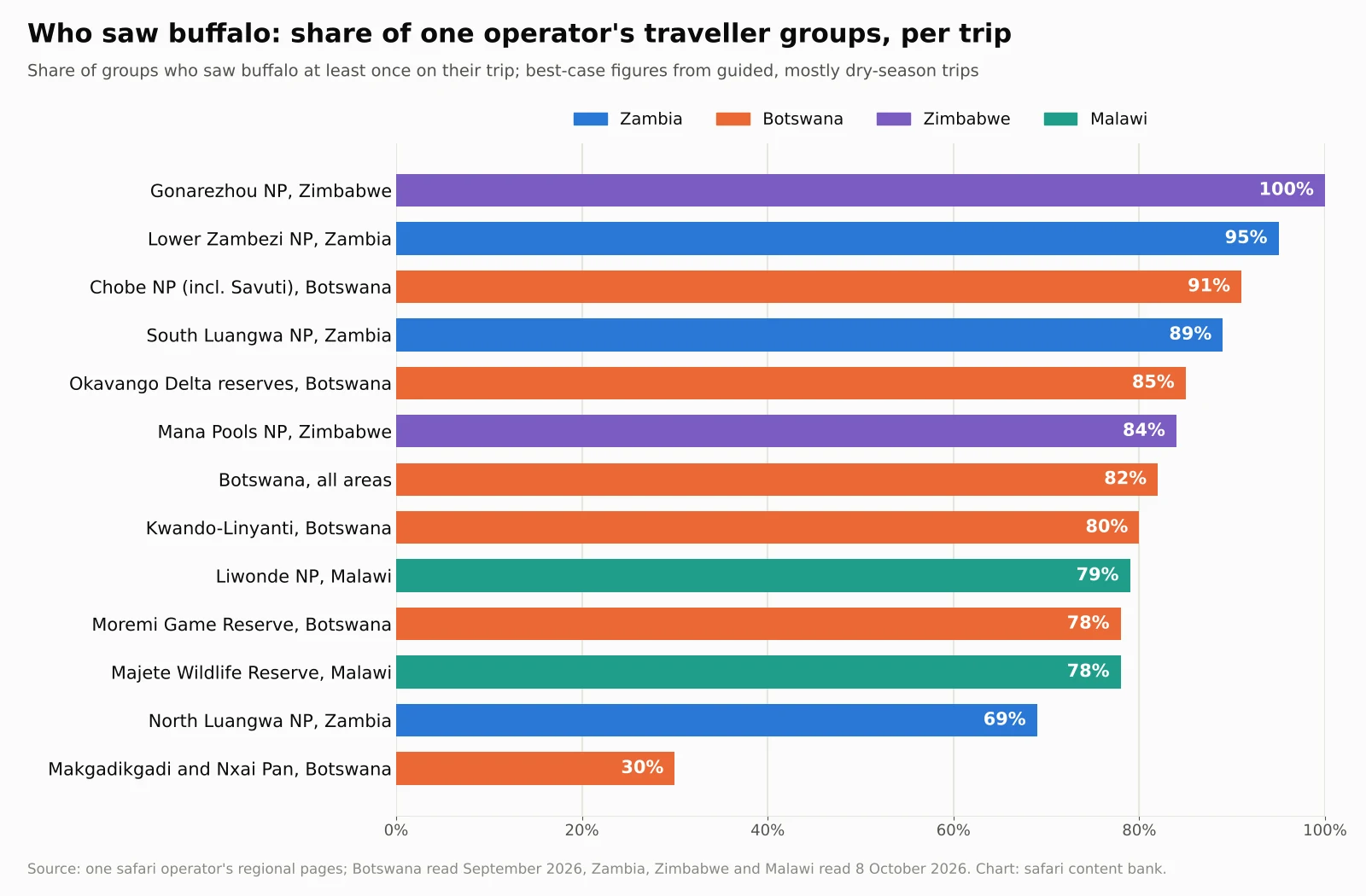 Traveller-reported, per trip, from one operator’s clients; Botswana dataset 11,679 sightings from 1,356 groups since May 2018. Sources: one operator’s regional pages, Botswana read September 2026, Zambia, Zimbabwe and Malawi read 8 October 2026. Chart: safari content bank.
- Read these as best-case numbers. They come from one operator’s own clients, who tend to take longer, guided, dry-season trips, and the operator does not publish how many groups each regional figure rests on.
- North Luangwa is the odd one out: the same operator describes bigger buffalo herds there than in South Luangwa, yet only 69% of its North Luangwa travellers saw buffalo, against 89% in the south. Bigger herds in a wilder park are not the same as better odds.
- Ruaha, Nyerere and Katavi are often named for buffalo, but our sources hold no buffalo count or sighting rate for any of them, so they are not in the table.
Cape buffalo and the Big Five
The Cape buffalo is one of the Big Five; the full park-by-park answer, including which parks hold all five, is on where to see the Big Five. This page covers only where buffalo are.
- In Botswana, buffalo is the third most-seen of the five: 95% of one operator’s groups saw elephant, 91% lion and 82% buffalo, and 66% leopard (read September 2026).
- Namibia is the exception: Etosha has no buffalo. For buffalo in Namibia, a safari booking site rates them “common” in Nkasa Rupara and “occasional” in Bwabwata and Mudumu, Tier 2 parks at N$200 per foreign adult (Government Notice 115 of 2026; Namibia park fees).
- The same veterinary logic shapes Botswana. Its cordon fences were built to keep buffalo, which carry foot-and-mouth disease, apart from cattle; a 2025 risk assessment co-written by Botswana and Namibian government vets found that removing the sections studied did not raise disease risk (Rosen et al., Frontiers in Veterinary Science, 2025).
- Lions take buffalo: pride males often hunt alone by ambush and take a lot of buffalo (Wikipedia, secondary). See where to see lions.
Botswana: Chobe, the Delta and the Linyanti
Chobe has the highest published buffalo rate in Botswana, 91%, ahead of the Okavango Delta reserves at 85%, Kwando-Linyanti at 80% and Moremi at 78%; camp operators’ month guides list huge buffalo and elephant herds in August.
| Area | Buffalo seen by (per trip) | What drives the herds | Fee per adult | Source |
|---|---|---|---|---|
| Chobe National Park (incl. Savuti) | 91% | The Chobe River is the only permanent water in the dry season | P270 a day (last published DWNP schedule, 1 April 2022) | one operator’s Chobe page; Chobe |
| Okavango Delta reserves | 85% | Permanent swamp and floodplains | In the camp rate at many camps | one operator’s Okavango Delta page |
| Kwando-Linyanti | 80% | “Permanent waters serve as essential migration points” (Botswana Tourism) | Camp rate plus levy | one operator’s Kwando-Linyanti page; Botswana Tourism |
| Moremi Game Reserve (incl. Khwai) | 78% | Elephant and buffalo come to the river from April to October | P270 a day (same DWNP line) | one operator’s Moremi page; Moremi |
| Makgadikgadi and Nxai Pan | 30% | Dry pans | P190 a day (last published DWNP schedule, 1 April 2022) | one operator’s salt pans page |
Botswana pages read September 2026. In Feb 2026 the government news agency BOPA called the existing non-resident fee P380, a P500 rise was announced, then reported postponed. No official current tariff is published: confirm with DWNP or your operator.
- The Linyanti and Kwando: Botswana Tourism says their permanent waters “serve as essential migration points for wildlife” in dry seasons, naming buffalo with elephant, wildebeest and zebra (Botswana Tourism).
- Savuti: when the Savuti Channel flows, elephant, buffalo, zebra and wildebeest arrive and lions follow (Savuti).
- Duba Plains, in the northern Delta, is known for lions that hunt buffalo, often in daylight and often in water, behaviour filmed over years by Dereck and Beverly Joubert (Relentless Enemies, National Geographic, 2006). Prides change over 20 years, and guests report the interaction is not guaranteed. Duba Plains Camp charges US$2,150–3,950 per person a night, by season (Great Plains 2025; Botswana safari cost).
- No walking in Moremi or Chobe National Park: Botswana’s private concessions allow it (Botswana night drives and walking). Chobe or Moremi is compared on Moremi vs Chobe.
Zambia, Zimbabwe and Malawi: the Luangwa, the Zambezi and Gonarezhou
The Zambezi and Luangwa valleys give the highest buffalo rates in our sources outside Botswana: 95% in Lower Zambezi, 89% in South Luangwa and 84% at Mana Pools; Gonarezhou, in Zimbabwe’s south-east, is at 100%.
- Lower Zambezi: most game lives on the narrow valley floor, and 95% of one operator’s travellers saw buffalo. Entry is US$25 per international adult per day (DNPW 2025 schedule, the last published).
- South Luangwa: elephant and buffalo move in herds of hundreds (one safari operator), and 89% of the operator’s travellers saw buffalo. It is a walking park: every group has a licensed guide and an armed scout (walking safaris).
- North Luangwa: buffalo herds are larger than in South Luangwa, according to the same operator, but the sighting rate is 69%. Entry is US$20 a day (DNPW 2025, last published).
- Kafue: buffalo are mainly in the south of the park, and also on the Busanga Plains; no buffalo rate is published. Entry is US$20 a day.
- Mana Pools: 84% of the operator’s travellers saw buffalo. Walking is allowed with a guide, or unguided with a permit; the fee is US$24 a day (ZimParks Tariff 2026; Zimbabwe safari questions).
- Gonarezhou: every one of the operator’s Gonarezhou travellers saw buffalo; ZimParks charges US$30 a day as a day visitor and US$20 staying inside (Zimbabwe safari cost).
- Hwange: one operator lists buffalo among the park’s common animals; no rate is published. Entry is US$24 a day as a day visitor, US$12 staying inside (ZimParks Tariff 2026).
- Malawi: 79% of the operator’s Liwonde travellers and 78% at Majete saw buffalo; neither park’s fees are on our cost pages.
See also: South Luangwa vs Lower Zambezi and Hwange vs Mana Pools.
Uganda and Tanzania: Kidepo, Murchison and the Serengeti
Uganda’s wildlife authority gives the biggest East African buffalo figures in our sources: 10,000–15,000 in Kidepo Valley and over 10,000 in Murchison Falls; the Serengeti’s last count in our sources is 28,524, from 2008. None of these parks publishes a sighting rate.
- Kidepo Valley: UWA estimates 10,000–15,000 buffalo. Kidepo has one rainy season, April to September, and UWA names the dry season as the prime time, when animals gather in the Narus Valley. Entry is US$40 per 24 hours (last published UWA tariff, July 2024–June 2026).
- Murchison Falls: UWA counts over 10,000 buffalo, over 900 elephants and about 35,000 Uganda kob. Entry is US$45 per 24 hours, the highest in Uganda.
- Queen Elizabeth and Lake Mburo: UWA lists buffalo in both, with no count. Entry is US$40 per 24 hours each. The two parks are compared on Murchison Falls vs Queen Elizabeth.
- Serengeti: 28,524 buffalo in 2008 (Wikipedia, secondary). Buffalo there recovered after rinderpest ended in 1963 (Scientific Data, 2020). Entry is US$82.60 per adult per day from 16 May to 14 March (last published tariff, 2023/24).
- Tanzania held about 240,000 Cape buffalo in 2021, more than any other country (Wikipedia, secondary, citing Caron et al. 2023).
- Katavi, Ruaha and Nyerere: sellers’ Big Five guides attribute the biggest herds to Katavi and the Serengeti, but no survey in our sources backs a herd size for Katavi. Katavi and Ruaha cost US$35.40 per adult per day (last published tariff, 2023/24; Tanzania park fees). See Ruaha vs Nyerere.
- Kenya: buffalo on Kenya’s rangelands fell by 30–50% between 1977 and 2016 (Ogutu et al., PLOS ONE 2016).
South Africa and Namibia: Kruger, Addo and the Zambezi Region
Kruger has the largest dated buffalo count in our sources, 37,130 in 2011, and is a self-drive park; Namibia’s buffalo are in the Zambezi Region, not Etosha.
- Kruger: the census series tabulated on Wikipedia, citing SANParks, gives 27,000 buffalo in 2009, 37,500 in 2010 and 37,130 in 2011; nothing newer is in our sources (Wikipedia, secondary). The north (Letaba, Mopani, Shimuwini) is mopane shrubveld with elephant and buffalo and fewer cars.
- Kruger’s rules: stay in your vehicle except at designated spots (Kruger self-drive); walking is with SANParks only. The fee is R692 per international adult per day from 1 November 2026 (R602 until 31 October 2026) (Kruger park fees).
- Addo: about 400 Cape buffalo (Wikipedia, secondary), in a park that is not in a malaria-risk area (malaria-free safaris). The fee is R565 per international adult per day from 1 November 2026 (R492 until 31 October 2026) (South Africa safari cost).
- Etosha: no buffalo. Namibia’s Zambezi Region: Nkasa Rupara is rated “common” for buffalo by a safari booking site; entry N$200 per foreign adult (Government Notice 115 of 2026).
Forest buffalo: the small red buffalo of Central Africa
The forest buffalo is the small, reddish form of the African buffalo: 100–130 cm at the shoulder and 265–320 kg, with roughly 56,000 left in a 2018 rough estimate (SDZWA Library, forest buffalo, checked 9 October 2026). A Cape buffalo bull stands 140–160 cm and weighs 650–900 kg (Wikipedia, secondary).
| Cape buffalo | Forest buffalo | Source | |
|---|---|---|---|
| Shoulder height | 140–160 cm | 100–130 cm | Wikipedia (secondary); SDZWA |
| Weight | Bulls 650–900 kg; cows up to about 500 kg | 265–320 kg | same |
| Horns | Span 56–165 cm in savanna bulls; a fused “boss” across the forehead marks a mature bull | To 65 cm, swept back, no boss | Wikipedia (secondary) |
| Herd size | Often more than 1,000 on floodplains | 3–25 | Wikipedia (secondary, citing Caron et al. 2023) |
| Daily walk | 4–6 km | 0.5–1.5 km | same |
| Where to see it | Savanna parks on this page | Forest clearings (bais) in Central Africa | see below |
Read 9 October 2026.
- Where: two safari sellers’ Odzala-Kokoua pages (Republic of Congo) list forest buffalo among the animals that visit the bais, and Wikipedia lists them for Lopé National Park (Gabon) and Dzanga-Sangha (Central African Republic) (Lopé; Dzanga-Sangha, secondary). We hold no sighting rate or count for any of them.
- East and southern African safari parks have the Cape form. Rwanda’s Nyungwe Forest lost its last buffalo in 1974 (Wikipedia); Akagera, in Rwanda’s savanna east, has buffalo, with no count in our sources.
Walking near buffalo: where it is allowed, and the rules
Walking safaris are allowed in South Luangwa, Mana Pools, Botswana’s private concessions, Tanzania’s national parks with a ranger and Kruger with SANParks only, but not in Moremi or Chobe National Park; the rule follows the land, not the camp. Our sources hold no incident data for walking safaris, so we print no accident rate.
| Where | Walking | The rule | Fee | Source |
|---|---|---|---|---|
| South Luangwa NP (Zambia) | Yes | Licensed guide plus armed scout; usual minimum age 12 | In the camp rate | Walking safaris |
| Mana Pools NP (Zimbabwe) | Yes | Guided, or unguided with a permit | US$24 a day park fee | Zimbabwe Field Guide |
| Botswana private concessions (Khwai, Delta, Linyanti) | Yes | No specialist walking qualification required by Botswana’s guiding regulations (one operator) | In the camp rate | Botswana night drives and walking |
| Moremi Game Reserve; Chobe National Park | No | “Night drives and walking safaris are not permitted within the reserve” (one operator, Moremi) | – | same |
| Tanzania national parks (Serengeti, Ruaha, Nyerere) | With an armed ranger | TANAPA walking fee plus ranger fee | US$20 (1–4 h) or US$25, ranger US$20 per group, all + 18% VAT (last published tariff, 2023/24) | Walking safari cost |
| Kruger NP | SANParks walks and trails only | Otherwise stay in your vehicle except at designated spots | Morning walk R726; afternoon walk R580 (SANParks 2024/25) | Walking safari cost |
Read 8–10 October 2026. “One operator” is a safari operator’s regional guide; names and links are in our editor notes.
- Lone bulls live close by. Young bulls leave the herd at four to five years for bachelor groups whose ranges are tiny, 0.5–4 km² (Wikipedia, secondary), so they are the buffalo walkers meet near camps and rivers.
- Ask for the guide’s walking qualification and whether they are armed. A review of injuries to visitors in South Africa advises using only registered trail guides of the right grade and not pressing guides to approach large animals; it counted 7 tourist deaths and 14 non-fatal injuries from wild mammals over ten years (Leggat et al., Journal of Travel Medicine 2001, PDF).
- The number to remember is not a buffalo number. In Zimbabwe, 2016–2022, Nile crocodiles caused about 51% of 322 confirmed wildlife-related deaths and elephants about 32%; hippo and buffalo made up the rest, with no separate figure for buffalo (Scientific Reports, 2025).
- Insurance: name walking safaris to your insurer in writing (safari travel insurance).
Which buffalo trip to choose
Pick by what you want from buffalo: the highest published odds in Zimbabwe and Zambia, river herds and a boat in Chobe, buffalo on foot in South Luangwa or Mana Pools, or the biggest counted numbers in Kruger and Uganda’s Kidepo.
| If you want | Go to | Why |
|---|---|---|
| The highest published odds | Gonarezhou or Lower Zambezi | 100% and 95% of one operator’s travellers saw buffalo |
| Buffalo with elephants on a river | Chobe | 91% buffalo and 99% elephant on the same operator’s figures |
| Buffalo on foot | South Luangwa or Mana Pools | Guided walks; 89% and 84% saw buffalo |
| Lions hunting buffalo | Duba Plains, Okavango Delta | Behaviour filmed over years; not guaranteed |
| Big numbers on a self-drive | Kruger | 37,130 in the 2011 census; R692 a day (R602 until 31 Oct 2026) |
| A remote East African herd | Kidepo Valley | 10,000–15,000 (UWA); dry season October–March |
| Buffalo in Namibia | Nkasa Rupara, not Etosha | Etosha has no buffalo |
| The forest form | Odzala-Kokoua, Lopé or Dzanga-Sangha | Forest bais in Central Africa; no published odds |
When is the best time to see buffalo?
In the dry season, when herds that need water every two days stay near rivers and swamps: roughly June to October in Botswana, Zambia and Zimbabwe, April to September in Kruger, and October to March in Kidepo. No source in our bank gives buffalo-specific months for every park; the table uses each park’s general dry or best season.
| Park | Best months in our sources | What the source says | Source |
|---|---|---|---|
| Chobe riverfront | June–October; herds peak in August | Huge buffalo and elephant herds in August | Camp operators’ Botswana month guides; Chobe |
| Moremi | April–October | Elephant and buffalo come to the river | Moremi |
| Okavango Delta, Linyanti | June–October | Animals gather at the remaining water | A camp operator’s best-time guide for Botswana |
| South Luangwa | June–October | When every camp is open | South Luangwa |
| Lower Zambezi | Mid-August to mid-October for peak game | Camps open about April to mid-November | Lower Zambezi |
| Mana Pools | June–October | Most camps closed December–March | Mana Pools |
| Kafue | June–September | Dry season | Kafue |
| Kidepo Valley | October–March | Outside the April–September rains; animals gather in the Narus Valley | Kidepo |
| Murchison Falls | December–February and June–September | Uganda’s dry seasons | Murchison Falls |
| Queen Elizabeth | June–August and December–February | Uganda’s dry seasons | Queen Elizabeth |
| Katavi | May–October and December–February | “Animals congregate around the remaining water bodies” | A safari agent’s park guide |
| Kruger | April–September | Dry season, best for game viewing | Kruger |
Read 8–10 October 2026. General game-viewing seasons, not buffalo calendars, except the Chobe and Moremi lines. More: best time for a safari.
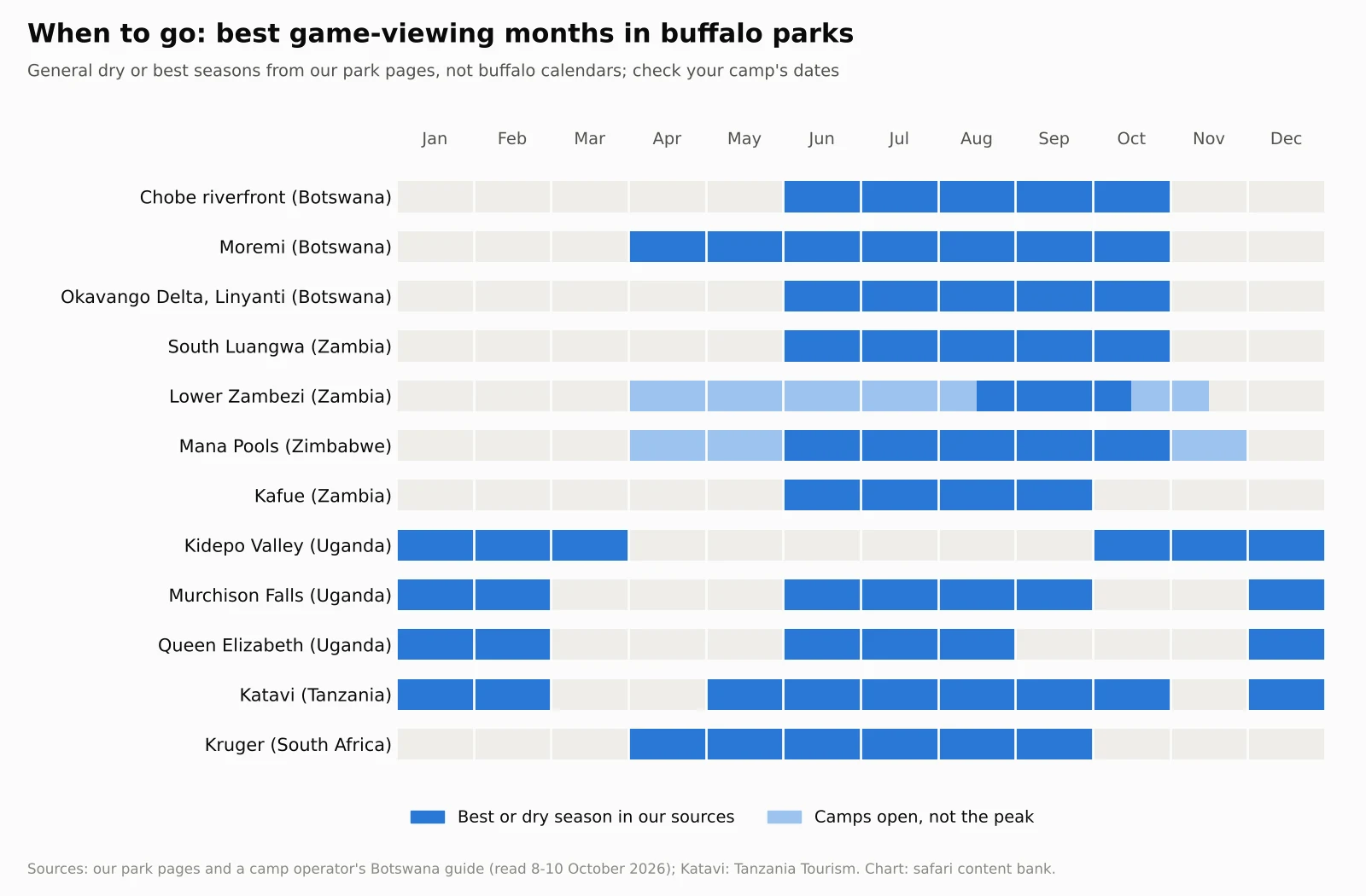 Sources: our park pages and a camp operator’s Botswana best-time guide, read 8–10 October 2026; Katavi: a safari agent’s park guide. General seasons, not buffalo calendars. Chart: safari content bank.
- The dry months are the peak-price months. Duba Plains charges US$3,950 per person a night from 15 June to 31 October against US$2,150 from 11 January to 31 March (Great Plains 2025; best time for a safari).
- Kidepo runs against Uganda’s usual calendar: elsewhere in Uganda the dry seasons are June–August and December–February (Kidepo).
How many buffalo are left, and their IUCN status
The African buffalo is Near Threatened on the IUCN Red List (assessed 2018, published 2019); the forest form numbered roughly 56,000 in a 2018 rough estimate, and Tanzania held about 240,000 Cape buffalo in 2021. We hold no confirmed continental total.
| Measure | Figure | Source |
|---|---|---|
| IUCN Red List category | Near Threatened (assessed 2018, published 2019) | SDZWA Library fact sheet |
| Forest buffalo | Roughly 56,000 (2018 rough estimate) | Same |
| Tanzania | About 240,000 (2021), the most of any country | Wikipedia (secondary, citing Caron et al. 2023) |
| Kruger (South Africa) | 37,130 (2011 census) | Wikipedia (secondary, citing SANParks) |
| Serengeti (Tanzania) | 28,524 (2008) | Wikipedia (secondary) |
| Kenya’s rangelands | Down 30–50%, 1977–2016 | Ogutu et al., PLOS ONE 2016 |
| Rinderpest, 1890s | About 95% of Africa’s buffalo killed | Wikipedia (secondary) |
| Hunting | Legal in 16 of 37 range countries in 2022 | Same (citing Caron et al. 2023) |
Read 9 October 2026.
- Four kinds are recognised by the Red List: Cape, forest, West African savanna and Central African savanna buffalo (Wikipedia, secondary). The buffalo on an East or southern African safari is the Cape buffalo.
- They live about 12 years in the wild and spend 17–19 hours a day feeding and ruminating (Wikipedia, secondary).
The official fee lines, with the date each took effect and the authority’s own source:
| Fee | Amount | In force from | Source |
|---|---|---|---|
| Chobe National Park and Moremi Game Reserve (DWNP), non-resident adult, per person per day | BWP 270 (SADC residents BWP 205; Botswana citizens and residents BWP 30) | Last published DWNP schedule, 1 April 2022 (via Tourism Update). In Feb 2026 the government news agency BOPA called the existing non-resident fee P380; a P500 rise was announced, then reported postponed. No official current tariff: confirm with DWNP or your operator | Tourism Update, 23 Feb 2022 (DWNP fee schedule) |
| Other DWNP parks and reserves (Central Kalahari Game Reserve, Khutse, Nxai Pan, Makgadikgadi Pans), non-resident adult, per person per day | BWP 190 (SADC residents BWP 145; Botswana citizens and residents BWP 20) | Last published DWNP schedule, 1 April 2022 (via Tourism Update). In Feb 2026 the government news agency BOPA called the existing non-resident fee P380; a P500 rise was announced, then reported postponed. No official current tariff: confirm with DWNP or your operator | Tourism Update, 23 Feb 2022 (DWNP fee schedule) |
| South Luangwa and Lower Zambezi National Parks (DNPW Category A), international adult, entry per day (06:00–18:00) | USD 25 (SADC and resident USD 20; Zambian citizen ZMW 55.60); child 5–13 half price, under 5 free | DNPW 2025 schedule ("official 2025 rates"), the last published; page last modified 8 May 2025, still shown 9 Oct 2026 | DNPW 2025 fee schedule, as shown on a Zambia travel portal |
| Kafue and North Luangwa National Parks, international adult, entry per day | USD 20 (SADC and resident USD 15; Zambian citizen ZMW 44.80) | DNPW 2025 schedule, the last published; page last modified 8 May 2025, still shown 9 Oct 2026 | DNPW 2025 fee schedule, as shown on a Zambia travel portal |
| Mana Pools National Park, Sapi and Chewore, international adult, conservation fee per day | USD 24, day visitor or staying overnight (SADC USD 18; local USD 8) | ZimParks Tariff 2026 (tariff year 2026, published February 2026); the conservation-fee table does not say whether VAT is included | ZimParks De-Gazetted Tariff 2026 |
| Hwange National Park, Main Camp (row as labelled in the ZimParks 2026 tariff), international adult, conservation fee per day | USD 24 day visitor; USD 12 if staying overnight in the park (SADC USD 18 / 10; local USD 5 / 3) | ZimParks Tariff 2026 (tariff year 2026, published February 2026); the conservation-fee table does not say whether VAT is included; Robins, Sinamatella and Kazuma Pan are not listed separately in our sources | ZimParks De-Gazetted Tariff 2026 |
| Uganda: park entry, Murchison Falls NP, foreign non-resident adult, per 24 hours | USD 45 (child USD 25) | 1 Jul 2024 (UWA Conservation Tariff July 2024–June 2026, the last published park-entry rates; the 2026/27 letter does not cover park entry) | UWA Conservation Tariff July 2024–June 2026 |
| Uganda: park entry, Queen Elizabeth, Bwindi, Mgahinga, Kibale, Kidepo Valley and Lake Mburo NPs, foreign non-resident adult, per 24 hours | USD 40 (child USD 20) | 1 Jul 2024 (UWA Conservation Tariff July 2024–June 2026, the last published park-entry rates; the 2026/27 letter does not cover park entry) | UWA Conservation Tariff July 2024–June 2026 |
| Serengeti and Nyerere National Parks, non-East African adult, entry per day, 16 May–14 Mar | USD 70 + 18% VAT = USD 82.60 | 1 Jul 2023 (2023/24 tariff, last published) | TANAPA Tariffs 2023/24 |
| Ruaha, Katavi, Mikumi, Saadani, Udzungwa, Mkomazi, Rubondo, Kitulo and the other parks in this group, non-East African adult, entry per day | USD 30 + 18% VAT = USD 35.40 | 1 Jul 2023 (2023/24 tariff, last published) | TANAPA Tariffs 2023/24 |
| Tanzania national parks (TANAPA) walking safari, per person, plus ranger fee per group per day | Short (1–4 h) USD 20, long (over 4 h) USD 25; ranger USD 20; all + 18% VAT | 1 Jul 2023 (2023/24 tariff, last published) | TANAPA Tariffs 2023/24 |
| Kruger National Park daily conservation fee, international adult (12+), per day | ZAR 602 | 1 Nov 2025 to 31 Oct 2026 (SANParks 2025/26 schedule) | SANParks daily conservation fees 2025/26 |
| Kruger National Park daily conservation fee, international adult (12+), per day | ZAR 692 | 1 Nov 2026 to 31 Oct 2027 (SANParks 2026/27 schedule, already published) | SANParks daily conservation fees 2026/27 |
| Addo Elephant National Park daily conservation fee, international adult, per day | ZAR 492 (child ZAR 246) | 1 Nov 2025 to 31 Oct 2026 (SANParks 2025/26 schedule) | SANParks daily conservation fees 2025/26 |
| Addo Elephant National Park daily conservation fee, international adult, per day | ZAR 565 (child ZAR 283) | 1 Nov 2026 to 31 Oct 2027 (SANParks 2026/27 schedule) | SANParks daily conservation fees 2026/27 |
| Kruger National Park guided walks and backpack trail, per person | Morning walk ZAR 726 (ZAR 848 from Crocodile Bridge); afternoon walk ZAR 580; Olifants river walk ZAR 424; Mphongolo backpack trail, 3 nights, ZAR 3,460–4,018 | SANParks tariffs 2024/25, the latest in our sources | SANParks tariffs 2024/25 |
| Tier 2 parks (Bwabwata, Mudumu, Nkasa Rupara, Khaudum, Mangetti, Popa Falls, Daan Viljoen, Hardap, Naute, Von Bach, South West Nature Reserve), foreign adult 16+, per person | NAD 200 | 1 Apr 2026 (Government Notice 115 of 2026; the notice prices fees per person with no period; MEFT's 2021 schedule made fees valid for 24 hours from entry); was NAD 100 | Government Gazette 8877 (Government Notice 115 of 2026), hosted by the Legal Assistance Centre |
Before paying an agent, check the operator’s licence.
Common mistakes about seeing buffalo
| What you’ll often read | What is correct |
|---|---|
| “Etosha has buffalo” | It has none: they are kept out by veterinary policy. In Namibia, go to the Zambezi Region parks such as Nkasa Rupara. |
| “Buffalo kill 200 people a year” | No source in anything we hold. In Zimbabwe’s 2016–2022 data, crocodiles (about 51%) and elephants (about 32%) caused most deaths. |
| “African buffalo are not threatened” | Near Threatened on the IUCN Red List (assessed 2018, published 2019). |
| “Chobe is only for elephants” | Chobe has Botswana’s highest buffalo rate: 91% of one operator’s travellers, against 82% Botswana-wide. |
| “Bigger herds mean better odds” | Not always: North Luangwa has bigger herds than South Luangwa (one operator), but a 69% sighting rate against 89%. |
| “Katavi has herds of 1,000+” | Not confirmed in our sources. Floodplain herds of more than 1,000 are documented in general (Wikipedia, secondary), but no survey we hold gives a Katavi herd size. |
| “You can walk among the buffalo in Moremi or Chobe” | Walking is not permitted in Moremi, and Chobe National Park has no walks. Botswana’s private concessions allow walking. |
| “Kruger costs R602 a day” | That was the 2025/26 rate, which ended on 31 October 2026. Since 1 November 2026: R692 per international adult per day. |
Frequently asked questions
Where is the best place to see buffalo in Africa? On published figures, Zimbabwe and Zambia’s river valleys and northern Botswana: 100% of one operator’s traveller groups saw buffalo in Gonarezhou, 95% in Lower Zambezi, 91% in Chobe and 89% in South Luangwa (read September–October 2026). For the biggest counted numbers, Kruger had 37,130 in 2011 and UWA estimates 10,000–15,000 in Kidepo Valley.
Is the Cape buffalo one of the Big Five? Yes. The Big Five are lion, leopard, elephant, buffalo and rhino. Buffalo are present in most savanna parks on this page but not in Etosha. Which parks hold all five is on where to see the Big Five.
Where are the biggest buffalo herds? Floodplain herds often number more than 1,000 (Wikipedia, secondary, citing Caron et al. 2023). The largest park figures in our sources are Kruger’s 37,130 (2011 census), the Serengeti’s 28,524 (2008), Kidepo Valley’s 10,000–15,000 and Murchison Falls’ over 10,000 (UWA). Sellers name Katavi too, but we hold no survey for it.
Are buffalo dangerous on a walking safari? They are one of the animals guides watch for, but our sources hold no incident data for walking safaris and no reliable buffalo death toll. Walk with a qualified guide, ask whether the guide is armed, and do not press the guide to approach. In South Luangwa every walk has a licensed guide and an armed scout.
When is the best time to see buffalo? The dry season, when herds stay near water: June–October in Botswana, Zambia and Zimbabwe, April–September in Kruger, and October–March in Kidepo Valley. Camp operators’ month guides list huge buffalo and elephant herds on the Chobe in August. These are general seasons from our sources, not buffalo-specific calendars.
Are African buffalo endangered? No, but they are Near Threatened on the IUCN Red List, in an assessment made in 2018 and published in 2019. Rinderpest killed about 95% of Africa’s buffalo in the 1890s (Wikipedia, secondary), and Kenya’s rangeland buffalo fell 30–50% between 1977 and 2016 (PLOS ONE).
Where can you see forest buffalo? In the forest clearings of Central Africa: two safari sellers list them at Odzala-Kokoua’s bais in the Republic of Congo, and Wikipedia lists them for Lopé in Gabon and Dzanga-Sangha in the Central African Republic. They are smaller and redder than Cape buffalo, 265–320 kg, in herds of 3–25. We hold no sighting rate for them.
Why are there no buffalo in Etosha? Cape buffalo carry foot-and-mouth disease, and they are kept out of Etosha to protect Namibia’s foot-and-mouth-free livestock exports. In Namibia, buffalo are found in the Zambezi Region parks: a safari booking site rates them “common” in Nkasa Rupara (N$200 per foreign adult, Government Notice 115 of 2026).
Sources
- Status and numbers: San Diego Zoo Wildlife Alliance Library, forest buffalo fact sheet (checked 9 Oct 2026; IUCN Red List assessment, assessed 2018, published 2019); Wikipedia, African buffalo (secondary; Tanzania 2021, herds, size, rinderpest, hunting, behaviour); Wikipedia, Kruger National Park (secondary, citing SANParks); Wikipedia, Serengeti National Park (secondary); Wikipedia, Addo Elephant National Park (secondary); Ogutu et al., PLOS ONE 2016; Scientific Data, 2020 (Serengeti)
- Sighting rates: one operator’s pages on Botswana wildlife, Moremi, the Okavango Delta reserves, Kwando-Linyanti, Chobe and the salt pans (read September 2026); Lower Zambezi, South Luangwa, North Luangwa, Mana Pools, Gonarezhou, Liwonde and Majete (read 8 October 2026); a safari booking site’s wildlife pages for Nkasa Rupara, Bwabwata and Mudumu (names and links kept in our editor notes)
- Parks: Botswana Tourism, Savuti and Linyanti; Rosen et al., Frontiers in Veterinary Science 2025; UWA park pages for Kidepo Valley and Murchison Falls; Zimbabwe Field Guide, Mana Pools; Wikipedia, Lopé National Park, Dzanga-Sangha and Nyungwe Forest (secondary); two safari sellers’ Odzala-Kokoua pages; Relentless Enemies (Dereck and Beverly Joubert, National Geographic, 2006); camp operators’ Botswana month guides; a safari agent’s park guide, Katavi; and the sources cited on our park pages linked above
- Safety: Scientific Reports, 2025 (Zimbabwe, 2016–2022); Leggat et al., Journal of Travel Medicine 2001 (PDF)
- Fees: DWNP schedule effective 1 April 2022 via Tourism Update, 23 Feb 2022; DNPW 2025 schedule, the last published, from a safari agent’s guide read 9 Oct 2026; ZimParks Tariff 2026 (PDF); UWA Conservation Tariff July 2024–June 2026 (PDF); TANAPA Tariffs 2023/24 (PDF), the last published tariff; SANParks daily conservation fees 2025/26 and 2026/27; SANParks tariffs 2024/25 (PDF); Government Notice 115 of 2026 (PDF); Great Plains 2025 rates, as on our Botswana safari cost page
More on where to see the other animals: elephants, hippos, lions, leopards and the Big Five.
Figures, rates and fees checked 10 October 2026; SANParks fees checked 1 November 2026. We will update this page when the IUCN Red List publishes a new African buffalo assessment, when the operator’s sighting rates change, when SANParks’ 2026/27 fees take effect on 1 November 2026, when DNPW publishes a 2026 Zambia schedule or Botswana an official tariff, when TANAPA publishes a new tariff, when UWA publishes park-entry rates after June 2026, and when SANParks or any park authority publishes a new buffalo count.