 Experience

Last verified · Next check due
On this page
- Katavi and Mahale at a glance
- How to get to Katavi and Mahale
- Park fees for Katavi and Mahale
- What a Katavi and Mahale safari costs
- Chimpanzee viewing in Mahale: the rules
- What you do in Katavi
- When to go: month by month
- Which western Tanzania trip suits you
- Common mistakes about Katavi and Mahale
- Frequently asked questions
- Sources
Short answer: Fly in. Safari Air Link’s scheduled Ruaha–Katavi–Mahale flights run on Mondays and Thursdays from 1 June to 31 October, and on request from November to February, so you stay in 3- or 4-night blocks. Sleeping inside costs US$70.80 per adult per night in TANAPA fees in Katavi and US$129.80 in Mahale (our sums; last published tariff, 2023/24). Camp rates listed for 2026 run US$445–1,050 per person per night, before fees and flights.
Key facts
- The western circuit runs on a timetable. Safari Air Link flies Ruaha–Katavi–Mahale on Mondays and Thursdays only from 1 June to 31 October, and on request from 1 November to 28 February, with 4-passenger minimums on several legs (Safari Air Link 2026–27, PDF).
- Katavi is a cheap park with expensive camps. Entry is US$35.40 a day and the concession fee US$35.40 a night (last published tariff, 2023/24), so US$70.80 per adult per night inside, our sum. Camp rates listed for 2026 run from US$445 (Katavi Wildlife Camp) to US$955 (Chada Katavi).
- Mahale costs more to enter: US$94.40 a day plus the US$35.40 concession, so US$129.80 per adult per night inside (our sum). TANAPA’s chimpanzee habituation experience adds US$118.
- Mahale has no roads inside the park. You arrive by light aircraft or by boat on Lake Tanganyika (Wikipedia; a safari agent’s guide, read 10 October 2026).
- The best months are May–October for both parks (a safari agent’s guide, read 10 October 2026), and the scheduled flights cover June–October.
- Very few people go. The last published counts are about 1,500 foreign visitors a year in Katavi (2012/13) and 1,074 in Mahale (2012) (Wikipedia, Katavi; Wikipedia, Mahale). We hold no newer figure.
Katavi and Mahale at a glance
Katavi is a big-game floodplain park reached by air or a long road; Mahale is a roadless chimpanzee forest on Lake Tanganyika reached by air or boat. Both are TANAPA national parks in western Tanzania, and all but one of the camps in our sources are inside the park.
| Katavi National Park | Mahale Mountains National Park | |
|---|---|---|
| What you go for | Hippos and buffalo along the Katuma River as it shrinks to pools; night drives and walks | Chimpanzees in lakeshore forest, studied by Kyoto University since the 1960s; Lake Tanganyika |
| Entry, non-East African adult, per day | US$35.40 (US$30 + VAT) | US$94.40 (US$80 + VAT) |
| Concession, per adult per night inside | US$35.40 | US$35.40 |
| TANAPA fees per adult per night inside (our sums) | US$70.80 | US$129.80 |
| Getting there | Flights to Ikuu airstrip; road via Mpanda to Sitalike | Flights to Mahale airstrip, then boat; boat from Kigoma |
| Roads inside | Yes; self-drivers arrive via Mpanda | None |
| Best months (a safari agent’s guide, read 9 October 2026) | May–October and December–February | May–October |
| 2026 camp rates in our sources, per person per night | US$445–955 | US$683–1,050 |
| Distance from Arusha (a safari agent’s guide, read 9 October 2026) | 1,015.7 km by road via Tabora | About 1,020 km |
Fees: TANAPA Tariffs 2023/24 (PDF), the last published tariff, as on our Tanzania park fees page, read 9 October 2026. Camp rates: agent listings for each camp, read 9–10 October 2026. Seasons and distances: a safari agent’s guides to Katavi and Mahale. Mahale research history: Kyoto University.
How to get to Katavi and Mahale
Most trips in our sources fly: the Monday and Thursday air bridge from Ruaha is the backbone of a western Tanzania trip. Overland routes exist but run to 741–1,513 km.
| Route | How | When | Source |
|---|---|---|---|
| Ruaha → Katavi → Mahale (scheduled) | Safari Air Link’s “Western Circuit” | Mondays and Thursdays, 1 June–31 October; on request 1 November–28 February; 4-passenger minimums on several legs | Safari Air Link 2026–27 (PDF) |
| Charters and shared charters | Zantas Air, Safari Air Link, Coastal Aviation to Katavi; also Air Excel to Mahale | Katavi: “usually every Monday and Thursday” | A safari agent’s guides to Katavi and Mahale, read 10 October 2026 |
| Arusha → Katavi (camp flights) | Chada Katavi’s flights from Arusha, 3–3.5 hours with a refuelling stop | Mondays and Thursdays | A safari listing site’s Chada Katavi page |
| Katavi by road | Arusha via Tabora 1,015.7 km; Dar es Salaam via Mbeya 1,513 km or via Tabora 1,392 km; Mwanza via Tabora and Inyonga 741 km | Dry season | A safari agent’s guide, read 10 October 2026 |
| Katavi by rail | Dar es Salaam–Tabora–Mpanda train, then public transport to Sitalike, the park headquarters | Not stated | A safari agent’s guide, read 10 October 2026 |
| Mahale by road and boat | 128 km (about 5 hours) from Kigoma along the Lake Tanganyika shore, then a boat; there are no roads inside the park | Not stated | A safari agent’s guide, read 10 October 2026; Wikipedia |
- Plan the trip around the flight days. With scheduled seats only on Mondays and Thursdays, stays fall into 3- or 4-night blocks, for example Monday to Thursday in Katavi and Thursday to Monday in Mahale. That is how one safari operator’s 9-day fly-in trip runs: Kilimanjaro Airport–Katavi–Mahale–Kilimanjaro Airport.
- Combine it with Ruaha. The scheduled leg starts in Ruaha, so one week can take in Ruaha, Katavi and Mahale (Ruaha; Tanzania northern vs southern circuit). More on choosing flights over roads: fly-in vs drive-in safari.
- We print no flight fares. The 2026–27 rack-rate sheet lists one-way fares for these legs, but its columns are ambiguous and we could not tie each fare to its route with confidence. Ask the airline or your operator for a quote.
- Self-drivers fill up in Mpanda. Tanzania’s energy regulator, EWURA, capped prices at Katavi (Mpanda) at TZS 4,275 a litre for petrol and TZS 4,304 for diesel from 7 October 2026 (EWURA, PDF).
Park fees for Katavi and Mahale
TANAPA fees are a small part of the bill here: US$70.80 per adult per night inside Katavi and US$129.80 inside Mahale (our sums from the last published tariff, 2023/24). Fees are paid through GePG, “online through TANAPA online reservation, banks using electronic cards and mobile”; there is no cash payment at the gate (Tanzania park fees).
| Fee (non-East African adult) | Katavi | Mahale |
|---|---|---|
| Entry, per day | US$30 + VAT = US$35.40 | US$80 + VAT = US$94.40 |
| Entry, child 5–15, per day | US$10 + VAT = US$11.80 | US$20 + VAT = US$23.60 |
| Concession, per adult per night inside | US$30 + VAT = US$35.40 | US$30 + VAT = US$35.40 |
| Entry + concession per night (our sums) | US$70.80 | US$129.80 |
| Night game drive, adult / child | US$50 / US$25 + VAT = US$59 / US$29.50 | Not on TANAPA’s night-drive list |
| Walking safari per person, 1–4 h / over 4 h | US$20 / US$25 + VAT = US$23.60 / US$29.50 | US$20 / US$25 + VAT = US$23.60 / US$29.50 |
| Guide or ranger, per group per day | US$20 + VAT = US$23.60 | US$20 + VAT = US$23.60 |
| Chimpanzee habituation experience, adult | — | US$100 + VAT = US$118 |
Source: TANAPA Tariffs 2023/24 (PDF), the last published tariff, as on our Tanzania park fees page (read 9 October 2026). Under-5s enter free. Night drives: see night drive safaris.
- Katavi is in TANAPA’s cheapest group, with Ruaha and Mikumi. For comparison, a night inside the Serengeti costs US$129.80–153.40 per adult in entry and concession fees (Tanzania park fees).
- For Mahale our sources hold the daily entry fee, not a chimp-tracking permit, plus the US$118 habituation experience (where to see chimpanzees).
What a Katavi and Mahale safari costs
Three nights in each park cost about US$5,100–6,600 per adult in camp rates and TANAPA fees in June–October 2026, before flights (our sums). Only three camps in our sources publish a 2026 rate.
| Camp | Park | 2026 rate per person per night | Basis, as listed | Rate + TANAPA fees per night (our sums) |
|---|---|---|---|---|
| Katavi Wildlife Camp | Katavi | US$445; US$575 from 1 July to 31 October and 24 December to 4 January | Bed, breakfast, lunch, tea and dinner | US$515.80–645.80 |
| Chada Katavi | Katavi | US$730 from 1 to 14 June and 1 to 12 November; US$955 from 15 June to 31 October; open June–November only | Full board, shared activities, airstrip transfers, most drinks, laundry | US$800.80–1,025.80 |
| Mbali Mbali Mahale (formerly Kungwe Beach Lodge) | Mahale | US$1,050 from 1 June to 31 October; US$683 from 1 November to 20 December; US$765 from 1 January to 28 February 2027 | Per person sharing; accommodation, all meals, select drinks and activities | US$812.80–1,179.80 |
| Greystoke Mahale | Mahale | We print no rate: the listing we hold shows overlapping season dates | — | — |
Camp rates as listed by safari agents for each camp, read 9–10 October 2026; the listings do not say park fees are included, so we add them. Greystoke Mahale was named Africa’s Leading Safari Lodge at the World Travel Awards 2026 (also 2025).
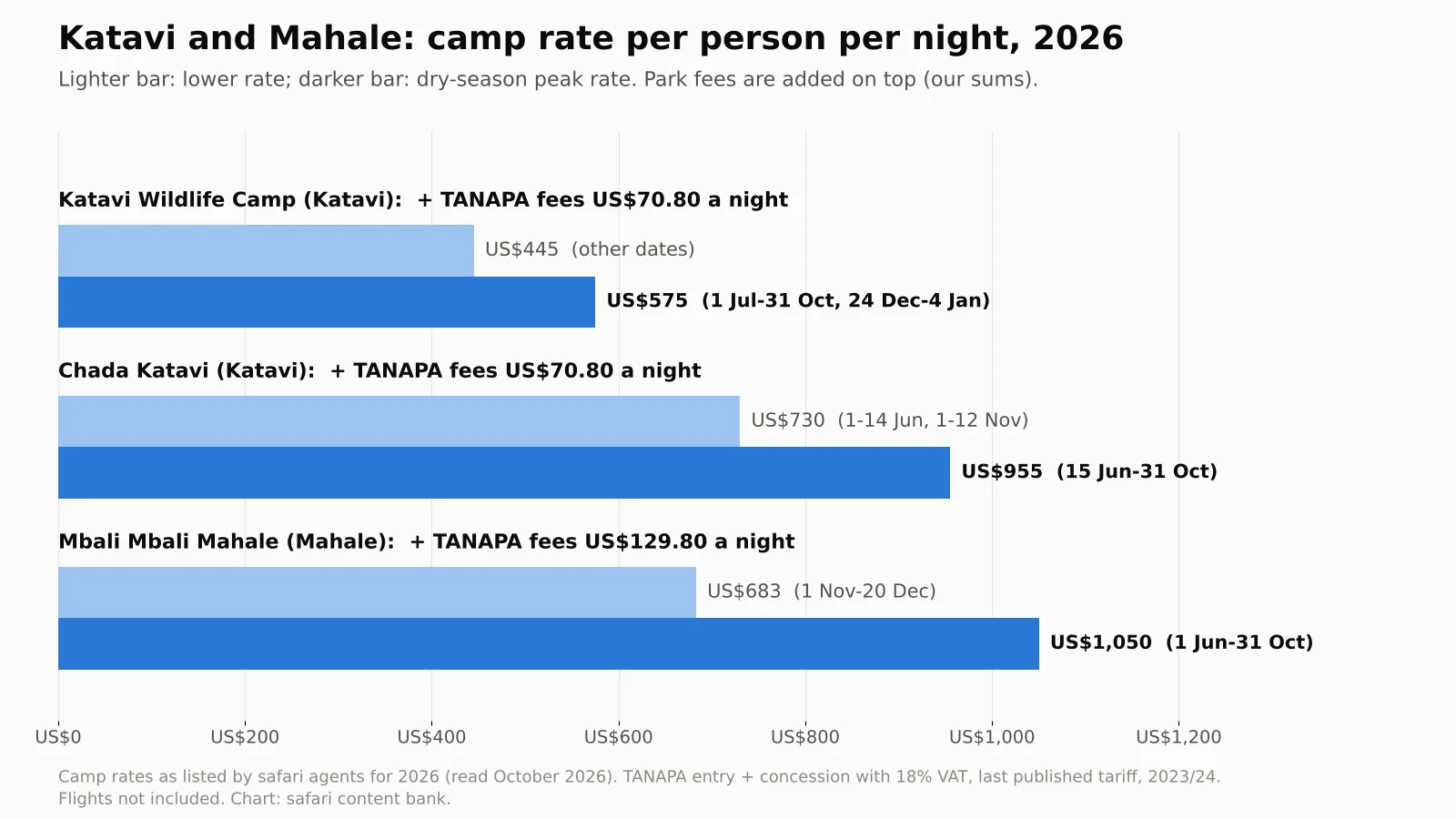 Camp rates as listed by safari agents for 2026 (read October 2026); TANAPA entry and concession with 18% VAT, last published tariff, 2023/24, our sums. Flights not included. Chart: safari content bank.
Three nights in Katavi and three in Mahale, per adult (our sums, before flights):
| Plan | Camps | TANAPA fees | Total |
|---|---|---|---|
| June, value camp in Katavi | Katavi Wildlife Camp 3 × US$445 + Mbali Mbali Mahale 3 × US$1,050 = US$4,485 | 3 × US$70.80 + 3 × US$129.80 = US$601.80 | US$5,086.80 |
| July–October, value camp in Katavi | Katavi Wildlife Camp 3 × US$575 + Mbali Mbali Mahale 3 × US$1,050 = US$4,875 | US$601.80 | US$5,476.80 |
| Mid-June–October, Chada Katavi | Chada Katavi 3 × US$955 + Mbali Mbali Mahale 3 × US$1,050 = US$6,015 | US$601.80 | US$6,616.80 |
- Packages in our sources: one safari operator’s 9-day, 8-night private fly-in trip from Kilimanjaro Airport to Katavi and Mahale was priced at ZAR 234,570–246,940 per person for two travellers, shown in rand to our browser, including transfers within Tanzania, park fees and guided activities, but not international flights (read October 2026).
- Flights are the swing cost and are not in the sums above. More on Tanzanian budgets: Tanzania safari cost and luxury safari.
Chimpanzee viewing in Mahale: the rules
TANAPA’s own chimp-viewing rules for Mahale are not in our sources, so the rules below come from Kyoto University’s research guidelines and from operators. Our sources disagree on the minimum age.
| Rule | Kyoto University research guidelines | What operators say the camps enforce |
|---|---|---|
| Group size | “Preferably less than five, not larger than 10 people at a time” | 6 per group |
| Time with the chimps | No longer than an hour | 1 hour |
| Distance | At least 10 m | 10 m |
| Groups per day | No more than 4 | Not stated |
| Masks | Not stated | Surgical masks close to the chimps |
| Illness | No visitor with a disease may visit | Not stated |
| Minimum age | Not stated | 12 in one operator’s guide, 15 in another; no TANAPA age in our sources |
Sources: Kyoto University, Mahale visitor guidelines, undated, read October 2026; two operators’ chimp-trekking guides (names in our editor notes). Minimum ages by country: safari age limits.
- No sighting rate is published for Mahale. Kibale in Uganda is the only chimp site in our sources with one (where to see chimpanzees; chimpanzee trekking permits).
- Tanzania sells no gorilla trek in our sources, so gorillas mean a flight to Uganda or Rwanda (gorilla vs chimpanzee trekking; Tanzania or Uganda?).
What you do in Katavi
Katavi is about the dry-season squeeze: as the Katuma River shrinks to pools, hippos, buffalo and elephants gather on the river line. It is one of the Tanzanian parks where TANAPA sells night drives.
- Hippos: a safari agent’s guide (read 10 October 2026) describes “up to 200 in pools”, and Wikipedia says mudholes can be packed with hundreds; neither figure rests on a survey (where to see hippos).
- Elephants: a 2019 survey estimated about 20,145 elephants across the Ruaha-Rungwa and Katavi-Rukwa ecosystems combined (WCS, 12 Nov 2019); we hold no Katavi-only count (where to see elephants).
- Night drives and walks: Katavi is on TANAPA’s night-drive list at US$59 per adult, and walks cost US$23.60–29.50 plus a guide fee (last published tariff, 2023/24) (walking safaris). Chada Katavi also runs fly-camping (mobile safaris).
- Sleeping outside the park: Sitalike village at the northern boundary has a budget lodge, Katavi Hippo Garden Lodge; outside the park, it avoids the concession fee. We found no rate for it.
When to go: month by month
June to October is the window for both parks: the scheduled flights run, the camps are open, and the lakeshore is driest. We hold no climate table for Katavi; the nearest station in our sources is Kigoma, on Lake Tanganyika north of Mahale.
| Months | Flights (Safari Air Link) | Katavi | Mahale | Kigoma rain, mm a month |
|---|---|---|---|---|
| January–February | On request, 4-passenger minimums | A best season (a safari agent’s guide, read 9–10 October 2026); Chada closed | Wet; one agent says trekking is harder | 120 |
| March–April | Not in the 2026–27 timetable | Wet; Chada closed | Wet; one agent says camps may close | 140, 120 |
| May | Not in the 2026–27 timetable | Best season begins (a safari agent’s guide, read 9–10 October 2026) | Best season begins (a safari agent’s guide, read 9–10 October 2026) | 40 |
| June–August | Mondays and Thursdays | Best season; Chada open | Best season | 0 |
| September–October | Mondays and Thursdays | Best season; pools at their smallest | Best season | 10, 40 |
| November–December | On request, 4-passenger minimums | A best season again from December (a safari agent’s guide, read 9–10 October 2026); Chada open to 12 November | Waterfalls and birding (a safari agent’s guide, read 9–10 October 2026); Mbali Mbali Mahale’s lower rate | 140, 130 |
Sources: Safari Air Link 2026–27 (PDF); a safari agent’s guides to Katavi and Mahale; camp rate listings and a safari agent’s Mahale page, read 9–10 October 2026; Kigoma rainfall from Climates to Travel. More: best time for a safari.
Which western Tanzania trip suits you
Pick by what you want to see and how many flight days you can spare.
| If you want | Choose | Why |
|---|---|---|
| Chimps and big game in one week | Ruaha, Katavi and Mahale on the Monday/Thursday flights | The scheduled leg links all three, June–October |
| The lowest camp rate in our sources | Katavi Wildlife Camp, then Mahale | US$445–575 per person per night in 2026 |
| Chimps only, at the lowest TANAPA fee | Mahale, not Gombe | Entry US$94.40 a day vs US$118 in Gombe (last published tariff, 2023/24) |
| A published chimp sighting rate | Kibale, Uganda | Mahale publishes none (where to see chimpanzees) |
| Night drives and walks | Katavi | On TANAPA’s night-drive list; walks sold |
| Travel between November and February | Ask early | Flights only on request, with 4-passenger minimums; Chada closes after 12 November |
| A shorter, cheaper Tanzania trip | The southern or northern circuit | See Tanzania safari itineraries and Ruaha safari cost |
Common mistakes about Katavi and Mahale
| Mistake | What our sources say |
|---|---|
| “You can fly to Katavi or Mahale any day” | Scheduled seats run on Mondays and Thursdays, 1 June–31 October; from 1 November to 28 February flights are on request with 4-passenger minimums. |
| “Mahale sells a chimp permit like Kibale’s” | Our sources hold the daily entry fee, US$94.40, plus the US$118 habituation experience (last published tariff, 2023/24). |
| “Katavi’s park fees are as high as the Serengeti’s” | US$70.80 per adult per night inside Katavi (our sum) vs US$129.80–153.40 in the Serengeti. |
| “You can drive into Mahale” | There are no roads inside the park; the last leg is by boat. |
| “The minimum age for Mahale’s chimps is set” | We found no TANAPA age; operators give 12 or 15. Ask the camp in writing. |
| “You can pay park fees in cash” | TANAPA takes no cash at the gate; fees are paid through GePG. |
| “Visitor numbers are current” | The last published counts are from 2012 and 2012/13. |
Frequently asked questions
How do you get to Katavi and Mahale? By light aircraft. Safari Air Link flies Ruaha–Katavi–Mahale on Mondays and Thursdays from 1 June to 31 October, and on request from 1 November to 28 February. Katavi can also be reached by road or by train to Mpanda; Mahale by boat from Kigoma.
How much does a Katavi and Mahale safari cost? Three nights in each park come to about US$5,100–6,600 per adult in camp rates and TANAPA fees in June–October 2026, before flights (our sums). One safari operator’s 9-day private fly-in trip was priced at ZAR 234,570–246,940 per person, including park fees.
What are the park fees for Katavi and Mahale? Entry is US$35.40 a day in Katavi and US$94.40 in Mahale, and the concession fee is US$35.40 a night in both, for a non-East African adult with VAT (last published tariff, 2023/24). TANAPA takes no cash at the gate.
Is there a chimpanzee permit for Mahale? Our sources hold no chimp-tracking permit for Mahale: you pay the daily entry fee, US$94.40, and TANAPA lists a chimpanzee habituation experience at US$118 (last published tariff, 2023/24). The camps sell the guided walks.
When is the best time to visit Katavi and Mahale? June to October: the scheduled flights run, the camps are open and Kigoma on the lakeshore gets 0–40 mm of rain a month. A safari agent’s guide (read 10 October 2026) names May–October for both parks, plus December–February for Katavi.
How many nights do I need? Plan around the flight days: Monday to Thursday or Thursday to Monday gives 3 or 4 nights in each park. One operator’s fly-in trip covering both parks takes 9 days. See how many days on safari.
Can I combine Katavi and Mahale with Ruaha or the Serengeti? Ruaha, yes: the scheduled western flights start there (Ruaha). For the Serengeti, one operator’s trip starts and ends at Kilimanjaro Airport, so the northern circuit can be added before or after (Tanzania).
Do I need a visa? Our Tanzania visa page covers who needs one and how to apply. For malaria in western Tanzania, see safari malaria risk.
Sources
- Park fees: TANAPA Tariffs 2023/24 (PDF), effective 1 July 2023, the last published tariff, as on our Tanzania park fees page, read 9 Oct 2026
- Flights: Safari Air Link rack rates 2026–27 (PDF), read 8 Oct 2026
- Parks: a safari agent’s guides to Katavi and Mahale Mountains, read 8 Oct 2026; Kyoto University, Mahale visitor guidelines, undated, read Oct 2026
- Wikipedia (secondary): Katavi National Park, Mahale Mountains National Park, read 8 Oct 2026
- Elephants: WCS, 12 Nov 2019
- Fuel: EWURA cap prices, effective 7 Oct 2026 (PDF)
- Climate: Climates to Travel, Tanzania (Kigoma station), read Oct 2026
- Awards: World Travel Awards 2026, Africa
- Camp rates and packages (names and links kept in our editor notes): safari agents’ listings for Katavi Wildlife Camp, Chada Katavi, Mbali Mbali Mahale and Greystoke Mahale; a safari listing site’s Chada Katavi page; a safari agent’s Katavi and Mahale guides; one safari operator’s 9-day fly-in trip; an agent’s 8-day package listing; read 9–10 Oct 2026
- Chimp rules: two operators’ Tanzania chimp-trekking guides (names in our editor notes), read Oct 2026
More on western and southern Tanzania: Ruaha, Tanzania northern vs southern circuit, where to see chimpanzees and safari money.
Fees and flights checked 8–10 October 2026. We will update this page when TANAPA publishes a tariff after 2023/24 and when Safari Air Link publishes its 2027–28 timetable.