 Experience

Last verified · Next check due
On this page
- Mobile safari, fixed tented camp or camping trip: at a glance
- The four main kinds of mobile safari
- Botswana: private mobile safaris through Moremi, Chobe, Savuti, Khwai and the Kalahari
- Tanzania: migration mobile camps and fly-camping
- Kenya: fly-camps in Laikipia and the Mara conservancies
- Zambia and Zimbabwe: walking-trail fly-camps
- Comfort levels: from dome tents to en-suite walk-in tents
- Best months for each kind of mobile safari
- What a mobile safari costs per person per night, with fees
- Which kind of mobile safari to choose
- Common mistakes about mobile safaris
- Frequently asked questions
- Sources
Short answer: A mobile safari is a tented camp that moves. In Botswana a crew pitches your camp at reserved campsites in Moremi, Savuti and Chobe while one guide drives you between them; in the Serengeti, seasonal camps move to follow the herds. Published prices run from about US$265 a night (budget trip, basis not stated) to about US$710 fully serviced in Botswana, and US$325–1,490 per person at Serengeti mobile camps before US$141.60–153.40 in park fees (last published tariff, 2023/24).
Key facts
- “Mobile” means the camp moves, not you alone. On a Botswana mobile safari, one operator’s 9-night route spends 3 nights at Xakanaxa in Moremi, 3 in the Mababe reserve and 3 at Savuti, and “the same professional guide and staff accompany you throughout” (the operator’s page).
- Botswana trip prices usually include park and campsite fees; Tanzanian camp rates do not. One fully serviced Botswana trip, 9 nights from US$6,395, includes “exclusive private campsites and park fees”; a Serengeti mobile camp adds US$141.60–153.40 per adult per night in park fees (last published tariff, 2023/24).
- A mobile camp pays the same Serengeti bed-night fee as a lodge. The special-campsite fee and the concession fee are both US$70.80 per adult a night from July to September and US$59 from October to June (last published tariff, 2023/24). Full comparison: safari lodge vs tented camp.
- Botswana has a whole mobile-safari trade. On 9 September 2026 the HATAB directory listed 443 members, including 104 mobile-safari operators (HATAB directory).
- Park rules still apply. Night drives and walks are not permitted inside Moremi or Chobe National Park, so a mobile route that stays in the parks drives by day only (night drives and walking in Botswana).
- Comfort ranges from your own dome tent to an en-suite walk-in tent. On participation trips guests pitch their own tents and share bathrooms; fully serviced mobile safaris use walk-in tents with en-suite bucket showers and flush or chemical toilets (operators’ trip descriptions).
Mobile safari, fixed tented camp or camping trip: at a glance
A mobile safari moves its camp with you (Botswana) or with the season (Tanzania); a fixed tented camp stays put; a camping or overland trip has you pitch the tent. The table compares the three on what changes the price and the experience.
| Mobile safari | Fixed tented camp | Camping or overland trip | |
|---|---|---|---|
| Who moves | The crew strikes and rebuilds the camp at each site; in the Serengeti the camp moves 2–3 times a year | Nobody: you fly or drive between camps | You, with the group; you pitch and strike your own tent |
| Where you sleep | Reserved campsites inside the national parks (Botswana); seasonal sites near the herds (Tanzania) | A fixed site, often on a private concession | Public campsites |
| Guide | The same guide for the whole trip (Botswana) | Changes at each camp | The trip leader and driver |
| Getting between areas | By road in the safari vehicle | Usually by light aircraft in Botswana | By road, often a truck on a fixed multi-country route |
| Bathroom | En-suite bucket shower and flush or chemical toilet (fully serviced); shared on participation trips | Varies by camp | Shared campsite facilities |
| Night drives and walks | Not inside Moremi or Chobe; possible where the route leaves the park | Allowed on many private concessions | Not inside the parks |
| Per person per night | About US$265–710 in Botswana, fees included; US$325–1,490 at Serengeti mobile camps, fees extra | US$115–2,250 at tented camps (2026 rates) | See camping safari |
Sources: operators’ published trip descriptions and prices (Botswana, captured 9 September 2026); camps’ and agents’ listings for the Serengeti; tented-camp range as on our lodge vs tented camp page. Read 9–10 October 2026.
- A mobile safari is not the same as self-drive camping. On a self-drive trip you book the campsites and pay DWNP yourself; on a mobile safari the operator does it and drives (Botswana self-drive).
- Fly-in camps or mobile? In a 2026 forum case a private mobile safari was quoted at US$3,300 per person for 7 nights, against US$4,700 for non-private fly-in camps (TripAdvisor). The mobile trip keeps a private vehicle but spends hours driving between sites.
The four main kinds of mobile safari
Botswana’s private mobile safari is the classic form; the Serengeti’s migration camps, Kenya’s fly-camps and the walking-trail camps of Zambia and Zimbabwe are the other three.
| Kind | Where | How it moves | Typical stay | Published price, per person per night |
|---|---|---|---|---|
| Private or scheduled mobile safari | Botswana: Moremi, Khwai, Savuti, Chobe, Central Kalahari, Makgadikgadi | The crew moves ahead and rebuilds the camp at the next reserved campsite | 5–10 days; about 3 nights per site on one operator’s route | About US$265 (budget) to US$710 (fully serviced), park fees included |
| Seasonal migration camp | Tanzania: Ndutu and the southern plains, then the northern Serengeti | The whole camp relocates between seasonal sites | Part of a longer trip; nights not stated in our sources | US$325–1,490 camp rate, plus park fees |
| Fly-camp | Kenya: Laikipia and the Mara conservancies; Tanzania: Ruaha, Nyerere, Katavi | A light camp for one or more nights away from the main camp, usually on a walk | 1–2 nights, or a multi-day walk | No per-night rate published in our sources |
| Walking-trail mobile camp | Zambia: South Luangwa; Zimbabwe: Mana Pools | Moves with the walkers, or a seasonal camp open only in the dry months | Set-date trips; length not stated in our sources | Trails camps from US$650 (Remote Africa, 2026; basis not stated) |
Sources: operators’ and camps’ published pages; agents’ listings for the camps that publish no rate sheet. Read 8–10 October 2026.
Botswana: private mobile safaris through Moremi, Chobe, Savuti, Khwai and the Kalahari
A Botswana mobile safari is how most travellers sleep inside Moremi and Chobe without a lodge: the operator books the campsites and park fees, the crew sets up camp, and one guide drives you from Maun to Kasane. The Okavango Delta’s private concessions are fly-in camps; Moremi, the formally protected part of the Delta, and Chobe are where mobile safaris go.
| Route on sale | Nights or days | Published price, per person | Per day (our division) | Park fees |
|---|---|---|---|---|
| Central Kalahari and Makgadikgadi, participation camping | 6 nights, from US$1,590 | Basis not stated | about US$265 | Check whether they are in the “from” price |
| Moremi, some adding Khwai, guided camping from Maun | 5 days, US$1,350–1,980 (3 operators) | Per person | US$270–396 | Included |
| Chobe riverfront and Savuti, mobile camping | 5 days, US$2,981–3,150 (one operator) | Per person | US$596–630 | Included |
| Maun → Moremi → Savuti → Chobe (Kasane) | 10 days US$4,500 and US$4,556–5,569; 9 days private US$5,290–5,335 (3 operators) | Per person | US$450–593 | As each operator states |
| Maun → Moremi (Xakanaxa) → Mababe → Savuti → Chobe River, fully serviced | 9 nights, from US$6,395 (2026) | Basis not stated | about US$710 | Included, with exclusive private campsites |
Operators’ published prices, unnamed, captured 9 September 2026, as on our Botswana safari cost, Moremi, Chobe safari cost and Botswana pages. Per day is the trip price divided by the days or nights stated (our division).
- The fully serviced operator caps scheduled departures at 7 guests (6 on photographic trips) and guarantees departure from one person. Its minimum age is 12 on scheduled departures and 5 on private safaris; drinks at its camps, activities and 14% VAT are in the price (the operator’s page).
- Budget operators run participation trips. One Maun operator calls its lowest tier “raw safari for those who value adventure over comfort” and sells a premium tier with en-suite tents above it (the operator’s page).
- The Central Kalahari runs the other way round. Its best game is December–May, the reverse of the Okavango (Central Kalahari); trips there often add the Makgadikgadi.
- Khwai is outside Moremi. The Khwai community concession beside North Gate takes self-drivers and mobile safaris and allows night drives (Moremi).
- Vehicles carry up to eight or nine people, with raised suspension and luggage on the roof or in a trailer (one safari agent’s mobile-safari guide).
Park and campsite fees on a Botswana mobile safari
The last published DWNP park fees are P270 (BWP 270) per non-resident adult per day in Chobe and Moremi and P190 in the Central Kalahari and other parks (1 April 2022 schedule); in February 2026 the government news agency called the existing non-resident fee P380, so confirm the fee with DWNP or your operator. Mobile operators book these fees for you; check the quote says so.
| Campsite | Operator | Non-resident, per person per night |
|---|---|---|
| Ihaha (Chobe riverfront) | Kwalate Safaris | US$40 |
| Xakanaxa, South Gate (Moremi) | Kwalate Safaris | US$40 |
| Savuti, Linyanti (Chobe); North Gate / Khwai (Moremi) | SKL Camps | US$50 |
| Passarge, Piper, Sunday Pan and others (CKGR); Khutse | Bigfoot Tours | BWP 200 |
| Khwai community sites | Khwai Development Trust | BWP 300 |
Public campsites, as on our Botswana safari cost page. Source: a safari operator’s Botswana public campsite information sheet, undated (name and link in our editor notes). The same sheet still shows the pre-2022 park fee, so treat these as last published rates and confirm with the campsite operator. Most rows add a government levy of P10 per person per night. Read 9 Oct 2026.
- Fully serviced operators use “exclusive private campsites”, not the public sites above (one operator’s inclusions). We found no published rate for an exclusive campsite.
- Park fees alone on a 9-night Moremi-to-Chobe trip come to P2,430 per adult at the last published P270 a day (our sum: 9 × P270), before campsites, crew and vehicle.
Tanzania: migration mobile camps and fly-camping
In Tanzania a mobile camp is a seasonal camp that moves between Ndutu or the southern plains for calving (about December–March) and the northern Serengeti for the river crossings (about June or July to October). Where the herds usually are each month is on the Great Migration month by month.
| Camp | Camp rate, per person per night (2026) | Plus park fees per adult per night | Total (our sums) |
|---|---|---|---|
| Camp Zebra, Kogatende (Jul–Sep) | US$445 | US$153.40 (Serengeti entry + special campsite) | US$598.40 |
| Camp Zebra, Ndutu (Dec–Mar) | US$445 | US$141.60 (NCA entry + special campsite) | US$586.60 |
| Ubuntu, Kusini (calving) | US$1,080 | US$141.60 | US$1,221.60 |
| Olakira, north (Jul–Sep) | US$1,490 | US$153.40 | US$1,643.40 |
Camp rates per person sharing, full board; Ubuntu and Olakira include game drives. Sources: a safari agent’s listings (agent listings, not the camps’ own sheets); fees: TANAPA Tariffs 2023/24 (last published tariff, 2023/24) and NCAA (NCAA’s page does not say whether VAT is included). Same figures as our Great Migration safari cost page. Read 9–10 October 2026.
- Lemala’s Ndutu and Mara camps list US$330–825 per person a night, excluding guide and vehicle (Lemala rates). Lemala Mara-Ndutu runs its northern site June–October and its Ndutu site December–March.
- Ndutu is in the Ngorongoro Conservation Area, not the Serengeti. A mobile camp there pays the NCAA special-campsite fee of US$70.80, a lodge US$59 (Ngorongoro safari cost).
- Fly-camping is a southern-circuit speciality. TANAPA’s fly-campsite fee is US$59 per adult per night (last published tariff, 2023/24). Sand Rivers, Selous Impala Camp and Rufiji River Camp run fly-camps in Nyerere, and Jongomero and Kichaka run multi-day walking and fly-camp trips in Ruaha; our sources do not say whether a fly-camp night is billed instead of, or on top of, the concession fee (Nyerere safari cost).
- Ruaha has a mobile camp too: Charlie Ruaha is listed from US$1,540, July–October only, year not stated (an agent listing; see Ruaha).
Kenya: fly-camps in Laikipia and the Mara conservancies
Kenya’s mobile safaris are mostly walking fly-camps and riding trips on private conservancies, not in the national reserves. Night drives, walks and fly-camping happen in the conservancies around the Mara, not in the reserve (Mara reserve or conservancy).
- Laikipia: Karisia Walking Safaris runs multi-day walks supported by camels, with a camp that moves (an agent’s listing); it is a 2026-season winner of The Safari Awards (The Safari Awards).
- Mara conservancies: Kicheche Fly Camp is a dome camp used on Kicheche’s two-day walking safari, not sold on its own (an agent’s listing). Kicheche’s Mara conservancy camps carry a conservancy fee of US$130 per adult per night (Kicheche 2026).
- Riding mobile: a 7-night Mara ride with a mobile camp covers about 250 km for up to 12 riders and costs about US$11,950, park fees and internal charters included, about US$1,707 a night (our sum; one tour operator’s guide). Rider standards: horseback safari.
- Laikipia’s best months: Ol Pejeta names June–October and January–February (Laikipia).
We found no published per-night rate for a Kenyan fly-camp: ask whether fly-camp nights are priced like the main camp.
Zambia and Zimbabwe: walking-trail fly-camps
In South Luangwa and Mana Pools the mobile camp follows the walkers: set-date walking trails that move camp, seasonal trails camps open only June–October, and canoe trails with riverbank camps. Rules, guides and minimum ages are on walking safaris.
| Area | What runs | Season | Park fee, international adult |
|---|---|---|---|
| South Luangwa, Zambia | One camp company’s set-date mobile walking safaris in the remote north (Mupamadzi), moving camp between sites (an agent’s listing); Remote Africa’s trails camps, Chikoko Tree and Big Lagoon, from US$650 (2026; basis and fees not stated) | Trails camps open 25 May or 1 June to 31 October | US$25 per day (DNPW 2025 schedule, the last published) |
| Mana Pools, Zimbabwe | A multi-day canoe trail with riverbank camps (an agent’s listing); walks with Zimbabwe professional guides | Best June–October; most camps open about April–November | US$24 per day (ZimParks 2026) |
| Lower Zambezi, Zambia | Chula Island, an island fly-camp (an agent’s listing) | Not stated in our sources | US$25 per day (DNPW 2025 schedule, the last published) |
Read 8–10 October 2026. Our sources hold no published per-night rate for the mobile walking safaris or the canoe trail.
- Mana Pools campsites are priced per person or per site: ordinary or bush camping US$35 per person per night; an exclusive site US$235 per site per night (ZimParks Tariff 2026).
- A sleep-out is the shortest version: Time + Tide’s costs US$275 per person, from age 12 (Time + Tide 2027 rates (PDF)).
Comfort levels: from dome tents to en-suite walk-in tents
Ask four things before you book: who pitches the tent, whether the bathroom is en-suite, whether the shower is a bucket or plumbed, and whether the toilet is flush, chemical or a long-drop.
| Level | Tent | Bathroom | Group size | Who it suits |
|---|---|---|---|---|
| Participation (budget) | Dome or small walk-in tents you pitch and strike yourself; you help with chores, staff cook, drive and guide | Shared, or a communal bush shower | Up to 12 | Budget travellers who want Botswana’s parks with a guide |
| Premium or fully serviced | Walk-in tents set up by the crew; a mess tent and a chef | En-suite bucket shower; flush or chemical toilet | Up to 7 on one operator’s scheduled departures | First-timers, older travellers, photographers who want one guide throughout |
| Seasonal migration camp (Tanzania) | Tents fixed for the season; Camp Zebra has 10 tents including 2 two-bedroom family units | Not stated in our sources; ask the camp | About 8–10 tents per camp in our sources | Migration timing without a fixed lodge |
| Fly-camp | Small tents or mosquito-net cubes for a night or two, a fire | Usually a long-drop | Small walking groups | Walkers; several are adults only |
Sources: operators’ trip descriptions (Botswana); camps’ and agents’ listings; our lodge vs tented camp and Nyerere safari cost pages. Read 8–17 October 2026.
- Age limits apply on the lighter end: Selous Impala Camp’s and Sand Rivers’ fly-camps are adults only, and Time + Tide’s sleep-outs start at 12.
- Ask whether staff walk you to your tent after dark. Campsites in Moremi, Chobe and Savuti are unfenced.
Best months for each kind of mobile safari
June to October is the main mobile season in Botswana’s north, Zambia, Zimbabwe and Tanzania’s southern parks; the Serengeti’s mobile camps follow the herds all year, and the Central Kalahari is best December–May.
| Kind | Best months | Why | Source |
|---|---|---|---|
| Botswana north: Moremi, Khwai, Savuti, Chobe | June–October | Dry season; one operator departs all year | Botswana |
| Botswana: Central Kalahari | December–May | Best game on the short-grass plains | Central Kalahari |
| Migration camps, south (Ndutu) | December–March | Calving | Great Migration month by month |
| Migration camps, north (Mara River) | July–October | River crossings; Lemala opens June, Camp Zebra stays to November | Lemala rates; a safari agent’s listing |
| Kenya: Laikipia | January–February, June–October | Ol Pejeta’s best months | Laikipia |
| Tanzania: Ruaha and Nyerere fly-camping | June–October | Walking season | Ruaha |
| Zambia: South Luangwa trails camps | June–October | Trails camps open 25 May or 1 June to 31 October | South Luangwa |
| Zimbabwe: Mana Pools | June–October | Most camps open about April–November | Mana Pools |
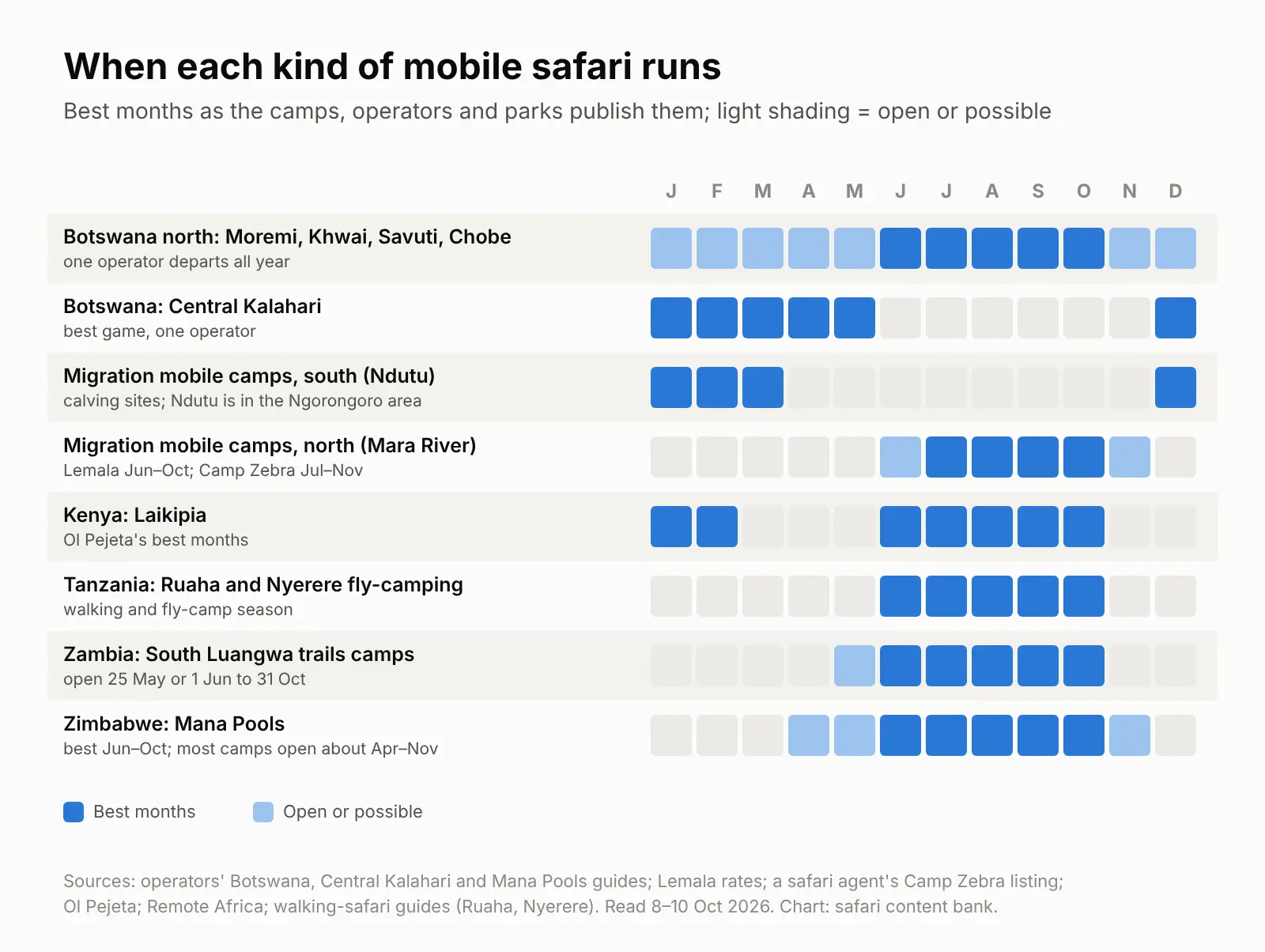 Sources: operators’ Botswana, Central Kalahari and Mana Pools guides; Lemala rates; a safari agent’s Camp Zebra listing; Ol Pejeta; Remote Africa; walking-safari guides. Read 8–10 October 2026. Chart: safari content bank.
What a mobile safari costs per person per night, with fees
Botswana mobile safaris are sold as trips with park fees included, from about US$265 to US$710 a night; Tanzanian mobile camps are sold per night, and park fees of US$141.60–153.40 per adult come on top (last published tariff, 2023/24).
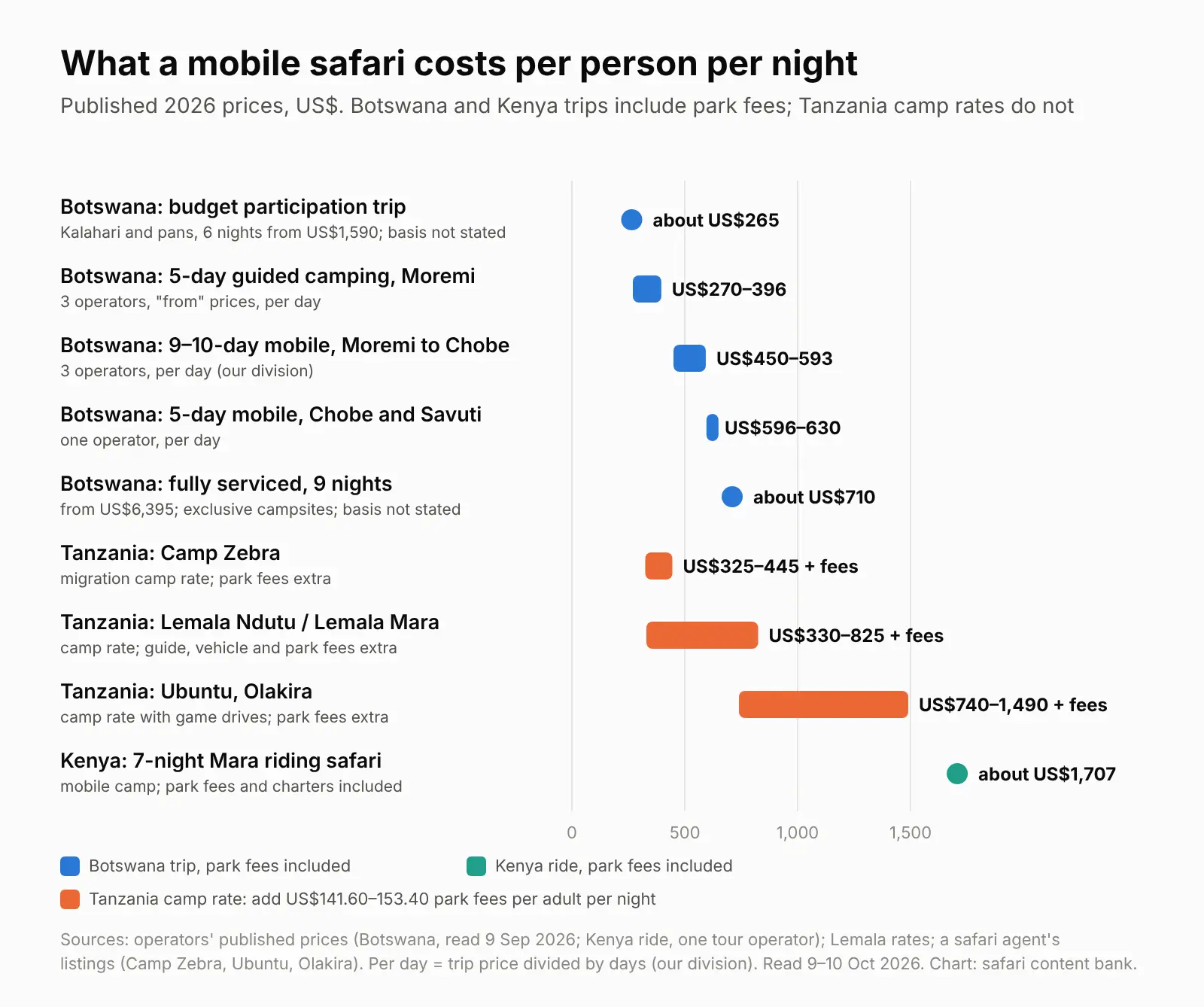 Sources: operators’ published prices (Botswana, captured 9 September 2026; Kenya ride, one tour operator); Lemala rates; a safari agent’s listings. Per day is the trip price divided by days (our division). Read 9–10 October 2026. Chart: safari content bank.
The park and campsite fees behind the prices, with the date each took effect and the source:
| Fee | Amount | In force from | Source |
|---|---|---|---|
| Chobe National Park and Moremi Game Reserve (DWNP), non-resident adult, per person per day | BWP 270 (SADC residents BWP 205; Botswana citizens and residents BWP 30) | Last published DWNP schedule, 1 April 2022 (via Tourism Update). In Feb 2026 the government news agency BOPA called the existing non-resident fee P380; a P500 rise was announced, then reported postponed. No official current tariff: confirm with DWNP or your operator | Tourism Update, 23 Feb 2022 (DWNP fee schedule) |
| Other DWNP parks and reserves (Central Kalahari Game Reserve, Khutse, Nxai Pan, Makgadikgadi Pans), non-resident adult, per person per day | BWP 190 (SADC residents BWP 145; Botswana citizens and residents BWP 20) | Last published DWNP schedule, 1 April 2022 (via Tourism Update). In Feb 2026 the government news agency BOPA called the existing non-resident fee P380; a P500 rise was announced, then reported postponed. No official current tariff: confirm with DWNP or your operator | Tourism Update, 23 Feb 2022 (DWNP fee schedule) |
| Serengeti and Nyerere National Parks, non-East African adult, entry per day, 16 May–14 Mar | USD 70 + 18% VAT = USD 82.60 | 1 Jul 2023 (2023/24 tariff, last published) | TANAPA Tariffs 2023/24 |
| Serengeti special campsite (used by mobile camps), adult, per night | Jul–Sep USD 60 + VAT = USD 70.80; Oct–Jun USD 50 + VAT = USD 59 | 1 Jul 2023 (2023/24 tariff, last published) | TANAPA Tariffs 2023/24 |
| Fly campsite, adult, per night (booked in advance) | USD 50 + 18% VAT = USD 59 | 1 Jul 2023 (2023/24 tariff, last published) | TANAPA Tariffs 2023/24 |
| Serengeti public campsite, adult, per night | USD 30 + 18% VAT = USD 35.40 | 1 Jul 2023 (2023/24 tariff, last published) | TANAPA Tariffs 2023/24 |
| Ruaha, Katavi, Mikumi, Saadani, Udzungwa, Mkomazi, Rubondo, Kitulo and the other parks in this group, non-East African adult, entry per day | USD 30 + 18% VAT = USD 35.40 | 1 Jul 2023 (2023/24 tariff, last published) | TANAPA Tariffs 2023/24 |
| Ngorongoro Conservation Area (including Ndutu), non-East African adult, entry per 24 h (single entry) | USD 70.80 (NCAA's page does not say whether VAT is included) | Undated official page, read 9 Oct 2026 | NCAA |
| Ngorongoro special campsite, non-East African adult, per night | USD 70.80 (child USD 35.40) | Undated official page, read 9 Oct 2026 | NCAA |
| South Luangwa and Lower Zambezi National Parks (DNPW Category A), international adult, entry per day (06:00–18:00) | USD 25 (SADC and resident USD 20; Zambian citizen ZMW 55.60); child 5–13 half price, under 5 free | DNPW 2025 schedule ("official 2025 rates"), the last published; page last modified 8 May 2025, still shown 9 Oct 2026 | DNPW 2025 fee schedule, as shown on a Zambia travel portal |
| Mana Pools National Park, Sapi and Chewore, international adult, conservation fee per day | USD 24, day visitor or staying overnight (SADC USD 18; local USD 8) | ZimParks Tariff 2026 (tariff year 2026, published February 2026); the conservation-fee table does not say whether VAT is included | ZimParks De-Gazetted Tariff 2026 |
| Mana Pools National Park camping, SADC and international visitors | Ordinary or bush camping USD 35 per person per night; Nyamepi site (6 people) USD 120; exclusive site USD 235; Chitake 1 and 3B USD 355; Chitake 2 and Baobab USD 235 per site per night | ZimParks Tariff 2026 (tariff year 2026, published February 2026) | ZimParks De-Gazetted Tariff 2026 |
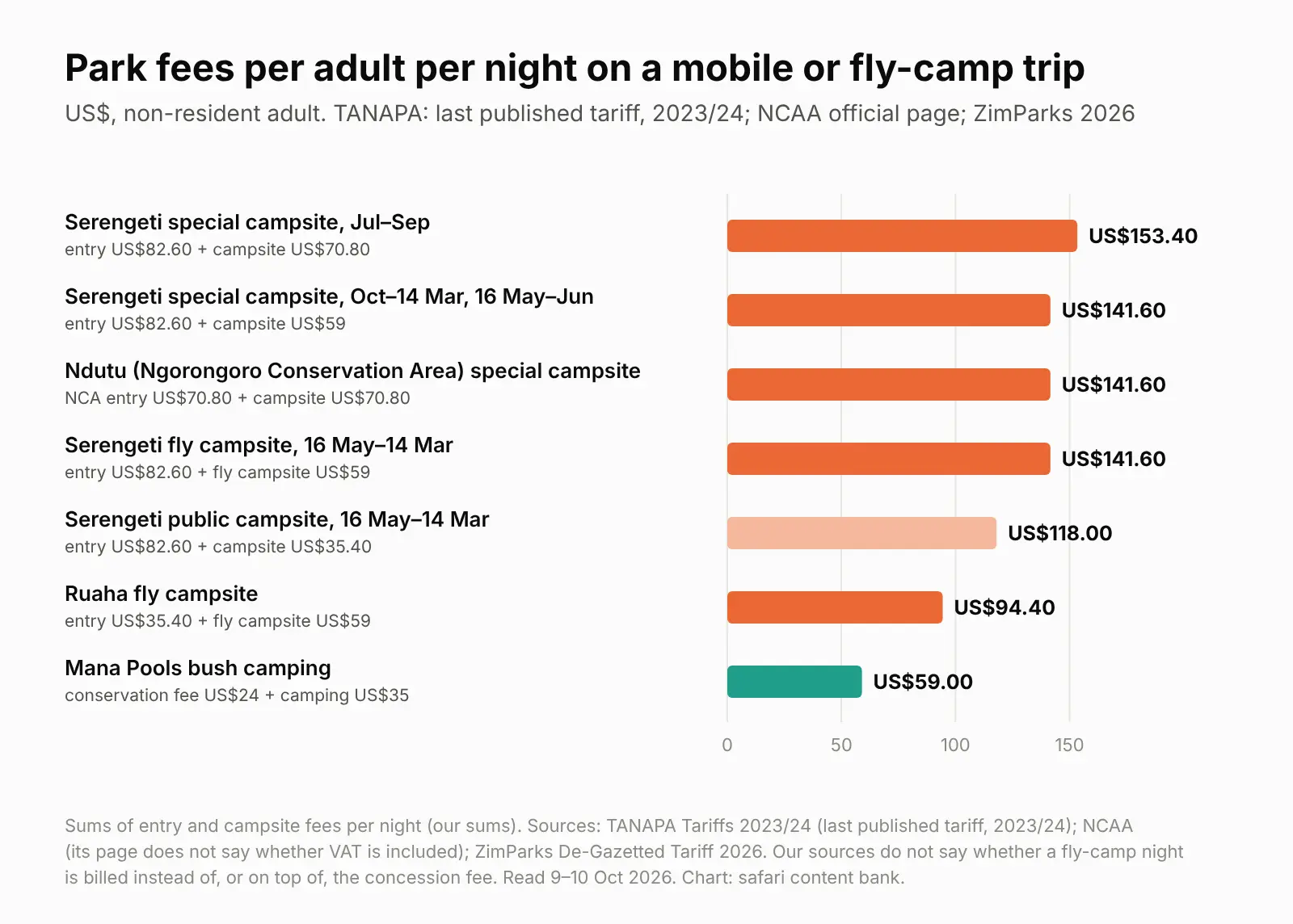 Our sums of entry and campsite fees. Sources: TANAPA Tariffs 2023/24 (last published tariff, 2023/24); NCAA (its page does not say whether VAT is included); ZimParks De-Gazetted Tariff 2026. Read 9–10 October 2026. Chart: safari content bank.
- Three nights at Camp Zebra at Kogatende in August cost US$1,795.20 per person with park fees (our sum: 3 × US$598.40); a guide and vehicle for the transfers are on top.
- A Ruaha fly-camp night costs US$94.40 per adult in park fees (our sum: US$35.40 entry plus US$59 fly campsite, last published tariff, 2023/24), against US$141.60 in the Serengeti from 16 May to 14 March.
- Botswana’s park fee is in pula and has no official current tariff. Ask the operator whether the trip price uses P270 or a newer figure; full fees on Botswana park fees and Chobe park fees.
- Tips are extra on every kind. One Botswana mobile operator publishes US$10 per guide per day, US$5 per chef per day and US$5 per staff member per day (safari tipping).
Which kind of mobile safari to choose
| If you want… | Choose | Why |
|---|---|---|
| Moremi, Savuti and Chobe in one trip with one guide | A fully serviced Botswana mobile safari | The operator books the reserved campsites and park fees and moves the camp ahead of you |
| Botswana’s parks on the smallest budget, with a guide | A participation mobile trip | From about US$265 a night; you pitch your tent and share bathrooms |
| To be near the wildebeest in a given month | A Serengeti seasonal mobile camp | The camp sits at Ndutu for calving and in the north for the crossings |
| To walk for several days | A walking fly-camp in Laikipia, Ruaha or South Luangwa | The camp is set up for walkers; see walking safari |
| Night drives every night | A fixed camp on a private concession | Night drives are not permitted inside Moremi or Chobe |
| The lowest cost overall, doing the work yourself | Self-drive or a camping safari | See Botswana self-drive and camping safari |
Common mistakes about mobile safaris
| What you’ll often read | What is correct |
|---|---|
| “A mobile safari is basic camping” | Fully serviced trips use walk-in tents with en-suite bucket showers and flush or chemical toilets; only participation trips have you pitch your own tent. |
| “Mobile camps avoid park fees” | They pay them. A Serengeti special campsite costs US$59–70.80 per adult a night on top of entry (last published tariff, 2023/24), and Botswana trip prices include campsites and park fees. |
| “A mobile safari is the cheap way to see Botswana” | Fully serviced trips cost about US$710 a night on one operator’s 2026 route; only participation trips start near US$265. |
| “A mobile safari can do night drives in Moremi” | No. Night drives and walks are not permitted inside Moremi or Chobe; they happen on concessions such as Khwai. |
| “Ndutu mobile camps pay Serengeti fees” | Ndutu is in the Ngorongoro Conservation Area: NCA entry US$70.80 plus a special campsite US$70.80 a night. |
| “The ‘from’ price is per person sharing” | Two Botswana operators do not say so on the page; ask before comparing. |
Frequently asked questions
What is a mobile safari? A safari where the tented camp moves. In Botswana a crew pitches your camp at reserved campsites in Moremi, Savuti and Chobe while one guide drives you between them; one operator’s route spends 3 nights at each site. In Tanzania, seasonal mobile camps move between Ndutu and the northern Serengeti to stay near the herds.
How much does a mobile safari cost in Botswana? From about US$265 a night on a budget participation trip (one operator’s 6 nights from US$1,590; basis not stated) to about US$710 on a fully serviced trip (9 nights from US$6,395, park fees and exclusive campsites included). Three operators sell 9–10-day Moremi-to-Chobe routes for US$450–593 a day (our division).
Are park fees included in a mobile safari price? In Botswana, usually: the fully serviced and guided camping trips in our sources include park fees, but check the budget “from” prices. In Tanzania, no: a Serengeti mobile camp adds US$141.60–153.40 per adult per night in entry and special-campsite fees (last published tariff, 2023/24).
Do mobile safari tents have bathrooms? On fully serviced trips, yes: walk-in tents with en-suite bucket showers and flush or chemical toilets. On participation trips you share bathrooms or a bush shower. Fly-camps usually have a long-drop.
What is the difference between a mobile camp and a fly-camp? A mobile camp is a full camp that moves with you or with the season. A fly-camp is a light camp for a night or two away from the main camp, usually on a walk; TANAPA charges US$59 per adult per night for a fly campsite (last published tariff, 2023/24).
When is the best time for a mobile safari? June to October in Botswana’s north, South Luangwa, Mana Pools, Ruaha and Nyerere. December–May in the Central Kalahari. In the Serengeti, December–March at Ndutu for calving and July–October in the north for the river crossings.
Can you do night drives on a mobile safari? Not inside Moremi or Chobe National Park, where night drives and walks are not permitted. A route that spends nights on a community concession such as Khwai can include them.
Sources
- Fees and tariffs: TANAPA Tariffs 2023/24 (PDF); NCAA tariffs; Tourism Update, 23 Feb 2022 (DWNP fee schedule); a safari agent’s guide to park entry fees (DNPW), read 10 October 2026; ZimParks De-Gazetted Tariff 2026 (PDF); a safari operator’s Botswana public campsite information sheet, undated (name and link kept in our editor notes)
- Camps’ own rates: Lemala rates; Kicheche 2026 (PDF); Time + Tide 2027 (PDF); Remote Africa
- Operators and agents (names and links kept in our editor notes): Botswana mobile-safari operators’ published trips, inclusions and tipping guidance, captured 9 September 2026; a safari agent’s listings for Camp Zebra, Ubuntu, Olakira, Charlie Ruaha, Karisia Walking Safaris, Kicheche Fly Camp, the South Luangwa mobile walking safari, the Mana Pools canoe trail and Chula Island; one safari agent’s mobile-safari guide; one tour operator’s Mara riding guide
- Trade and awards: HATAB member directory, read 9 September 2026; The Safari Awards
- Forum: TripAdvisor, mobile vs fly-in, Botswana, 2026
- More: Safari lodge vs tented camp, walking safari, camping safari, Great Migration month by month, Great Migration safari cost, Botswana safari cost, Okavango Delta, Moremi, Botswana park fees, Serengeti park fees, Tanzania safari cost
Prices and fees checked against the content bank on 10 October 2026. We will recheck this page by 21 November 2026, and sooner when DWNP publishes an official Botswana tariff, TANAPA a tariff after 2023/24, or the camps above publish 2027 rates.