 Experience

Last verified · Next check due
On this page
- Fly-in vs drive-in safari at a glance (2026)
- How much time does flying save?
- What each costs: a seat per person, a vehicle per day
- Luggage: what fits on a bush flight
- Where flying is the only practical option, and where the road works
- What you gain and what you miss
- Mixing fly-in and drive-in on one trip
- When the season changes the answer
- Which should you choose?
- Common mistakes in fly-in vs drive-in comparisons
- Frequently asked questions
- Sources
Short answer: Fly when the road eats your safari: Nairobi to the Masai Mara is 5.5–6.5 hours by road, about 1 hour by air; Arusha to Seronera 7–7.5 hours against 1–2; Lusaka to Mfuwe 9–10 hours against about 70 minutes. The inner Okavango Delta has no road. Drive when three or more share a vehicle, on a tighter budget, or between nearby parks. Light aircraft take 15–20 kg in a soft bag. Many trips mix both.
Key facts
- A flight is priced per seat, a vehicle per day. Two people pay US$820 to fly Nairobi–Masai Mara and back, against US$240–360 for two road days in a private vehicle before fuel; three pay US$1,230 to fly (our sums on fly-in safari cost).
- Flying saves about 9–11 hours on a Nairobi–Mara round trip (our sum on Nairobi to the Masai Mara), before the drive to Wilson Airport and from the airstrip to camp.
- Some places are fly-in only. The inner and western Okavango Delta has no road access, and its private concessions are closed to self-drivers (Okavango Delta safari cost).
- Light aircraft allow 15 kg per person in Kenya and Uganda and 20 kg in Tanzania and Botswana, hand luggage included, in a soft bag (carriers’ own baggage pages, read 9–10 October 2026).
- Park fees are the same however you arrive, with one exception: driving from Arusha to the Serengeti crosses the Ngorongoro Conservation Area at US$70.80 per adult each way; the flight skips it.
- Night rules shape the first day. Botswana’s light aircraft do not fly after dark, and in Tanzania tourists are not driven outside towns after dark (Botswana bush flights; Serengeti safari cost).
Fly-in vs drive-in safari at a glance (2026)
Flying buys time and access to roadless camps; driving buys a lower price for groups, more luggage and game viewing on the travel days.
| Fly-in | Drive-in | Source | |
|---|---|---|---|
| Gateway to park, one way | About 1 h (Nairobi–Mara); 1–2 h (Arusha–Serengeti); about 70 min (Lusaka–Mfuwe) | 5.5–6.5 h; 7–7.5 h; 9–10 h on the same routes | Nairobi to the Masai Mara; Serengeti safari cost; South Luangwa safari cost |
| How it is priced | Per seat, per sector: US$200–594 one way where fares are published | Per vehicle per day: US$120–180 in Kenya, US$200–300 in Tanzania with driver-guide | Fly-in safari cost; private vs group safari cost |
| Luggage | 15–20 kg per person, hand luggage included, soft bag | No airline limit | Carriers’ baggage pages |
| Vehicle and guide in the park | The camp’s vehicle and guide; a private vehicle is usually extra | The same vehicle and guide for the whole trip | Safari vehicles; Nairobi to the Masai Mara |
| Places only one can reach | Inner and western Okavango Delta; Chief’s Island in Moremi | – | Okavango Delta safari cost; Moremi |
| Schedule | Fixed departures, e.g. Wilson → Mara 10:00 and 14:15 (Mombasa Air Safari); no night flying in Botswana | Leave when you choose; in Tanzania, not outside towns after dark | Nairobi to the Masai Mara; Mara to the Serengeti |
| Park fees | Same | Same, plus Ngorongoro entry each way on the Arusha–Serengeti road | NCAA; TANAPA; Narok County |
Read 9–10 October 2026. Fares and vehicle rates as printed on the linked cost pages; the Kenya vehicle rate is a listing site’s 2026 market range and the Tanzania rate one Tanzanian operator’s published range.
How much time does flying save?
On the Mara, Serengeti and South Luangwa routes, flying saves about 4.5 to 9 hours each way; the inner Okavango Delta has no road to compare. Published times are door to gate or runway to runway; add the drive to the airport, check-in and the transfer from the airstrip to camp.
| Route, one way | By road | By air | Saved each way (our sum) | Source |
|---|---|---|---|---|
| Nairobi → Masai Mara (Kenya) | 5.5–6 h to Sekenani or Talek; about 6.5 h to Musiara or Oloololo | About 1 h from Wilson Airport | 4.5–5.5 h | Nairobi to the Masai Mara |
| Arusha → Seronera, central Serengeti (Tanzania) | 7–7.5 h, through the Ngorongoro Conservation Area | 1–2 h from Arusha or Kilimanjaro to the Serengeti airstrips | 5–6.5 h | Serengeti safari cost; northern vs southern circuit |
| Lusaka → Mfuwe, South Luangwa (Zambia) | 9–10 h | About 70 min (Proflight, up to 3 a day) | About 8–9 h | South Luangwa safari cost |
| Maun → inner Okavango Delta (Botswana) | No road access | Light aircraft to the camp’s airstrip; no flight time published in our sources | – | Okavango Delta safari cost |
| Dar es Salaam → Ruaha (Tanzania) | 600 km, 10 h minimum | About 2.5 h | 7.5 h or more | Northern vs southern circuit |
| Harare → Mana Pools (Zimbabwe) | 388 km, 7–8 h by 4x4 | No flight time published; most visitors fly in | – | Mana Pools |
| Maun → Makgadikgadi pans (Botswana) | About 250 km, 3–4 h | 30–60 min by charter | 2–3.5 h | Makgadikgadi |
Times as each source publishes them, read 9–10 October 2026: The Kenya Times (20 August 2026) and Mombasa Air Safari’s 2026 schedule for the Mara; Proflight for Mfuwe; safari operators’ and a safari booking site’s travel-time pages for the rest (names in our editor notes). “Saved” subtracts the flight from the road time (our sums).
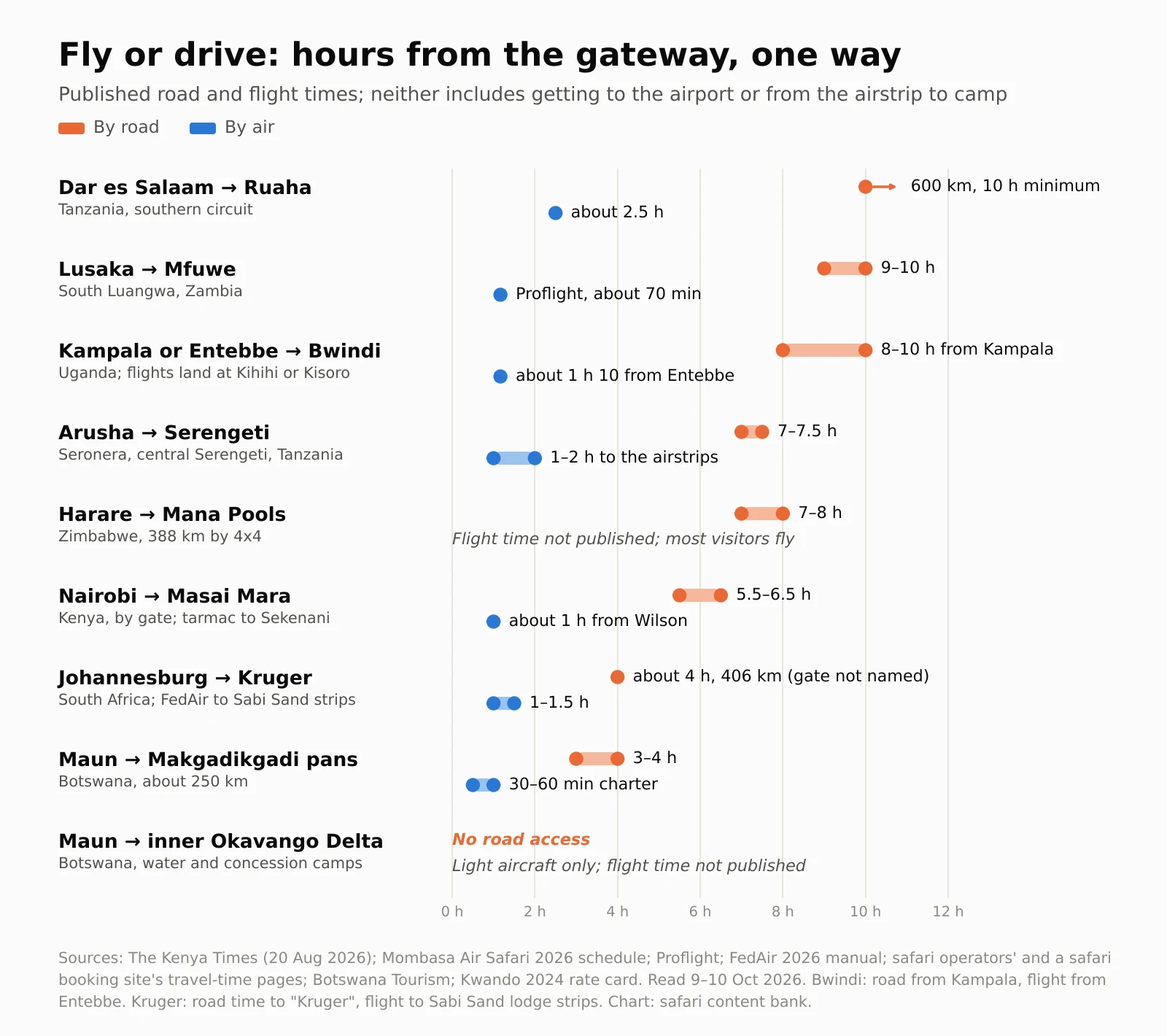 Published times, one way; neither includes airport or airstrip transfers. Sources: The Kenya Times; Mombasa Air Safari 2026; Proflight; FedAir 2026 manual; safari operators’ and a safari booking site’s travel-time pages; Botswana Tourism; Kwando 2024. Read 9–10 October 2026. Chart: safari content bank.
- A road transfer day is mostly a travel day. One Kenya traveller’s review from March 2026 counted “6+ hrs of travel with only 2 hrs of game viewing” (a safari booking site’s Kenya reviews). By road, our Masai Mara page suggests at least two nights.
- A flying day is not free either. Botswana forum regulars report that light-aircraft transfers cluster around midday and reckon a 2-2-2-1 night itinerary loses about a third of its game-viewing time to logistics (TripAdvisor forum; traveller reports).
- Flights stop at several strips. AirKenya lists nine Masai Mara airstrips, and one flight can land at several, so your leg can run longer than the nominal hour (Nairobi to the Masai Mara).
- The clock decides the first day. In Tanzania, a same-day road transfer to a park needs a flight landing at Kilimanjaro, Arusha or Dar es Salaam before 13:00; in Botswana, a late regional arrival into Maun means a night in town, because light aircraft do not fly at night (one safari operator’s travel-times page; Botswana bush flights).
- Fewer moves, longer stays. Most camps that set a minimum ask for 2 nights; how many days each circuit needs is on how many days for a safari.
What each costs: a seat per person, a vehicle per day
For two people, flying in and out costs more than two road days in a private vehicle on every route where both can be priced; the gap narrows for one traveller and widens with each extra person. The full fare tables and worked examples are on fly-in safari cost; the summary:
| Comparison (our sums from published prices) | Fly-in | Drive-in | Source page |
|---|---|---|---|
| Nairobi ⇄ Masai Mara, 1 traveller | US$410 | US$240–360 for two vehicle days, before fuel | Nairobi to the Masai Mara |
| Same, 2 travellers | US$820 | US$240–360, before fuel | same |
| Same, 3 travellers | US$1,230 | US$240–360, before fuel | Fly-in safari cost |
| Arusha ⇄ Serengeti, per adult | Not printed: our sources disagree on the fare | Vehicle US$200–300 a day, plus Ngorongoro entry US$70.80 each way | Serengeti safari cost |
| Maun ⇄ Okavango, per person | US$525 to Kwara (Moremi Air, with US$25 Maun tax, 2024) | No road to the inner Delta; to Moremi, own 4x4 for 4 days, 2 sharing: US$520–600, fuel extra | Okavango Delta safari cost |
| Lusaka ⇄ Mfuwe, per person | US$373 (lowest Proflight return shown, 9 Oct 2026) | No road-transfer price published | South Luangwa safari cost |
| Zimbabwe, one operator’s private trips, per person per day | US$1,081–1,456 (9 days, Harare–Mana Pools–Hwange–Victoria Falls) | US$418–491 (8 days by road, Victoria Falls–Hwange–Matobo) | Zimbabwe safari cost |
| Kruger, two shared 4-day packages, per person | US$1,394 fly-in from Johannesburg | US$839 by road (inclusions differ) | Kruger safari cost |
Fares: Mombasa Air Safari 2026 (Wilson–Mara US$370 + US$40 return); Moremi Air via Kwando’s 2024 rate card; Proflight, 9 October 2026. Vehicle rates: a listing site’s Kenya market range (US$120–180 a day) and a Tanzanian operator’s published range (US$200–300). Packages: operators’ published prices, read 8–10 October 2026, operators not named. Two people flying one way only pay US$440 to the Mara.
- Most of a fly-in bill is the camp, not the flight. In our worked examples the return flight is 7–17% of a 3–4 night fly-in stay (fly-in safari cost).
- A fly-in camp usually supplies the game drives. Governors’ Camp and Kicheche include them in their 2026 Mara rates; a private vehicle at a camp is an extra, US$385–512 a day at Governors’ (safari vehicles).
- On a self-drive, the car is the biggest line: a camping-equipped 4x4 rents for US$170–300 a day in Maun, per vehicle (self-drive safari cost).
- The vehicle gets cheaper per head as it fills: a Tanzanian Land Cruiser at US$200–300 a day is US$100–150 each for two and US$33–50 for six (private vs group safari cost).
Park fees do not change with how you arrive. Mara reserve tickets cost US$100 per adult per day from January to June and US$200 from July to December; Serengeti entry is US$82.60 per adult per day with VAT (US$70.80 from 15 March to 15 May) in the last published TANAPA tariff, 2023/24. Only the Arusha–Serengeti road adds a fee: Ngorongoro entry of US$70.80 per adult each way (NCAA’s page does not say whether VAT is included). The official lines:
| Fee | Amount | In force from | Source |
|---|---|---|---|
| Maasai Mara National Reserve, non-resident adult, per day (12-hour ticket, 06:00–18:00), 1 Jan–30 Jun | USD 100 | Since 1 Jan 2024; Narok County FY2025/26 schedule, the last published | Narok County fee schedule FY2025/26 |
| Maasai Mara National Reserve, non-resident adult, per day (12-hour ticket, 06:00–18:00), 1 Jul–31 Dec | USD 200 | Since 1 Jul 2024; Narok County FY2025/26 schedule, the last published, expired 30 Jun 2026 (no 2026/27 schedule as of 9 Oct 2026); The Kenya Times (6 Aug 2026, secondary) reports US$200 still applies for Jul–Dec 2026 | Narok County fee schedule FY2025/26 |
| Serengeti and Nyerere National Parks, non-East African adult, entry per day, 16 May–14 Mar | USD 70 + 18% VAT = USD 82.60 | 1 Jul 2023 (2023/24 tariff, last published) | TANAPA Tariffs 2023/24 |
| Serengeti and Nyerere National Parks, non-East African adult, entry per day, 15 Mar–15 May | USD 60 + 18% VAT = USD 70.80 | 1 Jul 2023 (2023/24 tariff, last published) | TANAPA Tariffs 2023/24 |
| Ngorongoro Conservation Area, non-East African adult, entry per 24 h (single entry) | USD 70.80 (NCAA's page does not say whether VAT is included) | Undated official page, read 9 Oct 2026 | NCAA |
Luggage: what fits on a bush flight
Light aircraft take 15 kg per person in Kenya and Uganda and 20 kg in Tanzania, Botswana and Zimbabwe, hand luggage included, in a soft bag; by road, no airline limit applies. Carrier-by-carrier rules, sizes and excess charges are on fly-in safari cost and Botswana bush flights.
| Where you fly | Allowance per person | Bag | Carriers (their own pages) |
|---|---|---|---|
| Kenya | 15 kg incl. hand luggage | Soft; AirKenya checked bag 60 × 45 × 33 cm | Safarilink, AirKenya |
| Uganda | 15 kg incl. 5 kg hand luggage | Soft-sided | Aerolink |
| Tanzania | 20 kg incl. hand luggage and cameras | Soft-sided recommended | Auric Air |
| Botswana and Zimbabwe | 20 kg incl. hand luggage | Soft; 65–70 cm long at most | Mack Air; Moremi Air (via Kwando 2024) |
| South Africa | 20 kg in the hold + 5 kg hand | Soft-sided preferred | FedAir 2026 manual |
| Zambia, scheduled jets | 23 kg checked (domestic) | – | Proflight |
Read 9–10 October 2026. We found no confirmed limit for Coastal Aviation, Regional Air or Fly Namibia Safari.
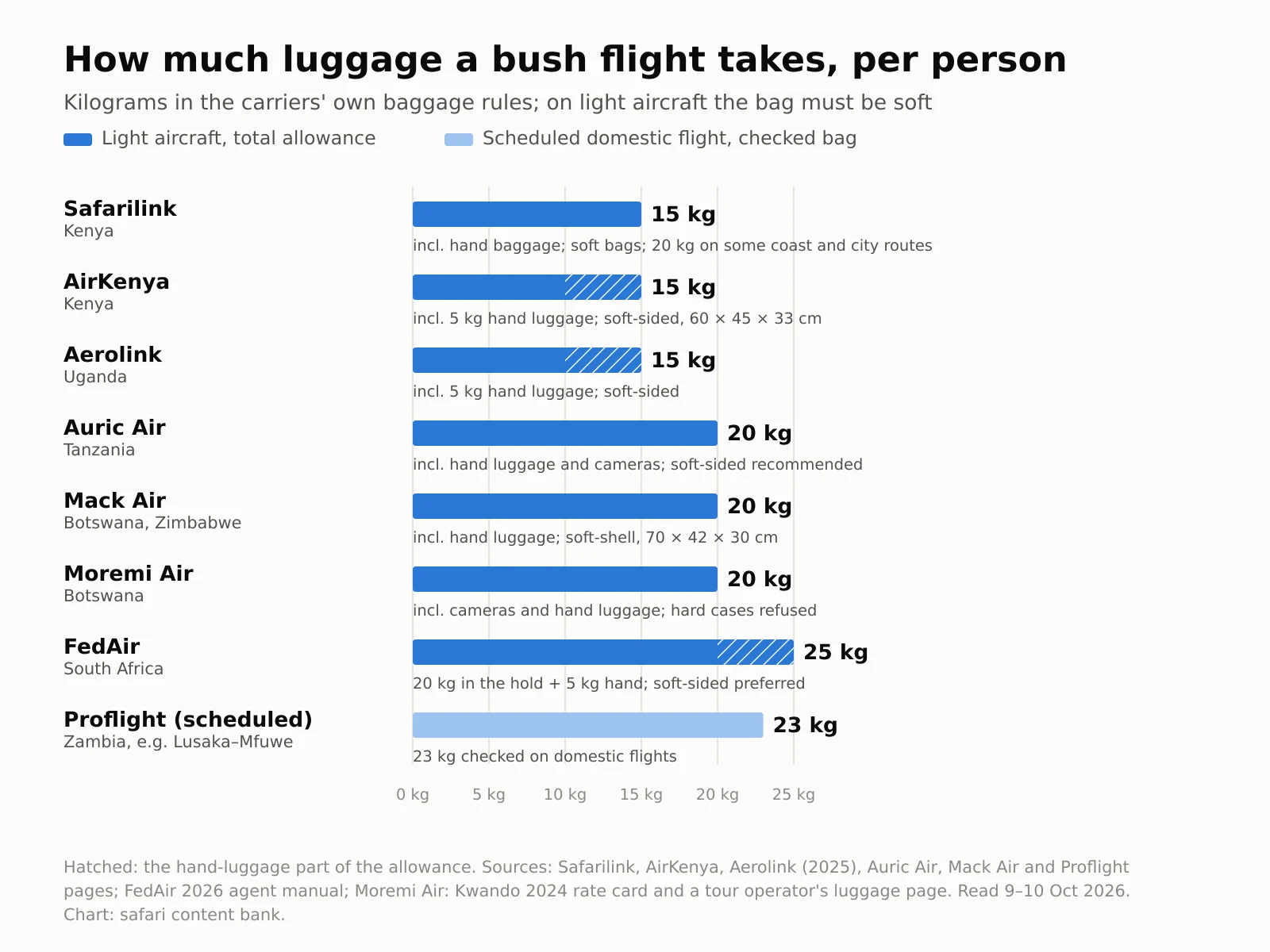 Sources: Safarilink, AirKenya, Aerolink (2025), Auric Air, Mack Air and Proflight pages; FedAir 2026 agent manual; Kwando 2024 rate card and a tour operator’s luggage page (Moremi Air). Chart: safari content bank.
- Heavy camera kit is the usual problem. Safarilink and AirKenya sell a freight seat that carries up to 75 kg more; AirKenya charges US$5 per extra kg and may refuse excess on the day (Nairobi to the Masai Mara).
- Bags can wait for you. AirKenya stores bags free at Wilson for returning passengers; Ker & Downey stores them at its Maun office (fly-in safari cost).
- Heavier passengers may need a second seat: Kwando sets the line at 100 kg, Great Plains at 115–120 kg (Botswana bush flights).
- What to pack inside the limit: safari packing list.
Where flying is the only practical option, and where the road works
Fly into the inner Okavango Delta, Chief’s Island, Mana Pools and the northern Serengeti’s river camps; drive Tanzania’s northern circuit, Moremi’s road circuit, the Chobe riverfront, Kruger and the Mara from Nairobi if time allows.
| Area | Flying | Driving | Source |
|---|---|---|---|
| Inner and western Okavango Delta, private concessions (Botswana) | The only way in: light aircraft from Maun; Mack Air lists 35 airstrips in the Delta, Moremi and Khwai area | No road access; concessions are closed to non-guests | Okavango Delta safari cost; Botswana bush flights |
| Chief’s Island, Moremi Game Reserve | Fly-in only | – | Moremi |
| Moremi road circuit and Khwai community area | Light aircraft to camp strips | 4x4 with a booked campsite: South Gate, North Gate, Third Bridge, Xakanaxa; about 80 km from Maun to Moremi | Botswana bush flights; Okavango Delta |
| Northern Serengeti river camps (Kogatende, Lamai) | Most crossing-season trips fly | Two days’ drive from Arusha: 7–7.5 h to Seronera, 4–5 h more to Kogatende | Great Migration safari cost |
| Mana Pools (Zimbabwe) | Most visitors fly in by light aircraft | 388 km and 7–8 h from Harare, 4x4 needed | Mana Pools |
| Ruaha (Tanzania) | About 2.5 h from Dar es Salaam | 600 km, 10 h minimum | Northern vs southern circuit |
| Tanzania’s northern circuit | Arusha or Kilimanjaro to Serengeti strips, 1–2 h | Short legs: Arusha → Tarangire about 2 h; Tarangire → Lake Manyara 1 h 20; Manyara → Ngorongoro about 1 h | Northern vs southern circuit |
| Masai Mara | About 1 h from Wilson | 5.5–6.5 h, tarmac to Sekenani Gate | Nairobi to the Masai Mara |
| Kruger and its private reserves | FedAir to Sabi Sand, Timbavati and Thornybush strips, 1–1.5 h to Sabi Sand | Gates 411–600 km from Johannesburg | Kruger safari cost; Sabi Sand |
Read 9–10 October 2026. Times as published by the sources cited on each linked page.
- In Botswana the land decides the activities as well as the access. Off-road driving and night drives are prohibited in the national parks and reserves and allowed on private and community concessions, where camps offer them to their own guests (night drives and walking in Botswana). A drive-in trip through Moremi and Chobe stays under park rules.
- “Khwai” is two places. The community concession admits self-drivers and mobile safaris; the Khwai Private Reserve admits neither self-drivers nor day visitors (same page).
- Water or land camp: inside the Delta, the choice between mokoro and game drives is on Okavango water vs land camps.
What you gain and what you miss
Flying swaps road hours for camp hours; driving keeps one guide and vehicle, and turns some travel legs into game drives.
| Fly-in | Drive-in | Source | |
|---|---|---|---|
| Travel days | A shorter transfer, but forum regulars say it still costs half a day or more around midday flights | Most of a day on the long routes; legs inside the parks are game drives, e.g. Seronera → Kogatende via Lobo, 154 km, a 5-hour game drive | Botswana bush flights; Serengeti safari cost |
| Vehicle | The camp’s: open-sided 4x4s with six or nine seats at Botswana’s lodges, says Botswana Tourism | In Kenya and Tanzania usually a closed 4x4 or minibus with a pop-up roof | Safari vehicles |
| Guide | A new camp guide at each stop | The same driver-guide throughout | Nairobi to the Masai Mara |
| Activities | Concession camps can sell night drives, walks and off-road driving | Inside Botswana’s national parks: day drives only, on the roads | Night drives and walking in Botswana |
| Flexibility | Fixed departures and daylight only; scheduled sectors may need two passengers | Stop when you want; Tanzania does not allow tourist driving outside towns after dark | Nairobi to the Masai Mara; Mara to the Serengeti |
| Self-drive | – | Possible in Botswana’s parks, Kruger and Namibia; Narok County banned private vehicles from Mara game drives in June 2024 | Self-drive safari cost; Nairobi to the Masai Mara |
| Luggage | 15–20 kg in a soft bag | What fits in the vehicle | Carriers’ pages |
Read 9–10 October 2026. Traveller reports are labelled as such on the linked pages.
- Solo travellers: forum members report that scheduled light aircraft need two passengers, and that a solo booker may pay for the empty seat or be moved to a later flight, though operators say this is rarely enforced (TripAdvisor Mara forum, September 2026; traveller reports). Mombasa Air Safari’s Wilson–Amboseli fare states a minimum of 2 passengers.
- Most Mara conservancy camps include night drives and walks; night drives are not sold inside the reserve, however you arrive (Kenya safari questions).
- A road safari can still be private or shared: what the vehicle costs per person in each case is on private vs group safari cost.
Mixing fly-in and drive-in on one trip
Many itineraries drive the short legs and fly the long ones, or fly one way and drive the other. These combinations are priced or timed on our existing pages:
| Combination | How it works | What it costs or saves | Source |
|---|---|---|---|
| Kenya: drive in, fly out (or the reverse) | Road Nairobi → Mara, flight Mara → Wilson | Two people pay US$440 for one-way seats instead of US$820 return (our sum) | Fly-in safari cost |
| Kenya: Mara on to the coast | Mombasa Air Safari Mara → coast at 11:30, arriving 13:45 | US$420 + US$35 per person | Nairobi to the Masai Mara |
| Tanzania: drive the circuit, fly out of the Serengeti | Arusha → Tarangire → Ngorongoro → Serengeti by road, then a flight back | Saves one Ngorongoro crossing, US$70.80 per adult, and the 7–7.5 h drive back; the fare is not printed | Serengeti safari cost |
| Kenya + Tanzania by air | Safarilink Mara → Migori 11:30; road across Isebania–Sirari; Coastal Aviation Tarime → Serengeti 14:00 | Runs 16 Dec–31 Mar and 1 Jul–31 Oct; 15 kg baggage; yellow fever card needed | Mara to the Serengeti |
| Kenya + Tanzania by road | Nairobi → Arusha via Namanga, 5–6 h by shuttle, border included; change vehicle and guide at the border | The road route from the Mara to the Serengeti adds 17.5–19 h of driving (our sum) | Kenya–Tanzania border crossings; how many days |
| Botswana: fly Maun in, Kasane out | Light aircraft between Delta camps, out via Kasane | Skips the US$495 Maun–Kasane sector; by road the towns are 600 km, about 7 h apart | Botswana bush flights |
| Botswana: drive Moremi and Chobe, fly into one concession camp | Mobile or self-drive through the parks; a light-aircraft hop into the Delta | Seat US$250 one way Maun → Kwara (Moremi Air, 2024) plus US$25 Maun tax | Okavango Delta safari cost; mobile safari |
| Zambia: fly Lusaka–Mfuwe, drive to camp | Proflight to Mfuwe, then road | Mfuwe-area lodges are close; bush camps 1–2.5 h by road | South Luangwa safari cost |
Read 9–10 October 2026. Your safari vehicle does not cross the Kenya–Tanzania border: Tanzanian-plated safari cars are “currently banned” in Kenyan parks, and Kenyan-registered vehicles cannot enter Tanzanian parks (a self-drive operator’s guide).
When the season changes the answer
Some air links run only in the main seasons, and the rains make some roads hard going or close them.
| When | What changes | Source |
|---|---|---|
| 16 Dec–31 Mar and 1 Jul–31 Oct | The Mara–Serengeti air link runs; at other times it flies on request with at least 4 passengers | Mara to the Serengeti |
| 1 Jun–31 Oct | Safari Air Link flies Ruaha–Katavi–Mahale on Mondays and Thursdays | Northern vs southern circuit |
| Until 30 Nov 2026 | FlyNamibia flies Windhoek–Maun four days a week | Botswana bush flights |
| November–March (Botswana rains) | A traveller reported parts of Moremi closed for a couple of weeks in early 2026; no carrier or camp group in our sources publishes a weather-delay policy | Botswana bush flights |
| Rainy season, Central Kalahari | Tracks4Africa calls travel on the Rakops approach inadvisable; flying from Maun takes 45–60 minutes | Central Kalahari |
| Rains, South Luangwa | Only the central all-weather network near Mfuwe is reliably passable | South Luangwa safari cost |
| Rains, Nyerere | The road to the eastern Mtemere gate ends in 90 km of gravel, “very challenging in the rainy season” | Northern vs southern circuit |
| April, Serengeti | April averages 155 mm of rain, and some plains away from Seronera can be hard to drive | Serengeti safari cost |
| July–October, northern Serengeti | Crossing-season camps are two days’ drive from Arusha; most trips fly | Great Migration safari cost |
Read 9–10 October 2026. Month by month for the whole continent: best time for a safari.
Which should you choose?
Fly for short stays, far-off camps and roadless areas; drive for groups, budgets, heavy luggage and circuits of nearby parks.
| If you… | Choose | Why (sourced figures) |
|---|---|---|
| Have 2 nights or fewer in a park 5+ hours from the gateway | Fly | The road takes 5.5–6.5 h to the Mara, 7–7.5 h to Seronera, 9–10 h to Mfuwe |
| Are booked into an inner-Delta or concession camp in Botswana | Fly | No road access; concessions closed to non-guests |
| Want river crossings in the northern Serengeti, July–October | Fly | Two days’ drive from Arusha |
| Are three or more sharing one vehicle | Drive | Mara return flights for three cost US$1,230 against US$240–360 for two vehicle days, before fuel (our sums) |
| Are travelling alone to the Mara | Either | US$410 return against US$240–360 for the vehicle days, before fuel; some flights need two passengers |
| Do Tanzania’s northern circuit (Tarangire, Manyara, Ngorongoro, Serengeti) | Drive in, think about flying out | The legs from Arusha to Ngorongoro are 1–2 h each; flying back saves the 7–7.5 h drive and one Ngorongoro crossing |
| Carry more than 15–20 kg of camera kit | Drive, or buy a freight seat | Kenyan carriers sell a freight seat carrying up to 75 kg more |
| Want to self-drive | Drive in Botswana’s parks, Kruger or Namibia | Narok County banned private vehicles from Mara game drives in June 2024 |
| Combine Kenya and Tanzania | Fly the Mara–Serengeti link in season | The direct road has been closed since 1977 |
If you pay a tour company for flights or vehicle days in advance, check it first: how to check a safari operator’s licence.
Common mistakes in fly-in vs drive-in comparisons
| What you’ll often read | What is correct |
|---|---|
| “Flying saves a whole day each way” | It saves 4.5–5.5 hours each way to the Mara (our sum), before the drive to Wilson and the airstrip transfer; a flying day still costs part of a game-viewing day. |
| “Fly-in is always the expensive option” | For one traveller to the Mara the two are close: US$410 return against US$240–360 for two vehicle days before fuel. For two or more, driving is cheaper on every route both can be priced. |
| “You can drive to any Okavango Delta camp” | The inner and western Delta has no road, and its concessions are closed to non-guests. Moremi’s road circuit and Khwai’s community area are drivable. |
| “A 23 kg suitcase is fine” | 15 kg in Kenya and Uganda, 20 kg in Tanzania and Botswana, hand luggage included, in a soft bag. 23 kg is Proflight’s checked allowance on scheduled domestic flights in Zambia. |
| “Flying in means no park fees on the way” | Park fees are the same however you arrive. Only the Arusha–Serengeti road adds Ngorongoro entry, US$70.80 per adult each way. |
| “Land in the afternoon and fly straight to camp” | Light aircraft do not fly at night, and Botswana Tourism lists Maun’s port hours as 07:30–16:30. In Tanzania, a same-day road transfer needs a flight landing before 13:00. |
| “You can drive from the Mara into the Serengeti” | The Sand River–Bologonja crossing has been closed since 1977. Fly via Migori and Tarime, or drive round through Namanga or Isebania–Sirari. |
| “Your safari vehicle comes with you across the border” | It does not: Tanzanian-plated safari cars are “currently banned” in Kenyan parks, and Kenyan-registered vehicles cannot enter Tanzanian parks (a self-drive operator’s guide). |
Frequently asked questions
Is it better to fly or drive on safari? Fly when the road would take most of a day or there is no road: Nairobi to the Masai Mara is 5.5–6.5 hours by road and about 1 hour by air, Lusaka to Mfuwe 9–10 hours against about 70 minutes, and the inner Okavango Delta has no road. Drive when three or more share a vehicle, on a tighter budget, or on Tanzania’s northern circuit, where the legs from Arusha to Ngorongoro are 1–2 hours each.
How much time does a fly-in safari save? About 4.5–5.5 hours each way between Nairobi and the Mara, 5–6.5 hours between Arusha and the central Serengeti, and about 8–9 hours between Lusaka and Mfuwe (our sums from published times). Add the drive to the airport and the airstrip transfer, and expect the flight day to cost part of a game-viewing day.
Is a fly-in safari more expensive than a drive-in safari? Usually, for two or more people. Two people pay US$820 to fly Nairobi–Masai Mara and back, against US$240–360 for two road days in a private vehicle before fuel (our sums). One operator’s Zimbabwe trips cost US$1,081–1,456 a day with Mana Pools by air and US$418–491 by road. Full figures: fly-in safari cost.
Can you drive to the Okavango Delta? Only to its eastern side. Moremi Game Reserve’s road circuit and the Khwai community area take a 4x4 and a booked campsite, about 80 km from Maun. The inner and western Delta has no road access, its private concessions are closed to self-drivers, and Chief’s Island is fly-in only.
What is the luggage limit on safari flights? 15 kg per person in Kenya (Safarilink, AirKenya) and Uganda (Aerolink), and 20 kg in Tanzania (Auric Air) and Botswana and Zimbabwe (Mack Air, Moremi Air), hand luggage included, in a soft bag. FedAir in South Africa allows 20 kg plus 5 kg hand luggage. By road no airline limit applies.
Can I fly one way and drive the other? Yes. Between Nairobi and the Masai Mara, one-way seats for two cost US$440 instead of US$820 return (our sum, Mombasa Air Safari 2026 fares). In Tanzania, driving to the Serengeti and flying out saves the 7–7.5-hour drive back and one Ngorongoro crossing at US$70.80 per adult; we print no Arusha–Serengeti fare, because our sources disagree.
What do you miss by flying in? The road legs that double as game drives, such as Seronera to Kogatende via Lobo, a 5-hour game drive, and one driver-guide for the whole trip. You gain camp time, and on Botswana’s private concessions you gain night drives, walks and off-road driving, which the national parks do not allow.
Can you fly from the Masai Mara to the Serengeti? Yes, with a road hop: Safarilink flies the Mara to Migori at 11:30, you cross by road at Isebania–Sirari, and Coastal Aviation leaves Tarime for the Serengeti at 14:00. The link runs 16 December–31 March and 1 July–31 October, allows 15 kg and needs a yellow fever card. The direct road has been closed since 1977. See Kenya–Tanzania border crossings.
Sources
- Airlines: Mombasa Air Safari 2026 schedule; Safarilink baggage allowance and Mara–Serengeti link; AirKenya baggage policy and Maasai Mara destinations; Aerolink baggage policy 2025 (PDF); Auric Air baggage policy; Mack Air destinations; FedAir 2026 agent manual (PDF); Proflight Zambia, read 9–10 Oct 2026
- Camp groups’ fares and flight terms: Kwando 2024 rate sheet (PDF); Great Plains 2025 (PDF), read 10 Oct 2026
- Park fees: Narok County fee schedule FY2025/26 (PDF); TANAPA Tariffs 2023/24 (PDF), the last published tariff; NCAA tariffs, read 9 Oct 2026
- Road times and rules: The Kenya Times, 20 Aug 2026; Botswana Tourism, game drives and ports of entry; safari operators’ and a safari booking site’s travel-time and getting-there pages, read 9–10 Oct 2026 (names and links in our editor notes)
- Traveller reports: TripAdvisor Botswana forum, mobile vs fly-in; TripAdvisor Mara forum, flights with fewer than 2 passengers; a safari booking site’s Kenya reviews (March 2026)
- Package prices and vehicle rates: tour operators’ published listings and market ranges as cited on our cost pages linked in each table, read 8–10 Oct 2026 (operators not named)
Times, fares and fees checked against our cost and getting-there pages on 10 October 2026. We will update this page when Safarilink, AirKenya, Coastal Aviation or Auric Air publish fares we can confirm, when an Arusha–Serengeti fare can be checked, when Narok County publishes its 2026/27 Mara fee schedule and when TANAPA publishes a new tariff.
Ask for a quote
Tell us your dates and we send you a priced itinerary. Free, no obligation.
- Free quote, no obligation
- Trips run by licensed local operators