 Experience

Last verified · Next check due
On this page
- Where to see hippos: parks, odds and fees (2026)
- Zambia: the Luangwa, the Zambezi and the Kafue
- Zimbabwe: Mana Pools and Lake Kariba
- Botswana: the Okavango, Moremi and the Chobe River
- Uganda: the Kazinga Channel, the Nile and Lake Mburo
- Tanzania, Kenya, Malawi and South Africa
- Boat, canoe, mokoro or on foot: how close, and how safe
- Which hippo trip to choose
- When is the best time to see hippos?
- How many hippos are left, and their IUCN status
- Common mistakes about seeing hippos
- Frequently asked questions
- Sources
Short answer: Go where rivers and lagoons hold water all year. 95–100% of one safari operator’s travellers saw hippo in Zambia’s South Luangwa, Lower Zambezi and Kafue, at Mana Pools, in Moremi and the Okavango Delta, and 89% in Chobe. For a boat trip, Uganda’s Kazinga Channel, whose hippos UWA ranks among Africa’s densest, has a US$30 launch. The common hippo is Vulnerable on the IUCN Red List, with 115,000–130,000 left. In a canoe, go with a guide.
Key facts
- The common hippo is listed as Vulnerable on the IUCN Red List, in an assessment made in 2016 and published in 2017 (Lewison & Pluháček), with an estimated 115,000–130,000 animals (San Diego Zoo Wildlife Alliance Library, hippopotamus fact sheet, checked 9 October 2026; Wikipedia, secondary, which calls the population stable).
- The highest published hippo sighting rate is 100%: every one of one safari operator’s traveller groups saw hippo in Lower Zambezi and North Luangwa (Zambia), Liwonde (Malawi) and Moremi Game Reserve (Botswana). South Luangwa, Kafue and Kwando-Linyanti are at 99% (read September–October 2026). These are per-trip rates, not the chance on one drive.
- Uganda’s Kazinga Channel is the hippo boat trip: UWA’s brochure counts its hippos among the densest concentrations in Africa, and the 2-hour launch from Mweya costs US$30 per person on top of entry (Queen Elizabeth).
- Mana Pools holds Zimbabwe’s largest concentration of hippo and Nile crocodile (Zimbabwe Field Guide), and 95% of the same operator’s Mana Pools travellers saw hippo (Mana Pools).
- Hippo attacks are unusually deadly: in archived Ugandan records about 87% of recorded attacks on people were fatal, and about 55% in Mozambique (Frontiers in Conservation Science, 2022). The popular claim that hippos kill more people than any other African animal has no primary source in anything we hold.
- Dry parks have few or none: a safari booking site lists no hippo in Damaraland or the Central Kalahari; for Etosha our sources disagree, and none describes a permanent population.
Where to see hippos: parks, odds and fees (2026)
Zambia’s three big river parks, Mana Pools, Liwonde and northern Botswana’s Delta, Moremi and Linyanti areas all have a published hippo sighting rate of 95% or more; Uganda’s Kazinga Channel, Katavi and iSimangaliso are known for hippo numbers but publish no sighting rate. No park in our sources publishes both a rate and a current count.
| Place | Country | How you see them | Seen by (per trip) | Fee to be there, per adult | Source |
|---|---|---|---|---|---|
| South Luangwa | Zambia | Drives along the Luangwa River; walks with a scout | 99% | US$25 a day (DNPW 2025 schedule, the last published) | one operator’s South Luangwa page |
| Lower Zambezi | Zambia | Boat cruises and guided canoes on the Zambezi | 100% | US$25 a day; boating or canoeing US$20 a day each (DNPW 2025, last published) | one operator’s Lower Zambezi page |
| North Luangwa | Zambia | Walking-led camps on the Mwaleshi River, June–October | 100% | US$20 a day (DNPW 2025, last published) | one operator’s North Luangwa page |
| Kafue | Zambia | Boat cruises and canoeing on the Kafue and Lunga rivers | 99% | US$20 a day; boating US$20 a day (DNPW 2025, last published) | one operator’s Kafue page |
| Mana Pools | Zimbabwe | Guided canoe trips and walks | 95% | US$24 a day (ZimParks Tariff 2026) | one operator’s Mana Pools page; Zimbabwe Field Guide |
| Moremi Game Reserve | Botswana | Game drives | 100% | P270 a day (last published DWNP schedule, 1 April 2022) | one operator’s Moremi page |
| Kwando-Linyanti (private concessions) | Botswana | Camp game drives | 99% | Camp rate plus levy | one operator’s Kwando-Linyanti page |
| Okavango Delta reserves (private concessions) | Botswana | Boats and mokoro from water camps | 98% | In the camp rate at many camps | one operator’s Okavango Delta page |
| Okavango Panhandle | Botswana | Camps oriented to boats rather than vehicles | 90% | – | one operator’s Panhandle page |
| Chobe National Park | Botswana | Three-hour river cruises from Kasane | 89% | P270 a day (last published DWNP schedule, 1 April 2022) | one operator’s Chobe page; Chobe |
| Makgadikgadi and Nxai Pan | Botswana | Drives | 75% | P190 a day (last published DWNP schedule, 1 April 2022) | one operator’s salt pans page |
| Liwonde National Park | Malawi | Park and lodge boat trips on the Shire River, 2 hours | 100% | Boat trip US$25 (African Parks 2025 rate sheet) | one operator’s Liwonde page; boat safaris |
| Queen Elizabeth, Kazinga Channel | Uganda | UWA launch from Mweya, about 2 hours, up to 40 on board | Not published | US$40 per 24 hours + launch US$30 (last published UWA tariff, July 2024–June 2026) | UWA brochure; Queen Elizabeth |
| Murchison Falls, Victoria Nile | Uganda | UWA launch to the foot of the falls | Not published | US$45 per 24 hours + launch US$30 (same UWA tariff) | UWA brochure |
| Lake Mburo | Uganda | UWA boat trip, about 2 hours, at least 4 passengers | Not published | US$40 per 24 hours + boat US$30 (same UWA tariff) | UWA; Lake Mburo |
| Katavi National Park | Tanzania | Drives along the Katuma River as it shrinks to pools | Not published | US$35.40 a day (last published tariff, 2023/24) | A safari agent’s guide, read September 2026 |
| Tsavo West, Mzima Springs | Kenya | Mzima Springs, a stop on Tsavo West drives | Not published | US$80 per 24 hours (KWS) | Tsavo |
| Kruger | South Africa | Self-drive to rivers and dams | Not published; 3,100 in the 2009–2011 census | R692 (R602 until 31 Oct 2026) | Wikipedia (secondary, citing SANParks) |
| iSimangaliso Wetland Park, St Lucia estuary | South Africa | Estuary cruises run by private operators from St Lucia town | Not published; about 800 hippo | Section entry fees not in our sources | Hluhluwe-iMfolozi |
Sighting rates: one operator’s traveller reports, share of groups who saw hippo at least once on their trip; Botswana pages read September 2026, Zambia, Zimbabwe and Malawi pages read 8 October 2026. Fees per non-resident or international adult, copied from our Zambia, Zimbabwe, Botswana, Chobe, Uganda, Tanzania, Kenya and Kruger fee and cost pages, read 8–10 October 2026; the UWA launch fee and Liwonde’s boat price as on our boat safaris page. Botswana’s fee lines are the last published DWNP schedule; no official current tariff is published.
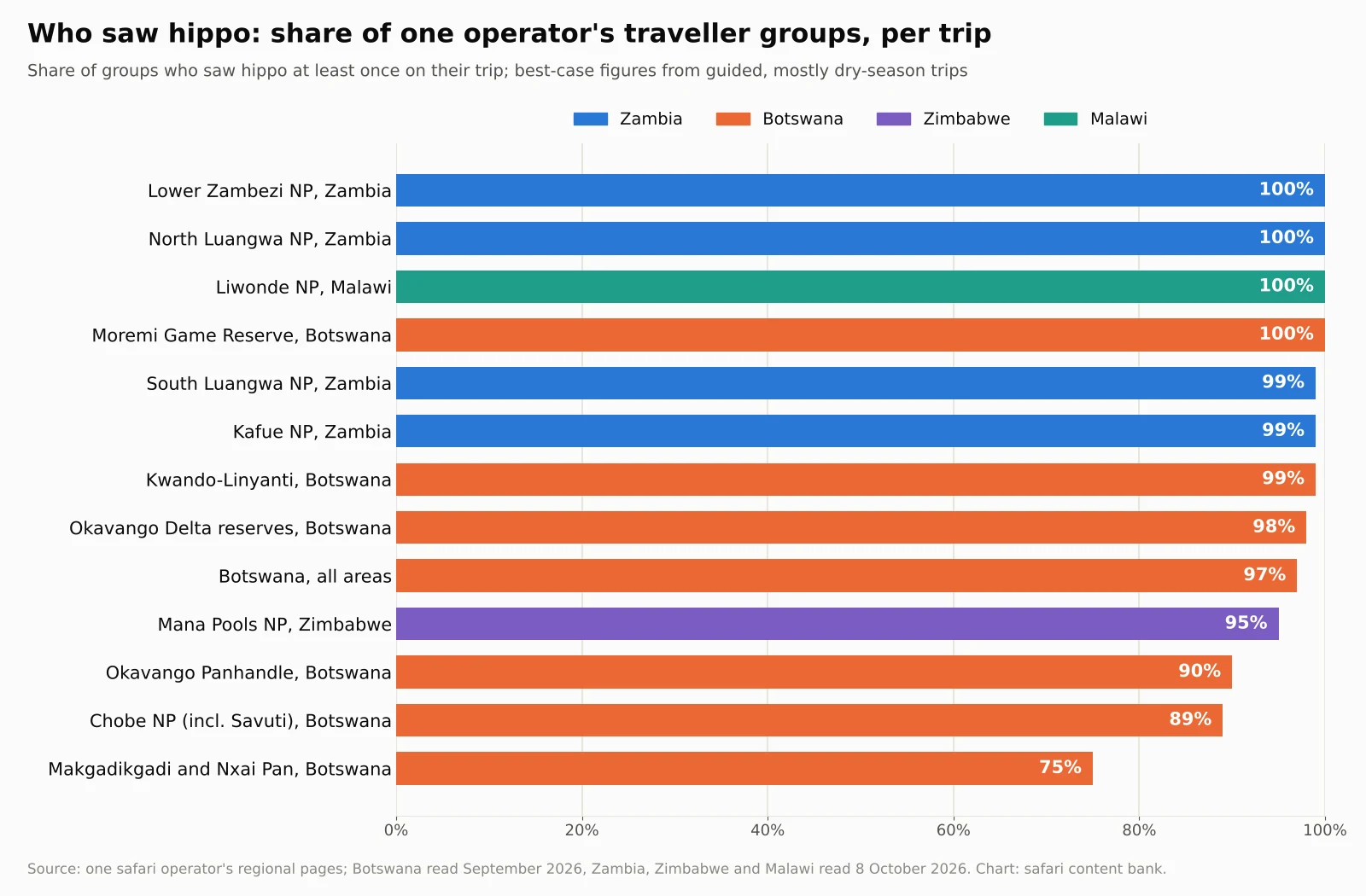 Traveller-reported, per trip, from one operator’s clients. Sources: one operator’s regional pages, Botswana read September 2026, Zambia, Zimbabwe and Malawi read 8 October 2026. Chart: safari content bank.
- Read these as best-case numbers. They come from one operator’s own clients, who tend to take longer, guided, dry-season trips, and the operator does not publish how many groups each regional figure rests on.
- Hippo tops that operator’s Botswana list: 97% of the same operator’s groups saw hippo, against 95% for elephant and 91% for lion (read September 2026). For the other big animals, see where to see elephants and where to see the Big Five; hippo is not one of the Big Five.
- The Mara River and Ruaha are often named for hippo, but our sources hold no hippo count or sighting rate for either, so they are not in the table.
Zambia: the Luangwa, the Zambezi and the Kafue
Zambia has the best published hippo odds in our sources: 99% in South Luangwa and Kafue and 100% in Lower Zambezi and North Luangwa, from one safari operator’s traveller reports. All four are river parks, and the camps sit on the water.
- South Luangwa: hippo and crocodile are abundant, with elephant and buffalo in herds of hundreds (one safari operator; South Luangwa). Kaingo Camp’s Hippo Hide sits at river level, one of four photographic hides at the camp (photography safaris). Gate entry is US$25 per international adult per day (DNPW 2025 schedule, the last published).
- Lower Zambezi: every one of the operator’s Lower Zambezi travellers saw elephant and hippo (Lower Zambezi). Camps run boat cruises and guided two-person canoe trips on the main river and side channels such as the Chifungulu; DNPW charges US$20 a day for boating and US$20 for canoeing, on top of US$25 entry (2025 schedule, the last published).
- Kafue: level with South Luangwa on hippo, at 99%; camps run cruises and canoeing on the Kafue and Lunga rivers (Kafue; Kafue vs South Luangwa). Entry is US$20 a day.
- What camps bill: full-board camps in South Luangwa and Lower Zambezi bill US$90–110 per person a night in fees and levies, more than the gate fee (Zambia safari cost).
See also: South Luangwa vs Lower Zambezi.
Zimbabwe: Mana Pools and Lake Kariba
Mana Pools holds Zimbabwe’s largest concentration of hippo and Nile crocodile (Zimbabwe Field Guide), and 95% of one operator’s travellers there saw hippo; it is a canoe and walking park, with motorboats banned except on one private concession.
- The pools: “Mana” means four in Shona, after the park’s four main pools, old oxbows of the Zambezi; Long Pool is more than 6 km long and has resident hippo and crocodile (Zimbabwe Field Guide).
- On the water: guided two-person canoes, from half a day to trails of several days that sleep on islands; motorboats are banned except on Ruckomechi’s private concession to the west (one safari operator’s Mana Pools guide; canoe safaris).
- Fees: US$24 per international adult per day, whether or not you sleep in the park (ZimParks Tariff 2026). Most camps close from December to March (Zimbabwe safari questions).
- Lake Kariba: in Matusadona National Park, on the lake’s southern shore, lion, leopard, elephant, buffalo and hippo live along the lakeshore, and camps run boats (boat safaris). Do not swim in Lake Kariba: crocodiles and bilharzia (Wild Zambezi).
See also: Mana Pools vs Lower Zambezi, which face each other across the river.
Botswana: the Okavango, Moremi and the Chobe River
Northern Botswana’s water areas are near-certain for hippo on one operator’s figures: 100% in Moremi, 99% in Kwando-Linyanti, 98% in the Okavango Delta reserves and 97% across all its Botswana trips; Chobe, seen mostly from river cruises, is lower at 89%.
| Area | Hippo seen by (per trip) | How you see them | Fee per adult | Source |
|---|---|---|---|---|
| Moremi Game Reserve (incl. Khwai) | 100% | Game drives | P270 a day (last published DWNP schedule, 1 April 2022) | one operator’s Moremi page; Moremi |
| Kwando-Linyanti | 99% | Camp game drives | Camp rate plus levy | one operator’s Kwando-Linyanti page |
| Okavango Delta reserves | 98% | Motorboats on permanent lagoons; mokoro | In the camp rate at many camps | one operator’s Okavango Delta page; Okavango Delta |
| Okavango Panhandle | 90% | Boat-oriented camps; elephant only 40% and leopard 0% here | – | one operator’s Panhandle page |
| Chobe National Park | 89% | Three-hour river cruises from Kasane; houseboats on the Namibian bank | P270 a day (same DWNP line) | one operator’s Chobe page; Chobe |
| Makgadikgadi and Nxai Pan | 75% | Drives | P190 a day (last published DWNP schedule, 1 April 2022) | one operator’s salt pans page |
Botswana pages read September 2026. In Feb 2026 the government news agency BOPA called the existing non-resident fee P380, a P500 rise was announced, then reported postponed. No official current tariff is published: confirm with DWNP or your operator.
- Hippos shape the Delta: a review of Okavango science records that hippo and elephant create new channels, influencing the Delta’s shape (Mosepele & Mosepele, IntechOpen).
- Chobe from the water: forum regulars favour the afternoon cruise, from about 15:00, for elephants coming to drink; hippos are seen on either cruise (Chobe). Sedudu Gate is 80 km from Victoria Falls, so the riverfront works as a day trip (Chobe day trip from Victoria Falls).
- Water camps or land camps: boats and mokoro depend on the flood in the seasonal swamp, but run all year on permanent water (Okavango water vs land camps; Okavango flood calendar).
- No walking in Moremi or Chobe National Park: Botswana’s private concessions allow walking (Botswana night drives and walking).
Uganda: the Kazinga Channel, the Nile and Lake Mburo
Uganda is the country for a hippo boat trip at a park-run price: UWA’s launches on the Kazinga Channel and the Victoria Nile, and its boat on Lake Mburo, all cost US$30 per person, on top of entry (last published UWA tariff, July 2024–June 2026). No sighting rate is published for Uganda’s parks.
- Kazinga Channel, Queen Elizabeth: the channel, about 40 km long, joins Lake George and Lake Edward; UWA’s brochure counts its hippos among the densest concentrations in Africa. The launch leaves Mweya for about 2 hours and takes up to 40. With a day’s entry at US$40, a launch day costs US$70 per foreign adult (our sum).
- Victoria Nile, Murchison Falls: the UWA launch runs to the foot of the falls; UWA’s brochure lists hippos, and the park has Uganda’s largest Nile crocodile population. Entry is US$45 per 24 hours, the highest in Uganda.
- Lake Mburo: UWA lists hippo and crocodile among the park’s animals; its boat trip lasts about 2 hours, costs US$30 and needs at least 4 passengers.
- Which one: the usual Uganda loop includes both Murchison and Queen Elizabeth; the full comparison is on Murchison Falls vs Queen Elizabeth.
Tanzania, Kenya, Malawi and South Africa
Outside the Zambezi–Okavango river system and Uganda, our sources point to Katavi’s dry-season pools, Malawi’s Shire River, Tsavo West’s Mzima Springs, Kruger and South Africa’s St Lucia estuary.
- Katavi (Tanzania): a safari agent’s guide (read 10 October 2026) describes hippos “up to 200 in pools” and Wikipedia says mudholes can be packed with hundreds; neither figure rests on a survey. A safari agent’s guide (read 10 October 2026) names May–October and December–February as the best months, when “animals congregate around the remaining water bodies”. Entry is US$35.40 a day (last published tariff, 2023/24).
- Nyerere (Tanzania): TANAPA prices a boat safari on the Rufiji and its lakes at US$23.60 per person, on top of US$82.60 entry from 16 May to 14 March (last published tariff, 2023/24; Nyerere safari cost). Our sources publish no hippo rate for Nyerere.
- Liwonde (Malawi): hippo and crocodile at very high densities on the Shire River, and 100% of one operator’s Liwonde travellers saw hippo; a 2-hour boat trip costs US$25 (African Parks 2025 rate sheet, as on our boat safaris page).
- Tsavo West (Kenya): our Tsavo page lists Mzima Springs hippos among Tsavo West’s sights. Entry is US$80 per adult per 24 hours (KWS).
- Kruger (South Africa): the last census table we hold gives 3,100 hippo for 2009–2011 (Wikipedia, secondary, citing SANParks); that is about 15 years old. Kruger is a self-drive park: stay in your vehicle except at designated spots (Kruger self-drive).
- iSimangaliso (South Africa): South Africa’s first World Heritage Site holds about 800 hippo and 1,200 Nile crocodile; estuary cruises leave St Lucia, 50 km from Hluhluwe-iMfolozi (Hluhluwe-iMfolozi).
Boat, canoe, mokoro or on foot: how close, and how safe
A motor launch or camp boat keeps the most water between you and the hippos; a canoe or mokoro puts you at water level, and every trip in our sources goes with a guide because hippo and crocodile are the real risk (one safari operator’s Lower Zambezi guide). Our sources hold no incident data for boat, canoe or walking safaris, so we print no accident rate.
| Way to see them | Where | How it works | Rules in our sources | Source |
|---|---|---|---|---|
| Park launch | Kazinga Channel, Victoria Nile, Lake Mburo (Uganda) | UWA boats, about 2 hours; the Kazinga launch takes up to 40 | Crewed; US$30 per person | Boat safaris |
| Camp motorboat or river cruise | Chobe, Okavango, Lower Zambezi, Kafue, Kariba, Liwonde | Small boats from lodges and camps; three-hour cruises on the Chobe | Crewed; some camps require life vests (Xigera, Okavango) | Boat safaris |
| Canoe | Lower Zambezi, Mana Pools, Kafue | Two-person Canadian canoes with a guide | Follow the guide; up to three canoes per trip in Zambia (DNPW); no under-12s in Lower Zambezi | Canoe safaris |
| Mokoro | Okavango Delta | Poled canoe: guests sit amidships, a poler stands at the stern | Most camps set 12 as the minimum age, Great Plains 8; Xigera takes no under-13s | Canoe safaris |
| Walking | South Luangwa, Mana Pools, Botswana’s private concessions | Guided walks | South Luangwa: licensed guide and armed DNPW scout, minimum age 12; not in Moremi or Chobe National Park | Walking safaris |
| Vehicle | Every park in the table above | Drives along rivers and to dams | In Kruger, stay in your vehicle except at designated spots | Kruger self-drive |
Read 8–10 October 2026.
- Why hippos are dangerous: in archived Ugandan records about 87% of recorded hippo attacks on people were fatal, and about 55% in Mozambique. The usual settings are boats and fishing gear, crop fields near water at night, and paths between water and grazing (Frontiers in Conservation Science, 2022).
- They leave the water at night to graze: a hippo walks 3–5 km a night and eats about 40 kg of grass (Wikipedia, secondary). A review of injuries to visitors in South Africa advises not driving fast after dusk where hippos graze (Leggat et al., Journal of Travel Medicine 2001, PDF).
- Crocodiles kill more people than hippos in the one national dataset we hold: of 322 confirmed human deaths from large wild animals in Zimbabwe in 2016–2022, about 51% were caused by Nile crocodiles and 32% by elephants (Scientific Reports, 2025). The victims’ breakdown between residents and visitors is not given in what we read.
- Insurance: canoeing among hippos is an activity to name to your insurer in writing (safari travel insurance).
Which hippo trip to choose
Pick by how you want to be on the water: a park launch in Uganda for the cheapest boat hours, a canoe on the Zambezi for water-level hippos with a guide, a mokoro in the Okavango for silence, or a Zambian river camp for the highest published odds.
| If you want | Go to | Why |
|---|---|---|
| The highest published odds | Lower Zambezi, South Luangwa or Moremi | 99–100% of one operator’s travellers saw hippo |
| Hippos from a boat, cheaply | The Kazinga Channel, Queen Elizabeth | UWA launch US$30; densest hippo concentrations in Africa, per UWA |
| Hippos from a canoe | Lower Zambezi or Mana Pools | Guided two-person canoes; Mana Pools has Zimbabwe’s largest hippo concentration |
| A mokoro among hippos | Okavango Delta water camps | 98% saw hippo; mokoro on permanent water all year |
| Hippos and elephants from one boat | Chobe from Kasane | 89% hippo, 99% elephant on the same operator’s figures |
| Hippos with a waterfall | Murchison Falls | UWA launch to the foot of the falls, US$30 |
| A dry-season hippo crowd | Katavi | “Up to 200 in pools” (a safari agent’s guide, read 10 October 2026); best May–October |
| Hippos on a South Africa trip | iSimangaliso or Kruger | About 800 hippo at iSimangaliso; self-drive in Kruger |
When is the best time to see hippos?
Hippos spend the day in water, so you can see them in every month in the parks on this page; the dry season shrinks rivers and pools and pulls other game to them too, and it is also the peak-price season. No source in our bank gives hippo-specific months, so the table uses each park’s general dry or best season.
| Park | Best months in our sources | Source |
|---|---|---|
| Chobe riverfront | June–October, the dry season, when game concentrates on the river | Chobe |
| Okavango Delta | Seasonal-floodplain boats from about late May to September; permanent water all year | Okavango flood calendar |
| South Luangwa | June–October, when every camp is open | South Luangwa |
| Lower Zambezi | Mid-August to mid-October for peak game; camps open about April to mid-November | Lower Zambezi |
| Mana Pools | June–October; most camps closed December–March | Mana Pools |
| Kafue | June–September | Kafue |
| Queen Elizabeth | June–August and December–February, Uganda’s dry seasons | Queen Elizabeth |
| Murchison Falls | December–February and June–September | Murchison Falls |
| Katavi | May–October and December–February | A safari agent’s guide, read 8–10 October 2026 |
| Liwonde | August–September best overall | Boat safaris |
| Kruger | April–September, the dry season | Kruger |
Read 8–10 October 2026. General seasons from our park pages, not hippo calendars. More: best time for a safari.
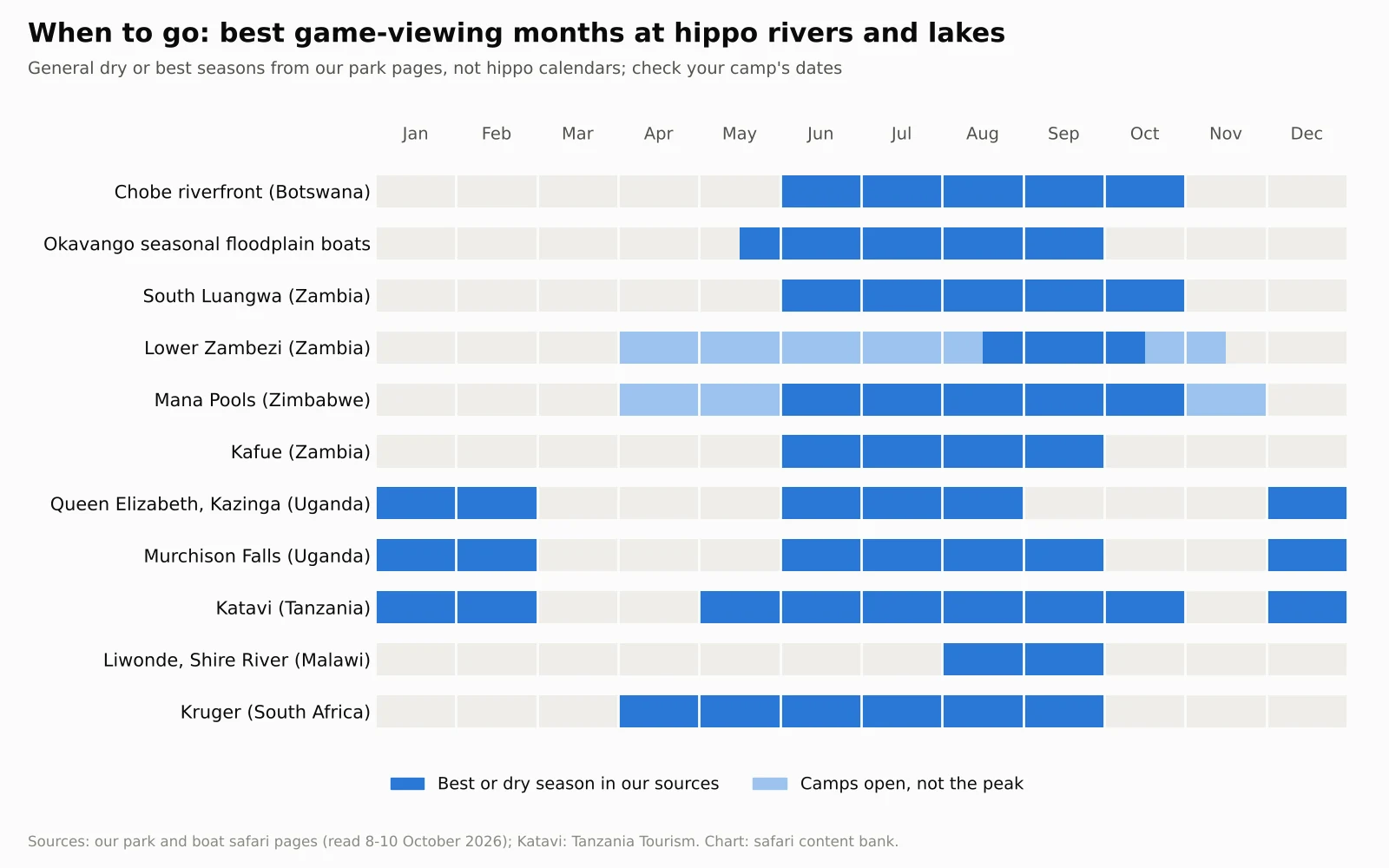 Sources: our park and boat safari pages and the sources they cite, read 8–10 October 2026; Katavi: a safari agent’s guide. General seasons, not hippo calendars. Chart: safari content bank.
- The dry months are the peak-price months. Chongwe Camp in Lower Zambezi charges US$810 per person a night from April to June and in November, against US$990 from July to October (Time + Tide, 2026; canoe safaris).
- October is hot on the rivers: it can pass 40°C on the Chobe and on both banks of the Zambezi (boat safaris).
How many hippos are left, and their IUCN status
The common hippo is Vulnerable on the IUCN Red List, with 115,000–130,000 animals in the assessment made in 2016 and published in 2017; there is no newer continental count in our sources. Country and park counts are scarce and mostly old.
| Measure | Figure | Source |
|---|---|---|
| IUCN Red List category | Vulnerable (Lewison & Pluháček; assessed 2016, published 2017) | SDZWA Library fact sheet; Wikipedia (secondary) |
| Wild population | 115,000–130,000 | Same |
| Virunga National Park (DR Congo) | About 29,000 in the mid-1970s; 800–900 by 2005 | Wikipedia (secondary, citing the BBC) |
| Kruger (South Africa) | 3,100 (2009–2011 census) | Wikipedia (secondary, citing SANParks) |
| iSimangaliso (South Africa) | About 800 | Hluhluwe-iMfolozi |
| Malawi | 928 hippos shot in 1984–89, in human-hippo conflict | Frontiers, 2022 |
| Kenya | Hippo-conflict reports rose 1,285% between 1997 and 2008 | Same |
Read 9 October 2026.
- About 1.5 tonnes: our two sources differ on the averages (bulls 1,480 or 1,546 kg, cows 1,365 or 1,385 kg), but both put “three tonnes” as a typical weight too high (SDZWA; Wikipedia, secondary).
- They do not sweat blood: the skin secretion is colourless, turns red-orange within minutes and works as a sunscreen and antiseptic (Wikipedia, secondary, citing Saikawa et al. 2004).
- Territories are short on rivers: a bull holds 250–500 m of lake shore but only 50–100 m of river, with 5–30 cows and calves (Wikipedia, secondary).
The official fee lines, with the date each took effect and the authority’s own source:
| Fee | Amount | In force from | Source |
|---|---|---|---|
| South Luangwa and Lower Zambezi National Parks (DNPW Category A), international adult, entry per day (06:00–18:00) | USD 25 (SADC and resident USD 20; Zambian citizen ZMW 55.60); child 5–13 half price, under 5 free | DNPW 2025 schedule ("official 2025 rates"), the last published; page last modified 8 May 2025, still shown 9 Oct 2026 | DNPW 2025 fee schedule, as shown on a Zambia travel portal |
| Kafue and North Luangwa National Parks, international adult, entry per day | USD 20 (SADC and resident USD 15; Zambian citizen ZMW 44.80) | DNPW 2025 schedule, the last published; page last modified 8 May 2025, still shown 9 Oct 2026 | DNPW 2025 fee schedule, as shown on a Zambia travel portal |
| All national parks, non-resident activity fees, per person per day | Boating USD 20; canoeing or rafting USD 20; angling USD 30; camping USD 5 per person | DNPW 2025 schedule, the last published; page last modified 8 May 2025, still shown 9 Oct 2026 | DNPW 2025 fee schedule, as shown on a Zambia travel portal |
| Mana Pools National Park, Sapi and Chewore, international adult, conservation fee per day | USD 24, day visitor or staying overnight (SADC USD 18; local USD 8) | ZimParks Tariff 2026 (tariff year 2026, published February 2026); the conservation-fee table does not say whether VAT is included | ZimParks De-Gazetted Tariff 2026 |
| Chobe National Park and Moremi Game Reserve (DWNP), non-resident adult, per person per day | BWP 270 (SADC residents BWP 205; Botswana citizens and residents BWP 30) | Last published DWNP schedule, 1 April 2022 (via Tourism Update). In Feb 2026 the government news agency BOPA called the existing non-resident fee P380; a P500 rise was announced, then reported postponed. No official current tariff: confirm with DWNP or your operator | Tourism Update, 23 Feb 2022 (DWNP fee schedule) |
| Other DWNP parks and reserves (Central Kalahari Game Reserve, Khutse, Nxai Pan, Makgadikgadi Pans), non-resident adult, per person per day | BWP 190 (SADC residents BWP 145; Botswana citizens and residents BWP 20) | Last published DWNP schedule, 1 April 2022 (via Tourism Update). In Feb 2026 the government news agency BOPA called the existing non-resident fee P380; a P500 rise was announced, then reported postponed. No official current tariff: confirm with DWNP or your operator | Tourism Update, 23 Feb 2022 (DWNP fee schedule) |
| Uganda: launch cruise, Murchison Falls NP (same price on the Kazinga Channel, Queen Elizabeth NP, and at Lake Mburo NP), foreign non-resident, per person | USD 30 (foreign resident USD 25; rest of Africa USD 20; East African citizens UGX 30,000) | 1 Jul 2024 (UWA Conservation Tariff July 2024–June 2026, the last published rates) | UWA Conservation Tariff July 2024–June 2026 |
| Uganda: park entry, Murchison Falls NP, foreign non-resident adult, per 24 hours | USD 45 (child USD 25) | 1 Jul 2024 (UWA Conservation Tariff July 2024–June 2026, the last published park-entry rates; the 2026/27 letter does not cover park entry) | UWA Conservation Tariff July 2024–June 2026 |
| Uganda: park entry, Queen Elizabeth, Bwindi, Mgahinga, Kibale, Kidepo Valley and Lake Mburo NPs, foreign non-resident adult, per 24 hours | USD 40 (child USD 20) | 1 Jul 2024 (UWA Conservation Tariff July 2024–June 2026, the last published park-entry rates; the 2026/27 letter does not cover park entry) | UWA Conservation Tariff July 2024–June 2026 |
| Serengeti and Nyerere National Parks, non-East African adult, entry per day, 16 May–14 Mar | USD 70 + 18% VAT = USD 82.60 | 1 Jul 2023 (2023/24 tariff, last published) | TANAPA Tariffs 2023/24 |
| Nyerere boating safari fee, per person | USD 20 + 18% VAT = USD 23.60 | 1 Jul 2023 (2023/24 tariff, last published) | TANAPA Tariffs 2023/24 |
| Ruaha, Katavi, Mikumi, Saadani, Udzungwa, Mkomazi, Rubondo, Kitulo and the other parks in this group, non-East African adult, entry per day | USD 30 + 18% VAT = USD 35.40 | 1 Jul 2023 (2023/24 tariff, last published) | TANAPA Tariffs 2023/24 |
| Nairobi, Tsavo East and Tsavo West National Parks (KWS), non-resident adult, per 24 hours | USD 80 (child under 18, 5 and under free, USD 40) | Legal Notice 160 of 2025, gazetted 22 Sep 2025, which states no start date; in force 1 Oct 2025 per the KWS press release of 29 Sep 2025 | KWS Fees Regulations 2025 (LN 160/2025) |
| Kruger National Park daily conservation fee, international adult (12+), per day | ZAR 602 | 1 Nov 2025 to 31 Oct 2026 (SANParks 2025/26 schedule) | SANParks daily conservation fees 2025/26 |
| Kruger National Park daily conservation fee, international adult (12+), per day | ZAR 692 | 1 Nov 2026 to 31 Oct 2027 (SANParks 2026/27 schedule, already published) | SANParks daily conservation fees 2026/27 |
Before paying an agent, check the operator’s licence.
Common mistakes about seeing hippos
| What you’ll often read | What is correct |
|---|---|
| “Hippos are Africa’s deadliest animal, killing 500 (or 3,000) people a year” | No primary source in anything we hold. In Zimbabwe’s 2016–2022 data, crocodiles (about 51%) and elephants (32%) caused most deaths. Hippo attacks are often fatal, though: about 87% in Ugandan records. |
| “Hippos are not threatened” | The common hippo is Vulnerable on the IUCN Red List (assessed 2016, published 2017). |
| “Hippos sweat blood” | The secretion is colourless and turns red-orange; it works as a sunscreen (Wikipedia, secondary). |
| “A typical hippo weighs three tonnes” | About 1.5 tonnes on average; heavier figures are extremes. |
| “You can paddle yourself among the hippos” | Every canoe and mokoro trip in our sources goes with a guide; follow the guide’s instructions. |
| “Etosha is a place to see hippos” | Our sources disagree on whether Etosha has hippo at all, and none describes a permanent population. Go to a river park. |
| “Chobe is the best place for hippos” | Chobe is the best for elephants from a boat; for hippo, 89% of one operator’s Chobe travellers saw them, against 98–100% in Moremi, the Delta reserves and Zambia’s river parks. |
| “Kruger costs R602 a day” | That was the 2025/26 rate, which ended on 31 October 2026. Since 1 November 2026: R692 per international adult per day. |
Frequently asked questions
Where is the best place to see hippos in Africa? On published figures, Zambia’s river parks and northern Botswana: 100% of one operator’s traveller groups saw hippo in Lower Zambezi, North Luangwa and Moremi, and 99% in South Luangwa, Kafue and Kwando-Linyanti (read September–October 2026). For a boat trip at a park-run price, Uganda’s Kazinga Channel, whose hippos UWA counts among the densest concentrations in Africa.
Can you see hippos on a boat safari? Yes, on almost every water in our sources: the Kazinga Channel and Victoria Nile launches in Uganda (US$30), river cruises on the Chobe, camp boats in the Okavango, Lower Zambezi and Kafue, and Liwonde’s Shire River in Malawi. See boat safaris.
Is a canoe safari safe with hippos? Hippo and crocodile are the real risk in a canoe, so every trip in our sources goes with a guide and you follow the guide’s instructions. In Zambia a trip may have up to three canoes, and under-12s do not canoe in Lower Zambezi. Our sources hold no incident data for canoe trips. See canoe safaris.
How dangerous are hippos? Hippo attacks on people are often fatal: about 87% in archived Ugandan records and about 55% in Mozambique. But the claim that hippos kill more people than any other African animal has no primary source we hold; in Zimbabwe crocodiles and elephants caused most wildlife-related deaths in 2016–2022.
Are hippos endangered? No, but they are threatened: the common hippo is listed as Vulnerable on the IUCN Red List, in an assessment made in 2016 and published in 2017, with an estimated 115,000–130,000 animals. Local losses can be steep: Virunga in DR Congo fell from about 29,000 in the mid-1970s to 800–900 by 2005 (Wikipedia, secondary).
When is the best time to see hippos? Any month, because hippos spend the day in water. The dry season, roughly June–October in Zambia, Zimbabwe and Botswana, pulls other game to the rivers too and is when most river camps are open. These are general seasons from our sources, not hippo-specific calendars.
Can you see hippos in Kenya or Tanzania? Yes, but our sources hold fewer figures there. In Kenya, our Tsavo page lists Mzima Springs hippos in Tsavo West (US$80 per 24 hours, KWS). In Tanzania, a safari agent’s guide (read 10 October 2026) describes Katavi’s hippos as “up to 200 in pools” (US$35.40 a day, last published tariff, 2023/24). We hold no hippo count or rate for the Mara River or Ruaha.
Which parks have no hippos? A safari booking site lists none in Namibia’s Damaraland or Botswana’s Central Kalahari, both dry. For Etosha our sources disagree: one site lists hippo as absent, another as present, and none describes a permanent population.
Sources
- Status and numbers: San Diego Zoo Wildlife Alliance Library, hippopotamus fact sheet (checked 9 Oct 2026; IUCN Red List assessment by Lewison & Pluháček, assessed 2016, published 2017); Wikipedia, Hippopotamus (secondary; Virunga, behaviour, secretion, territory); Wikipedia, Kruger National Park (secondary, citing SANParks)
- Danger and conflict: Frontiers in Conservation Science, 2022; Scientific Reports, 2025 (Zimbabwe, 2016–2022); Leggat et al., Journal of Travel Medicine 2001 (PDF); Wild Zambezi, safety and health
- Sighting rates: one operator’s pages on Botswana wildlife, Moremi, the Okavango Delta reserves, Kwando-Linyanti, Chobe, the salt pans and the Okavango Panhandle (read September 2026); South Luangwa, Lower Zambezi, North Luangwa, Kafue, Mana Pools and Liwonde (read 8 October 2026); a safari booking site’s wildlife ratings for Etosha, Damaraland and the Central Kalahari (names and links kept in our editor notes)
- Parks: UWA park pages and brochures for Queen Elizabeth and Murchison Falls (PDF); Zimbabwe Field Guide, Mana Pools; a safari agent’s guide to Katavi, read 10 October 2026; iSimangaliso; and the sources cited on our park pages linked above
- Fees: a safari agent’s guide to park entry fees, read 10 October 2026 (DNPW 2025 schedule, the last published); ZimParks Tariff 2026 (PDF); DWNP schedule effective 1 April 2022 via Tourism Update, 23 Feb 2022; UWA Conservation Tariff July 2024–June 2026 (PDF); TANAPA Tariffs 2023/24 (PDF), the last published tariff; KWS LN 160/2025 (PDF); SANParks daily conservation fees 2025/26 and 2026/27; African Parks’ 2025 Liwonde rate sheet and Time + Tide 2026 rates, as on our boat safaris and canoe safaris pages
More on where to see the other animals: elephants, giraffes, lions, leopards and the Big Five.
Figures, rates and fees checked 10 October 2026; SANParks fees checked 1 November 2026. We will update this page when the IUCN Red List publishes a new hippo assessment, when the operator’s sighting rates change, when SANParks’ 2026/27 fees take effect on 1 November 2026, when DNPW publishes a 2026 Zambia schedule or Botswana an official tariff, when TANAPA publishes a new tariff, and when UWA publishes park-entry rates after June 2026.