 Experience

Last verified · Next check due
On this page
Short answer: Take a card for park fees and small US dollar notes, series 2009 or newer, for tips. Kenya’s KWS parks, Tanzania’s national parks, Akagera, Nyungwe and SANParks gates take no cash (bar one Addo gate). Zimbabwe runs on US dollars, and torn or old notes are refused there (UK FCDO). Botswana’s DWNP takes pula, rand, major currencies and cards; Namibia’s gate card machines are unreliable, so carry Namibian dollars or rand. Day to day, use local currency or M-Pesa.
Key facts
- Five park authorities or parks in our sources take no cash at the gate: Kenya Wildlife Service (KWSPay since 1 November 2025), Tanzania’s national parks (the government payment gateway, GePG), Akagera and Nyungwe in Rwanda, and SANParks in South Africa, where only Addo’s Darlington Gate takes cash.
- Three expect cash or treat cards as a backup: Zimbabwe (US dollar notes for visas and park gates, UK FCDO), Botswana (cards unreliable in remote areas) and Namibia (gate card facilities “not dependable”, traveller reports).
- The “series 2009 or newer” rule for US dollar notes comes from safari operators’ tipping guides, not from a government. The one official line we hold is the UK FCDO’s for Zimbabwe: torn or old notes are refused.
- Park fees for foreign visitors are priced in US dollars in Kenya, Tanzania, Uganda, Rwanda, Zambia and Zimbabwe, and in local currency in Botswana (pula), Namibia (N$) and South Africa (rand).
- Card and mobile payments can cost more than the printed fee: KWSPay adds facilitation charges and converts dollar fees at a monthly rate, and Tanzanian camp card machines add 3–5% (traveller reports).
- Tips are paid in cash at the end of each stay. Amounts by country are on our safari tipping page; this page covers which notes to bring.
Which currency to bring for each safari country (2026)
Bring a Visa or Mastercard everywhere, US dollar notes for East Africa, Zambia and Zimbabwe, and rand or Namibian dollars in the south. The table gives the local currency, the currency park fees are priced in for a foreign visitor, and how the gates take payment, as on our park-fee and cost pages.
| Country | Local currency | Park fees for foreign visitors priced in | How park gates take payment | Bring | Source |
|---|---|---|---|---|---|
| Kenya | Kenyan shilling (KSh, KES) | US dollars | No cash at KWS parks: KWSPay by M-Pesa, card or bank transfer; Mara Triangle by M-Pesa or card; Ol Pejeta cashless | Card or M-Pesa for gates; shillings day to day; small US$ notes for tips | Kenya park fees |
| Tanzania | Tanzanian shilling (TZS) | US dollars (East Africans pay NCAA fees in shillings) | No cash at the gate: GePG, “online through TANAPA online reservation, banks using electronic cards and mobile” | Card; clean US$ notes for tips and the visa on arrival | Tanzania park fees |
| Uganda | Ugandan shilling (UGX) | US dollars (East African citizens in shillings) | UWA’s park brochures (2018 editions) list UGX, US$, GBP, EUR and Visa; travellers report no reliable card payment at remote park offices | Cash as well as a card; US$ notes for tips | Uganda safari cost |
| Rwanda | Rwandan franc (RWF) | US dollars | No cash in Akagera or Nyungwe; Nyungwe lists card, mobile money or bank transfer | Card (Visa safest, traveller reports); US$ notes for tips | Rwanda safari cost |
| Botswana | Pula (P, BWP) | Pula | Pula, rand, major currencies and cards; cards unreliable in remote areas | Cash as a backup; US$ notes for tips | Botswana park fees |
| Namibia | Namibian dollar (N$, NAD), pegged 1:1 to the rand; rand also circulates | Namibian dollars | Paid at the gate; card facilities “not dependable” (traveller reports) | N$ or rand in cash; card for lodges and fuel | Namibia park fees |
| South Africa | Rand (R, ZAR) | Rand | SANParks gates and most camps are cashless; Addo’s Darlington Gate is the exception | Card; rand for tips and Sabi Sand’s cash-only movement fee | South Africa safari questions |
| Zambia | Kwacha (ZMW) | US dollars (citizens in kwacha) | Not in our sources: ask your camp or the Department of National Parks and Wildlife (DNPW) | US$ cash for a visa or the KAZA Univisa, if you need one | Zambia safari questions |
| Zimbabwe | US dollars for visitors; Zimbabwe Gold (ZiG) for local use | US dollars | Small US$ notes for visas and park gates (UK FCDO) | Small, clean US$ notes, newer series | Zimbabwe safari cost |
As on the linked pages, checked 8–10 October 2026. “Not in our sources” means we hold no checked source for that rule, not that none exists. Zambia’s fee currencies: a safari agent’s guide to DNPW fees.
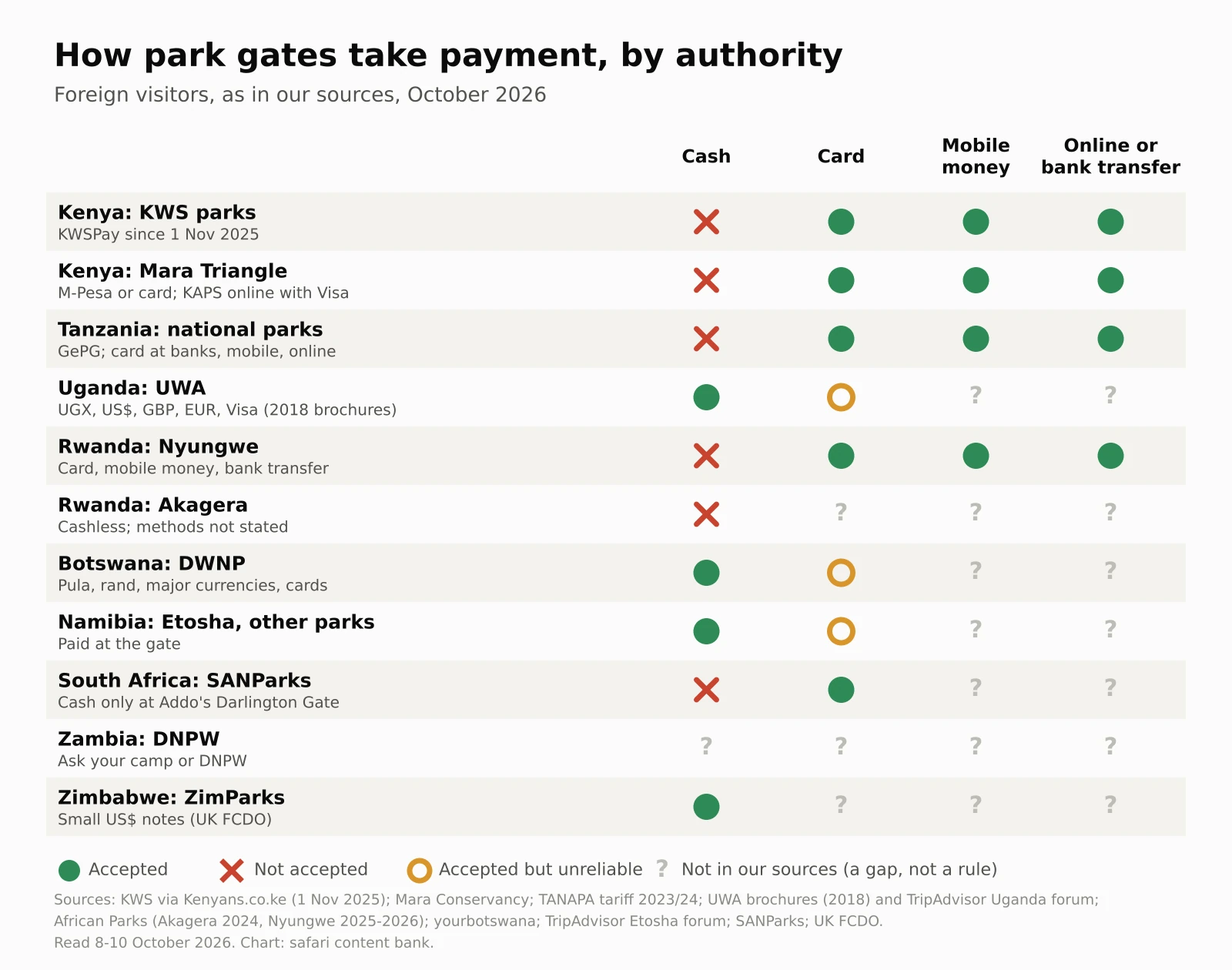 “Not in our sources” is a gap in what we hold, not a rule. Sources: KWS via Kenyans.co.ke; Mara Conservancy; TANAPA tariff 2023/24; UWA brochures (2018); African Parks (Akagera 2024, Nyungwe 2025–2026); yourbotswana; TripAdvisor forums; SANParks; UK FCDO. Chart: safari content bank.
- Gate rules differ inside one country. In Kenya the Mara Triangle and Ol Pejeta are cashless like KWS, but our sources do not confirm how the Narok-side Mara gates take payment, so ask your camp (Masai Mara park fees).
- On a guided safari your operator usually pays the park fees, travellers on the TripAdvisor Nairobi forum note (TripAdvisor); the gate rules matter most to self-drivers and day visitors.
US dollar notes: which ones are accepted
Bring US dollar notes from series 2009 or newer, in small denominations, clean and untorn. That is safari operators’ guidance in our sources; only Zimbabwe’s rule comes from a government.
- Series 2009 or newer: two safari operators’ tipping guides ask for notes from “Series 2009 or newer” (a camp operator’s guide, June 2026; a Tanzanian operator’s guide, 15 July 2026), and the first says older notes are often refused. Our packing list carries the same rule.
- Small denominations: US$1, 5, 10 and 20 bills, because camps cannot make change (a Tanzanian operator’s tipping guide).
- Zimbabwe, from the UK government: card withdrawals can fail for lack of cash, change is scarce, and torn or old notes are refused (UK FCDO, Zimbabwe safety and security).
- Rwanda: TripAdvisor Rwanda forum members in mid-2026 suggested US$100–200 in clean notes for tips, and one warned that paying in US dollars is officially restricted to licensed businesses (TripAdvisor, traveller reports). Pay everyday purchases in Rwandan francs or by card.
- Visa-on-arrival desks: Tanzania’s card machine is sometimes down, so carry clean US dollar notes (Tanzania visa); Zimbabwe’s visa is paid in small US dollar notes (Zimbabwe visa); for Zambia and the KAZA Univisa, carry US dollars in cash (Zambia visa).
We hold no official notice from any of the nine countries’ central banks or park authorities that sets a cut-off year for US dollar notes. If you want certainty, ask your camp or operator which series it accepts before you leave home.
Cards vs cash at park gates, country by country
East Africa’s big park systems and South Africa’s SANParks have gone cashless; Botswana, Namibia and Zimbabwe still need cash in hand. The rules below are copied from our park-fee pages.
Kenya: KWSPay, M-Pesa or card
- KWS parks have taken no cash since 1 November 2025. Fees are paid through KWSPay by M-Pesa, card or bank transfer, with dollar fees converted at a monthly rate “in addition to facilitation charges” (Kenyans.co.ke, 1 Nov 2025), so checkout can exceed the gazetted fee (Kenya park fees).
- The Mara Triangle takes no cash: M-Pesa or card at Oloololo Gate, Purungat Bridge or Serena airstrip, or KAPS online with Visa (Mara Conservancy). Ol Pejeta’s gates are cashless too (OPC Tariff Guide 2026, PDF).
- Carry a second card. A backpacker in August 2026 reported terminals rejecting cards at park entrances, and the Nairobi National Park eCitizen portal “had failed for almost the whole day” (TripAdvisor, traveller reports).
Tanzania: electronic payment only
- TANAPA fees are paid through GePG, “online through TANAPA online reservation, banks using electronic cards and mobile” (TANAPA Tariffs 2023/24, PDF, the last published tariff); there is no cash payment at the gate (Tanzania park fees).
- A self-drive visitor may not be able to pay alone: a traveller hiring a car and driver separately found the rental firm had to pay the Serengeti concession fee (TripAdvisor).
- Kenya’s M-Pesa does not work in Tanzania; buy a Tanzanian SIM (TripAdvisor, traveller reports).
Uganda: permits paid in full, cash as a backup
- UWA prices foreign visitors in US dollars and East African citizens in shillings (UWA tariff 2024–26, PDF). Since 1 March 2026 a gorilla permit is held only against full payment (UWA letter TDO 93/04; Uganda safari cost).
- UWA’s park brochures list Ugandan shillings, US dollars, pounds, euros and Visa as accepted (UWA Queen Elizabeth brochure, PDF); the brochures are 2018 editions, so confirm with UWA.
- Remote park offices may have no phone signal or reliable card payment, travellers on the TripAdvisor Uganda forum warned in September 2026 (TripAdvisor). Carry cash.
Rwanda: cashless parks, cards and mobile money
- Akagera and Nyungwe take no cash for park fees (Akagera price list 2024, PDF; Nyungwe pricing 2025–2026, PDF). Nyungwe lists card, mobile money or bank transfer; ask Akagera which methods it takes (Akagera; Nyungwe).
- Gorilla permits are booked through Irembo, RDB’s booking portal or a licensed operator (Visit Rwanda, as on our Rwanda safari cost page).
- Cards and MTN mobile money cover most spending: forum members in mid-2026 called Rwanda surprisingly cashless, with card readers even at small stalls; Visa is the safest card and American Express is poorly accepted (TripAdvisor, traveller reports; Rwanda safari questions).
Botswana: cash backup for DWNP gates
- Pula, rand, major currencies and cards are accepted, but cards are unreliable in remote areas, so carry cash (yourbotswana; Botswana park fees).
- Self-drivers pay every campsite first, then DWNP; day visitors pay at the gate (Chobe park fees).
- Little cash is needed on a fly-in safari: most costs are paid in advance (one Botswana camp company’s guest FAQ; Botswana safari questions); Ker & Downey Botswana’s own camps take Visa and Mastercard but not American Express (Ker & Downey FAQ).
Namibia: pay at the gate, carry cash
- Park fees are paid at the gate, and card facilities there are not dependable, travellers on the TripAdvisor Etosha forum report, so carry cash (Namibia park fees; Etosha park fees).
- The Namibian dollar is pegged 1:1 to the rand and both circulate in Namibia (one safari operator’s FAQ), so rand from a South African leg can be spent at the same value (Namibia safari cost).
- Fuel: most stations take Visa and Mastercard, but card machines fail in remote areas; one TripAdvisor poster found Halali’s pump in Etosha cash-only in October 2022 (Namibia safari questions; Namibia self-drive distances).
South Africa: cashless SANParks gates
- SANParks gates and most camps are cashless, so pay by card. In Addo only Darlington Gate takes cash (SANParks Addo).
- Sabi Sand runs the other way: its early or late movement fee of R150 is cash only (Sabi Sand access; South Africa safari questions).
Zambia: what we hold
- DNPW prints citizen park fees in kwacha and international rates in US dollars (a safari agent’s guide to DNPW fees, read 9 October 2026); camp and lodge rates are in US dollars (Zambia safari questions).
- How DNPW gates take payment is not in our checked sources; a booking site’s claim of cash-only gates is unverified, so we do not print it. Ask your camp or DNPW before a self-drive.
- The KAZA Univisa (US$50, Zambia and Zimbabwe) is paid in US dollar cash (Zambia safari questions; Zambia visa).
Zimbabwe: small, clean US dollar notes
- Parks, visas and activities are paid in US dollars; ZiG, introduced in April 2024, is for local use (Wild Zambezi; Zimbabwe safari questions).
- Cash limits: declare US$10,000 or more on entry; leaving with more than US$2,000 in cash is illegal (UK FCDO, Zimbabwe entry requirements).
- Foreign visitors have paid 15.5% VAT on tourism services since 1 January 2026 (Tourism Update, 6 Oct 2026, a single press source; Zimbabwe).
What each cost is priced in
Camps across East Africa, Botswana, Zambia and Zimbabwe price in US dollars; South Africa and Namibia price in their own currencies, which move together.
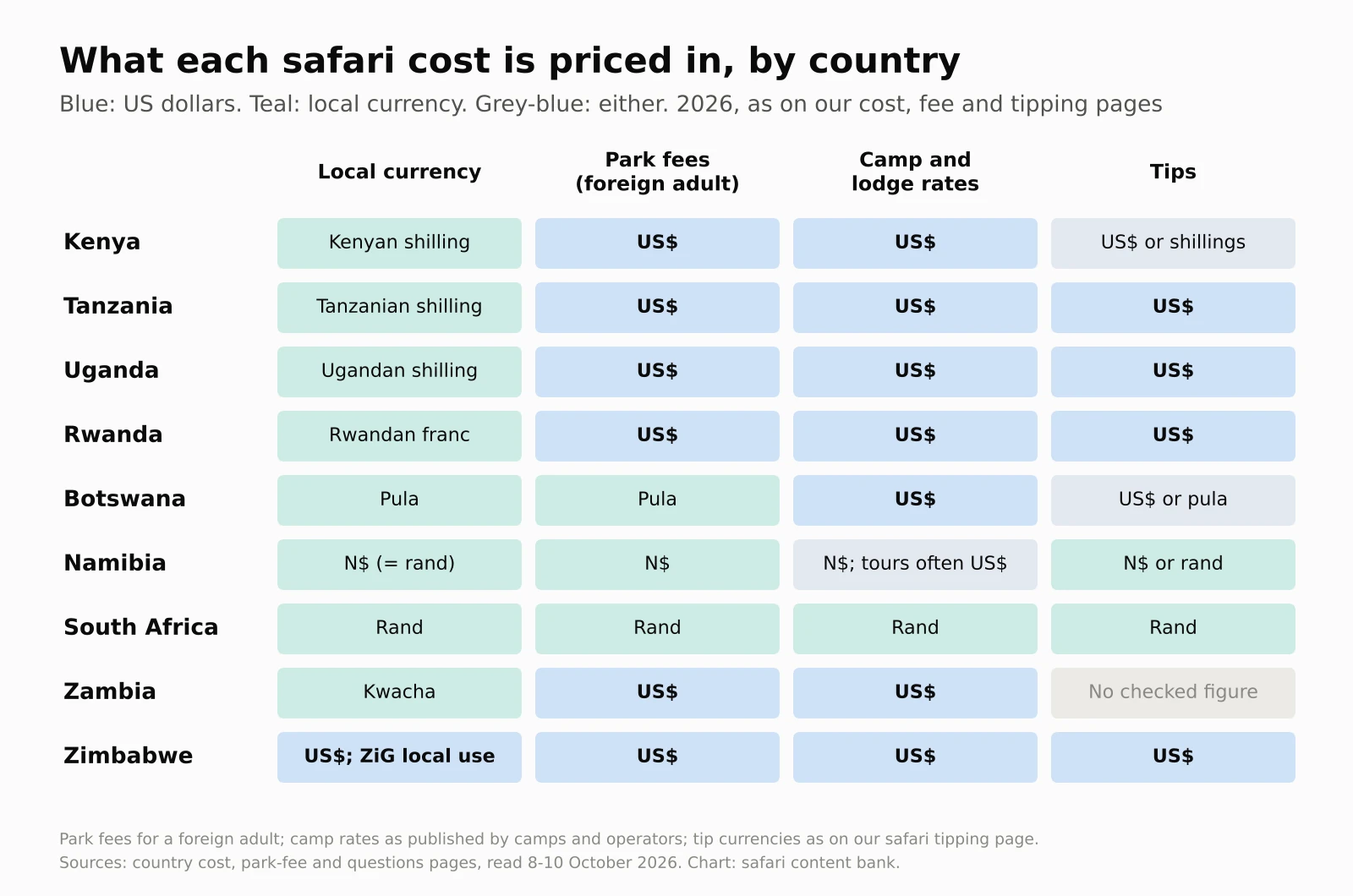 Tip currencies as on our safari tipping page; Zambia has no checked tipping figure. Park fees for a foreign adult. Sources: our country cost and park-fee pages, read 8–10 October 2026. Chart: safari content bank.
- We print no exchange rates: our sources hold no dated rate for most of these currencies, so we compare prices in their own currency (how to book a safari).
- A US dollar contract still moves with your own currency, and the balance, paid 45–60 days before arrival in the terms we hold, is where a swing bites. A tour operator in your own country can fix the price in your currency (same page).
ATMs and getting cash
Our sources hold few checked facts about ATMs; plan to arrive with the cash you need for the first days.
- Namibia: ATMs are in all towns and banks change money (one safari operator’s FAQ), and the same source suggests N$500–1,000 per person in cash for day-to-day buying (Namibia safari questions). In Windhoek, petty theft happens at car parks and ATMs (one safari operator’s safety guide).
- Zimbabwe: card withdrawals can fail for lack of cash (UK FCDO), so bring your US dollars with you.
- Kenya: a German forum member advised withdrawing the maximum, KSh 40,000, at a time because of the fixed fee per withdrawal, and not changing money at hotels (HolidayCheck, 2024, a traveller report). For M-Pesa, travellers report the Safaricom shop at Nairobi airport sets it up with your passport (Kenya safari questions).
- Tanzania: one operator’s published cost guide budgets US$300–500 per person in cash for a week’s safari (Tanzania: is it safe?).
- Uganda, Rwanda, Botswana, South Africa and Zambia: we hold no checked source on ATM locations, limits or fees. Ask your bank about fees abroad, and your camp or operator where the last ATM on your route is.
Cash for tips
Tips are discretionary, paid per guest at the end of each stay, and mostly in cash: US dollars in East Africa and Botswana, Namibian dollars or rand in Namibia, rand in South Africa. Amounts by country, porters and polers are on our safari tipping page; we do not repeat them here.
- Bring more small notes than you think: a tip goes to each guide, tracker and staff box at each camp, and camps cannot make change (a Tanzanian operator’s tipping guide).
- Some camps take tips by card: Ker & Downey Botswana takes them by card at departure (Ker & Downey FAQ).
- Zambia and Zimbabwe: we hold no checked tipping amounts; in Zimbabwe tips are paid in US dollars like everything else (Zimbabwe safari questions).
Which payment to plan for
Match the cash you carry to how you travel: fly-in and guided trips need little; self-drive in the south needs the most.
| If you are… | Plan for | Why |
|---|---|---|
| On a guided safari in Kenya or Tanzania | A card, small US$ notes for tips, a little local currency | Gates are cashless and the operator usually pays them |
| Self-driving in Kenya | Two cards and M-Pesa | KWSPay only; terminals and the portal sometimes fail |
| Self-driving in Namibia | N$ or rand in cash, plus a card | Gate card facilities and remote fuel-pump machines are unreliable |
| Self-driving in Botswana | Pula or rand in cash, plus a card | DWNP takes cash; cards are unreliable in remote areas |
| Self-driving in Kruger or Addo | A card; a little rand | SANParks gates are cashless; Addo’s Darlington Gate takes cash |
| Gorilla trekking in Uganda or Rwanda | Permit paid in full in advance; US$ notes for porters and tips | Uganda holds permits only against full payment; Rwanda’s parks are cashless |
| Visiting Victoria Falls or Hwange | Small, clean US$ notes, newer series | Zimbabwe runs on US dollars; torn or old notes are refused |
Rules as on our park-fee, cost and visa pages, checked 8–10 October 2026.
Common mistakes about money on safari
| What you’ll often read | What is correct |
|---|---|
| “Bring US dollars in cash for the park gate” | KWS parks, Tanzania’s national parks, Akagera, Nyungwe and SANParks take no cash. |
| “Any US dollar note will do” | Operators ask for series 2009 or newer, in small denominations; in Zimbabwe torn or old notes are refused (UK FCDO). |
| “Paying by card costs the printed fee” | KWSPay adds facilitation charges and converts at a monthly rate; Tanzanian camp card machines add 3–5% (traveller reports). |
| “M-Pesa works across East Africa” | Kenya’s M-Pesa does not work in Tanzania (traveller reports). |
| “Zimbabwe uses ZiG now, so bring cards” | Visitors pay in US dollars; ZiG is for local use. |
| “Namibian gates take cards like the shops” | Gate card facilities are not dependable; carry N$ or rand. |
| “Rwanda runs on US dollars” | Use Rwandan francs, card or mobile money day to day; keep dollars for tips. |
| “You can pay a Uganda gorilla permit later” | Since 1 March 2026 a permit is held only against full payment (UWA). |
Frequently asked questions
Which currency should I take on an African safari? A Visa or Mastercard plus US dollar notes, series 2009 or newer, for East Africa, Zambia and Zimbabwe. In Namibia and South Africa, use Namibian dollars or rand. Botswana’s park fees are in pula, though its camps price in US dollars.
Can I pay park fees in cash at the gate? Not at Kenya’s KWS parks, Ol Pejeta or the Mara Triangle, Tanzania’s national parks, Akagera or Nyungwe, or SANParks parks (except Addo’s Darlington Gate). Botswana’s DWNP takes cash, Namibia’s gates are best paid in cash, and Zimbabwe’s take US dollar notes.
Why are old US dollar notes refused? Our sources do not say why. Safari operators ask for notes from series 2009 or newer and say older ones are often refused; the UK FCDO says torn or old notes are refused in Zimbabwe. Bring clean, untorn, recent notes.
Do I need US dollars in Zimbabwe? Yes. Parks, visas and activities are paid in US dollars, and ZiG is for local use. Bring small notes: change is scarce, card withdrawals can fail, and leaving with more than US$2,000 in cash is illegal (UK FCDO).
Can I use South African rand in Namibia? Yes. The Namibian dollar is pegged 1:1 to the rand and both circulate in Namibia, so a price in rand is the same number in Namibian dollars.
Is Rwanda cashless? Mostly: Akagera and Nyungwe take no cash for park fees, and travellers report card readers even at small stalls and MTN mobile money as the local standard. Bring US dollar notes for tips; forum members suggested US$100–200.
Can I pay by card on safari? At most lodges and cashless park gates, yes, but machines fail where the network is down, and Tanzanian camp card machines add about 3–5% (traveller reports). American Express is poorly accepted in Rwanda (traveller reports) and not taken at Ker & Downey’s Botswana camps.
How much cash do I need for tips? Enough for every guide, tracker and staff box at each camp, in small notes. Amounts by country are on our safari tipping page; for a couple on 7 nights in Kenya, Tanzania or Botswana they come to US$140–560 (our sum there).
Sources
- Kenya: Kenya Wildlife Service fees via Kenyans.co.ke, 1 Nov 2025; Mara Conservancy, conservation fees; Ol Pejeta Tariff Guide 2026 (PDF); as on our Kenya park fees page, read 9 Oct 2026
- Tanzania: TANAPA Tariffs 2023/24 (PDF), the last published tariff, and NCAA tariffs, read 9 Oct 2026
- Uganda: Uganda Wildlife Authority, Conservation Tariff July 2024–June 2026 (PDF), letter TDO 93/04 (PDF) of 26 Feb 2026, and Queen Elizabeth brochure (PDF, 2018), read 8–9 Oct 2026
- Rwanda: African Parks, Akagera price list 2024 (PDF) and Nyungwe pricing 2025–2026 (PDF); Visit Rwanda (Rwanda Development Board), as on our Rwanda safari cost page; read 8–9 Oct 2026
- Botswana: yourbotswana, booking campsites; Ker & Downey Botswana FAQ; read 9–10 Oct 2026
- South Africa: SANParks, Addo; Sabi Sand, access; read 9 Oct 2026
- Zambia: a safari agent’s guide to DNPW fees, read 9 Oct 2026; Tourism Update (visa fees)
- Zimbabwe: UK FCDO, safety and security and entry requirements (updated July–October 2026); Wild Zambezi, money; Tourism Update, 6 Oct 2026; read 9–10 Oct 2026
- Traveller reports (forum posts, not fact): TripAdvisor threads on Nairobi National Park payment, Serengeti concession fees, credit cards in the Serengeti, M-Pesa in Kenya and Tanzania, Uganda primate itinerary, cash in Rwanda and the Etosha forum; HolidayCheck Kenya forum (2024); read June–October 2026
- Operators (names and links kept in our editor notes): a camp operator’s tipping guide (June 2026); a Tanzanian operator’s tipping guide (15 Jul 2026) and cost guide; a Namibian safari operator’s money FAQ and another’s safety guide
More on money: safari tipping, how to book and pay for a safari and safari packing list.
Payment rules checked 8–10 October 2026. We will update this page when Zambia’s DNPW, Akagera or UWA publish their payment methods, and when TANAPA publishes a tariff after 2023/24.