 Experience

Last verified · Next check due
On this page
- Kenya vs Zambia at a glance (2026)
- Which is cheaper, Kenya or Zambia?
- Park fees: Narok County and KWS vs DNPW
- Walking safaris and night drives
- Wildlife: migration herds or leopards on foot
- When to go: Kenya and Zambia month by month
- Getting there and getting around
- Entry costs, health and children
- Can you combine Kenya and Zambia?
- Which should you choose?
- Common mistakes in Kenya vs Zambia comparisons
- Frequently asked questions
- Sources
Short answer: Choose Kenya for the wildebeest herds, usually in the Masai Mara from July to October; choose Zambia for walking safaris and night drives inside South Luangwa. The Mara reserve charges US$100 per adult per day from January to June and US$200 from July to December; South Luangwa’s gate fee is US$25 a day (DNPW 2025 schedule, the last published), but camps bill US$90–110 a night. Kenya’s eTA costs US$30; UK and US passports need no Zambian visa.
Key facts
- At the budget end the two cost about the same once Kenya’s reserve fee is added. A 3-day budget Mara group safari works out at about US$157–160 a day with the January–June reserve fee and US$257–260 with the July–December fee (our sums); Zambia’s group camping trips cost US$234–331 a day, inclusions not itemised.
- In August, three nights at a South Luangwa bush camp cost about the same as three nights at Governors’ Camp in the Mara reserve: US$4,273 against US$4,154 per person, with fees and the return flight from the capital (our sums from 2026 rate sheets). Mfuwe Lodge, by South Luangwa’s main gate, costs US$2,896 for the same three nights in July–September.
- Kenya charges at the gate; Zambia charges through the camp. The Mara reserve’s US$200 a day from July to December is eight times South Luangwa’s US$25 gate fee, but Zambian camps bill US$90–110 per person per night in fees and levies, against US$130 a night in the Mara conservancies.
- The Masai Mara reserve sells no walks and no night drives; South Luangwa sells both inside the national park. Every South Luangwa walk goes with a licensed guide and an armed scout, from age 12. In Kenya, walks and night drives are sold on private land: the Mara conservancies and Laikipia.
- Zambia’s two Category A parks publish the best leopard and lion odds in our sources; no Kenyan park publishes one. 83% of one operator’s South Luangwa groups and 88% in Lower Zambezi saw a leopard.
- A UK visitor pays US$30 for Kenya’s eTA, plus a government health policy of up to US$44, required for arrivals since 5 October 2026, and nothing to enter Zambia. Kenya to Zambia needs a yellow fever certificate: Kenya is a risk country.
Kenya vs Zambia at a glance (2026)
Kenya is a road-based safari built around the Masai Mara, its conservancies and the migration months; Zambia is a country of seasonal bush camps in river valleys, where walking and night drives happen inside the national parks.
| Kenya | Zambia | Source | |
|---|---|---|---|
| Headline areas | Maasai Mara National Reserve and its conservancies; Amboseli; Samburu; Tsavo; Laikipia | South Luangwa, Lower Zambezi and Kafue National Parks | Kenya hub; Zambia safari questions |
| Getting to the flagship park | Operator’s 4x4 with a driver-guide by road from Nairobi (5.5–6 h), or light aircraft from Wilson airport | Proflight from Lusaka to Mfuwe (about 70 min), or 9–10 h by road; no scheduled flights to Kafue | Kenya safari cost; Zambia safari cost |
| Cheapest guided trip, per person per day | US$57–60 before fees (3-day Mara group safari); about US$157–260 with the Mara fee (our sums) | US$234–331, group camping; inclusions not itemised | Operators’ published prices |
| Flagship park fee, adult | Mara reserve US$100 per day (1 Jan–30 Jun); US$200 (1 Jul–31 Dec) | South Luangwa US$25 a day; camps bill US$90–110 a night in fees and levies | Narok County FY2025/26 (last published); DNPW 2025 schedule (last published) |
| Walking and night drives | Not sold in the Mara reserve; sold in the conservancies and on Laikipia ranches | Both allowed inside South Luangwa | Walking safaris |
| Main wildlife draw | Wildebeest herds July–October; resident big cats | Leopard and lion: 83% and 86% of one operator’s South Luangwa groups saw them; walking | Migration and leopard pages |
| Best months | July–October for the herds; game resident all year | June–October; bush camps open only late May to mid-November | Best time for a safari |
| Entry, UK passport | eTA US$30 + government health policy of up to US$44 (eCitizen) | No visa; 90 days in any 12 months | Kenya eTA; UK FCDO |
| Malaria | Risk all year in the entire country (WHO) | US State Department recommends tablets for all travellers; no official areas or months in our sources | Safari malaria risk |
Fees and prices as on our Kenya safari cost, Masai Mara safari cost, Zambia safari cost and South Luangwa safari cost pages, checked 8–10 October 2026. Non-resident (Kenya) or international (Zambia) adult.
Which is cheaper, Kenya or Zambia?
At the budget end and at the top the two cost about the same once fees are counted; Kenya is cheaper from January to June, when the Mara fee halves, and in peak season Mfuwe Lodge costs less than a camp inside the Mara reserve. Kenya’s extra is the reserve fee of US$100–200 a day or the conservancy fee of US$130 a night; Zambia’s is a fees-and-levies line of US$90–110 a night and a longer journey to the park.
| What you’re comparing, per person | Kenya | Zambia | Source (read 8–10 Oct 2026) |
|---|---|---|---|
| Cheapest guided trip, per day | US$57–60 before fees (3-day Mara group safari, US$170–180, “park fees NOT included”); about US$157–160 (Jan–Jun) or US$257–260 (Jul–Dec) with the reserve fee, our sums | US$234–331, group camping trips; inclusions not itemised | Operators’ published prices |
| Private short safari, per day | From about US$290, 3-day private Mara safari for two, reserve fee included | US$263–499, 4-day private trips (two listings) | Operators’ published prices |
| Lodge inside a national park | Ol Tukai Lodge, Amboseli: US$190–325 a night, full board; vehicle and the US$90 park fee extra | Mfuwe Lodge, South Luangwa: US$655–841 a night with US$90 fees and levies, two activities a day (our sums) | Ol Tukai; Bushcamp Company 2026 (PDF) |
| Classic camp, per night with fees | Governors’ Camp, in the Mara reserve: US$603–1,248, game drives included (our sums) | South Luangwa bush camps: US$705–1,300, walks and drives included (our sums) | Masai Mara safari cost; South Luangwa safari cost |
| Walks in the rate, per night with fees | Kicheche Mara North: US$755–1,125 (US$625–995 + US$130 conservancy fee) | Bushcamp Company bushcamps US$841–1,061; Time + Tide Mchenja and Kakuli US$980–1,300 | Kicheche 2026 (PDF); Time + Tide |
| Top of our sources, per night with fees | Wilderness Mara: US$1,324–2,028, “Conservation levy and government taxes are included” | Chinzombo: US$1,430–1,940 (US$1,330–1,840 + US$100 fees and levies; our sums) | Wilderness; Time + Tide |
| Flight to the flagship park | Wilson → Masai Mara US$200 + US$20 fuel surcharge one way; US$410 return | Proflight Lusaka → Mfuwe, lowest return fare shown US$373 (9 Oct 2026) | Mombasa Air Safari 2026; Proflight |
Per person sharing, low to peak season, without international flights. Tour operators’ packages are shown as unnamed ranges; camp rates as on our cost pages. “With fees” adds that night’s reserve, conservancy or camp levy line for one adult (our sums). Compare quotes line by line.
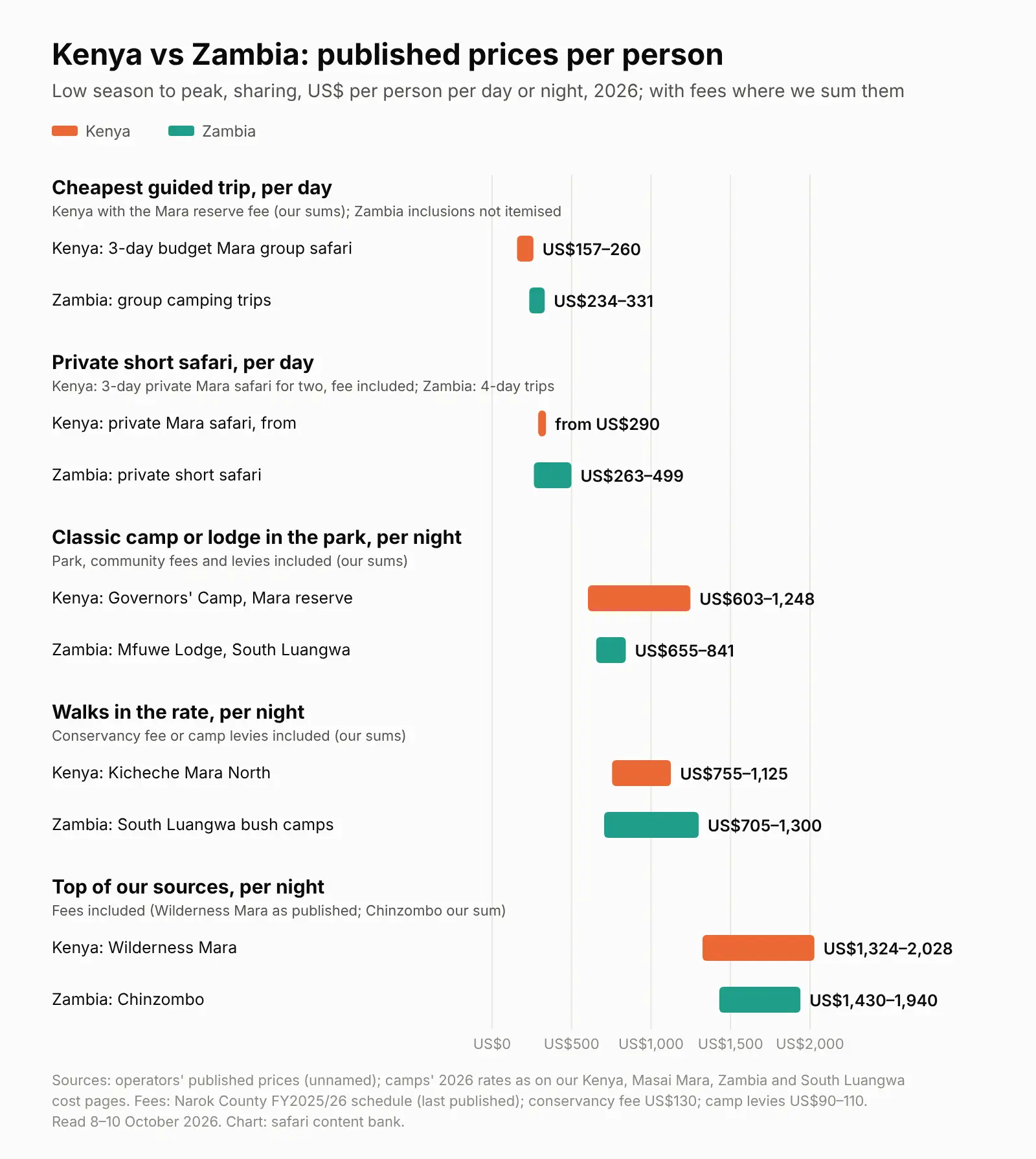 Published 2026 rates per person, sharing, read 8–10 October 2026, with fees as summed on our cost pages. Operators not named. Sources: operators’ published prices; camps’ rates as on our Kenya, Masai Mara, Zambia and South Luangwa cost pages. Chart: safari content bank.
Three nights with the flight from the capital
Three nights with return flights cost one adult about the same at a Mara reserve camp and a South Luangwa bush camp in peak season, and less at Mfuwe Lodge. The table adds each camp’s rate, its fees and the cheapest published return flight (our sums).
| 3 nights, one adult sharing (our sums) | Low season | Peak | What is added |
|---|---|---|---|
| Governors’ Camp, Masai Mara reserve | US$2,729 (February) | US$4,154 (August) | 3 reserve days + 3 × US$50 community fee + Wilson–Mara return US$410 |
| Mfuwe Lodge, South Luangwa | US$2,338 (Jan–May, Nov–Dec) | US$2,896 (Jul–Sep) | 3 × US$90 fees and levies + Lusaka–Mfuwe return US$373 |
| Mchenja or Kakuli bush camp, South Luangwa | US$3,313 (20 May–30 Jun, 1–15 Nov) | US$4,273 (Jul–Oct) | 3 × US$100 fees and levies + US$373 |
Governors’ Camp as on our Masai Mara safari cost page (February assumes the January–March 2026 rate carries over; a game drive on the departure day adds a fourth reserve ticket). South Luangwa: 3 × US$565 or US$751 (Mfuwe Lodge) and 3 × US$880 or US$1,200 (Mchenja, Kakuli), plus fees and the lowest Proflight return fare shown on 9 October 2026. Mchenja and Kakuli are closed from mid-November to 20 May. Tips and the Kenyan eTA not included.
- The Mara’s fee is per calendar day; Zambia’s levy is per night. A Mara ticket is valid for 12 hours, 06:00–18:00, and does not carry overnight, whether you sleep inside or outside the reserve (Kenya safari cost).
- A budget Mara price can be smaller than the fee. One operator’s 3-day group safari costs US$170–180 per person and says “park fees NOT included”; from July to December the reserve charges US$200 per adult for each day in it.
- Zambia’s levy line is about four times the gate fee. It bundles the US$25 DNPW fee with bed levies, community levies and conservation funds such as the Luangwa Conservation and Community Fund (LCCF) (Zambia safari cost).
Park fees: Narok County and KWS vs DNPW
The Masai Mara reserve charges US$100 per non-resident adult per day from January to June and US$200 from July to December; South Luangwa and Lower Zambezi charge US$25 per international adult per day under DNPW’s 2025 schedule, the last published. Neither authority has published a newer schedule in our sources.
| Kenya (Narok County, KWS, Samburu County, conservancies) | Zambia (DNPW) | |
|---|---|---|
| Flagship area, adult | Masai Mara reserve US$100 (1 Jan–30 Jun), US$200 (1 Jul–31 Dec) per day; 12-hour ticket, 06:00–18:00 | South Luangwa, Lower Zambezi US$25 per day; a park day runs 06:00–18:00 |
| Other parks, adult | Amboseli, Lake Nakuru US$90; Nairobi, Tsavo US$80; Meru, Aberdare US$70 per 24 h (KWS, no seasons since 1 October 2025); Samburu US$85 (the county states no period) | Kafue, North Luangwa US$20 a day |
| Private land and levies | Mara conservancies US$130 per adult per night or day (2026 rate sheets); Ol Pejeta US$110 a day, VAT included | Camps bill US$90–110 per person per night in fees and levies, which include the gate fee |
| Children | Mara: 9–17 US$50, under 9 free; KWS: child under 18, 5 and under free, US$40–45 | 5–13 half price; under 5 free |
| Self-drivers | Private vehicles banned from game drives in the Mara reserve since 3 June 2024; KWS parks KSh 600 a day for a vehicle with under 6 seats | US$30 a day in South Luangwa and Lower Zambezi; foreign-registered car US$15 a day |
| Activities | Night drive in selected KWS parks US$50 per person per trip, plus the park fee | Boating US$20, canoeing US$20 a day; no walking or night-drive fee in the 2025 schedule |
| Last change | Mara: Narok County FY2025/26, the last published, expired 30 June 2026; no 2026/27 schedule as of 9 October 2026. KWS: Legal Notice 160 of 2025, in force 1 October 2025 | DNPW 2025 schedule, page last modified 8 May 2025, still shown 9 October 2026; no 2026 DNPW fee document found |
| How you pay | Cashless: KWSPay (M-Pesa, card, bank transfer); Mara Triangle by M-Pesa or card | Usually inside the camp’s levy line |
Sources: Narok County fee schedule FY2025/26 (PDF), the last published, with The Kenya Times, 6 Aug 2026 (secondary) for July–December 2026; Mara Conservancy; KWS LN 160/2025 (PDF); Samburu County Finance Act 2025; Kicheche 2026 (PDF); Ol Pejeta Tariff Guide 2026 (PDF); a safari agent’s guide to DNPW fees (DNPW 2025 schedule); camp levies from the Zambia safari cost page. Checked 9–10 October 2026.
- Sleeping outside the Mara reserve does not save the fee. The Mara Conservancy’s table is headed “Non-Residents (Accommodated Inside & Outside the Park) – Per Day”. From July to December a conservancy night (US$130) costs less in fees than a reserve day (US$200); side by side on Mara reserve vs conservancies.
- Three days in the flagship park cost one adult US$300–600 in the Mara reserve and US$75 at South Luangwa’s gate, or US$270–330 through a camp’s fees-and-levies line (our sums).
- Flatdogs, outside South Luangwa’s gate, bills the US$25 park fee per day and a US$15 LCCF levy per night separately (Flatdogs rates, 2026).
The official fee lines, with the date each took effect and the source:
| Fee | Amount | In force from | Source |
|---|---|---|---|
| Maasai Mara National Reserve, non-resident adult, per day (12-hour ticket, 06:00–18:00), 1 Jan–30 Jun | USD 100 | Since 1 Jan 2024; Narok County FY2025/26 schedule, the last published | Narok County fee schedule FY2025/26 |
| Maasai Mara National Reserve, non-resident adult, per day (12-hour ticket, 06:00–18:00), 1 Jul–31 Dec | USD 200 | Since 1 Jul 2024; Narok County FY2025/26 schedule, the last published, expired 30 Jun 2026 (no 2026/27 schedule as of 9 Oct 2026); The Kenya Times (6 Aug 2026, secondary) reports US$200 still applies for Jul–Dec 2026 | Narok County fee schedule FY2025/26 |
| Maasai Mara National Reserve, non-resident child 9–17 or student, per day (under 9 free) | USD 50, all year | Narok County FY2025/26 schedule, the last published | Narok County fee schedule FY2025/26 |
| Amboseli and Lake Nakuru National Parks (KWS), non-resident adult, per 24 hours | USD 90 (child under 18, 5 and under free, USD 45) | Legal Notice 160 of 2025, gazetted 22 Sep 2025, which states no start date; in force 1 Oct 2025 per the KWS press release of 29 Sep 2025 | KWS Fees Regulations 2025 (LN 160/2025) |
| Nairobi, Tsavo East and Tsavo West National Parks (KWS), non-resident adult, per 24 hours | USD 80 (child under 18, 5 and under free, USD 40) | Legal Notice 160 of 2025, gazetted 22 Sep 2025, which states no start date; in force 1 Oct 2025 per the KWS press release of 29 Sep 2025 | KWS Fees Regulations 2025 (LN 160/2025) |
| Meru, Kora and Aberdare National Parks (KWS), non-resident adult, per 24 hours | USD 70 (child under 18, 5 and under free, USD 40) | Legal Notice 160 of 2025, gazetted 22 Sep 2025, which states no start date; in force 1 Oct 2025 per the KWS press release of 29 Sep 2025 | KWS Fees Regulations 2025 (LN 160/2025) |
| Samburu National Reserve (Samburu County), non-resident adult, per day (basis not stated by the county) | USD 85 (child USD 50) | Samburu County Finance Act 2025, published 22 Dec 2025 | Samburu County Finance Act 2025 |
| Ol Pejeta Conservancy, non-resident adult, per day (24 hours for overnight guests) | USD 110, VAT included (child 3–11 USD 55) | 2026 tariff | Ol Pejeta Conservancy Tariff Guide 2026 |
| South Luangwa and Lower Zambezi National Parks (DNPW Category A), international adult, entry per day (06:00–18:00) | USD 25 (SADC and resident USD 20; Zambian citizen ZMW 55.60); child 5–13 half price, under 5 free | DNPW 2025 schedule ("official 2025 rates"), the last published; page last modified 8 May 2025, still shown 9 Oct 2026 | DNPW 2025 fee schedule, as shown on a Zambia travel portal |
| Kafue and North Luangwa National Parks, international adult, entry per day | USD 20 (SADC and resident USD 15; Zambian citizen ZMW 44.80) | DNPW 2025 schedule, the last published; page last modified 8 May 2025, still shown 9 Oct 2026 | DNPW 2025 fee schedule, as shown on a Zambia travel portal |
| South Luangwa and Lower Zambezi, self-driver entry per person per day (resident and non-resident) | USD 30 | DNPW 2025 schedule, the last published; page last modified 8 May 2025, still shown 9 Oct 2026 | DNPW 2025 fee schedule, as shown on a Zambia travel portal |
| All national parks, foreign-registered vehicle, per day | USD 15 under 3 tonnes; USD 30 over 3 tonnes | DNPW 2025 schedule, the last published; page last modified 8 May 2025, still shown 9 Oct 2026 | DNPW 2025 fee schedule, as shown on a Zambia travel portal |
| All national parks, non-resident activity fees, per person per day | Boating USD 20; canoeing or rafting USD 20; angling USD 30; camping USD 5 per person | DNPW 2025 schedule, the last published; page last modified 8 May 2025, still shown 9 Oct 2026 | DNPW 2025 fee schedule, as shown on a Zambia travel portal |
Walking safaris and night drives
South Luangwa sells walks and night drives inside the national park; in Kenya the Masai Mara reserve sells neither, and both are sold on private land. Walking is the main activity at South Luangwa’s bush camps; in Kenya it is an add-on at conservancy and ranch camps.
| Kenya | Zambia | |
|---|---|---|
| Walking in the flagship park | No: the Masai Mara reserve sells no walks | Yes: every South Luangwa walk has a licensed guide and an armed DNPW scout |
| Where you can walk | Mara conservancies (Mara North, Olare Motorogi, Naboisho), with the camp’s guides; Laikipia ranches; Ol Pejeta guided bush walk US$70 per adult, VAT included | South Luangwa bush camps; North Luangwa, where Mwaleshi camp is walking-only; three of Remote Africa’s five Luangwa camps were walking-only in 2024 |
| Fee for the walk | In the camp rate in the Mara conservancies, plus the US$130 conservancy fee a night | No walking fee in DNPW’s 2025 schedule; walks are one of the two daily activities in bushcamp rates |
| Minimum age | No published minimum for Mara conservancy walks in our sources | 12 |
| Guides | KPSGA bronze, silver and gold grades (one tour operator’s guide-qualifications article) | Licensed guide plus armed scout |
| Night drives | Not sold in the Mara reserve; at some conservancy camps; selected KWS parks US$50 per person per trip, plus the park fee; Ol Pejeta US$70 per adult | Allowed inside South Luangwa: afternoon drives continue after dark with a spotlight; Kafue for overnight guests, at most seven to a vehicle; Lower Zambezi in the dry season |
| Walking camp, per night with fees | Kicheche Mara North US$755–1,125 (our sums) | Bushcamp Company bushcamps US$841–1,061; Time + Tide Mchenja and Kakuli US$980–1,300 (our sums) |
| Season | Mara conservancy camps: many close in April–May | June–October; bush camps open late May to mid-November; trails camps 25 May or 1 June–31 October |
Sources: Kicheche 2026 (PDF); Ol Pejeta Tariff Guide 2026 (PDF); KWS LN 160/2025 (PDF); Fortune, April/May 2024; Remote Africa; Bushcamp Company 2026 (PDF); Time + Tide; Visit Kafue; one safari operator’s South Luangwa, North Luangwa and Lower Zambezi guides and one tour operator’s guide-qualifications article (names and links kept in our editor notes); as on our walking safari and walking safari cost pages. Read 8–10 October 2026.
- South Luangwa is where the commercial walking safari began. Norman Carr opened Zambia’s first safari camp there in 1950 and promoted walking as an alternative to hunting (walking safaris).
- You do not have to walk in South Luangwa. On the TripAdvisor Zambia forum in 2026, replies said only a minority of guests walk and put the share at 10–20% (Zambia safari questions, traveller reports).
- In Kenya, walking is a Laikipia speciality. Karisia Walking Safaris in Laikipia is a 2026-season winner of The Safari Awards (The Safari Awards).
- Walking costs across Africa, including walking camps in Zambia, Zimbabwe and the Mara at US$654–1,300 a night with fees (2026), are on walking safari cost.
Wildlife: migration herds or leopards on foot
Kenya has the wildebeest herds from July to October, more rhino and resident big cats in the Mara; Zambia’s two Category A parks publish the best leopard and lion odds in our sources.
| Kenya | Zambia | Source | |
|---|---|---|---|
| Big herd movement | Wildebeest in the Masai Mara about July–October; crossings busiest August–September | Liuwa Plain wildebeest, “over 47,000”, gathering late October–December | Mara Conservancy; African Parks, Liuwa Plain |
| Leopard | No published sighting rate in our sources | 83% South Luangwa, 88% Lower Zambezi, 61% Kafue (one operator’s traveller groups) | Where to see leopards |
| Lion | Mara reserve 21.5 lions per 100 km² (management plan); no published sighting rate | 86% South Luangwa, 96% Lower Zambezi, 83% Kafue (same operator) | GMME plan 2023–2032 (PDF); Zambia pages |
| Wild dog | Western Laikipia ranches described as wild dog country (one operator); no Kenyan sighting rate or count | 45% of the same operator’s South Luangwa groups and 46% in Lower Zambezi saw them | Where to see wild dogs |
| Elephant | Amboseli: 2,065 at the end of 2025 (Amboseli Trust for Elephants) | 99% of the same operator’s South Luangwa groups saw elephant | Born Free, 23 May 2026; South Luangwa |
| Giraffe | Reticulated giraffe: 20,746 of the world’s 20,901 live in Kenya | Luangwa (Thornicroft’s) giraffe: about 764, all in Zambia | Giraffe Conservation Foundation, as on our Samburu and South Luangwa pages |
| Rhino in the country (end of 2024) | 2,102 (1,059 black, 1,043 white) | 114 | IUCN SSC African Rhino Specialist Group report to CITES, 2025 |
Sighting shares are one safari operator’s traveller surveys, per trip, not per drive and not population data (name and links kept in our editor notes), read 8 October 2026. No comparable sighting dataset for Kenya is in our sources. We do not publish where rhino are found.
- Zambia’s rates come from one operator, so they compare park with park, not country with country. The Mara, Amboseli and Samburu publish no sighting rates in our sources.
- The Luangwa has its own forms: Thornicroft’s giraffe, Cookson’s wildebeest and Crawshay’s zebra (South Luangwa). Kenya’s northern reserves have the reticulated giraffe (Samburu).
- Crowding is a Mara complaint. The reserve allows five vehicles at a sighting, with others waiting 100 m away (Narok County’s management plan), yet reviews on a safari booking site describe 20 to 40 vehicles at one sighting (traveller reports). Mara visitor numbers fell from 420,000 in 2023 to 213,000 in 2025 (Kenya Economic Survey 2026, via Business Daily). South Luangwa’s remote sectors are nearly vehicle-free, posters on the TripAdvisor Zambia forum said in 2026 (traveller reports).
- Tsavo has big tuskers: about 12 “super tuskers”, bulls with tusks over 45 kg each, are monitored in the Tsavo Conservation Area (Tsavo).
When to go: Kenya and Zambia month by month
July to October is the main season in both countries. Outside it the calendars split: the Mara’s camps stay open from November to March, when most of Zambia’s bush camps are shut, and the Mara reserve fee halves to US$100 from January to June.
| Months | Kenya (Masai Mara) | Zambia (South Luangwa, Lower Zambezi, Kafue) |
|---|---|---|
| January–March | Between the short and the long rains (Mara 95–145 mm a month); Mara fee US$100; the resident Loita herd calves in Ol Kinyei, February–March | Emerald (rainy) season; most bush camps closed and walking impractical; Chinzombo US$1,330 a night |
| April–May | Long rains (April 210 mm in the Mara); lowest camp rates (Governors’ Camp US$453), and many conservancy camps close | Lower Zambezi camps open about April; South Luangwa’s bush camps open between 20 May and 1 June |
| June | After the long rains (Mara 95 mm); herds usually still in Tanzania; Mara fee US$100 to 30 June | Every camp open; ideal walking, nights about 10°C; Busanga Plains (Kafue) camps open |
| July–October | Herds in the Mara; crossings busiest August–September; Mara fee US$200; top camp rates (Governors’ US$998) | Peak camp rates from 1 July (Chinzombo US$1,840); September has the best game; October is the hottest month, above 40°C in the valleys; trails and Busanga camps close 31 October |
| November–December | Short rains (Mara 155 mm in November); herds back in Tanzania; Mara fee still US$200 | Seasonal camps close mid-November (Time + Tide 15 November, Nsefu 20 November); rains begin |
Typical year, not a forecast. Kenya: Mara Conservancy; a camp operator’s migration guide; Climates to Travel (aggregator); a Kenyan camp operator’s Loita migration page; Governors’ Camp 2026 rate sheet. Zambia: Time + Tide; Robin Pope Safaris, Nsefu Camp; one safari operator’s Zambia weather, South Luangwa, Lower Zambezi and Kafue guides; Visit Kafue. Read 8–10 October 2026.
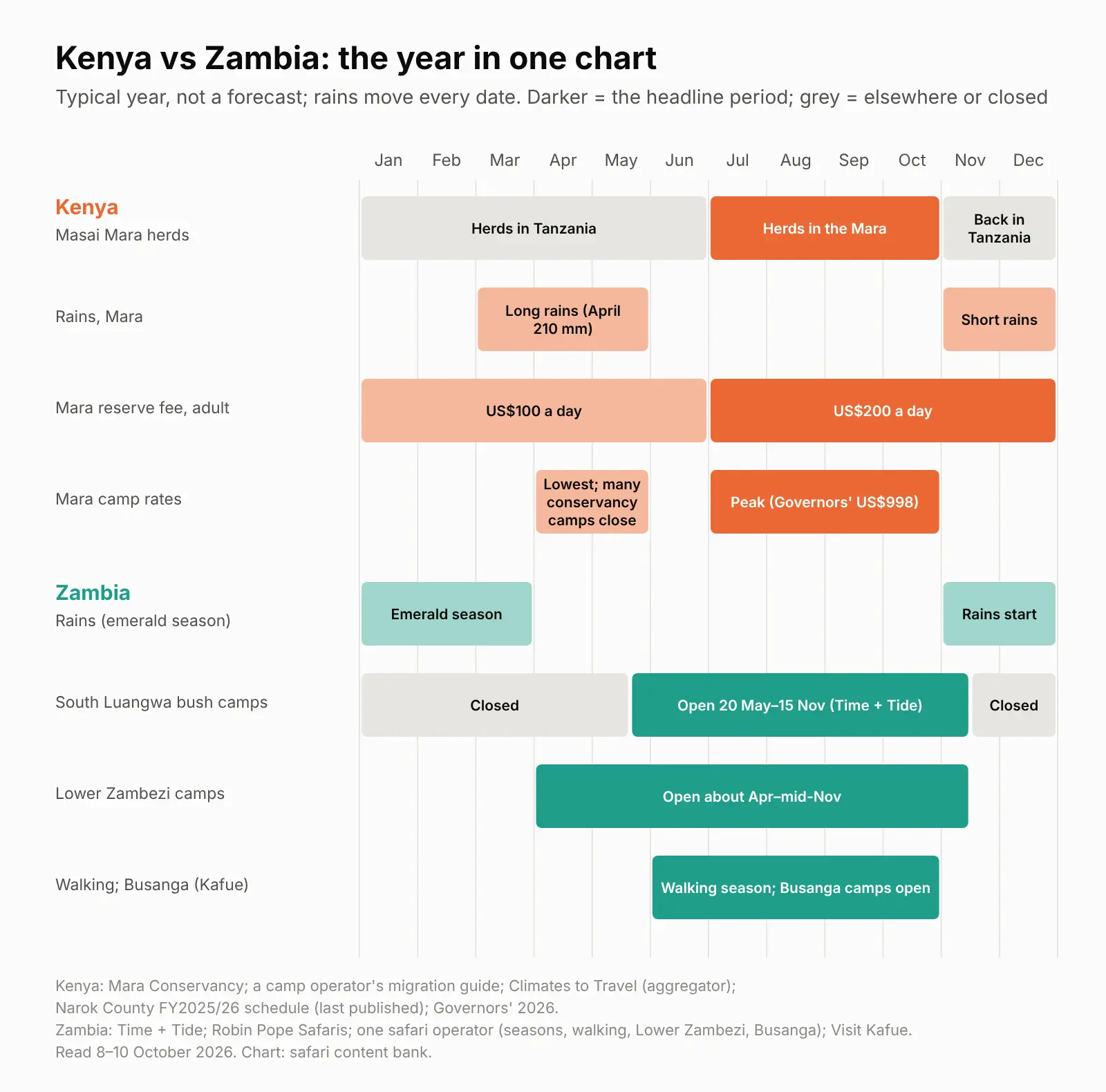 Typical year. Sources: Mara Conservancy; a camp operator’s migration guide; Climates to Travel; Narok County FY2025/26 schedule (last published); Governors’ Camp 2026 rate sheet; Time + Tide; Robin Pope Safaris; one safari operator’s Zambia guides; Visit Kafue. Read 8–10 October 2026. Chart: safari content bank.
- The two peaks fall in the same months. July to October is the Mara’s herd season and Zambia’s dry-season peak, so a trip then pays the Mara’s US$200 fee or Zambia’s peak camp rates.
- From November to March, Kenya is open and most of Zambia is not. Governors’ Camp in the Mara publishes rates for every month, though many conservancy camps close in April–May; in Zambia only some Mfuwe-area lodges stay open, at green rates (green-season safari).
- No source can date a river crossing. The Mara Conservancy says crossings “happen frequently during the migration but are difficult to predict” (Great Migration month by month).
Getting there and getting around
Kenya’s Mara is half a day’s drive or about an hour’s flight from Nairobi; South Luangwa is a 9–10 hour drive or a 70-minute flight from Lusaka.
| Kenya | Zambia | Source | |
|---|---|---|---|
| Gateways | Nairobi; light aircraft from Wilson airport to the Mara and Amboseli | Lusaka; Mfuwe (South Luangwa); Jeki (Lower Zambezi) | Hubs and cost pages |
| Flagship park by road | Nairobi → Sekenani Gate 5.5–6 h, tarmac all the way | Lusaka → Mfuwe 9–10 h via Chipata | The Kenya Times, 20 Aug 2026; Zambia safari cost |
| Flagship park by air | Wilson → Masai Mara about 1 h, US$200 + US$20 one way | Lusaka → Mfuwe, up to 3 a day, about 70 min, lowest return fare shown US$373 | Mombasa Air Safari 2026; Proflight, 9 Oct 2026 |
| Second park | Amboseli or Tsavo → Mara US$310 + US$20; Wilson → Amboseli US$190 + US$20 | Lusaka → Jeki (Lower Zambezi), lowest return fare shown US$483; Kafue 360 km, about 4 h by road, no scheduled flights | Same sources |
| Luggage on light aircraft | AirKenya 15 kg in soft bags, hand luggage included | 15 kg in a soft bag; Proflight’s scheduled domestic flights allow 23 kg checked | Kenya safari cost; Zambia safari cost |
| Self-drive | Legal in KWS parks; private vehicles banned from game drives in the Mara reserve since 3 June 2024 | Kafue and South Luangwa’s all-weather loops near Mfuwe; out of the parks by 18:00 | Masai Mara; Zambia safari questions |
| Victoria Falls | – | Lusaka → Livingstone, lowest return fare shown US$426; Mfuwe → Livingstone 2–2.5 h direct | Proflight; Victoria Falls |
Read 9–10 October 2026. Airline schedules and fares change; check the live timetable before you book.
- Pack for 15 kg in a soft bag in both countries. AirKenya and Zambia’s light aircraft set the same limit.
- Zambia’s usual pairing is South Luangwa with Lower Zambezi, then Victoria Falls from Livingstone (Victoria Falls). Kenya’s is the Mara with Amboseli, Samburu or Tsavo (Amboseli, Samburu, Tsavo).
Entry costs, health and children
Kenya charges before you fly (eTA US$30 plus a government health policy of up to US$44 (eCitizen)); Zambia charges UK and US passport holders nothing (UK FCDO; trade press adds Canada, Germany, France, Italy, Spain, the Netherlands and Belgium; other passports should check). Kenya has malaria risk all year in the entire country. Checked 9–10 October 2026.
| Kenya | Zambia | Source | |
|---|---|---|---|
| Visa or authorisation | eTA US$30, plus payment charges; apply online before travel; no visa since January 2024 | None for UK and US passports; 90 days in any 12 months for British tourists (UK FCDO); trade press adds Canada, Germany, France, Italy, Spain, the Netherlands and Belgium; other passports, Australia included, should check | KCAA AIC 14/25 (PDF); UK FCDO, Zambia; VisasNews |
| Visa fee where one is needed | – | US$50 single entry since 1 January 2026; US$80 double or multiple entry | Tourism Update |
| Compulsory insurance | Government health policy required for arrivals since 5 October 2026 (U.S. Embassy Nairobi), up to US$44 (eCitizen); your own policy is not accepted in its place | None in our sources | Kenya visitor health insurance |
| In your air ticket | API-PNR fee US$4.95 per passenger per international segment | None in our sources | AIC 14/25 (PDF) |
| Malaria | Risk all year in the entire country (WHO); only central Nairobi low risk (CDC) | US State Department recommends prophylaxis for all travellers (3 Sep 2025); no official areas or months in our sources | WHO country list (PDF); CDC, Kenya; Safari malaria risk |
| Yellow fever certificate | Only if arriving from a risk country | Only if arriving from a risk country; Kenya is one | Yellow fever and safaris |
| Children | Every child, including infants, needs their own eTA; no child discount. Kicheche Bush and Valley from 7, Porini camps from 8 | No one under 12 may walk in South Luangwa or canoe in Lower Zambezi | AIC 14/25 (PDF); Kicheche 2026 (PDF); Zambia safari questions |
| Currency | Camp rates in US dollars; KWS takes no cash | Kwacha (ZMW); camps and international park fees in US dollars | Kenya and Zambia cost pages |
This is what the sources say, not medical advice: whether you need malaria tablets, and which, is a question for a travel clinic. Check the official Kenya eTA portal, not a third-party site, and eservices.zambiaimmigration.gov.zm the week you travel. Full Kenyan rules: Kenya eTA. We have no Zambia visa page yet; Zambia’s visa questions are answered on Zambia safari questions.
- US citizens: Kenya sells them an optional 5-year multiple-entry eTA for US$185; Zambia asks no visa of US passport holders.
- A UK visitor’s entry costs are US$74 plus the policy’s fees for Kenya and nothing for Zambia (our sum: US$30 eTA + up to US$44 policy), before payment charges.
Can you combine Kenya and Zambia?
Yes, but our sources hold no verified flight between Nairobi and Lusaka, and you need a yellow fever certificate to enter Zambia from Kenya. Kenya is a yellow fever risk country, and Zambia asks for the certificate from travellers arriving from one (Yellow fever and safaris).
- Flights: Lusaka’s links in Proflight’s 2026 connections sheet include Emirates and Ethiopian Airlines daily, Qatar Airways and Proflight’s own flights from Johannesburg (Proflight tourism routes 2026 (PDF)). No Nairobi–Lusaka schedule is confirmed in our sources, so check the live timetable.
- Going north, Zambia to Kenya: no official source we read says whether Kenya treats arrivals from Zambia as coming from a risk country. Carry the certificate if you have one.
- Entry costs apply on each leg: Kenya’s US$30 eTA and the health policy of up to US$44 (eCitizen) on the Kenyan leg; nothing on the Zambian leg for UK and US passports (UK FCDO; trade press adds Canada, Germany, France, Italy, Spain, the Netherlands and Belgium; other passports should check).
- The usual pairings are elsewhere. Kenya pairs with Tanzania (Kenya vs Tanzania); Zambia with Botswana or Zimbabwe (Botswana vs Zambia; Zambia vs Zimbabwe). Zambia against Tanzania, Kenya’s neighbour: Tanzania vs Zambia.
Which should you choose?
Choose Kenya for the migration months, a drive-in trip and a trip from November to March; choose Zambia for walking-led safaris, night drives in a national park, leopard odds and no visa or insurance costs.
| If you… | Pick | Why |
|---|---|---|
| Want the wildebeest herds or a river crossing | Kenya, July–October | Herds in the Masai Mara about July–October; crossings busiest August–September |
| Want walking to be the main activity | Zambia | South Luangwa walks with a licensed guide and armed scout; some camps are walking-only |
| Want night drives inside a national park | Zambia | Allowed inside South Luangwa; the Mara reserve sells none |
| Want the best published leopard odds | Zambia | 83% of one operator’s South Luangwa groups, 88% in Lower Zambezi |
| Travel from November to March | Kenya | Mara camps open, fee US$100 from January; most Zambian bush camps closed |
| Travel January–June on a budget | Kenya | Mara fee US$100 a day; a budget Mara trip is about US$157–160 a day with the fee (our sum) |
| Want to avoid a long road transfer | Kenya | The Mara is 5.5–6 h from Nairobi on tarmac; South Luangwa is 9–10 h from Lusaka, or a flight |
| Want to avoid entry costs | Zambia | No visa for UK and US passports (trade press adds Canada, Germany, France, Italy, Spain, the Netherlands and Belgium); no insurance levy in our sources |
| Want Victoria Falls at the end | Zambia | Lusaka–Livingstone flights; Mfuwe–Livingstone 2–2.5 h direct |
Whichever you choose, check that the operator holds a current licence: see how to check a safari operator is licensed.
Common mistakes in Kenya vs Zambia comparisons
| What you’ll often read | What is correct |
|---|---|
| “Zambia is the expensive, exclusive alternative to Kenya” | Not in peak season once fees are counted. Three August nights with flights cost US$4,154 at Governors’ Camp in the Mara and US$4,273 at a Time + Tide bush camp in South Luangwa (our sums); Mfuwe Lodge costs US$2,896 in July–September. |
| “South Luangwa park fees are US$25” | That is the gate fee per day. Camps bill US$90–110 per person per night in fees and levies. |
| “The Masai Mara costs US$200 a day all year” | US$100 from January to June, US$200 from July to December, per non-resident adult per day, under Narok County’s last published schedule. |
| “You can walk in the Masai Mara” | Not in the reserve, which sells no walks. Mara conservancy camps include them, with a US$130 nightly conservancy fee. |
| “Night drives are not allowed in African national parks” | South Luangwa allows them inside the park. The Mara reserve does not sell them; Mara conservancies and selected KWS parks do. |
| “Kenya visa on arrival, US$50” | Kenya has had no visa since January 2024; the eTA costs US$30, plus a government health policy of up to US$44, required for arrivals since 5 October 2026. |
| “Zambia’s visa costs US$25” | Single entry doubled to US$50 on 1 January 2026, and UK and US passport holders need no visa (UK FCDO; trade press adds Canada, Germany, France, Italy, Spain, the Netherlands and Belgium; other passports should check). |
| “These are the 2026 DNPW fees” | They are the 2025 schedule, the last published, still shown in October 2026. |
| “Kenya to Zambia needs no yellow fever card” | It does. Kenya is a risk country, and Zambia asks for the certificate from arrivals from one. |
Frequently asked questions
Is Kenya or Zambia cheaper for a safari? At the budget end they cost about the same once Kenya’s reserve fee is added: about US$157–260 a day on a 3-day budget Mara group safari (our sums) against US$234–331 on Zambian group camping trips. In peak season, three nights with flights cost US$4,154 at Governors’ Camp in the Mara and US$4,273 at a South Luangwa bush camp (our sums). Kenya is cheaper from January to June, when the Mara fee halves to US$100 a day.
Is Kenya or Zambia better for a walking safari? Zambia: South Luangwa is where the commercial walking safari began, every walk has a licensed guide and an armed scout, and some camps are walking-only. Kenya’s Masai Mara reserve sells no walks; the Mara conservancies and Laikipia ranches do, inside the camp rate. Ol Pejeta sells a guided bush walk at US$70 per adult.
Which has higher park fees, Kenya or Zambia? Kenya at the gate: the Mara reserve charges US$100 per adult per day from January to June and US$200 from July to December (Narok County’s last published schedule, FY2025/26). South Luangwa charges US$25 a day (DNPW 2025 schedule, the last published), but its camps bill US$90–110 per person per night in fees and levies. A Mara conservancy charges US$130 a night.
When is the best time to go to Kenya or Zambia? July to October in both. The wildebeest herds are in the Masai Mara about July to October, and Zambia’s game gathers at water, with September the best month and October above 40°C in the valleys. From mid-November to late May most Zambian bush camps are closed, while Kenya’s Mara camps stay open.
Can you see the Great Migration in Zambia? No. The wildebeest migration moves between Tanzania’s Serengeti and Kenya’s Masai Mara, where the herds usually are from July to October. Zambia’s largest wildebeest gathering is on Liuwa Plain, “over 47,000” (African Parks), from late October to December.
Do I need a visa for Kenya or Zambia? For Kenya, most non-African visitors need an eTA (US$30, applied for online before travel) and, since 5 October 2026, a government health policy of up to US$44 (eCitizen). For Zambia, not with a UK or US passport (UK FCDO; trade press adds Canada, Germany, France, Italy, Spain, the Netherlands and Belgium; other passports, Australia included, should check); nationalities that need one pay US$50 for a single entry since 1 January 2026.
Can I combine Kenya and Zambia on one trip? Yes, but our sources hold no verified flight between Nairobi and Lusaka, so plan a connection and check the live timetable. Carry a yellow fever certificate: Kenya is a risk country, and Zambia asks for one from travellers arriving from a risk country. Kenya’s eTA and health policy apply on the Kenyan leg only.
Do I need malaria tablets for Kenya and Zambia? Very likely for both. WHO says Kenya has malaria risk all year in the entire country, and the US State Department recommends prophylaxis for all travellers to Zambia (3 September 2025). Which tablets to take is a decision for a travel clinic.
Sources
- Kenya fees: Narok County, Maasai Mara fee schedule FY2025/26 (PDF), the last published; The Kenya Times, 6 Aug 2026 (press, secondary); Mara Conservancy, conservation fees and wildebeest migration; KWS, Fees Regulations 2025, LN 160/2025 (PDF); Samburu County Finance Act 2025; Ol Pejeta Tariff Guide 2026 (PDF); Narok County, GMME management plan 2023–2032 (PDF)
- Zambia fees: a safari agent’s guide to DNPW fees (DNPW 2025 schedule, last modified 8 May 2025), re-checked 9 Oct 2026; Flatdogs
- Kenya prices: Ol Tukai, Governors’ 2026, Kicheche 2026, Wilderness Mara; Mombasa Air Safari 2026; tour operators’ published 2026 prices, as on our Kenya and Masai Mara cost pages (names and links kept in our editor notes)
- Zambia prices: Bushcamp Company 2026 (PDF); Time + Tide; Robin Pope Safaris, Nsefu Camp; Proflight (read 9 Oct 2026) and tourism routes 2026 (PDF); tour operators’ published 2026 prices, as on our Zambia and South Luangwa cost pages (names and links kept in our editor notes)
- Walking and activities: Fortune, April/May 2024; Remote Africa; Visit Kafue; The Safari Awards; one safari operator’s park guides and one tour operator’s guide-qualifications article (names and links kept in our editor notes)
- Wildlife: African Parks, Liuwa Plain; Born Free, 23 May 2026; Giraffe Conservation Foundation, as on our Samburu and South Luangwa pages; Tsavo Trust, as on our Tsavo page; IUCN SSC African Rhino Specialist Group report to CITES, 2025; Business Daily, Mara visitor numbers; one safari operator’s traveller sighting surveys and a safari booking site’s Mara reviews (names and links kept in our editor notes)
- Seasons: a camp operator’s migration guide; Climates to Travel (aggregator); a Kenyan camp operator’s Loita migration page; one safari operator’s Zambia weather and park guides (names and links kept in our editor notes)
- Travel: The Kenya Times, 20 Aug 2026; AirKenya and Proflight luggage rules as on our cost pages; a safari booking site’s Zambian getting-there guides (names and links kept in our editor notes)
- Entry and health: KCAA AIC 14/25 (PDF); Kenya eTA portal; UK FCDO, Zambia; Tourism Update; WHO country list (PDF); CDC, Kenya; US State Department, Zambia country information (3 Sep 2025), as on our malaria page; yellow fever rules as on our yellow fever page
- Traveller reports (opinion and experience, not official findings): TripAdvisor Kenya and Zambia forums, via our Zambia safari questions page and Kenya pages
Prices and fees checked 8–10 October 2026; page checked against the content bank on 17 October 2026. More: Kenya, Masai Mara, Amboseli, Samburu, Tsavo, South Luangwa, Victoria Falls, where to see leopards and where to see wild dogs. We will update this page when Narok County publishes a 2026/27 Mara schedule, when DNPW publishes a fee schedule newer than 2025, when Kenya publishes an official price for its visitor health policy, and when camps move to 2027 rates on 1 January 2027.