 Experience

Last verified · Next check due
On this page
- Kenya vs Namibia at a glance (2026)
- Which is cheaper, Kenya or Namibia?
- Self-drive or guided?
- Park fees: Narok County and KWS vs MEFT
- When to go: Kenya and Namibia month by month
- Wildlife: migration herds or waterholes and desert species
- Night drives, walking and vehicles at a sighting
- Getting there and getting around
- Entry costs, health and children
- Can you combine Kenya and Namibia?
- Which should you choose?
- Common mistakes in Kenya vs Namibia comparisons
- Frequently asked questions
- Sources
Short answer: Choose Kenya for the wildebeest herds (Masai Mara, about July to October) and guided game drives; choose Namibia for desert, coast and a self-drive in a rooftop-tent 4x4 at N$2,619–3,880 a day (2026). The Mara reserve charges US$100 per adult per day from January to June and US$200 from July to December; Etosha charges N$280 per foreign adult plus N$60 per car since 1 April 2026. Kenya has malaria all year; Namibia’s coast and south have none listed.
Key facts
- Namibia is a self-drive country; Kenya is a guided one. In Namibia a 4x4 is not needed for the standard Windhoek–Sossusvlei–Swakopmund–Etosha loop in the dry season. In Kenya self-driving is legal in KWS parks, but forum regulars advise first-timers against it, and a Narok County memo of 3 June 2024 banned private vehicles from game drives in the Masai Mara reserve.
- The flagship park fees are set differently. The Maasai Mara National Reserve charges US$100 per non-resident adult per day from 1 January to 30 June and US$200 from 1 July to 31 December (Narok County’s last published schedule, FY2025/26). Etosha and Namibia’s other Tier 1 parks charge N$280 per foreign adult and N$60 per vehicle since 1 April 2026 (Government Gazette 8877, Government Notice 115 of 2026), and the notice states no time period.
- Both countries peak from July to October. The herds are in the Mara then, and Etosha’s game gathers at the waterholes, with September and October the peak months. Governors’ Camp in the Mara charges US$998 a night then (US$453 in April–May); NWR’s Sossus Dune Lodge charges N$7,000 (N$4,030 from November to June).
- Namibia held 3,598 rhinos at the end of 2024 and Kenya 2,102 (IUCN SSC African Rhino Specialist Group report to CITES, 2025). Neither flagship park reliably shows all of the Big Five in our sources: Etosha has no Cape buffalo, and rhino are hard to see in the Mara, by forum regulars’ reports.
- Kenya has malaria risk all year in the entire country (WHO); Namibia’s coast, Sossusvlei and the south have no risk listed (WHO), but Etosha is not malaria-free and the Zambezi Region has year-round high risk (HealthyTravel / Swiss TPH).
- Both charge before or at entry. Kenya’s eTA costs US$30, and since 5 October 2026 arrivals have needed a government health policy, up to US$44 (eCitizen). UK, US and German visitors have needed a visa for Namibia since 1 April 2025: N$1,600 on arrival.
Kenya vs Namibia at a glance (2026)
Kenya is a guided safari built around the Masai Mara, its conservancies and the migration months; Namibia is a self-drive road trip built around landscape, with Etosha’s waterholes as its game park.
| Kenya | Namibia | Source | |
|---|---|---|---|
| Flagship areas | Maasai Mara National Reserve and its conservancies; Amboseli; Laikipia; Samburu; Tsavo | Etosha National Park; Sossusvlei (Namib-Naukluft); the Skeleton Coast and Damaraland | Kenya and Namibia hubs |
| How most people travel | Operator’s 4x4 with a driver-guide by road from Nairobi, or light aircraft from Wilson airport | Self-drive in a hired car or 4x4, a loop of about 2,170–2,200 km from Windhoek | Kenya safari cost; Namibia self-drive distances |
| Cheapest guided trip, per person per day | US$57–60 before fees (3-day Mara group safari); about US$157–260 with the Mara fee (our sums) | About US$138–153 (14-day camping tour) | Operators’ published prices |
| Self-drive vehicle, per vehicle per day | Land Cruiser €129–159 (year not stated), before fuel and fees | Rooftop-tent 4x4 N$2,619–3,880, zero-excess cover included (2026) | Kenya safari cost; Namibia safari cost |
| Flagship park fee, adult | Mara reserve US$100 per day (1 Jan–30 Jun); US$200 (1 Jul–31 Dec) | Etosha, Sossusvlei N$280 per foreign adult plus N$60 per vehicle, since 1 Apr 2026; no time period stated | Narok County FY2025/26 (last published); Government Gazette 8877 |
| Main wildlife draw | Wildebeest herds July–October; resident big cats | Game at Etosha’s waterholes in the dry season; desert-adapted wildlife | Migration and Etosha pages |
| Best months for game | July–October for the herds; game resident all year | May–October; Etosha’s peak September–October | Great Migration month by month; Etosha |
| Malaria | Risk all year in the entire country | None listed for the coast, Sossusvlei or the south; Etosha not malaria-free | WHO; HealthyTravel / Swiss TPH |
| Entry, UK passport | eTA US$30 + government health policy of up to US$44 (eCitizen) | Visa on arrival N$1,600, since 1 April 2025 | Kenya eTA; Namibia visa |
| Currency of rates | US dollars | Namibian dollars (N$), pegged 1:1 to the rand; tour operators often price in US dollars | Rate sheets; Namibia safari cost |
Fees and prices as on our Kenya safari cost and Namibia safari cost pages, checked 9 October 2026. Non-resident or foreign adult. We print each price in the currency it is published in. We have no dated exchange rate, so we do not convert Namibian dollars into US dollars.
Which is cheaper, Kenya or Namibia?
Namibia is cheaper if you drive yourself and camp, because the car and the campsite are shared; on guided trips priced in US dollars, Namibia’s cheapest camping tour lists below a budget Mara trip once the Mara fee is added. At the top end, Kenya’s conservancy camps (US$584–1,320 a night) cost less than Namibia’s published fly-in safaris (about US$1,407–1,590 a night), but the two are not the same product: the camp rates leave out flights.
| What you’re comparing | Kenya | Namibia | Source (read 3 Sep–9 Oct 2026) |
|---|---|---|---|
| Cheapest guided trip, per person per day | US$57–60 before fees (3-day Mara group safari, US$170–180, “park fees NOT included”); about US$157–160 (Jan–Jun) or US$257–260 (Jul–Dec) with the reserve fee, our sums | About US$138–153 (14-day camping tour, US$1,935–2,147); our sources do not say whether park fees are included | Operators’ published prices |
| Self-drive vehicle, per vehicle per day | Self-drive Land Cruiser, 6 seats, pop-top: €129–159, unlimited mileage (year not stated on the page) | Namibia2Go camping double cab: N$2,910 (low season) to N$3,880 (high), N$2,619 in low season for 15+ days; zero excess included | A self-drive operator’s car-rental page; Namibia2Go 2026 |
| Campsite in the flagship park, per person per night | KWS public campsite, Amboseli and Lake Nakuru: US$30, plus the park fee | NWR camping inside Etosha: N$460–560; park fees extra | KWS LN 160/2025 (PDF); NWR rates from a booking agent’s listing, read September 2026 |
| Lodge inside the flagship park, per night | Ol Tukai Lodge, Amboseli: US$190–325, full board; vehicle and park fee extra | NWR Okaukuejo, Etosha: N$1,900–2,380, bed and breakfast; park fees extra | Ol Tukai; NWR rates from a booking agent’s listing, read September 2026 |
| Guided lodge trip | Governors’ Camp, inside the Mara reserve: US$453–998 a night, game drives included | Small-group lodge tours, 10–13 days: about US$387–405 a day | Governors’ 2026 (PDF); operators’ published prices (2 listings) |
| Private land | Porini Mara / Cheetah US$584–836; Hemingways Ol Seki US$810–1,305; conservancy fee extra | Wolwedans Dune Camp, NamibRand: N$13,550–14,900 plus N$1,600 levy (2026) | Porini 2026; Hemingways 2026; Wolwedans 2026 (PDF) |
| Top of our sources, per night | Borana, Laikipia: US$1,025–1,320, plus a 24% conservation donation on the bed rate | Shipwreck Lodge, Skeleton Coast: N$17,995–30,195, fully inclusive, plus N$650 reserve fee (2026) | Borana; Natural Selection 2026 (PDF) |
| Fly-in | Wilson → Masai Mara US$200 + US$20 fuel surcharge one way | Fly-in safaris, 6–9 nights: about US$1,407–1,590 a night, land only | Mombasa Air Safari 2026; one operator’s published prices (3 listings) |
Per person, sharing, without international flights; low season to peak. Kenyan camp rates include meals and game drives and usually charge the conservancy fee on top (for Porini, sources disagree). NWR and Gondwana rates in Namibia are bed and breakfast with park fees extra. Tour prices are as published, usually for two travellers sharing. Compare quotes line by line.
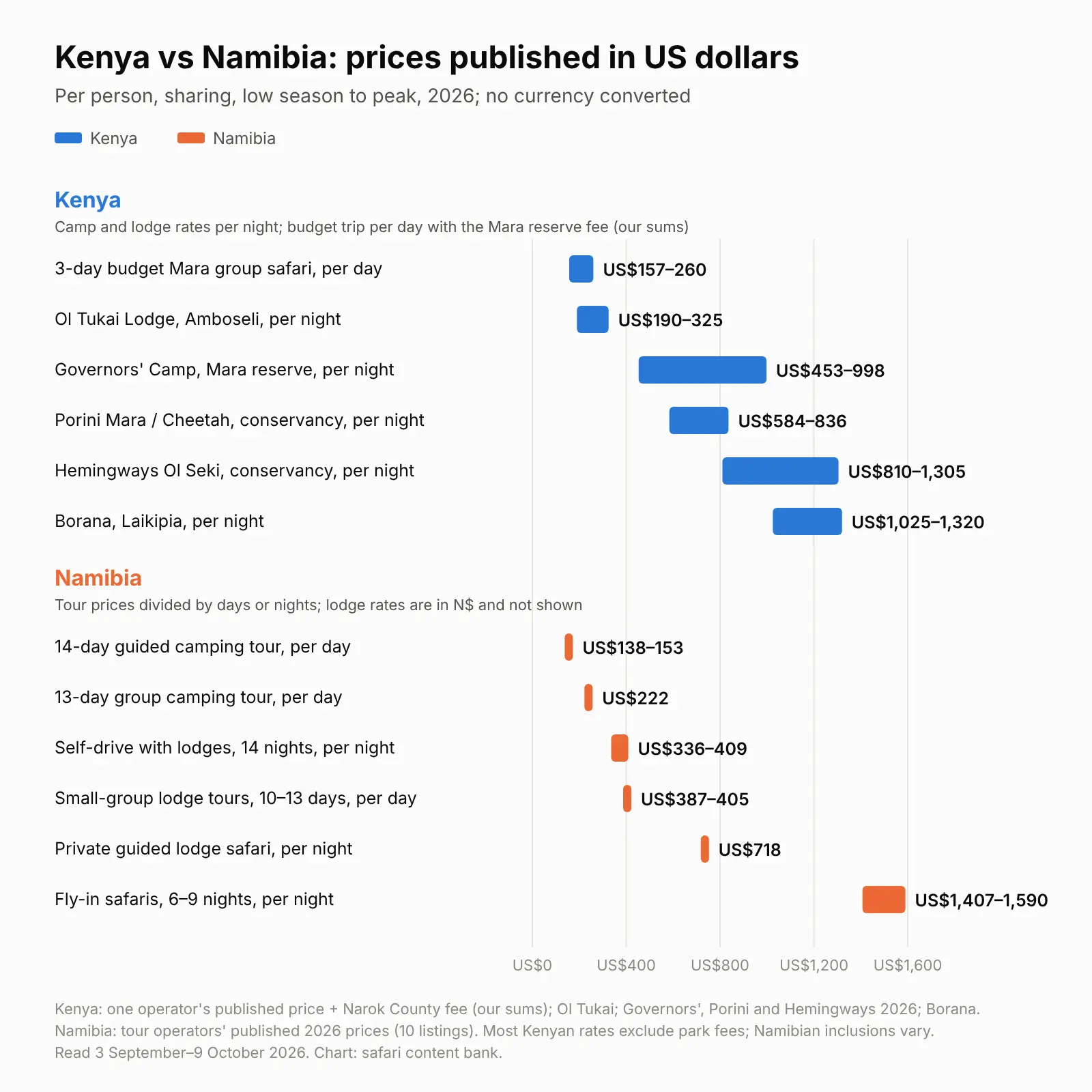 Published 2026 prices per person, sharing, read 3 September–9 October 2026. Sources: operators’ published prices; Narok County FY2025/26 schedule (our sums); Ol Tukai; Governors’, Porini and Hemingways 2026; Borana. Chart: safari content bank.
What a day in the flagship park costs two people
Two adults camping one night in the flagship park pay about US$240 in Amboseli and N$1,540–1,740 in Etosha, before the car, fuel and food (our sums). In Amboseli that is two KWS campsite places and two park fees: 2 × US$30 + 2 × US$90 = US$240, plus KSh 600 a day for a vehicle with under 6 seats. In Etosha it is two NWR campsite places at N$460–560 each plus one entry for two adults and their car at N$620 (2 × N$280 + N$60): N$1,540–1,740. The Masai Mara reserve itself is not a self-drive option: private vehicles have been banned from game drives there since 3 June 2024.
- Three days of park fees for two adults (our sums): in the Mara reserve, 2 × 3 × US$100 = US$600 from January to June and 2 × 3 × US$200 = US$1,200 from July to December. In Etosha, 3 × N$620 = N$1,860 for two adults and one car, counting one fee per park day as MEFT’s 2021 schedule did; the 2026 notice states no time period.
- A budget Mara price can be smaller than the fee. One operator’s 3-day group safari costs US$170–180 per person and says “park fees NOT included”; from July to December the reserve charges US$200 per adult for each day in it (Kenya safari cost).
- Namibia’s top end is priced in Namibian dollars. Its lodges and camps publish in N$ (Wilderness through agents, in rand), so they cannot be set against Kenya’s US-dollar camps without an exchange rate, which our sources do not hold.
Self-drive or guided?
In Namibia the self-drive is the standard product and the guided tour the alternative; in Kenya the guided safari is the standard and self-driving is legal but rare, and not possible for game drives in the Masai Mara reserve.
| Kenya | Namibia | Source | |
|---|---|---|---|
| Is self-drive normal? | Legal; few visitors do it, and forum regulars advise first-timers against it | The mainstream way to travel | Kenya safari questions; Namibia safari cost |
| Where you can drive yourself | KWS parks (entry and campsites booked on KWSPay); not on game drives in the Mara reserve (Narok County memo, 3 June 2024) | Etosha and the other national parks; not the northern Skeleton Coast, which is open only through licensed concession operators | Kenyans.co.ke; Skeleton Coast |
| Vehicle needed | 4x4 “strongly recommended during the rainy season” at Ol Pejeta | 2WD for the standard circuit in the dry season; a 4x4 for the last 5–6 km to Sossusvlei (or the shuttle), the far north-west, Khaudum and Nkasa Rupara, and for a rooftop tent | Ol Pejeta FAQs; Namibia safari cost |
| Vehicle hire, per day | Self-drive Land Cruiser €129–159 | Rooftop-tent 4x4 N$2,619–3,880 with zero excess; standard excess elsewhere N$40,000–55,000 | A self-drive operator’s car-rental page; Namibia safari cost |
| Guided alternative, per day | Land Cruiser with driver-guide US$120–180 per vehicle, before fuel (a safari listing site’s market range, Aug 2026) | Guided camping tours about US$138–222 per person; small-group lodge tours about US$387–405 | Kenya safari cost; Namibia safari cost |
| Fuel | Diesel KSh 217.86 a litre, Nairobi (EPRA cap, 15 Sep–14 Oct 2026) | Diesel N$27.86 a litre, Walvis Bay, from 2 Sep 2026; inland pumps charge more | Citizen Digital; The Brief |
| After dark | Forum regulars’ rule is never to drive at night; the Mara ticket runs 06:00–18:00 | In Etosha, be in a camp or out of the park by sunset; rental firms such as AfriCar advise against night driving | Kenya safari questions; Namibia self-drive distances |
Read 3 September–10 October 2026. Forum lines are traveller reports, not official guidance.
- A 10-day camping self-drive for two in Namibia costs about N$47,800–59,700 in all, or N$2,390–2,985 per person a day, with the 4x4, diesel, park fees and campsites (our sum on self-drive safari cost, low to high season). Our sources hold no comparable Kenyan sum.
- “Zero excess” does not always mean fully covered in Namibia. Britz’s conditions say “roll-overs are not covered in any liability cover options”, and water damage is excluded by every supplier in our sources (Namibia safari cost).
- Kenya’s guide is most of what you pay for. Travellers who booked a cheap driver say a driver is not the same as a guide; conservancy camps with resident guides are the forum’s alternative (Kenya safari questions).
- Taking a Namibian rental across a border needs the company’s letter, and charges differ by company; detail on taking a Namibian rental car across borders.
Distances: Namibia’s long gravel days
Namibia’s legs are long and mostly gravel: Windhoek to Sesriem is 310 km (4–4.5 h), Sesriem to Swakopmund 340–350 km (4–6 h) and Windhoek to Okaukuejo in Etosha 414–435 km (4–6 h). The classic loop adds up to 2,169–2,199 km (our sum on Namibia self-drive distances). Kenya’s Mara is 5.5–6 hours from Nairobi on tarmac (The Kenya Times, 20 Aug 2026), and travellers give Amboseli to Ol Pejeta as about 8 hours (traveller reports).
- For north-west Namibia we print only two lodges’ fact-sheet distances. Opuwo to Epupa Falls is 180 km on the C43 (Gondwana Collection fact sheet, Omarunga Epupa-Falls Camp, updated April 2025). Möwe Bay, the road access point in the 2024 fact sheet of Shipwreck Lodge on the Skeleton Coast, is 432 km from Swakopmund, 273 km from Palmwag and 279 km from Khorixas on gravel. We found no reliable source for other north-west legs, such as Twyfelfontein or Sesfontein.
- Google Maps underestimates Namibian gravel. One operator’s road guide says to double its estimate on C roads, and one 2WD driver reported journeys taking up to three times the GPS time (Namibia self-drive distances).
- Sossusvlei’s last stretch is sand: from Sesriem gate to the 2x4 car park is 50–60 km, then 5–6 km in a 4x4 or on the shuttle (Sossusvlei; getting to Sossusvlei).
Park fees: Narok County and KWS vs MEFT
The Masai Mara reserve charges US$100 per non-resident adult per day from January to June and US$200 from July to December; Etosha and Namibia’s other Tier 1 parks charge N$280 per foreign adult plus N$60 per vehicle since 1 April 2026, and the Government Notice states no time period. One is set in US dollars and the other in Namibian dollars; we do not convert.
| Kenya (Narok County, KWS, conservancies) | Namibia (MEFT, Government Gazette 8877) | |
|---|---|---|
| Flagship area, foreign adult | Masai Mara reserve US$100 (1 Jan–30 Jun), US$200 (1 Jul–31 Dec) per day; 12-hour ticket, 06:00–18:00, does not carry overnight | N$280 per person: Etosha, Sossusvlei (Namib-Naukluft), Skeleton Coast, Fish River Canyon and the other Tier 1 parks |
| Other parks, foreign adult | Amboseli, Lake Nakuru US$90; Nairobi, Tsavo US$80; Meru, Aberdare US$70 per 24 h (KWS, no seasons since 1 October 2025) | N$200: Bwabwata, Mudumu, Nkasa Rupara, Khaudum and the other Tier 2 parks |
| Vehicle | Under 6 seats KSh 600 a day in KWS parks | N$60 per vehicle up to 10 seats, most national parks (N$50 at Sandwich Harbour) |
| Private land | Mara conservancies US$130 per adult per night or day (2026 rate sheets); Ol Pejeta US$110 per day, VAT included | Wolwedans N$1,600 per adult per night, including the NamibRand Nature Reserve fee; Natural Selection camps N$650 reserve fee per person |
| Children | Mara: 9–17 US$50, under 9 free; KWS: child under 18, 5 and under free, US$40–45 | 9–15 N$180, under 9 free |
| Period | Mara: per calendar day; KWS: per 24 hours | The notice prices fees per person and states no time period |
| In the accommodation rate? | No at most camps: conservancy fees on top at Kicheche and Governors’; for Porini, sources disagree | No: NWR rates exclude park fees, paid at the gate |
| Last change | Mara: Narok County FY2025/26, the last published schedule, expired 30 June 2026; no 2026/27 schedule as of 9 October 2026 | Rose on 1 April 2026 (from N$150), Government Notice 115 of 2026 |
| How you pay | Cashless: KWSPay (M-Pesa, card, bank transfer); Mara Triangle by M-Pesa or card | At the gate, on top of NWR accommodation |
Sources: Narok County fee schedule FY2025/26 (PDF), the last published, with The Kenya Times, 6 Aug 2026 (secondary) for July–December 2026; Mara Conservancy; KWS LN 160/2025 (PDF); Kicheche 2026 (PDF); Ol Pejeta Tariff Guide 2026 (PDF); Government Gazette 8877 (Government Notice 115 of 2026), PDF, hosted by the Legal Assistance Centre; Wolwedans 2026 (PDF); Natural Selection 2026 (PDF). Checked 9 October 2026.
- Sleeping outside the Mara reserve does not save the fee. The Mara Conservancy’s table is headed “Non-Residents (Accommodated Inside & Outside the Park) – Per Day” (Masai Mara park fees).
- KWS takes no cash. Dollar fees are converted at a monthly rate “in addition to facilitation charges” (Kenyans.co.ke, 1 Nov 2025), so the amount charged can be above the gazetted fee.
- N$620 is two adults and one car, not the vehicle fee. The vehicle fee is N$60; 2 × N$280 + N$60 = N$620 (Etosha park fees).
- Every tier is on the fee pages: Kenya park fees, Masai Mara park fees, Namibia park fees and Etosha park fees.
The official fee lines, with the date each took effect and the source:
| Fee | Amount | In force from | Source |
|---|---|---|---|
| Maasai Mara National Reserve, non-resident adult, per day (12-hour ticket, 06:00–18:00), 1 Jan–30 Jun | USD 100 | Since 1 Jan 2024; Narok County FY2025/26 schedule, the last published | Narok County fee schedule FY2025/26 |
| Maasai Mara National Reserve, non-resident adult, per day (12-hour ticket, 06:00–18:00), 1 Jul–31 Dec | USD 200 | Since 1 Jul 2024; Narok County FY2025/26 schedule, the last published, expired 30 Jun 2026 (no 2026/27 schedule as of 9 Oct 2026); The Kenya Times (6 Aug 2026, secondary) reports US$200 still applies for Jul–Dec 2026 | Narok County fee schedule FY2025/26 |
| Maasai Mara National Reserve, non-resident child 9–17 or student, per day (under 9 free) | USD 50, all year | Narok County FY2025/26 schedule, the last published | Narok County fee schedule FY2025/26 |
| Amboseli and Lake Nakuru National Parks (KWS), non-resident adult, per 24 hours | USD 90 (child under 18, 5 and under free, USD 45) | Legal Notice 160 of 2025, gazetted 22 Sep 2025, which states no start date; in force 1 Oct 2025 per the KWS press release of 29 Sep 2025 | KWS Fees Regulations 2025 (LN 160/2025) |
| Tier 1 parks (Etosha, Namib-Naukluft including Sossusvlei, Skeleton Coast, Ai-Ais/Fish River Canyon, Waterberg Plateau, Cape Cross, Dorob, Tsau //Khaeb), foreign adult 16+, per person | NAD 280 (NAD 140 park entrance + NAD 140 conservation fee) | 1 Apr 2026 (Government Notice 115 of 2026; the notice prices fees per person with no period; MEFT's 2021 schedule made fees valid for 24 hours from entry); was NAD 150 under the 2021 schedule | Government Gazette 8877 (Government Notice 115 of 2026), hosted by the Legal Assistance Centre |
| Tier 2 parks (Bwabwata, Mudumu, Nkasa Rupara, Khaudum, Mangetti, Popa Falls, Daan Viljoen, Hardap, Naute, Von Bach, South West Nature Reserve), foreign adult 16+, per person | NAD 200 | 1 Apr 2026 (Government Notice 115 of 2026; the notice prices fees per person with no period; MEFT's 2021 schedule made fees valid for 24 hours from entry); was NAD 100 | Government Gazette 8877 (Government Notice 115 of 2026), hosted by the Legal Assistance Centre |
| Vehicle up to 10 seats, most national parks (N$50 at Sandwich Harbour), per vehicle | NAD 60 | 1 Apr 2026 (Government Notice 115 of 2026; the notice states no period; MEFT's 2021 schedule made fees valid for 24 hours from entry); was NAD 50 | Government Gazette 8877 (Government Notice 115 of 2026), hosted by the Legal Assistance Centre |
When to go: Kenya and Namibia month by month
July to October is the best game viewing in both countries, and the dearest; outside it, Kenya’s Mara keeps its resident cats at half the reserve fee from January to June, and Namibia’s coast is dry all year while Etosha’s game disperses from November to March.
| Months | Kenya (Masai Mara) | Namibia (Etosha, Sossusvlei) |
|---|---|---|
| January–March | Between the short and the long rains (Mara 95–145 mm a month); Mara fee US$100; the resident Loita herd calves in Ol Kinyei, February–March | Rains (Tsumeb, near Etosha, 80–140 mm a month; February the wettest); Etosha’s poorest months, as game disperses; NWR low season |
| April–May | Long rains (April 210 mm in the Mara); lowest camp rates (Governors’ Camp US$453), and many conservancy camps close | Rains end (Tsumeb 40 mm in April, 5 mm in May); game returning to Etosha’s waterholes; NWR low season (Sossus Dune Lodge N$4,030) |
| June | After the long rains (Mara 95 mm); herds usually still in Tanzania; Mara fee US$100 to 30 June | Dry (Tsumeb 0 mm); Windhoek nights 7.5 °C; NWR still low season |
| July–October | Herds in the Mara; crossings busiest August–September; Mara fee US$200; top camp rates (Governors’ US$998) | Dry; game at Etosha’s waterholes, peak September–October; NWR high season (Sossus Dune Lodge N$7,000); Namibia2Go 4x4 N$3,880 a day |
| November–December | Short rains (Mara 155 mm in November); herds back in Tanzania; Mara fee still US$200 | Rains start (Tsumeb 55–95 mm a month); game disperses; Sesriem fills with Namibian families from mid-December (traveller reports) |
Typical year, not a forecast. Rain: Climates to Travel (Masai Mara; Namibia, Tsumeb), an aggregator. Herds: Mara Conservancy; a camp operator’s migration guide; a Kenyan camp operator’s Loita migration page. Etosha: a safari agent’s Etosha guide and a safari booking site’s Etosha page. Rates: Governors’ 2026 rate sheet; NWR 2026–27 rates from a booking agent’s listing; Namibia2Go 2026. Read 3 September–10 October 2026.
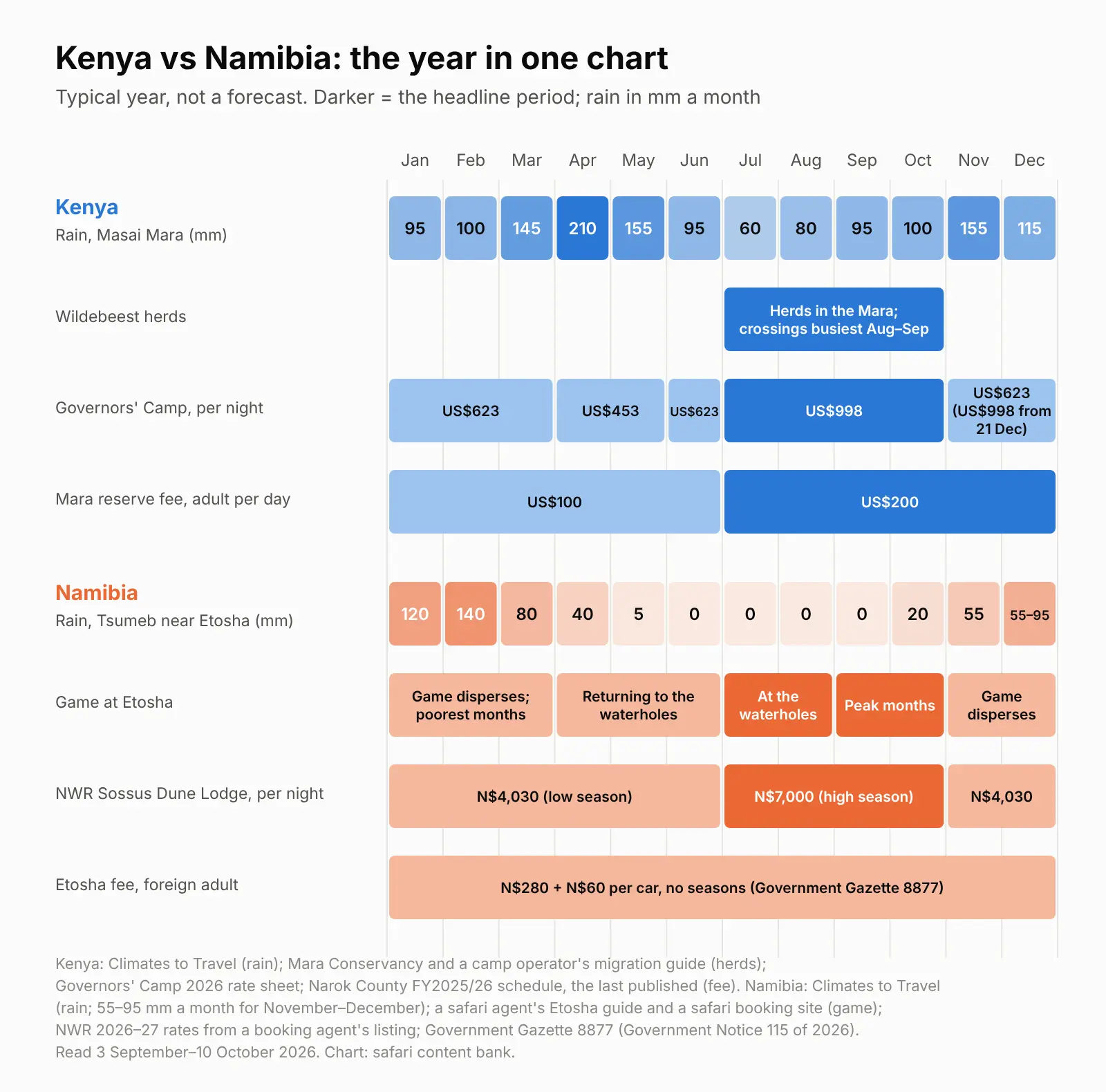 Typical year. Sources: Climates to Travel (rain, an aggregator); Mara Conservancy and a camp operator’s migration guide (herds); Governors’ Camp 2026 rate sheet; Narok County FY2025/26 schedule (last published); a safari agent’s Etosha guide and a safari booking site (Etosha); NWR 2026–27 rates from a booking agent’s listing; Government Gazette 8877. Read 3 September–10 October 2026. Chart: safari content bank.
- The two peaks fall in the same months. July to October is the Mara’s herd season and Namibia’s dry-season peak at Etosha, so a trip then pays the Mara’s US$200 fee or Namibia’s high-season rates (NWR and Namibia2Go both move up on 1 July).
- Kenya never has a dry month in the Mara; Etosha’s dry season has none of its rain. The Mara’s driest month, July, averages 60 mm; Tsumeb, near Etosha, averages 0 mm from June to September, and Swakopmund on the coast 0 mm in every month (Climates to Travel, an aggregator).
- Nights are cold in both dry seasons. Mara lows are 11–13 °C in every month; Windhoek averages 7.2 °C on July nights (Climates to Travel).
- No source can date a river crossing. The Mara Conservancy says crossings “happen frequently during the migration but are difficult to predict” (Great Migration month by month).
- Month by month for both countries: safari in February, April, July, September, November and the other month guides.
Wildlife: migration herds or waterholes and desert species
Kenya has the wildebeest herds from July to October and resident big cats in the Mara; Namibia has more rhino, Etosha’s dry-season waterholes and desert-adapted lions and elephants in the north-west.
| Kenya | Namibia | Source | |
|---|---|---|---|
| Big herd movement | Wildebeest in the Masai Mara about July–October; crossings busiest August–September | None in our sources | Mara Conservancy; Great Migration month by month |
| Rhino in the country (end of 2024) | 2,102 (1,059 black, 1,043 white); hard to see in the Mara, by forum regulars’ reports | 3,598 (2,098 black, 1,500 white); the largest free-roaming black rhino population | IUCN SSC African Rhino Specialist Group report to CITES, 2025; Save the Rhino Trust; Where to see rhino |
| Big Five in the flagship park | No single Kenyan park in our sources reliably shows all five | Four in Etosha: Cape buffalo are kept out by veterinary policy | Where to see the Big Five; a safari agent’s Etosha guide, read September 2026 |
| Big cats | The Mara’s lions, leopards and cheetahs are resident all year | Etosha: lion “occasional”, leopard and cheetah “very rare” (a safari booking site’s ratings) | Kenya safari questions; Etosha |
| Elephant | Amboseli: 2,065 at the end of 2025 (Amboseli Trust for Elephants) | Etosha: “abundant” (same booking site); about 150 desert-adapted elephants in the north-west’s main riverbeds (undated) | Born Free, 23 May 2026; Elephant Human Relations Aid |
| Desert-adapted wildlife | Not in our Kenya sources | 57–60 adult desert-adapted lions across about 40,000 km² of the north-west (2022–23 count) | Heydinger and others, 2024; Skeleton Coast |
Etosha ratings read September 2026, from one booking site’s Etosha wildlife page. No comparable sighting dataset for Kenya is in our sources. We do not publish where in a park rhino are found.
- Namibia has more black rhino than Kenya (2,098 against 1,059 at the end of 2024; IUCN). Kenya’s rhino parks charge US$80–110 per adult a day; which ones, and why, is on where to see rhino.
- Desert lions are few and unpredictable. That count is the lowest density recorded for a free-ranging, self-sustaining lion population in Africa, and one safari operator’s camp page says “no season guarantees or excludes a sighting” (Skeleton Coast).
- Crowding is a Mara complaint, not an Etosha statistic. Mara visitor numbers fell from 420,000 in 2023 to 213,000 in 2025 (Kenya Economic Survey 2026, via Business Daily), yet reviews on a safari booking site still describe 20 to 40 vehicles at one sighting in the reserve (traveller reports). Our sources hold no current Etosha visitor count.
Night drives, walking and vehicles at a sighting
Both flagship parks keep visitors to daytime drives on set rules; the night drives and walks are on private land: Kenya’s conservancies and the reserves on Etosha’s boundary.
| Kenya | Namibia | |
|---|---|---|
| Flagship park | Masai Mara reserve: night drives not sold; off-road prohibited except to approach big cats on nearby open ground, no closer than 25 m | Etosha: stay in your vehicle except in camps and at marked stops; no off-road driving, walking, night driving or spotlighting |
| Night drives | Mara conservancies at some camps; selected KWS parks US$50 per person per trip, plus the park fee; Ol Pejeta US$70 per adult | Etosha: only NWR’s guided night drives, about N$620 per person; reserves on Etosha’s boundary run their own |
| Walking | None sold in the Mara reserve, as far as we found; included at some conservancy camps | Not allowed inside Etosha; guided walks on the boundary reserves |
| Vehicles at a sighting | Mara reserve: five, others wait 100 m away; no published cap in the conservancies | No published limit in our sources |
| Floodlit waterholes | Not in our Kenya sources | Okaukuejo and Halali, for guests sleeping inside the park |
| Self-drive game viewing | Legal in KWS parks; private vehicles banned from game drives in the Mara reserve since 3 June 2024 | Standard in Etosha, in an ordinary car in the dry season |
Sources: Narok County’s Greater Maasai Mara Ecosystem Management Plan, as reported by Business Daily; Kenyans.co.ke (Narok memo); KWS LN 160/2025 (PDF); Ol Pejeta Tariff Guide 2026 (PDF); a safari agent’s Etosha guide; one operator’s Etosha guide. Read 8–10 October 2026.
- Private land sells the same thing in both countries: night drives and walks. The Maasai Mara Wildlife Conservancies Association lists 24 conservancies covering about 450,000 acres (MMWCA); side by side on Mara reserve vs conservancies. Onguma’s 4-hour game drive into Etosha cost N$1,750 per person on its 2026 rate sheet, which ran to 31 October 2026 (Onguma 2026 (PDF)).
- We found no 2026 statement on how the Mara’s private-vehicle ban is applied (Masai Mara). Check with your camp before planning to drive into the reserve.
Getting there and getting around
Kenya’s Mara is half a day’s drive or a short flight from Nairobi; Namibia’s parks are reached by road from Windhoek, with charter flights for the remote north-west.
| Kenya | Namibia | Source | |
|---|---|---|---|
| International gateway | Nairobi; light aircraft from Wilson airport to the Mara and Amboseli | Windhoek Hosea Kutako, 40–45 km east of the city; Discover Airlines non-stop from Frankfurt daily | Masai Mara getting there; Etosha |
| Gateway to the flagship park by road | Nairobi → Sekenani Gate 5.5–6 h, tarmac all the way | Windhoek → Okaukuejo (Etosha) 414–435 km, tar, 4–6 h | The Kenya Times, 20 Aug 2026; Namibia self-drive distances |
| Light aircraft | Wilson → Mara US$200 + US$20; Wilson → Amboseli US$190 + US$20 one way | Charters mostly from Windhoek’s Eros Airport; no charter price in our sources | Mombasa Air Safari 2026; Skeleton Coast |
| Luggage on light aircraft | AirKenya: 15 kg in soft bags, hand luggage included; US$5 per kg over | Skeleton Coast fly-ins: 10 kg including hand luggage, soft bag 60 × 40 × 40 cm (one safari operator’s luggage guide) | AirKenya 2025 (PDF); Skeleton Coast |
| Daylight limits | Mara ticket 06:00–18:00 | Okaukuejo gates about 07:25–18:25 in June and 06:30–19:40 in January | Mara Conservancy; a safari agent’s Etosha guide, read September 2026 |
| Booking ahead | No advance-booking rule in our sources; many conservancy camps close in April–May | NWR’s Etosha camps 6–12 months ahead for July–September (forum regulars’ advice) | Kenya safari cost; Etosha |
Read 3 September–10 October 2026. Airline schedules change by season; check the live timetable before you book.
- Pack for the smaller limit on a Namibian fly-in. The Skeleton Coast’s 10 kg is 5 kg less than AirKenya’s 15 kg (safari packing list).
- Kenya’s parks are far apart by road, and Namibia’s are linked by long gravel days: plan both by hours, not kilometres (Kenya safari questions; Namibia safari questions).
Entry costs, health and children
Kenya charges before you fly (eTA US$30 plus a government health policy of up to US$44 (eCitizen)); Namibia charges UK, US and German visitors N$1,600 for a visa on arrival. Malaria is year-round in Kenya and regional in Namibia. Checked 9–10 October 2026.
| Kenya | Namibia | Source | |
|---|---|---|---|
| Visa or authorisation | eTA US$30, plus payment charges; apply online before travel; no visa since January 2024 | Visa on arrival N$1,600 per adult (non-African Union nationals), required since 1 April 2025 from 33 previously exempt countries, including the UK, the US and Germany; e-visa fee not printed (sources differ) | KCAA AIC 14/25 (PDF); Namibian Mission in Switzerland |
| Compulsory insurance | Government health policy required for arrivals since 5 October 2026 (U.S. Embassy Nairobi), up to US$44 (eCitizen); your own policy is not accepted in its place | None listed in our Namibia sources | Kenya visitor health insurance; Namibia visa |
| In your air ticket | API-PNR fee US$4.95 per passenger per international segment | None in our sources | AIC 14/25 (PDF) |
| Malaria | Risk all year in the entire country (WHO); only central Nairobi low risk (CDC) | Year-round high risk in the Zambezi Region; Etosha at the edge of the seasonal zone, not malaria-free; no risk listed for the coast, Sossusvlei or the south | WHO country list (PDF); CDC, Kenya; HealthyTravel / Swiss TPH, Namibia |
| Yellow fever certificate | Only if arriving from a risk country | From age 9 months if arriving from a risk country, or after more than 12 hours’ transit in one; Kenya is one | Yellow fever and safaris |
| Children’s entry | Every child, including infants, needs their own eTA; no child discount | Visa N$800 for ages 6–11, free under 6; a full (unabridged) birth certificate, plus a notarised consent letter if both parents are not travelling | AIC 14/25 (PDF); Namibia safari cost |
| Children in camps | No national minimum; Kicheche Bush and Valley from 7, Porini camps from 8 | NWR: under 6 stay free, 6–12 pay 50% when sharing with two adults; Wolwedans Dune Camp from 7 | Kicheche 2026 (PDF); Namibia safari cost |
The two countries’ malaria is rated by different bodies in our sources (WHO and CDC for Kenya, Swiss TPH and WHO for Namibia). This is what the sources say, not medical advice: whether you need tablets, and which, is a question for a travel clinic. Check the official Kenya eTA portal, not a third-party site, the week you apply. Full rules: Kenya eTA and Namibia visa.
- Namibia’s malaria-free areas are desert and coast, not game parks. On a Namibian loop the risk sits in the north: Etosha and the north-east. In 2026 Swiss TPH extended its advice to cover June–August in the seasonal-risk regions (Namibia safari questions). Kenya has no low-risk season in the safari areas.
- US citizens: Kenya sells them an optional 5-year multiple-entry eTA for US$185; Namibia’s visa on arrival applies to US passports since 1 April 2025.
- Families: camp by camp, with child rates, on family safari.
Can you combine Kenya and Namibia?
Yes, but our sources hold no direct flight between them, and you need a yellow fever certificate for Namibia if you arrive from Kenya. Kenya is a yellow fever risk country, and Namibia asks for the certificate from travellers aged 9 months and over arriving from one (Yellow fever and safaris).
- Flights: Windhoek’s published links include Ethiopian Airlines from Addis Ababa daily, and Airlink and SAA from Johannesburg several times a day (Namibian flights sheet, May/June 2026 (PDF)). No Nairobi–Windhoek schedule is in our sources, so check the live timetable.
- A long connection counts too. Namibia counts a transit of more than 12 hours in a risk country, and Ethiopia is one (WHO).
- Entry costs apply on each leg: Kenya’s US$30 eTA and the health policy of up to US$44 (eCitizen) on the Kenyan leg; Namibia’s N$1,600 visa on arrival on the Namibian leg.
- The usual pairings are elsewhere. Kenya pairs with Tanzania (Kenya vs Tanzania); Namibia with Botswana or South Africa (Namibia vs Botswana; Namibia vs South Africa). Kenya against Botswana: Kenya vs Botswana.
Which should you choose?
Choose Kenya for the migration months, guided game drives and big cats on open plains; choose Namibia for a self-drive, landscapes, rhino numbers and a dry-season safari with no rain.
| If you… | Pick | Why |
|---|---|---|
| Want the wildebeest herds or a river crossing | Kenya, July–October | Herds in the Masai Mara about July–October; crossings busiest August–September |
| Want to drive yourself | Namibia | Self-drive is the mainstream product; the Mara reserve bans private vehicles from game drives |
| Want dunes, desert and coast | Namibia | Sossusvlei, the Skeleton Coast and Swakopmund |
| Want a guide to find the animals | Kenya | Driver-guides and conservancy camps are the standard product |
| Travel January–June on a budget | Kenya for the Mara fee, Namibia for the lowest guided price | Mara fee US$100 a day; Namibia’s cheapest camping tour about US$138–153 a day |
| Want to avoid rain | Namibia, May–October | Tsumeb averages 0–5 mm from May to September; the Mara’s driest month has 60 mm |
| Want to avoid malaria areas | Namibia’s desert and coast | No risk listed for Sossusvlei, the coast or the south; Kenya has risk all year |
| Want night drives and walks | Either, on private land | Mara conservancies; reserves on Etosha’s boundary |
Whichever you choose, check that the operator holds a current licence: see how to check a safari operator is licensed.
See also: Etosha vs Sossusvlei.
Common mistakes in Kenya vs Namibia comparisons
| What you’ll often read | What is correct |
|---|---|
| “Kenya is a self-drive country like Namibia” | Legal, but rare, and forum regulars advise first-timers against it. Private vehicles have been banned from game drives in the Masai Mara reserve since 3 June 2024. |
| “Namibia is a malaria-free safari destination” | Etosha is not malaria-free, and the Zambezi Region has year-round high risk. No risk is listed for the coast, Sossusvlei or the south. |
| “Etosha has the Big Five” | Four. Cape buffalo are kept out of Etosha by veterinary policy. |
| “Etosha costs N$150 a day” | N$280 per foreign adult since 1 April 2026, plus N$60 per vehicle. Government Notice 115 of 2026 states no time period. |
| “The Masai Mara costs US$200 a day all year” | US$100 from January to June, US$200 from July to December, per non-resident adult, under Narok County’s last published schedule. |
| “Kenya visa on arrival, US$50” | Kenya has had no visa since January 2024; the eTA costs US$30, plus a government health policy of up to US$44, required for arrivals since 5 October 2026. |
| “No visa needed for Namibia” | UK, US and German visitors have needed one since 1 April 2025; N$1,600 on arrival. |
| “Kenya has more rhino than Namibia” | Namibia has more: 3,598 against Kenya’s 2,102 at the end of 2024 (IUCN). |
| “Kenya to Namibia needs no yellow fever card” | It does. Kenya is a risk country, and Namibia asks for the certificate from arrivals from one, from age 9 months. |
Frequently asked questions
Is Kenya or Namibia better for a first safari? It depends on whether you want to drive. Kenya suits a first safari with a guide: the wildebeest herds are in the Masai Mara about July to October, and the Mara is 5.5–6 hours from Nairobi on tarmac. Namibia suits a first safari built around landscape and a self-drive, but its classic loop is 2,169–2,199 km, mostly on gravel, and Etosha has no buffalo.
Is Kenya or Namibia cheaper for a safari? Namibia, if you drive yourself and camp: a rooftop-tent 4x4 rents for N$2,619–3,880 a day and NWR camping in Etosha costs N$460–560 per person a night. On guided trips in US dollars, Namibia’s cheapest camping tour lists at about US$138–153 a day, against about US$157–260 for a budget Mara trip once the reserve fee is added (our sums). We do not convert Namibian dollars into US dollars.
What are the park fees in Kenya and Namibia in 2026? The Masai Mara reserve charges US$100 per non-resident adult per day from January to June and US$200 from July to December (Narok County’s last published schedule, FY2025/26); KWS charges US$90 for Amboseli and Lake Nakuru per 24 hours. Namibia’s Tier 1 parks, including Etosha and Sossusvlei, charge N$280 per foreign adult plus N$60 per vehicle since 1 April 2026 (Government Gazette 8877, Government Notice 115 of 2026); the notice states no time period. Tier 2 parks charge N$200.
Can you self-drive a safari in Kenya like in Namibia? Not in the same way. Self-driving is legal in Kenya’s KWS parks, but private vehicles have been banned from game drives in the Masai Mara reserve since a Narok County memo of 3 June 2024, and forum regulars advise first-timers against driving in Kenya. In Namibia a 2WD car covers the standard circuit in the dry season, and a 4x4 is needed only for the last stretch to Sossusvlei, the far north-west, Khaudum and Nkasa Rupara.
When is the best time to go to Kenya or Namibia? July to October in both. The wildebeest herds are in the Masai Mara about July to October, and Etosha’s game gathers at the waterholes, with September and October the peak months. Outside those months Kenya’s Mara fee halves to US$100 from January to June, while Etosha’s game disperses from November to March.
Do I need malaria tablets for Kenya and Namibia? Very likely for Kenya, where WHO says the risk exists all year in the entire country. For Namibia it depends on the route: the WHO lists no risk for the coast, Sossusvlei or the south, but Etosha is not malaria-free and the Zambezi Region has year-round high risk. Which tablets to take is a decision for a travel clinic.
Do I need a visa for Kenya or Namibia? For Kenya, most non-African visitors need an eTA (US$30, applied for online before travel) and, since 5 October 2026, a government health policy of up to US$44 (eCitizen). For Namibia, UK, US and German passport holders have needed a visa since 1 April 2025: N$1,600 per adult on arrival, N$800 for children aged 6–11, free under 6.
Can I combine Kenya and Namibia on one trip? Yes, but our sources hold no direct flight between the two, so plan a connection and check the live timetable; Windhoek has daily flights from Addis Ababa and several a day from Johannesburg. Carry a yellow fever certificate: Kenya is a risk country, and Namibia asks for one from travellers aged 9 months and over arriving from one.
Sources
- Kenya fees: Narok County, Maasai Mara fee schedule FY2025/26 (PDF), the last published; The Kenya Times, 6 Aug 2026 (press, secondary); Mara Conservancy, conservation fees and wildebeest migration; KWS, Fees Regulations 2025, LN 160/2025 (PDF); Kenyans.co.ke, 1 Nov 2025 (KWSPay); Ol Pejeta Tariff Guide 2026 (PDF)
- Namibia fees: Government Gazette 8877 (Government Notice 115 of 2026), PDF, hosted by the Legal Assistance Centre; MEFT, Park Entrance and Conservation Fees, 2021 (PDF)
- Rules: Narok County management plan via Business Daily; Kenyans.co.ke, Narok memo; MMWCA; a safari agent’s Etosha guide (wildlife, gate times, night drives, month by month); one operator’s Etosha guide (name and link kept in our editor notes)
- Kenya prices: Ol Tukai, Governors’ 2026, Porini 2026, Kicheche 2026, Hemingways 2026, Borana; a self-drive operator’s car-rental page; Mombasa Air Safari 2026; AirKenya 2025 (PDF); EPRA fuel caps via Citizen Digital; one tour operator’s published 2026 price and a safari listing site’s market range (names and links kept in our editor notes)
- Namibia prices: NWR 2026–27 rates from a booking agent’s listing, read September 2026; Namibia2Go 2026 rack rates; Wolwedans 2026 (PDF); Natural Selection 2026 (PDF); Onguma 2026 activities (PDF), sheet ran to 31 October 2026; diesel: The Brief; tour operators’ published 2026 package prices, as on our Namibia safari cost page (names and links kept in our editor notes)
- Roads and distances: Namibian legs as on our self-drive distances page, including the Gondwana Collection fact sheet for Omarunga Epupa-Falls Camp and the 2024 Shipwreck Lodge fact sheet; The Kenya Times, 20 Aug 2026; Ol Pejeta FAQs
- Seasons: Climates to Travel (Kenya and Namibia; an aggregator); a camp operator’s migration guide; a Kenyan camp operator’s Loita migration page; a safari booking site’s Etosha page (name and link kept in our editor notes)
- Wildlife: IUCN SSC African Rhino Specialist Group report to CITES, 2025, as on our rhino page; Save the Rhino Trust; Born Free, 23 May 2026; Elephant Human Relations Aid; Heydinger and others, 2024; Business Daily, Mara visitor numbers; a safari booking site’s Mara reviews and Etosha ratings (names and links kept in our editor notes)
- Travel and entry: KCAA AIC 14/25 (PDF); Kenya eTA portal; Namibian Mission in Switzerland (visa fees); Namibian flights sheet, May/June 2026 (PDF); yellow fever rules as on our yellow fever page
- Health: WHO country list, 2022 rev. Jan 2023 (PDF); CDC, Kenya; HealthyTravel / Swiss TPH, Namibia. Checked 10 Oct 2026
- Traveller reports (opinion and experience, not official findings): TripAdvisor Kenya and Namibia forums, via our Kenya and Namibia questions pages
Prices and fees checked 9–10 October 2026; page checked 17 October 2026. Hubs: Kenya, Masai Mara, Amboseli, Samburu, Tsavo, Namibia, Etosha, Sossusvlei and the Skeleton Coast. We will update this page when Narok County publishes a 2026/27 Mara schedule, when MEFT changes Namibia’s park-fee schedule, when Kenya publishes an official price for its visitor health policy, and when the 2027 rate sheets take effect.