 Experience

Last verified · Next check due
On this page
- Which vaccines are recommended for a safari?
- Tanzania, Uganda, Rwanda and southern Africa: where to check
- Rabies, hepatitis B and the “some travellers” list
- Safari health risks with no vaccine
- When to see a travel clinic, and what to bring
- Common mistakes about safari vaccinations
- Frequently asked questions
- Sources
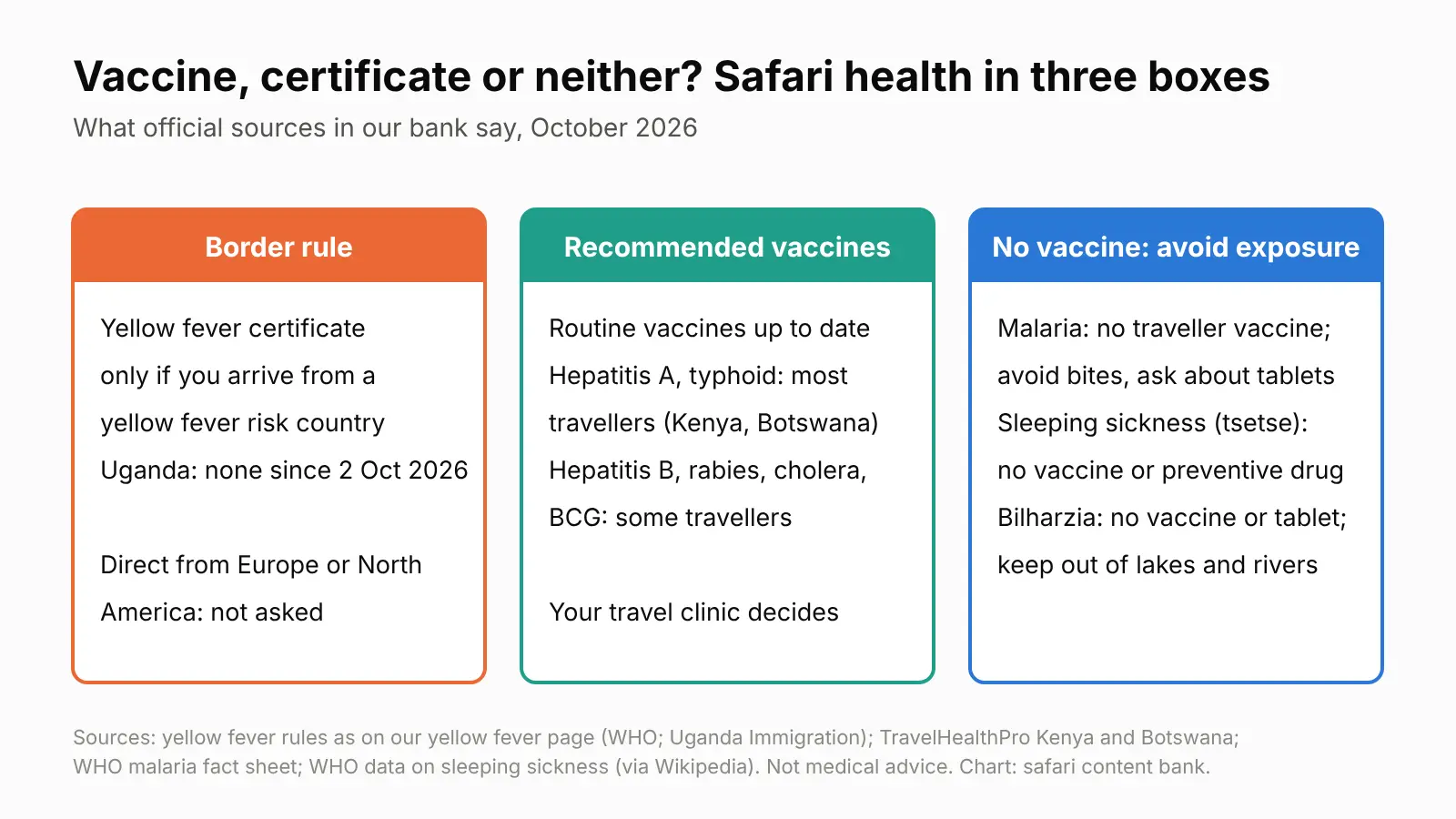
Short answer: At the border, only yellow fever can apply, and only if you arrive from a yellow fever risk country (rules on our yellow fever page). For your health, UK TravelHealthPro advises routine vaccines up to date plus hepatitis A and typhoid for most travellers to Kenya and Botswana, with hepatitis B, rabies, cholera and BCG for some. There is no malaria vaccine for travellers. We hold no official list for the other seven countries. Sources read 8–10 October 2026.
Key facts
- Yellow fever is the only vaccine in the official entry rules we read for the nine safari countries, and none of them asks for the certificate if you fly in directly from Europe or North America. Every country rule is on yellow fever certificate by country.
- Kenya: TravelHealthPro advises all travellers to keep routine vaccines up to date (MMR, and a tetanus booster if the last dose was over 10 years ago and medical care may be limited), and hepatitis A and typhoid for most travellers (TravelHealthPro, Kenya).
- Botswana: TravelHealthPro advises hepatitis A, tetanus and typhoid for most travellers, with routine vaccines up to date; hepatitis B, rabies, cholera and BCG for some (TravelHealthPro, Botswana).
- Three common safari health risks have no vaccine: malaria (WHO’s malaria vaccines are for children living in endemic areas), sleeping sickness from tsetse flies, and bilharzia from fresh water.
- For Tanzania, Uganda, Rwanda, Namibia, Zambia, Zimbabwe and South Africa, our sources hold no official vaccine list. Check TravelHealthPro or the US CDC page for each country you visit.
- This page is not medical advice and gives no doses. See a travel clinic or your doctor several weeks before you leave; they decide which vaccines suit you, your children and your route.
Which vaccines are recommended for a safari?
Our sources hold official vaccine advice for two safari countries, Kenya and Botswana, both from the UK’s National Travel Health Network and Centre (NaTHNaC), which publishes TravelHealthPro. Both list the same core: routine vaccines, hepatitis A and typhoid. The rest depends on how long you stay, where you sleep and what you do.
| Vaccine | Kenya (TravelHealthPro) | Botswana (TravelHealthPro) |
|---|---|---|
| Routine vaccines (MMR; diphtheria–tetanus–polio) | All travellers: keep up to date | Most travellers: keep up to date |
| Tetanus | All travellers: booster if the last dose was over 10 years ago and medical care may be limited | Most travellers: booster if more than 10 years since the last dose |
| Hepatitis A | Most travellers | Most travellers |
| Typhoid | Most travellers | Most travellers |
| Hepatitis B | Some travellers, depending on risk | Some travellers; Botswana is an intermediate/high-prevalence country |
| Rabies (before travel) | Some travellers, depending on risk | Some travellers: long stays, remote areas, certain occupations |
| Cholera | Some travellers, depending on risk | Some travellers: humanitarian workers, outbreak exposure |
| BCG (tuberculosis) | Some travellers, depending on risk | Children under 16 staying more than 3 months; healthcare workers |
| Meningococcal ACWY | Some travellers, depending on risk | Not listed in our source |
| Dengue, chikungunya | Some travellers, depending on risk | Not listed in our source |
| Measles | Not listed separately in our source | Extra advice for infants from 6 months |
TravelHealthPro Kenya read 8 October 2026; TravelHealthPro Botswana as summarised in our sources and used on our Botswana safari questions page. “Not listed” means our summary of the page does not list it, not that it is never advised. Yellow fever is left out here: see the yellow fever page.
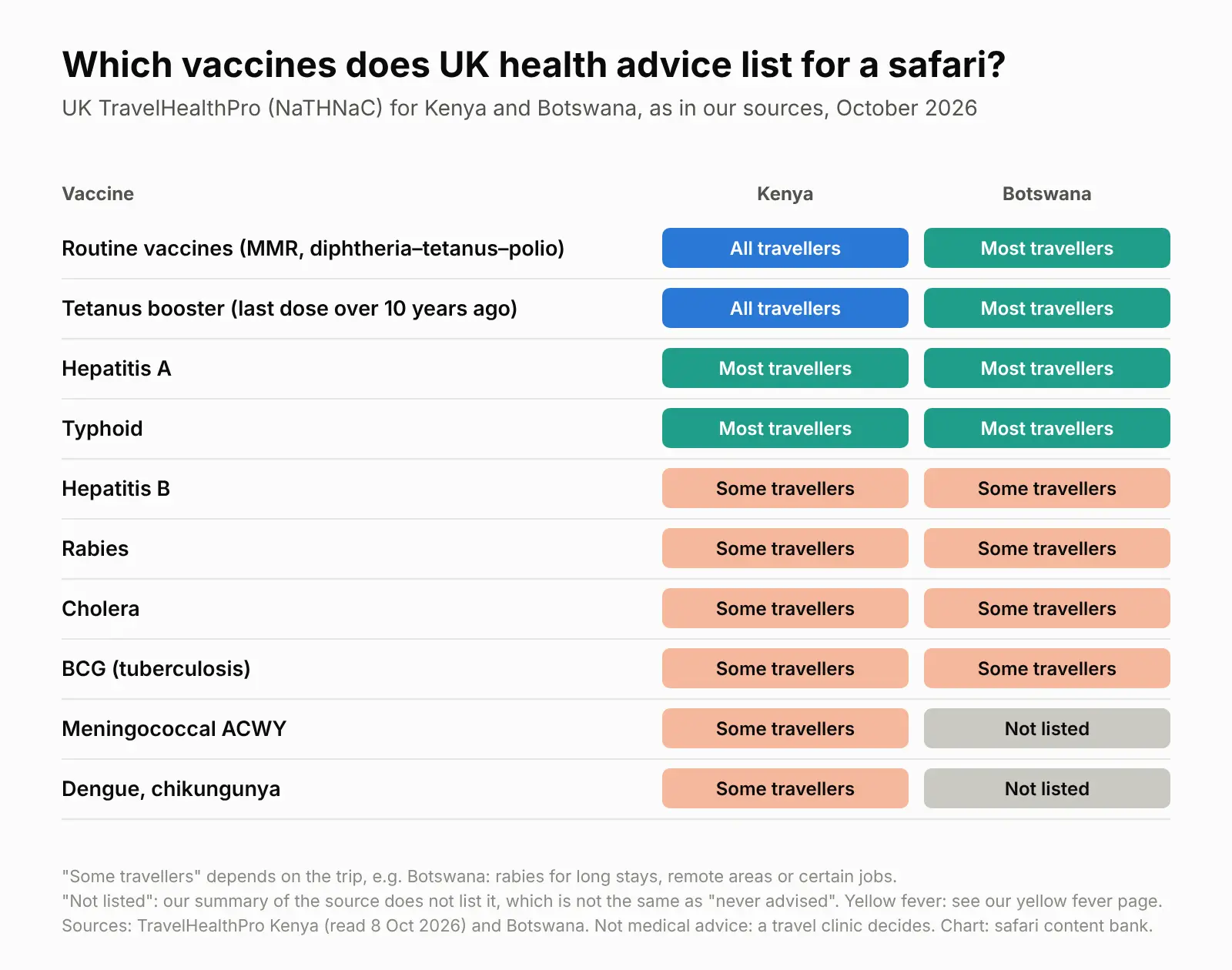
- “Most travellers” and “some travellers” are TravelHealthPro’s own groupings. A clinic places you in one or the other from your itinerary, your age and your health.
- The table covers Kenya and Botswana only because they are the two countries whose official vaccine pages are in our sources; the clinic will cover the rest of your route.
Tanzania, Uganda, Rwanda and southern Africa: where to check
For seven of the nine safari countries, our sources hold no official routine-vaccine list, so this page does not give one. Operator and forum lists exist, but they are not official, so we leave them out.
- Check the official page for each country on your route: TravelHealthPro (UK NaTHNaC), the US CDC destination pages, or fitfortravel (NHS Scotland). Our malaria page found the same gap for Uganda, Zambia and Zimbabwe.
- Give the clinic the whole route in order, including connections. A Kenya and Tanzania trip, or gorillas in Uganda and Rwanda, is one consultation, not two.
- Yellow fever in one line: none of the nine asks for the certificate if you arrive direct from Europe or North America; eight ask if you arrive from a risk country, and Uganda has not asked since 2 October 2026. Details: yellow fever certificate by country.
Rabies, hepatitis B and the “some travellers” list
These are the vaccines a clinic weighs against your trip rather than advising for everyone.
- Rabies: in Botswana, “rabies is considered a risk and has been reported in domestic animals in this country” (TravelHealthPro, Botswana). TravelHealthPro lists the vaccine for long stays, remote areas and certain jobs. Whether vaccinated or not, do not approach dogs, and have any animal bite or scratch seen by a doctor straight away.
- Hepatitis B: listed for some travellers in both countries; for Botswana, TravelHealthPro classes it as an intermediate/high-prevalence country.
- Cholera: for Botswana, TravelHealthPro names humanitarian workers and outbreak exposure, not ordinary safari travellers.
- BCG: for Botswana, children under 16 staying more than 3 months, and healthcare workers.
- Children and older travellers: ask the clinic about each child’s vaccines and about any medical condition. Age rules for activities are on safari age limits, and family planning on family safari and safari for seniors.
Safari health risks with no vaccine
Three risks that come up on safari have no vaccine, so protection is about avoiding exposure.
| Risk | Vaccine? | What protects you | Source |
|---|---|---|---|
| Malaria | No traveller vaccine. WHO’s RTS,S (2021) and R21 (2023) are for children living in endemic areas | Avoiding bites; ask a clinic about tablets. Areas and months: malaria risk on safari | WHO malaria fact sheet |
| Sleeping sickness (tsetse fly) | No vaccine and no preventive drug | Long sleeves and avoiding dense tsetse areas; the risk from a single bite is put at under 0.1% | Wikipedia, African trypanosomiasis, citing WHO data |
| Bilharzia (schistosomiasis) | No vaccine or preventive tablet | Do not wade, swim or bathe in fresh water; chlorinated pools and the sea are safe | TravelHealthPro, Kenya |
- Avoid insect bites “day and night”: TravelHealthPro makes this the core protection against all insect-borne risks. What to pack for it (repellent, long sleeves, neutral colours against tsetse) is on our safari packing list.
- Check current alerts before you fly. As of 11 November 2026 Kenya had 9 confirmed Ebola cases and 2 deaths, all in one cluster, none since 20 October, with no travel restrictions of its own; one patient was still in treatment on 10 November, so the outbreak cannot be declared over before the second half of December 2026 (Daily Nation, 23 Oct 2026; ECDC; ECDC, 28 Oct 2026; Kenyans.co.ke, 6 Nov 2026; Healthcare MEA, 10 Nov 2026). Follow official health advice; see is a Kenya safari safe?.
When to see a travel clinic, and what to bring
Book the appointment several weeks before you leave. WHO advises this for malaria prevention, because some tablets start 2–3 weeks before travel (WHO malaria fact sheet); the same visit covers vaccines.
- Bring: your route in order (countries, parks, connections and stopovers), travel dates, ages of everyone travelling, your vaccination record and any yellow fever certificate you already hold.
- Mention the activities: walking safaris, village visits, long stays or volunteering change the “some travellers” list.
- Insurance: medical evacuation from remote airstrips, and the compulsory policies in Kenya and Tanzania, are on safari travel insurance.
- Entry paperwork: visas are on the Kenya, Tanzania, Uganda, Rwanda, Botswana, Namibia, Zambia, Zimbabwe and South Africa visa pages.
Common mistakes about safari vaccinations
| What you’ll often read | What the sources say |
|---|---|
| “You need lots of jabs to enter African safari countries” | Only yellow fever appears in the official entry rules we read, and only if you arrive from a risk country. Other vaccines are health advice, not border rules. |
| “The yellow fever jab covers you for everything” | It covers one disease. TravelHealthPro advises hepatitis A and typhoid for most travellers to Kenya and Botswana. |
| “There is a malaria vaccine for safari travellers” | No. WHO’s RTS,S and R21 are for children living in endemic areas. |
| “Botswana has no yellow fever, so it has no vaccine advice” | TravelHealthPro still advises hepatitis A, tetanus and typhoid for most travellers, and lists rabies as a risk. |
| “Rabies vaccine is for everyone going on safari” | TravelHealthPro lists it for some travellers, such as long stays, remote areas and certain jobs; the clinic decides. |
| “A vaccine list from one country covers the whole trip” | Advice is per country. Give the clinic every country on the route. |
| “Any website’s list is as good as the official one” | Use TravelHealthPro, the CDC or fitfortravel; operator lists in our sources are not official. |
Frequently asked questions
Do I need any vaccinations to enter a safari country? Only yellow fever can be an entry rule, and only if you arrive from a yellow fever risk country; none of the nine asks travellers flying in directly from Europe or North America. Uganda has not asked since 2 October 2026. Full rules: yellow fever certificate by country.
Which vaccines are recommended for a Kenya safari? TravelHealthPro advises routine vaccines up to date for all travellers, including a tetanus booster if the last dose was over 10 years ago and medical care may be limited, and hepatitis A and typhoid for most. Hepatitis B, rabies, meningococcal ACWY, cholera, BCG, dengue and chikungunya are for some travellers, depending on risk.
Which vaccines are recommended for a Botswana safari? TravelHealthPro advises hepatitis A, tetanus and typhoid for most travellers, with routine vaccines up to date. Hepatitis B, rabies, cholera, BCG and extra measles advice for infants apply to some. There is no yellow fever risk in Botswana, but there is a certificate rule for arrivals from risk countries.
Do I need a rabies vaccine for a safari? TravelHealthPro lists it for some travellers, not all: in Botswana, for long stays, remote areas and certain jobs. Rabies has been reported in domestic animals there. Whatever you decide, have any animal bite or scratch seen by a doctor straight away.
Is there a vaccine for malaria? Not for travellers. WHO’s RTS,S and R21 vaccines are for children living in endemic areas. Protection is avoiding bites and, where a clinic advises it, tablets: see malaria risk on safari.
What about Tanzania, Uganda, Rwanda, Namibia, Zambia, Zimbabwe and South Africa? Our sources hold no official vaccine list for these seven countries, so we do not print one. Check TravelHealthPro, the US CDC destination page or fitfortravel for each country on your route, and ask a travel clinic.
How long before a safari should I see a travel clinic? Several weeks before you leave. WHO advises this for malaria prevention, since some tablets start 2–3 weeks before travel, and the same visit covers vaccines.
Is there a vaccine against tsetse flies or bilharzia? No. There is no vaccine or preventive drug for sleeping sickness, which tsetse flies carry, and no vaccine or tablet for bilharzia. Cover up against tsetse and keep out of lakes and rivers; chlorinated pools and the sea are safe (TravelHealthPro).
Sources
- UK NaTHNaC, TravelHealthPro: Kenya, read 8 Oct 2026 (vaccines, yellow fever zones, bilharzia, bite avoidance, Ebola alert); Botswana (vaccines, rabies, yellow fever), as summarised in our sources and on our Botswana safari questions page
- WHO, Malaria fact sheet: malaria vaccines, travellers’ advice
- Wikipedia, African trypanosomiasis (secondary, citing WHO data): no vaccine or preventive drug; risk per bite
- Yellow fever entry rules: as on our yellow fever certificate by country page (WHO country list 2022, rev. 3 Jan 2023; Uganda Immigration notice of 2 Oct 2026; UK FCDO entry pages), checked 10 Oct 2026
More on safari health and paperwork: malaria risk on safari, safari travel insurance and the safari packing list.
Sources read 8–10 October 2026; TravelHealthPro could not be re-opened from our session on 24 October 2026. We will add countries to the vaccine table when we have read their official TravelHealthPro or CDC pages.