 Experience

Last verified · Next check due
On this page
- Private or shared vehicle: what the space costs
- Which vehicle, and which seat?
- Off-road driving, night drives and sighting limits by park
- Hides and boats: where to shoot at eye level
- Best parks and months by subject
- Light and gate hours
- Luggage limits on bush flights: cameras count
- Drones: permits before you travel
- Which to choose
- Common mistakes on a photography safari
- Frequently asked questions
- Sources
Short answer: Plan around space and land rules, not lenses. Shared safari vehicles carry 4–7 guests in East Africa and seat six or nine at Botswana’s lodges; photographic vehicles take 3–4. A private vehicle costs US$385–935 a day or night on 2026 camp rate cards. Off-road driving and night drives are allowed on private concessions and conservancies, not in most national parks. Bush flights allow 15–20 kg per person, cameras included. Checked 10 October 2026.
Key facts
- The number that decides your pictures is guests per vehicle. Shared trips in our sources publish a maximum of four to seven per vehicle; Botswana Tourism says its lodges’ open vehicles seat “either six or nine”; a Chobe photographic operator caps its vehicles at four photographers. Details: safari vehicles.
- A private vehicle is priced per vehicle, so it gets cheaper per head as the party grows: US$385–512 a day at Governors’ Camp in the Masai Mara, US$725–935 a night at Natural Selection’s Botswana camps, free there for parties of 6–7 (2026 rate cards).
- The land, not the vehicle, decides where you may drive. Botswana Tourism: in its national parks and reserves “off-roading and night driving [are] prohibited”; private concessions allow both “in moderation”. South Luangwa, and Lower Zambezi in the dry season, run night drives inside the national park.
- Hides and low boats are concentrated in a few places: underground hides at Mashatu (Northern Tuli, Botswana) and in the Khwai Private Reserve, waterhole hides at Camp Hwange, four hides at Kaingo Camp in South Luangwa, and photo boats on the Chobe River.
- Bush flights count your camera bag: 15 kg per person including hand luggage in Kenya and Uganda, 20 kg on Auric Air in Tanzania (hand luggage and cameras included) and in Botswana, in a soft bag (carriers’ baggage pages, read 9 October 2026).
- Drones need permits arranged before you travel in Kenya, Tanzania and Namibia, and SANParks bans them in and over its parks.
Private or shared vehicle: what the space costs
On a shared drive you get one seat and one side; a private vehicle costs US$385–935 a day or night at camps on 2026 rate cards, and on an East African road safari the whole vehicle is usually yours anyway. Prices are as each camp or operator publishes them, per vehicle unless stated.
| Option | Guests per vehicle, as published | What it costs | Source |
|---|---|---|---|
| Shared camp vehicle, Botswana lodges | 6 or 9 seats, open-sided | In the camp rate | Botswana Tourism |
| Shared group safari, Kenya and Tanzania | 4–7 per vehicle; one operator guarantees a window seat in writing | Tanzania group camping US$220–300 per person per day, park fees included; group lodges about US$380 | Private vs group safari cost |
| Photographic vehicle | 3–4 guests (an operator’s vehicle glossary); a Chobe photographic operator caps at 4 photographers | Sold within photographic departures; no separate price in our sources | Safari vehicles |
| Private vehicle, Tanzania road safari | Your party | US$200–300 per vehicle per day, the same for 2 or 6 people | One Arusha operator’s 2026 cost guide, on Tanzania safari cost |
| Governors’ Camp, Masai Mara | Up to 6 | US$385 a day (Jan–Jun, Nov–15 Dec); US$512 (Jul–Oct, 16–31 Dec) (2026) | Governors’ 2026 (PDF) |
| Machaba Camp, Khwai (Botswana) | Your party | US$550 a night (2026) | Machaba 2026 |
| Natural Selection, Okavango camps (Botswana) | Your party | US$725–935 per vehicle per night; free for parties of 6–7 (2026) | NS 2026 (PDF) |
| Kwando (Botswana) | Your party | US$150–210 per empty seat (Kwara US$300–440) (2024) | Kwando 2024 (PDF) |
| Time + Tide (Zambia) | Your party | US$570 a night; US$750 with a private guide (2027) | Time + Tide 2027 (PDF) |
| The Bushcamp Company, South Luangwa | Your party | US$600 a night (2026) | Bushcamp Company 2026 (PDF) |
| South African lodges (MalaMala, Thornybush, Sabi Sand lodges) | Your party | R6,350–25,000 a day (2026) | Thornybush 2026 (PDF); a safari seller’s survey of 2026 rate cards |
| Tswalu (South Africa) | Your party | Included in every booking (vehicle, guide and tracker) | Tswalu rates |
Rate cards as linked, read 8–10 October 2026; the same figures are on our safari vehicles and single supplements and child rates pages. Group and Tanzanian prices are operators’ published prices, as on private vs group safari cost.
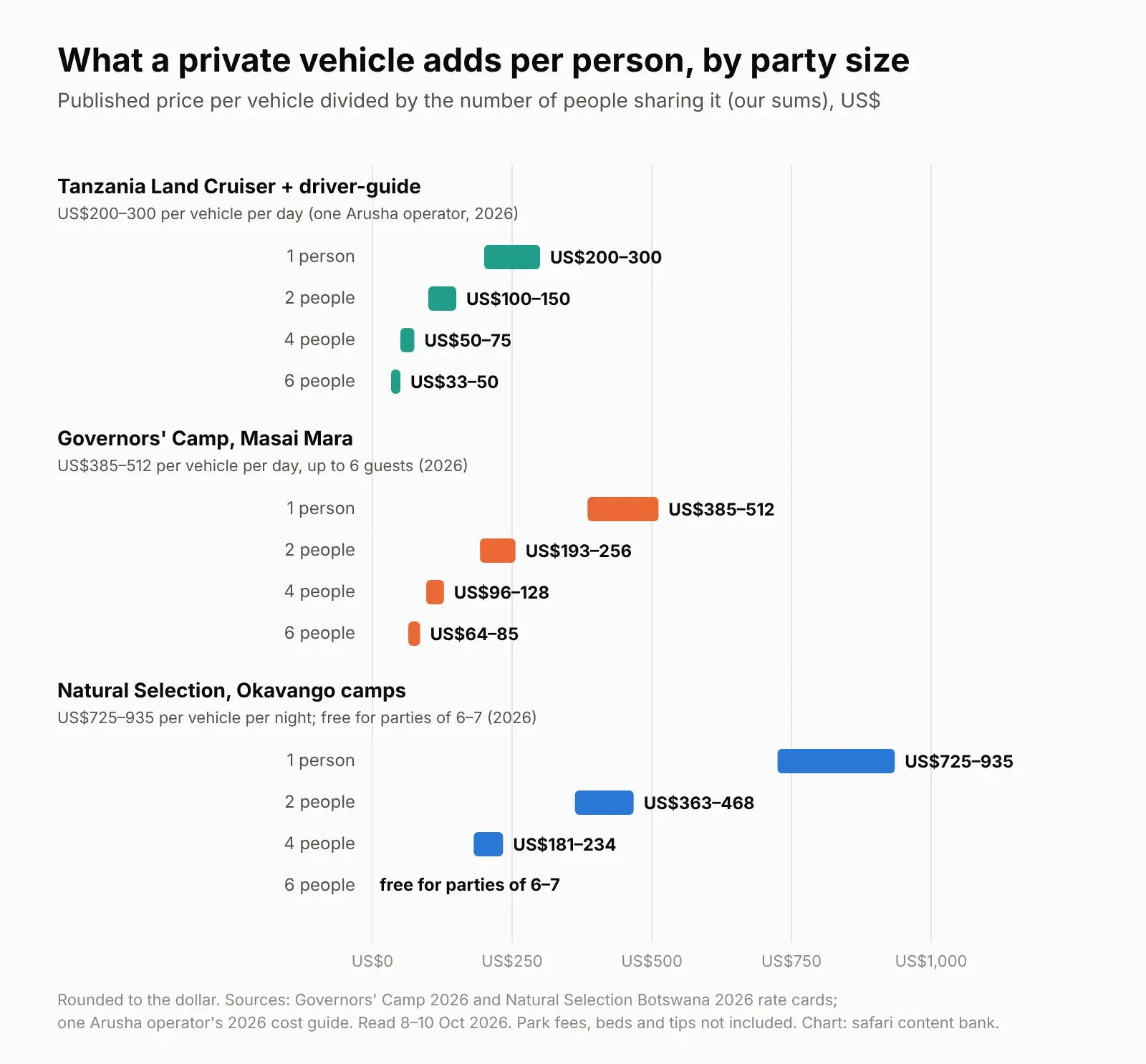 Per-vehicle prices divided by party size (our sums, rounded to the dollar). Sources: Governors’ 2026 and Natural Selection 2026 rate cards; one Arusha operator’s 2026 cost guide. Chart: safari content bank.
- Two people pay half each. US$725–935 a night at Natural Selection comes to US$362.50–467.50 each for two; the Tanzanian US$200–300 a day comes to US$100–150 each for two and US$33–50 each for six (our sums).
- Per-vehicle park charges split the same way. The Ngorongoro Crater descent is US$295 per vehicle: US$147.50 each for two and US$49.17 each for six (NCAA; our sums). See Ngorongoro park fees.
- A private Tanzanian safari for two costs US$406–656 per person per day at mid-range level, against US$220–300 on a group camping safari (operators’ published prices, as on Tanzania safari cost). The extra buys the whole vehicle and the guide’s time at a sighting.
- Mashatu’s own photographic packages in the Northern Tuli (Botswana) are published from ZAR 33,820 per person for 2 nights and ZAR 42,000–50,500 for 4 nights; the year is not stated in our notes (PhotoMashatu).
- We hold no published price for a photographic departure’s vehicle alone, so we cannot say whether a specialist trip or a private vehicle at a camp is cheaper for two; price both.
Which vehicle, and which seat?
For photography the trade-off is height against side access: a pop-top lets you stand and shoot over the roof, an open vehicle puts you at eye level, and a photographic vehicle gives each person a row. Seat counts and trade-offs below are what two safari sellers publish, not official specifications.
| Vehicle | Seats and layout | Where you meet it | For a photographer | Less good |
|---|---|---|---|---|
| Pop-top (closed) Land Cruiser | 6–7 guests plus driver-guide; roof hatch lifts so you stand to view | Tanzania, Kenya, Uganda, Rwanda | Standing view over the roof | Side-window tops can sit below a tall person’s eye line |
| Extended Land Cruiser | Stretched chassis, six guests, larger windows | Tanzania and Kenya private safaris | More room for bags and a second body | Premium price |
| Safari minibus (Toyota HiAce) | Nine seats, seven carried so everyone has a window; pop-up roof | Kenya; some Tanzanian budget operators | Cheapest | No four-wheel drive, low clearance |
| Open game viewer | 6–8 guests on tiered benches; no doors | Botswana, South Africa, Zambia, Zimbabwe, Namibia; Kenyan conservancies | Eye-level shooting, all-round view | Exposed to dust and rain; one side per seat |
| Photographic vehicle | 3–4 guests; bean-bag or clamp mounts; sides or doors removed | Kenya, Tanzania, South Africa, Botswana | A full row per photographer | Cost |
Sources: two safari sellers’ vehicle guides (2026), read 9 October 2026, as on our safari vehicles page.
- In a nine-seat open vehicle the middle seat of a row is not beside the open side. Ask whether the middle seat is sold.
- Kicheche’s Mara camps describe vehicles with side doors removed, lens platforms, padded floors and bean bags, bookable exclusively (a safari operator’s photographic-safari guide). The camps are in the Mara conservancies, where off-road driving is practised.
- Ask for a photograph of the actual vehicle. A Botswana forum thread calls it the most under-checked item in a booking (TripAdvisor, traveller report).
- Say early what angle you want. Guides at Sausage Tree in Olifants West (Greater Kruger) say they place the vehicle before the action, weighing sun, wind and the animal’s likely exit, and cannot move it mid-moment (Sausage Tree, 12 Jan 2026).
Off-road driving, night drives and sighting limits by park
National parks keep you on the track and out of the dark; private reserves, conservancies and concessions let camp vehicles leave the track and drive at night. The wording below is each authority’s, as on our safari vehicles page.
| Where | Off-road | Night drives | Vehicles at a sighting | Source |
|---|---|---|---|---|
| Maasai Mara National Reserve (Kenya) | Prohibited, except to approach big cats on nearby open ground, no closer than 25 m | Ticket covers 06:00–18:00 | Five; others wait at least 100 m away | Narok County’s plan, via Business Daily |
| Mara conservancies (Kenya) | Practised | Sold by camps | No published cap | Mara reserve or conservancies |
| Ol Pejeta and Lewa (Laikipia, Kenya) | Not stated in our sources | Not stated | Ol Pejeta: six, 10 minutes per vehicle; Lewa: two | OPC Tariff Guide 2026; Lewa Code of Conduct |
| Amboseli (KWS) | “Strictly prohibited”; wildlife viewed from at least 20 m | Gates 06:00–18:00 unless you sleep inside | No published cap | KWS, on our Amboseli page |
| Serengeti (Tanzania) | No official text in our sources | None inside the park; Grumeti and Klein’s concessions sell them | No published cap | TANAPA 2023/24 (PDF), last published tariff |
| Ngorongoro Crater | Not without the Conservation Commissioner’s authority | None; driving 06:00–18:00, descent closes 16:00 | None published | NCAA guidelines |
| Kruger National Park | Not in private vehicles; no part of your body out of a window or sunroof | Not in private vehicles; SANParks sells guided drives | No published limit | SANParks |
| Sabi Sand, Timbavati (Greater Kruger) | Lodge vehicles, per operators | On lodge vehicles | No published rule | Kruger or a private reserve |
| Chobe, Moremi (Botswana) | Prohibited | Prohibited | No published count | Botswana Tourism |
| Botswana private concessions (Khwai, Selinda, Linyanti, Kwara, Vumbura) | Allowed, “in moderation” | Allowed | Guests of camps on that lease only | Botswana Tourism |
| South Luangwa (Zambia) | Not stated in our sources | Allowed inside the park; afternoon drives continue after sunset with a spotlight | Not stated | Our South Luangwa page; Lower Zambezi runs dry-season night drives too |
| Etosha (Namibia) | No off-road driving | Not in your own car; camps sell guided drives; floodlit waterholes at Okaukuejo and Halali for camp guests | Not stated | Our Etosha page |
Read 8–10 October 2026. Botswana’s area-by-area rules: night drives, walking and off-road driving in Botswana.
- Travellers report more vehicles than the rules allow. Reviews of the Mara reserve on a safari booking site, 2019–2026, describe 20 to 40 vehicles at a single sighting; at Ndutu a reviewer wrote it “was common to see 15–20 vehicles at a single sighting” in March 2026 (TripAdvisor). Traveller reports, not counts.
- For leopards at night, night drives run in South Luangwa and on private reserves and concessions, not in Moremi, Chobe, the Serengeti or the Mara reserve (where to see leopards).
Hides and boats: where to shoot at eye level
Purpose-built hides are few and specific to a camp; book the camp for its hide, and ask which way the hide faces and at what time of day it works. Most rows below come from one safari operator’s photographic-safari guide and from operators’ own descriptions of their kit; we hold no independent check of any hide or boat.
| Where | What | Season or note | Source |
|---|---|---|---|
| Mashatu, Northern Tuli (Botswana) | Matebole Hide, underground, built for elephant at eye level, “Active since 2012”; Lala Limpopo Hide, an underground night hide | A resident photographer tutors guests in the hide | PhotoMashatu |
| Khwai Private Reserve (NG18) (Botswana) | “Underground photographic hides”, plus off-road and night-drive rights | Individual hides not named or specified in our sources | a safari agent’s Khwai page |
| Savute Safari Lodge, Savuti (Chobe National Park) | Elevated hides at a waterhole | Inside the national park: no off-road, no night drives | An operator’s Chobe page |
| Kasane, Chobe River (Botswana) | A photographic hotel with an underground hide; “eight-seat photo boats with custom gimbals and seats that rotate a full 360 degrees” | Dry season, May–October | A Chobe photographic operator, via a safari agent’s list |
| Duba Plains, Okavango (Botswana) | A specialist photographic boat; Great Plains tents include a professional camera and lens for guests, images downloaded on departure | — | A safari operator’s photographic-safari guide |
| Okavango seasonal floodplains | Motorboat and mokoro trips | Boats from about late May to September; none in January and February | Okavango flood calendar |
| Kaingo Camp, South Luangwa (Zambia) | Four hides: Hippo Hide at river level, an elevated Elephant Hide over a crossing, Wild Dog Lagoon Hide, Carmine Bee-eater Hide | Bee-eaters from September | A safari operator’s photographic-safari guide |
| Tena Tena, South Luangwa | Riverside carmine bee-eater hide | September | Same |
| Camp Hwange (Hwange, Zimbabwe) | Log-pile hides at waterholes: elephant, buffalo, sable, zebra, giraffe, kudu | Dry season | Same |
| Ol Donyo Lodge, Chyulu Hills (Kenya) | Two hides overlooking big-tusker elephants | — | Same |
| Etosha (Namibia) | Olifantsrus camp: a two-storey hide over its waterhole. Private reserves on the boundary: Ongava has a photographic hide; Etosha Heights and Onguma have hides | Dry season for waterholes | Etosha; an operator’s guide to Etosha’s private reserves |
| Lower Zambezi (Zambia) | Camps run boat cruises and canoeing | DNPW charges non-residents US$20 a day for canoeing and US$20 for boating | A safari agent’s guide, read 8–10 October 2026 (DNPW) |
| Mana Pools (Zimbabwe) | Canoe trips on the Zambezi; motorboats banned except on Ruckomechi’s private concession | June–October | Our Mana Pools page |
| Chobe houseboats | Boat game viewing from houseboats moored on the Namibian bank | Guests clear Botswana immigration at Kasane | Our Chobe page |
Read 8–10 October 2026. The operator guide and the Chobe operator are unnamed sellers; names and links are in our editor notes. Hide fees and Kaingo, Camp Hwange and Ol Donyo rates are not in our sources.
The DNPW activity fees in Zambia, with the date and source:
| Fee | Amount | In force from | Source |
|---|---|---|---|
| Ngorongoro Crater descent (crater service fee), per vehicle | USD 295 (NCAA's page does not say whether VAT is included) | Undated official page, read 9 Oct 2026 | NCAA |
| All national parks, non-resident activity fees, per person per day | Boating USD 20; canoeing or rafting USD 20; angling USD 30; camping USD 5 per person | DNPW 2025 schedule, the last published; page last modified 8 May 2025, still shown 9 Oct 2026 | DNPW 2025 fee schedule, as shown on a Zambia travel portal |
- A hide is a camp choice, not a country choice. Our Botswana notes rate hide work as a minor part of the Okavango offer: the underground hides we can name are at Mashatu, in the country’s south-east, and in the Khwai Private Reserve.
- A mokoro is a poor camera platform. You sit on the floor of a narrow canoe poled by a guide; use it for atmosphere and a motorboat for long lenses (Okavango Delta).
- Hides we could not check are left out. Zimanga (KwaZulu-Natal) and several others appear in search results but on no page our sources opened.
Best parks and months by subject
Pick the subject first, then the park and month; most of the reliable photographic windows fall in the Southern African dry season, June to October, with calving at Ndutu the main exception.
| Subject | Where | When | Source |
|---|---|---|---|
| Wildebeest calving and predators | Ndutu and the southern plains (Ngorongoro Conservation Area and southern Serengeti) | Late January to mid-March; peak in February, in two to three weeks | Great Migration month by month |
| Mara River crossings | Kogatende and Lamai (northern Serengeti); the Masai Mara | July–October; no one can date or guarantee a crossing | Same |
| Leopard | Lower Zambezi (88%), South Luangwa (83%), Moremi (76%), Chobe (59%); Sabi Sand publishes no rate | Night drives in South Luangwa, Lower Zambezi (dry season) and on private land | Where to see leopards (one operator’s traveller groups) |
| Wild dog | Moremi (65%), Okavango Delta (61%), Kwando-Linyanti (49%); Mana Pools (58%) | Botswana: pups emerge around June, denning August–September; Mana Pools June–October | Where to see wild dogs |
| Elephants at water | Chobe riverfront by boat; Hwange’s pumped waterholes | Chobe May–October; Hwange July–October | Hwange; one operator’s Chobe page |
| Carmine bee-eaters | South Luangwa; also Lower Zambezi | August–October | South Luangwa |
| Dunes and Deadvlei | Sossusvlei | Any month; sunrise, from inside the gate | Our Sossusvlei page |
| Game at waterholes from your car | Etosha | May–October | Etosha vs Sossusvlei |
| Aerial views | Masai Mara, Serengeti balloons; scenic flights | Dawn | Hot-air balloon safari |
Sighting percentages are the share of one operator’s traveller groups who saw the animal, read September–October 2026, as printed on our species pages. They are not counts. We do not publish rhino locations or den sites.
Month by month
| Month | What photographers plan around | Source |
|---|---|---|
| January | Calving starts at Ndutu late in the month; Okavango seasonal camps run no boats; most South Luangwa bush camps closed | Great Migration; Okavango flood calendar; South Luangwa |
| February | Peak calving at Ndutu; Sossusvlei forum regulars report dramatic cloud and the highest chance of water in the pan, and of road closures | Great Migration; Sossusvlei (TripAdvisor, traveller reports) |
| March | Calving herds usually stay to mid-March | Great Migration (forum posters) |
| April | Okavango flood arrives; Mana Pools camps open from about April | Okavango Delta; Mana Pools |
| May | Okavango boating resumes late in the month; Chobe riverfront’s dry season begins; Kruger gates close at 17:30 (May–July) | Okavango Delta; one operator’s Chobe page; Kruger self-drive |
| June | Wild dog pups emerge in Botswana; Grumeti crossings in the Serengeti’s Western Corridor; Mana Pools’ best months begin | Where to see wild dogs; Great Migration; Mana Pools |
| July | Mara River crossings season opens; Hwange’s best waterhole months begin | Great Migration; Hwange |
| August | Wild dogs denning in Botswana; carmine bee-eaters in South Luangwa; haze and dust spoil photographs in Mana Pools (August–October) | Where to see wild dogs; South Luangwa; Mana Pools |
| September | South Luangwa’s best game; boats still on the Okavango’s seasonal floodplains | South Luangwa; Okavango flood calendar |
| October | Last month of the crossing season; Mana Pools above 40°C; last month of Chobe riverfront’s dry season | Great Migration; Mana Pools; one operator’s Chobe page |
| November | Kruger gates open 05:30–18:30 (November–February); Mana Pools camps close by December | Kruger self-drive; Mana Pools |
| December | Herds settle on the southern short-grass plains ahead of calving; Lower Zambezi tracks impassable, most camps closed (December–March) | Great Migration; Lower Zambezi |
From our park and planning pages as linked, read 8–10 October 2026. For general timing see best time for a safari and the green season.
Light and gate hours
The best light is the first and last hour, and gate hours decide whether you can be there for it: in public parks most gates open at 05:30–06:00 and close at 17:30–19:00, while camps inside the park or on private land reach the light first. Our sources hold no sunrise or sunset tables for any park.
| Park | Hours | What it means for light | Source |
|---|---|---|---|
| Kruger (entrance gates) | Open 05:30 (October–March) or 06:00 (April–September); close 17:30 (May–July) to 18:30 (November–February) | Camp gates open at 04:30 in November–January; late arrivals at an entrance gate are refused | SANParks entrance gates |
| Etosha (Okaukuejo) | Follows sunrise and sunset: opens 06:10–07:30, closes 18:25–19:40, by month | Be in a camp or out of the park by sunset | A safari agent’s guide, read September–October 2026 |
| Sossusvlei (Sesriem) | Outer gate 06:00–18:00 (September–April), 06:45–18:00 (June–August); inner gate one hour earlier and later, for guests sleeping inside | Only inside guests reach Deadvlei in the first light | A safari agent’s guide, read September–October 2026, on our Sossusvlei page |
| Ngorongoro | Driving 06:00–18:00; crater descent closes 16:00 | Rim lodges give the earliest descent | NCAA guidelines |
| Masai Mara reserve | Ticket covers 06:00–18:00 | Camps inside or on the boundary are at the sighting at opening | Our Masai Mara park fees page |
| KWS parks (Amboseli, Tsavo) | 06:00–18:00 unless you sleep inside | Sleep inside to drive gate opening to closing | KWS |
| South Luangwa | DNPW park day 06:00–18:00; one camp’s guests are covered until 20:00 for night drives | Dusk and the night drive are inside the park | A safari agent’s guide, read September–October 2026 (DNPW); Flatdogs rates |
| Chobe | April–September 06:00–18:30; October–March 05:30–19:00 | No night driving; be at your campsite before closing | A booking agent’s site; no DWNP page found |
| Serengeti | No official gate hours in our sources | Ask your camp | — |
Read September–October 2026. Etosha and Chobe hours come from non-official sites, as labelled.
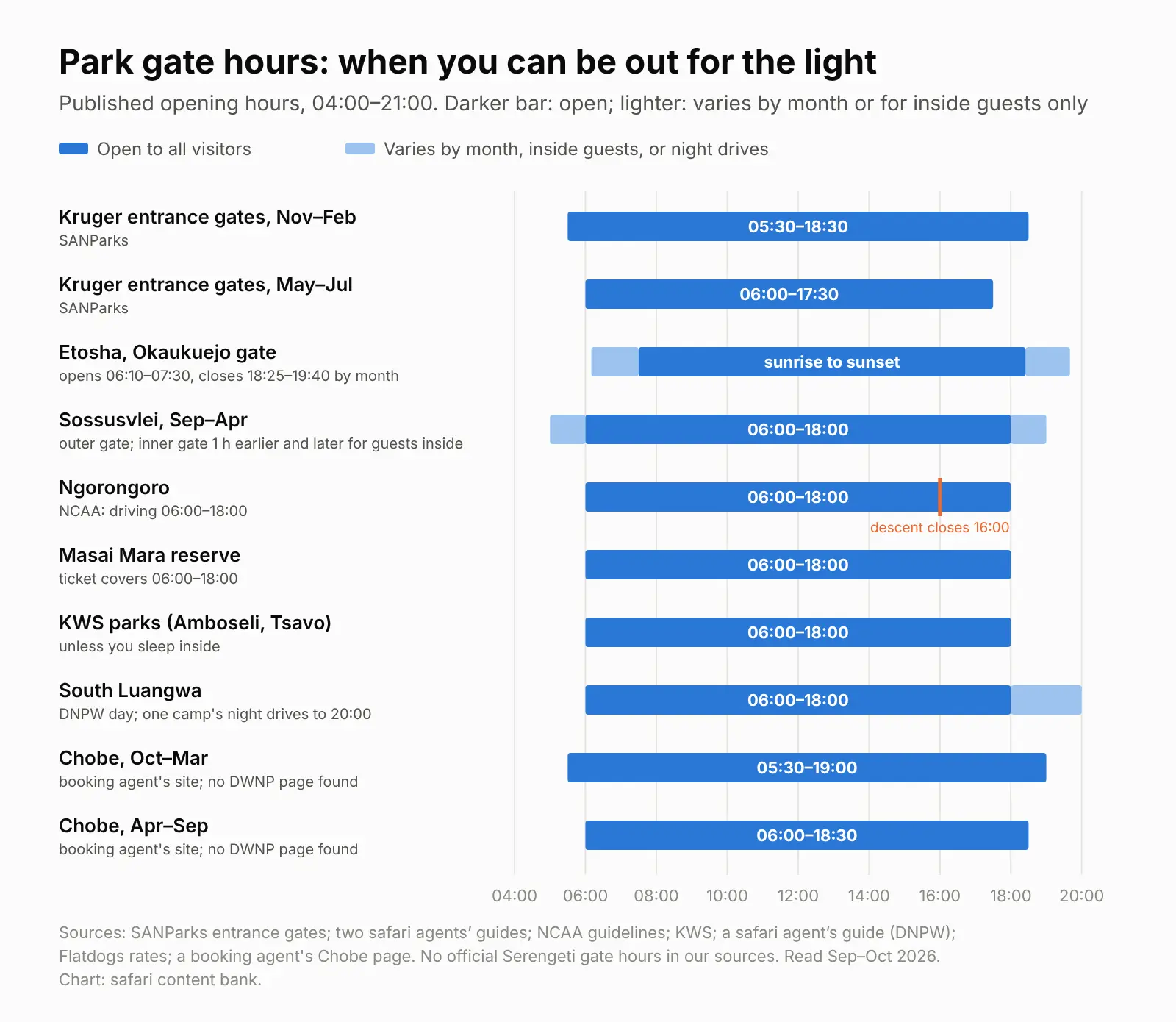 Sources: SANParks entrance gates; two safari agents’ guides; NCAA guidelines; KWS; a safari agent’s guide (DNPW); Flatdogs rates; a booking agent’s Chobe page (no DWNP page found). Read September–October 2026. Chart: safari content bank.
What working photographers advise, from interviews and articles our sources opened:
- Shoot into the rising sun for backlight, focus on the eye and get low; a monopod lowered beside the seat gives eye-level frames from a vehicle (Sipps Maswanganyi, head guide at Cheetah Plains, Sabi Sand, in Afar, 7 Mar 2023).
- Plan the day around dawn and dusk and raise ISO to stretch the twilight; do not change lenses in dust or rain (Henk Venter, interviewed on a safari operator’s blog, updated 9 May 2024).
- Stay on the tracks and use focal length instead of driving closer; if an animal stops feeding, hunting or mating, you are too close (Patrick Bentley, in TravelAwaits, 20 Aug 2021).
- Light comes first, mood second: Greg du Toit scouts how light falls on a place and waits there, shooting from a vehicle or a covered pit (CNN, via Yahoo, 13 Sep 2024).
- Haze and dust spoil photographs in Mana Pools from August to October (one safari operator’s guide, on our Mana Pools page).
Luggage limits on bush flights: cameras count
Light aircraft allow 15 kg per person in Kenya and Uganda and 20 kg in Tanzania (Auric Air) and Botswana, hand luggage included, in a soft bag; several carriers say in writing that cameras count. The long-haul flight is not the limit; the smallest plane is.
| Carrier | Allowance | Cameras | Bag rule | Extra weight | Source |
|---|---|---|---|---|---|
| Safarilink (Kenya) | 15 kg incl. hand baggage; 20 kg on some coast and city routes, not the Mara | Inside the 15 kg | Soft bags; large rigid suitcases “may be offloaded” | Listed as 2023/24 rates: 0–10 kg US$50; 11–20 kg US$80 prepaid; a freight seat at the adult fare carries 75 kg more (safari routes) | Safarilink |
| AirKenya (Kenya) | 15 kg incl. 5 kg hand luggage | Inside the 15 kg | Soft-sided; checked bag 60 × 45 × 33 cm | US$5 per kg, may be refused on the day; freight seat up to 75 kg | AirKenya |
| Aerolink (Uganda) | 15 kg incl. 5 kg hand luggage | Inside the 15 kg | Soft-sided | US$5 per kg; freight space up to 75 kg at the child fare plus taxes | Aerolink 2025 baggage policy (PDF) |
| Auric Air (Tanzania) | 20 kg incl. hand luggage and cameras | Named in the allowance | Soft-sided recommended; max piece 90 × 65 × 35 cm | Extra 10 kg: US$60 on safari routes; freight seat 75 kg | Auric Air |
| Ker & Downey (Safari Air, Botswana) | 20 kg incl. camera gear and hand luggage | Named in the allowance | Soft duffel, “no wheels or frames”; 65 × 40 × 30 cm | Not stated | Ker & Downey |
| Moremi Air (Kwando, Botswana) | 20 kg incl. cameras and hand luggage | Named in the allowance | “hard case bags will not be accepted”; 70 × 35 × 30 cm | Kwando: 50% of the seat rate for up to 15 kg extra, 100% for 15–40 kg | Botswana bush flights |
| Mack Air (Botswana, Zimbabwe) | 20 kg incl. hand luggage | Inside the 20 kg | Soft-shell; 70 × 42 × 30 cm | Not stated | Mack Air |
| FedAir (South Africa: Sabi Sand, Timbavati, Madikwe, Phinda) | 20 kg in the hold plus 5 kg hand luggage; X-Class fare 32 kg | Hand allowance separate | Soft-sided preferred; hard shell at most 40 × 30 × 60 cm | Under 10 kg R800; 10–20 kg R1,500; freight seat R2,000 | FedAir 2026 manual (PDF) |
| Skeleton Coast fly-in safaris (Namibia) | 10 kg incl. hand luggage | Inside the 10 kg | Soft; 60 × 40 × 40 cm | Not stated | A safari agent’s reference page |
Carriers’ own baggage pages, read 9–10 October 2026, as on our safari packing list and fly-in safari cost pages. We could not read Coastal Aviation’s, Regional Air’s or Wilderness Air’s own rules for cameras.
- Hard camera cases are the usual casualty. Moremi Air refuses hard cases outright; Safarilink may offload large rigid suitcases to the next flight. Carry lenses in a soft bag inside the allowance.
- A freight seat is the published way to carry more: 75 kg extra on Safarilink’s safari routes at the adult fare, up to 75 kg on AirKenya and Auric Air, R2,000 on FedAir. Book it in advance; excess sold on the day “may be refused” (AirKenya).
- In Botswana a bag 1–15 kg over the limit costs US$125 each way on a US$250 Maun–Kwara seat: 50% of the seat rate on Kwando’s 2024 card, as on Botswana bush flights.
- By road there is no comparable limit. Mashatu in the Northern Tuli is reached by road from Johannesburg, and Kruger’s gates are 411–600 km from Johannesburg by road (Kruger self-drive).
Drones: permits before you travel
Do not pack a drone for a safari unless you hold the permits before you arrive: Kenya and Tanzania require civil-aviation permits, Namibia needs approval at least 60 days ahead, and SANParks bans drones in and over its parks. None of the rules below lets a tourist fly from a game-drive vehicle without permission.
| Country or park | Rule | Cost | Source |
|---|---|---|---|
| Kenya | Importing or exporting a drone without prior Kenya Civil Aviation Authority (KCAA) approval is illegal; no flight above 400 ft or within 50 m of any person, vehicle or structure, and none at night; no image of a person without that person’s written consent | Temporary permit KES 20,000; in KWS parks, US$300 per drone per day per park for non-residents, with a KCAA licence | FCDO; KCAA UAS Regulations 2020 (PDF); KWS Fees Regulations 2025 (PDF) |
| Tanzania | Non-residents apply at least 3 weeks before arrival; “Without TCAA Import Permit, the drone will be confiscated at the entry point upon arrival” | Non-resident, drone under 5 kg: import permit US$50, registration US$100, operations permit US$10 per day | TCAA, drones; TCAA, drone charges |
| Ngorongoro | The NCAA visitor guidelines in our sources do not mention drones | — | NCAA guidelines |
| Namibia | NCAA authorisation applied for at least 60 days ahead, plus MEFT permission for any national park; maximum 45 m (150 ft) | Application fee N$1,200 | Drone Laws, Namibia (secondary summary) |
| South Africa (SANParks) | Drones banned in and over its parks, including Kruger | — | SANParks rules |
| Zimbabwe (Mana Pools, Hwange) | Drones need a permit | No price in our sources | 4x4afrika.com, 19 Jan 2026 |
| Gorilla parks (Uganda, Rwanda) | Neither UWA nor RDB publishes a drone rule on the pages we checked | — | Gorilla trekking day |
| Botswana, Zambia, Uganda, Rwanda (civil aviation) | No civil-aviation drone rules in our sources | — | — |
Read 8–10 October 2026, as on our safari packing list. A summary of Chobe park rules in our bank says drones need a written DWNP permit, but we hold no DWNP document, so we do not print it as a rule.
- The KWS park fee does not replace the KCAA permit. The schedule prices drone use “KCAA licenses required”, per drone, per day, per park.
- For aerial pictures, take a balloon or a scenic flight instead: see hot-air balloon safari.
Which to choose
Match the booking to the picture you want: the land rules and the number of people in the vehicle matter more than the camp’s star rating.
| If you want… | Book | Avoid | Why |
|---|---|---|---|
| Leopard and nocturnal species | South Luangwa, Lower Zambezi (dry season), or a private concession or reserve with night drives | Moremi, Chobe, the Serengeti, the Mara reserve | Night drives are prohibited there |
| To follow wild dogs off the track | A Botswana private concession, June–September | Moremi, despite its higher sighting rate | Off-road driving is prohibited in the reserve |
| Eye-level elephants and water | A Chobe photo boat, May–October; hides at Mashatu or Camp Hwange | A mokoro as a camera platform | Low, stable platform |
| River crossings | Kogatende, Lamai or the Mara, July–October, with several days | One day at the river | Crossings cannot be dated |
| Calving and predators | Ndutu, February | The Masai Mara in February | Calving happens only in Tanzania |
| Control of time and position, two people | A private vehicle at a camp (US$550–935 a night in Botswana, 2026) | A shared vehicle that seats six or nine | You choose where and how long |
| Heavy lenses | Road transfers, or a pre-booked freight seat | Hard cases on light aircraft | 15–20 kg limits include cameras |
| Aerial images | Balloon or scenic flight | A drone without permits | Permits take weeks; Tanzania confiscates |
Common mistakes on a photography safari
| What you’ll often read | What is correct |
|---|---|
| “A photographic safari means a smaller group” | Only if the vehicle cap is written down. Botswana’s lodge vehicles seat six or nine; photographic vehicles take 3–4. Ask for the maximum per vehicle and whether the middle seat is sold. |
| “Luxury camps give you a private vehicle” | At most camps you share the camp’s vehicle; a private one is an extra: US$385–512 a day at Governors’ Camp, US$725–935 a night at Natural Selection (2026). |
| “An open vehicle can go off-road” | The land decides. Lodge vehicles in Chobe and Moremi are open-sided and off-roading is still prohibited there (Botswana Tourism). |
| “Camera gear goes in hand luggage on top of the allowance” | On Auric Air, Ker & Downey and Moremi Air the 20 kg includes cameras and hand luggage; FedAir is the exception with 5 kg of hand luggage on top. |
| “You can fly a drone in the parks with a park ticket” | Kenya and Tanzania require civil-aviation permits first, and Tanzania confiscates drones without an import permit at the entry point. SANParks bans them. |
| “Night drives in the Serengeti” | Not inside the park; only in private concessions outside it, such as Grumeti or Klein’s. |
| “Stay outside the gate and drive in for sunrise” | At Sossusvlei only guests sleeping inside leave by the inner gate an hour earlier; in Kruger, Etosha and the KWS parks you are on gate hours unless you sleep inside. |
| “Post the location with the picture” | Strip GPS and location data from wild dog photos before you post them, and do not name the den area, road or waterhole (where to see wild dogs). |
Frequently asked questions
Is a private vehicle worth it for photography? For two keen photographers it usually is: you choose where to sit, where to stop and how long to stay. On 2026 rate cards a private vehicle costs US$385–512 a day at Governors’ Camp in the Masai Mara and US$550–935 a night at Machaba and Natural Selection in Botswana, which is US$275–467.50 each per night for two (our sums). On a Tanzanian road safari the vehicle is usually yours anyway, at US$200–300 a day per vehicle.
How many people share a safari vehicle? Shared trips in our sources publish four to seven guests per vehicle in Kenya and Tanzania. Botswana Tourism says its lodges’ open-sided vehicles seat six or nine. Photographic vehicles take three or four guests, and a Chobe photographic operator caps its vehicles at four photographers.
Can I drive off-road for a better angle? Not in most national parks. The Masai Mara reserve allows it only to approach big cats on nearby open ground, no closer than 25 m; Botswana’s parks and reserves prohibit off-roading and night driving; Kruger bans both in private vehicles. Botswana’s private concessions allow off-road driving “in moderation”, and the Mara conservancies practise it.
Where are the best photographic hides in Africa? Among the hides our sources name, Mashatu in the Northern Tuli (Botswana) has two underground hides, Matebole and the Lala Limpopo night hide; the Khwai Private Reserve has underground hides; Camp Hwange has log-pile hides at waterholes; Kaingo Camp in South Luangwa has four, including a carmine bee-eater hide; and Etosha’s Olifantsrus camp has a two-storey hide. We hold no independent review of any hide.
How much camera gear can I take on a bush flight? 15 kg per person including hand luggage in Kenya (Safarilink, AirKenya) and Uganda (Aerolink); 20 kg in Tanzania on Auric Air and in Botswana, and Auric Air, Ker & Downey and Moremi Air name cameras inside that allowance. Skeleton Coast fly-in safaris allow 10 kg. To carry more, book a freight seat: 75 kg on Safarilink’s safari routes at the adult fare.
Can I fly a drone on safari? Not without permits arranged before you travel. Kenya needs prior KCAA approval to import a drone and charges US$300 per drone per day in KWS parks; Tanzania confiscates drones without a TCAA import permit at the entry point; Namibia needs NCAA approval at least 60 days ahead; SANParks bans drones in and over its parks.
What is the best month for a photography safari? It depends on the subject: February for calving at Ndutu, July–October for Mara River crossings, June–September for wild dog dens in Botswana, August–October for carmine bee-eaters in South Luangwa, and May–October for elephants on the Chobe River. Mana Pools is best from June to October, though haze and dust spoil photographs from August.
What time do park gates open for sunrise? Kruger’s entrance gates open at 05:30 from October to March and 06:00 from April to September; Etosha’s Okaukuejo gate opens between 06:10 and 07:30 by month; the Masai Mara ticket and the KWS parks run from 06:00. At Sossusvlei the inner gate opens an hour before the outer gate for guests sleeping inside. We found no official gate hours for the Serengeti.
Sources
- Rules: Narok County’s Greater Maasai Mara management plan, as reported by Business Daily; OPC Tariff Guide 2026; Lewa Code of Conduct; NCAA visitor guidelines; Botswana Tourism, game viewing; SANParks vital information, rules and regulations and entrance gates; KWS, Amboseli; TANAPA, Tariffs 2023/24 (PDF), the last published tariff
- Fees: NCAA, tariffs, read 9 Oct 2026; a safari agent’s guide to park entry fees (DNPW 2025 schedule, the last published)
- Private vehicles: rate cards of Governors’ Camp 2026, Machaba 2026, Natural Selection 2026, Kwando 2024, Time + Tide 2027, Bushcamp Company 2026, Thornybush 2026 and Tswalu; a safari seller’s survey of 2026 rate cards; operators’ published group and private prices (unnamed)
- Hides and boats: PhotoMashatu; a safari agent’s Khwai page; a safari agent’s list of photographic operators; a safari operator’s photographic-safari guide, an operator’s Chobe page and an operator’s guide to Etosha’s private reserves (unnamed; names and links in our editor notes)
- Gates: SANParks; two safari agents’ guides, read 10 October 2026; NCAA; KWS; a safari agent’s guide, read 10 October 2026 (DNPW); Flatdogs rates; a booking agent’s Chobe page
- Luggage: Safarilink; AirKenya; Aerolink 2025 baggage policy (PDF); Auric Air; Ker & Downey; Mack Air; Kwando 2024 rate card; FedAir 2026 manual (PDF); a safari agent’s reference page (Skeleton Coast)
- Drones: FCDO, Kenya entry requirements; KCAA UAS Regulations 2020 (PDF); KWS Fees Regulations 2025 (PDF); TCAA drones and charges; Drone Laws, Namibia; 4x4afrika.com
- Photographers’ advice: Afar, 7 Mar 2023; TravelAwaits, 20 Aug 2021; CNN, via Yahoo, 13 Sep 2024; Sausage Tree, 12 Jan 2026; a safari operator’s blog (unnamed)
- Traveller reports, not facts: TripAdvisor threads as linked; a safari booking site’s Mara reviews
- Our pages for the detail: safari vehicles, private vs group safari cost, safari packing list, fly-in safari cost, Botswana bush flights, Great Migration month by month, where to see leopards, where to see wild dogs, Kruger self-drive, Etosha vs Kruger
Rules, prices, gate hours and baggage limits checked 8–10 October 2026. We will update this page when camps issue 2027 rate cards, when TANAPA publishes a tariff after 2023/24 or official Serengeti gate hours, when Botswana’s CAAB or DWNP drone rules can be read, and when Coastal Aviation, Regional Air or Wilderness Air publish baggage rules we can read.