 Experience

Last verified
On this page
- Tanzania vs South Africa at a glance (2026)
- Which is cheaper, Tanzania or South Africa?
- Park fees: TANAPA and NCAA vs SANParks
- Getting there and getting around
- Malaria and health: the clearest difference
- Wildlife: the migration or the Big Five
- When to go: seasons in each country
- Crowds and game-drive rules
- Families: ages, fees and malaria
- Entry: Tanzania’s visa and insurance vs South Africa’s traveller declaration
- Can you combine Tanzania and South Africa?
- Which should you choose?
- Common mistakes in Tanzania vs South Africa comparisons
- Frequently asked questions
- Sources
Short answer: Choose Tanzania for the wildebeest herds: calving at Ndutu peaks in February, and Mara River crossings run from July to October. Choose South Africa for self-drive, rhino or no malaria tablets. A night inside the Serengeti costs US$129.80–153.40 per adult in park fees (last published tariff, 2023/24); Kruger charges R692 a day from 1 November 2026 (R602 until 31 October 2026). Tanzania adds a US$50 visa and US$44 insurance; UK and US citizens need no South African visa.
Key facts
- Tanzania’s safari parks carry malaria risk all year; South Africa has reserves with none. WHO lists malaria risk all year in the whole of Tanzania below 1,800 m. UK TravelHealthPro rates South Africa’s North West and Eastern Cape reserves (Madikwe, Pilanesberg, Addo) no risk, and recommends tablets for Kruger from September to May.
- Tanzania’s park fees date from 2023/24; Kruger’s 2026/27 fee is in force. No Tanzania National Parks (TANAPA) tariff newer than 2023/24 has been published: Serengeti entry is US$82.60 per adult per day with VAT, plus US$59–70.80 a night if you sleep inside. Kruger charges R692 per international adult per day from 1 November 2026 (R602 until 31 October 2026; SANParks).
- The wildebeest migration is a Tanzanian (and Kenyan) event. The Tanzania Wildlife Research Institute (TAWIRI) counted 1,366,109 wildebeest at the end of March 2023; our South African sources describe no migration of that kind.
- South Africa held 14,389 rhinos at the end of 2024 and Tanzania 268 (IUCN SSC African Rhino Specialist Group report to CITES, 2025).
- Kruger can be self-driven in an ordinary hire car; Tanzania’s northern circuit is usually driven by a guide. A private Land Cruiser with a driver-guide costs about US$200–300 per vehicle per day, and forum experts advise first-timers against driving themselves.
- Neither country’s flagship park allows night drives in your own vehicle. Night drives are not permitted in the Serengeti or the Ngorongoro Conservation Area; in Kruger only SANParks’ own guided drives go out after dark. Tanzania’s Tarangire, Lake Manyara, Nyerere and Ruaha, and the Greater Kruger private reserves, sell them.
Tanzania vs South Africa at a glance (2026)
Tanzania sells the wildebeest herds, open plains and a guided road circuit priced in US dollars; South Africa sells bushveld you can drive yourself, most of Africa’s rhino and reserves outside the malaria area.
| Tanzania | South Africa | Source | |
|---|---|---|---|
| Main safari areas | Northern circuit: Serengeti, Ngorongoro Crater, Tarangire, Lake Manyara; in the south, Nyerere and Ruaha | Kruger National Park and the Greater Kruger private reserves; malaria-free reserves in North West, the Waterberg and the Eastern Cape | Tanzania and South Africa hubs |
| Flagship park fee, foreign adult | Serengeti US$82.60 a day with VAT, plus US$59–70.80 a night inside the park (last published tariff, 2023/24) | Kruger R692 a day (R602 until 31 Oct 2026) | TANAPA 2023/24; SANParks 2025/26 and 2026/27 |
| Cheapest guided trip, per person per day | US$220–300, group camping from Arusha | US$214–242, shared Kruger tours | Operators’ published prices, read 8–9 Oct 2026 |
| Cheapest bed in the bush | Serengeti public campsite US$35.40 per person with VAT (last published tariff, 2023/24), plus park fees | SANParks campsite R484–508 per site (stays 9–18 Oct 2026), plus the park fee | TANAPA 2023/24 (PDF); SANParks Kruger |
| Camp or lodge, per person sharing per night | US$125–2,250 (Tloma Lodge to Namiri Plains and Sayari, 2026), park fees not included | R7,300–44,000 (Elephant Plains to Sabi Sabi Earth Lodge, 2026) | Rate sheets, below |
| How you game-view | Driver-guide’s 4x4, mostly by road from Arusha; light aircraft as a shortcut | Your own hire car in Kruger; lodge vehicles in the private reserves | Tanzania safari cost; Kruger vs private reserves |
| Wildebeest migration | Calving at Ndutu January–March; Mara River crossings July–October | None in our sources | Great Migration month by month |
| Rhino, end of 2024 | 268 (species split not given) | 14,389 (2,307 black, 12,082 white) | IUCN SSC African Rhino Specialist Group report to CITES, 2025 |
| Night drives | Not in the Serengeti or Ngorongoro; sold in Tarangire, Lake Manyara, Nyerere and Ruaha | SANParks’ own drives in Kruger; lodge vehicles in the private reserves | TANAPA 2023/24; SANParks |
| Malaria | Risk all year below 1,800 m (WHO) | Kruger: tablets recommended September–May; North West and Eastern Cape no risk | WHO list (PDF); TravelHealthPro |
| Entry, UK citizens | Visa US$50 + compulsory insurance US$44, as of October 2026 | No visa for up to 90 days; online traveller declaration for all arrivals from 1 July 2026 | Tanzania e-visa; UK FCDO |
| Currency of camp and lodge rates | US dollars; bring clean US dollar notes from 2009 or later for tips and extras | Rand (tour listings often in US dollars) | Rate sheets; Tanzania safari questions |
Fees and prices as on our Tanzania safari cost and South Africa safari cost pages, checked 8–10 October 2026. Non-East African (Tanzania) or international (South Africa) adult. We print each price in the currency it is published in and do not convert.
Which is cheaper, Tanzania or South Africa?
South Africa is cheaper if you drive yourself; at the budget guided level the two are close in US dollars, and Tanzania’s park fees widen the gap from there. Group camping from Arusha is published at US$220–300 per person per day and shared Kruger tours at US$214–242. The one source in our bank that prices both countries, a budget operator’s 2026 first-safari guide, gives US$400–740 a day for a Serengeti safari and US$240–470 for Kruger. Camp and lodge rates are in US dollars in Tanzania and in rand in South Africa, and we do not convert.
| Tier | Tanzania, per person | South Africa, per person | Source |
|---|---|---|---|
| Self-drive camping | Serengeti public campsite US$35.40 a night, plus US$82.60 a day entry; a foreign-plated car pays US$150 + VAT per park entry (2,001–3,000 kg); all last published tariff, 2023/24 | SANParks campsite R484–508 a night per site, plus R692 per adult per day (R602 until 31 Oct 2026), in an ordinary hire car | TANAPA 2023/24 (PDF); SANParks Kruger |
| Budget guided, per day | Group camping from Arusha: US$220–300; the 4- and 5-day listings say “all meals & park fees included” | Shared Kruger tours: US$214–242; the listings do not say whether the Kruger fee is included | Operators’ published 2026 prices, read 8–9 Oct 2026 |
| One-source daily range | US$400–740 a day (Serengeti) | US$240–470 a day (Kruger) | One budget operator’s 2026 first-safari guide |
| Private trip, per day | 7-day private northern circuit for two: US$406–656 (mid-range); US$578–873 (luxury, drive-in) | Private Kruger safari, 3 days: US$371–405; Sabi Sand + Kruger private, 5 days: US$579–652 | Operators’ published 2026 prices |
| Mid-range camp or lodge, per night | Serengeti Wilderness Camp US$250–400; Lemala Ewanjan US$305–595, park fees not included | Elephant Plains, Sabi Sand: R7,300 rondavel / R9,300 suite (2026) | A safari agent’s listing; Lemala; Elephant Plains |
| Luxury camp or lodge, per night | Namiri Plains US$740–2,250; Sayari US$980–2,250, park fees not included | Thornybush Game Lodge R19,800; Sabi Sabi Bush Lodge R29,600 to Earth Lodge R44,000 | A safari agent’s listing; Thornybush 2026 (PDF); Sabi Sabi |
| Top end in our sources | Singita Grumeti camps US$2,210–3,220 (2026) | Singita Ebony R51,665–60,470 (page undated) | Singita Serengeti 2026 (PDF); Singita Ebony |
Per person sharing, low to peak season where the card has seasons, without international flights. Rate sheets and listings read 8–9 October 2026. Tour listings are usually based on two travellers. Lodge rates include meals and game drives; the Tanzanian camp rates leave park fees out, the South African ones leave reserve levies out, so compare line by line.
“From” prices are lower than what two people pay
Tanzania’s advertised prices assume a full vehicle in low season; South Africa’s assume two people on the cheapest date. For two people in peak season, one Tanzanian operator’s price is 54% higher than its “from” price and another’s 78% higher, because the vehicle and the crater fee are charged per vehicle (Tanzania safari cost). South African tour listings do not itemise inclusions, so ask whether the Kruger fee is in the price and which nights fall after 1 November 2026 (South Africa safari cost).
What comes on top of the rate
In Tanzania, budget for park and concession fees, the crater fee and the vehicle; in South Africa, for the Kruger fee or a private reserve’s gate fee or levy.
| Extra | Tanzania | South Africa | Source |
|---|---|---|---|
| Park fee | Serengeti US$82.60 per adult per day; Tarangire and Lake Manyara US$53.10–59 (last published tariff, 2023/24) | Kruger R692 per adult per day (R602 until 31 Oct 2026) | Tanzania and South Africa cost pages |
| Sleeping inside the park or reserve | Serengeti concession US$70.80 (Jul–Sep) or US$59 (Oct–Jun) per night (last published tariff, 2023/24); Ngorongoro rim and Ndutu lodges US$59 per night (NCAA) | Timbavati levy R660 per adult per night; Sabi Sand gate R170 per person + R370 per vehicle per entry; lodge levies Sabi Sabi R450, Thornybush R650, Simbambili R850 | NCAA; Timbavati; Sabi Sand access |
| Crater or special area | Ngorongoro entry US$70.80 per adult per 24 h + crater descent US$295 per vehicle (NCAA’s page does not say whether VAT is included) | None in Kruger | NCAA |
| Vehicle | Private Land Cruiser with driver-guide US$200–300 per vehicle per day | Your hire car in Kruger (no price in our sources); Thornybush private vehicle R17,500 a day | One operator’s cost guide; Thornybush 2026 (PDF) |
| Entry | Visa US$50 (US citizens US$100) + insurance US$44 per adult | None for UK and US citizens | Tanzania and South Africa cost pages |
Read 8–10 October 2026. Tipping guidance for both countries: safari tipping.
Park fees for two adults for one day, before beds and the vehicle (our sums): inside the Serengeti from July to September, 2 × US$153.40 = US$306.80; in Kruger, 2 × R692 = R1,384 from 1 November 2026 (2 × R602 = R1,204 until 31 October 2026). A Ngorongoro Crater day for two in a private vehicle costs US$295 + 2 × US$70.80 = US$436.60 in fees, as on our Tanzania safari questions page.
Park fees: TANAPA and NCAA vs SANParks
Tanzania’s fees are higher per night and stacked across two authorities, and its national-park tariff is three years old; South Africa’s Kruger fee is one SANParks figure, already published to October 2027.
| Tanzania (TANAPA, NCAA) | South Africa (SANParks, Kruger) | |
|---|---|---|
| Who sets it | TANAPA for the national parks; the Ngorongoro Conservation Area Authority (NCAA) for Ngorongoro and Ndutu | SANParks, revised every 1 November |
| Foreign adult, per day | Serengeti US$82.60 with 18% VAT (US$70 + VAT), US$70.80 from 15 March to 15 May; Tarangire, Lake Manyara, Arusha US$53.10–59 | R692 per day (1 Nov 2026–31 Oct 2027; R602 until 31 Oct 2026) |
| Sleeping inside | Serengeti concession fee US$70.80 a night (July–September), US$59 (October–June) | Fee charged per person per day on top of SANParks accommodation, plus a 1% community fund |
| Crater and conservation area | Ngorongoro entry US$70.80 per 24 h, single entry; crater descent US$295 per vehicle | None; the private reserves charge their own fees instead |
| Child | Serengeti 5–15: US$20 before VAT; Ngorongoro 5–15: US$23.60; under 5 free | Ages 2–11: R345 (R300 until 31 Oct 2026); under 2 free |
| Status | No TANAPA tariff newer than 2023/24 has been published. Fee rises frozen for 12 months on 24 March 2025; 12 months’ notice promised. NCAA’s page is undated | Both schedules published by SANParks |
| How you pay | Electronically, through the government payment gateway (GePG); no cash at the gate | Cashless gates; pay by card |
Sources: TANAPA Tariffs 2023/24 (PDF), the last published tariff; NCAA tariffs, undated page, read 9 Oct 2026 (it does not say whether VAT is included); The Citizen, 24 Mar 2025; Tourism Update; SANParks 2025/26 (PDF) and 2026/27 (PDF) schedules and Kruger rates page. Checked 9–10 October 2026.
- Two adults, 3 nights (our sums): inside the Serengeti from July to September, 2 × 3 × US$153.40 = US$920.40 in entry and concession fees. In Kruger in December 2026, 2 × 3 × R692 = R4,152, as on our South Africa safari cost page.
- Ndutu, the February calving base, is in the Ngorongoro Conservation Area, not the Serengeti, and charges NCA fees. NCA entry is single-entry, so a vehicle that drives in on the Arusha–Serengeti road and back out the same way pays it twice.
- Kruger’s fee does not change with the season, only on 1 November; Tanzania’s entry fee drops from 15 March to 15 May and its concession fee rises from July to September. Every tier: Tanzania park fees, Serengeti park fees, Ngorongoro Crater fees and Kruger park fees.
The official fee lines, with the date each took effect and the source:
| Fee | Amount | In force from | Source |
|---|---|---|---|
| Serengeti and Nyerere National Parks, non-East African adult, entry per day, 16 May–14 Mar | USD 70 + 18% VAT = USD 82.60 | 1 Jul 2023 (2023/24 tariff, last published) | TANAPA Tariffs 2023/24 |
| Serengeti and Nyerere National Parks, non-East African adult, entry per day, 15 Mar–15 May | USD 60 + 18% VAT = USD 70.80 | 1 Jul 2023 (2023/24 tariff, last published) | TANAPA Tariffs 2023/24 |
| Serengeti and Nyerere, concession fee per person per night inside the park | Jul–Sep USD 60 + VAT = USD 70.80; Oct–Jun USD 50 + VAT = USD 59 | 1 Jul 2023 (2023/24 tariff, last published) | TANAPA Tariffs 2023/24 |
| Tarangire, Lake Manyara and Arusha National Parks, non-East African adult, entry per day | Peak USD 50 + VAT = USD 59; low USD 45 + VAT = USD 53.10 | 1 Jul 2023 (2023/24 tariff, last published) | TANAPA Tariffs 2023/24 |
| Ngorongoro Conservation Area, non-East African adult, entry per 24 h (single entry) | USD 70.80 (NCAA's page does not say whether VAT is included) | Undated official page, read 9 Oct 2026 | NCAA |
| Ngorongoro Crater descent (crater service fee), per vehicle | USD 295 (NCAA's page does not say whether VAT is included) | Undated official page, read 9 Oct 2026 | NCAA |
| Ngorongoro concession fee, rim and Ndutu lodges, per person per night | USD 59 (NCAA's page does not say whether VAT is included) | Undated official page, read 9 Oct 2026 | NCAA |
| Kruger National Park daily conservation fee, international adult (12+), per day | ZAR 602 | 1 Nov 2025 to 31 Oct 2026 (SANParks 2025/26 schedule) | SANParks daily conservation fees 2025/26 |
| Kruger National Park daily conservation fee, international adult (12+), per day | ZAR 692 | 1 Nov 2026 to 31 Oct 2027 (SANParks 2026/27 schedule, already published) | SANParks daily conservation fees 2026/27 |
| Kruger National Park daily conservation fee, international child (2–11), per day (under 2 free) | ZAR 300 | 1 Nov 2025 to 31 Oct 2026 (SANParks 2025/26 schedule) | SANParks daily conservation fees 2025/26 |
| Kruger National Park daily conservation fee, international child (2–11), per day (under 2 free) | ZAR 345 | 1 Nov 2026 to 31 Oct 2027 (SANParks 2026/27 schedule) | SANParks daily conservation fees 2026/27 |
| Sabi Sand Nature Reserve gate fee, per person, per entry (VAT included) | ZAR 170 (ZAR 180 in 2027) | 1 Jan to 31 Dec 2026 | Sabi Sand Nature Reserve, access and gate fees |
| Timbavati Private Nature Reserve conservation levy, fully catered lodges, per adult (12+) per night | ZAR 660 (child ZAR 330) | 1 Jan to 31 Dec 2026 | Timbavati Private Nature Reserve, getting here |
Getting there and getting around
Tanzania’s northern circuit is a long drive or a light-aircraft hop from Kilimanjaro or Arusha, with a driver-guide; Kruger is a long drive or a flight from Johannesburg, and once there you can drive yourself.
| Tanzania | South Africa | Source | |
|---|---|---|---|
| Gateway | Kilimanjaro (JRO), then Arusha | Johannesburg by road; Skukuza (inside Kruger), Hoedspruit Eastgate or Kruger Mpumalanga International by air | Tanzania safari questions; South Africa safari questions |
| By road | Kilimanjaro airport → Arusha 55 km, 1 h 20; Arusha → Seronera (central Serengeti) 7–7.5 h, gravel after the Ngorongoro gate | Johannesburg → Kruger gates 411 km (Numbi) to 600 km (Pafuri), all access roads tarred | One operator’s travel-times page; a safari booking site’s Serengeti guide; SANParks gates |
| By air | Lake Manyara → Seronera about US$200; Seronera → Arusha about US$280 (Auric Air) | FedAir shuttles from O.R. Tambo to lodge airstrips in Sabi Sand; fares not in our sources | A safari travel company’s bush-flight guide; FedAir 2026 (PDF) |
| Luggage on light aircraft | Auric Air: 20 kg including hand luggage and cameras | FedAir: 20 kg in a soft bag plus 5 kg hand luggage | Auric Air; FedAir baggage |
| Self-drive | Legal; forum experts advise first-timers against it. A licensed or NCAA guide must accompany every crater visit | Ordinary two-wheel-drive car in Kruger; 50 km/h on tar, 40 km/h on gravel | NCAA visitor guidelines; Kruger self-drive |
| Daylight limits | Tourists are not driven outside towns after dark: land before about 13:00 to reach a park the same day | Kruger entrance gates close 17:30 (May–July) to 18:30 (November–February); late entry for emergencies only | One operator’s travel-times page; SANParks gates |
Read 8–10 October 2026. Airline schedules change by season; check the live timetable before you book. Forum lines are traveller reports, not official guidance.
- How many days: forum regulars suggest 7–10 days for Tanzania’s northern circuit and warn against moving every day (Tanzania safari questions). Kruger is about 360 km from north to south, at least 7 hours 12 minutes at 50 km/h with no stops (our arithmetic, as on South Africa safari questions).
- Tanzania’s standard fix is to drive one way and fly the other. Flying out from a Serengeti airstrip also avoids paying Ngorongoro entry a second time (Tanzania safari questions).
- A Tanzanian quote does not need a car-hire line; a Kruger self-drive does. Our sources hold no South African car-hire or fuel price, so we print none.
Malaria and health: the clearest difference
If anyone in your party cannot take antimalarial tablets, South Africa has an answer and Tanzania does not. WHO lists malaria risk in Tanzania all year in the whole country below 1,800 m, mainly the dangerous P. falciparum type. South Africa’s North West and Eastern Cape reserves are rated no risk.
| Area | What the health source says | Source (checked 10 Oct 2026) |
|---|---|---|
| Tanzania: Serengeti, Tarangire, Nyerere, Ruaha and Zanzibar | Risk all year in the whole country below 1,800 m | WHO country list (PDF) |
| Kruger and the Greater Kruger private reserves | Risk area; tablets recommended September–May. SANParks puts the peak at November–April | TravelHealthPro, South Africa; SANParks |
| Madikwe, Pilanesberg (North West), Waterberg, Addo, Amakhala, Kwandwe (Eastern Cape) | No risk; bite avoidance only | TravelHealthPro; Malaria-free safaris |
The Tanzania row rests on WHO and the South Africa rows on UK TravelHealthPro, as on our Tanzania and South Africa question pages. This is what the sources say, not medical advice: whether you need tablets, and which, is a question for a travel clinic.
- Malaria-free is not cheaper. Pilanesberg charges R748 per foreign adult a day plus R168 per vehicle (from 1 December 2025), more than Kruger’s R692 (R602 until 31 October 2026).
- Kruger is not malaria-free in winter. TravelHealthPro’s season runs September to May and no source exempts any month; in Tanzania the WHO listing has no season at all.
- Yellow fever: each country asks for a certificate only from travellers arriving from a risk country. Tanzania counts Kenya, and transits of more than 12 hours in one. No official source we read says whether South Africa treats arrivals from Tanzania as coming from a risk country, so check before you fly between them (Yellow fever and safaris).
Wildlife: the migration or the Big Five
Tanzania is the country for the wildebeest herds and the Ngorongoro Crater; South Africa is the more reliable Big Five country because of rhino. Neither side has published sighting rates in our sources.
| Tanzania | South Africa | Source | |
|---|---|---|---|
| Wildebeest herds | 1,366,109 counted at the end of March 2023 (± 231,741 SE); calving at Ndutu, peak February; Mara River crossings July–October | None in our sources | TAWIRI 2023 census (PDF); Great Migration month by month |
| Rhino, end of 2024 | 268 (species split not given). Tanzania’s own 2025 census counted 285 black rhinos, by a different method | 14,389, 64% of Africa’s total | IUCN SSC African Rhino Specialist Group report to CITES, 2025; The Star / Xinhua, 22 Sep 2026; Where to see rhino |
| Big Five in one park | Ngorongoro Crater holds all five; rhino are scarce in the Serengeti | All five in Kruger and the Greater Kruger reserves | Where to see the Big Five |
| Wild dog | Nyerere (Selous) is the stronghold, about 800 dogs (IUCN assessment); no sighting rate published | Present in Kruger, Sabi Sand and Madikwe; no rate published | Where to see wild dogs |
| Elephant, lion, leopard | No comparable sighting rates in our sources | No Kruger census newer than 2011 in our sources | Tanzania safari questions; South Africa safari questions |
Read 8–10 October 2026. We do not publish where in a park rhino are found.
- Rhino numbers are falling in Kruger. Its population is down about 60% since 2013 (Save the Rhino), and 175 rhinos were poached there in 2025, against 88 in 2024 (SANParks).
- No source can date a river crossing. Every reply on a 2026 forum thread said “No one can guarantee river crossing sightings on the Mara River”, and advised at least four nights near the river (traveller reports, via Tanzania safari questions).
- The herds are not in one place all year. In a typical year they are on the southern plains from about December to March, move north through the central Serengeti in April–May, reach the Western Corridor in June and the northern Serengeti from July (a camp operator’s migration guide; one operator’s migration guide).
When to go: seasons in each country
Tanzania’s two big windows are calving (January–March) and the dry season with the crossings (June–October); Kruger’s best game months are April to September, and its fee does not follow the season.
| Tanzania (Serengeti) | South Africa (Kruger) | Source | |
|---|---|---|---|
| Rains | Long rains March–May (Serengeti 155 mm in April); short rains November (115 mm) | About October–March; Skukuza 635 mm a year | Best time for a safari |
| Best months for game | June–October dry season; January–March for calving; July–October crossings | April–September, the dry season | same; SANParks climate |
| Park fee by season | Night inside the Serengeti US$129.80 (15 Mar–15 May), US$141.60 (most of the year), US$153.40 (Jul–Sep) (last published tariff, 2023/24) | Same all year: R692 (R602 until 31 Oct 2026) | TANAPA 2023/24; SANParks |
| Top-rate season | Singita Grumeti US$3,220 (16 May–30 Sep 2026); luxury Serengeti camps charge up to three times as much in July–September as in April–May | SANParks high season 13 December–15 January (2024/25 tariff); Sabi Sabi +15% for arrivals 20 Dec–5 Jan | Singita Serengeti 2026 (PDF); SANParks 2024/25 (PDF); Sabi Sabi |
| Cheapest window | 15 March–15 May (long rains); Singita Grumeti US$2,210 (6 Jan–15 May 2026) | SANParks low season 16 January–19 March (2024/25 tariff); Eastern Cape winter: Kwandwe R17,930 (1 May–30 Sep 2026) | same; Kwandwe 2026–27 (PDF) |
| Malaria | All year | Kruger: tablets September–May | WHO; TravelHealthPro |
Typical year, not a forecast. Read 8–10 October 2026.
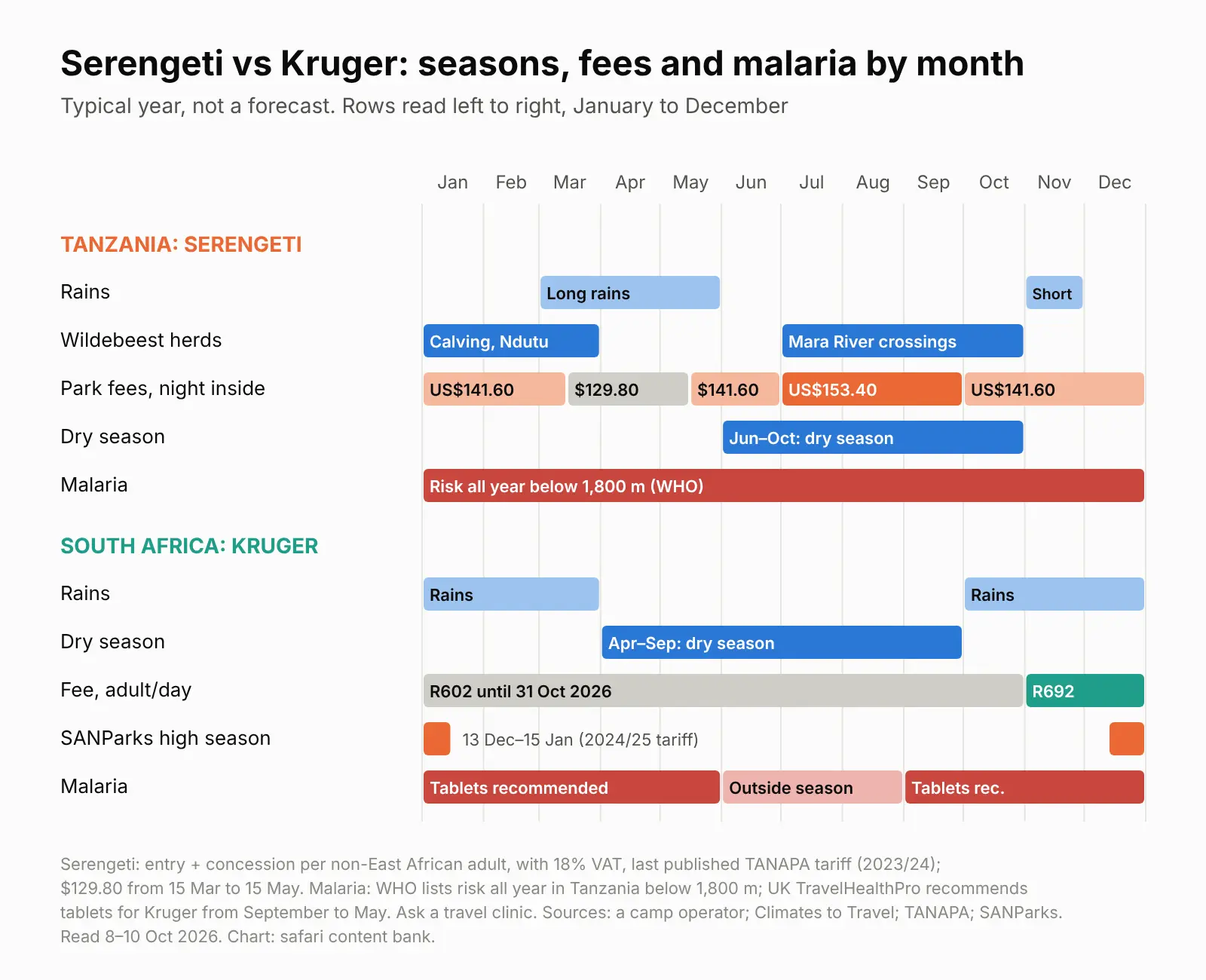 Typical year. Sources: a camp operator’s migration guide; one operator’s migration guide; Climates to Travel; TANAPA Tariffs 2023/24 (last published); SANParks fee schedules, climate page and 2024/25 tariff; WHO; UK TravelHealthPro. Read 8–10 October 2026. Chart: safari content bank.
- Tanzania’s cheapest fee dates are its wettest. Serengeti entry drops to US$70.80 from 15 March to 15 May, the long rains; in March 2026 a traveller reported being “stuck 11 times in 7 days” (traveller report, via Tanzania safari questions).
- Nights are cold in Kruger’s dry season. A July 2026 TripAdvisor thread reports safari tents at about 5 °C on winter nights (a traveller report), and Kruger’s gates close at 17:30 from May to July.
- July–September is peak in both, for different reasons: the crossings in Tanzania and the dry bush in Kruger. Book river-front Serengeti camps about a year ahead and Kruger’s rest camps when SANParks opens the dates, 11–12 months ahead.
Crowds and game-drive rules
Both countries keep their flagship public parks to daytime drives on the roads; neither publishes a limit on vehicles at a sighting. Night drives are not permitted in the Serengeti or the Ngorongoro Conservation Area, and SANParks forbids off-road and night driving in private vehicles in Kruger. Tanzania’s other national parks and South Africa’s private reserves are where the rules loosen.
| Rule | Serengeti and Ngorongoro | Tarangire, Lake Manyara, Nyerere, Ruaha | Kruger National Park | Greater Kruger private reserves |
|---|---|---|---|---|
| Who is on the tracks | Operators’ vehicles, self-drivers and day visitors (12-hour day permit); Ngorongoro crater visits need a licensed or NCAA guide | Operators’ vehicles, self-drivers and day visitors (12-hour day permit) | Self-drivers, SANParks drives, day visitors | Lodge guests on lodge vehicles; Sabi Sand takes no day visitors |
| Night drives | Not permitted | Sold: US$50 per adult + VAT (last published tariff, 2023/24) | SANParks’ own guided drives only | On lodge vehicles, per operators |
| Walking | Serengeti: with an armed ranger, US$23.60–29.50 per person in park fees | Not covered in our sources | With SANParks only; morning walk R726 (2024/25 tariff) | With lodge guides |
| Off-road driving | Not covered in our Tanzania sources | Not covered in our Tanzania sources | Not in private cars | On lodge vehicles, per operators |
| Vehicles per sighting | No published cap | No published cap | No published limit | No published rule |
Sources: TANAPA Tariffs 2023/24 (PDF), the last published tariff; NCAA visitor guidelines; SANParks vital information and tariffs 2024/25 (PDF); Sabi Sand access; one tour operator’s blog (off-road and night drives in the private reserves). Read 8–10 October 2026.
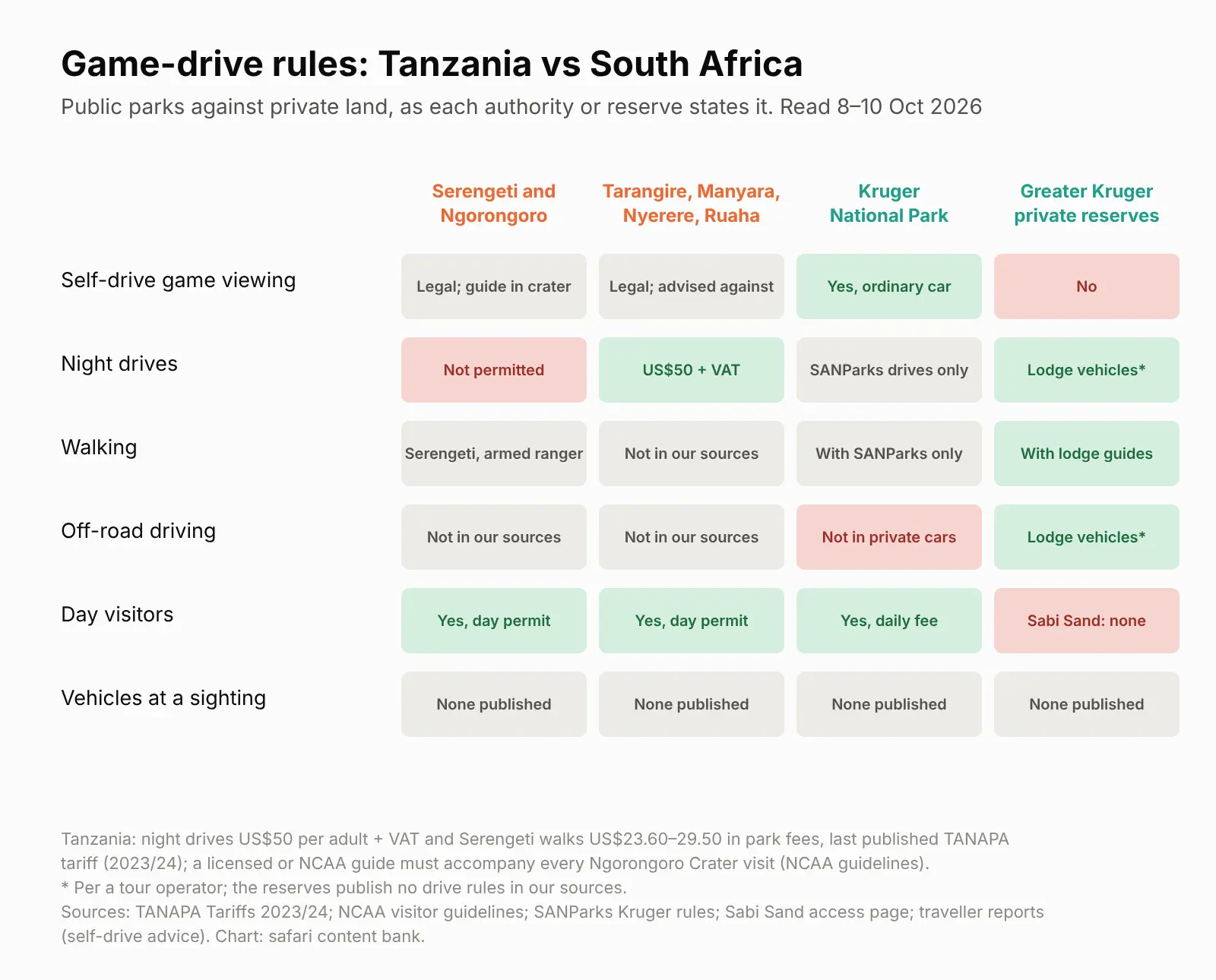 Sources: TANAPA Tariffs 2023/24 (last published); NCAA visitor guidelines; SANParks; Sabi Sand; one tour operator. Read 8–10 October 2026. Chart: safari content bank.
- Tanzania’s crowding is local. Travellers report “15–20 vehicles at a single sighting” at Ndutu (March 2026), “easily 70 other cars” in the central Serengeti (June 2024), and that “it is not uncommon for fifty or more trucks to be parked on the river banks” at a crossing (traveller reports, via Tanzania safari questions).
- Kruger can stop admitting day visitors. On busy days, when the daily visitor limit is reached, only pre-booked overnight guests get in; SANParks publishes no number (SANParks day visits).
- In South Africa the private land costs extra, as a gate fee or levy in each Greater Kruger reserve. Side by side: Kruger vs private reserves.
Families: ages, fees and malaria
South Africa is the easier family safari: malaria-free reserves, shorter drives from Johannesburg to Pilanesberg, and lodges that take all ages; in Tanzania every child needs a visa and the safari areas carry malaria risk all year.
| Tanzania | South Africa | Source | |
|---|---|---|---|
| Malaria-free option | None in our sources | Madikwe, Pilanesberg, the Waterberg, Addo and the Eastern Cape reserves | WHO; TravelHealthPro; Malaria-free safaris |
| Child park fee | Serengeti, ages 5–15: US$20 before VAT; Ngorongoro, 5–15: US$23.60; under 5 free | Kruger, ages 2–11: R345 (R300 until 31 Oct 2026); under 2 free | TANAPA 2023/24; NCAA; SANParks |
| Youngest age at camps | Not in our sources | Thornybush Game Lodge all ages, but under-6s not on shared drives; Saseka from 12; Tswalu children 0–11 free when sharing (2026) | Thornybush 2026 (PDF); Tswalu |
| Drive to the first park | Arusha → Tarangire north gate 109 km, about 2 h; Arusha → Seronera 7–7.5 h | Johannesburg O.R. Tambo → Pilanesberg about 220 km | Tanzania safari questions; Malaria-free safaris |
| Entry documents | Every child needs their own visa; a parent travelling alone should carry the birth certificate and a notarised consent letter from the other parent | Special documents for under-18s, such as a birth certificate and in some cases consent | US State Department, Tanzania; UK FCDO |
Rate sheets and child policies 2026, read 8–10 October 2026. Ages change; confirm in writing before you book. Camp by camp: family safari.
Entry: Tanzania’s visa and insurance vs South Africa’s traveller declaration
A UK traveller pays US$94 to enter Tanzania (US$50 visa + US$44 insurance) and a US traveller US$144; neither pays a visa fee for South Africa. Checked 9–10 October 2026.
| Item | Tanzania | South Africa | Source |
|---|---|---|---|
| Visa | US$50, single entry, 90 days; US citizens must buy the US$100 multiple-entry visa. Visa on arrival costs the same as the e-visa | None for UK and US citizens for up to 90 days | Tanzania e-visa guidelines; UK FCDO |
| Compulsory insurance | US$44 per adult, 92 days, as of October 2026, for foreign visitors except residents of East African Community (EAC) and SADC countries; your own policy does not replace it | None in our sources | Clyde & Co, 16 Sep 2026; Tanzania visitor insurance |
| Online form | The e-visa, if you do not take the visa on arrival | Traveller declaration for all arrivals and departures from 1 July 2026; no fee confirmed in our sources | UK FCDO |
| Passport | Valid at least six months, with at least one unused page; return or onward ticket | Valid 30 days beyond departure, with 2 blank consecutive pages | Tanzania e-visa guidelines; US State Department |
| Yellow fever certificate | Only if arriving from a risk country, Kenya included, or after a transit of more than 12 hours in one | Only if arriving from a risk country; vaccination at least 10 days before arrival | Yellow fever and safaris |
Check the official Tanzania e-visa portal and the NIC insurance portal, not a third-party site, the week you travel. Full rules: Tanzania visa, Tanzania visitor insurance and South Africa safari questions. Other passports, EU ones included, should check South Africa’s rules with the Department of Home Affairs.
Can you combine Tanzania and South Africa?
Yes, but our sources hold no airline timetable or fare between Johannesburg and Kilimanjaro or Dar es Salaam, so check the live schedule. Most published Tanzanian itineraries pair the safari with Zanzibar instead: 26 of the 29 in our dataset that include Zanzibar put the beach after the safari (Tanzania safari and Zanzibar).
- Yellow fever: no official source we read says whether South Africa treats arrivals from Tanzania as coming from a risk country. Going the other way, Tanzania’s rule bites only if you arrive from or transit more than 12 hours in a risk country such as Kenya (Yellow fever and safaris).
- Insurance and visa: Tanzania’s US$44 policy and US$50 visa apply on the Tanzanian leg only. One policy and one visa also cover Zanzibar.
Which should you choose?
Choose Tanzania for the migration, the Ngorongoro Crater and a guided road circuit; choose South Africa for a first self-drive safari, a family, rhino or no malaria.
| If you… | Pick | Why |
|---|---|---|
| Want the wildebeest herds or a river crossing | Tanzania | Calving at Ndutu peaks in February; Mara River crossings about July–October |
| Can’t or won’t take malaria tablets | South Africa (malaria-free reserves) | Tanzania has risk all year below 1,800 m (WHO); North West and Eastern Cape are no risk |
| Want to drive yourself in an ordinary car | South Africa (Kruger) | Tarred access to all 9 gates; Tanzanian self-driving is legal, but forum experts advise first-timers against it |
| Want all of the Big Five, rhino included | South Africa, or Ngorongoro Crater in Tanzania | 14,389 rhinos against Tanzania’s 268 (end 2024) |
| Have young children | South Africa | Malaria-free reserves; child park fee from age 2; Pilanesberg about 220 km from Johannesburg |
| Have under US$300 a day for a guided trip | Either | Group camping US$220–300 (Tanzania) or shared Kruger tours US$214–242 a day |
| Want night drives | Tanzania (Tarangire, Lake Manyara, Nyerere, Ruaha) or South Africa (private reserves) | Not in the Serengeti or Ngorongoro, and only with SANParks in Kruger |
| Want a beach to finish | Tanzania | Kilimanjaro–Zanzibar from US$200 one way (Flightlink, October 2026); one visa and one insurance policy cover both |
| Want to avoid a visa fee | South Africa | No visa for UK and US citizens; Tanzania’s visa and insurance cost a UK traveller US$94 |
Whichever you choose, check that the operator holds a current licence: see how to check a safari operator is licensed. Weighing Tanzania against its neighbour instead? See Kenya or Tanzania; against Botswana, Tanzania or Botswana; South Africa against Kenya, Kenya or South Africa.
See also: Cape Town and safari and Serengeti vs Kruger.
Common mistakes in Tanzania vs South Africa comparisons
| What you’ll often read | What is correct |
|---|---|
| “Serengeti entry is US$70” | US$70 is before VAT. The visitor pays US$82.60, from the last published tariff, 2023/24. |
| “Tanzania’s 2026 park fees are…” | No TANAPA tariff newer than 2023/24 has been published. Operators still charge the 2023/24 amounts. |
| “Kruger costs R602 a day” (with no date) | That was the 2025/26 rate, which ended on 31 October 2026. Since 1 November 2026: R692 per international adult per day. |
| “Kruger is malaria-free in winter” | No source says so. TravelHealthPro recommends tablets September to May; SANParks exempts no month. |
| “The northern circuit is high enough to be malaria-free” | WHO lists risk all year in the whole of Tanzania below 1,800 m, the Serengeti, Tarangire and Zanzibar included. |
| “The Ngorongoro Crater fee is per person” | It is US$295 per vehicle per descent, plus US$70.80 entry per adult. |
| “You can self-drive the Serengeti like Kruger” | Legal, but forum experts advise first-timers against it, and a guide must accompany every crater visit. Kruger needs only an ordinary hire car. |
| “Add a night drive in the Serengeti” | Not permitted in the Serengeti or the Ngorongoro Conservation Area. |
| “Your own travel insurance covers Tanzania” | It does not. As of October 2026 the US$44 government policy is compulsory; needed “even if” you have your own policy (UK FCDO, 20 Oct 2026). |
| “Malaria-free reserves are the cheap option” | Pilanesberg charges R748 per foreign adult a day plus R168 per vehicle, more than Kruger. |
Frequently asked questions
Is Tanzania or South Africa better for a first safari? South Africa, if you want to drive yourself, travel with young children or avoid malaria tablets: Kruger can be self-driven in an ordinary hire car and malaria-free Big Five reserves exist. Tanzania, if the wildebeest herds are the point: calving at Ndutu peaks in February, Mara River crossings run from about July to October, and forum regulars suggest 7–10 days for the northern circuit.
Is Tanzania more expensive than South Africa? At the budget guided level they are close: group camping from Arusha is published at US$220–300 per person per day and shared Kruger tours at US$214–242. One budget operator’s 2026 guide puts a Serengeti safari at US$400–740 a day and Kruger at US$240–470. Self-driving Kruger is cheaper still: a campsite and two fees cost R1,892 a day for two adults from 1 November 2026 (October 2026 site price; R1,712 in October 2026), before the car. SANParks had not published its 2026/27 accommodation tariff when we checked on 1 November 2026, so confirm the price when you book.
What are the park fees in Tanzania and South Africa? The Serengeti charges US$82.60 per non-East African adult per day with VAT, plus US$59–70.80 a night if you sleep inside the park (TANAPA, last published tariff, 2023/24). Ngorongoro charges US$70.80 per adult per 24 hours plus US$295 per vehicle for the crater (NCAA). Kruger charges R692 per international adult per day from 1 November 2026 (R602 until 31 October 2026; SANParks).
Which country has malaria-free safaris? South Africa. UK TravelHealthPro rates North West province (Madikwe, Pilanesberg) and the Eastern Cape (Addo, Amakhala, Kwandwe) no risk. Our sources name none in Tanzania: WHO lists risk all year in the whole country below 1,800 m, and Kruger is a risk area with tablets recommended from September to May.
Can you self-drive a safari in Tanzania like in Kruger? Not as easily. Self-driving is legal in Tanzania, but forum experts advise first-timers against it, a foreign-plated car pays US$150 + VAT per park entry (last published tariff, 2023/24), and a licensed or NCAA guide must accompany every Ngorongoro Crater visit. Kruger needs only an ordinary hire car on tarred and gravel roads.
Where will I see more rhino, Tanzania or South Africa? South Africa, which held 14,389 rhinos at the end of 2024 against Tanzania’s 268 (IUCN SSC African Rhino Specialist Group, 2025). In Tanzania, Ngorongoro Crater is the northern-circuit park that holds all of the Big Five; rhino are scarce in the Serengeti.
Are night drives allowed in the Serengeti and Kruger? Not in the Serengeti or anywhere in the Ngorongoro Conservation Area, and not in private cars in Kruger, where SANParks sells its own guided night drives. Tanzania’s Tarangire, Lake Manyara, Nyerere and Ruaha sell them at US$50 per adult + VAT (last published tariff, 2023/24), and Greater Kruger lodges run them for their guests.
Can you combine Tanzania and South Africa on one trip? Yes, but our sources hold no Johannesburg–Kilimanjaro or Johannesburg–Dar es Salaam timetable or fare, so check the live schedule. No official source we read says whether South Africa asks travellers arriving from Tanzania for a yellow fever certificate. Tanzania’s US$50 visa and US$44 insurance apply on the Tanzanian leg.
Sources
- Tanzania fees: TANAPA, Tariffs 2023/24 (PDF), the last published tariff; NCAA, tariffs and visitor guidelines, read 9 Oct 2026; The Citizen, fee freeze, 24 Mar 2025; Tourism Update, 12 months’ notice
- South Africa fees: SANParks daily conservation fees 2025/26 (PDF) and 2026/27 (PDF); Kruger rates and entry fees; tariff booklet 2024/25 (PDF); Sabi Sand access; Timbavati; Pilanesberg tariffs as quoted by a booking agent’s site, read 9 October 2026
- Rules: SANParks vital information, entrance gates, day visits and climate; one tour operator’s blog (names and links kept in our editor notes)
- Health: WHO country list, 2022 rev. Jan 2023 (PDF); TravelHealthPro, South Africa; SANParks, Kruger malaria. Checked 10 Oct 2026
- Wildlife: TAWIRI 2023 wildebeest census (PDF); IUCN SSC African Rhino Specialist Group report to CITES, 2025, and IUCN wild dog figures, as on our rhino and wild dog pages; The Star / Xinhua, 22 Sep 2026; Save the Rhino; SANParks rhino statement; a camp operator’s migration guide; one operator’s migration guide (names and links kept in our editor notes)
- Rate sheets: a safari agent’s listings (Serengeti Wilderness Camp, Namiri Plains, Sayari), Lemala, Singita Serengeti 2026 (PDF); Elephant Plains, Thornybush 2026 (PDF), Sabi Sabi, Singita Ebony, Kwandwe 2026–27 (PDF), Tswalu; tour operators’ published 2026 prices, one operator’s cost guide and one budget operator’s first-safari guide (names and links kept in our editor notes)
- Access: one operator’s travel-times page and a safari booking site’s Serengeti guide (names and links kept in our editor notes); a safari travel company’s bush-flight guide; Auric Air baggage policy; FedAir 2026 (PDF) and baggage; Flightlink
- Entry: Tanzania e-visa guidelines; NIC inbound portal; Clyde & Co, Introduction of inbound travel insurance, 16 Sep 2026; UK FCDO, Tanzania and South Africa entry requirements; US State Department, Tanzania and South Africa; Department of Home Affairs
- Climate: Climates to Travel, Tanzania (an aggregator); SANParks climate page, as on our best time for a safari page
- Traveller reports (opinion and experience, not official findings): TripAdvisor Tanzania, Serengeti and Kruger forums, as cited on our Tanzania and South Africa question pages
Prices and fees checked 8–10 October 2026. We will recheck this page on 2 November 2026, after Kruger’s fee changes on 1 November, and when TANAPA publishes a new tariff or the Tanzanian visa or insurance rules change. More: Tanzania safaris, South Africa safaris, Serengeti, Ngorongoro Crater, Kruger National Park.