 Experience

Last verified
On this page
- Tanzania vs Botswana at a glance (2026)
- Which is cheaper, Tanzania or Botswana?
- Park fees: Serengeti vs Chobe and Moremi
- When to go: Tanzania and Botswana month by month
- Wildlife: migration herds or water and predators
- Night drives, walking and off-road driving
- Getting around: roads in Tanzania, light aircraft in Botswana
- Entry costs, health and children
- Can you combine Tanzania and Botswana?
- Which should you choose?
- Common mistakes in Tanzania vs Botswana comparisons
- Frequently asked questions
- Sources
Short answer: Choose Tanzania for the wildebeest migration and a drive-in safari; choose Botswana for the Okavango Delta, wild dogs and private concessions. At the budget end they cost about the same: guided camping runs US$220–300 a day in Tanzania and US$189–270 in Botswana, park fees included. At the top they don’t: Botswana’s fly-in camps charge US$530–5,345 a night. A night inside the Serengeti costs US$129.80–153.40 in park fees (last published tariff, 2023/24).
Key facts
- Tanzania charges more at the gate; Botswana charges more for the bed. A night inside the Serengeti costs US$129.80–153.40 per adult in entry and concession fees (TANAPA, last published tariff, 2023/24). Chobe and Moremi cost P270 a day under Botswana’s last published park-fee schedule (1 April 2022), while its fly-in camps publish US$530–5,345 per person a night.
- No official current Botswana park fee is published. In February 2026 the government news agency BOPA called the existing non-resident fee P380; a P500 rise was announced, then reported postponed. Confirm the fee with DWNP or your operator.
- The wildebeest migration is in Tanzania; Botswana’s migration is zebra. TAWIRI counted 1,366,109 wildebeest at the end of March 2023; more than 20,000 zebra move between the Chobe floodplains and Nxai Pan (Africa Geographic).
- Both countries ban night drives in their flagship parks. Night drives are not permitted in the Serengeti or the Ngorongoro Conservation Area, and Botswana Tourism says night driving and off-roading are prohibited in Botswana’s national parks and reserves. Botswana’s private concessions and Tanzania’s Tarangire, Lake Manyara and Nyerere allow them.
- The two dry seasons overlap. June to October is peak game viewing in both; the Okavango Delta’s water is highest from about May to August, and the Mara River crossings run from about July to October.
- Entry costs differ by about US$94 for a UK traveller. Tanzania charges a US$50 visa and, as of October 2026, US$44 compulsory insurance; British citizens enter Botswana visa-free for 90 days, and no border levy is charged.
Tanzania vs Botswana at a glance (2026)
Tanzania is a road-based safari built around the Serengeti and the migration; Botswana is a fly-in and mobile-safari country built around water, with its best land leased to a few camps.
| Tanzania | Botswana | Source | |
|---|---|---|---|
| Flagship areas | Serengeti, Ngorongoro Crater, Tarangire | Okavango Delta, Moremi Game Reserve, Chobe | Tanzania and Botswana hubs |
| How most people travel | Private or shared 4x4 with a driver-guide, mostly by road from Arusha | Light aircraft between camps, or a guided mobile safari | Tanzania and Botswana cost pages |
| Cheapest guided trip, per person per day | US$220–300, group camping, park fees included | US$189–270, Botswana-only camping trips, park fees included | one operator’s published price; Namibia vs Botswana |
| Luxury camp, per person per night | Namiri Plains US$740–2,250, park fees not included | Mombo US$3,062–5,345, park fees included | A safari agent’s listing; Wilderness |
| Flagship park fee, adult | Serengeti US$82.60 a day with VAT, plus US$59–70.80 a night if you sleep inside (last published tariff, 2023/24) | Chobe and Moremi P270 a day (last published schedule, 1 April 2022; no official current tariff) | TANAPA 2023/24; DWNP via Tourism Update |
| Main wildlife draw | Wildebeest migration; Ngorongoro Crater | Okavango water, elephant, wild dog | Migration and Botswana pages |
| Best months for game | June–October (dry); January–March for calving | June–October (dry); December–March on the Kalahari pans | Great Migration month by month; Okavango flood calendar |
| Night drives | Not in the Serengeti or Ngorongoro; allowed in Tarangire, Lake Manyara, Nyerere and Ruaha | Not in national parks and reserves; allowed on private concessions | TANAPA 2023/24; Botswana Tourism |
| Entry, UK passport | Visa US$50 + insurance US$44 | Visa-free, 90 days; no border levy | Tanzania e-visa; UK FCDO |
| Malaria | Risk all year below 1,800 m | North high risk October–May, low June–September | WHO; TravelHealthPro |
| Currency | Tanzanian shilling (TZS); bring clean US dollar notes from 2009 or later for tips and extras | Pula (P, BWP); camps price in US dollars | Tanzania and Botswana questions pages |
Fees and prices as on our Tanzania safari cost and Botswana safari cost pages, checked 9 October 2026. Non-East African (Tanzania) or non-resident (Botswana) adult.
Which is cheaper, Tanzania or Botswana?
At the budget end they cost about the same per day; from mid-range up, Botswana costs more, because its camps are fly-in and its beds are capped. Tanzania has a road-based mid-range that Botswana mostly lacks.
| What you’re comparing | Tanzania | Botswana | Source (read 9 Oct 2026) |
|---|---|---|---|
| Cheapest guided trip, per person per day | US$220–300, group camping from Arusha, “all meals & park fees included” (two operators) | US$189–270, Botswana-only camping trips, park fees included (three operators) | Operators’ published prices |
| Private mid-range, per person per day | US$406–656, 7-day northern circuit for two (one operator’s two price tiers) | No like-for-like product; a road-accessible Chobe Safari Lodge costs US$500–550 a night, park fees included | Operator’s published price; Chobe Safari Lodge |
| Entry-level camp in the main wildlife area, per night | Serengeti Wilderness Camp US$250–400, park fees not included | Kwando Moremi Crossing US$530–850 (2024), fully inclusive; levy US$20 | A safari agent’s listing; Kwando 2024 |
| Luxury camp, per night | Namiri Plains US$740–2,250; Sayari US$980–2,250, park fees not included | Sable Alley US$995–1,995, park fees included; levy US$60 | A safari agent’s listing; Natural Selection 2026 |
| Top camp in our sources, per night | Singita Grumeti camps US$2,210–3,220 (2026) | Mombo US$3,062–5,345 (2026–27) | Singita Serengeti 2026 (PDF); Wilderness |
| Getting around | Private Land Cruiser with driver-guide US$200–300 per vehicle per day | Light-aircraft seat US$220–594 per person per sector | one operator’s cost guide; Botswana cost page |
Per person, sharing, without international flights; low season to peak. Botswana camp rates are fully inclusive of meals and activities; the Tanzanian camp rates are full board with park fees extra, so the gap at camp level is narrower than the headline numbers. One of these operators does not say whether its price is per person.
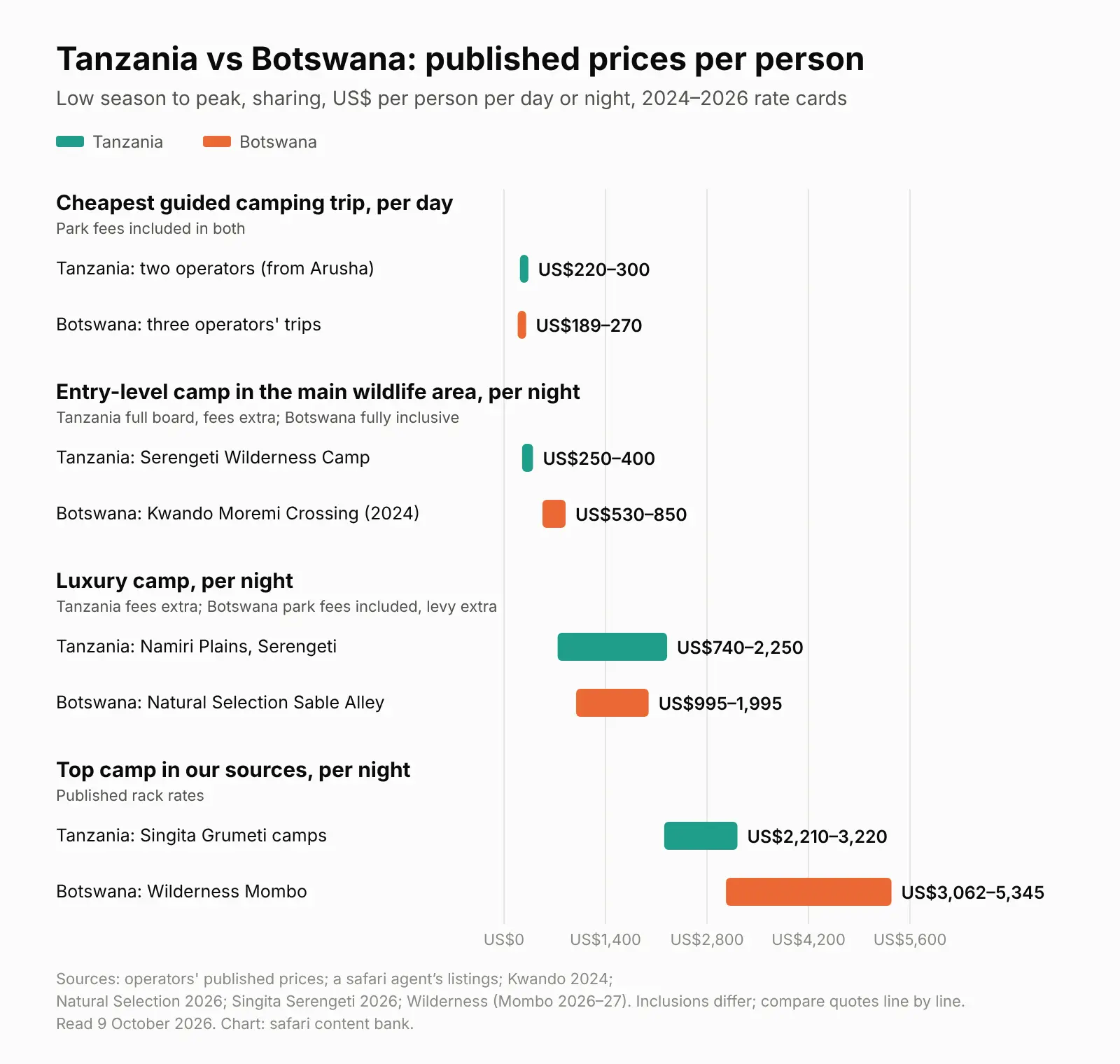 Published 2024–2026 rates per person, sharing, read 9 October 2026. Sources: operators’ published prices; a safari agent’s listings; Kwando 2024; Natural Selection 2026; Singita 2026; Wilderness. Chart: safari content bank.
Why Botswana costs more from mid-range up
Botswana limits the beds in its best wildlife areas, and most Delta camps can only be reached by air. The prime land outside the national parks is divided into concessions, each leased to one operator or community trust with a limited number of beds; the government calls this the high-value, low-volume model (The Ngami Times, 7 Sep 2026). We found no published schedule of bed caps per concession.
- Flights are a separate line. A light-aircraft seat costs US$220–594 per person per sector, plus US$20–25 departure tax per leg from Maun or Kasane, unless the camp group includes air (Botswana bush flights).
- Levies come on top. Camp groups charge US$20–100 per person per night: US$100 at Great Plains, US$60 at Natural Selection, US$35 at Machaba, US$20 at Kwando.
- The cheap tier is a mobile or self-drive safari in the national parks, not a lodge: Botswana-only guided camping starts at about US$189 a day.
Why Tanzania costs more at the gate
Tanzania’s government fees are higher per night, and the vehicle is priced per day whatever the head count. A night inside the Serengeti costs US$129.80–153.40 per adult in entry and concession fees, the Ngorongoro Crater adds US$295 per vehicle per descent (NCAA), and a private Land Cruiser costs US$200–300 a day. Advertised “from” prices assume a full vehicle in low season: for two people in peak season, one operator’s price is 54% higher and another’s 78% higher (Tanzania safari cost).
Park fees: Serengeti vs Chobe and Moremi
The Serengeti charges US$82.60 per adult per day, plus US$59–70.80 a night if you sleep inside (last published tariff, 2023/24); Chobe and Moremi charge P270 per non-resident per day under the last published DWNP schedule (1 April 2022), and no official current tariff is published.
| Tanzania (TANAPA, NCAA) | Botswana (DWNP) | |
|---|---|---|
| Flagship park, entry per adult per day | Serengeti US$82.60 with 18% VAT (US$70 + VAT); US$70.80 from 15 March to 15 May | Chobe, Moremi: P270 |
| Sleeping inside the park | Concession fee US$70.80 a night (July–September), US$59 (October–June) | Campsites are paid separately, to the concessionaires: about US$40–50 per person a night in Chobe and Moremi |
| Other parks | Tarangire, Lake Manyara, Arusha US$53.10–59; Ruaha, Katavi, Mikumi US$35.40 | Central Kalahari, Khutse, Nxai Pan, Makgadikgadi P190 |
| Crater and vehicle fees | Ngorongoro entry US$70.80 per 24 h, single entry; crater descent US$295 per vehicle | Vehicle fee charged per day, arrival and departure day both; current amount for a foreign car not confirmed officially |
| Children | US$20 (5–15, Serengeti group) before VAT; under-5s free | Under 8 free; older children pay half |
| Last change | No tariff newer than 2023/24 has been published. Fee rises frozen for 12 months on 24 March 2025; 12 months’ notice promised | Last published schedule: 1 April 2022. BOPA called the existing non-resident fee P380 (Feb 2026); a P500 rise was announced, then reported postponed. Confirm with DWNP or your operator |
| Usually in the trip price? | Included in the group camping prices above; not in the Tanzanian camp rates above | Included at Natural Selection, Wilderness and Desert & Delta camps; check each camp |
Sources: TANAPA Tariffs 2023/24 (PDF), the last published tariff; NCAA tariffs, undated page, read 9 Oct 2026 (it does not say whether VAT is included); DWNP schedule of 1 April 2022 via Tourism Update, 23 Feb 2022; Botswana Daily News (BOPA), 24 Feb 2026; Gabz FM, 5 May 2026; child rates from the Botswana and Tanzania cost pages. Checked 9 October 2026.
Three nights inside the Serengeti from July to September cost US$460.20 per adult in park fees (our sum: 3 × US$153.40); three days in Chobe or Moremi cost P810 at the last published fee (our sum: 3 × P270). In February 2026 Botswana’s tourism minister argued that its fees “remain among the lowest in the region” (Botswana Daily News, 24 Feb 2026). Fee detail for each country: Tanzania park fees, Serengeti park fees, Ngorongoro Crater fees, Botswana park fees and Chobe park fees.
- Tanzanian fees are paid electronically; there is no cash payment at the gate (TANAPA 2023/24).
- Botswana self-drivers pay the campsites first, then DWNP. “Park fees can only be paid to the DWNP once all camping fees … have been settled” (yourbotswana).
The official fee lines, with the date each took effect and the source:
| Fee | Amount | In force from | Source |
|---|---|---|---|
| Serengeti and Nyerere National Parks, non-East African adult, entry per day, 16 May–14 Mar | USD 70 + 18% VAT = USD 82.60 | 1 Jul 2023 (2023/24 tariff, last published) | TANAPA Tariffs 2023/24 |
| Serengeti and Nyerere National Parks, non-East African adult, entry per day, 15 Mar–15 May | USD 60 + 18% VAT = USD 70.80 | 1 Jul 2023 (2023/24 tariff, last published) | TANAPA Tariffs 2023/24 |
| Serengeti and Nyerere, concession fee per person per night inside the park | Jul–Sep USD 60 + VAT = USD 70.80; Oct–Jun USD 50 + VAT = USD 59 | 1 Jul 2023 (2023/24 tariff, last published) | TANAPA Tariffs 2023/24 |
| Ngorongoro Conservation Area, non-East African adult, entry per 24 h (single entry) | USD 70.80 (NCAA's page does not say whether VAT is included) | Undated official page, read 9 Oct 2026 | NCAA |
| Ngorongoro Crater descent (crater service fee), per vehicle | USD 295 (NCAA's page does not say whether VAT is included) | Undated official page, read 9 Oct 2026 | NCAA |
| Chobe National Park and Moremi Game Reserve (DWNP), non-resident adult, per person per day | BWP 270 (SADC residents BWP 205; Botswana citizens and residents BWP 30) | Last published DWNP schedule, 1 April 2022 (via Tourism Update). In Feb 2026 the government news agency BOPA called the existing non-resident fee P380; a P500 rise was announced, then reported postponed. No official current tariff: confirm with DWNP or your operator | Tourism Update, 23 Feb 2022 (DWNP fee schedule) |
| Other DWNP parks and reserves (Central Kalahari Game Reserve, Khutse, Nxai Pan, Makgadikgadi Pans), non-resident adult, per person per day | BWP 190 (SADC residents BWP 145; Botswana citizens and residents BWP 20) | Last published DWNP schedule, 1 April 2022 (via Tourism Update). In Feb 2026 the government news agency BOPA called the existing non-resident fee P380; a P500 rise was announced, then reported postponed. No official current tariff: confirm with DWNP or your operator | Tourism Update, 23 Feb 2022 (DWNP fee schedule) |
When to go: Tanzania and Botswana month by month
June to October is the best game viewing in both countries; outside it, Tanzania has the calving season (January–March) and Botswana the green-season pans (December–March).
| Months | Tanzania | Botswana |
|---|---|---|
| January–March | Calving on the southern plains around Ndutu, peak in February; long rains start late March | Rains; zebra at Nxai Pan and the Makgadikgadi; Delta water low; lowest camp rates (Mombo US$3,062) |
| April–May | Long rains (Serengeti 155 mm in April); Serengeti entry US$70.80 to 15 May; herds move north | Flood rising in the Delta; boating resumes late May; Machaba Shoulder (April) then High (from 1 May) |
| June | Grumeti River crossings, about the first half of June; dry season starts | Highest Delta water; dry season, game starting to gather at water |
| July–September | Mara River crossings in the northern Serengeti; Serengeti concession fee US$70.80 a night | Highest water to August; game concentrated on the remaining water; top camp rates (Mombo US$5,345) |
| October | Herds leave the north; crossings can run into early October | Hottest month, above 40°C at times; Delta water falling |
| November–December | Short rains (Serengeti 115 mm in November); herds head south | Rains start in November; Delta water lowest; zebra back on the pans from December |
Typical year, not a forecast. Tanzania: a camp operator’s migration guide; one operator’s migration guide; Climates to Travel (aggregator); TANAPA 2023/24. Botswana: one operator’s Okavango flood guide; two camp operators’ seasonal guides; Africa Geographic; Machaba 2026. Read 9–10 October 2026.
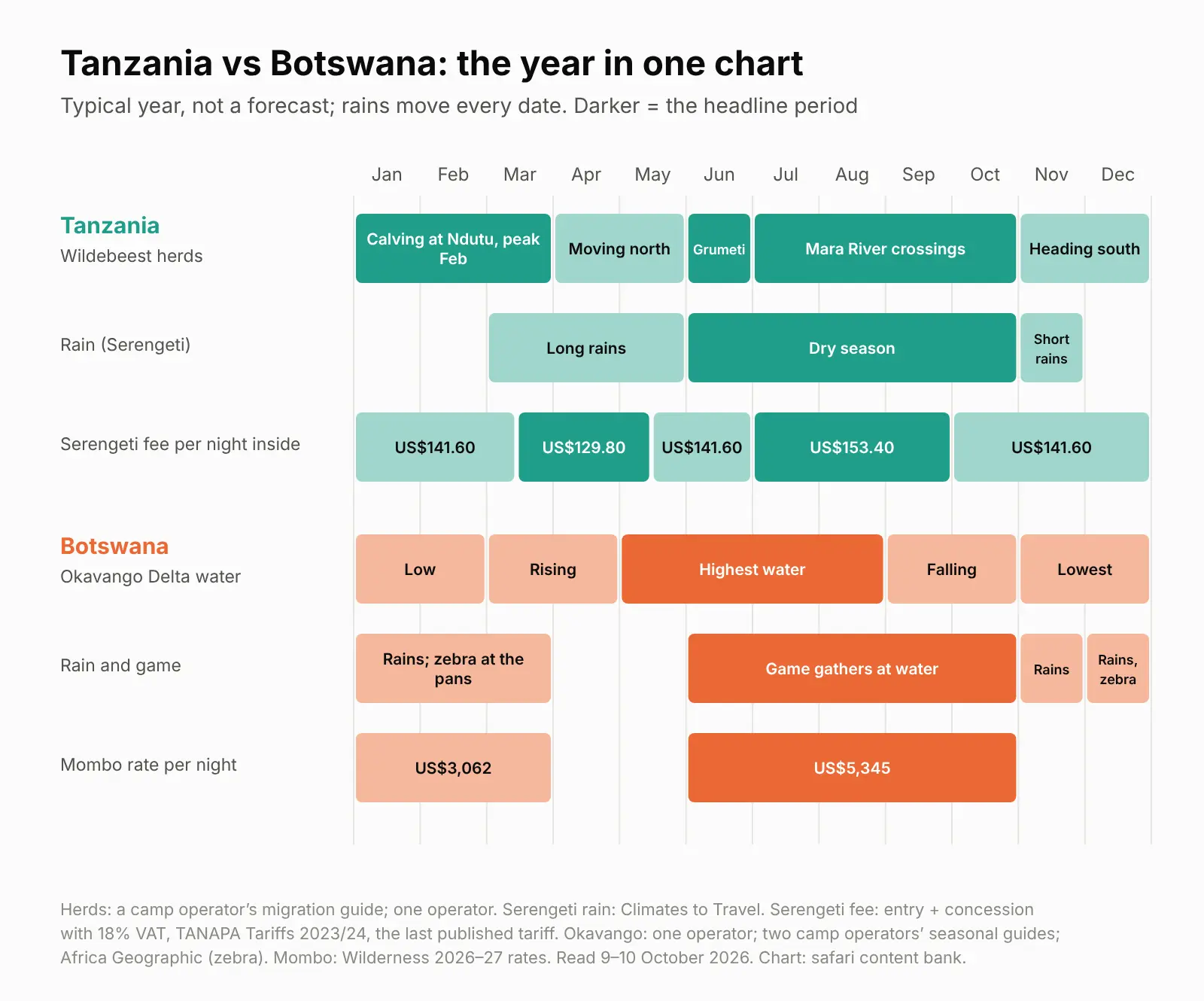 Typical year. Sources: a camp operator’s migration guide; one operator’s guides; Climates to Travel; TANAPA Tariffs 2023/24 (last published); two camp operators’ seasonal guides; Africa Geographic; Wilderness Mombo rates. Read 9–10 October 2026. Chart: safari content bank.
- Botswana’s Delta floods in its dry season. The water is Angolan rain; its peak enters Botswana at Mohembo between mid-March and mid-May, and water is highest in most of the Delta from about May to August (one operator’s flood guide). Detail: Okavango flood calendar.
- Tanzania’s cheapest fee dates are its wettest. Serengeti entry drops to US$70.80 from 15 March to 15 May, the long rains; in March 2026 a traveller reported being “stuck 11 times in 7 days” (TripAdvisor forum, traveller report).
- Botswana’s green season is cheaper in the camps, not at the gate. Machaba falls from US$1,315 to US$718 a night and Mombo from US$5,345 to US$3,062 from January to March (Machaba 2026; Wilderness).
Wildlife: migration herds or water and predators
Tanzania has the wildebeest migration and the Ngorongoro Crater; Botswana has the Okavango’s water-based wildlife and the best published wild dog odds. Neither is a reliable place for rhino outside one or two sites.
| Tanzania | Botswana | Source | |
|---|---|---|---|
| Big herd movement | Wildebeest: 1,366,109 counted at the end of March 2023 (± 231,741 SE) | Zebra: more than 20,000 between the Chobe floodplains and Nxai Pan | TAWIRI 2023 census (PDF); Africa Geographic |
| Rhino in the country (end of 2024) | 268 (IUCN; species split not given); black rhino seen in Ngorongoro Crater | 345 (25 black, 320 white; IUCN); 10% of one operator’s traveller groups saw a white rhino, 1% a black rhino | Where to see rhino; one operator’s Botswana wildlife statistics |
| Wild dog | Nyerere (Selous) is the stronghold, about 800 dogs (IUCN assessment); no sighting rate published | 65% of one operator’s Moremi groups saw wild dog; 50% across Botswana | Where to see wild dogs |
| Elephant, lion, leopard | No comparable sighting rates in our sources | 95%, 91% and 66% of one operator’s Botswana groups | one operator’s Botswana wildlife statistics |
| Water-based safari (mokoro, boats) | No boat or canoe safari in our Tanzania sources | Mokoro and boats from about late May to September at seasonal-floodplain camps; all year on permanent water | Okavango flood calendar |
That operator’s rates are traveller-reported, per trip, not per drive: 11,679 sightings from 1,356 groups since May 2018, read September 2026. IUCN figures via our rhino page.
- Tanzania has more wildebeest, Botswana more rhino. By the IUCN’s end-2024 figures Botswana held 345 rhinos and Tanzania 268, but few safari travellers see one in either. In Tanzania black rhino are seen on the floor of Ngorongoro Crater; in Botswana the usual place to add rhino is Khama Rhino Sanctuary near Serowe.
- Gemsbok and meerkats are Kalahari animals, not Delta ones. One operator’s travellers saw gemsbok on 0% of Okavango Delta trips and 93% of Central Kalahari trips (Botswana safari questions).
- Crowding is local in both. Tanzania’s complaints centre on Ndutu in February, the crater and the central Serengeti (Tanzania safari questions); Botswana’s on the Chobe riverfront (a safari booking site’s Chobe reviews). We found no published vehicle cap for TANAPA or the NCAA, and no published bed cap per Botswana concession.
Night drives, walking and off-road driving
Both countries keep their flagship parks to daytime drives on the road; Tanzania allows night drives in some other national parks, and Botswana moves them onto private concessions.
| Tanzania | Botswana | |
|---|---|---|
| Flagship parks | Night drives not permitted in the Serengeti or the Ngorongoro Conservation Area | Off-roading and night driving prohibited in national parks and reserves, including Chobe and Moremi |
| Where night drives are allowed | Katavi, Ruaha, Mikumi, Tarangire, Lake Manyara and Nyerere: US$50 per adult + VAT (last published tariff, 2023/24) | Private and community concessions, “in moderation” |
| Walking | Allowed in the Serengeti with an armed ranger: US$23.60–29.50 per person in park fees, plus the ranger | Not in Moremi or Chobe National Park; usually offered on concessions |
| Off-road to a sighting | Not covered in our Tanzania sources | Concessions only |
Sources: TANAPA Tariffs 2023/24 (PDF), the last published tariff; Botswana Tourism, game viewing; one operator’s Moremi and Chobe pages; our walking safari page. Read 10 October 2026.
- Botswana’s top-rate camps can sit inside a reserve. Mombo (US$3,062–5,345 a night) is in Moremi Game Reserve, where Botswana Tourism says night driving is prohibited. Check any camp’s activity list for your dates before paying a concession premium for night drives.
- Every area’s rules in Botswana are on night drives, walking and off-road driving; the two DWNP areas are compared on Moremi vs Chobe.
Getting around: roads in Tanzania, light aircraft in Botswana
Tanzania’s northern circuit is driven, with flights as a shortcut; Botswana’s Delta camps are reached by light aircraft, and only the eastern Delta and Chobe can be driven.
| Tanzania | Botswana | Source | |
|---|---|---|---|
| Main gateway | Kilimanjaro (JRO), then Arusha | Maun for the Delta; Kasane for Chobe | Tanzania and Botswana questions pages |
| Gateway to the flagship park by road | Arusha → Seronera 7–7.5 h, gravel after the Ngorongoro gate | Maun → Moremi’s South Gate by 4x4; no road to the inner Delta camps | a safari booking site’s Serengeti guide; Botswana safari questions |
| Light aircraft | Lake Manyara → Seronera about US$200; Seronera → Arusha about US$280 (Auric Air) | US$220–594 per person per sector; Maun → Kasane US$495 (Moremi Air, 2024) | A safari travel company’s bush-flight guide; Kwando 2024 |
| Luggage on light aircraft | 20 kg including hand luggage and cameras (Auric Air) | 20 kg in one soft bag, up to 65 × 40 × 30 cm (Ker & Downey) | Auric Air; Ker & Downey |
| Driving after dark | Tourists are not driven outside towns after dark | Light aircraft do not fly at night; Maun’s port of entry is open 07:30–16:30 | one operator’s travel-times page; Botswana Tourism, Ports of Entry |
| Self-drive | Possible; forum experts advise first-timers against it. A guide must accompany every crater visit | Possible in a 4x4 (US$170–300 a day from Maun); campsites US$40–50 per person a night, booked up to a year ahead | Tanzania safari questions; Botswana self-drive |
Read 9–10 October 2026. Forum lines are traveller reports, not official guidance.
- How many days: forum regulars suggest 7–10 days for Tanzania’s northern circuit (Tanzania safari questions), and at least one three-night stop in Botswana, because every light-aircraft move costs half a day or more (Botswana safari questions). Both are traveller reports.
- A foreign-plated car pays US$150 + VAT per Tanzanian park entry (2,001–3,000 kg, last published tariff, 2023/24); Botswana charges foreign-registered vehicles a BWP 40 road safety levy at the border (BURS).
Entry costs, health and children
A UK traveller pays US$94 to enter Tanzania (US$50 visa + US$44 insurance) and nothing to enter Botswana; both have malaria in the safari areas. Checked 9–10 October 2026.
| Tanzania | Botswana | Source | |
|---|---|---|---|
| Visa | US$50, single entry, 90 days; US citizens US$100 (multiple entry) | “Citizens of most European and Commonwealth countries do not require a visa”; UK 90 days visa-free | Tanzania e-visa; Botswana Tourism |
| Compulsory insurance or levy | US$44 per adult, 92 days, as of October 2026, except EAC and SADC residents; your own policy does not replace it | None. The US$30 Tourism Development Levy Bill was withdrawn on 11 December 2017 | Tanzania visitor insurance; Inside Travel |
| Malaria | Risk all year in the whole country below 1,800 m | North (Delta, Chobe) high risk October–May, low June–September; south very low all year | WHO country list (PDF); TravelHealthPro |
| Yellow fever certificate | Only if arriving from a risk country, Kenya included, or after a transit of more than 12 hours in one | Only if arriving from, or transiting through, a risk country | Yellow fever and safaris |
| Children | Every child needs their own visa; a parent travelling alone should carry the birth certificate and the other parent’s consent letter | Full (unabridged) birth certificate naming both parents, plus an affidavit from any parent not travelling; families have been turned away without it | Tanzania safari questions; BOPA via AllAfrica, 24 Dec 2025 |
| Camp minimum ages | Not in our sources | Set by each camp group; “the majority of camps set the minimum age at either 8 years or 12 years” | one operator’s guide to camp age limits |
Which malaria tablets to take is a decision for a travel clinic.
- Dry-season Botswana is lower risk, not risk-free. TravelHealthPro rates the north low risk from June to September and advises bite avoidance; it recommends tablets from October to May.
- Botswana camps often require a private vehicle for young children, at US$550 a night at Machaba (under-6s) and US$725–935 at Natural Selection (Botswana safari cost).
Can you combine Tanzania and Botswana?
Yes, but our sources hold no direct flight between them, and the yellow fever rule for this route is not confirmed. Maun’s published links run to Windhoek (FlyNamibia) and to Livingstone and Lusaka (Proflight) (content bank gateway table, read 9 October 2026); no schedule between Kilimanjaro or Arusha and Maun or Kasane is in our sources.
- Yellow fever: no official source we read says whether Botswana treats arrivals from Tanzania as coming from a risk country. Botswana does count transits through a risk country, so a connection via Nairobi needs the certificate (Yellow fever and safaris).
- Insurance and visa: Tanzania’s US$44 policy and US$50 visa apply on the Tanzanian leg only; Botswana adds no levy.
- The usual pairings are elsewhere. Tanzania pairs with Zanzibar (Tanzania safari and Zanzibar) or Kenya (Kenya vs Tanzania); Botswana with Victoria Falls, Namibia or South Africa (Namibia vs Botswana; Botswana vs South Africa). Tanzania against Zambia is on Tanzania vs Zambia.
Which should you choose?
Choose Tanzania for the migration, the crater and a drive-in trip on a mid-range budget; choose Botswana for the Okavango Delta, wild dogs, water-based safaris and private concessions.
| If you… | Pick | Why |
|---|---|---|
| Want the wildebeest migration or a river crossing | Tanzania | Calving January–March; Mara River crossings about July–October |
| Want mokoro and boat safaris | Botswana | The Okavango is highest about May–August; seasonal-floodplain camps run boats late May–September |
| Want the best odds of wild dog | Botswana | 65% of one operator’s Moremi groups saw them |
| Have a mid-range budget (US$400–650 a day) and want a private vehicle | Tanzania | Private mid-range for two US$406–656 a day; Botswana’s entry fly-in camp starts at US$530 a night before flights |
| Have under US$300 a day | Either | Guided camping US$220–300 (Tanzania) or US$189–270 (Botswana), park fees included |
| Want night drives | Botswana (private concession) or Tanzania (Tarangire, Lake Manyara, Nyerere, Ruaha) | Not permitted in the Serengeti, Ngorongoro, Chobe or Moremi |
| Travel January–March | Tanzania for calving; Botswana for the Kalahari pans and green-season camp rates | Delta water is low, and the rains disperse game in the north |
| Want a beach to finish | Tanzania | Zanzibar is about an hour from Kilimanjaro by air (Flightlink, from US$200) |
| Are wary of small aircraft | Tanzania | The northern circuit can be done entirely by road |
Whichever you choose, check that the operator holds a current licence: see how to check a safari operator is licensed.
See also: Okavango Delta vs Serengeti.
Common mistakes in Tanzania vs Botswana comparisons
| What you’ll often read | What is correct |
|---|---|
| “Botswana is always more expensive” | Not at the budget end. Botswana-only guided camping starts at about US$189 a day and Tanzanian group camping at US$220, both with park fees included. The gap opens at fly-in camps. |
| “Botswana is expensive because of its park fees” | The last published fee is P270 a day in Chobe and Moremi. The price is in the bed and the flight: camps charge US$530–5,345 a night and sectors US$220–594. |
| “Botswana park fees are P500 from April 2026” | The P500 rise was announced, then reported postponed. No official current tariff is published: the last published schedule (1 April 2022) gives P270 Chobe and Moremi, P190 other parks, and the government news agency called the existing non-resident fee P380 in February 2026. Confirm with DWNP or your operator. |
| “Serengeti entry is US$70” | US$70 is before VAT. The visitor pays US$82.60, from the last published tariff, 2023/24. |
| “Botswana has a great migration too” | Botswana’s migration is zebra, more than 20,000 between Chobe and Nxai Pan; the wildebeest migration (1,366,109 counted in 2023) is in Tanzania and Kenya. |
| “Night drives are part of a Botswana safari” | Not in Chobe or Moremi, where Botswana Tourism says night driving is prohibited; only on private concessions. |
| “The Okavango floods in the rainy season” | It floods in the dry season: highest about May–August, after Botswana’s rains of November–March. |
| “Botswana is malaria-free in the dry season” | TravelHealthPro rates the north low risk from June to September, not no risk. |
Frequently asked questions
Is Tanzania or Botswana cheaper for a safari? At the budget end they cost about the same: guided camping runs US$220–300 per person per day in Tanzania and US$189–270 in Botswana-only trips, with park fees included in both. From mid-range up Tanzania is cheaper, because Botswana’s camps are fly-in and capped: they publish US$530–5,345 per person a night, plus US$220–594 per flight sector.
Which has higher park fees, Tanzania or Botswana? Tanzania. A night inside the Serengeti costs US$129.80–153.40 per adult in entry and concession fees (last published tariff, 2023/24), and Ngorongoro Crater adds US$295 per vehicle. Botswana’s last published DWNP schedule (1 April 2022) charges P270 a day in Chobe and Moremi; in February 2026 the government news agency called the existing non-resident fee P380, and a P500 rise was announced, then reported postponed. No official current Botswana tariff is published, so confirm with DWNP or your operator.
When is the best time to go to Tanzania or Botswana? June to October in both, the dry season, when game gathers at water. Tanzania adds the calving season at Ndutu from January to March, peaking in February. Botswana’s green season, January to March, suits the Kalahari pans and has the lowest camp rates, with Mombo at US$3,062 a night against US$5,345 from June to October.
Can you see the Great Migration in Botswana? No. The wildebeest migration moves between Tanzania’s Serengeti and Kenya’s Masai Mara; TAWIRI counted 1,366,109 wildebeest at the end of March 2023. Botswana’s migration is zebra: more than 20,000 move between the Chobe floodplains and Nxai Pan (Africa Geographic).
Which is better for wildlife, Tanzania or Botswana? It depends on the animal. Tanzania has the wildebeest herds and the black rhino of Ngorongoro Crater. Botswana has the best published wild dog odds (65% of one operator’s Moremi groups) and water-based wildlife in the Okavango Delta, but only 10% of one operator’s Botswana groups saw a white rhino.
Can I combine Tanzania and Botswana on one trip? Yes, but our sources hold no direct flight between the two, so plan a connection. No official source we read says whether Botswana treats arrivals from Tanzania as coming from a yellow fever risk country, and Botswana counts transits, so a connection via Nairobi needs the certificate. Tanzania’s US$50 visa and US$44 insurance apply on the Tanzanian leg.
Do I need malaria tablets for Tanzania and Botswana? Very likely for Tanzania, where WHO lists malaria risk all year below 1,800 m, including the Serengeti and Zanzibar. For northern Botswana, TravelHealthPro rates the risk high and recommends tablets from October to May; from June to September it rates the north low risk and advises bite avoidance. Which tablets to take is a decision for a travel clinic.
Sources
- Tanzania fees: TANAPA, Tariffs 2023/24 (PDF), the last published tariff; NCAA, tariffs, read 9 Oct 2026
- Botswana fees: DWNP schedule of 1 April 2022 via Tourism Update, 23 Feb 2022; Botswana Daily News (BOPA), 24 Feb 2026; Gabz FM, 5 May 2026; yourbotswana
- Rules and policy: Botswana Tourism, game viewing; one operator’s Moremi and Chobe pages; The Ngami Times, 7 Sep 2026 (names and links kept in our editor notes)
- Tanzania prices: operators’ published prices (names and links kept in our editor notes); a safari agent’s listings (Serengeti Wilderness Camp, Namiri Plains, Sayari); Singita Serengeti 2026 (PDF); one operator’s cost guide; a safari travel company’s bush-flight guide
- Botswana prices: three operators’ published trips, two of them listed on a safari booking site; Chobe Safari Lodge; Kwando 2024; Natural Selection 2026; Machaba 2026; Wilderness, Mombo; Great Plains 2025 (names and links kept in our editor notes)
- Seasons: a camp operator’s migration guide; one operator’s migration and Okavango flood guides; two camp operators’ seasonal guides; Climates to Travel (aggregator) (names and links kept in our editor notes)
- Wildlife: TAWIRI 2023 wildebeest census (PDF); Africa Geographic, zebra migrations; one operator’s Botswana wildlife statistics; IUCN rhino and wild dog figures as on our rhino and wild dog pages; a safari booking site’s Chobe reviews (names and links kept in our editor notes)
- Travel and entry: a safari booking site’s Serengeti guide; one operator’s travel-times page; Auric Air; Ker & Downey Botswana; Botswana Tourism, Ports of Entry and Entry Formalities; Tanzania e-visa guidelines; Inside Travel, Dec 2017; BOPA via AllAfrica, 24 Dec 2025; BURS (names and links kept in our editor notes)
- Health and families: WHO country list, 2022, rev. Jan 2023 (PDF); TravelHealthPro, Botswana; one operator’s guide to camp age limits (names and links kept in our editor notes)
- Traveller reports: TripAdvisor Tanzania and Botswana forums, via our Tanzania and Botswana questions pages
Prices and fees checked 9–10 October 2026. We will update this page when TANAPA publishes a new tariff, when DWNP publishes a new fee schedule, an official current tariff or a start date for the increase reported postponed, and when camps move to 2027 rates on 1 January 2027.