 Experience

Last verified
On this page
Short answer: Take the US$50 visa on arrival (US citizens must buy the US$100 multiple-entry visa) and, as of October 2026, a US$44 government insurance policy per adult. Serengeti entry is US$82.60 a day in the last published tariff (2023/24); Ngorongoro Crater adds US$295 per vehicle. The herds cross the Mara River from July to October, and nobody can guarantee a crossing. Allow 7–10 days. Checked 10 October 2026.
Key facts
- The questions come from 213 real traveller threads on the TripAdvisor, routard.com and Fodor’s forums, collected on 9 October 2026; this page answers the 44 most asked, with the source next to each answer.
- Visa on arrival costs the same as the e-visa: US$50, and a traveller at Kilimanjaro airport in September 2026 was through in under 10 minutes.
- One US$44 insurance policy covers the mainland and Zanzibar, bought for your first port of entry; your own travel insurance is not accepted in its place (UK FCDO, updated 6 October 2026).
- No Tanzania National Parks (TANAPA) tariff newer than 2023/24 has been published. Serengeti entry in it is US$70 before VAT, so the visitor pays US$82.60.
- Ndutu, the February calving base, is in the Ngorongoro Conservation Area, not the Serengeti, and charges NCA fees.
- Night drives are not permitted in the Serengeti or the Ngorongoro Conservation Area. Tarangire and Lake Manyara allow them.
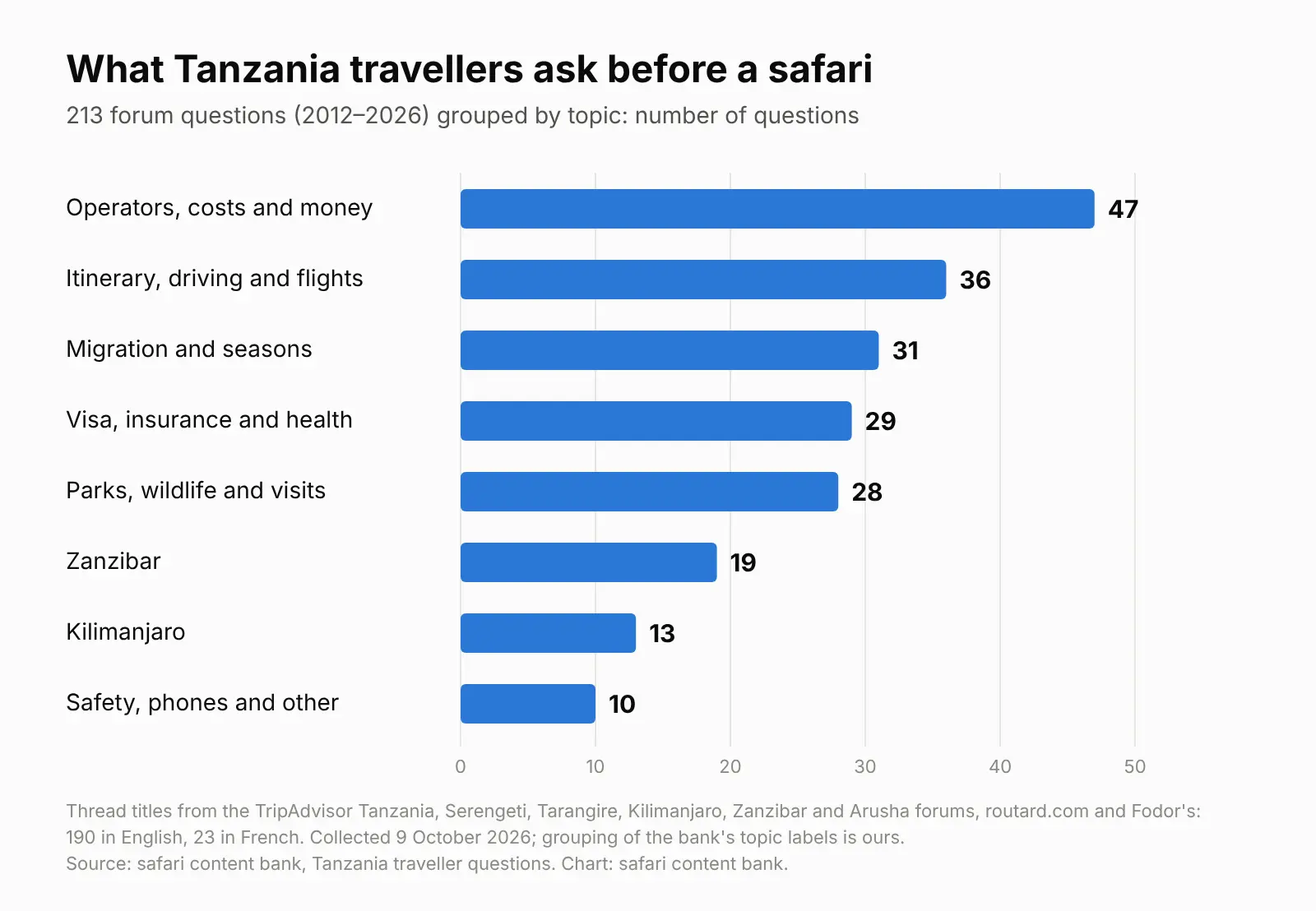 Thread titles from the TripAdvisor, routard.com and Fodor’s forums (190 English, 23 French), collected 9 October 2026; the topic grouping is ours. Kilimanjaro climbs are outside this page; see Kilimanjaro and safari. Chart: safari content bank.
Visa, insurance and health
Should I get the e-visa or a visa on arrival?
Take the visa on arrival: it costs the same, US$50, and is issued at main ports of entry to all nationalities except those on the referral list, who must apply online at least two months ahead (TripAdvisor summary thread; e-visa guidelines; UK FCDO). The official guidelines say online applications are “processed within ten days” (Tanzania e-visa guidelines), and a 218-reply forum thread records payments stuck at “pending payment” for three years (TripAdvisor). A traveller at Kilimanjaro airport on 18 September 2026 cleared the visa-on-arrival desk in under 10 minutes, with no form and no photo, while the e-visa queue was “enormous” (TripAdvisor). Bring clean US dollar notes; the card machine is sometimes down (TripAdvisor).
How much is the Tanzania visa, and what do US citizens pay?
US$50 for a single-entry tourist visa valid 90 days; US passport holders must buy the US$100 multiple-entry visa, even for one trip (e-visa guidelines). One visa covers the mainland and Zanzibar. Our sources disagree on whether the multiple-entry visa is issued on arrival, so US citizens should check the portal or their operator before flying.
What passport validity and documents do I need?
A passport valid for at least six months with at least one unused page, plus a return or onward ticket (e-visa guidelines). Every child needs their own visa application. A parent travelling alone with a child should carry the birth certificate and a notarised consent letter from the other parent (US State Department, 3 Sep 2026). Airlines refuse boarding below six months; a forum poster one week short found no fix (TripAdvisor).
Do I have to buy Tanzania’s US$44 travel insurance?
Yes. As of October 2026 every foreign visitor must hold Tanzania’s inbound travel policy (on the mainland, East African Community (EAC) and SADC travellers are exempt; ZIC says this is not automatic for Zanzibar): US$44 per adult, valid 92 days with multiple entries, under Government Notice 256 of 2026 (Clyde & Co, 16 Sep 2026). You need it “even if” you already have a personal policy, and visitors without it “may be refused entry” (UK FCDO, updated 20 Oct 2026). Buy it online before you fly from the National Insurance Corporation (NIC). It covers emergency medical care, evacuation and repatriation, not cancellation, so keep your own policy too. Full details: Tanzania visitor insurance.
If I visit the mainland and Zanzibar, do I need two policies?
No. Buy one policy, for your first port of entry: NIC if you land on the mainland, the Zanzibar Insurance Corporation (ZIC) if you land on Zanzibar (UK FCDO, updated 6 Oct 2026). ZIC sells through Visit Zanzibar at US$44 per adult and US$22 per child aged 3–17 (US State Department, 3 Sep 2026). Pages from before October 2026 that say “pay twice” are out of date. The start date on the certificate must match your arrival date.
Do I need a yellow fever certificate for Tanzania?
Only if you arrive from a yellow fever risk country, Kenya included, or after a transit of more than 12 hours in one. The rule applies to travellers aged 1 and over, and WHO does not recommend the vaccine for a trip to Tanzania alone (WHO country list, 2022, rev. Jan 2023 (PDF)). The case that catches people is a Masai Mara safari followed by the Serengeti or Zanzibar: Kenya is on the list. Forum regulars name Uganda, Ethiopia and Rwanda as other common triggers (TripAdvisor).
Do I need malaria tablets for a Tanzania safari?
Malaria risk exists all year in the whole country below 1,800 m, mainly the dangerous P. falciparum type (WHO country list (PDF)). That covers the Serengeti, Tarangire, Nyerere, Ruaha and Zanzibar. Which tablets to take is a decision for a travel clinic; the forum’s pinned question is from travellers tempted to skip them. Health risks are set out on our page Is a Tanzania safari safe?
Park fees, prices and tipping
How much does a Tanzania safari cost per day?
About US$220–300 per person per day on a group camping safari, US$406–656 on a private mid-range trip for two and US$578–873 at private luxury level, in operators’ published 2026 prices (one operator’s group-joining prices; another operator’s private northern-circuit tour, read 9 Oct 2026). Season moves the price more than anything else. The full price ladder, with lodges and extras, is on our Tanzania safari cost page.
What are the Serengeti park fees in 2026?
No 2026 tariff has been published; the last published TANAPA tariff (2023/24) charges US$70 a day before VAT, so US$82.60 with 18% VAT, and US$70.80 from 15 March to 15 May (TANAPA Tariffs 2023/24 (PDF)). Sleeping inside the park adds a concession fee of US$70.80 per night in July–September and US$59 the rest of the year. TANAPA froze fee rises for 12 months on 24 March 2025 (The Citizen), and the government promised “a minimum of 12 months’ notice before any future changes” (Tourism Update).
The official fee lines, with the date each took effect and the authority’s own source:
| Fee | Amount | In force from | Source |
|---|---|---|---|
| Serengeti and Nyerere National Parks, non-East African adult, entry per day, 16 May–14 Mar | USD 70 + 18% VAT = USD 82.60 | 1 Jul 2023 (2023/24 tariff, last published) | TANAPA Tariffs 2023/24 |
| Serengeti and Nyerere National Parks, non-East African adult, entry per day, 15 Mar–15 May | USD 60 + 18% VAT = USD 70.80 | 1 Jul 2023 (2023/24 tariff, last published) | TANAPA Tariffs 2023/24 |
| Serengeti and Nyerere, concession fee per person per night inside the park | Jul–Sep USD 60 + VAT = USD 70.80; Oct–Jun USD 50 + VAT = USD 59 | 1 Jul 2023 (2023/24 tariff, last published) | TANAPA Tariffs 2023/24 |
| Tarangire, Lake Manyara and Arusha National Parks, non-East African adult, entry per day | Peak USD 50 + VAT = USD 59; low USD 45 + VAT = USD 53.10 | 1 Jul 2023 (2023/24 tariff, last published) | TANAPA Tariffs 2023/24 |
| Ngorongoro Conservation Area, non-East African adult, entry per 24 h (single entry) | USD 70.80 (NCAA's page does not say whether VAT is included) | Undated official page, read 9 Oct 2026 | NCAA |
| Ngorongoro Crater descent (crater service fee), per vehicle | USD 295 (NCAA's page does not say whether VAT is included) | Undated official page, read 9 Oct 2026 | NCAA |
| Ngorongoro concession fee, rim and Ndutu lodges, per person per night | USD 59 (NCAA's page does not say whether VAT is included) | Undated official page, read 9 Oct 2026 | NCAA |
Is Ngorongoro included in the Serengeti fees, and what does a crater day cost?
No. The Ngorongoro Conservation Area Authority (NCAA) charges its own fees: US$70.80 per adult per 24 hours, single entry, plus US$295 per vehicle for the crater descent (NCAA tariffs, read 9 Oct 2026). For two people in a private vehicle that is US$436.60 in fees before the vehicle, guide or bed (our sum: US$295 + 2 × US$70.80). A full vehicle of six shares the US$295. The usual Arusha–Serengeti road crosses the NCA, so a vehicle that drives in and back out the same way pays NCA entry twice.
Is Ndutu part of the Serengeti?
No. Ndutu is inside the Ngorongoro Conservation Area, so NCA fees apply there: US$70.80 entry per adult per 24 hours and US$59 per person per night at Ndutu lodges (NCAA tariffs). A Ndutu stay does not include Serengeti entry. Forum regulars tell February travellers to “make sure the camp is in the Ngorongoro Conservation Area (NCA) and not in Serengeti NP” before booking (TripAdvisor, Sep 2026).
Why does my quote have so many fee lines?
Because each authority charges separately, and TANAPA adds 18% VAT on top: park entry, a concession fee for each night inside a park, NCA entry, the crater fee and vehicle entry. The TANAPA tariff states “All charges are VAT (18%) exclusive” (TANAPA 2023/24 (PDF)). NCAA’s tariff page does not say whether VAT is included in its fees. One traveller wrote “I am discovering new costs for going to Serengeti every day… In Kenya things were much simpler” (TripAdvisor, May 2025). A quote that does not list park, concession, crater and VAT lines is hard to compare with others; ask for them.
Can I pay park fees in cash at the gate?
No. TANAPA fees are paid through the government’s electronic payment gateway (GePG), “online through TANAPA online reservation, banks using electronic cards and mobile” (TANAPA 2023/24 (PDF)). The concession fee cannot be paid by a visitor at the gate at all; a self-drive traveller’s car-hire firm charged US$50 plus VAT to arrange the fees (TripAdvisor). On an operator safari the fees are paid for you and included in the price.
Is it cheaper to arrange the safari myself or book on arrival?
Usually not. A destination expert on the TripAdvisor forum: “There’s no price advantage to doing it yourself”, because operators hold contract rates below the lodges’ rack rates and handle a fee system that is “(needlessly) complex” (TripAdvisor, Mar 2026). A private Land Cruiser with a driver-guide costs about US$200–300 per vehicle per day (one operator’s cost guide); hire one alone and “Don’t forget 18% sales tax” (TripAdvisor, Jun 2026). For August, French forum regulars say book “au moins 6 mois avant”, at least six months ahead (Routard).
How much should I tip on a Tanzania safari?
There is no fixed rate: operators suggest US$10–25 per person per day for the guide, or US$30–50 per vehicle per day. One operator suggests US$10 per person per day (one operator’s tipping guide, rev. Apr 2026); a second operator US$10–20 on a group safari, US$15–25 private, or US$30–50 per vehicle per day, plus US$5–15 per person per day for the camp tip box (a second operator’s tipping guide, 15 Jul 2026). Forum regulars tip per vehicle, about US$20–30 a day for a group, and called one operator’s US$30 per person per day “ridiculous” (TripAdvisor, Sep 2026). For a Kilimanjaro climb, the second operator gives the porter-association rates: lead guide US$20 and porter US$6 per day, about US$300–350 per climber over 7 days.
The migration and when to go
Where is the Great Migration each month?
In a typical year the herds are on the southern plains around Ndutu from late November to March, move north through Moru and Seronera from April, reach the Western Corridor in May–June, the northern Serengeti in July–September, and head south through Lobo and Loliondo in October (one operator’s migration guide). The same guide adds that the timing “is entirely dependent upon the rainfall patterns each year”. One January reviewer stayed in the central Serengeti and “didn’t know that animals were migrating to the south” (a safari booking site’s reviews). Month by month, with fees: Great Migration month by month.
Will I see a river crossing?
Maybe, but nobody can promise one. On the Tanzanian bank, at Kogatende and Lamai, Mara River crossings happen from July to October; every reply on a 2026 timing thread said “No one can guarantee river crossing sightings on the Mara River” and advised at least four nights near the river (TripAdvisor). Expect company: “It is not uncommon for fifty or more trucks to be parked on the river banks waiting for a crossing” (TripAdvisor, Apr 2026).
Should I go to the northern Serengeti or the Masai Mara in July?
For early and mid-July, the northern Serengeti. A destination expert on the forum: “Most years you would not find the migration in the Masai Mara as early as July 11-15” (TripAdvisor, Apr 2026). From July to December the Mara reserve charges US$200 a day, more than a night inside the Serengeti at up to US$153.40 with concession (Narok County FY2025/26; TANAPA 2023/24, the last published). Doing both costs a long transfer day; the comparison is on Kenya vs Tanzania.
Where should I go in February for the calving?
To the short-grass plains around Ndutu and the southern Serengeti, where most calves are born “in a short window around February” (one operator’s migration guide). Late March is the edge: the Tanzania Wildlife Research Institute’s end-of-March 2023 survey found the lowest wildebeest density on the south-east Ndutu plains (TAWIRI 2023 census (PDF)). Ndutu is busy: in March 2026 a traveller saw “15–20 vehicles at a single sighting” and called it “a dealbreaker” (TripAdvisor). Arusha to Ndutu by road is “an awfully long day”, so several posters fly in (TripAdvisor). More: Serengeti calving season.
Is the long rainy season (March to May) worth it?
Only if you accept closed roads for a modest saving. Serengeti entry drops from US$82.60 to US$70.80 from 15 March to 15 May (last published tariff, 2023/24), but April is the wettest month at 155 mm in the Serengeti (Climates to Travel). In March 2026 a destination expert expected rain “until early May”, heavy “most of April”, with plains away from Seronera possibly impassable (TripAdvisor). The same month another traveller was “stuck 11 times in 7 days” and lost about US$2,000 that “insurance didn’t cover” (TripAdvisor). Check the cancellation terms before you book.
Are October and November good months?
Yes for fewer vehicles, but the herds are on the move and the short rains start. In October the herds leave the north through Loliondo and Lobo (one operator’s migration guide), so October crossings are the least reliable of the season. November brings the short rains, 115 mm in the Serengeti (Climates to Travel); forum regulars find “Early November can be lovely fewer crowds, greener scenery” (TripAdvisor).
How far ahead should I book a July–September safari?
About a year for the northern Serengeti in peak season. In April 2026 a Tanzanian operator wrote that for mid-July “most accommodations have already filled up their spots” (TripAdvisor). French forum regulars give at least six months for August (Routard).
Itinerary, driving and flights
How many days do I need for a Tanzania safari?
7–10 days for the northern circuit. In a 2026 forum thread: “7-10 days is ideal”, “5-6 days still works, but it can feel a bit packed”, and “You really don’t want to be moving every day” (TripAdvisor). The French forum’s rule is two parks in six days: “pendant vos 6 jours, allez dans seulement 2 réserves” (Routard). A returning French traveller who did Tarangire, the Serengeti, the crater and Manyara in six days would now do one park (Routard, Sep 2026).
How long are the drives between parks?
Arusha to the central Serengeti takes about 7–7.5 hours, and every leg of the northern circuit is 1–5 hours (a safari booking site’s Serengeti guide; one operator’s travel-times page, modified 1 Jul 2026).
| Leg | Distance | Driving time |
|---|---|---|
| Kilimanjaro airport (JRO) → Arusha | 55 km | 1 h 20 |
| Arusha → Tarangire north gate | 109 km | 2 h |
| Southern Tarangire → Ngorongoro Crater | 148 km | 2.5 h |
| Ngorongoro Crater → Ndutu | 106 km | 2.5 h |
| Ngorongoro Crater → Seronera (central Serengeti) | 135 km | 3.5 h |
| Seronera → northern Serengeti, via Ikoma / via Lobo | 90 km / 154 km | 4 h / 5 h, at game-drive pace |
Source: one operator’s travel-times page, read 9 Oct 2026. Travellers report longer times in rain.
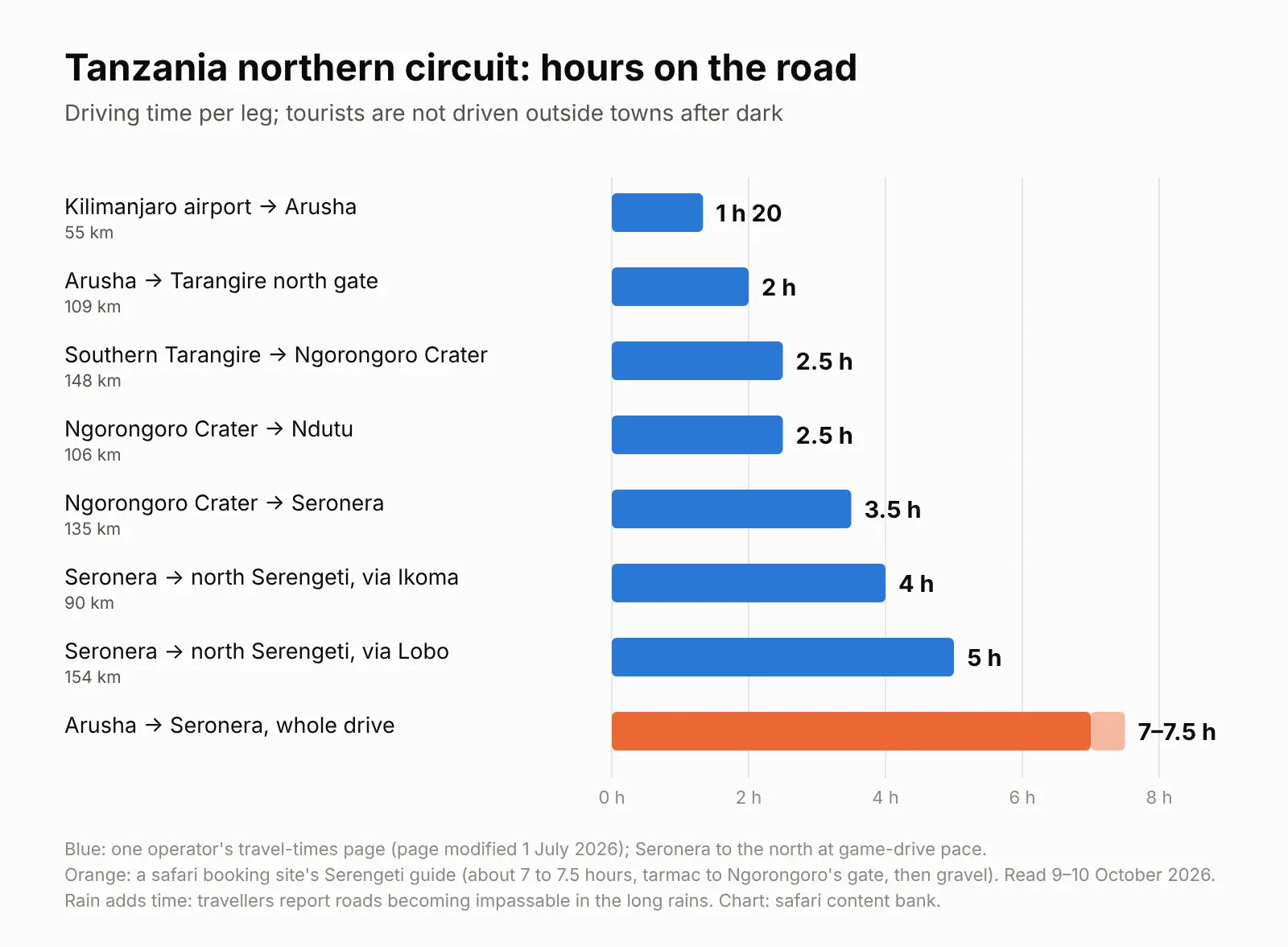 Sources: one operator’s travel-times page (legs, modified 1 July 2026); a safari booking site’s Serengeti guide (Arusha to Seronera). Read 9–10 October 2026. Chart: safari content bank.
Should I fly or drive between the parks?
Drive one way and fly the other; that is the forum’s standard fix. On the road from the northern Serengeti back to the crater rim, a regular wrote “It is an all day drive and not worth it” (TripAdvisor, Aug 2026). Driving out through the Ngorongoro Conservation Area also pays NCA entry a second time; flying out from a Serengeti airstrip does not. Scheduled flights link Seronera, Kogatende and Ndutu with Arusha, Kilimanjaro and Zanzibar (one operator’s travel-times page).
Can I land and drive to a park the same day?
Only if your flight lands at Kilimanjaro, Arusha or Dar es Salaam before about 13:00, because tourists are not driven outside towns after dark (one operator’s travel-times page, modified 1 Jul 2026). The same applies on the last day: forum regulars judged a Tarangire-to-Kilimanjaro evening flight too tight, at “3-4 hours” by road, with rain turning the Arusha–airport road from 45 minutes into about 1.5 hours (TripAdvisor, Aug 2025).
Is Tarangire worth a short visit or a day trip?
Forum regulars say give it at least two days, and go from August to October. “Rushing around parks and to them is not worth it”; “You need at least 2 days” (TripAdvisor). A short visit still pays the full day permit: US$59 with VAT (last published tariff, 2023/24). Arusha to the north gate is 109 km, about 2 hours each way (one operator’s travel-times page). Tarangire is no longer quiet: a September 2026 reviewer wrote that it “is creeping up towards the realm of losing its quiet charm” (a safari booking site’s reviews).
Can I drive from the Serengeti to the Masai Mara, and how many visas do I need?
There is no direct crossing: the Bologonja–Sand River border closed in 1977, so you fly via Migori and Tarime or drive round through Isebania–Sirari, changing vehicles at the border. Forum regulars describe the road route as a full day (TripAdvisor, Jun 2026); routes and times are on Kenya vs Tanzania. A Tanzanian single-entry visa is used up when you leave, so Kenya–Tanzania–Kenya–Zanzibar needs two Tanzanian visas (TripAdvisor). Entering Tanzania from Kenya needs a yellow fever certificate.
Can I self-drive a Tanzania safari?
Yes, but forum experts advise first-timers against it. “I would not attempt a safari without a 4x4 and basic mechanical and GPS skills”; one roof-tent couple waited “two days for help and parts” (TripAdvisor). In Ngorongoro Crater only 4x4 vehicles up to 3,500 kg tare are allowed, and “A licensed guide or an official NCAA guide must accompany all crater visitors” (NCAA visitor guidelines). A foreign-plated car of 2,001–3,000 kg pays US$150 + VAT per park entry (last published tariff, 2023/24).
Parks, crowds and wildlife
Are Tanzania’s parks crowded?
In a few places, yes: Ndutu in February, Ngorongoro Crater every day, and the central Serengeti and the Mara River crossings in peak months. Reviewers report “15–20 vehicles at a single sighting” at Ndutu (March 2026), “easily 70 other cars” in the central Serengeti (June 2024) and a crater that “feels like a zoo” (TripAdvisor; a safari booking site’s Serengeti and Ngorongoro reviews). French regulars say the south “On rencontre moins de monde sur les pistes”, you meet fewer people on the tracks, but it costs a bit more (Routard, May 2026). We found no published vehicle cap for TANAPA or the NCAA.
Is Ngorongoro Crater worth the cost?
Most visitors think so: the crater scores 4.8 out of 5 on 638 reviews on a safari booking site, and the complaints are crowds and price. The fees for two people are US$436.60 before vehicle and guide (our sum, NCAA tariff). Low-scoring reviewers wrote “Too many vehicles no bush vibe” (Aug 2025), and one advised that “If you have been on other safaris, I would recommend skipping it and just do the lookout at the rim” (Mar 2024) (a safari booking site’s reviews). Under the NCAA’s published guidelines, crater descents close at 16:00 and driving ends at 18:00 (NCAA visitor guidelines).
Can I do a night drive in the Serengeti?
No. Night drives are not permitted in Serengeti National Park or anywhere in the Ngorongoro Conservation Area. The TANAPA night-drive fee names Katavi, Ruaha, Mikumi, Tarangire, Lake Manyara and Nyerere, at US$50 per adult plus VAT (last published tariff, 2023/24). Operators quoted US$100 per person for Lake Manyara in 2026, and forum regulars warn that in Manyara’s forest you “most probably won’t see any wildlife at night” (TripAdvisor).
How bad are tsetse flies, and where are they?
Bad in patches, and repellent barely helps. Guides on the forum place them at Kusini, the Western Corridor and the Lobo road in the Serengeti and at Tarangire’s north gate and river, and report none at Seronera, in Arusha National Park or in Ngorongoro; one guide: “I don’t know of any repellent that works for tsetse fly” (TripAdvisor). Avoid dark blue and black clothing. When they swarm, close the windows or move to open ground; one Tarangire group “spent the entire afternoon with them” (TripAdvisor).
What does a balloon safari cost?
The park’s own fee inside the price is US$50 + VAT per person in the Serengeti and US$40 + VAT in Tarangire (last published TANAPA tariff, 2023/24). We could not verify a flight price on an operator’s own site. In the 2026 forum thread, the only reservations were price and weather cancellations; posters advised checking the operator’s licence with the Tanzania Civil Aviation Authority and the basket size (TripAdvisor).
Can I skip the Maasai village and curio-shop stops?
Yes; say so at booking and again at the start of each day. Guides earn commission on these stops, and a September 2026 traveller found them pushed “at very high prices”, with one village visit “very staged and cringe-y” (TripAdvisor). Boma visits are around Ngorongoro, Karatu and Manyara; there are none in the northern Serengeti, which is inside the park (TripAdvisor).
Zanzibar after the safari
How do I add Zanzibar to a Tanzania safari?
Fly from Kilimanjaro or a Serengeti airstrip; Kilimanjaro to Zanzibar is from US$200 one way on Flightlink, about an hour (Flightlink, read 9 Oct 2026). One US$50 visa and one US$44 insurance policy cover both parts of the trip. Zanzibar adds an infrastructure tax of US$1–5 per person per night by hotel class (Zanzibar Revenue Authority). Routes, fares and hotel prices are on Tanzania safari and Zanzibar.
Can I swim at any Zanzibar beach at any time?
No. On the east coast (Paje, Jambiani, Matemwe) “The tides go out about 1km to the reef”, so swimming works around high tide only; Kendwa and parts of Nungwi swim at all tides (TripAdvisor, traveller reports). Low tide comes “35-40 minutes later every day”. Seaweed on the east coast comes and goes within days (TripAdvisor).
When does it rain on Zanzibar?
April and May are the long rains (385 mm and 255 mm), and November the short rains (215 mm) (Climates to Travel). Some hotels close: Pongwe Beach Hotel from 10 April to 31 May (Tanzania safari and Zanzibar). A 51-reply thread began with a June visitor who had sun “only as a total of 6 hours” in a week; the first reply was “Wrong time of year. Do your research before booking” (TripAdvisor).
How much luggage can I take on safari flights?
Plan for one soft bag of 15–20 kg including hand luggage. Auric Air allows 20 kg including hand luggage and cameras (Auric Air); AirKenya, which links the Mara with the Serengeti, allows 15 kg including 5 kg hand luggage, in soft bags (AirKenya). Hotels and operators in Arusha and Zanzibar commonly store the rest; check before you travel.
Money, phones, operators and safety
Should I bring US dollars or use a card?
Bring US dollars in clean notes from 2009 or later; cards fail too often in the bush. Camps “will have a point-of-sale machine” but “it is very common that there is a poor network in the bush and the machine doesn’t work”, and card surcharges run about 3–5% (TripAdvisor). One operator’s tipping guide asks for “Series 2009 or newer” bills for tips. A July 2026 traveller spent about US$85–100 a day on extras on top of prepaid meals (TripAdvisor).
How should I pay a Tanzanian operator’s deposit?
By bank transfer (SWIFT) to the company’s registered business account, or by a card link or Pesapal invoice, which adds 3–4.5%. Check that the account name matches the company, and never pay into a personal account (TripAdvisor).
Will my phone work on safari?
Partly. Buy a SIM in an official shop with your passport, and expect gaps in the parks. Two SIMs bought from unauthorised sellers both failed (TripAdvisor). Guides on the forum say Airtel is best in the northern parks and no carrier works at Ndutu; travellers found Airalo’s eSIM on Vodacom “very unstable” (TripAdvisor). One traveller had good coverage across the northern parks and Zanzibar with an eSIM that switches between Vodacom, Airtel and Yas (TripAdvisor).
How do I check a Tanzania safari operator?
Check its Tanzania Tourist Agents Licensing Authority (TALA) licence, pay only a company account, and get the vehicle, crew and days in the contract. Our guide to checking a safari operator’s licence shows how. Membership of the Tanzania Association of Tour Operators (TATO) is not proof of conduct: a solo traveller’s 2026 complaint was against a member company (TripAdvisor). A scammer has spent three years impersonating named guides and emailing their former clients for “loans” (TripAdvisor); a guide asking for money after the trip is a red flag.
Is Tanzania safe for a safari?
The documented risks are malaria, long roads and town streets after dark, not crime inside the parks. Forum regulars advise a taxi after dark even for short distances in Dar es Salaam, Arusha and Stone Town (TripAdvisor). Protests after the 29 October 2025 election cancelled flights, and one UK traveller’s deposit was not refunded (a safari booking site’s reviews). Read the UK FCDO and US State Department pages before you book; the full answer is on Is a Tanzania safari safe?
Common mistakes in Tanzania safari answers
| What you’ll often read | What is correct |
|---|---|
| “The e-visa is the safe option; visa on arrival is risky” | Both cost US$50. Visa on arrival is issued at main ports of entry, except to nationalities on the referral list; a September 2026 arrival cleared it in under 10 minutes. |
| “Americans pay US$50 for the visa” | US citizens must buy the US$100 multiple-entry visa, even for one trip. |
| “Your own travel insurance covers Tanzania’s new requirement” | It does not. As of October 2026 the US$44 government policy is compulsory; needed “even if” you have your own policy (UK FCDO, 20 Oct 2026). |
| “Mainland and Zanzibar need two US$44 policies” | One policy, for your first port of entry. |
| “Serengeti entry is US$70” | US$70 is before VAT. The visitor pays US$82.60, from the last published tariff, 2023/24. |
| “Ndutu is in the Serengeti” | Ndutu is in the Ngorongoro Conservation Area: US$70.80 entry and US$59 concession per night. |
| “The crater fee is per person” | It is US$295 per vehicle per descent. |
| “July migration means Kenya” | In early and mid-July the herds are usually in the northern Serengeti. |
| “Book a crossing safari and you will see a crossing” | No one can guarantee a crossing, and 50 or more vehicles can wait at one. |
| “Add a night drive in the Serengeti” | Not permitted in the Serengeti or the NCA; Tarangire and Lake Manyara allow them. |
| “Five parks in six days” | Forum regulars advise 7–10 days and two parks in six days; Arusha to Seronera alone is 7–7.5 hours by road. |
| “Zanzibar beaches are swimmable any time” | On the east coast the tide goes out about 1 km; Kendwa and parts of Nungwi swim at all tides. |
Sources
- Traveller questions: 213 thread titles from the TripAdvisor Tanzania, Serengeti, Tarangire, Kilimanjaro, Zanzibar Island and Arusha forums, routard.com Forum Tanzanie and Fodor’s Travel Talk, collected 9 October 2026; threads linked in each answer
- Entry: Tanzania Immigration, e-visa guidelines; UK FCDO, Tanzania entry requirements, updated 6 Oct 2026; US State Department, Tanzania, 3 Sep 2026; Clyde & Co, Introduction of inbound travel insurance, 16 Sep 2026; NIC inbound portal; Visit Zanzibar inbound portal
- Health: WHO vaccination requirements, country list 2022, rev. Jan 2023 (PDF)
- Fees: TANAPA, Tariffs 2023/24 (PDF), the last published national parks tariff; NCAA, Tariffs and visitor guidelines, read 9 Oct 2026; The Citizen, fee freeze, 24 Mar 2025; Tourism Update, 12 months’ notice; Zanzibar Revenue Authority, infrastructure tax
- Prices and tipping: two operators’ published tour prices; one operator’s cost and tipping guides, 15 Jul 2026; another operator’s tipping guide (names and links kept in our editor notes)
- Migration and climate: one operator’s migration guide (names and links kept in our editor notes); TAWIRI 2023 wildebeest census (PDF); Climates to Travel, Tanzania
- Roads and flights: one operator’s travel-times page, modified 1 Jul 2026; a safari booking site’s Serengeti guide (names and links kept in our editor notes); Flightlink; Auric Air baggage policy; AirKenya baggage policy
- Reviews: a safari booking site’s user reviews for Tanzania (1-star and 4-star), the Serengeti and Ngorongoro, read 9 Oct 2026 (names and links kept in our editor notes)
Answers checked against the content bank on 10 October 2026. Forum and review lines are travellers’ reports, not official findings. We will update this page when TANAPA publishes a new tariff, when the visa or insurance rules change (we re-check the e-visa, NIC and ZIC portals monthly), and when the 2027 migration season’s camp availability is known.
More photos from Tanzania
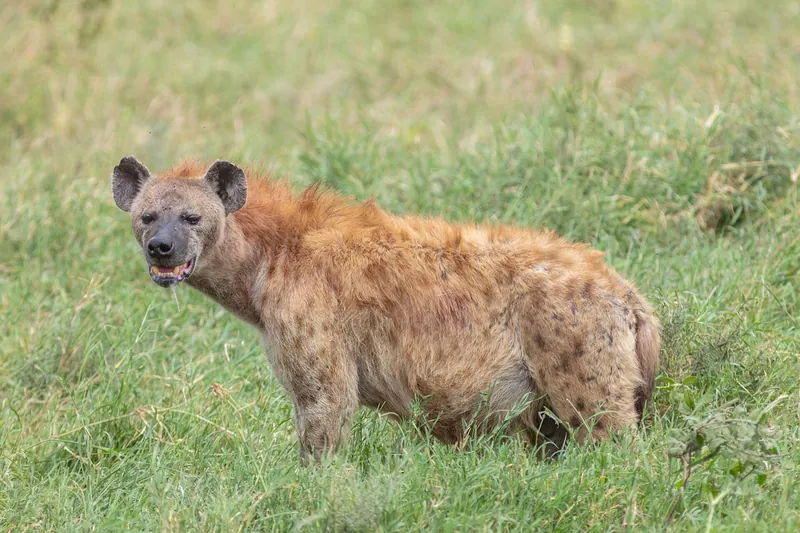
Spotted hyena in Tarangire National Park. Diego Delso, Wikimedia Commons, CC BY-SA 4.0, cropped 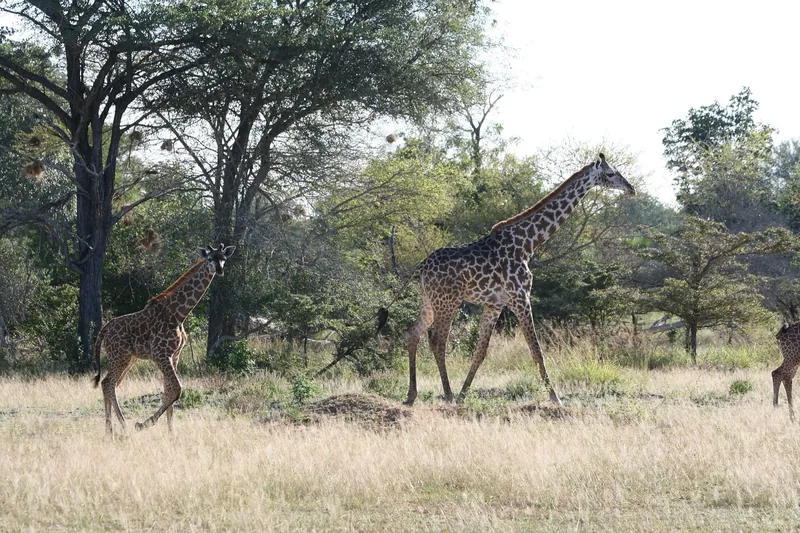
Giraffes in the woodland of Nyerere (Selous). Marco Zanferrari, Wikimedia Commons, CC BY-SA 2.0, cropped 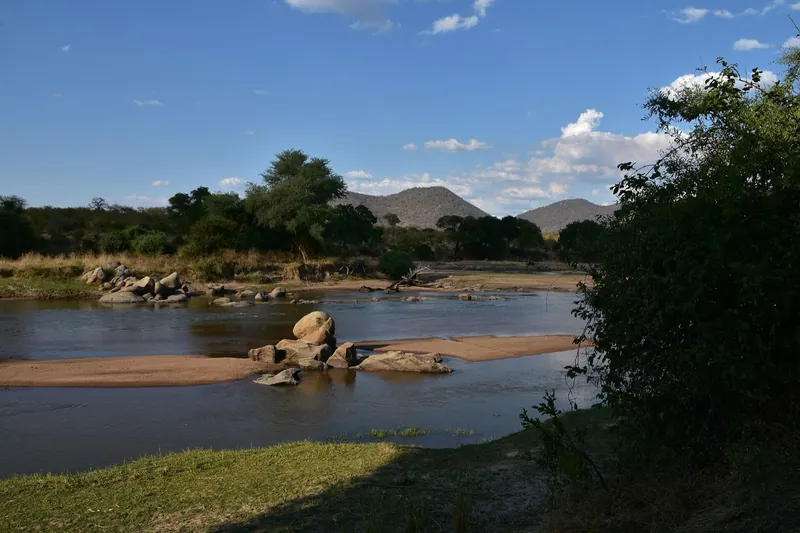
The Ruaha River and its boulders. Richard Mortel, Wikimedia Commons, CC BY 2.0, cropped


Photos by visitors and photographers, used under their free licences. Click a name to see the original.