 Experience

Last verified
On this page
- Kenya vs South Africa at a glance (2026)
- Which is cheaper, Kenya or South Africa?
- Park fees: Narok County and KWS vs SANParks
- Getting there and getting around
- Malaria and health: the clearest difference
- Wildlife: the migration or the Big Five
- When to go: seasons in each country
- Crowds and game-drive rules
- Families: ages, fees and malaria
- Entry: Kenya’s eTA vs South Africa’s traveller declaration
- Which should you choose?
- Common mistakes in Kenya vs South Africa comparisons
- Frequently asked questions
- Sources
Short answer: Choose Kenya for the wildebeest herds, which are usually in the Masai Mara from July to October, and for conservancy camps that sell night drives and walks. Choose South Africa for a self-drive, rhino or a safari without malaria tablets. The Mara reserve charges US$100 per adult per day from January to June and US$200 from July to December; Kruger charges R692 a day from 1 November 2026 (R602 until 31 October 2026).
Key facts
- Kenya has no malaria-free safari area; South Africa has several. WHO says malaria risk in Kenya “exists throughout the year in the entire country”. UK TravelHealthPro rates South Africa’s North West and Eastern Cape reserves (Madikwe, Pilanesberg, Addo) no risk, and recommends tablets for Kruger from September to May.
- The Mara fee doubles on 1 July; Kruger’s changes only on 1 November. The Maasai Mara National Reserve charges US$100 per non-resident adult per day from 1 January to 30 June and US$200 from 1 July to 31 December (Narok County’s last published schedule, FY2025/26). Kruger charges R692 per international adult per day from 1 November 2026 (R602 until 31 October 2026; SANParks).
- The wildebeest herds are in Kenya’s Masai Mara for about four months, July to October, and in Tanzania for the rest of the year (Mara Conservancy; a camp operator’s migration guide). No source can date a river crossing in advance.
- South Africa held 14,389 rhinos at the end of 2024 and Kenya 2,102 (IUCN SSC African Rhino Specialist Group report to CITES, 2025). Forum regulars report rhino are hard to see in the Masai Mara.
- Kruger can be self-driven in an ordinary hire car; the Masai Mara reserve cannot. Narok County banned private vehicles from game drives in the reserve by a memo of 3 June 2024 (Kenyans.co.ke).
- Kenya needs an eTA (US$30) and, since 5 October 2026, a government health policy of up to US$44 (eCitizen). UK and US passport holders need no visa for South Africa for stays of up to 90 days.
Kenya vs South Africa at a glance (2026)
Kenya sells open plains, the migration months and conservancy camps on operators’ vehicles; South Africa sells bushveld you can drive yourself, the most rhino in Africa and reserves outside the malaria area.
| Kenya | South Africa | Source | |
|---|---|---|---|
| Main safari areas | Maasai Mara National Reserve and its conservancies; Amboseli; Laikipia (Ol Pejeta); Samburu; Tsavo | Kruger National Park and the Greater Kruger private reserves; malaria-free reserves in North West, the Waterberg and the Eastern Cape | Kenya safari cost; South Africa safari cost |
| Flagship park fee, foreign adult | US$100 per day (1 Jan–30 Jun); US$200 (1 Jul–31 Dec), Masai Mara reserve | R692 (R602 until 31 Oct 2026), Kruger | Narok County FY2025/26 (last published); SANParks 2025/26 and 2026/27 |
| Cheapest bed in the bush | KWS public campsite US$30 per person (Amboseli, Lake Nakuru), plus the park fee | SANParks campsite R484–508 per site (stays 9–18 Oct 2026), plus the park fee | KWS LN 160/2025 (PDF); SANParks Kruger |
| Camp or lodge, per person sharing per night | US$190–1,305 (Ol Tukai Lodge to Hemingways Ol Seki, 2026) | R7,300–44,000 (Elephant Plains to Sabi Sabi Earth Lodge, 2026) | Rate sheets, below |
| Self-drive game viewing | Legal in KWS parks; private vehicles banned from game drives in the Mara reserve since 3 June 2024 | Ordinary hire car in Kruger; not in the private reserves | Kenyans.co.ke; SANParks |
| Capital to flagship park | Nairobi → Sekenani Gate 5.5–6 h on tarmac; Wilson → Mara by air US$200 + US$20 one way | Johannesburg → Kruger gates 411–600 km on tarred roads | The Kenya Times, 20 Aug 2026; Mombasa Air Safari; SANParks gates |
| Malaria | Risk all year in the entire country (WHO); only central Nairobi low risk (CDC) | Kruger: tablets recommended September–May; North West and Eastern Cape no risk | WHO list (PDF); TravelHealthPro |
| Wildebeest migration | Herds in the Mara about July–October | None in our sources | Great Migration month by month |
| Rhino, end of 2024 | 2,102 (1,059 black, 1,043 white) | 14,389 (2,307 black, 12,082 white) | IUCN SSC African Rhino Specialist Group report to CITES, 2025 |
| Night drives | In Mara conservancies; not sold in the Mara reserve | SANParks’ own drives in Kruger; lodge vehicles in the private reserves | Mara reserve vs conservancies; Kruger vs private reserves |
| Entry, UK citizens | eTA US$30, plus a government health policy of up to US$44 (eCitizen) | No visa for up to 90 days; online traveller declaration for all arrivals from 1 July 2026 | KCAA AIC 14/25 (PDF); UK FCDO |
| Currency of camp and lodge rates | US dollars | Rand (tour listings often in US dollars) | Rate sheets |
Fees and prices as on our Kenya safari cost and South Africa safari cost pages, checked 9–10 October 2026. Non-resident or international adult. We print each price in the currency it is published in and do not convert.
Which is cheaper, Kenya or South Africa?
South Africa is cheaper if you drive yourself and camp; at the budget guided level the answer depends on the Mara month. The one source in our bank that prices both countries, a budget operator’s 2026 first-safari guide, gives US$336–600 per person per day for Kenya (Masai Mara) and US$240–470 for South Africa (Kruger). Above that level Kenyan camps price in US dollars and South African lodges in rand, and we do not convert.
| Tier | Kenya, per person | South Africa, per person | Source |
|---|---|---|---|
| Self-drive camping | KWS campsite US$30 a night (Amboseli, Lake Nakuru), plus US$90 per adult per 24 h | SANParks campsite R484–508 a night per site, plus R692 per adult per day (R602 until 31 Oct 2026) | KWS LN 160/2025 (PDF); SANParks Kruger |
| Budget group safari, 3 days | Masai Mara: US$170–180, “park fees NOT included” (about US$57–60 a day) | Shared Kruger tour from Johannesburg: US$642 (US$214 a day); budget tours US$218–242 a day | Operators’ published 2026 prices, read 8–9 Oct 2026 |
| One-source daily range | US$336–600 a day (Masai Mara) | US$240–470 a day (Kruger) | One budget operator’s 2026 first-safari guide |
| Mid-range lodge | Ol Tukai Lodge, Amboseli: US$190–325 a night | Elephant Plains, Sabi Sand: R7,300 rondavel / R9,300 suite (2026) | Ol Tukai; Elephant Plains |
| Classic camp or lodge | Governors’ Camp (inside the Mara reserve): US$453–998 | Thornybush Game Lodge: R19,800 (2026) | Governors’ 2026 (PDF); Thornybush 2026 (PDF) |
| Private conservancy or reserve | Kicheche Mara North: US$625–995 (game drives included) | Sabi Sabi Bush Lodge R29,600 to Earth Lodge R44,000 (1 Mar 2026–28 Feb 2027) | Kicheche 2026 (PDF); Sabi Sabi |
| Top end | Hemingways Ol Seki: US$810–1,305; Borana (Laikipia) US$1,025–1,320 | Singita Ebony: R51,665–60,470 (page undated) | Hemingways 2026 (PDF); Borana; Singita |
Per person sharing, low to peak season where the card has seasons, without international flights. Rate sheets and listings read 8–9 October 2026. Tour listings are usually based on two travellers and do not itemise inclusions. Camp and lodge rates include meals and game drives; what else is included differs, so compare line by line.
The budget gap in US dollars
A 3-day budget Mara safari’s US$57–60 a day becomes about US$157–160 with the January–June reserve fee and US$257–260 with the July–December fee (our sums: price per day + US$100 or US$200). The shared Kruger tours list at US$214–242 a day; their listings do not say whether the Kruger fee is in the price, so ask. From January to June the Kenyan budget trip is cheaper; from July to December the Kruger tour is.
What comes on top of the rate
In Kenya, budget for the reserve or conservancy fee; in South Africa, for the Kruger fee or a private reserve’s levy.
| Extra | Kenya | South Africa | Source |
|---|---|---|---|
| Park or reserve fee | Mara reserve US$100 (Jan–Jun) or US$200 (Jul–Dec) per adult per day; KWS parks US$70–90 per 24 h | Kruger R692 per adult per day (R602 until 31 Oct 2026) | Kenya and South Africa cost pages |
| Conservancy fee or reserve levy | Mara conservancies US$130 per adult per night (Kicheche and Porini 2026 sheets) | Timbavati R660 per adult per night; Sabi Sand gate R170 per person + R370 per vehicle per entry; lodge levies Sabi Sabi R450, Thornybush R650, Simbambili R850 | Kicheche 2026 (PDF); Timbavati; Sabi Sand access |
| Community fee | Governors’ Camp US$50 per guest per night | None in our sources | Governors’ 2026 (PDF) |
| Private vehicle | Governors’ exclusive-use vehicle US$385–512 per vehicle per day, up to 6 guests | Thornybush R17,500 a day | Governors’ 2026; Thornybush 2026 |
| Flight to the park | Nairobi Wilson → Masai Mara US$200 + US$20 fuel surcharge one way | No published 2026 airfare in our sources | Mombasa Air Safari 2026 |
Read 8–9 October 2026. Kenya’s conservancy fees are camps’ rate-sheet figures; Offbeat’s 2026 sheet gives US$150 for Mara North.
One self-drive day for two adults, before the car, fuel and food (our sums): in Kruger, a Pretoriuskop campsite and two conservation fees cost R508 (October 2026 site price) + 2 × R692 = R1,892 from 1 November 2026 (R1,712 at the previous R602 fee). SANParks had not published its 2026/27 accommodation tariff when we checked on 1 November 2026, so confirm the price when you book. In Amboseli, two KWS campsite places and two park fees cost 2 × US$30 + 2 × US$90 = US$240, plus KSh 600 a day for a vehicle with under 6 seats.
Park fees: Narok County and KWS vs SANParks
Kenya’s fees are higher per day in US dollars and set by three bodies; South Africa’s Kruger fee is one SANParks figure, already published to October 2027.
| Kenya | South Africa (Kruger) | |
|---|---|---|
| Who sets it | Narok County (Masai Mara reserve), KWS (national parks), counties and conservancies | SANParks, revised every 1 November |
| Foreign adult | Mara US$100 (1 Jan–30 Jun) / US$200 (1 Jul–31 Dec) per day; Amboseli and Lake Nakuru US$90, Nairobi and Tsavo US$80 per 24 h | R692 per day (1 Nov 2026–31 Oct 2027; R602 until 31 Oct 2026) |
| Child | Mara: 9–17 US$50, under 9 free; KWS: child under 18 US$40–45, 5 and under free | Ages 2–11 R345 (R300 until 31 Oct 2026); under 2 free |
| Ticket length | Mara: 12 hours, 06:00–18:00, does not carry overnight; KWS: 24 hours | Per person per day |
| Status | Mara: last published schedule (FY2025/26) expired 30 June 2026; no 2026/27 schedule as of 9 October 2026 | Both schedules published |
| How you pay | Cashless: KWSPay (M-Pesa, card, bank transfer); Mara Triangle M-Pesa or card | Cashless gates; pay by card |
Sources: Narok County fee schedule FY2025/26 (PDF), with The Kenya Times, 6 Aug 2026 (secondary) for July–December 2026; Mara Conservancy; KWS LN 160/2025 (PDF); Kenyans.co.ke, 1 Nov 2025 (KWSPay); SANParks 2025/26 (PDF) and 2026/27 (PDF). Checked 9–10 October 2026.
- Two adults, 3 days (our sums): in the Mara reserve, 2 × 3 × US$100 = US$600 from January to June and 2 × 3 × US$200 = US$1,200 from July to December. In Kruger in December 2026, 2 × 3 × R692 = R4,152, as on our South Africa safari cost page.
- Sleeping outside the Mara reserve does not save the fee. The Mara Conservancy’s table is headed “Non-Residents (Accommodated Inside & Outside the Park) – Per Day”. Ticket rules: Masai Mara park fees.
- KWS fees have had no seasons since 1 October 2025, and Kruger’s fee is the same all year apart from the 1 November change. Every tier: Kenya park fees and Kruger park fees.
The official fee lines, with the date each took effect and the source:
| Fee | Amount | In force from | Source |
|---|---|---|---|
| Maasai Mara National Reserve, non-resident adult, per day (12-hour ticket, 06:00–18:00), 1 Jan–30 Jun | USD 100 | Since 1 Jan 2024; Narok County FY2025/26 schedule, the last published | Narok County fee schedule FY2025/26 |
| Maasai Mara National Reserve, non-resident adult, per day (12-hour ticket, 06:00–18:00), 1 Jul–31 Dec | USD 200 | Since 1 Jul 2024; Narok County FY2025/26 schedule, the last published, expired 30 Jun 2026 (no 2026/27 schedule as of 9 Oct 2026); The Kenya Times (6 Aug 2026, secondary) reports US$200 still applies for Jul–Dec 2026 | Narok County fee schedule FY2025/26 |
| Maasai Mara National Reserve, non-resident child 9–17 or student, per day (under 9 free) | USD 50, all year | Narok County FY2025/26 schedule, the last published | Narok County fee schedule FY2025/26 |
| Amboseli and Lake Nakuru National Parks (KWS), non-resident adult, per 24 hours | USD 90 (child under 18, 5 and under free, USD 45) | Legal Notice 160 of 2025, gazetted 22 Sep 2025, which states no start date; in force 1 Oct 2025 per the KWS press release of 29 Sep 2025 | KWS Fees Regulations 2025 (LN 160/2025) |
| Nairobi, Tsavo East and Tsavo West National Parks (KWS), non-resident adult, per 24 hours | USD 80 (child under 18, 5 and under free, USD 40) | Legal Notice 160 of 2025, gazetted 22 Sep 2025, which states no start date; in force 1 Oct 2025 per the KWS press release of 29 Sep 2025 | KWS Fees Regulations 2025 (LN 160/2025) |
| Kruger National Park daily conservation fee, international adult (12+), per day | ZAR 602 | 1 Nov 2025 to 31 Oct 2026 (SANParks 2025/26 schedule) | SANParks daily conservation fees 2025/26 |
| Kruger National Park daily conservation fee, international adult (12+), per day | ZAR 692 | 1 Nov 2026 to 31 Oct 2027 (SANParks 2026/27 schedule, already published) | SANParks daily conservation fees 2026/27 |
| Kruger National Park daily conservation fee, international child (2–11), per day (under 2 free) | ZAR 300 | 1 Nov 2025 to 31 Oct 2026 (SANParks 2025/26 schedule) | SANParks daily conservation fees 2025/26 |
| Kruger National Park daily conservation fee, international child (2–11), per day (under 2 free) | ZAR 345 | 1 Nov 2026 to 31 Oct 2027 (SANParks 2026/27 schedule) | SANParks daily conservation fees 2026/27 |
| Sabi Sand Nature Reserve gate fee, per person, per entry (VAT included) | ZAR 170 (ZAR 180 in 2027) | 1 Jan to 31 Dec 2026 | Sabi Sand Nature Reserve, access and gate fees |
| Timbavati Private Nature Reserve conservation levy, fully catered lodges, per adult (12+) per night | ZAR 660 (child ZAR 330) | 1 Jan to 31 Dec 2026 | Timbavati Private Nature Reserve, getting here |
Getting there and getting around
Kenya’s Mara is half a day’s drive or a short flight from Nairobi, on an operator’s vehicle; Kruger is a long drive or a flight from Johannesburg, and once there you can drive yourself.
| Kenya | South Africa | Source | |
|---|---|---|---|
| Gateway | Nairobi; light aircraft from Wilson airport to the Mara and Amboseli | Johannesburg by road; Skukuza (inside Kruger), Hoedspruit Eastgate or Kruger Mpumalanga International by air | Kenya safari cost; South Africa safari cost |
| By road | Nairobi → Sekenani Gate 5.5–6 h, tarmac all the way; Nairobi → Ol Pejeta about 220 km, 4–4.5 h | Johannesburg → Kruger gates 411 km (Numbi) to 600 km (Pafuri), all access roads tarred | The Kenya Times, 20 Aug 2026; Ol Pejeta FAQs; SANParks gates |
| By air | Wilson → Mara US$200 + US$20 one way; Wilson → Amboseli US$190 + US$20 | FedAir shuttles from O.R. Tambo to lodge airstrips in Sabi Sand; fares not in our sources | Mombasa Air Safari 2026; FedAir 2026 (PDF) |
| Luggage on light aircraft | AirKenya: 15 kg in soft bags, hand luggage included; US$5 per kg over | FedAir: 20 kg in a soft bag plus 5 kg hand luggage | AirKenya 2025 (PDF); FedAir baggage |
| Self-drive | Legal; self-drivers book KWS entry and campsites on KWSPay. Forum regulars advise first-timers against it and never to drive at night | Ordinary two-wheel-drive car in Kruger; 50 km/h on tar, 40 km/h on gravel | Kenya safari questions; Kruger self-drive |
| Daylight limits | Mara ticket 06:00–18:00 | Kruger entrance gates close 17:30 (May–July) to 18:30 (November–February); late entry for emergencies only | Mara Conservancy; SANParks gates |
Read 8–10 October 2026. Airline schedules change by season; check the live timetable before you book.
- In Kenya the parks are far apart. The Mara is in the west, Amboseli and Tsavo in the south-east and Samburu in the north; travellers give Amboseli to Ol Pejeta as about 8 hours by road (traveller reports on the Kenya safari questions page).
- Kruger itself is long: about 360 km from north to south, at least 7 hours 12 minutes at 50 km/h with no stops (our arithmetic, as on South Africa safari questions).
- Hiring a driver in Kenya is not the same as a guide, travellers warn; a Land Cruiser with driver-guide from Nairobi runs US$120–180 a day before fuel on a safari listing site’s market range (August 2026). Road, flight and luggage detail: Nairobi to the Masai Mara.
Malaria and health: the clearest difference
If anyone in your party cannot take antimalarial tablets, South Africa has an answer and Kenya does not. WHO says malaria risk in Kenya “exists throughout the year in the entire country”, and CDC recommends tablets everywhere below 2,500 m, game parks and the coast included. South Africa’s North West and Eastern Cape reserves are rated no risk.
| Area | What the health source says | Source (checked 10 Oct 2026) |
|---|---|---|
| Kenya, all safari areas and the coast | Risk all year; tablets recommended below 2,500 m; only central Nairobi low risk | WHO country list (PDF); CDC, Kenya |
| Kruger and the Greater Kruger private reserves | Risk area; tablets recommended September–May. SANParks puts the peak at November–April | TravelHealthPro, South Africa; SANParks |
| Madikwe, Pilanesberg (North West), Waterberg, Addo, Amakhala, Kwandwe (Eastern Cape) | No risk; bite avoidance only | TravelHealthPro; Malaria-free safaris |
The Kenya row rests on WHO and CDC and the South Africa rows on UK TravelHealthPro, as on our Kenya and South Africa question pages. This is what the sources say, not medical advice: whether you need tablets, and which, is a question for a travel clinic.
- Malaria-free is not cheaper. Pilanesberg charges R748 per foreign adult a day plus R168 per vehicle (from 1 December 2025), more than Kruger’s R692 (R602 until 31 October 2026).
- Kruger is not malaria-free in winter. TravelHealthPro’s season runs September to May and no source exempts any month; in Kenya there is no season at all.
- Yellow fever: each country asks for a certificate only from travellers arriving from a risk country. Arriving in South Africa from Kenya counts, and South Africa requires the vaccination at least 10 days before arrival (US State Department); route by route on yellow fever and safaris.
Wildlife: the migration or the Big Five
Kenya is the country for the wildebeest herds and open-plains predators; South Africa is the more reliable Big Five country because of rhino. Neither side has published sighting rates in our sources.
| Kenya | South Africa | Source | |
|---|---|---|---|
| Wildebeest herds | In the Masai Mara about July–October; crossings busiest August–September and “difficult to predict” | None in our sources | Mara Conservancy; Great Migration month by month |
| Rhino, end of 2024 | 2,102 (1,059 black, 1,043 white) | 14,389, 64% of Africa’s total | IUCN SSC African Rhino Specialist Group report to CITES, 2025; Where to see rhino |
| Big Five in one park | No single Kenyan park in our sources reliably shows all five; rhino are hard to see in the Mara, by forum regulars’ reports | All five in Kruger and the Greater Kruger reserves | Where to see the Big Five |
| Resident predators | The Mara’s lions, leopards and cheetahs are resident all year | Present in Kruger and the reserves; no census newer than 2011 in our sources | Kenya safari questions; South Africa safari questions |
| Elephant | Amboseli: 2,065 at the end of 2025 (Amboseli Trust for Elephants) | Kruger: no current census in our sources | Born Free, 23 May 2026 |
Read 8–10 October 2026. We do not publish where in a park rhino are found.
- Rhino numbers are falling in Kruger. Its population is down about 60% since 2013 (Save the Rhino), and 175 rhinos were poached there in 2025, against 88 in 2024 (SANParks).
- In Kenya, rhino are a separate stop from the Mara. Kenya’s rhino parks charge US$80–110 per adult a day; which ones, and what they cost, is on where to see rhino.
- The Mara has a second, smaller migration. The resident Loita wildebeest calve in the Ol Kinyei and Naboisho conservancies in February and March (a Kenyan camp operator’s Loita migration page).
When to go: seasons in each country
Kenya’s best and dearest months are July to October; Kruger’s best game months are April to September, but its dearest period is the December holiday and its fee does not follow the season.
| Kenya (Masai Mara) | South Africa (Kruger) | Source | |
|---|---|---|---|
| Rains | Long rains March–May (April 210 mm in the Mara); short rains November–December; no month dry (July 60 mm) | About October–March; Skukuza 635 mm a year | Best time for a safari |
| Best months for game | July–October for the herds; Mara game resident all year | April–September, the dry season | same |
| Park fee by season | US$100 Jan–Jun; US$200 Jul–Dec | Same all year: R692 (R602 until 31 Oct 2026) | Narok County FY2025/26; SANParks |
| Top-rate season | July–October: Governors’ Camp US$998, Kicheche Mara North US$995 | SANParks high season 13 December–15 January (2024/25 tariff); Sabi Sabi +15% for arrivals 20 Dec–5 Jan | Governors’ 2026 (PDF); SANParks 2024/25 (PDF); Sabi Sabi |
| Cheapest window | April–May: Governors’ Camp US$453, Ol Tukai US$190; many conservancy camps closed | SANParks low season 16 January–19 March (2024/25 tariff); Eastern Cape winter: Kwandwe R17,930 (1 May–30 Sep 2026) | same; Kwandwe 2026–27 (PDF) |
| Malaria | All year | Kruger: tablets September–May | WHO; TravelHealthPro |
Typical year, not a forecast. Read 8–10 October 2026.
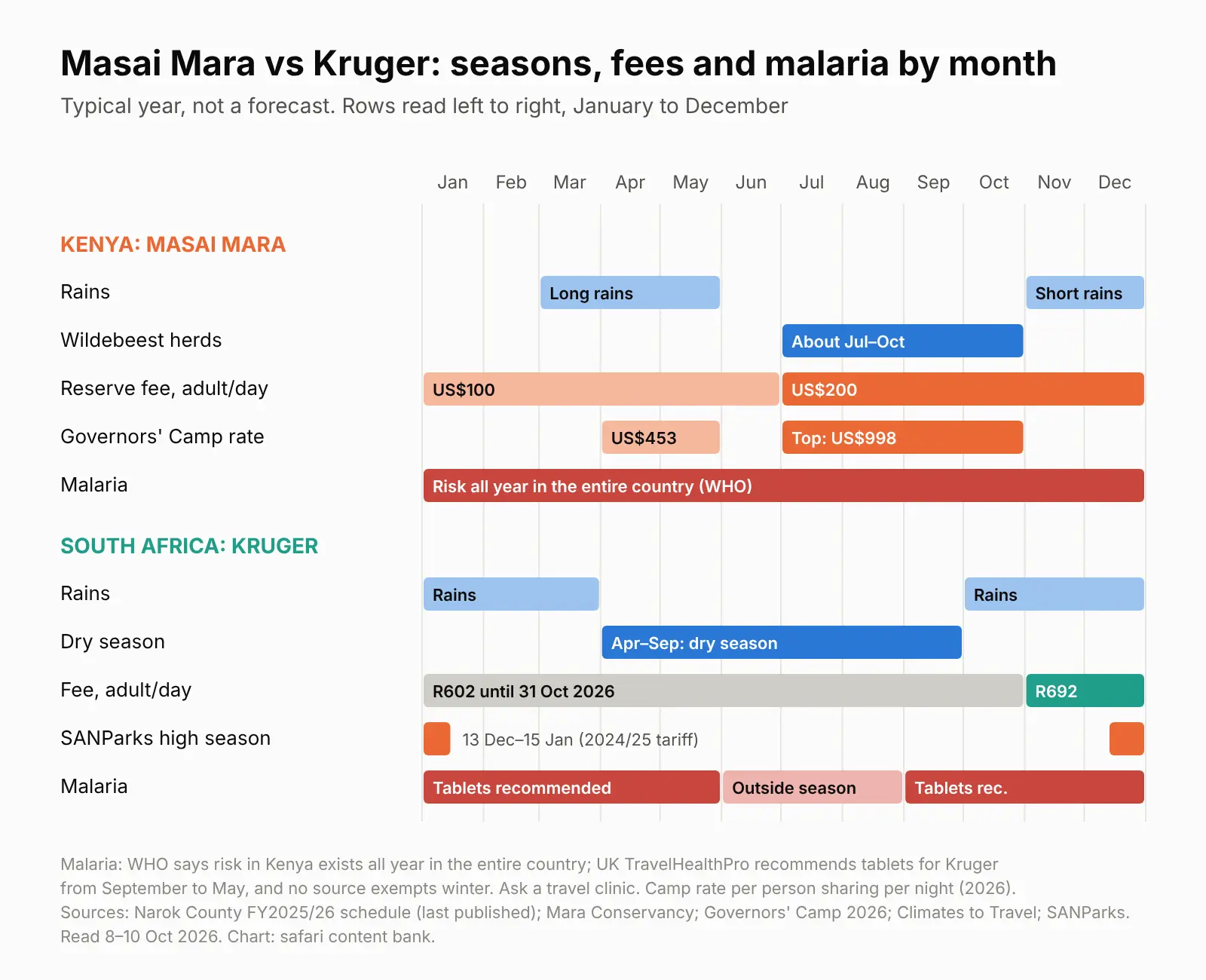 Typical year. Sources: Narok County FY2025/26 schedule; Mara Conservancy; Governors’ Camp 2026 rate sheet; Climates to Travel; SANParks fee schedules, climate page and 2024/25 tariff; WHO; UK TravelHealthPro. Read 8–10 October 2026. Chart: safari content bank.
- November–December falls in the Mara’s US$200 half. The cheaper Mara fee runs from January to June.
- Nights are cold in both dry seasons. Mara lows are 11–13 °C in every month (Climates to Travel); a July 2026 TripAdvisor thread reports Kruger safari tents at about 5 °C on winter nights (a traveller report).
Crowds and game-drive rules
Both flagship parks have public land where you share sightings and private land where the rules loosen; only the Masai Mara reserve publishes a vehicle limit. Narok County’s management plan caps a sighting at five vehicles, with others waiting at least 100 m away. No Mara conservancy, Kruger or Greater Kruger reserve publishes a cap in our sources.
| Rule | Masai Mara reserve | Mara conservancies | Kruger National Park | Greater Kruger private reserves |
|---|---|---|---|---|
| Who is on the tracks | Anyone with a day ticket, on operators’ vehicles | Guests of the camps on the conservancy | Self-drivers, SANParks drives, day visitors | Lodge guests on lodge vehicles; Sabi Sand takes no day visitors |
| Self-drive game viewing | No (private vehicles banned from game drives, 3 June 2024) | No; camp vehicles | Yes, ordinary car | No |
| Off-road driving | Prohibited, except to approach big cats on nearby open ground, no closer than 25 m | Practised | Not in private cars | On lodge vehicles, per operators |
| Night drives | Not sold | Sold at some camps | SANParks’ own guided drives only | On lodge vehicles, per operators |
| Walking | None sold, as far as we found | Included at some camps | With SANParks only | With lodge guides |
| Vehicles per sighting | Five; others wait 100 m away | No published cap | No published limit | No published rule |
Sources: Narok County’s Greater Maasai Mara Ecosystem Management Plan, as reported by Business Daily; Kenyans.co.ke (Narok memo); Kicheche 2026 (PDF) and Porini Lion Camp factsheet (PDF); SANParks vital information; Sabi Sand access; one tour operator’s blog (off-road and night drives in the private reserves). Read 8–10 October 2026.
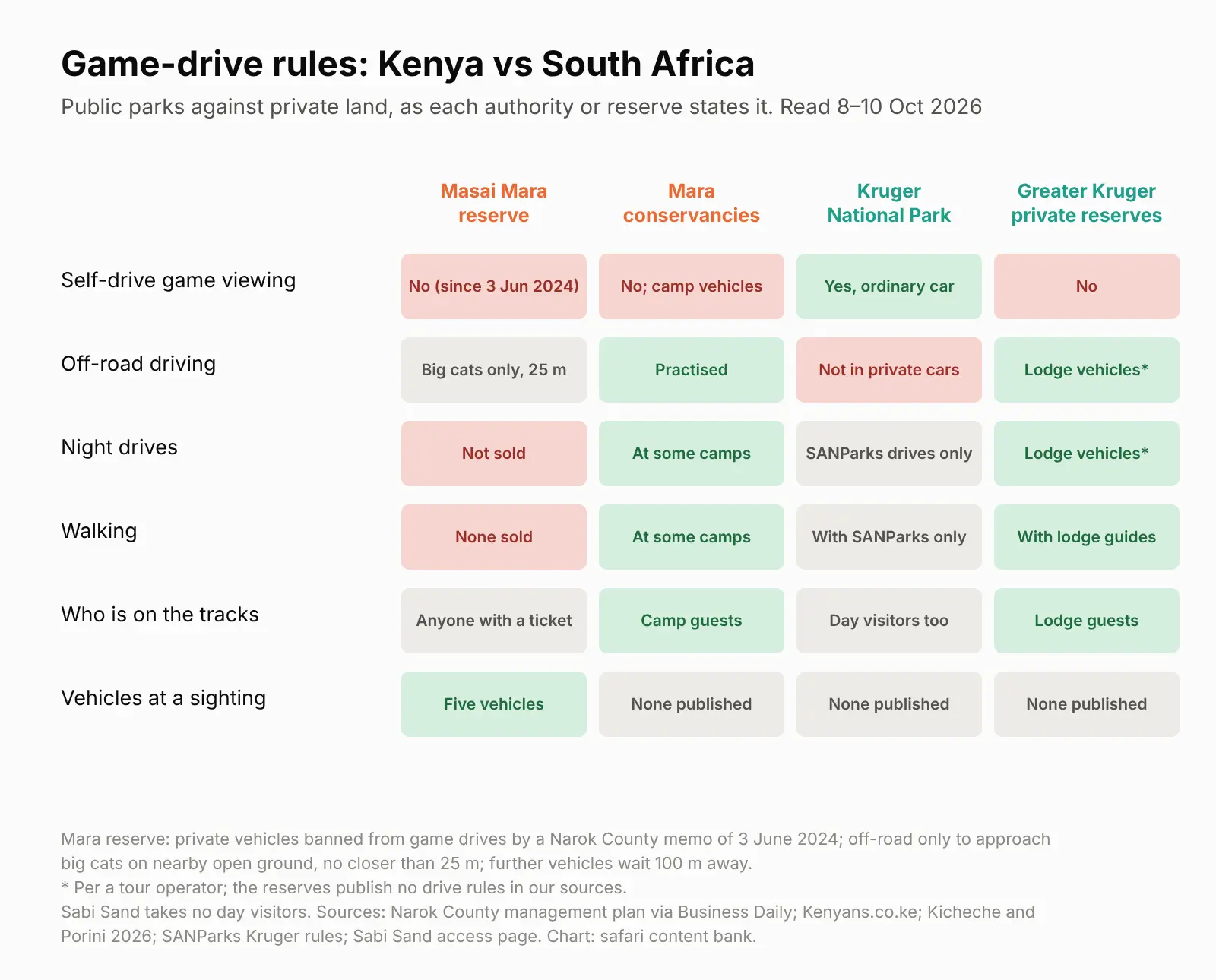 Sources: Narok County management plan via Business Daily; Kenyans.co.ke; Kicheche and Porini; SANParks; Sabi Sand; one tour operator. Read 8–10 October 2026. Chart: safari content bank.
- Mara visitor numbers have fallen: 420,000 in 2023, 343,000 in 2024 and 213,000 in 2025 (Kenya Economic Survey 2026, via Business Daily). Reviews on a safari booking site still describe 20 to 40 vehicles at a single sighting in the reserve (traveller reports).
- Kruger can stop admitting day visitors. On busy days, when the daily visitor limit is reached, only pre-booked overnight guests get in; SANParks publishes no number (SANParks day visits).
- The private land costs extra in both countries: US$130 per adult per night in a Mara conservancy, and a gate fee or levy in each Greater Kruger reserve. Side by side: Mara reserve vs conservancies and Kruger vs private reserves.
Families: ages, fees and malaria
South Africa is the easier family safari: malaria-free reserves, a child park fee from age 2 and lodges that take all ages; in Kenya, some conservancy camps set a minimum age of 7 or 8.
| Kenya | South Africa | Source | |
|---|---|---|---|
| Malaria-free option | None | Madikwe, Pilanesberg, the Waterberg, Addo and the Eastern Cape reserves | WHO; TravelHealthPro; Malaria-free safaris |
| Child park fee | Mara: under 9 free, 9–17 US$50; KWS: child under 18 US$40–45, 5 and under free | Kruger: ages 2–11 R345 (R300 until 31 Oct 2026); under 2 free | Narok County; KWS LN 160/2025; SANParks |
| Youngest age at camps | No national minimum; Kicheche Bush and Valley from 7, Porini camps from 8 | Thornybush Game Lodge all ages, but under-6s not on shared drives; Saseka from 12; Tswalu children 0–11 free when sharing (2026) | Kicheche 2026 (PDF); Thornybush 2026 (PDF); Tswalu |
| Entry documents | Every child, including infants, needs their own eTA; no child discount | Special documents for under-18s, such as a birth certificate and in some cases consent | AIC 14/25 (PDF); UK FCDO |
Rate sheets and child policies 2026, read 8–10 October 2026. Ages change; confirm in writing before you book. Camp by camp: family safari.
Entry: Kenya’s eTA vs South Africa’s traveller declaration
Kenya charges before you fly; South Africa, for UK and US passport holders, does not. Checked 9 October 2026.
| Item | Kenya | South Africa | Source |
|---|---|---|---|
| Visa or authorisation | eTA US$30, plus payment charges; apply online before travel | None for UK and US citizens for up to 90 days | KCAA AIC 14/25 (PDF); UK FCDO |
| Compulsory health insurance | Required for arrivals since 5 October 2026, up to US$44 (eCitizen); your own policy is not accepted in its place | None in our sources | U.S. Embassy Nairobi; VisasNews, 7 Oct 2026; Kenya visitor health insurance |
| Online form | The eTA itself | Traveller declaration for all arrivals and departures from 1 July 2026; no fee confirmed in our sources | UK FCDO |
| Passport | Validity rules not in our sources | Valid 30 days beyond departure, with 2 blank consecutive pages | US State Department |
| Exempt | African nationals except Somalia and Libya, and EAC citizens, need no eTA | Other passports, EU ones included: check with the Department of Home Affairs | Citizen Digital, 22 Jan 2025; Department of Home Affairs |
Check the official Kenya eTA portal, not a third-party site, the week you apply. Full rules: Kenya eTA and South Africa safari questions.
Which should you choose?
Choose Kenya for the migration months, open plains and conservancy night drives; choose South Africa for a first self-drive safari, a family, rhino or no malaria.
| If you… | Pick | Why |
|---|---|---|
| Want the wildebeest herds | Kenya, July–October | The herds are in the Masai Mara about July–October; crossings busiest August–September |
| Can’t or won’t take malaria tablets | South Africa (malaria-free reserves) | Kenya has risk all year everywhere (WHO); North West and Eastern Cape are no risk |
| Want to drive yourself in an ordinary car | South Africa (Kruger) | Tarred access to all 9 gates; Mara reserve game drives are on operators’ vehicles |
| Want all of the Big Five, rhino included | South Africa | 14,389 rhinos against Kenya’s 2,102 (end 2024); rhino hard to see in the Mara |
| Have young children | South Africa | Child park fee from age 2 and no-risk reserves; some Kenyan conservancy camps take children only from 7 or 8 |
| Want night drives and walks with few vehicles | Either, on private land | Mara conservancies; Greater Kruger private reserves |
| Travel January–June on a budget | Kenya | Mara fee US$100 a day; a 3-day budget Mara group safari is US$170–180 before fees |
| Travel July–December on a budget | South Africa | Mara fee US$200 a day; shared Kruger tours list at US$214–242 a day |
| Have under a week | Either | Nairobi → Mara 5.5–6 h or a short flight; Johannesburg → Kruger 411–600 km |
Whichever you choose, check that the operator holds a current licence: see how to check a safari operator is licensed. Weighing Kenya against its neighbour instead? See Kenya or Tanzania; for South Africa against Botswana, Botswana or South Africa.
See also: Kruger vs Masai Mara and Cape Town and safari.
Common mistakes in Kenya vs South Africa comparisons
| What you’ll often read | What is correct |
|---|---|
| “Kenya is malaria-free in the dry season” | WHO says risk exists throughout the year in the entire country; CDC rates only central Nairobi low risk. |
| “Kruger is malaria-free in winter” | No source says so. TravelHealthPro recommends tablets September to May; SANParks exempts no month. |
| “The Masai Mara costs US$200 a day all year” | US$100 from January to June, US$200 from July to December, per non-resident adult. |
| “Kruger costs R602 a day” (with no date) | That was the 2025/26 rate, which ended on 31 October 2026. Since 1 November 2026: R692 per international adult per day. |
| “You can self-drive the Masai Mara like Kruger” | Narok County banned private vehicles from game drives in the reserve on 3 June 2024. Kruger allows an ordinary hire car. |
| “Kenya visa on arrival, US$50” | Kenya has had no visa since January 2024; the eTA costs US$30, plus a government health policy of up to US$44, required for arrivals since 5 October 2026. |
| “Malaria-free reserves are the cheap option” | Pilanesberg charges R748 per foreign adult a day plus R168 per vehicle, more than Kruger. |
| “Kenya is a Big Five country like South Africa” | Rhino are hard to see in the Mara; South Africa held 14,389 rhinos at the end of 2024, Kenya 2,102. |
| “Private land allows only two or three vehicles at a sighting” | No published cap for the Mara conservancies or the Greater Kruger reserves. The Mara reserve’s rule is five. |
Frequently asked questions
Is Kenya or South Africa better for a first safari? South Africa, if you want to drive yourself, travel with young children or avoid malaria tablets: Kruger can be self-driven in an ordinary hire car and malaria-free Big Five reserves exist. Kenya, if the wildebeest herds are the point: they are in the Masai Mara about July to October, and the Mara is 5.5–6 hours from Nairobi on tarmac.
Is Kenya more expensive than South Africa? At the budget end it depends on the month. A 3-day budget Mara group safari costs US$170–180 before park fees, about US$157–160 a day with the January–June reserve fee and US$257–260 with the July–December fee (our sums); shared Kruger tours list at US$214–242 a day. One budget operator’s 2026 guide puts Kenya at US$336–600 and Kruger at US$240–470 per person per day.
What are the park fees in Kenya and South Africa? The Masai Mara reserve charges US$100 per non-resident adult per day from January to June and US$200 from July to December (Narok County’s last published schedule, FY2025/26). KWS charges US$90 for Amboseli and Lake Nakuru and US$80 for Nairobi and Tsavo per 24 hours. Kruger charges R692 per international adult per day from 1 November 2026 (R602 until 31 October 2026; SANParks).
Which country has malaria-free safaris? South Africa. UK TravelHealthPro rates North West province (Madikwe, Pilanesberg) and the Eastern Cape (Addo, Amakhala, Kwandwe) no risk. Kenya has none: WHO says the risk exists all year in the entire country, and Kruger is a risk area with tablets recommended from September to May.
Can you self-drive a safari in Kenya like in Kruger? Not in the same way. Self-driving is legal in Kenya’s KWS parks, but private vehicles have been banned from game drives in the Masai Mara reserve since a Narok County memo of 3 June 2024, and forum regulars advise first-timers against driving in Kenya. Kruger needs only an ordinary hire car on tarred and gravel roads.
Where will I see more rhino, Kenya or South Africa? South Africa, which held 14,389 rhinos at the end of 2024 against Kenya’s 2,102 (IUCN SSC African Rhino Specialist Group, 2025). Rhino are hard to see in the Masai Mara, by forum regulars’ reports, so Kenya trips add a rhino park at US$80–110 per adult a day.
Are night drives allowed in the Masai Mara and Kruger? Not in the Masai Mara reserve, where none are sold, and not in private cars in Kruger, where SANParks sells its own guided night drives. Mara conservancy camps and Greater Kruger private-reserve lodges run night drives for their guests.
Can you combine Kenya and South Africa on one trip? Yes, but carry a yellow fever certificate: South Africa asks for one from travellers arriving from a risk country, which includes Kenya, and requires the vaccination at least 10 days before arrival. Our sources hold no Nairobi–Johannesburg timetable or fare, so check the live schedule.
Sources
- Kenya fees: Narok County, Maasai Mara fee schedule FY2025/26 (PDF), the last published; The Kenya Times, 6 Aug 2026 (press, secondary); Mara Conservancy, conservation fees and wildebeest migration; KWS, Fees Regulations 2025, LN 160/2025 (PDF); Kenyans.co.ke, 1 Nov 2025 (KWSPay)
- South Africa fees: SANParks daily conservation fees 2025/26 (PDF) and 2026/27 (PDF); tariff booklet 2024/25 (PDF); Sabi Sand access; Timbavati
- Rules: Narok County management plan via Business Daily; Kenyans.co.ke, Narok memo; SANParks vital information, entrance gates and day visits; one tour operator’s blog (name and link kept in our editor notes)
- Health: WHO country list, 2022 rev. Jan 2023 (PDF); CDC, Kenya; TravelHealthPro, South Africa; SANParks, Kruger malaria; US State Department, South Africa. Checked 10 Oct 2026
- Wildlife: IUCN SSC African Rhino Specialist Group report to CITES, 2025, as on our rhino page; Save the Rhino; SANParks rhino statement; Born Free, 23 May 2026; a Kenyan camp operator’s Loita migration page; Business Daily, Mara visitor numbers
- Rate sheets: Ol Tukai, Governors’ 2026, Kicheche 2026, Porini Lion Camp factsheet, Hemingways 2026, Borana; Elephant Plains, Thornybush 2026, Sabi Sabi, Singita Ebony, Kwandwe 2026–27, Tswalu; tour operators’ published 2026 prices and one budget operator’s first-safari guide (names and links kept in our editor notes)
- Access: The Kenya Times, 20 Aug 2026; Mombasa Air Safari 2026; AirKenya 2025 (PDF); Ol Pejeta FAQs; FedAir 2026 (PDF) and baggage
- Entry: KCAA AIC 14/25 (PDF); Kenya eTA portal; U.S. Embassy Nairobi; VisasNews, 7 Oct 2026; Citizen Digital, 22 Jan 2025; UK FCDO, South Africa entry requirements; Department of Home Affairs
- Climate: Climates to Travel, Kenya (an aggregator); SANParks climate page, as on our best time for a safari page
- Traveller reports (opinion and experience, not official findings): TripAdvisor Kenya, Maasai Mara and Kruger forums and a safari booking site’s reviews, as cited on our Kenya and South Africa question pages
Prices and fees checked 9–10 October 2026. We will recheck this page on 2 November 2026, after Kruger’s fee changes on 1 November, and when Narok County publishes a 2026/27 Mara schedule or Kenya publishes an official insurance price. More: Kenya safaris, South Africa safaris, Masai Mara, Kruger National Park.