 Experience

Last verified · Next check due
On this page
- Tap, bottled or filtered: country by country
- South Africa’s tap water: what the government’s own report says
- What camps and lodges provide
- Ice, salads, fruit and juice
- Plastic rules: Kenya, Tanzania and Rwanda
- Staying hydrated in the heat
- What to drink, situation by situation
- Common mistakes about water on safari
- Frequently asked questions
- Sources
Short answer: Drink the filtered or bottled water your camp provides, and treat tap water as unsafe unless the lodge says it is treated. In South Africa, the US CDC suggests treated or bottled water even in cities, and a 2023 government report rated 46% of supply systems poor or bad. Kenya has banned single-use plastics, bottles included, in parks since 5 June 2020. Tanzania and Rwanda ban plastic carrier bags. Read 7 November 2026.
Key facts
- Contaminated food and water spread “cholera, hepatitis A, travellers’ diarrhoea and typhoid”, says UK TravelHealthPro, which lists hepatitis A and typhoid vaccines under “Most travellers” for Kenya and Botswana (TravelHealthPro, Food and water hygiene; our safari vaccinations page).
- South Africa: the CDC Yellow Book’s South Africa chapter says travellers “could consider treating tap water or drinking bottled water in cities”, and “In more rural areas, travelers should consume only bottled water” (CDC Yellow Book 2026, South Africa).
- Namibia: a Namibian lodge group tells guests that “Namibian tap water quality permits safe consumption” and that many lodges bottle their own groundwater (the group’s guest guide, fetched 3 Sep 2026).
- Ice is tap water: “Because ice might be made from contaminated water, ask that all beverages be served without ice”, says CDC, for places where water may be unsafe (CDC Yellow Book, Food and water precautions).
- Plastic: Kenya bans single-use plastics, water bottles included, in national parks, beaches, forests and conservation areas from 5 June 2020 (UNEP, 5 Jun 2020). Bring a refillable bottle.
- This page is not medical advice. A travel clinic advises on vaccines and on what to carry for stomach upsets.
Tap, bottled or filtered: country by country
In all nine safari countries, the safe default in camp is the water the camp gives you; official sources add country detail only for South Africa, and a lodge group adds it for Namibia. For the other countries, the general food-and-water advice of TravelHealthPro, CDC and fitfortravel applies.
| Country | What our sources say about tap water | Practical note | Source |
|---|---|---|---|
| Kenya | No country tap-water rating in our sources; hepatitis A and typhoid listed for most travellers | Camp rates in our sources include filtered or drinking water; single-use plastic bottles are banned in parks | TravelHealthPro, Kenya; UNEP |
| Tanzania | No country tap-water rating in our sources | Plastic carrier bags banned since 1 Jun 2019 | Tanzania government notice, 16 May 2019 |
| Botswana | No country tap-water rating in our sources; hepatitis A and typhoid listed for most travellers | Self-drivers carry water: none listed on the Botswana side of the Kgalagadi | TravelHealthPro, Botswana; our Kgalagadi page |
| Namibia | A lodge group: tap water “permits safe consumption”; many lodges bottle their own groundwater | Carry an extra 5 litres per person in the car (same lodge group) | A Namibian lodge group’s guest guide |
| South Africa | CDC: travellers “could consider” treated tap water or bottled water in cities, only bottled water in rural areas; Blue Drop 2023: 46% of systems poor or bad | Ask your lodge whether its water is treated | CDC Yellow Book, South Africa; DWS Blue Drop 2023 |
| Zambia | No country tap-water rating in our sources | Use the camp’s water | General advice (TravelHealthPro, CDC) |
| Zimbabwe | No country tap-water rating in our sources | Gonarezhou’s camps: water untreated, bring drinking water | Our Gonarezhou vs Kruger page (GCT FAQ, 2022) |
| Uganda | No country tap-water rating in our sources | Use the camp’s water | General advice (TravelHealthPro, CDC) |
| Rwanda | No country tap-water rating in our sources | Plastic bags confiscated at the airport or other point of entry | Visit Rwanda |
Official sources as linked, read 7 November 2026; the lodge group’s guest guide fetched 3 Sep 2026. “No country rating in our sources” means we found none, not that the water is safe or unsafe.
- Why so few country ratings: the TravelHealthPro and NHS fitfortravel food-and-water pages give one set of precautions for all travellers, not a tap-water verdict per country (fitfortravel, Food and water precautions, archived copy of 3 Sep 2025). TravelHealthPro adds only that “bottled water may be safer to drink than tap water”.
- Brushing teeth: CDC lists brushing teeth among the uses that need safe water (CDC Yellow Book). Use the bottle by the basin.
South Africa’s tap water: what the government’s own report says
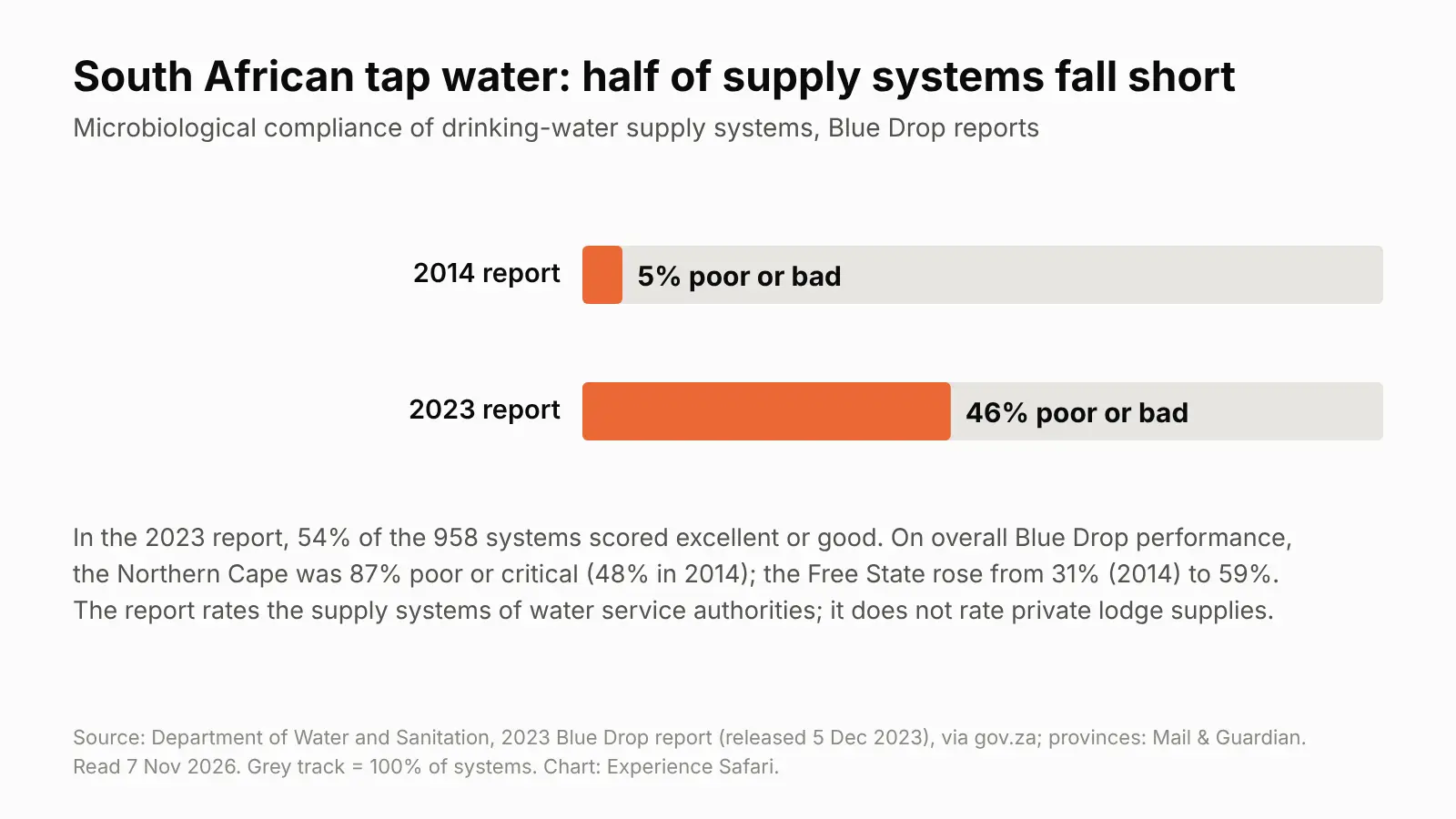
South Africa is the one safari country with a published national test of its drinking water, and the 2023 Blue Drop report found that 46% of supply systems had poor or bad microbiological compliance, against 5% in 2014 (Department of Water and Sanitation, 2023 Blue Drop report, released Tuesday 5 Dec 2023).
| Blue Drop 2023 finding | Figure | Source |
|---|---|---|
| Supply systems assessed | 958, run by 144 water services authorities | DWS via gov.za, 5 Dec 2023 |
| Excellent or good microbiological compliance | 54% | DWS via gov.za |
| Poor or bad | 46% (5% in 2014) | DWS via gov.za |
| Northern Cape, overall performance | “poor or critical performance (87%), up from 48% in 2014” | Mail & Guardian, 6 Dec 2023 |
| Free State, overall performance | “from 2014 (31%) to 2023 (59%)” | Mail & Guardian |
The provincial figures are overall Blue Drop performance scores, not microbiological compliance. The report rates municipal supply systems, not a private lodge’s own borehole and filters.
- What it means on safari: the report rates municipal systems, not a lodge’s own supply, so ask the lodge whether its water is treated. On Kruger self-drive, drink bottled water: the CDC chapter says to consume only bottled water in more rural areas.
What camps and lodges provide
Most camps give guests filtered water in a refillable bottle rather than plastic bottles; the groups below say so on their own pages or in trade press. Practices change, so check with your camp.
| Camp group | What it publishes about guest water | Source and date |
|---|---|---|
| Elewana Collection | A reusable aluminium bottle for each guest, “filled at points around the property”, replacing plastic water bottles (#BandtheBottle) | Elewana news, seen 31 Oct 2026 |
| Asilia | Reusable stainless-steel bottles; a circular water system at Sayari Camp in the Serengeti cut nearly 18,000 single-use bottles a year | Asilia press; ATC News, seen 31 Oct 2026 |
| Governors’ Camp (Masai Mara) | Reverse-osmosis systems installed to cut plastic; water served in glass jugs at meals | Tourism Update, seen 31 Oct 2026 |
| Singita | Bottled-water purchasing cut by more than 90%; guests get reusable glass or steel bottles of filtered water | ATTA, 5 Feb 2019 |
| Wilderness | Refillable bottles filled with reverse-osmosis-filtered water | Wilderness press release (undated), seen 31 Oct 2026 |
| A Namibian lodge group | Many lodges bottle their own groundwater | The group’s guest guide, fetched 3 Sep 2026 |
Lodge practices as each group or the trade press describes them; we have not tested any water, and older items may no longer be current.
- Mobile and budget camps are in our sources only as agent rate listings that include “drinking water” or “filtered water” in the price; how it is treated is not stated. Ask before you book a camping safari.
- On a game drive, bring your own refillable bottle and fill it in camp before you leave.
Ice, salads, fruit and juice
Ice and anything washed in water count as water: they are safe if the camp’s water is treated, and a risk where it is not.
- Ice: “Because ice might be made from contaminated water, ask that all beverages be served without ice” (CDC Yellow Book).
- Salads, fruit and berries: fitfortravel says “Avoid salads and fresh herbs”, “Peel all fruits and vegetables” and “Avoid berries, in particular raspberries” (fitfortravel, archived copy of 3 Sep 2025).
- Juice: “Choose fruit juice from sealed cartons” (fitfortravel).
- Smart lodges are not exempt: TravelHealthPro tells travellers to keep up food and water hygiene “even in high-end, all-inclusive resorts” (TravelHealthPro news, 30 Mar 2026).
- Babies: for infants under 3 months and those with weakened immune systems, CDC advises preparing formula with hot water (70 °C or above) (CDC Yellow Book). Family planning is on family safari.
Plastic rules: Kenya, Tanzania and Rwanda
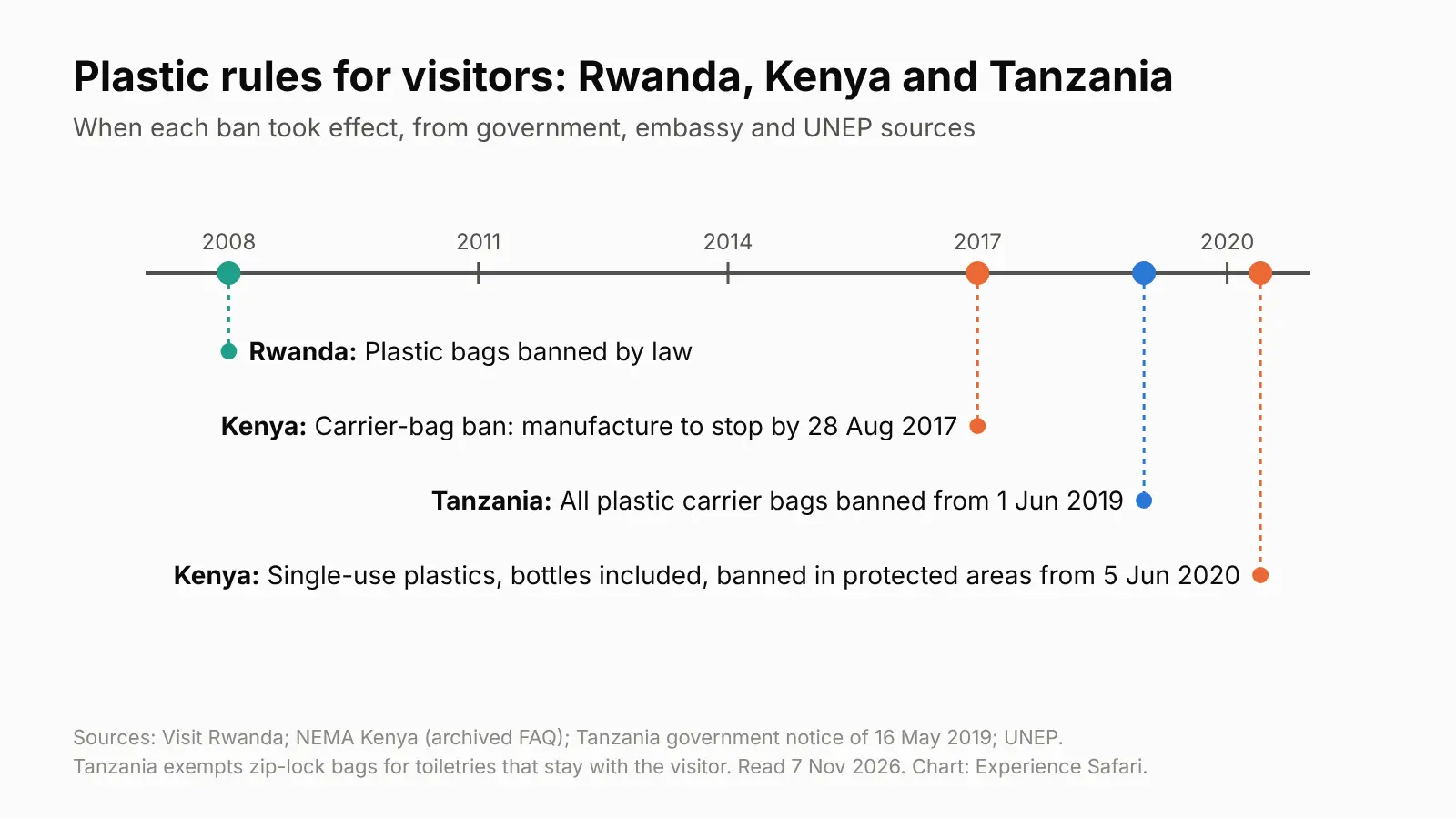
Three safari countries ban plastic bags at the border, and Kenya also bans single-use plastic bottles in its protected areas. Pack reusable bags and a refillable bottle.
| Country | Rule | What it means for visitors | Official source |
|---|---|---|---|
| Kenya, nationwide | Ban on plastic carrier and flat bags; NEMA says the Gazette Notice was published on 28 Feb 2017 and gives 28 Aug 2017 as the deadline for manufacture to stop | Leave shop bags at home; The EastAfrican reported penalties of up to four years in prison or a KSh4 million fine | NEMA, FAQs on the plastics ban (archived copy); The EastAfrican |
| Kenya, protected areas | Single-use plastics banned in national parks, beaches, forests and conservation areas from 5 Jun 2020 | Visitors “will no longer be able to carry plastic water bottles, cups, disposable plates, cutlery, or straws” | UNEP, 5 Jun 2020 |
| Tanzania (mainland) | All plastic carrier bags, “regardless of their thickness”, banned from 1 Jun 2019 | Surrender bags at the “Special desk” at entry points; zip-lock bags for toiletries are allowed, being “expected to remain in the permanent possession of visitors” | Vice President’s Office notice of 16 May 2019, as posted by Tanzanian embassies |
| Rwanda | Plastic bags “Banned by law since 2008” | “any plastic bags in your luggage will be confiscated at the airport or other point of entry” | Visit Rwanda |
Official sources read 7 November 2026 (NEMA as an archived copy); The EastAfrican seen 31 October 2026. We found no official visitor rule on plastics for Uganda, Botswana, Namibia, South Africa, Zambia or Zimbabwe in our sources, so we print none.
- Kenyan detail and drones: more on Kenya’s bag ban and customs is on the safari packing list and safari etiquette.
- Shop and duty-free bags: Rwanda confiscates any plastic bags in your luggage; Tanzania’s notice exempts only toiletry zip-locks. Repack before you land.
Staying hydrated in the heat
CDC calls dehydration “the most important predisposing factor in heat-related illness”, and “most acclimatization changes occur within 10 days”, so drink before you are thirsty and rest in the hottest hours (CDC Yellow Book, Heat and cold illness in travelers).
- Signs of heat exhaustion (NHS): tiredness, dizziness, headache, feeling or being sick, heavy sweating, cramps and intense thirst. Move to a cool place and drink; it should ease within about 30 minutes (NHS, Heat exhaustion and heatstroke).
- Heatstroke is an emergency: a very high temperature, hot skin without sweating, confusion, fast breathing or a seizure, or no improvement after 30 minutes of cooling, needs emergency help (NHS). CDC calls it a medical emergency requiring aggressive cooling and hospital care.
- Salt as well as water: CDC says mild heat illness is handled with rest and fluids, “optimally including some salt” from drinks or snacks.
- Self-drive in Namibia and Botswana: a Namibian lodge group advises carrying an extra 5 litres per person and recognising headaches as a sign of dehydration. Travellers report 36 °C with no shade at Deadvlei (Sossusvlei; Namibia safari questions); for Botswana’s remote areas see Botswana self-drive.
- Walking and canoeing days are the long, exposed ones: see walking safari and canoe safari.
What to drink, situation by situation
| Situation | What to drink | Source |
|---|---|---|
| In a camp or lodge | The camp’s filtered or bottled water, from your refillable bottle | Camp groups above |
| Tap in your room | Not for drinking or brushing teeth unless the lodge says it is treated | CDC Yellow Book |
| Drinks with ice | Fine if the camp’s water is treated; otherwise ask for no ice | CDC Yellow Book |
| In a Kenyan park | Refillable bottle; no single-use plastic bottles | UNEP |
| South African city hotel | Treated tap water or bottled water, which CDC says travellers “could consider” | CDC Yellow Book, South Africa |
| Namibian lodge | Tap water is “safe” per a Namibian lodge group; ask if unsure | A Namibian lodge group’s guest guide |
| Self-drive or camping in remote areas | Carry your own; a Namibian lodge group advises an extra 5 litres per person | A Namibian lodge group’s guest guide; our Kgalagadi and Gonarezhou pages |
| Mixing baby formula | For babies under 3 months or with weakened immunity, water heated to 70 °C or above | CDC Yellow Book |
Common mistakes about water on safari
| What you’ll often read | What the sources say |
|---|---|
| “South African tap water is safe everywhere” | CDC says travellers could consider treated or bottled water in cities and should drink only bottled water in rural areas; the 2023 Blue Drop report rated 46% of supply systems poor or bad. |
| “Ice is fine, it’s frozen” | CDC: ice might be made from contaminated water. It is only as safe as the water it came from. |
| “Luxury lodges don’t need food hygiene care” | TravelHealthPro: keep up hygiene “even in high-end, all-inclusive resorts”. |
| “Plastic bottles are fine in Kenya” | Not in protected areas since 5 June 2020 (UNEP), even though bottles are not covered by the national bag ban. |
| “A zip-lock toiletry bag will be confiscated in Tanzania” | Tanzania’s notice exempts toiletry zip-locks that stay with the visitor; shop and duty-free bags are the problem. |
| “Bottled water is sterile, so it is fine for baby formula” | TravelHealthPro’s infant-formula advice: bottled water is usually not sterile; for babies under 3 months, CDC advises water at 70 °C or above. |
| “You only need to drink when thirsty” | CDC: dehydration is “the most important predisposing factor in heat-related illness”, and most acclimatisation changes occur within 10 days. |
Frequently asked questions
Can you drink the tap water on safari? Not unless the camp tells you it is treated. Camps give you filtered or bottled water; use it for drinking and brushing teeth. CDC lists ice and brushing teeth among the uses that need safe water.
Is tap water safe in South Africa? CDC says travellers “could consider treating tap water or drinking bottled water in cities” and should drink only bottled water in more rural areas. The government’s 2023 Blue Drop report rated 46% of supply systems poor or bad for microbiological compliance; on overall Blue Drop performance, the Mail & Guardian reported the Northern Cape at 87% poor or critical.
Is tap water safe in Namibia? A Namibian lodge group tells guests that Namibian tap water “permits safe consumption” and that many lodges bottle their own groundwater. We found no official health-agency rating for Namibia.
Do safari camps give you bottled water? Most give filtered water in a refillable bottle instead. Elewana gives each guest an aluminium bottle filled at points around the property; Singita uses glass or steel bottles of filtered water; Wilderness fills refillable bottles with reverse-osmosis water.
Can I bring plastic water bottles to Kenya? Not into national parks, beaches, forests or conservation areas: Kenya banned single-use plastics there, water bottles included, from 5 June 2020 (UNEP). Bring a refillable bottle.
Are plastic bags banned in Tanzania and Rwanda? Yes. Tanzania banned all plastic carrier bags from 1 June 2019, with desks at entry points to surrender them; toiletry zip-locks are allowed. Rwanda has banned plastic bags since 2008 and confiscates them at the airport or other point of entry.
Is ice safe on safari? Only if it is made from treated water. CDC says ice might be made from contaminated water; in a camp with filtered water, ask whether the ice comes from the same supply.
How much water should I carry on a self-drive? A Namibian lodge group advises an extra 5 litres per person in the vehicle in Namibia. Our sources list no drinking water on the Botswana side of the Kgalagadi, and Gonarezhou’s camps have untreated water, so carry your own there.
Sources
- UK NaTHNaC, TravelHealthPro: Food and water hygiene factsheet; hygiene reminder, 30 Mar 2026; Kenya; Botswana; read 7 Nov 2026
- US CDC Yellow Book 2026: Food and water precautions, South Africa, Heat and cold illness in travelers; read 7 Nov 2026
- NHS: fitfortravel, Food and water precautions, archived copy of 3 Sep 2025 (live site unreachable on 7 Nov 2026); Heat exhaustion and heatstroke, seen 31 Oct 2026
- South Africa, Department of Water and Sanitation: 2023 Blue Drop report media statement, 5 Dec 2023; Mail & Guardian, 6 Dec 2023; read 7 Nov 2026
- Plastic rules: UNEP, Kenya bans single-use plastics in protected areas (5 Jun 2020); NEMA FAQs on the plastics ban (archived copy); Tanzania Vice President’s Office notice of 16 May 2019 (embassy copy); Visit Rwanda, plastic ban; read 7 Nov 2026. The EastAfrican (2017), seen 31 Oct 2026
- Lodge and camp groups (own pages or trade press), seen 31 Oct 2026: Elewana Collection news; Asilia press; Tourism Update on Governors’ Camp; ATTA on Singita (5 Feb 2019); Wilderness press release; a Namibian lodge group’s guest guide (fetched 3 Sep 2026)
- Our pages: Gonarezhou vs Kruger (GCT FAQ, 2022) and Kgalagadi
More on safari health and packing: safari vaccinations, snakes and insects on safari, malaria risk on safari and the safari packing list.
Sources seen 3 September–7 November 2026. Official health, government and UNEP pages were read in full on 7 November 2026; where a live page could not be opened, the archived copy we used is named.