 Experience

Last verified · Next check due
On this page
- How likely are you to meet a snake, scorpion or biting insect?
- Snakes: who gets bitten, and what camps and guides do
- Tsetse flies and sleeping sickness
- Mosquitoes: the bite that matters most
- Ticks and African tick-bite fever
- Scorpions and spiders
- If you are bitten or stung
- Which precautions for which trip
- Seasons in our sources
- Common mistakes about snakes and insects on safari
- Frequently asked questions
- Sources
Short answer: Low for snakes and scorpions, and the insects matter more. WHO says agricultural workers and children are the most affected by snakebite; guests ride in vehicles, and some camps have staff to escort guests after dark. Malaria mosquitoes, tsetse flies and ticks are the real bites: CDC has a Level 1 notice on sleeping sickness in Zambia and Zimbabwe. Neutral long sleeves, repellent, closed shoes and a torch cover most of it. Sources read 7 Nov 2026.
Key facts
- Snakebite is a working-life problem, not a tourist one: in Africa 435,000–580,000 bites a year need treatment, and “agricultural workers and children are the most affected” (WHO snakebite fact sheet, dated 17 Sep 2026). We found no count of bites to safari tourists.
- Tsetse flies are “attracted to bright and very dark colors” and “can bite through thin fabric”; permethrin-treated clothing and repellent are “not particularly effective” against them (CDC, Preventing sleeping sickness, dated 25 Mar 2024). NHS fitfortravel advises “avoiding darker colours, particularly blue” (fitfortravel, CDC alert relayed, archived copy of 14 May 2025).
- Sleeping sickness in travellers is rare but real: 35 cases of the East African form were diagnosed outside Africa in 2011–2020, mainly in tourists visiting wildlife areas (Franco et al., PLOS NTD 2022). CDC: “There is no vaccine or drug that prevents sleeping sickness.”
- African tick-bite fever was diagnosed in 4.0% of 940 travellers to rural sub-equatorial Africa; game hunting, travel to southern Africa and travel from November to April were the risk factors (Jensenius et al., Clinical Infectious Diseases 2003, abstract).
- Mosquitoes carry the biggest risk, malaria: where and when is on our malaria risk on safari page.
- This page is not medical advice and gives no doses. If you are bitten or stung by anything venomous, the advice from WHO and the African Snakebite Institute is the same: get to medical care.
How likely are you to meet a snake, scorpion or biting insect?
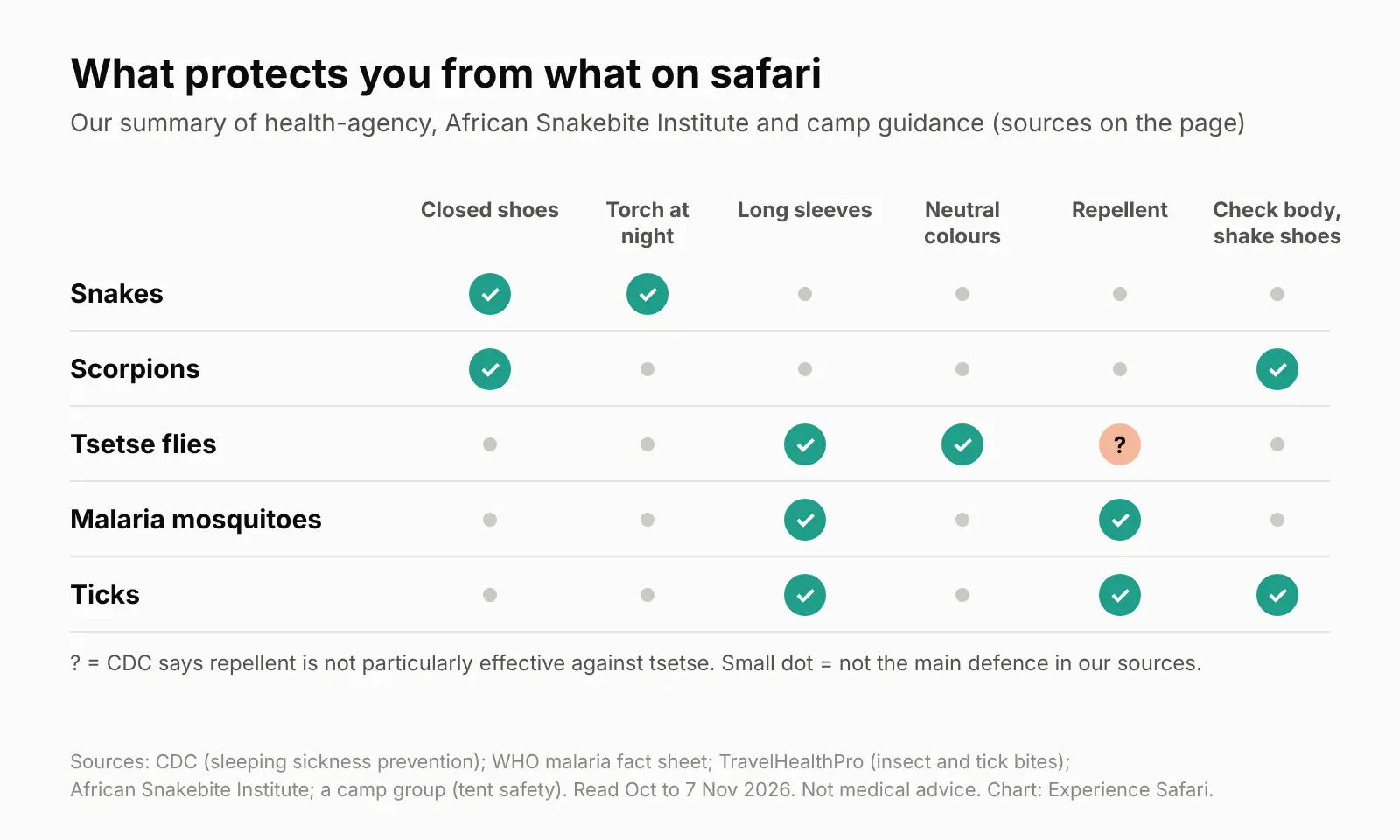
You will almost certainly be bitten by an insect, and you will very probably never be bitten by a snake. The table ranks each risk by what the sources say about travellers, not by how frightening the animal is.
| Creature | Realistic risk for a safari guest | What protects you | Source |
|---|---|---|---|
| Malaria mosquitoes | The main disease risk in most safari areas | Nets, repellent with DEET, IR3535 or icaridin, covering clothing; tablets if a clinic advises them | WHO malaria fact sheet; our malaria page |
| Tsetse flies | Painful bites in some parks; sleeping sickness is rare | Neutral, medium-weight long sleeves and trousers; inspect the vehicle for tsetse before you get in | CDC |
| Ticks | African tick-bite fever: 4.0% of 940 travellers in one study | Long clothing, repellent on exposed skin, clothing treated with insecticide such as permethrin, a body check after walks | Jensenius et al., 2003; TravelHealthPro factsheet |
| Snakes | Bites to guests are not counted anywhere we found; WHO says agricultural workers and children are the most affected | Closed shoes, a torch after dark, watching where you step | WHO; African Snakebite Institute |
| Scorpions | A few species, mainly thick-tailed Parabuthus, matter medically in southern Africa | Shake out shoes and clothes; check bedding | African Snakebite Institute; UN medical SOP |
Sources as linked, read 7 Nov 2026 (WHO malaria fact sheet: October 2026). No source we found counts snakebites or scorpion stings in safari guests, so the table gives no rate for them.
Snakes: who gets bitten, and what camps and guides do
Snakes avoid people, and the species that bite most often do so when they are trodden on or cornered. Africa’s snakebite toll is real, but WHO says “agricultural workers and children are the most affected”, not visitors in vehicles (WHO, dated 17 Sep 2026).
- The puff adder “relies on its excellent camouflage and is reluctant to move”, so the risk is stepping on it (African Snakebite Institute, Puff Adder, read 7 Nov 2026).
- On a game drive you are in a vehicle; in camp the risk is the walk to your tent. Asilia says “most of Asilia’s camps and lodges are unfenced”; after dark guests are “not permitted to walk around alone”, camp security staff “are on hand to escort you”, and “each guest tent has a torch and radio” (Asilia, Safari tent safety, read 7 Nov 2026). Ask your camp what its own after-dark rule is.
- On foot, the guide sets the rules. Guide qualifications, rifles and minimum ages are on walking safari; wear closed shoes and step where the guide steps.
- If you see a snake, back away and tell the staff. Do not try to move, catch or photograph it up close.
No document we found sets out a standard guide briefing on snakes, so we print none. The puff adder behaviour above is the African Snakebite Institute’s, read 7 November 2026.
Tsetse flies and sleeping sickness
Tsetse flies bite hard and are common in some parks, but sleeping sickness is rare: WHO counted under 1,000 cases in all of Africa in 2018, “remaining below that threshold as of 2022”, and 8% of cases are the East African (rhodesiense) form that occurs in safari areas (WHO sleeping sickness fact sheet, read 7 Nov 2026).
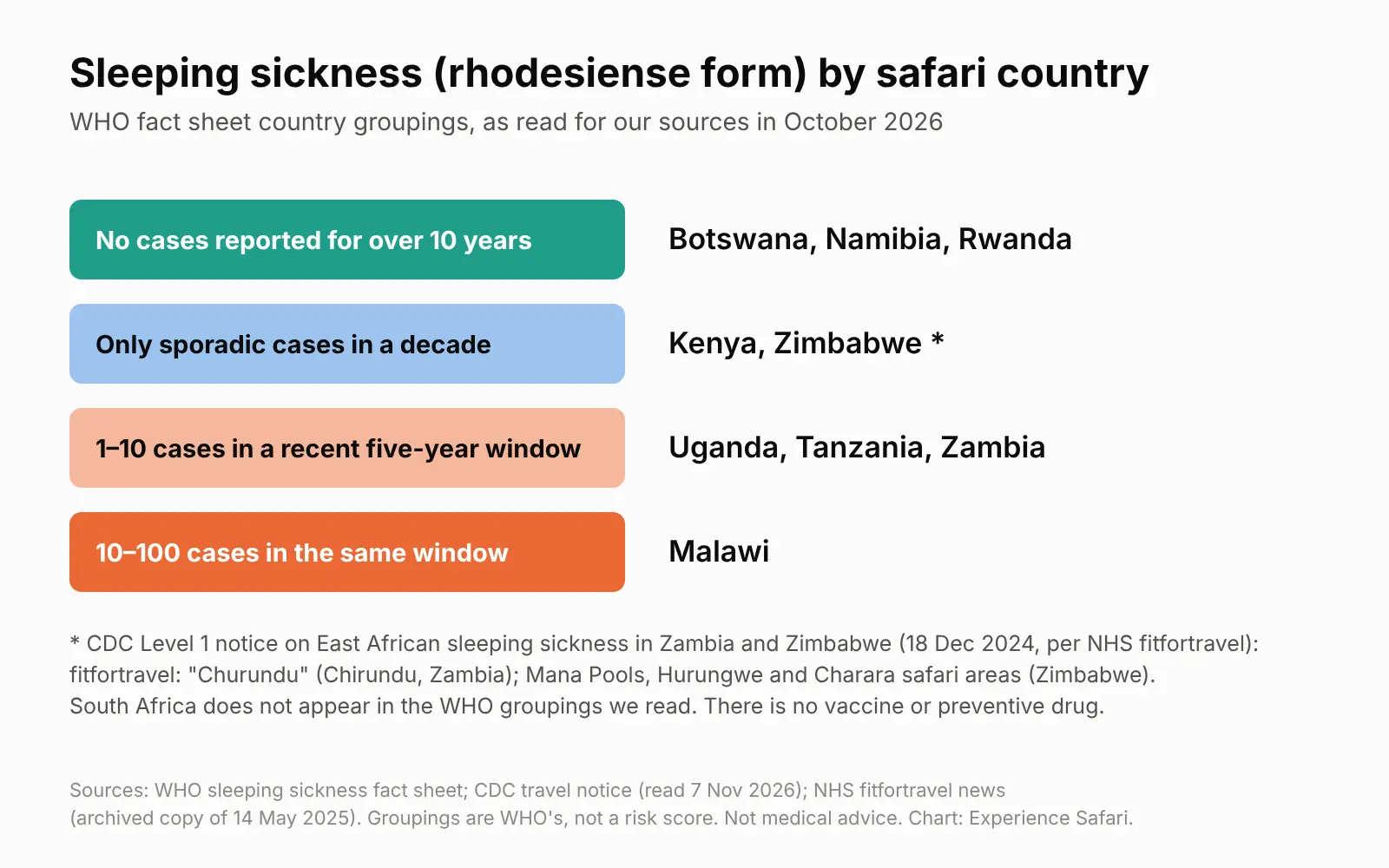
| Country | WHO grouping (rhodesiense sleeping sickness) | Travel notices |
|---|---|---|
| Botswana, Namibia, Rwanda | No cases reported for over 10 years | None in our sources |
| Kenya | Only sporadic cases in a decade | None in our sources |
| Zimbabwe | Only sporadic cases in a decade | CDC Level 1 notice (18 Dec 2024, per fitfortravel); fitfortravel names Mana Pools National Park and the Hurungwe and Charara safari areas |
| Zambia | 1–10 cases in a recent five-year window | Same CDC notice; fitfortravel names Chirundu (spelled “Churundu”) |
| Tanzania, Uganda | 1–10 cases in a recent five-year window | None in our sources |
| South Africa | Not in the WHO groupings we read | None in our sources |
WHO groupings as read for our sources, October 2026; CDC travel notice, read 7 Nov 2026 (the page shows no issue date, only “Page last reviewed: December 18, 2024”; fitfortravel says CDC issued the alert on 18 December 2024: archived copy of 14 May 2025). Level 1 is CDC’s lowest level, “Practice Usual Precautions”.
- Colours: CDC’s prevention page says tsetse “are attracted to bright and very dark colors”; its travel notice says “attracted to bright colors” and to “avoid areas where black or blue tsetse fly traps are present”. fitfortravel advises “avoiding darker colours, particularly blue”, and TravelHealthPro says to “avoid dark blue clothing where tsetse fly is present”. Since tsetse “can bite through thin fabric”, wear neutral, medium-weight long sleeves and trousers in tsetse areas (CDC). Where guides report tsetse in Tanzania’s parks is on what to wear on safari.
- “Permethrin-treated clothing and insect repellant are not particularly effective against tsetse flies”, though they still help against other bites (CDC); the travel notice says “insect repellents have not proven effective”. CDC also says: “Inspect vehicles for tsetse flies before entering.”
- “There is no vaccine or drug that prevents sleeping sickness” (CDC). In “forty-five reports on Caucasians” with the East African form, 97.8% had fever and 84.4% a sore at the bite site, called a chancre (Urech et al., PLOS NTD 2011). If you have a fever after a safari, tell the doctor where you were.
Mosquitoes: the bite that matters most
Mosquitoes carry malaria, the main health risk in most safari areas; the risk areas and months by country are on our malaria risk on safari page. WHO’s bite advice is nets, repellents containing DEET, IR3535 or icaridin, and covering clothing; see a doctor several weeks before you leave, since some preventive tablets start 2–3 weeks ahead (WHO malaria fact sheet).
- Malaria-free options: reserves without malaria are listed on malaria-free safari.
- Vaccines: there is no malaria vaccine for travellers; what else a clinic may advise is on safari vaccinations.
Ticks and African tick-bite fever
Ticks are the bite most walkers forget, and African tick-bite fever is the result: caused by Rickettsia africae and carried by Amblyomma ticks, it was diagnosed in 4.0% of 940 travellers to rural sub-equatorial Africa (Jensenius et al., 2003).
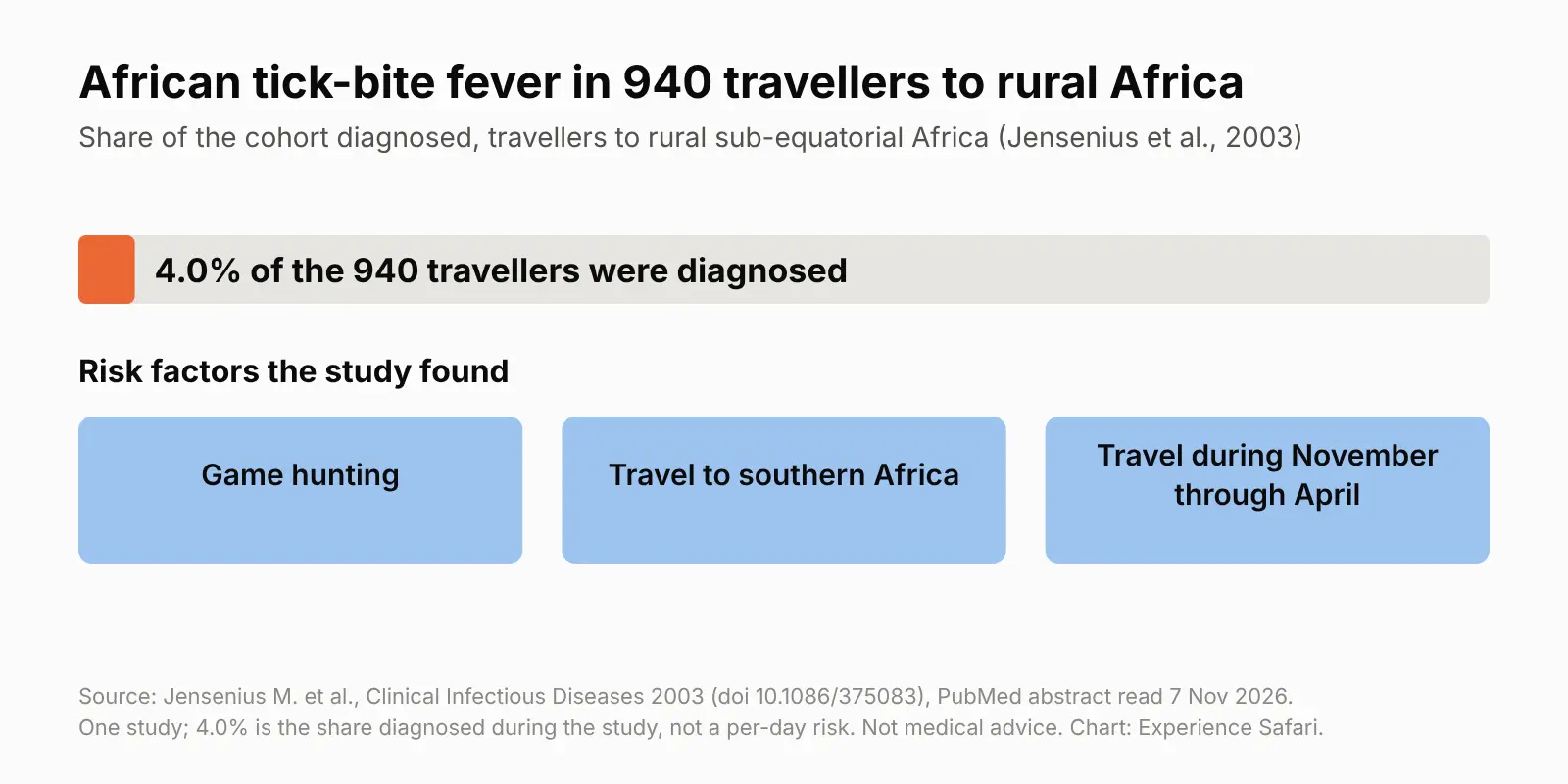
- Who and when: the study found three risk factors: “game hunting, travel to southern Africa, and travel during November through April” (Jensenius et al., 2003, abstract read 7 Nov 2026).
- “Symptoms usually appear within two weeks after the bite”: fever, muscle aches, rash, headache, and a “red sore with dark center” at the bite (Maricopa County Public Health, ATBF fact sheet, read 7 Nov 2026).
- Prevention: long clothing, repellent on exposed skin, clothing “sprayed or impregnated with insecticide (e.g. permethrin)”, and “check body for ticks after outdoor activity” (UK TravelHealthPro, Insect and tick bite avoidance, read 7 Nov 2026).
Scorpions and spiders
Of “the 150-odd described species” of scorpion in southern Africa, “only a few of the Thick-tailed scorpions of the genus Parabuthus are considered to be of medical significance” (African Snakebite Institute, scorpions, read 7 Nov 2026).
- Where they hide: “scorpions may hide in … bedding, clothing, and footwear”, so “clothing, shoes, packages, and bedding should be carefully checked” (UN medical services, scorpion sting SOP, 2024, archived copy of 9 Jun 2025). Shake out boots left outside a tent, and wear shoes outdoors after dark.
- Spiders: we found no official guidance on spider bites for safari travellers, so we print none.
- If stung: get to medical care.
If you are bitten or stung
Get to medical care quickly; this is the core of WHO’s and the African Snakebite Institute’s advice, and the reason evacuation cover matters on safari.
- WHO: access to “a health facility that has personnel trained and capable of diagnosing snakebite envenoming is essential”; “avoid traditional first aid methods, herbal medicines and other unproven or unsafe forms of first aid” (WHO, snakebite treatment, read 7 Nov 2026).
- The African Snakebite Institute lists as “outdated and incorrect”: “cutting around the site of the bite and trying to suck venom out, making incisions and rubbing Condy’s crystals in, applying ice or heat”. Its repeated advice is to “transport the victim to the hospital” (African Snakebite Institute, First aid for snakebite, published 4 Dec 2025).
- Tell your guide or camp at once. They run the radio and call in transport.
- Antivenom is scarce in Africa: WHO says “several manufacturers have ceased production”, the price of some antivenoms has “dramatically increased”, and “inappropriate, untested, or even fake antivenom products” circulate (WHO fact sheet). That is a reason to check that your policy includes air evacuation: see safari travel insurance.
Which precautions for which trip
| Your trip | What matters most | Where to read more |
|---|---|---|
| Lodge safari with game drives (Masai Mara, Serengeti, Kruger) | Mosquitoes; the walk to your tent after dark; tsetse in parts of the Serengeti and Tarangire (guide reports) | Malaria risk; what to wear |
| Walking safari | Closed shoes, long trousers, a tick check; ticks peak November–April in southern Africa (Jensenius) | Walking safari |
| Zambezi valley and Zambian parks (Mana Pools, Lower Zambezi, South Luangwa, Kafue) | Tsetse: neutral long sleeves; CDC notice of December 2024 | Mana Pools; Lower Zambezi; Zambia safari questions |
| Camping and self-drive (Kruger rest camps, Botswana public campsites) | Torch and shoes after dark; shake out shoes and check bedding | Camping safari; Botswana self-drive |
| Gorilla and chimp trekking | Long sleeves and gloves (Visit Rwanda, on our clothing page); Rwanda has reported no sleeping sickness for over 10 years (WHO) | Gorilla trekking day |
| Namibia and Botswana | No sleeping sickness reported for over 10 years (WHO); malaria in the north in the rains | Malaria risk |
| Family safari | Children in closed shoes after dark; age rules for walks | Family safari; safari age limits |
Sources as in the sections above. A precaution listed for one trip type is not “unneeded” on the others.
Seasons in our sources
Only two of these risks have a season in the sources we read: ticks and malaria.
| Risk | Higher-risk months | Source |
|---|---|---|
| Ticks (African tick-bite fever) | November–April, as a risk factor in one study of travellers | Jensenius et al., 2003 |
| Malaria, northern Botswana | High risk October–May, low June–September | TravelHealthPro, on our malaria page |
| Malaria, Kruger | November–April | SANParks, on our malaria page |
| Malaria, six northern Namibian regions | November–June | WHO, on our malaria page |
| Malaria, Kenya, Rwanda, Tanzania below 1,800 m | All year | WHO, on our malaria page |
| Snakes, scorpions, tsetse | No seasonal figures in our sources | None |
Common mistakes about snakes and insects on safari
| What you’ll often read | What the sources say |
|---|---|
| “Safari guests get bitten by snakes all the time” | WHO: “agricultural workers and children are the most affected”; we found no count of bites to guests. |
| “Repellent keeps tsetse off” | CDC: repellent is “not particularly effective” against tsetse flies. Neutral colours and long sleeves do more. |
| “Only dark blue attracts tsetse” | CDC says “bright and very dark colors”; fitfortravel singles out blue. |
| “There’s a jab for sleeping sickness” | “There is no vaccine or drug that prevents sleeping sickness” (CDC). |
| “Tick-bite fever is a hunters’ problem” | Game hunting was one risk factor, but so were travel to southern Africa and travel from November to April; 4.0% of all 940 travellers caught it (Jensenius et al., 2003). |
| “Cut and suck a snakebite” | The African Snakebite Institute calls this “outdated and incorrect”; WHO warns against unproven first aid. Get to hospital. |
Frequently asked questions
Will I see a snake on safari? Possibly, but most guests do not get close to one. The puff adder “relies on its excellent camouflage and is reluctant to move” (African Snakebite Institute), so watch where you step. WHO says agricultural workers and children are the most affected by snakebite, not visitors.
What do safari camps do about snakes and other animals at night? It varies by camp, so ask yours. Asilia, for example, says guests are not permitted to walk around alone after dark, security staff are on hand to escort them, and each guest tent has a torch and radio.
Which colours attract tsetse flies? CDC says bright and very dark colours; NHS fitfortravel singles out blue, and TravelHealthPro says to avoid dark blue. Wear neutral, medium-weight long sleeves and trousers in tsetse areas, and inspect the vehicle for tsetse before you get in.
Is sleeping sickness a real risk on safari? It is rare: 35 cases of the East African form were diagnosed outside Africa in 2011–2020, mainly in tourists to wildlife areas. CDC has a Level 1 notice on East African sleeping sickness in Zambia and Zimbabwe, issued in December 2024 according to NHS fitfortravel. There is no vaccine or drug that prevents it (CDC).
What is African tick-bite fever? An infection carried by ticks, with fever, aches, headache, rash and a dark-centred sore, usually within two weeks. In one study it was diagnosed in 4.0% of 940 travellers to rural sub-equatorial Africa. Long clothing, repellent and a body check after walks are the prevention.
Are scorpions dangerous on safari? A few southern African species are, mainly thick-tailed Parabuthus scorpions (African Snakebite Institute). Shake out shoes and clothing and check bedding; if you are stung, get to medical care.
What should I do if I am bitten by a snake? Tell your guide or camp and get to medical care quickly. WHO advises against traditional or unproven first aid, and the African Snakebite Institute lists cutting, sucking, and ice or heat as “outdated and incorrect”. Check your insurance covers air evacuation.
What should I pack against bites? Repellent with DEET, IR3535 or icaridin (WHO), neutral long sleeves and trousers, closed shoes and a head torch. The full list is on the safari packing list.
Sources
- WHO: Snakebite envenoming fact sheet, dated 17 Sep 2026, read 7 Nov 2026; Sleeping sickness fact sheet, read 7 Nov 2026 (country groupings as read for our source bank, October 2026); Snakebite treatment, read 7 Nov 2026; Malaria fact sheet, read for our source bank, October 2026
- US CDC: Preventing sleeping sickness, dated 25 Mar 2024; Level 1 travel notice, East African sleeping sickness in Zambia and Zimbabwe (page last reviewed 18 Dec 2024); both read 7 Nov 2026
- NHS fitfortravel (Public Health Scotland): news item relaying the CDC alert, dated 19 Dec 2024, archived copy of 14 May 2025 (live site unreachable on 7 Nov 2026)
- UK NaTHNaC: TravelHealthPro, Insect and tick bite avoidance, read 7 Nov 2026
- Maricopa County Public Health (US): African Tick Bite Fever, read 7 Nov 2026
- Peer-reviewed: Jensenius M. et al., “African tick bite fever in travelers to rural sub-equatorial Africa”, Clinical Infectious Diseases 2003, doi 10.1086/375083 (PubMed abstract, PMID 12766836); Franco J.R. et al., HAT in non-endemic countries 2011–2020, PLOS NTD 2022, doi 10.1371/journal.pntd.0010885; Urech K. et al., “Sleeping sickness in travelers: do they really sleep?”, PLOS NTD 2011, PMC3206012; read 7 Nov 2026
- African Snakebite Institute: Puff Adder, scorpions, First aid for snakebite (published 4 Dec 2025); read 7 Nov 2026
- UN medical services: Scorpion sting SOP, 2024, archived copy of 9 Jun 2025 (live link no longer available on 7 Nov 2026)
- Asilia (camp group): Safari tent safety, read 7 Nov 2026
- Malaria areas and months: as on our malaria risk on safari page (WHO, TravelHealthPro, SANParks; read 8–10 Oct 2026)
More on safari health: safari vaccinations, malaria risk on safari, drinking water on safari, safari travel insurance and is a Kenya safari safe? and is a Tanzania safari safe?.
Sources read 7 Nov 2026, or from the archived copies named above; WHO malaria fact sheet and WHO country groupings as read for our source bank, October 2026.