 Experience

Last verified · Next check due
On this page
- Etosha vs the Kgalagadi at a glance (2026)
- Which park has the wildlife you want?
- Park fees: N$280 plus N$60 a car, or R662 a day
- Where you sleep: NWR rest camps or SANParks camps
- Roads and driving yourself
- Border rules: the two-night rule at Mata-Mata
- Getting there: Windhoek for Etosha, Upington for the Kgalagadi
- When to go: heat, cold and rain by month
- Which should you choose?
- Doing both on one road trip
- Common mistakes in Etosha vs Kgalagadi comparisons
- Frequently asked questions
- Sources
Short answer: Choose Etosha (Namibia) for elephants at floodlit waterholes, gravel roads a 2WD car can drive in the dry season, and rest camps 4–6 hours from Windhoek on tar. Choose the Kgalagadi (South Africa and Botswana) for black-maned Kalahari lions, raptors and gemsbok in two dry riverbeds, and unfenced wilderness camps. Etosha charges N$280 per foreign adult plus N$60 per car; the Kgalagadi R662 per international adult per day from 1 November 2026.
Key facts
- Etosha charges N$280 per foreign adult (16+) plus N$60 per car since 1 April 2026 (Government Notice 115 of 2026). At one fee per park day, as MEFT’s 2021 schedule did, two adults in a car pay N$620 a day.
- The Kgalagadi fee rose on 1 November 2026: R662 per international adult per day on the South African side (SANParks 2026/27); the previous rate, to 31 October 2026, was R576. Two adults pay R1,324 a day (our sum); N$ and rand are pegged 1:1.
- To leave the Kgalagadi for Namibia through Mata-Mata you must stay at least two nights inside the park first (SANParks border crossings).
- Etosha is a waterhole park with elephants; the Kgalagadi is a predator-and-antelope park without them. A safari booking site rates elephant, zebra and wildebeest “abundant” in Etosha; Botswana Tourism names the “black-maned Kalahari lion” first among the Kgalagadi’s wildlife, and our research notes list no elephant or buffalo there.
- Malaria can decide it: the Kgalagadi’s South African side is outside malaria-risk areas and its Botswana side very low risk, while Swiss TPH says not to treat Etosha as malaria-free (Safari malaria risk).
- A Kgalagadi-to-Namibia route needs a Namibian visa for most Western passports: UK, US, German and 30 other nationalities have needed one since 1 April 2025, N$1,600 on arrival (Namibia visa).
Etosha vs the Kgalagadi at a glance (2026)
Etosha is a fenced Namibian park built around a salt pan and its waterholes, with state-run rest camps; the Kgalagadi is a transfrontier park across South Africa and Botswana, with SANParks rest camps, wilderness camps and a 4x4-only Botswana side.
| Etosha National Park | Kgalagadi Transfrontier Park | Source | |
|---|---|---|---|
| Country | Namibia | South Africa (27%) and Botswana (73%) | Kgalagadi |
| Size | Our sources disagree: 22,270 or 22,912 km²; the pan alone is 4,760 km² | 37,256 km² | Etosha; Kgalagadi |
| Park fee, foreign adult | N$280 plus N$60 per car (from 1 Apr 2026) | R662 a day (South African side; R576 until 31 Oct 2026) | Government Notice 115 of 2026; SANParks |
| Run by | MEFT; camps by Namibia Wildlife Resorts (NWR) | SANParks; DWNP on the Botswana side | Hubs |
| How you find game | Wait at waterholes, most perennial ones fed by boreholes | Drive the Nossob and Auob riverbeds | MEFT Etosha Management Plan; SANParks |
| Signature animals | Elephant, zebra, wildebeest “abundant”; lion occasional; leopard and cheetah very rare; no buffalo | Black-maned Kalahari lion, gemsbok, springbok, brown hyena; about 30 raptor species | A safari booking site’s ratings; Botswana Tourism; Wikipedia (secondary) |
| Species | 114 mammals | 59 mammals, 272 birds | A safari agent’s guide, read 9 October 2026; SANParks |
| Car you need | 2WD on the main gravel roads in the dry season; 4x4 for Dolomite and the wet season | Ask SANParks which roads need a 4x4; Botswana side 4x4 only, two vehicles minimum | Hubs |
| Beds inside | Camping N$460–560 per person; rooms N$1,400–2,380 per person with breakfast (NWR 2026–27) | Twee Rivieren family cottage from R2,017 per unit and Mata-Mata units from R2,717 a night (Oct 2026) | NWR via booking agents; SANParks |
| From the nearest city | Windhoek → Okaukuejo 414–435 km on tar, 4–6 h | No checked drive time in our sources; Upington has the nearest airport | Etosha; our South Africa research notes |
| Malaria | Not malaria-free (Swiss TPH) | South African side outside risk areas; Botswana side very low risk | SANParks; TravelHealthPro; Swiss TPH |
Fees as on our Etosha park fees and Kgalagadi pages, re-read 9 October 2026. Rates and distances as on our Etosha and Kgalagadi pages, read September–October 2026.
Which park has the wildlife you want?
Etosha, for elephants and big herds at a few waterholes in the dry season; the Kgalagadi, for lions, raptors and desert antelope along open riverbeds, without elephants.
- Etosha: a safari booking site rates elephant, zebra and wildebeest abundant, giraffe common, lion and hyena occasional, and leopard and cheetah very rare. Etosha has no Cape buffalo, kept out to protect Namibia’s foot-and-mouth-free livestock exports (a safari agent’s guide, read 10 October 2026). Its 114 mammal species include the black-faced impala, the Damara dik-dik and, in the west, Hartmann’s mountain zebra.
- Kgalagadi: Botswana Tourism lists the black-maned Kalahari lion, springbok, gemsbok, hartebeest, eland, jackal, brown hyena and wild cats (Botswana Tourism). About 30 of its bird species are raptors (Wikipedia, secondary). Our research notes list no elephant or buffalo, so it is not a Big Five park.
- Cheetah: no sighting rate is published for either park in our sources. The Kgalagadi is a cheetah research site, where juvenile survival is about 36% (Wikipedia, secondary); a safari booking site rates cheetah very rare in Etosha. More: where to see cheetahs.
- Meerkats: a safari booking site lists meerkat among the Kgalagadi’s smaller species; our Etosha sources do not. See where to see meerkats.
- Lions: compare both with other parks on where to see lions.
How you watch differs too. In Etosha you park at a waterhole and wait; wildlife typically arrives after 20–40 minutes (one safari operator’s waterhole guide). Okaukuejo’s and Halali’s waterholes are floodlit at night for guests in those camps. In the Kgalagadi the Nossob and Auob riverbeds are normally dry and “flow once or twice a century after heavy rains” (SANParks), so the game roads follow the riverbeds.
Park fees: N$280 plus N$60 a car, or R662 a day
Etosha charges N$280 per foreign adult plus N$60 per car (Government Notice 115 of 2026, from 1 April 2026); the Kgalagadi charges R662 per international adult per day from 1 November 2026 (R576 until 31 October 2026; SANParks). The Namibian notice prices fees per person and states no period; MEFT’s 2021 schedule made fees valid for 24 hours from entry, so budget one fee per park day.
| Per day | Etosha | Kgalagadi, South African side |
|---|---|---|
| Foreign / international adult | N$280 | R662 (R576 until 31 Oct 2026) |
| Child | N$180 aged 9–15; under 9 free | R331 (R288 until 31 October 2026), aged 2–11; under 2 free |
| Car | N$60 up to 10 seats | No vehicle fee in our sources |
| Two adults and a car | N$620 | R1,152 to 31 Oct 2026; R1,324 from 1 Nov 2026 |
| Botswana side | — | Not confirmed; see Botswana park fees |
Sources: Government Notice 115 of 2026 (PDF); SANParks daily conservation fees 2025/26 (PDF) and 2026/27 (PDF), as on our Etosha park fees and Kgalagadi pages, read 8–9 October 2026. Two-adult rows: our sums. SANParks bookings also carry a 1% community fund.
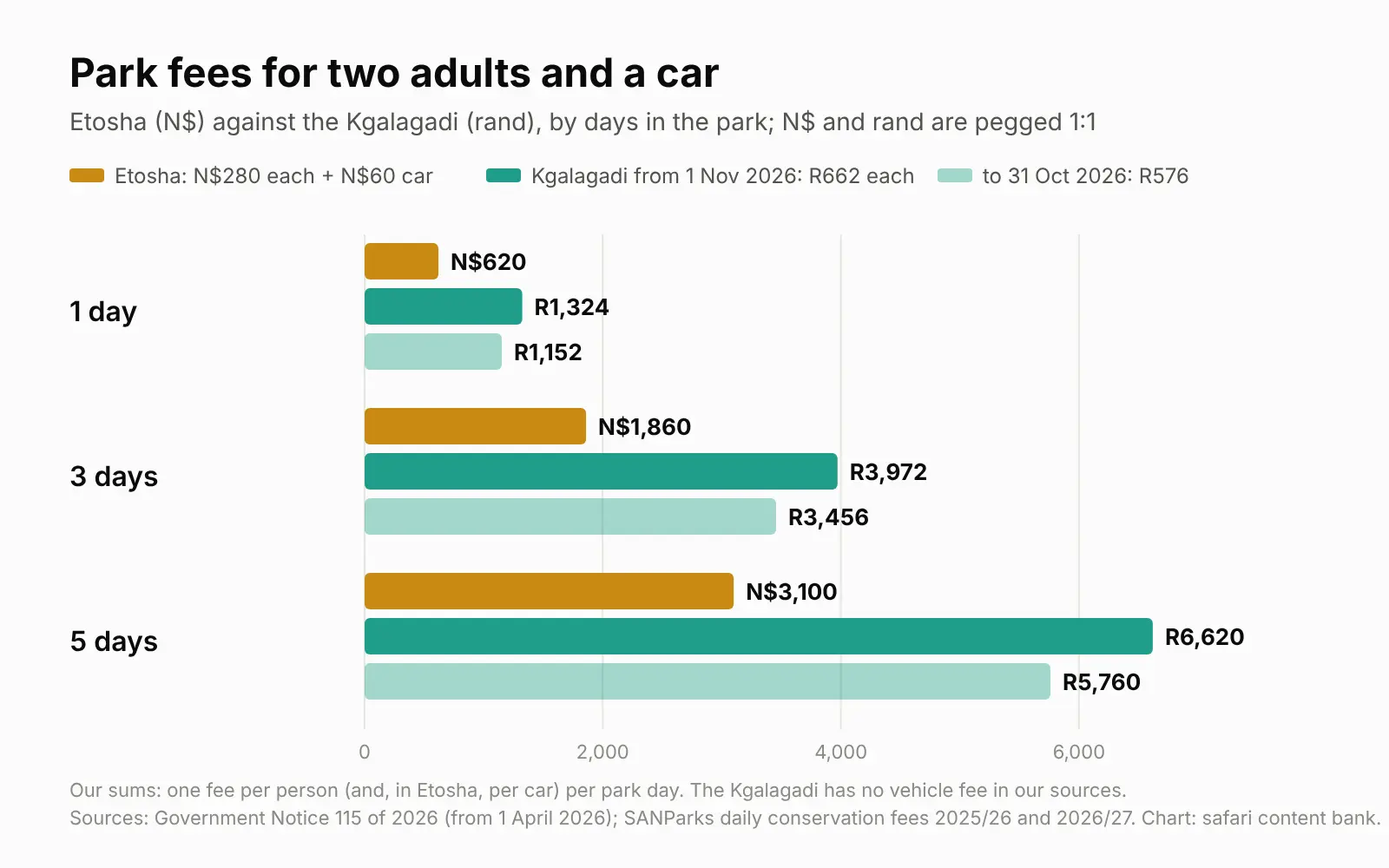 Our sums: one fee per person (and, in Etosha, per car) per park day. Sources: Government Notice 115 of 2026; SANParks 2025/26 and 2026/27 schedules. Chart: safari content bank.
The official fee lines, with the date each took effect and the authority’s own source:
| Fee | Amount | In force from | Source |
|---|---|---|---|
| Tier 1 parks (Etosha, Namib-Naukluft including Sossusvlei, Skeleton Coast, Ai-Ais/Fish River Canyon, Waterberg Plateau, Cape Cross, Dorob, Tsau //Khaeb), foreign adult 16+, per person | NAD 280 (NAD 140 park entrance + NAD 140 conservation fee) | 1 Apr 2026 (Government Notice 115 of 2026; the notice prices fees per person with no period; MEFT's 2021 schedule made fees valid for 24 hours from entry); was NAD 150 under the 2021 schedule | Government Gazette 8877 (Government Notice 115 of 2026), hosted by the Legal Assistance Centre |
| Tier 1 parks, foreign child 9–15, per person (under 9 free) | NAD 180 | 1 Apr 2026 (Government Notice 115 of 2026; the notice prices fees per person with no period; MEFT's 2021 schedule made fees valid for 24 hours from entry); was NAD 100 for foreign children up to 16 under the 2021 schedule | Government Gazette 8877 (Government Notice 115 of 2026), hosted by the Legal Assistance Centre |
| Vehicle up to 10 seats, most national parks (N$50 at Sandwich Harbour), per vehicle | NAD 60 | 1 Apr 2026 (Government Notice 115 of 2026; the notice states no period; MEFT's 2021 schedule made fees valid for 24 hours from entry); was NAD 50 | Government Gazette 8877 (Government Notice 115 of 2026), hosted by the Legal Assistance Centre |
| Kgalagadi Transfrontier Park daily conservation fee (South African side), international adult (12+), per day | ZAR 576 | 1 Nov 2025 to 31 Oct 2026 (SANParks 2025/26 schedule) | SANParks daily conservation fees 2025/26 |
| Kgalagadi Transfrontier Park daily conservation fee (South African side), international adult (12+), per day | ZAR 662 | 1 Nov 2026 to 31 Oct 2027 (SANParks 2026/27 schedule, already published) | SANParks daily conservation fees 2026/27 |
| Kgalagadi Transfrontier Park daily conservation fee (South African side), international child (2–11), per day (under 2 free) | ZAR 288 | 1 Nov 2025 to 31 Oct 2026 (SANParks 2025/26 schedule) | SANParks daily conservation fees 2025/26 |
| Kgalagadi Transfrontier Park daily conservation fee (South African side), international child (2–11), per day (under 2 free) | ZAR 331 | 1 Nov 2026 to 31 Oct 2027 (SANParks 2026/27 schedule) | SANParks daily conservation fees 2026/27 |
| Namibia Cross-Border Charge (Road Fund Administration), foreign-registered motor car, bakkie or minibus under 25 passengers (Type 2), single entry | NAD 534 (motorcycle, tricycle or caravan, Type 1: NAD 340; Regular User Permit NAD 751 a year) | 1 August 2026 | Road Fund Administration (RFA), fees and tariffs |
- The Kgalagadi costs about twice as much in fees from November: R1,324 a day for two adults against N$620 in Etosha (our sums; N$ and rand are pegged 1:1). Our sources don’t show how SANParks charges a stay spanning 1 November, so ask when you book.
- The SANParks International Wild Card: the previous price, for cards bought from 1 November 2025 to 31 October 2026, was R4,680 single and R7,310 couple; at last season’s prices it paid off at R576 a day from the 9th day solo or the 7th as a couple (our sums, as on our Kgalagadi page). SANParks had not published the 2026/27 price when we checked on 1 November 2026; check the SANParks Wild Card page before you buy.
- Neither rest-camp rate includes the park fee: NWR charges it separately in Etosha, and SANParks adds the conservation fee to every booking.
Where you sleep: NWR rest camps or SANParks camps
Etosha’s six NWR camps price beds per person, from N$460 camping to N$5,930 for a Premier Waterhole Chalet; the Kgalagadi’s SANParks camps price per unit, from R2,017 for a Twee Rivieren cottage in October 2026. Rest-camp units are listed on the hubs: Etosha and Kgalagadi.
| Etosha | Kgalagadi | |
|---|---|---|
| Main camps | Okaukuejo, Halali, Namutoni; Onkoshi, Dolomite, Olifantsrus | Twee Rivieren, Mata-Mata, Nossob |
| Wilderness or remote camps | Dolomite (4x4 approach); Olifantsrus (camping only, with a hide) | Bitterpan, Gharagab, Grootkolk, Kieliekrankie, Urikaruus: unfenced, 4–8 beds, no shop or fuel; Kalahari Tented Camp |
| Fuel and shops | Okaukuejo, Halali and Namutoni, with reported stock-outs | Twee Rivieren only, the one camp with 24-hour electricity and cell reception |
| Camping, per night | N$460–560 per person (Olifantsrus N$510) | No current price in our sources |
| Rooms and chalets, per night | N$1,400–2,380 per person sharing, B&B; Waterhole Chalet N$2,380–3,480 | From R2,017 (Twee Rivieren family cottage) and R2,717 (Mata-Mata units), per unit (Oct 2026) |
| Lodges outside | Gondwana, Onguma, Etosha Heights, Ongava, from N$341 camping to N$30,400 | No lodge inside the park with a published rate; Tswalu, a private reserve, R46,400 per adult at Motse (2026) |
| Booking | Forum regulars advise booking NWR 6–12 months ahead for July–September | SANParks opens bookings 11–12 months ahead, in tranches |
Sources: NWR 2026–27 rates via booking agents; Gondwana, Onguma (2027 sheet, valid 1 November 2026 to 31 October 2027, read 1 November 2026) and Natural Selection rate sheets; SANParks Kgalagadi page (“from” prices for stays of 9–18 October 2026), booking periods; Tswalu rates. As on our Etosha and Kgalagadi pages, read September–October 2026.
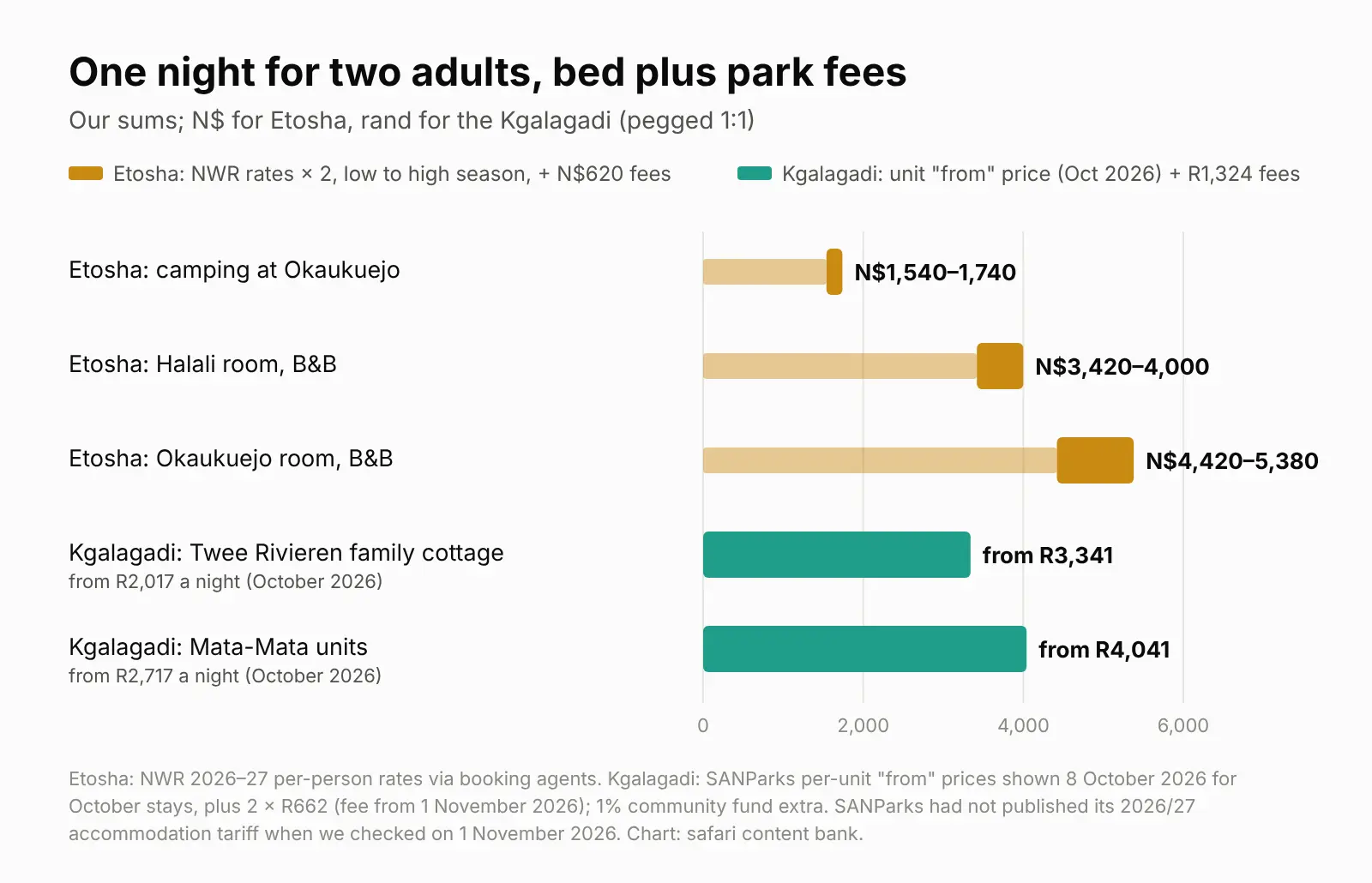 Our sums. Etosha: NWR 2026–27 per-person rates × 2, low to high season, plus N$620. Kgalagadi: SANParks “from” unit prices shown on 8 October 2026 for stays in October 2026, plus 2 × R662 from 1 November 2026; later unit prices may differ, and the 1% community fund is extra. SANParks had not published its 2026/27 accommodation tariff when we checked on 1 November 2026, so confirm the price when you book. Chart: safari content bank.
- A night for two at Twee Rivieren comes to R3,341 at the R662 fee (cottage price October 2026; our sum); with the previous R576 fee it came to R3,169 in October 2026 (as on our Kgalagadi page).
- For a cheap Etosha night, camp: two people camping at Okaukuejo pay N$1,540–1,740 with fees (our sums).
Roads and driving yourself
Both are self-drive parks with no off-road driving. Etosha’s main gravel roads take a 2WD car in the dry season; the Kgalagadi’s riverbed roads link camps far apart, and the Botswana side needs two 4x4s.
| Etosha | Kgalagadi | |
|---|---|---|
| Car | 2WD fine on the main gravel roads in the dry season; 4x4 recommended in the wet season and needed for Dolomite | Ask SANParks which camp roads need a 4x4; no convoy rule on the South African side in our sources |
| Botswana or remote sections | — | 4x4 compulsory and at least two vehicles on all Botswana-side routes; Polentswa Wilderness Trail 257 km, Mabuasehube Wilderness Trail 155 km, one way, pre-booked |
| Driving hours | Gates open at sunrise and close at sunset; be in a camp or out of the park by then | No checked gate times in our sources; confirm with SANParks |
| Night drives | Only NWR’s guided night drives, about N$620 per person | No price in our sources |
| Distances inside | Okaukuejo → Halali about 70 km, 1 h 45; Okaukuejo → Namutoni about 140 km, 3 h 15 | Nossob → Mabuasehube 170 km |
Sources: a safari agent’s Etosha self-drive guide and Etosha map; SANParks border crossings. As on our Etosha and Kgalagadi pages, read 8 October 2026.
- Carry more in the Kgalagadi: the wilderness camps have no shop or fuel, and our Botswana sources list no fuel or drinking water on the Botswana side. In Etosha, fill up and shop in Outjo, Tsumeb or Otjiwarongo before you enter (traveller reports).
- Self-drive or guided in general: self-drive vs guided safari and self-drive safari cost.
Border rules: the two-night rule at Mata-Mata
The Kgalagadi can be a border crossing, Etosha cannot: to leave for Namibia through Mata-Mata, or to cross to or from Botswana, you must stay at least two nights inside the park (SANParks border crossings).
| Your plan | The rule |
|---|---|
| Leave the Kgalagadi for Namibia through Mata-Mata | At least 2 nights inside the park first |
| Cross to or from Botswana inside the park | At least 2 nights inside the park |
| Leave by a different gate from the one you entered | All immigration at Twee Rivieren (South Africa) / Two Rivers (Botswana) |
| Drive a South African or other foreign-registered car into Namibia | N$534 Cross-Border Charge for a car since 1 August 2026 (RFA); SANParks lists a “ZA” sticker as required |
| Take a rental car across | The rental company’s letter of authority |
Sources: SANParks border crossings, read 8 October 2026; Road Fund Administration, effective 1 August 2026.
- SANParks’ border page still shows R242 per vehicle for Namibia’s road levy; the RFA now charges N$534 for a car.
- Rental cars: each company sets its own cross-border charge; see Namibian rental cars across borders.
- Entering Namibia needs a visa for most Western passports: UK, US, German, French, Italian, Spanish, Dutch, Belgian, Canadian and Australian citizens are among the 33 nationalities that lost visa-free entry on 1 April 2025; the visa on arrival costs N$1,600 per traveller aged 12 or over (Namibia visa).
- Entering or leaving South Africa: UK and US citizens need no visa for up to 90 days, and since 1 July 2026 every arrival and departure needs an online traveller declaration (South Africa visa). For the Botswana side: Botswana visa.
Getting there: Windhoek for Etosha, Upington for the Kgalagadi
Etosha is 414–435 km on tar from Windhoek, a 4–6 hour drive to Andersson Gate; our sources hold no checked drive time to the Kgalagadi from Upington, Cape Town, Johannesburg or Windhoek. Upington has the nearest airport to the Kgalagadi (our South Africa research notes).
| Route | Distance and time | Source |
|---|---|---|
| Windhoek → Okaukuejo (Etosha, Andersson Gate) | 414–435 km, tar; 4–6 h | Our Etosha page (a travel blog; a safari booking site) |
| Windhoek → Keetmanshoop (towards the southern border posts) | 482 km, tar | A travel booking site’s distance table, as on Namibia self-drive distances |
| Upington, Cape Town, Johannesburg or Windhoek → Kgalagadi | Not in our checked sources | Kgalagadi |
| Cape Town → Windhoek by air | Airlink, FlyNamibia and FlySafair | Namibian flights sheet, May/June 2026, as on Namibia vs South Africa |
| South Africa ↔ Namibia by road, outside the park | Noordoewer (Vioolsdrif) and Ariamsvlei, both listed as open 24 hours | A Namibia booking site (undated), as on Namibia vs South Africa |
Read September–October 2026. Ask your rental company or a route planner for the Kgalagadi legs before you book camps.
When to go: heat, cold and rain by month
Etosha is dry from May to October, when its game gathers at the waterholes, peaking in September and October; in the Kgalagadi most of the 222 mm of rain falls from January to April, January is the hottest month and July nights drop near freezing.
| Months | Etosha (rain and temperature at Tsumeb) | Kgalagadi (Twee Rivieren) |
|---|---|---|
| January–March | 80–140 mm of rain a month; 17–31 °C; poorest game viewing | Main rains; January mean maximum 35.8 °C |
| April | 40 mm; game starts returning to waterholes | End of the rains |
| May–June | 0–5 mm; 8–26 °C; good game viewing | Dry; cooling |
| July–August | 0 mm; 8–27 °C, cold dawns; very good; NWR high season | Dry; July mean minimum 0.9 °C, record −10.3 °C |
| September–October | 0–20 mm; 15–33 °C; peak game viewing | Dry; warming |
| November–December | 55–95 mm; 18–32 °C; game disperses | Hot; record maximum 45.4 °C |
Etosha: Climates to Travel, Tsumeb; seasons from an independent guide site and a safari booking site, as on our Etosha page. Kgalagadi: Wikipedia (secondary; no official climate normals in our sources), as on our Kgalagadi page. Read September–October 2026.
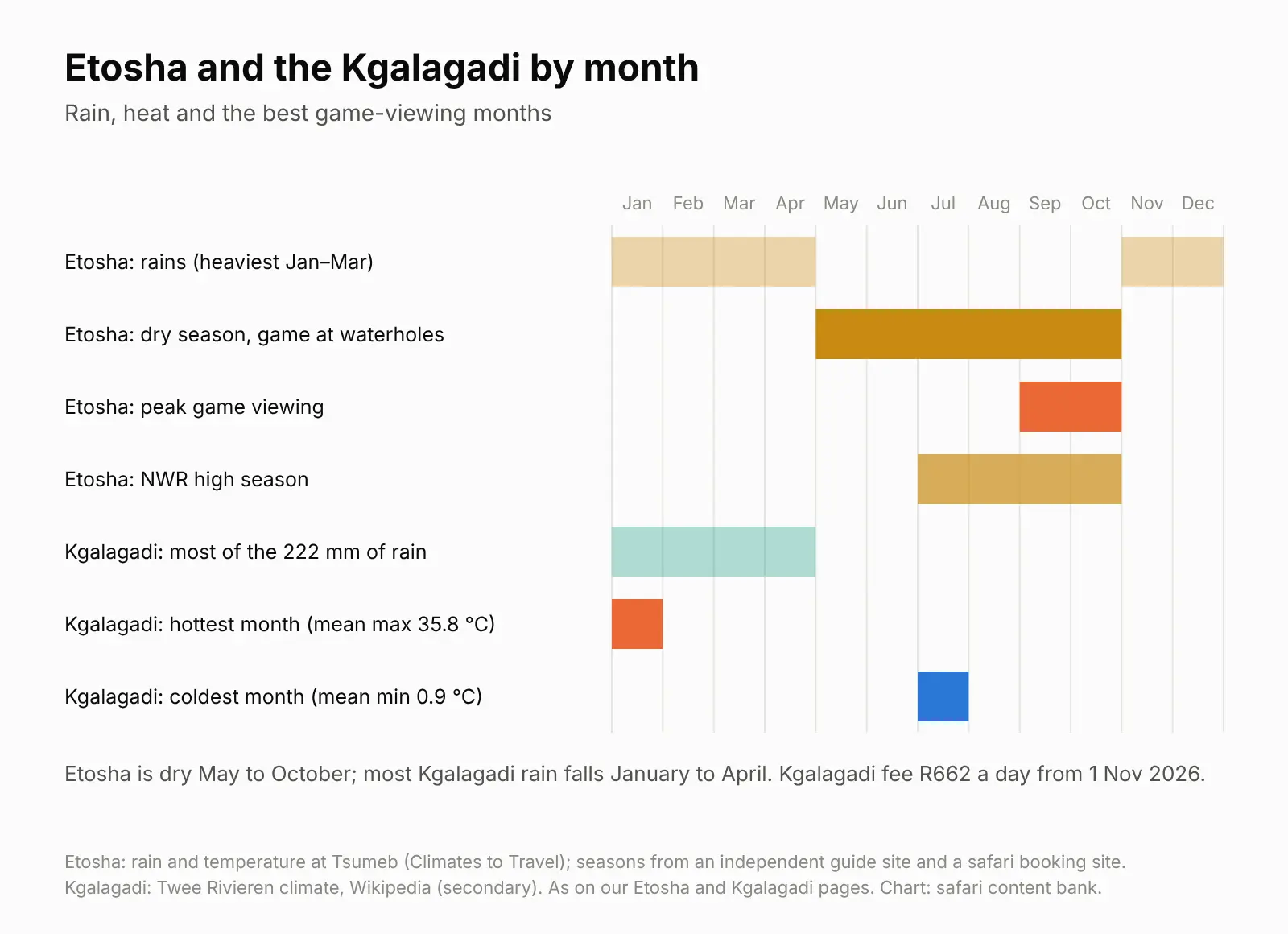 Sources: Climates to Travel; Wikipedia (secondary); SANParks; our Etosha and Kgalagadi pages. Chart: safari content bank.
- Malaria: SANParks names Kruger and Mapungubwe as its only parks in malaria-risk areas, and UK TravelHealthPro rates the southern half of Botswana, where the Kgalagadi’s Botswana side lies, very low risk all year. Swiss TPH says Etosha is at the edge of Namibia’s seasonal zone, not to be treated as malaria-free, and in 2026 extended its advice to cover June–August (Safari malaria risk; malaria-free safaris).
- The best months overlap: May to October suits Etosha’s waterholes and falls outside the Kgalagadi’s main rains (January to April) and its hottest month.
Which should you choose?
Choose Etosha for a first self-drive safari with elephants and easy roads; choose the Kgalagadi for predators and desert landscapes, for fewer services, or as the border crossing on a South Africa–Namibia road trip.
| If you… | Pick | Why |
|---|---|---|
| Want elephants | Etosha | Rated abundant; our Kgalagadi notes list none |
| Want Kalahari lions, raptors and gemsbok | Kgalagadi | Black-maned lion named first by Botswana Tourism; about 30 raptor species |
| Are driving a 2WD rental | Etosha | Main gravel roads are 2WD in the dry season |
| Want to avoid malaria areas | Kgalagadi | Outside SANParks’ malaria-risk parks; Botswana side very low risk |
| Are driving from South Africa into Namibia | Kgalagadi, then Etosha | Exit through Mata-Mata after at least two nights |
| Want floodlit waterholes at night | Etosha | Okaukuejo and Halali, for guests in those camps |
| Want unfenced camps with 4–8 beds | Kgalagadi | Five wilderness camps, no shop or fuel |
| Want the lower park fee | Etosha | N$620 a day for two adults and a car, against R1,324 from 1 November 2026 (our sums) |
Doing both on one road trip
The Kgalagadi and Etosha fit one route if you cross at Mata-Mata: at least two nights in the Kgalagadi, the Namibian road levy, a rental letter and a Namibian visa if your passport needs one. We found no checked drive time from Mata-Mata to Windhoek or Etosha, so plan the Namibian legs from a route planner and Namibia self-drive distances.
- Rental: a one-way cross-border drop is rare and costly according to forum regulars, and no company in our sources publishes the fee (Namibian rental cars across borders).
- Routings and add-ons: Namibia safari itinerary, Namibia vs South Africa and Cape Town and a safari.
- Other Etosha comparisons: Etosha vs Kruger, Etosha vs Sossusvlei and Etosha vs Okavango Delta.
- Budgets: Namibia safari cost and South Africa safari cost.
Common mistakes in Etosha vs Kgalagadi comparisons
| What you’ll often read | What is correct |
|---|---|
| “The Kgalagadi costs R576 a day” (no date) | That was the 2025/26 rate, which ended on 31 October 2026. Since 1 November 2026: R662 per international adult per day. |
| “Etosha costs N$150 a day” | N$280 per foreign adult since 1 April 2026, plus N$60 per car. N$150 was the 2021 rate. |
| “Mata-Mata is a one-night shortcut to Namibia” | You must stay at least two nights in the park to leave through Mata-Mata. |
| “Both parks are malaria-free” | Only the Kgalagadi. Swiss TPH says not to treat Etosha as malaria-free. |
| “Namibia’s road levy at Mata-Mata is R242” | The RFA charges N$534 for a car since 1 August 2026; SANParks’ page still shows R242. |
| “You’ll see the Big Five in either park” | Etosha has no Cape buffalo; our Kgalagadi notes list no elephant or buffalo. |
| “UK and US passports need no visa for Namibia” | They have needed one since 1 April 2025: N$1,600 on arrival. |
Frequently asked questions
Is Etosha or the Kgalagadi better for a first safari? Etosha, for most first-timers: elephant, zebra and wildebeest are rated abundant, the main gravel roads take a 2WD car in the dry season, and Okaukuejo is 4–6 hours from Windhoek on tar. The Kgalagadi suits travellers who want Kalahari lions, raptors and remote camps, and do not mind seeing no elephants.
Which park is cheaper to enter? Etosha. Two adults with a car pay N$620 a day (N$280 each plus N$60 per car, from 1 April 2026), against R1,324 a day in the Kgalagadi from 1 November 2026 (2 × R662; our sums). N$ and rand are pegged 1:1.
Do I have to stay two nights in the Kgalagadi to cross into Namibia? Yes. SANParks requires at least two nights inside the park to leave for Namibia through Mata-Mata, or to cross to or from Botswana. A South African or other foreign-registered car then pays Namibia’s N$534 Cross-Border Charge, and a rental car needs the company’s letter of authority.
Do I need a 4x4? Not for Etosha’s main roads in the dry season; a 4x4 is recommended in the wet season and needed for Dolomite Camp. On the Kgalagadi’s Botswana side a 4x4 and at least two vehicles are compulsory; on the South African side, ask SANParks which camp roads need one.
Is either park malaria-free? The Kgalagadi’s South African side is outside malaria-risk areas, and its Botswana side is very low risk (SANParks; UK TravelHealthPro). Etosha is at the edge of Namibia’s seasonal zone, and Swiss TPH says not to treat it as malaria-free. Ask a travel clinic about your own case.
When is the best time to visit both? May to October. Etosha’s game gathers at the waterholes then, with the peak in September and October, and the Kgalagadi’s main rains (January to April) and its hottest month (January, mean maximum 35.8 °C) are past. July nights at Twee Rivieren average 0.9 °C, so pack for cold.
Can I see cheetahs in either park? Possibly, but neither publishes a sighting rate. A safari booking site rates cheetah very rare in Etosha; the Kgalagadi is a cheetah research site, where juvenile survival is about 36% (Wikipedia, secondary). See where to see cheetahs.
Sources
- Fees: Government Notice 115 of 2026, Gazette 8877 (PDF); MEFT 2021 schedule (PDF); SANParks daily conservation fees 2025/26 (PDF) and 2026/27 (PDF); SANParks Wild Card; Road Fund Administration (1 Aug 2026); all as on our Etosha park fees and Kgalagadi pages, read 8–9 Oct 2026
- SANParks: Kgalagadi (camps, “from” prices, 8 Oct 2026); border crossings; transfrontier park; booking periods; malaria
- Botswana: Botswana Tourism, Kgalagadi; UK TravelHealthPro, Botswana
- Etosha: MEFT, Etosha Management Plan, 2007 (PDF); a safari agent’s guide (guide, self-drive, map, wildlife); NWR 2026–27 rates via booking agents; Climates to Travel; HealthyTravel / Swiss TPH, Namibia; read September–October 2026
- Lodges: Gondwana; Onguma 2027 (PDF); Natural Selection 2026 (PDF); Tswalu rates
- Secondary: Wikipedia, Kgalagadi Transfrontier Park (climate, raptors) and Cheetah
- A safari booking site’s Etosha wildlife ratings and Kgalagadi species list; one safari operator’s waterhole guide; a travel blog’s and a travel booking site’s distances (names and links in our editor notes)
Fees, rates and distances checked 8–10 October 2026 on our Etosha and Kgalagadi pages; Kgalagadi fees and the Wild Card checked 1 November 2026; this page was compiled on 31 October 2026. We will update it after the Kgalagadi fee change on 1 November 2026, when SANParks shows prices for stays after October 2026, when MEFT says whether its 2026 fee runs per park day, and when DWNP confirms a Botswana-side fee.
Ask for a quote
Tell us your dates and we send you a priced itinerary. Free, no obligation.
- Free quote, no obligation
- Trips run by licensed local operators