 Experience

Last verified · Next check due
On this page
- Etosha vs the Okavango Delta at a glance (2026)
- Wildlife: waterholes or water and land
- Park fees: Etosha vs Moremi and the concessions
- Cost per person per day
- Self-drive or fly-in: how you get in
- Best months for each
- Combining both on one trip
- Who each suits
- Verdict
- Common mistakes in Etosha vs Okavango Delta comparisons
- Frequently asked questions
- Sources
Short answer: Choose Etosha (Namibia) to drive yourself in an ordinary car and watch game gather at waterholes from May to October, for about N$2,225–2,810 per person a day camping, car and park fees included. Choose the Okavango Delta (Botswana) for mokoro, boats and guided drives from fly-in camps at US$530–5,345 a night, top rates June–October. Etosha charges N$280 per foreign adult plus N$60 a car; Moremi P270 a day (last published, 2022).
Key facts
- Etosha is a self-drive park; the Delta is mostly a fly-in one. A 2WD car is fine on Etosha’s main gravel roads in the dry season (a safari agent’s Etosha self-drive guide). In the Delta, self-drivers reach only Moremi Game Reserve’s public tracks and Khwai, in a 4x4; most camps are reached only by light aircraft from Maun (Okavango Delta safari cost).
- Etosha’s fee is current; Moremi’s is not. Etosha has charged N$280 per foreign adult plus N$60 per car since 1 April 2026 (Government Notice 115 of 2026). Moremi’s last published DWNP fee is P270 per non-resident adult per day (1 April 2022); in February 2026 the government news agency BOPA called the existing fee P380, and a P500 rise was announced, then reported postponed. Confirm it with DWNP or your operator.
- Both peak in the dry season. Etosha’s game is at the waterholes from May to October, peaking in September and October; the Delta’s water is highest in most areas from about May to August, and every camp group in our sources charges its top rate in the May–October dry season (Okavango Delta).
- Predators favour the Delta; Etosha has no buffalo. In one safari operator’s figures, 93% of its Delta travellers saw lion, 73% leopard and 61% wild dog; a safari booking site rates Etosha’s lion occasional and its leopard and cheetah very rare. Cape buffalo are kept out of Etosha by veterinary policy (a safari agent’s guide, read 10 October 2026).
- They link by road through Mohembo or by air through Maun. Namutoni to Rundu is 415 km on tar, and the Mohembo border into Botswana’s Okavango panhandle is 25 km south of Divundu (Namibian rental car across borders). FlyNamibia flies Windhoek–Maun four days a week until 30 November 2026 (Botswana bush flights).
Etosha vs the Okavango Delta at a glance (2026)
Etosha is a fenced waterhole park you drive yourself, with state rest camps inside; the Okavango Delta is an inland delta of flooded channels and islands where most beds are fly-in camps on private concessions, and Moremi Game Reserve is its only formally protected part. The country-level comparison, with visas and whole-trip budgets, is on Namibia or Botswana.
| Etosha National Park (Namibia) | Okavango Delta (Botswana) | Source | |
|---|---|---|---|
| Park fee, foreign adult | N$280 per person since 1 Apr 2026, plus N$60 per car; no time period stated | Moremi: P270 per non-resident adult per day (last published DWNP schedule, 1 April 2022). Concessions: camp levy US$20–100 a night instead | Etosha park fees; Botswana park fees |
| How you see game | From your own car, parked at waterholes along the pan’s edge | Guided game drives from camps on dry ground; mokoro and motorboats on the water | Etosha; Okavango Delta |
| Getting in | Windhoek → Okaukuejo 414–435 km on tar, 4–6 h | Fly to Maun, then a light aircraft: US$250 Maun → Kwara plus US$25 tax (Kwando, 2024); Moremi by road about 80 km from Maun | Namibia self-drive distances; Okavango Delta safari cost |
| Vehicle | 2WD on the main gravel roads in the dry season | 4x4 for Moremi and Khwai; no road to the inner Delta camps | Etosha; Botswana self-drive |
| Cheapest bed inside | NWR camping N$460–560 per person | Moremi campsites US$40–50 per person, last published rates, plus park fee and P10 levy | Etosha; Okavango Delta |
| Lodge or camp, per person a night | NWR rooms N$1,400–2,380 B&B; Etosha Mountain Lodge N$7,325–10,795 fully inclusive | Fly-in camps US$530–5,345, meals and activities included | same |
| Night drives | Only NWR’s guided night drives, about N$620 per person; floodlit waterholes for camp guests | Botswana Tourism: night driving and off-roading prohibited in parks and reserves, Moremi included; allowed on private concessions “in moderation” | Etosha; Botswana Tourism |
| Best months | May–October; peak September–October | June–October high season; flood highest about May–August | Etosha; Okavango flood calendar |
| Malaria | Not malaria-free (Swiss TPH) | Northern Botswana high risk October–May, low June–September (TravelHealthPro) | Safari malaria risk |
| Rhino in the country, end of 2024 | Namibia 3,598 | Botswana 345 | IUCN SSC African Rhino Specialist Group, as on where to see rhino |
Fees as on our Etosha park fees and Botswana park fees pages, checked 10 October 2026. Camp and lodge rates as on our Etosha and Okavango Delta pages: NWR 2026–27 rates are published by booking agents, not by NWR itself; Delta camps from operators’ 2024–2026 rate cards. We print each price in its own currency and convert neither N$ nor pula into US dollars. We publish national rhino counts only.
Wildlife: waterholes or water and land
In Etosha the game comes to a few waterholes and you wait in your car; in the Delta you go out to the game, on guided drives across dry islands and floodplains and by mokoro or boat through the channels. The Delta shows more predators and hippo; Etosha shows desert species and floodlit waterholes at night.
| Etosha | Okavango Delta | Source | |
|---|---|---|---|
| Where the game is | At waterholes along the southern and eastern edge of the Etosha Pan, a 4,760 km² salt flat; most perennial waterholes are fed by boreholes | Spread across islands, floodplains and channels; the flooded area grows from 6,000–8,000 km² at low water to about 15,000 km² at high water | Etosha; Okavango Delta |
| How you watch | Your own car: park at a waterhole and wait; 60 km/h on main roads, 40 km/h near waterholes | A camp guide’s vehicle on game drives; mokoro and motorboats where there is water | A safari agent’s Etosha self-drive guide; water camp or land camp |
| Elephant | Rated abundant | Seen by 99% | Etosha; Okavango Delta |
| Hippo | Not a feature in our sources | Seen by 98% | Okavango Delta |
| Lion | Rated occasional | Seen by 93% | same |
| Leopard | Rated very rare | Seen by 73% | same |
| Cheetah | Rated very rare | Seen by 56% | same |
| Wild dog | Not in our sighting ratings | Seen by 61% | same |
| Buffalo | None: kept out by veterinary policy | Not in the Delta figures we print | A safari agent’s guide, read September 2026 |
| Specialities | Black-faced impala, Damara dik-dik, Hartmann’s mountain zebra in the west; flamingos on the pan only after good rains, typically February–April | Red lechwe, which rut in May as the flood arrives; sitatunga on 31% of one operator’s Panhandle trips; 482 bird species (UNESCO) | Etosha; Okavango Delta |
| After dark | Floodlit waterholes at Okaukuejo and Halali for guests sleeping inside; NWR night drives about N$620 | No night driving in Moremi (Botswana Tourism); night drives allowed on private concessions “in moderation” | Etosha; Botswana night drives and walking |
Etosha ratings: a safari booking site’s sighting scale (abundant to very rare), read September 2026. Delta percentages: share of one safari operator’s travellers to the Okavango Delta reserves who saw each animal at least once on their trip, read September 2026. The two measures are not comparable figure for figure. We publish no rhino locations or local counts: see where to see rhino for national figures.
- Waiting pays in Etosha: wildlife typically arrives at a waterhole after 20–40 minutes (one tour seller’s waterhole guide, as on our Etosha page).
- A mokoro is for quiet, not big game. Mokoro trips focus on “silence and birdlife rather than large animals”, one forum regular says, and on the seasonal floodplains boats run only from about late May to September (Okavango Delta). For big cats, pick a land camp or pair a water camp with one: water camp or land camp.
- The rules depend on the land in the Delta. Moremi keeps vehicles on its tracks and in daylight; the private concessions around it set their own activities within Botswana’s rules (Moremi; private concession or national park; Botswana night drives and walking).
- Etosha is fully fenced and has no migration (Etosha); the Delta’s flood comes from rain in Angola, not Botswana, and reaches the Delta’s far edges up to six months later (Okavango flood calendar).
Park fees: Etosha vs Moremi and the concessions
Two adults pay N$620 a park day at Etosha with their car, and P540 a day in Moremi at the last published rate, plus a daily vehicle fee with no official published amount (our sums). Etosha’s NWR camps never include the fee; many Delta camps do.
| Etosha (MEFT, Government Notice 115 of 2026) | Okavango Delta (DWNP for Moremi; camp levies on concessions) | |
|---|---|---|
| Foreign adult | N$280 (N$140 park entrance + N$140 conservation fee), since 1 Apr 2026; was N$150 | Moremi P270 per non-resident per day (1 April 2022); BOPA called the existing fee P380 in February 2026; P500 announced, then reported postponed |
| Child | N$180 aged 9–15; under 9 free | Under 8 free; older children pay half, P135 at the last published rate (our arithmetic); sources give the band as 8–15, 8–17 or 8–18 |
| Car | N$60 per vehicle up to 10 seats | Daily vehicle fee, no official current amount, so we print none; a foreign-registered car pays a BWP 40 Road Safety Fund levy at the border |
| Private land | Boundary reserves add their own levy: Etosha Heights N$650 a night; Onguma N$350 (2027 sheet, valid 1 November 2026 to 31 October 2027; N$275 before) | Concession camps charge a levy instead of the park fee: US$20–100 per person a night, Kwando (2024) to Great Plains (2025) |
| In the bed rate? | No at NWR camps: you pay at the gate | Yes at Desert & Delta, Wilderness and Natural Selection; self-drivers pay DWNP after their campsites |
| 2 adults, 3 park days | N$1,860 with a car (our sum) | P1,620 in Moremi before vehicle fees (our sum) |
Sources: Government Notice 115 of 2026, Government Gazette 8877 (PDF), hosted by the Legal Assistance Centre, re-read 9 October 2026; Tourism Update, 23 Feb 2022 (DWNP schedule); Botswana Daily News (BOPA, 24 Feb 2026); Gabz FM, 5 May 2026; BURS. All as on our Etosha park fees, Etosha safari cost and Botswana park fees pages, checked 10 October 2026. N$ and pula are not converted.
The official fee lines, with the date each took effect and the source:
| Fee | Amount | In force from | Source |
|---|---|---|---|
| Tier 1 parks (Etosha, Namib-Naukluft including Sossusvlei, Skeleton Coast, Ai-Ais/Fish River Canyon, Waterberg Plateau, Cape Cross, Dorob, Tsau //Khaeb), foreign adult 16+, per person | NAD 280 (NAD 140 park entrance + NAD 140 conservation fee) | 1 Apr 2026 (Government Notice 115 of 2026; the notice prices fees per person with no period; MEFT's 2021 schedule made fees valid for 24 hours from entry); was NAD 150 under the 2021 schedule | Government Gazette 8877 (Government Notice 115 of 2026), hosted by the Legal Assistance Centre |
| Tier 1 parks, foreign child 9–15, per person (under 9 free) | NAD 180 | 1 Apr 2026 (Government Notice 115 of 2026; the notice prices fees per person with no period; MEFT's 2021 schedule made fees valid for 24 hours from entry); was NAD 100 for foreign children up to 16 under the 2021 schedule | Government Gazette 8877 (Government Notice 115 of 2026), hosted by the Legal Assistance Centre |
| Vehicle up to 10 seats, most national parks (N$50 at Sandwich Harbour), per vehicle | NAD 60 | 1 Apr 2026 (Government Notice 115 of 2026; the notice states no period; MEFT's 2021 schedule made fees valid for 24 hours from entry); was NAD 50 | Government Gazette 8877 (Government Notice 115 of 2026), hosted by the Legal Assistance Centre |
| Chobe National Park and Moremi Game Reserve (DWNP), non-resident adult, per person per day | BWP 270 (SADC residents BWP 205; Botswana citizens and residents BWP 30) | Last published DWNP schedule, 1 April 2022 (via Tourism Update). In Feb 2026 the government news agency BOPA called the existing non-resident fee P380; a P500 rise was announced, then reported postponed. No official current tariff: confirm with DWNP or your operator | Tourism Update, 23 Feb 2022 (DWNP fee schedule) |
| National Road Safety Fund levy, foreign-registered vehicle entering Botswana | BWP 40, valid to 31 December of the year paid | Last published on the BURS motor-vehicle clearance page (undated) | Botswana Unified Revenue Service (BURS) |
- We count one Etosha fee per park day, as MEFT’s 2021 schedule did; Government Notice 115 of 2026 prices the fee per person and states no period (Etosha park fees).
- On a 3-night Moremi self-drive the park fee is P1,080 per adult at P270 (4 days, arrival and departure day both counted), P1,520 at P380 and P2,000 at P500 (our sums, as on Okavango Delta safari cost).
- Fees are a small share of either bill. At July–October prices, park fees are 6–11% of a self-driver’s Etosha day (Etosha safari cost); at a Delta fly-in camp the bed is 59–83% of a three-night total, and the fee or levy is usually inside the rate (Okavango Delta safari cost).
Cost per person per day
A self-drive couple camping inside Etosha spends about N$2,225–2,810 per person a day with the car and park fees; in the Delta, the cheapest guided mokoro trips from Maun cost about US$214–307 a day, and a 7-day fly-in with flights US$1,290–1,630 a day (our sums from published prices, as printed on our cost pages). We do not convert between currencies.
| Style, per person sharing | Etosha | Okavango Delta |
|---|---|---|
| Self-drive, camping | N$2,225–2,810: half a rooftop-tent 4x4, NWR camping and N$310 in park fees | About US$170–200 plus P280 for two sharing: a Maun 4x4 at US$260–300 a day, Moremi campsites US$40–50, park fee P270 |
| Self-drive, room or lodge | N$2,948–3,790 in an Okaukuejo room; N$4,431–4,793 at a Gondwana lodge outside | Not possible: the Delta’s lodges are fly-in or camp-transfer only, outside Moremi’s campsites |
| Cheapest package | 3-day unguided shuttle safari from Windhoek US$615–633, about US$205–211 a day (one operator’s published price) | Guided mokoro trip from Maun US$214–307 a day (2 listings); 5-day mokoro and Moremi camping trip US$270 a day, park fees included |
| Mid-range | Gondwana’s Etosha Safari Camp N$1,980 B&B, flat all year, plus the car | Mobile safari through Moremi, usually on to Savuti and Chobe, US$450–593 a day (3 listings) |
| Fly-in | Fly-in safaris that include Etosha about US$1,407–1,590 a night, land only (3 listings) | 7-day fly-in, Maun to Maun, flights and park fees included, US$1,290–1,630 a day |
| Top end | Etosha Mountain Lodge N$7,975–11,445 with the reserve fee, plus the car; Ongava Lodge N$17,300, plus the car | Top-tier fly-in package US$3,220–4,989 a day; camps up to US$5,345 a night |
Our sums, as printed on our Etosha safari cost and Okavango Delta safari cost pages: Etosha rental prices and the unguided shuttle safari price read 3 September 2026, NWR and lodge rates read September–October 2026; Delta package prices captured 9 September 2026 and camp rates read 10 October 2026. “N$310 park fees” is N$280 per adult plus half the N$60 car fee. Package prices are operators’ published “from” prices; operators are not named.
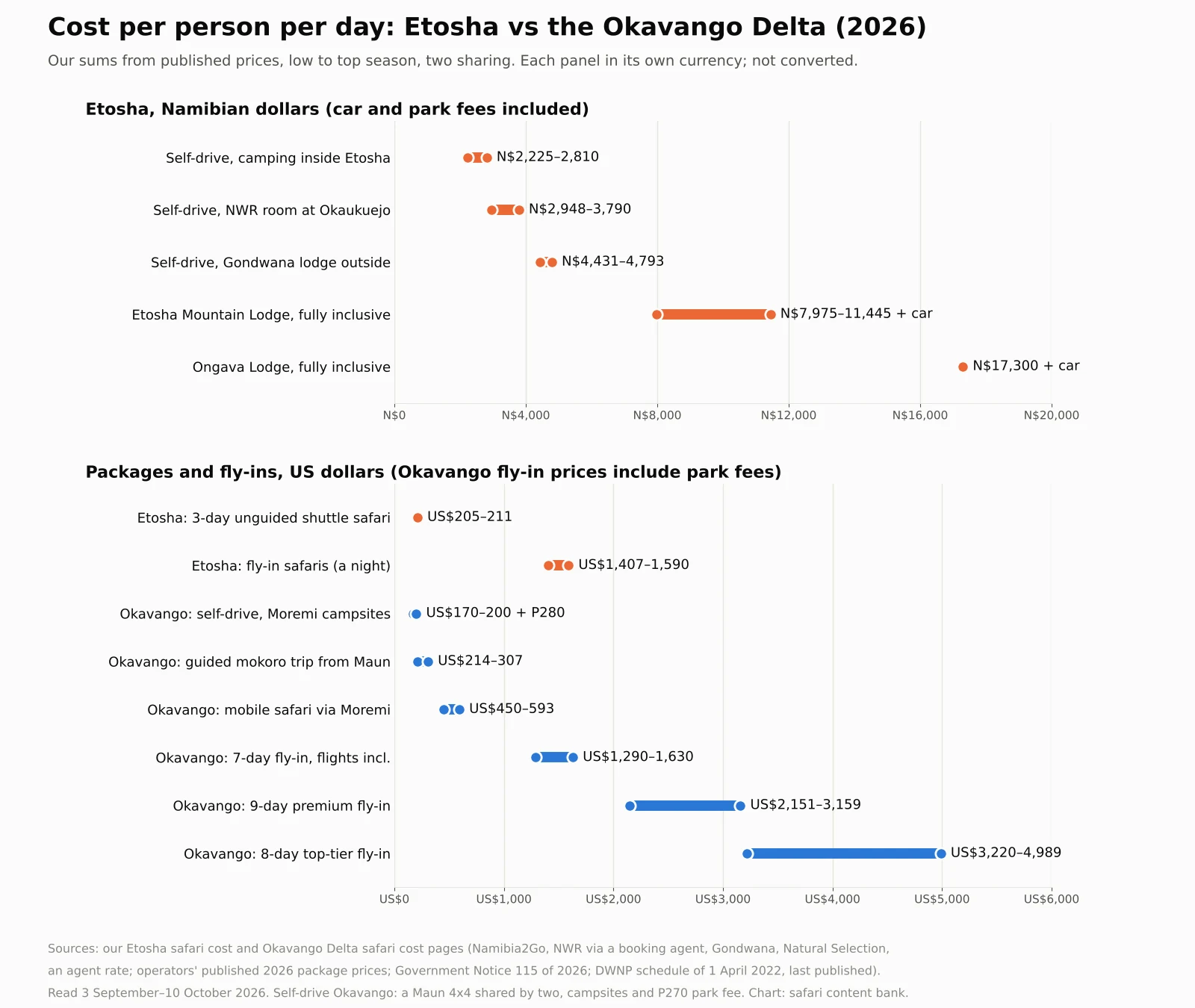 Our sums, as printed on our Etosha and Okavango Delta safari cost pages. Sources: Namibia2Go, NWR (via a booking agent), Gondwana, Natural Selection and an agent rate; operators’ published 2026 package prices; Government Notice 115 of 2026; DWNP schedule of 1 April 2022, last published. Read 3 September–10 October 2026. Chart: safari content bank.
Three nights in each
| Three nights | Etosha | Okavango Delta |
|---|---|---|
| Camping | Okaukuejo, July–October: N$5,220 for two, with N$1,860 in park fees; car extra | Moremi self-drive: US$650–730 plus P1,110 per person, two sharing, with the 4x4, campsites, levy and park fee |
| Room or camp | Okaukuejo room, July–October: N$16,140 for two, park fees included; car extra | Camp Xakanaxa inside Moremi: US$2,643–3,263 per person in Green season, US$4,188–4,808 in Peak, with flights from Maun and tips |
| With the car from Windhoek | 4 days, 3 nights camping in August: about N$12,000 per person, diesel included | — |
Our sums, as on our Etosha, Etosha safari cost and Okavango Delta safari cost pages. Fuel (Delta), food, drinks and tips (Etosha) extra.
- In Etosha the car is the big line: about two-thirds of a camping self-drive day (Etosha safari cost).
- In the Delta the bed and the flight are: a light-aircraft return from Maun costs about US$525–1,208 per person unless the camp includes it, and top-season camp rates are 1.6 to 2.6 times the lowest (Okavango Delta safari cost).
Self-drive or fly-in: how you get in
Etosha is the easy self-drive: tar from Windhoek, gravel park roads a 2WD car handles in the dry season, and no booking for day entry. In the Delta you fly from Maun into the camps; by road you reach only Moremi’s public tracks, Khwai and the Panhandle, in a 4x4, with every campsite booked first.
| Etosha | Okavango Delta | Source | |
|---|---|---|---|
| Gateway | Windhoek, Hosea Kutako International Airport | Maun airport: routes from Addis Ababa, Livingstone, Lusaka and Windhoek in our sources; no non-stop flight from Europe | Etosha; Botswana bush flights |
| By road | Windhoek → Okaukuejo 414–435 km, tar, 4–6 h; Windhoek → Namutoni 533 km | Maun → Moremi about 80 km in a 4x4; Moremi South Gate → Third Bridge about 2 hours on thick sand; no road to the inner Delta camps | Namibia self-drive distances; Okavango Delta safari cost |
| By air | Fly Namibia Safari serves the Ongava and Mokuti airstrips; no fare published in our sources | Light aircraft: Moremi Air US$250 Maun → Kwara + US$25 tax; Desert & Delta US$284–594 a seat + US$20 tax (2024); Great Plains includes air on 2+ nights | Etosha safari cost; Okavango Delta safari cost |
| Luggage | Not stated for Etosha’s airstrips in our sources | 20 kg per person in a soft bag on the light aircraft | Okavango Delta |
| Vehicle | 2WD on the main gravel roads in the dry season; 4x4 recommended in the wet season and needed for Dolomite Camp | 4x4 for Moremi and Khwai; Maun 4x4 hire US$260–300 a day | Etosha; Okavango Delta safari cost |
| Rules for drivers | Gates sunrise to sunset; stay in your car; no driving after dark except on NWR’s guided night drives | No night driving and no off-roading in Moremi (Botswana Tourism) | Etosha; Botswana Tourism |
| Booking | Day entry: pay at the gate. Beds: forum regulars advise booking NWR’s camps 6–12 months ahead for July–September | Book and pay every campsite first, then pay DWNP; no shared booking system | Etosha; Botswana park fees |
Read September–October 2026, as on the pages linked.
- Light aircraft do not fly at night. A late regional arrival in Maun means a night there; our sources publish no Maun hotel rate (Okavango Delta safari cost).
- Moremi self-drives start in Maun, not Namibia, for most people. Booking order, campsites and the sand tracks are on self-driving Moremi and Chobe.
- Self-drive is the mainstream way to see Namibia and rare in Botswana: 3 of 124 published Botswana safari products are self-drives, all routed through Namibia (Namibia vs Botswana).
Best months for each
June to October suits both: Etosha’s game is at the waterholes from May, peaking in September and October, and the Delta holds its flood until about August while its camps charge their top rates. The rains fall from about November to April in Etosha and November to March in Botswana. January to March is the Delta’s cheapest season and Etosha’s poorest for game.
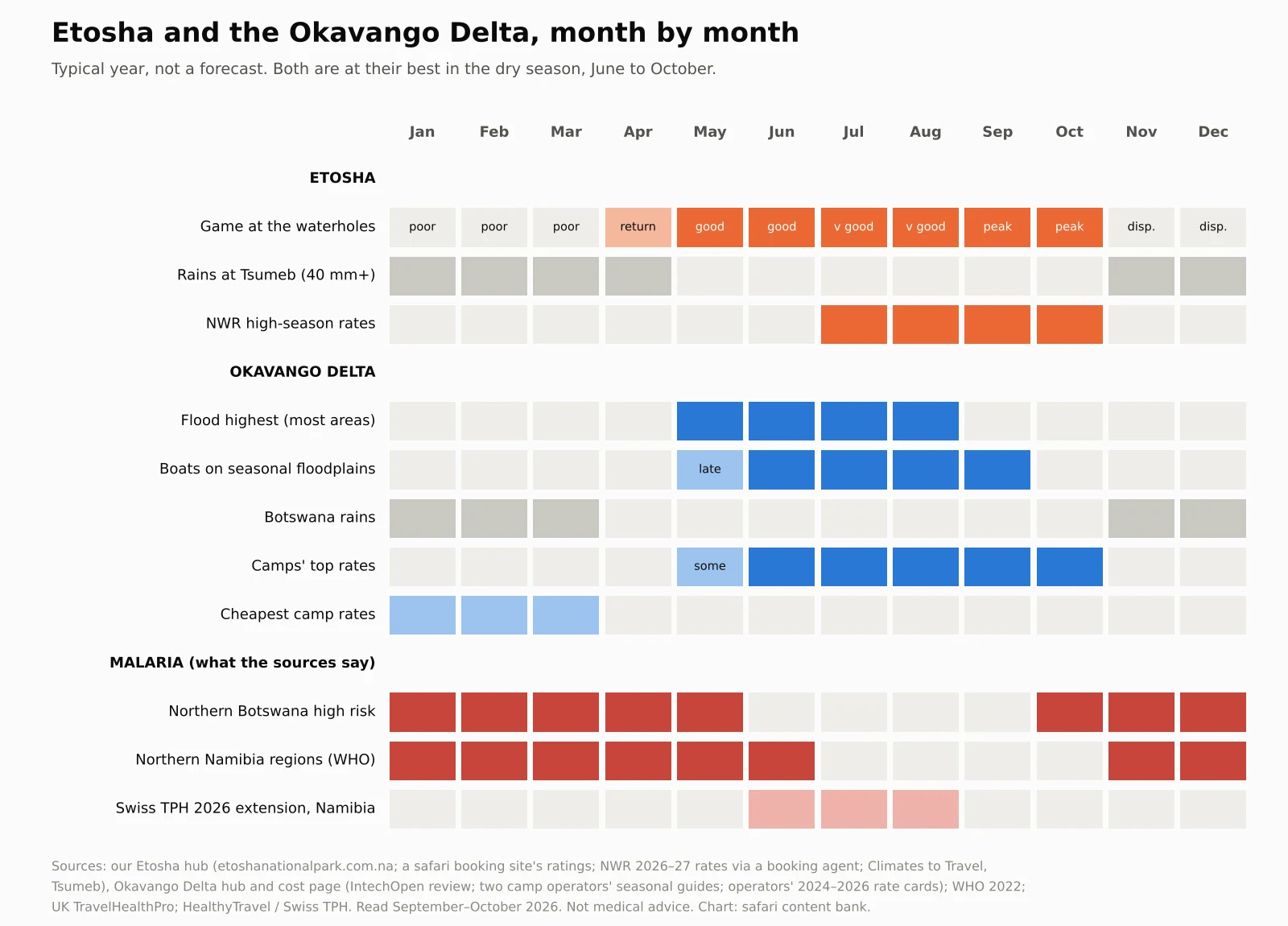 Typical year, not a forecast. Sources: our Etosha hub (a safari agent’s guide; a safari booking site’s ratings; NWR 2026–27 rates via a booking agent; Climates to Travel, Tsumeb) and our Okavango Delta hub and cost page (IntechOpen review; two camp operators’ seasonal guides; operators’ 2024–2026 rate cards); WHO country list 2022; UK TravelHealthPro; HealthyTravel / Swiss TPH. Read September–October 2026. Chart: safari content bank.
| Months | Etosha | Okavango Delta |
|---|---|---|
| January–March | Poorest game viewing; 80–140 mm of rain a month at Tsumeb; NWR low season | Botswana’s rains; water low; seasonal camps run no boats in January and February; lowest rates (Mombo US$3,062, Kwara US$820) |
| April–May | Game returning to the waterholes, good from May; NWR low season | The flood arrives; boating resumes in late May; red lechwe rut in May; Machaba’s high season starts 1 May |
| June | Good; cold dawns, 8 °C lows at Tsumeb | High water; top rates begin at most groups |
| July–August | Very good; NWR high season | Water highest in most areas; every group at or near its top rate |
| September–October | Peak; Tsumeb averages 33 °C highs in October | Flooded area largest July–September; October is the hottest month, above 40 °C at times, and some water activities may stop |
| November–December | Game disperses as the rain starts; NWR low season | Rains start; shoulder rates from 1 November at some groups, holiday rates from 20 December |
Sources as on our Etosha, Okavango Delta, Okavango Delta safari cost and Okavango flood calendar pages, read September–October 2026.
- May and June are Etosha’s value months: NWR and the rental firms are still on low-season rates, and game is already returning to the waterholes (Etosha safari cost).
- In the Delta, ask about water at your camp in your month. The flood peak enters Botswana at Mohembo between mid-March and mid-May and can take up to six months to reach the far edges (Okavango Delta).
- Neither area is malaria-free. Swiss TPH says not to treat Etosha as malaria-free and extended its 2026 advice to June–August; WHO lists Namibia’s Okavango river areas all year, and TravelHealthPro rates northern Botswana high risk from October to May. This is what the sources say, not medical advice (Safari malaria risk).
Combining both on one trip
Most people link the two by air through Maun or by road across northern Namibia and the Mohembo border. Published Namibia and Botswana trips run 7–19 days, with a median of 12 (our count of operators’ itineraries, on multi-country safaris).
| Way | Route | What it takes | Source |
|---|---|---|---|
| Fly | Etosha → back to Windhoek by road → FlyNamibia Windhoek–Maun → light aircraft to a Delta camp | FlyNamibia flies Windhoek–Maun on Monday, Wednesday, Friday and Sunday until 30 November 2026; no fare in our sources. Okaukuejo → Windhoek 414–435 km, Namutoni → Windhoek 533 km | Botswana bush flights; Namibia self-drive distances |
| Drive | Namutoni → Rundu → along the Okavango to Divundu → Mohembo border → the Panhandle → Maun → Moremi | Namutoni → Rundu 415 km on tar; Rundu → Divundu not measured in our sources; Mohembo is 25 km south of Divundu, open 06:00–18:00 (Botswana side); then 296 km on the A35 to Sehithwa | Namibian rental car across borders; Wikipedia, A35 |
| Drive via Chobe | Etosha → the Caprivi → Ngoma Bridge → Kasane → Moremi or Maun | The Caprivi route and its distances are on Etosha vs Chobe; Maun ↔ Kasane is 600 km on tar, about 7 hours | Etosha vs Chobe; Chobe vs Okavango Delta |
| Join a tour | An overland camping truck through Etosha and the Okavango Delta | One operator’s 12-day trip US$1,756, park fees included, about US$146 a day (our sum) | Multi-country safaris |
Read 3 September–10 October 2026, as on the pages linked. The 296 km is Mohembo to Sehithwa alone; one operator’s 16-day self-drive itinerary gives Ngepi Camp → Maun via Mohembo as 310 km, which does not square with it, so check the distance on your own route.
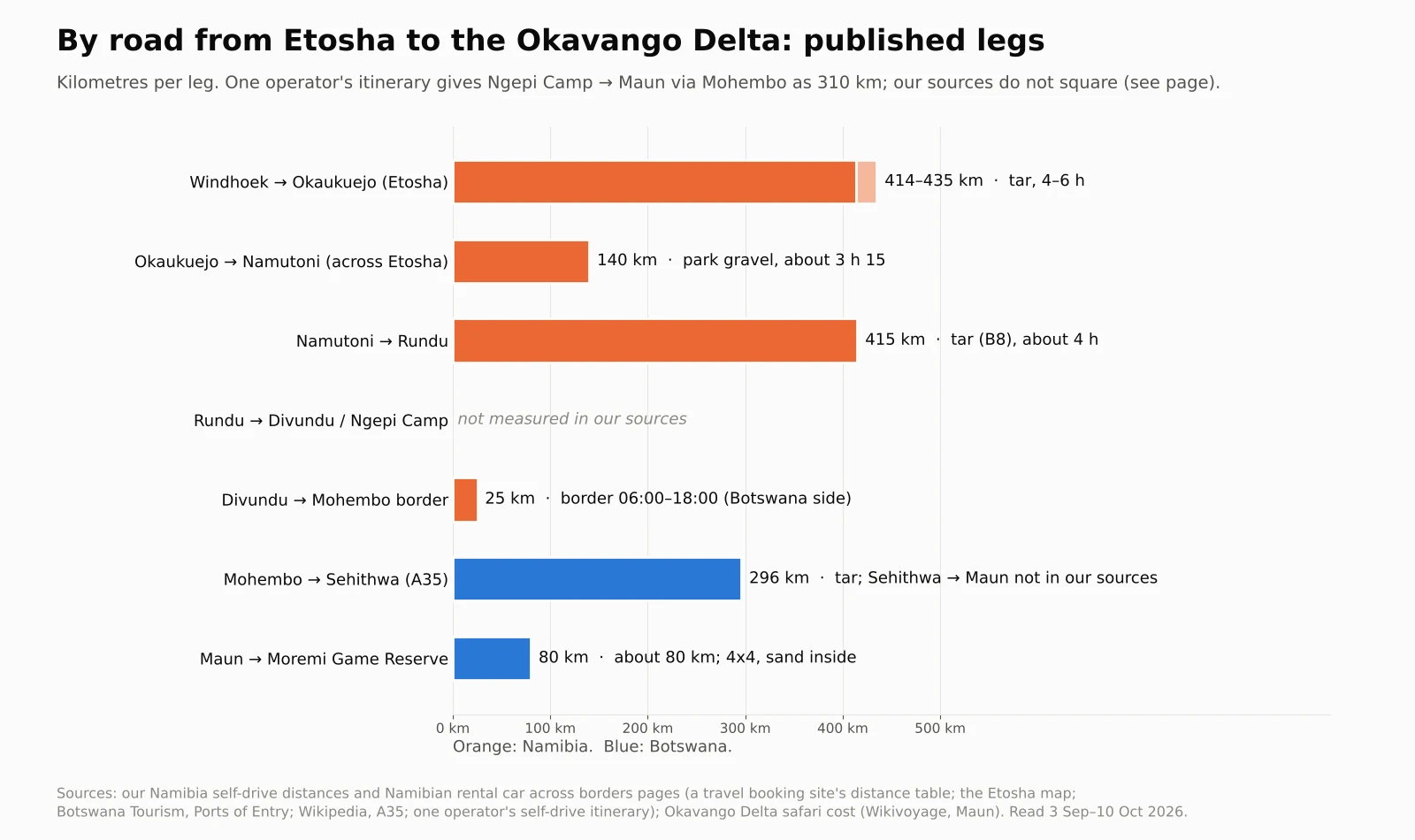 Sources: our Namibia self-drive distances and Namibian rental car across borders pages (a travel booking site’s distance table; the Etosha map; Botswana Tourism, Ports of Entry; Wikipedia, A35; one operator’s self-drive itinerary) and Okavango Delta safari cost page (Wikivoyage, Maun). Read 3 September–10 October 2026. Chart: safari content bank.
Driving a Namibian rental into Botswana
| Step | What you need | Source |
|---|---|---|
| Before you collect the car | The rental company’s cross-border letter: from nothing to ZAR 1,000 by company; a 2026 market survey found R1,250–2,000 at the big brands’ safari arms | Namibian rental car across borders |
| Mohembo border | Open 06:00–18:00 on the Botswana side; an undated Namibian listing gives 08:00–17:00, so arrive by mid-afternoon | same |
| Entering Botswana | BWP 40 Road Safety Fund levy, valid to 31 December; a foreign car may stay 14 days on a temporary import permit | BURS |
| Veterinary fences | Raw meat may not be carried between Rundu and Grootfontein, among other Namibian routes; cooked food may cross | Tracks4Africa |
| One-way rental | One Namibian rental company lists one-way drops at Maun and Kasane; none in our sources publishes the fee | Namibian rental car across borders |
| Visas | Namibia: N$1,600 on arrival for UK, US and German citizens aged 12 and over. Botswana: none for British citizens for 90 days; US citizens are not covered by name in our sources | Namibia visa; Botswana visa |
Read 9–11 October 2026, as on the pages linked.
- Bring a 4x4 if you mean to drive into Moremi. Etosha needs none in the dry season, but Moremi does, and a Namibian rental crosses only with the rental company’s letter (Botswana self-drive).
- How long in each: forum regulars put Etosha’s practical minimum at two nights, three to cover more than one section (Etosha), and suggest three nights per Delta camp, because every move costs a flight and part of a day (Okavango Delta safari cost).
- The Trans-Kalahari route via the Mamuno border is the other road from Windhoek, but our sources publish neither its distance to Maun nor consistent border hours (Botswana visa).
- Adding Chobe and Victoria Falls? The usual Botswana line runs Maun → Okavango Delta → Moremi → Khwai or Savuti → Chobe → Victoria Falls (Chobe vs Okavango Delta).
Who each suits
Etosha suits self-drivers, budget travellers, families who want their own pace and anyone on Namibia’s classic road loop; the Delta suits travellers who want guides, water, predators and a camp that bundles everything, and who can pay for fly-in beds.
| If you… | Pick | Why |
|---|---|---|
| Want to drive yourself in a 2WD | Etosha | Main gravel roads are fine in the dry season; the Delta needs a 4x4 or a light aircraft |
| Are on a tight budget | Etosha, or a mokoro trip from Maun | Etosha camping self-drive N$2,225–2,810 a day; Delta mokoro trips US$214–307 a day |
| Want mokoro, boats and birds | Okavango Delta | Mokoro and boats on permanent water, and on the floodplains from about late May to September |
| Want the best odds of leopard and wild dog | Okavango Delta | 73% and 61% of one safari operator’s Delta travellers saw them; leopard is rated very rare in Etosha |
| Want to sit at a waterhole, including after dark | Etosha | Floodlit waterholes at Okaukuejo and Halali for guests sleeping inside |
| Want guided drives and meals in one price | Okavango Delta | Fly-in camp rates include meals and activities, often park fees too |
| Want night drives | A Delta concession camp, or Etosha’s boundary reserves | Allowed on Botswana’s private concessions “in moderation”; Etosha has only NWR’s guided night drives |
| Are wary of small aircraft | Etosha, or Moremi by road | Most Delta camps are reached only by light aircraft |
| Are on Namibia’s loop | Etosha | It sits on the Windhoek–Sossusvlei–Swakopmund–Etosha loop: see Etosha vs Sossusvlei |
| Have 12 days or more | Both | By road via Mohembo or by air via Maun; published Namibia and Botswana trips have a median of 12 days |
Verdict
Etosha is the better safari if you want to drive yourself, keep the budget in Namibian dollars and watch game come to you; the Okavango Delta is the better safari if you want water, guides and predators, and can pay fly-in prices. Neither beats the other on the calendar: both are at their best from June to October. On price, Etosha is the easier budget: its cheapest beds are inside the park and a 2WD car will do, while the Delta’s cheapest ways in are mokoro trips from Maun and Moremi camping in a 4x4. On wildlife experience, the Delta wins for variety and predators, Etosha for easy, patient waterhole viewing. If you have about two weeks, do both: Etosha first by car, then the Delta by air from Windhoek to Maun or by road through Mohembo.
Other pairings: Etosha vs Chobe, Etosha vs Kruger, Etosha vs Masai Mara, Okavango Delta vs Kruger and Chobe vs Okavango Delta.
Common mistakes in Etosha vs Okavango Delta comparisons
| What you’ll often read | What is correct |
|---|---|
| “Etosha costs N$150 a day” | N$280 per foreign adult since 1 April 2026, plus N$60 per car. Government Notice 115 of 2026 states no time period. |
| “Moremi costs P500 a day from April 2026” | Reported postponed. The last published DWNP schedule (1 April 2022) gives P270; BOPA called the existing fee P380 in February 2026. Confirm with DWNP or your operator. |
| “You can self-drive to the Delta camps, like Etosha’s” | Only Moremi’s public tracks and Khwai are open to self-drivers, in a 4x4; the inner Delta camps are reached by light aircraft. |
| “The Delta is wettest in the rainy season” | It floods in the dry season: water is highest in most areas from about May to August, while Botswana’s rain falls November to March. |
| “Etosha has the Big Five” | Four at most. Cape buffalo are kept out of Etosha by veterinary policy. |
| “You need a 4x4 for Etosha” | Not on the main gravel roads in the dry season; a 4x4 is recommended in the wet season and needed for Dolomite Camp. |
| “Night drives are allowed everywhere in the Delta” | Not in Moremi: Botswana Tourism says night driving is prohibited in parks and reserves and allowed on private concessions “in moderation”. |
| “Park fees are always extra” | NWR’s Etosha camps exclude them; many Delta camps include them (Desert & Delta, Wilderness, Natural Selection). |
| “Any Namibian rental can drive into Botswana” | Only with the rental company’s cross-border letter; Botswana adds a BWP 40 levy and a 14-day limit on the temporary import permit. |
| “The dry season is malaria-free” | Not on this trip: Swiss TPH extended its Namibia advice to June–August 2026, and WHO lists Namibia’s Okavango river areas all year. |
Frequently asked questions
Is Etosha or the Okavango Delta better for a first safari? For a first safari you drive yourself, Etosha: a 2WD car is fine on its main roads in the dry season, day entry needs no booking, and game gathers at the waterholes from May to October. For a first safari with guides, the Delta: fly-in camp rates include meals, game drives and water activities, and 99% of one safari operator’s Delta travellers saw elephant.
Which is cheaper, Etosha or the Okavango Delta? Etosha. A couple camping inside on a self-drive spends about N$2,225–2,810 per person a day with the car and park fees, and a 3-day unguided shuttle safari from Windhoek costs about US$205–211 a day. In the Delta, guided mokoro trips from Maun cost about US$214–307 a day, and fly-in camps US$530–5,345 a night (our sums from published prices).
What are the park fees for Etosha and the Okavango Delta in 2026? Etosha charges N$280 per foreign adult plus N$60 per car since 1 April 2026 (Government Notice 115 of 2026); the notice states no time period, so we count one fee per park day. Moremi’s last published fee is P270 per non-resident adult per day (DWNP, 1 April 2022); BOPA called the existing fee P380 in February 2026, and a P500 rise was reported postponed. Concession camps charge levies of US$20–100 a night instead.
When is the best time to visit Etosha and the Okavango Delta? June to October suits both. Etosha’s game is at the waterholes from May to October, peaking in September and October. The Delta’s water is highest in most areas from about May to August, and its camps charge top rates in the dry season. January to March is the Delta’s cheapest season and Etosha’s poorest for game.
Can I self-drive the Okavango Delta like Etosha? Only in part. Self-drivers can reach Moremi Game Reserve’s public tracks and the Khwai community area, about 80 km from Maun, in a 4x4 with every campsite booked and paid before the park fee. The inner Delta camps have no road and are reached by light aircraft. Etosha’s main roads take a 2WD car in the dry season.
How do I get from Etosha to the Okavango Delta? By air, drive back to Windhoek and take FlyNamibia to Maun, which flies four days a week until 30 November 2026, then a light aircraft to your camp. By road, drive from Namutoni to Rundu (415 km on tar), follow the Okavango to Divundu and cross at Mohembo (06:00–18:00 on the Botswana side), then take the A35 south towards Maun. A rental needs a cross-border letter.
How many days do I need for Etosha and the Okavango Delta? Published Namibia and Botswana trips run 7–19 days, with a median of 12 (our count). Forum regulars put Etosha’s practical minimum at two nights, three to see more than one section, and suggest three nights per Delta camp. Add a night in Maun if your regional flight lands late, because light aircraft do not fly at night.
Do I need malaria tablets for Etosha and the Okavango Delta? Ask a travel clinic: neither is malaria-free. Swiss TPH says not to treat Etosha as malaria-free and extended its 2026 advice to June–August; WHO lists Namibia’s Okavango river areas all year. UK TravelHealthPro rates northern Botswana, the Delta included, high risk from October to May and low from June to September.
Sources
- Fees: Government Notice 115 of 2026, Government Gazette 8877 (PDF), hosted by the Legal Assistance Centre, re-read 9 Oct 2026; MEFT, Park Entrance and Conservation Fees, 2021 schedule (PDF); Tourism Update, 23 Feb 2022 (DWNP schedule, 1 April 2022); Botswana Daily News (BOPA, 24 Feb 2026); Gabz FM, 5 May 2026; BURS; all as on our Etosha park fees and Botswana park fees pages, checked 10 Oct 2026
- Camps and rates: NWR 2026–27 rates via a booking agent’s listing; Gondwana Collection; Natural Selection Namibia 2026 (PDF) and Botswana 2026 (PDF); Onguma 2027 (PDF), read 1 November 2026; Kwando 2024; Desert & Delta 2024; Great Plains 2025; Machaba 2026; Wilderness Mombo; Namibia2Go 2026 rack rates; read September–October 2026
- Parks, water and rules: a safari agent’s guide: self-drive guide, wildlife; Botswana Tourism, game viewing; IntechOpen review; UNESCO, Okavango Delta; Climates to Travel, an aggregator; as on our Etosha, Okavango Delta and Okavango flood calendar pages, read September–October 2026
- Travel and borders: Botswana Tourism, Ports of Entry; Wikipedia, A35; Tracks4Africa, veterinary fences; Namibia flight sheet, May/June 2026 (PDF) (FlyNamibia, Fly Namibia Safari); as on our Namibia self-drive distances, Namibian rental car across borders, Botswana bush flights, Namibia visa and Botswana visa pages, read 9–11 Oct 2026
- Health: HealthyTravel / Swiss TPH, Namibia; WHO country list 2022 (PDF); TravelHealthPro, Botswana; as on our Safari malaria risk page, read 8–10 Oct 2026
- Rhino: IUCN SSC African Rhino Specialist Group report to CITES, 2025 (national counts), as on our where to see rhino page
- Tour operators’ and listing sites’ published 2026 package prices, one safari operator’s sighting statistics, a safari booking site’s Etosha ratings, one tour seller’s waterhole guide, two camp operators’ seasonal guides, a travel booking site’s distance table, one operator’s self-drive itinerary and the itinerary datasets behind our day counts, read September–October 2026 (names and links kept in our editor notes)
- Traveller reports: TripAdvisor Etosha forum and mokoro trips thread
More: Etosha National Park, Etosha safari cost, Okavango Delta, Okavango Delta safari cost, Moremi Game Reserve, Namibia vs Botswana and multi-country safaris.
Fees, rates and package prices checked 10 October 2026 on our Etosha, Okavango Delta, cost and fee pages; this page was compiled on 24 October 2026. We will update it when DWNP publishes a current Botswana tariff, when MEFT publishes a new fee notice, when FlyNamibia publishes its schedule after 30 November 2026, and when NWR and the Delta camps publish 2027 rates.
Ask for a quote
Tell us your dates and we send you a priced itinerary. Free, no obligation.
- Free quote, no obligation
- Trips run by licensed local operators