 Experience

Last verified · Next check due
On this page
- Self-drive vs guided safari at a glance (2026)
- Where you can drive yourself, and where you can’t
- Cost per day: who pays less?
- Car hire: what the rental companies’ own terms say
- Safety and the official rules
- Sightings: does a guide find more animals?
- Hybrid options: drive yourself, add guided drives
- Which should you choose?
- Common mistakes in self-drive vs guided comparisons
- Frequently asked questions
- Sources
Short answer: Drive yourself in Kruger (South Africa) and Etosha (Namibia), where an ordinary car copes in the dry season, and in Botswana’s Moremi and Chobe if you can drive a 4x4 in deep sand. Go guided in Kenya’s Masai Mara reserve, which banned private cars from game drives in 2024, and in Tanzania, where a guide must accompany every Ngorongoro Crater visitor. Self-drive costs least for two or more who camp; travelling alone, you pay the whole car.
Key facts
- Self-drive is a Southern African habit; guided driving is the East African norm. Kruger and Etosha take an ordinary car in the dry season; Moremi and Chobe need a high-clearance 4x4. Narok County banned private vehicles from game drives in the Mara reserve on 3 June 2024, and self-driving the Serengeti is legal but discouraged by operators.
- Per day, a camping couple’s self-drive and a group tour are priced in different currencies: about N$2,390–2,985 per person a day on a 10-day Namibia camping self-drive for two, against US$138–222 on group camping tours; in Kruger R1,625–1,715 with a camp-ready 4x4, against US$214–242 on shared tours (our sums and operators’ published prices, as on our self-drive safari cost page; we have no dated exchange rate, so we convert neither).
- The car is priced per vehicle, the tour per person. A rooftop-tent 4x4 costs N$2,910–3,880 a day at Namibia2Go (2026), the same for one person as for two.
- In the national parks no private car may drive off-road or after dark. That holds in Kruger, Etosha, Moremi and Chobe; inside the parks only SANParks (Kruger) and NWR (Etosha) sell night drives, and private reserves and concessions run their own on lodge vehicles.
- No study in our sources compares sightings with and without a guide. One tour seller’s first-safari guide says self-drivers see fewer predators and advises first-timers to add some guided drives; it publishes no figures.
- You can mix the two. A SANParks sunrise drive in Kruger cost R424 per adult (2024/25 tariff); an NWR night drive in Etosha costs about N$620 per person; Onguma’s 4-hour game drive into Etosha cost N$1,750 on its 2026 rate sheet, which ran to 31 October 2026.
Self-drive vs guided safari at a glance (2026)
On a self-drive you hire the car, book the camps, navigate and spot the animals yourself; on a guided safari a driver-guide does all of that and the price is per person. This page compares the two ways of travelling. The full self-drive budget is on how much a self-drive safari costs; the gap between a private and a shared guided trip is on private vs group safari cost.
| Self-drive | Guided safari | Source | |
|---|---|---|---|
| Who drives and spots | You | A driver-guide; in private reserves, a guide and tracker | Kruger vs private reserves |
| Where it is the norm | Kruger, Namibia, Botswana’s parks | Kenya, Tanzania; private reserves and concessions everywhere | First safari |
| Vehicle | Ordinary 2WD car in Kruger and on Etosha’s main roads in the dry season; high-clearance 4x4 in Botswana | Closed pop-top 4x4 in Kenya and Tanzania; open-sided 4x4 at Botswana’s lodges and in South Africa’s private reserves | Safari vehicles |
| How it is priced | Per vehicle (hire, car fee, Kruger campsite) plus per person (park fee) | Per person, sharing; a private vehicle is per vehicle | Self-drive safari cost |
| Per person per day, Namibia | N$2,390–2,985, camping, 4x4, diesel and park fees included (our sum, two people, 10 days) | Group camping tours US$138–222 (2 listings) | Self-drive safari cost |
| Per person per day, Kruger | R820–910 for campsite and fees; R1,625–1,715 with a camp-ready 4x4, before fuel (our sum, two people, 7 days) | Shared tours US$214–242 (3 listings); private US$371–405 (1 listing) | Self-drive safari cost |
| Kruger fee | R692 (R602 until 31 Oct 2026), per international adult per day | The same fee; check whether the tour price includes it | Kruger park fees |
| After dark and off-road | Neither in your own car in Kruger, Etosha or Botswana’s parks | Night drives and off-road driving on private reserves and concessions | Night drive safari |
| Who sorts out a breakdown | You and the rental company; Botswana’s parks have no fuel at the campsites | The operator | Botswana self-drive |
Guided prices are operators’ published “from” prices per person, read 3 September – 9 October 2026; they usually include beds, meals and the guide, and the self-drive sums include no food. We print each price in its own currency and convert none.
Where you can drive yourself, and where you can’t
Self-drive works in Kruger, Etosha and Botswana’s public parks; it is closed in the Masai Mara reserve, unusual in the Serengeti, and impossible in the private reserves and concessions, where you game-view on the lodge’s vehicles.
| Park or area | Your own car on game drives? | Vehicle | After dark and off-road | Source |
|---|---|---|---|---|
| Kruger National Park (South Africa) | Yes | Ordinary car: all access roads to the 9 gates are tarred | No night or off-road driving in private cars; SANParks sells drives | Kruger self-drive |
| Sabi Sand, Timbavati (Greater Kruger) | No: you drive or are transferred to your lodge | Lodge vehicles | Lodge drives, off-road and at night | Kruger vs private reserves |
| Etosha (Namibia) | Yes | 2WD on the main gravel roads in the dry season; 4x4 recommended in the wet season and needed for Dolomite Camp | Be in camp or out by sunset; NWR guided night drives only | Etosha vs Kruger |
| Reserves on Etosha’s boundary (Ongava, Onguma) | No: lodge or camp vehicles | Lodge vehicles | Night drives, guided walks and off-road tracking on the reserve | Etosha |
| Moremi and Chobe (Botswana) | Yes, campsites booked and paid first | High-clearance 4x4: Third Bridge to Savuti takes 8–9 hours on sand | “Off-roading and night driving [are] prohibited” in the parks and reserves (Botswana Tourism) | Botswana self-drive |
| Botswana’s private concessions | Varies: the Khwai community concession admits self-drivers; the Khwai Private Reserve says “No self-drivers or day visitors are permitted” | Lodge vehicles | Night drives and off-road driving allowed outside the parks | Night drives and walking in Botswana |
| Masai Mara reserve (Kenya) | No: private vehicles banned from game drives by Narok County’s memo of 3 June 2024; we found no 2026 statement on how it is applied | Operator or camp vehicle | No night drives sold in the reserve | Mara reserve vs conservancies |
| Kenya’s KWS parks | Legal, but few visitors do it and forum regulars advise first-timers against it | Not specified in our sources | Forum regulars’ rule: never drive at night | Kenya safari questions |
| Serengeti (Tanzania) | Legal, but operators discourage it: park roads are rough | A 4x4, in forum experts’ advice | No night drives; tourists are not driven outside towns after dark | Serengeti safari cost |
| Ngorongoro Crater (Tanzania) | Only with a guide: “A licensed guide or an official NCAA guide must accompany all crater visitors” | 4x4 up to 3,500 kg tare only | Driving 06:00–18:00 | Tanzania safari questions |
Sources as on the linked pages: SANParks rules; Sabi Sand access page; a safari agent’s Etosha guide; Botswana Tourism; Narok County memo via Kenyans.co.ke, 4 Jun 2024; NCAA visitor guidelines; TripAdvisor forums; operators’ guides. Read 8–10 October 2026.
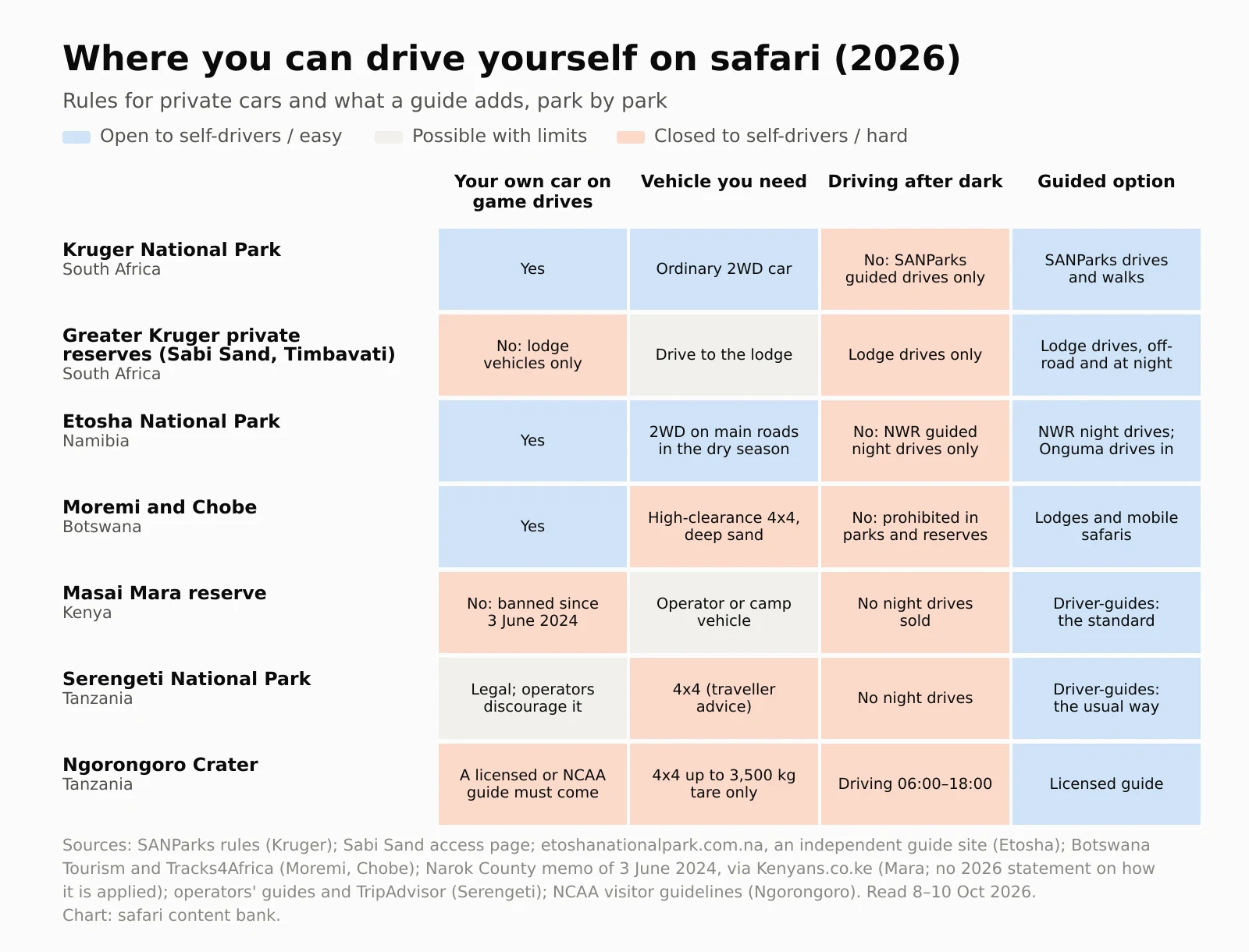 Sources: SANParks; Sabi Sand; a safari agent’s Etosha guide; Botswana Tourism and Tracks4Africa; Narok County memo of 3 June 2024 via Kenyans.co.ke; operators’ guides and TripAdvisor (Serengeti); NCAA visitor guidelines. Read 8–10 October 2026. Chart: safari content bank.
- National Geographic Traveller (March/April 2026) rates a Kruger self-drive as easy, Namibia as medium and Uganda as hard (National Geographic).
- First 4x4 trip? Forum regulars say start in Namibia rather than Botswana, citing deep sand, river crossings and unfenced campsites (Botswana self-drive). Etosha and Kruger are compared as self-drives on Etosha vs Kruger.
- Zambia, Zimbabwe, Uganda and Rwanda allow self-drive with limits; the country-by-country summary is on where to go on your first safari.
Cost per day: who pays less?
For two or more people who camp, self-drive usually costs less per day than a group tour; on your own it loses most of its edge, because the car, the vehicle fee and Kruger’s campsite are charged per vehicle or per site. The headline figures are below; every line of the self-drive budget is on self-drive safari cost.
| What the vehicle costs each person, per day | Per vehicle | Alone | Two sharing | Six sharing |
|---|---|---|---|---|
| Rooftop-tent 4x4, Namibia (Namibia2Go, self-drive) | N$2,910–3,880 | N$2,910–3,880 | N$1,455–1,940 | — |
| Camp-ready 4x4, South Africa (Britz, self-drive) | from R1,610 | from R1,610 | from R805 | — |
| 4x4 hired in Maun, Botswana (self-drive) | US$170–300 | US$170–300 | US$85–150 | — |
| Private Land Cruiser with driver-guide, Tanzania | US$200–300 | US$200–300 | US$100–150 | US$33–50 |
Our sums from published daily rates per vehicle: Namibia2Go 2026 (1–14 days, November–June to July–October, zero excess included); Britz terms (PDF) (minimum 5 days, rate year not shown); Travel Adventures Botswana and Chobe 4x4; one Arusha operator’s published 2026 range for a private Land Cruiser, as on our private vs group safari cost page. Before fuel, park fees and beds. Read September–October 2026.
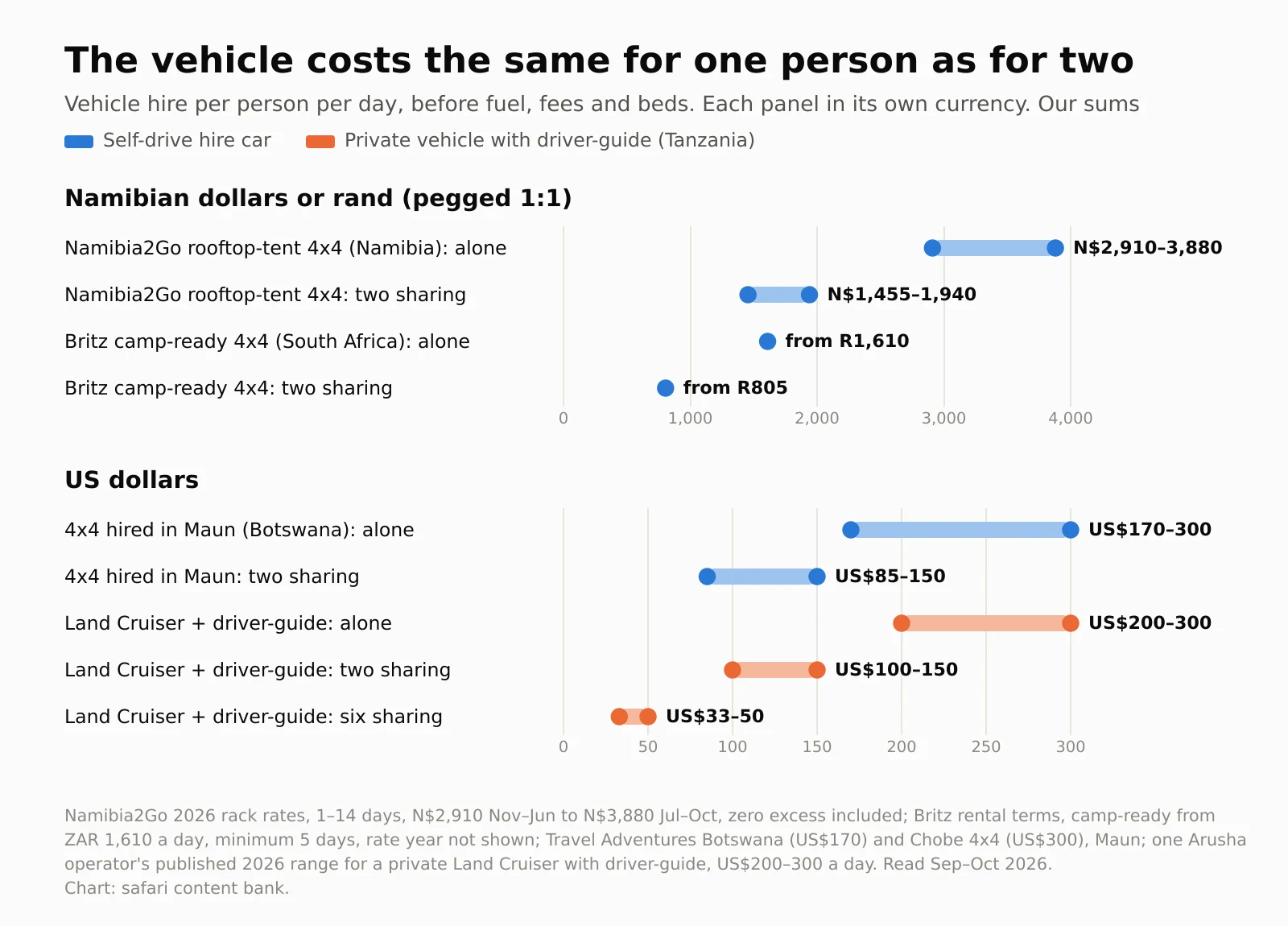 Our sums. Sources: Namibia2Go 2026 rack rates; Britz rental terms; Travel Adventures Botswana; Chobe 4x4; one Arusha operator’s published 2026 range. Read September–October 2026. Chart: safari content bank.
- In Namibia, a couple camping spends about N$2,390–2,985 each a day on a 10-day self-drive with the 4x4, diesel, park fees and campsites (our sum); published group camping tours cost US$138–222 per person a day and small-group lodge tours US$387–405 (self-drive safari cost).
- In Kruger, two international adults camping spend R820–910 each a day on site and fees, or R1,625–1,715 with a camp-ready 4x4, before fuel (our sums); shared tours list at US$214–242 a day and a private Kruger safari at US$371–405 (private vs group safari cost).
- In Botswana, a self-drive day for two in Moremi comes to US$263 + P560 + a daily vehicle fee (our sum, with the park fee of P270 per non-resident adult per day in the last published DWNP schedule, 1 April 2022; confirm with DWNP); a budget mobile camping safari lists at about US$265 a night (1 listing; basis not stated).
- Etosha’s park fee is a small line either way: N$280 per foreign adult plus N$60 per car since 1 April 2026, or N$620 a park day for two and a car (our sum; we count one fee per park day, as MEFT’s 2021 schedule did).
- Guided prices include what a self-drive leaves out: beds, meals and the guide. Fuel, food and the international flight sit on top of every self-drive sum above.
Car hire: what the rental companies’ own terms say
Read the cover before the rate: a low daily price with a N$40,000–55,000 excess and a rollover exclusion can cost more than a zero-excess package, and no supplier in our sources covers water damage.
| Company (where) | Published rate, per vehicle per day | Excess and cover | What stays excluded | Source |
|---|---|---|---|---|
| Namibia2Go (Namibia) | Camping double cab N$2,910 (Nov–Jun) to N$3,880 (Jul–Oct), 1–14 days | Zero excess, tyre and glass waiver built in; no deposit; minimum driver age 23 | Water damage, fines, fuel, one-way fees | Namibia2Go |
| Caprivi Car Hire (Namibia) | Hilux with camping kit for 2: N$2,470–2,890 | Insurance extra: zero-excess “Premium” +N$550 a day | Not stated in our sources | Caprivi Car Hire |
| Asco Car Hire (Namibia) | Not in our sources | Standard excess N$40,000; “Super Cover” to N$0 for €25 a day, minimum 10 days | Below Super Cover: tyres, windows, undercarriage, single-vehicle accidents; Super Cover’s undercarriage cover excludes the Kaokoveld and Damaraland | Asco |
| Kalahari Car Hire (Namibia) | Not in our sources | Standard excess N$40,000; buy-downs to zero for N$391 a day | Overturning or other single-vehicle accident, at every level | Kalahari |
| Britz (South Africa, Namibia, Botswana) | 4x4 from ZAR 1,360; camp-ready from ZAR 1,610; minimum 5 days | Standard excess ZAR 55,000; cover options reduce it | “Roll-overs are not covered in any liability cover options”; undercarriage and water damage not covered under any cover level | Britz terms (PDF) |
| Travel Adventures Botswana (Maun) | US$170 standard; US$183 fully equipped Land Cruiser | Collision waiver US$60 a day cuts the excess to US$380; satellite phone and GPS included | Not stated in our sources | Travel Adventures Botswana |
| McKenzie 4x4 (Maun) | BWP 1,500 unequipped; BWP 2,000 fully equipped | Insurance included; excess BWP 15,000; satellite phone, GPS and recovery kit | Not stated in our sources | McKenzie 4x4 |
Read 3 September – 10 October 2026, as on our Namibia safari cost and Botswana self-drive pages. Most suppliers print no validity year on their insurance pages.
- Zero excess is not full cover. Where the contract voids cover (a rollover at Britz or Kalahari, water damage anywhere), you owe the full repair cost, and a home excess-reimbursement policy pays back only an excess (Namibia safari cost).
- Crossing a border costs twice: the rental company’s letter, from nothing to ZAR 1,000 by company, then each country’s own levy; Britz’s fee “excludes visa, liability insurance and road tax” (Namibian rental car across borders).
- A guided safari moves this risk to the operator. You don’t sign a rental contract or carry an excess; check instead that the operator is licensed (how to check a safari operator’s licence).
Safety and the official rules
The park rules for self-drivers are the same in Kruger, Etosha and Botswana’s parks: stay in your vehicle except at marked places, keep to the roads, and be in camp before the gates close. The difference is help: Kruger’s main camps have fuel, a shop and a restaurant, while Botswana’s park campsites are unfenced, and SKL Camps lists no fuel and no phone signal at its sites.
| Rule | Kruger (SANParks) | Etosha | Moremi and Chobe (Botswana) |
|---|---|---|---|
| Speed | 50 km/h on tar, 40 km/h on gravel | 60 km/h on main roads, 40 km/h near waterholes (a safari agent’s Etosha guide; check the signs) | No official limit in our sources |
| Leaving the car | Only at designated spots; no part of your body out of a window or sunroof | Only in camps and at marked picnic and toilet stops | Campsites are unfenced: elephant, hyena and lion move through them at night (forum regulars) |
| Night and off-road | Not allowed in private vehicles | No off-road driving, walking, night driving or spotlighting | “Off-roading and night driving [are] prohibited” (Botswana Tourism) |
| Gates | Open 05:30 or 06:00; close 17:30–18:30 by month; latecomers refused | Sunrise to sunset; be in a camp or out of the park by closing time | No DWNP page with the hours in our sources |
| Fuel and help | All 12 main rest camps have fuel, a shop and a restaurant or cafeteria | Pumps and shops at Okaukuejo, Halali and Namutoni; travellers report stock-outs | SKL Camps lists no fuel, no phone signal and no internet at its campsites; Tracks4Africa advises two vehicles |
Sources: SANParks vital information, entrance gates and camps; SKL Camps; a safari agent’s Etosha guide; Botswana Tourism; Tracks4Africa; TripAdvisor forum, as on our Botswana self-drive page. Read 8–10 October 2026.
- Most visitor accidents in Namibia involve no other car: one safari operator’s self-drive advice says “most vehicle accidents that befall visitors in Namibia don’t involve any other car”. Namibia’s limits are 120 km/h on tar, 80 km/h on gravel and 60 km/h in towns (AfriCar), and rental firms such as AfriCar advise against night driving (Namibia self-drive distances).
- In Botswana, carry your own help. Travel Adventures Botswana and McKenzie include a satellite phone in the rental, and Travel Adventures sells air rescue membership at US$20 per person for 12 months (Botswana self-drive).
- In East Africa the road is the risk. Tourists are not allowed on Tanzanian roads outside cities after dark (one operator’s travel-times page, on is Tanzania safe for a safari), and Kenya’s forum regulars’ rule is never to drive at night (Kenya safari questions).
- Guided or not, the sighting rules apply to everyone. In the Mara reserve five vehicles may stay at a sighting and the others wait 100 m away (safari etiquette).
Sightings: does a guide find more animals?
Our sources hold no study that compares what self-drivers and guided guests see. What they do show is where a guide has access you don’t: off-road and at night on private land, and in the Masai Mara reserve, where only guided vehicles go out.
| Self-drive | With a guide | Source | |
|---|---|---|---|
| Published comparison | None in our sources | None in our sources | — |
| Getting closer | Roads only, wherever private cars are allowed | Off-road on private reserves and concessions; in the Mara reserve, off-road only to approach big cats on nearby open ground, no closer than 25 m | Kruger vs private reserves; Etosha vs Masai Mara |
| Night animals | Floodlit waterholes at Okaukuejo and Halali for guests sleeping inside Etosha | SANParks and NWR night drives; lodge night drives on private land | Night drive safari |
| Tactics | At Etosha, park at a waterhole and wait: wildlife typically arrives after 20–40 minutes (one tour seller’s waterhole guide) | The guide chooses the route; a private reserve adds a tracker | Etosha; Kruger |
| What travellers say | One tour seller’s first-safari guide says self-drivers see fewer predators than guided guests | Kenya reviewers who booked a cheap driver describe a “guide [who] was a driver more than a guide” (a safari booking site’s reviews) | Kenya safari questions |
Read 8–10 October 2026. The tour seller and review site are named in our editor notes. The sighting rates on our species pages come from one operator’s own travellers, not from self-drivers.
- A guide doesn’t change the park. Etosha has no Cape buffalo with or without one, and the Mara’s cats are resident all year either way (Etosha vs Masai Mara).
- Where animals are likely to be is on our species guides, such as where to see leopards and where to see the Big Five.
Hybrid options: drive yourself, add guided drives
In Kruger and Etosha you can self-drive by day and book guided drives from the camps, or add nights on private land next door; in the Masai Mara reserve there is no self-drive half to mix.
| Where | Guided add-on | Published price | Source |
|---|---|---|---|
| Kruger rest camps | SANParks sunrise, sunset and night drives; guided walks | Sunrise drive R424 per adult; morning walk R726 (2024/25 tariff, the latest in our sources); night-drive price not on our fee pages | Kruger; SANParks activities |
| Kruger plus a private reserve | Self-drive Kruger days, then lodge nights in Sabi Sand or Timbavati with guided drives | 2026 lodge rates from R7,300 per person sharing (Sabi Sand) and R7,761 (Timbavati), plus reserve fees | Kruger vs private reserves |
| Etosha rest camps | NWR guided night drives from Okaukuejo, Halali and Namutoni, 2–3 hours, booked at reception | About N$620 per person (a safari agent’s Etosha guide) | Night drive safari |
| Etosha’s boundary reserves | Onguma’s game drive into Etosha; sundowner drive on its own reserve | N$1,750 per person for 4 hours; N$890 for 3 hours (2026 rate sheet, which ran to 31 October 2026) | Onguma 2026 (PDF) |
| Botswana | Self-drive the parks; activities the parks forbid on the Khwai community concession | Not in our sources | Night drives and walking in Botswana |
Read 8–10 October 2026; Kruger fee checked 1 November 2026. Kruger’s fee is charged on top of SANParks activities: R692 (R602 until 31 Oct 2026), per international adult per day.
- One safari operator advises first-timers to mix self-drive with some guided drives (Kruger vs private reserves). On a July 2026 TripAdvisor thread about a self-drive and lodge trip, travellers advised keeping the hire car rather than paying for transfers to the lodge (Timbavati).
- Kruger days and reserve nights are charged separately: the Kruger fee for days in the park, the reserve’s own fee for nights at the lodge.
- “Just don’t underestimate driving times,” a TripAdvisor poster told a first-timer planning a hybrid Kruger trip; Kruger is about 360 km long (Kruger self-drive).
Which should you choose?
Choose self-drive for freedom, a lower daily cost for two or more, and parks built for it (Kruger, Etosha); choose a guided safari for East Africa, for travelling alone, for night drives and off-road viewing, or if you’d rather not drive at all.
| If you… | Choose | Why |
|---|---|---|
| Are two or more and happy to camp | Self-drive in Kruger or Namibia | The car and Kruger’s campsite are per vehicle or per site; group tours are per person |
| Are travelling alone | Guided group tour, usually | You pay the whole car hire; shared tours are priced per person |
| Want the Masai Mara | Guided | Private vehicles are banned from game drives in the reserve |
| Want the Serengeti or Ngorongoro | Guided | Serengeti self-drive is legal but discouraged; a guide must accompany every crater visit |
| Have never driven a 4x4 in sand | Kruger or Etosha self-drive, or a guided Botswana trip | Ordinary cars manage Kruger and Etosha’s main roads in the dry season; Moremi and Chobe are deep sand |
| Want night drives, walks or off-road viewing | Guided, on a private reserve or concession, or hybrid | Not allowed in private cars in the national parks |
| Want to see more with a short trip | Guided, or self-drive plus guided drives | No study in our sources compares sightings; one tour seller says self-drivers see fewer predators |
| Want to travel with children at your own pace | Self-drive in Kruger or Etosha | Your own stops and timing; see family safari cost |
Choosing where to go first: where to go on your first safari. The two classic self-drive parks side by side: Etosha vs Kruger; a self-drive park against a guided one: Etosha vs Masai Mara.
Common mistakes in self-drive vs guided comparisons
| What you’ll often read | What is correct |
|---|---|
| “Self-drive is always cheaper” | Only for two or more, camping. The car costs the same for one person as for two, so a solo traveller pays all of it. |
| “You can self-drive the Mara like Kruger” | No. Narok County banned private vehicles from game drives in the reserve on 3 June 2024. |
| “You need a 4x4 for any self-drive safari” | Not for Kruger or Etosha’s main roads in the dry season. Moremi and Chobe need a high-clearance 4x4. |
| “With your own car you can stay out for sunset and after” | Be in camp before the gates close in Kruger, Etosha and Botswana’s parks; night driving in private cars is not allowed. |
| “Zero excess means fully covered” | Britz excludes roll-overs under every option; water damage is excluded by every supplier in our sources. |
| “A guide guarantees the Big Five” | No guide changes what a park holds: Etosha has no Cape buffalo, guided or not. |
| “Guided means a private vehicle” | Most guided trips share a vehicle; a private one costs extra, US$200–300 a day per vehicle in Tanzania. |
| “Kruger costs R602 a day” | That was the 2025/26 rate, which ended on 31 October 2026. Since 1 November 2026: R692 per international adult per day. |
| “Botswana park fees are now P500” | P500 was announced, then reported postponed. The last published DWNP schedule gives P270; confirm with DWNP. |
Frequently asked questions
Is a self-drive safari better than a guided one? It depends on where and with whom. Self-drive suits Kruger and Etosha, where an ordinary car manages the main roads in the dry season, and couples or families who want their own pace. A guided safari suits East Africa, solo travellers and anyone who wants night drives, off-road viewing or someone else to spot the animals.
Is a self-drive safari cheaper than a guided safari? Usually, for two or more people who camp. A 10-day camping self-drive in Namibia costs a couple about N$2,390–2,985 each a day with the 4x4, diesel and park fees, against US$138–222 a day on group camping tours. Alone, you pay the whole car hire, which can make a group tour cheaper.
Where can you do a self-drive safari in Africa? Most easily in Kruger (South Africa) and Etosha and the rest of Namibia; in Botswana’s Moremi and Chobe with a high-clearance 4x4; and with limits in Zambia, Zimbabwe, Uganda and Rwanda. In Kenya’s KWS parks and Tanzania’s Serengeti self-drive is legal but uncommon, and the Masai Mara reserve bans private cars from game drives.
Can you self-drive in the Masai Mara or the Serengeti? Not on game drives in the Masai Mara reserve: Narok County banned private vehicles from them on 3 June 2024. In the Serengeti self-driving is legal, but operators discourage it and forum experts advise first-timers against it. In Ngorongoro Crater a licensed guide or an official NCAA guide must accompany all visitors.
Do you see more animals with a guide? Our sources hold no study comparing the two. One tour seller’s first-safari guide says self-drivers see fewer predators and advises first-timers to add some guided drives. A guide on a private reserve can also drive off-road and at night, which no private car may do in Kruger, Etosha or Botswana’s parks.
Is a self-drive safari safe? The park rules are what keep self-drivers safe: stay in the car except at marked places, keep to the roads and be in camp before the gates close. Botswana’s park campsites are unfenced and have no fuel, so rental firms there include a satellite phone. In Namibia one safari operator says most visitor accidents involve no other car.
Can I combine self-drive with guided game drives? Yes. In Kruger, SANParks sells sunrise, sunset and night drives from its rest camps (a sunrise drive cost R424 per adult under the 2024/25 tariff). In Etosha, NWR’s night drives cost about N$620 per person, and Onguma’s 4-hour game drive into the park cost N$1,750 on its 2026 rate sheet, which ran to 31 October 2026. You can also add lodge nights in a private reserve next to Kruger.
What should I check before hiring a car for a safari? The excess and the exclusions, not just the daily rate. Standard excesses in Namibia run N$40,000–55,000, Britz excludes roll-overs under every cover option, and every supplier in our sources excludes water damage. Check the cross-border letter and its fee if you cross a border, and the camping kit list line by line.
Sources
- Park rules and fees: SANParks vital information, entrance gates, camps and activities; SANParks daily conservation fees 2025/26 and 2026/27 (PDFs); SANParks tariffs 2024/25 (PDF); Government Gazette 8877 (Government Notice 115 of 2026), PDF, hosted by the Legal Assistance Centre; DWNP schedule via Tourism Update, 23 Feb 2022; Botswana Tourism, game-viewing drives; Sabi Sand access; NCAA visitor guidelines; Narok County memo via Kenyans.co.ke, 4 Jun 2024. Read 8–10 October 2026
- Etosha: a safari agent’s Etosha guide, read September 2026; Onguma 2026 activities (PDF), sheet ran to 31 October 2026
- Car hire, rental companies’ own pages: Namibia2Go; Caprivi Car Hire; Asco; Kalahari Car Hire; Britz terms (PDF); Travel Adventures Botswana; Chobe 4x4; McKenzie 4x4; AfriCar. Read 3 September – 10 October 2026
- Self-drive practice: Tracks4Africa, Botswana in 10 days; National Geographic, world’s best self-drive safaris (March/April 2026)
- Traveller reports: TripAdvisor forums as cited on our Botswana self-drive, Kruger self-drive, Timbavati, Kenya safari questions and Tanzania safari questions pages
- Tour operators’ and listing sites’ published 2026 prices and advice: group, shared and private tour listings, an Arusha operator’s private-vehicle range, one tour seller’s first-safari and waterhole guides, one safari operator’s Namibia driving advice and Serengeti guide, one operator’s Tanzania travel-times page, and a safari booking site’s reviews (names and links kept in our editor notes)
More: self-drive safari cost, private vs group safari cost, safari vehicles, Etosha vs Kruger, Kruger vs private reserves, first safari, Kruger self-drive, Botswana self-drive and Namibia self-drive distances.
The official fee lines, with the date each took effect and the source:
| Fee | Amount | In force from | Source |
|---|---|---|---|
| Tier 1 parks (Etosha, Namib-Naukluft including Sossusvlei, Skeleton Coast, Ai-Ais/Fish River Canyon, Waterberg Plateau, Cape Cross, Dorob, Tsau //Khaeb), foreign adult 16+, per person | NAD 280 (NAD 140 park entrance + NAD 140 conservation fee) | 1 Apr 2026 (Government Notice 115 of 2026; the notice prices fees per person with no period; MEFT's 2021 schedule made fees valid for 24 hours from entry); was NAD 150 under the 2021 schedule | Government Gazette 8877 (Government Notice 115 of 2026), hosted by the Legal Assistance Centre |
| Vehicle up to 10 seats, most national parks (N$50 at Sandwich Harbour), per vehicle | NAD 60 | 1 Apr 2026 (Government Notice 115 of 2026; the notice states no period; MEFT's 2021 schedule made fees valid for 24 hours from entry); was NAD 50 | Government Gazette 8877 (Government Notice 115 of 2026), hosted by the Legal Assistance Centre |
| Kruger National Park daily conservation fee, international adult (12+), per day | ZAR 602 | 1 Nov 2025 to 31 Oct 2026 (SANParks 2025/26 schedule) | SANParks daily conservation fees 2025/26 |
| Kruger National Park daily conservation fee, international adult (12+), per day | ZAR 692 | 1 Nov 2026 to 31 Oct 2027 (SANParks 2026/27 schedule, already published) | SANParks daily conservation fees 2026/27 |
| Chobe National Park and Moremi Game Reserve (DWNP), non-resident adult, per person per day | BWP 270 (SADC residents BWP 205; Botswana citizens and residents BWP 30) | Last published DWNP schedule, 1 April 2022 (via Tourism Update). In Feb 2026 the government news agency BOPA called the existing non-resident fee P380; a P500 rise was announced, then reported postponed. No official current tariff: confirm with DWNP or your operator | Tourism Update, 23 Feb 2022 (DWNP fee schedule) |
Fees, rental terms and prices checked 3 September – 10 October 2026 against SANParks, MEFT’s Government Notice 115 of 2026, the last published DWNP schedule and the companies’ own pages, as printed on our cost and self-drive pages; this page was compiled on 24 October 2026. We will update it when Kruger’s R692 fee starts on 1 November 2026, when DWNP publishes a new tariff, and when the rental companies publish 2027 rates.
What visitors say
Tripadvisor travel forums · read
What visitors praise
- The thrill of finding animals yourself, which many called addictive after a first try
- Freedom to stay at a sighting as long as you like and set your own pace
- Kruger's signposts, map books and sightings boards make it hard to get lost even for first-timers
- Far cheaper than private-reserve lodges with set drive times
- Kgalagadi delivered lions, cheetah, caracal and raptors in wide open scenery
What visitors criticise
- Corrugated, sandy or poorly kept gravel roads, especially in Etosha and parts of the Kgalagadi
- Long distances and long hours behind the wheel
- Camps book out months to a year ahead
- One 2025 Etosha visitor found the fuel stations in the main camps closed
- Road closures in Etosha in 2026 kept drivers away from the pan edge
- Rude or unhelpful service at some camp desks
Tips visitors repeat
- Stay inside the park so you are out when the gates open, and watch closing times closely
- A higher-clearance car with an automatic gearbox helps you see over the grass, but 4x4 is not needed on the main Kruger or Kgalagadi roads
- Buy a park map book, check the sightings boards and stop where cars have gathered
- Book two nights or more per camp rather than one-night hops
- Pair self-driving with a guided sunset or night drive, since you cannot drive after dark
What surprised visitors
- First-timers spotted leopard, black rhino and wild dog on their own
- Camp shops in the Kgalagadi stock more than people expected
- Kgalagadi winter nights get freezing, so canvas camps need hot water bottles
A September Kruger trip went well; one Etosha regular prefers December to a crowded September; Kgalagadi visits in May, October and February went well, with cold nights from May.
Ask for a quote
Tell us your dates and we send you a priced itinerary. Free, no obligation.
- Free quote, no obligation
- Trips run by licensed local operators