 Experience

Last verified · Next check due
On this page
- Where to see meerkats: places, odds and prices (2026)
- Botswana: the Makgadikgadi pan-edge camps
- How a meerkat visit works
- The Kalahari: Central Kalahari and Kgalagadi
- South Africa and Namibia: Tswalu and the Kalahari ranches
- Which meerkat trip to choose
- When to see meerkats, and combining them with the zebra migration
- Are meerkats endangered? IUCN status
- Common mistakes about seeing meerkats
- Frequently asked questions
- Sources
Short answer: Go to Botswana’s Makgadikgadi Pans, where the pan-edge camps take guests to habituated meerkat groups: 81% of one safari operator’s travellers to the salt pans saw meerkats, against 48% across Botswana and 10% in the Central Kalahari. Camp Kalahari charges US$795–1,325 per person a night (Natural Selection 2026 rate card). In South Africa, Tswalu includes its habituated meerkat colonies in the room rate. Meerkats are Least Concern on the IUCN Red List.
Key facts
- The salt pans are Botswana’s meerkat area: 81% of one safari operator’s traveller groups to the Makgadikgadi and Nxai Pan saw meerkats, against 48% across all its Botswana trips, 10% in the Central Kalahari and 0% in the Okavango Panhandle (read September 2026). These are per-trip rates, not the chance on one outing.
- The meerkats there are habituated: Natural Selection, which runs Jack’s Camp, San Camp and Camp Kalahari on the pan edge, writes of “our habituated meerkat who live in Makgadikgadi”, and Botswana Tourism lists walking with meerkats among the Makgadikgadi’s activities (Botswana Tourism).
- The three pan-edge camps charge US$795–3,895 per person a night in 2026, plus a US$60 nightly fee; rates include activities and park fees (Natural Selection 2026 rate card, PDF).
- Tswalu, in South Africa’s Kalahari, lists “habituated meerkat colonies” among what its rate includes; its Motse camp costs R46,400 per adult sharing a night in 2026 (Tswalu rates).
- Meerkats are not threatened: the species (Suricata suricatta) is Least Concern on the IUCN Red List, as in the GBIF copy of the Red List checklist checked 9 October 2026.
- They are desert animals, not Delta ones: the same operator’s travellers saw none in the Okavango Panhandle (Botswana safari questions).
Where to see meerkats: places, odds and prices (2026)
Botswana’s Makgadikgadi is the only place in our sources with a published meerkat sighting rate and camps that visit habituated groups; in South Africa, Tswalu includes its habituated colonies in the rate, and the Kgalagadi lists meerkats among its smaller species. No park or reserve in our sources publishes a meerkat count.
| Place | Country | How you see them | Seen by (per trip) | Price to be there, per adult | Source |
|---|---|---|---|---|---|
| Makgadikgadi pan-edge camps: Jack’s Camp, San Camp, Camp Kalahari | Botswana | Camp outings to habituated groups | 81% (salt pans area) | US$795–3,895 a night, park fees and activities included, plus US$60 a night (Natural Selection 2026) | one operator’s salt pans page; Natural Selection |
| Makgadikgadi Pans and Nxai Pan national parks | Botswana | Botswana Tourism lists walking with meerkats among the activities | 81% (same area figure) | P190 a day (last published DWNP schedule, 1 April 2022) | Botswana Tourism |
| Central Kalahari Game Reserve | Botswana | Game drives; no habituated group in our sources | 10% | P190 a day (last published DWNP schedule, 1 April 2022) | one operator’s Central Kalahari page |
| Kgalagadi Transfrontier Park | South Africa and Botswana | Self-drive in the dry riverbeds | Not published | R662 per international adult per day from 1 November 2026 (R576 until 31 October 2026; South African side) | a safari booking site’s Kgalagadi page; SANParks |
| Tswalu Kalahari (private reserve) | South Africa | Habituated meerkat colonies, included in the rate, with a private vehicle | Not published | Motse R46,400 per adult sharing a night (2026) | Tswalu rates |
| Bagatelle Kalahari Game Ranch, near Mariental | Namibia | Listed with “cheetah and meerkat encounters” | Not published | From NAD 3,840 per person sharing, dinner, bed and breakfast (Garden Room, January–October 2026) | a booking site’s listing |
| Okavango Panhandle | Botswana | Wrong habitat | 0% | – | one operator’s Panhandle page |
Sighting rates: one operator’s traveller reports, share of groups who saw meerkats at least once on their trip, Botswana pages read September 2026. Fees copied from our Botswana park fees and Kgalagadi pages, read 10 October 2026. Botswana’s fee line is the last published DWNP schedule; no official current tariff is published. Camp and lodge rates read 8–10 October 2026.
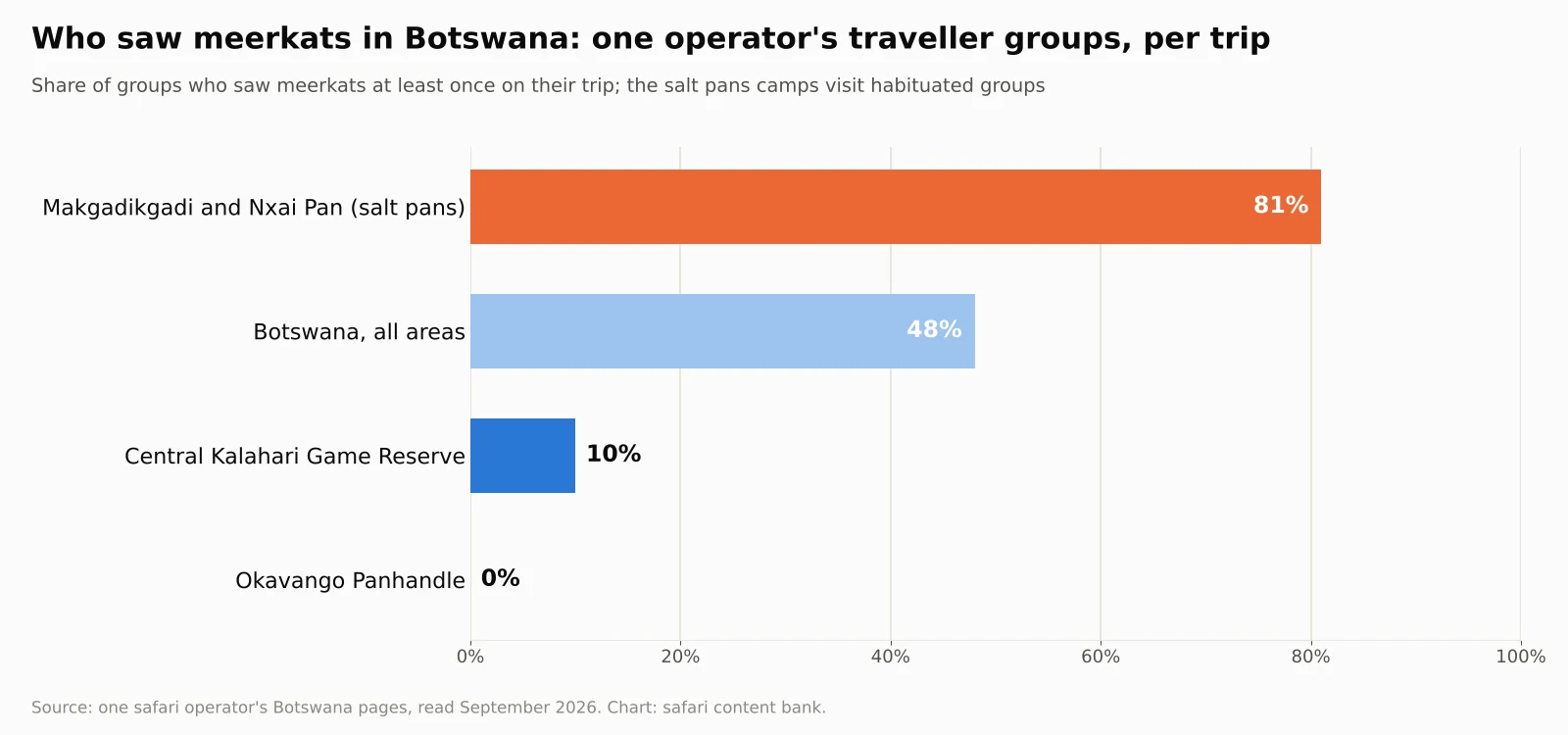 Traveller-reported, per trip, from one operator’s clients. Source: one operator’s Botswana pages, read September 2026. Chart: safari content bank.
- Read 81% as a good but not certain chance. About one group in five to the salt pans did not see meerkats, and the operator does not publish how many groups the figure rests on.
- The Botswana-wide 48% mixes desert and Delta trips, so it says more about where people go than about meerkat numbers.
- Namibia is thin in our sources: a Namibian listing site describes Suricate Kalahari Tented Lodge, in the Intu Afrika Kalahari Reserve, as meerkat-focused, but gives no rate and no detail of how visits work.
Botswana: the Makgadikgadi pan-edge camps
Three Natural Selection camps sit on the edge of Ntwetwe Pan, and one safari operator’s salt pans page names meerkats, quad biking and San-guided walks among what they offer (Botswana night drives and walking). Their rate includes activities, guiding, meals and park entry fees.
| Camp | Green, 10 Jan–31 Mar | Shoulder, Apr and 1 Nov–19 Dec | Shoulder High, May and Oct | High, Jun, Sep and 20 Dec–9 Jan | Peak, 1 Jul–31 Aug |
|---|---|---|---|---|---|
| Camp Kalahari | US$795 | US$995 | US$1,085 | US$1,125 | US$1,325 |
| San Camp (open 1 April–15 October) | Closed | US$1,995 | US$2,195 | US$2,395 | US$2,595 |
| Jack’s Camp | US$2,095 | US$2,795 | US$2,935 | US$3,495 | US$3,895 |
Per person per night sharing, 1–5 nights, plus a Community, Conservation and Reserve fee of US$60 per person a night. Included: meals and drinks, daily activities, guiding, airstrip transfers, park entry fees and VAT. Source: Natural Selection 2026 Botswana rate card (PDF). Read 8 October 2026.
- Camp Kalahari is the cheapest way in: US$795 a night in the green season, US$1,325 at Peak; three nights cost US$2,565–4,155 per person with the fee (our sums, as on our Makgadikgadi page).
- Families: the pan camps take all ages, under-6s stay free and 6–18s pay half; families with children aged 9 or younger must book a private vehicle at US$725–935 per vehicle a night (Makgadikgadi; family safaris).
- Getting there: the pans are about 250 km, 3–4 hours, by road from Maun, or 30–60 minutes by charter (one operator’s salt pans page). Mack Air flies to the Tsigaro airstrip for Jack’s and San Camp (Mack Air; bush flights).
- Self-drivers: the national parks charge P190 per non-resident adult per day (last published DWNP schedule, 1 April 2022); confirm it with DWNP or your operator. Our sources do not say whether meerkat outings are sold to visitors who are not staying at a pan-edge camp.
How a meerkat visit works
On the Makgadikgadi you go with your camp’s guide to a group of meerkats that is used to people; the animals are wild, and a sighting is not guaranteed. Our sources describe no fixed format, group size, distance rule or time of day, so ask your camp how its visits run.
| What to know | What our sources say | Source |
|---|---|---|
| Are the meerkats tame? | No: habituated to people. Natural Selection calls them “our habituated meerkat who live in Makgadikgadi” | Natural Selection, Jack’s Camp page |
| What it is called | “Walking with meerkats”, in Botswana Tourism’s list of Makgadikgadi activities | Botswana Tourism |
| What it costs | In the rate at the pan-edge camps, which include daily activities; at Tswalu, the meerkat colonies are in the rate | Natural Selection 2026; Tswalu rates |
| How likely you are to see them | 81% of one operator’s salt pans groups saw meerkats | one operator’s salt pans page |
| How the group was habituated | Not described in our sources | Ask your camp |
| Age limits | Pan camps take all ages; under-10s need a private vehicle at Natural Selection | Natural Selection 2026 |
Read 8–10 October 2026.
- Ask before you book: how the camp’s meerkat group was habituated, how close guests sit, and whether the outing runs in your month. Our Makgadikgadi page gives the same advice.
- Photographers: a habituated group lets you work close to the ground; for kit and planning, see photography safaris.
- Pair it with a night on the pan: some pan-edge camps sell a sleep-out on the dry pan; ask whether yours runs one in your month (Makgadikgadi).
The Kalahari: Central Kalahari and Kgalagadi
Both parks have meerkats, but neither publishes a habituated group or a high sighting rate; you see them by chance on drives.
- Central Kalahari: 10% of one operator’s traveller groups saw meerkats, against 89% lion and 93% gemsbok. Game is best from December to May, the reverse of the Okavango; the last published park fee is P190 per non-resident adult a day (DWNP, 1 April 2022). Tau Pan costs US$800 per person a night for 1–5 nights (Kwando’s 2024 rate card).
- Kgalagadi: a safari booking site lists meerkat among the park’s smaller species, with bat-eared fox, black-backed jackal and yellow mongoose; SANParks counts 59 mammal species (SANParks). It is a self-drive park. SANParks charges R662 per international adult per day from 1 November 2026 (R576 until 31 October 2026) on the South African side; a Twee Rivieren family cottage cost from R2,017 a night in October 2026 (SANParks had not published its 2026/27 accommodation tariff when we checked on 1 November 2026, so confirm the price when you book).
- The Kgalagadi’s Botswana side is 4x4-only, with two vehicles minimum (Kgalagadi); for Botswana self-drive rules see Botswana self-drive.
See also: where to see cheetahs and where to see lions, the Kalahari’s other draws.
South Africa and Namibia: Tswalu and the Kalahari ranches
Tswalu is the one South African reserve in our sources that lists habituated meerkat colonies among what its rate includes.
- Tswalu Kalahari: Motse costs R46,400 per adult sharing a night (single R57,700), valid to 31 December 2026. The rate includes a private vehicle, guide and tracker for every booking, all meals and drinks, walks, horse riding and the habituated meerkat colonies; flights to the reserve are extra. Children aged 0–11 sharing stay free and 12–17s pay R10,900. The minimum stay is 2 nights, or 3 from 20 December 2026 to 6 January 2027 (Tswalu rates).
- Tswalu has no elephant, so it is not a Big Five reserve (malaria-free safaris); riding there is covered on horseback safaris.
- Namibia: a booking site lists Bagatelle Kalahari Game Ranch, on the red dunes near Mariental, with “cheetah and meerkat encounters”, from NAD 3,840 per person sharing, dinner, bed and breakfast, in a Garden Room from January to October 2026. Confirm the rate and what the encounter involves with the lodge. More: Namibia safari cost.
Which meerkat trip to choose
Pick the Makgadikgadi for the best published odds, Tswalu for a South African trip with everything included, and the Kalahari parks only if meerkats are a bonus.
| If you want | Go to | Why |
|---|---|---|
| The best published odds | Makgadikgadi pan-edge camps | 81% of one operator’s salt pans groups saw meerkats |
| The cheapest camp with meerkats | Camp Kalahari | US$795 a night in the green season, US$1,325 at Peak (2026) |
| Meerkats and zebra on one trip | The Makgadikgadi, December–March | The zebra are on the pans then; see Botswana’s zebra migration |
| Meerkats on a South Africa trip | Tswalu Kalahari | Habituated colonies and a private vehicle in the rate |
| A self-drive with meerkats as a bonus | Kgalagadi | Meerkats listed among the smaller species; R662 a day from 1 November 2026 (R576 until 31 October 2026) |
| Meerkats added to an Okavango trip | The pans, 3–5 days before Maun | The usual add-on in Botswana trips on sale |
When to see meerkats, and combining them with the zebra migration
No source we hold gives meerkat-specific months; the pan-edge camps price every season except San Camp, which closes from 16 October to 31 March. Pick your month for the rest of the trip: zebra in the wet season, quad bikes on the dry crust.
| Period | On the Makgadikgadi | Camp Kalahari / Jack’s Camp, per night | Source |
|---|---|---|---|
| 10 Jan–31 Mar | Rains; zebra on the pans December–March, massing in March | US$795 / US$2,095 (Green) | Africa Geographic; Natural Selection |
| April | San Camp opens 1 April; Nxai Pan’s herds can stay into April | US$995 / US$2,795 | Makgadikgadi |
| May–November | Dry crust: quad bikes run from about May to November | US$995–1,325 / US$2,795–3,895 | one operator’s salt pans page |
| 1 Jul–31 Aug | Natural Selection’s Peak | US$1,325 / US$3,895 | Natural Selection |
| December | Rains; zebra on the pans from December | US$995 to 19 Dec, US$1,125 from 20 Dec / US$2,795, then US$3,495 | Africa Geographic (zebra); Natural Selection (rates) |
Read 8–10 October 2026. Our sources do not say whether meerkat outings run in every month; ask your camp.
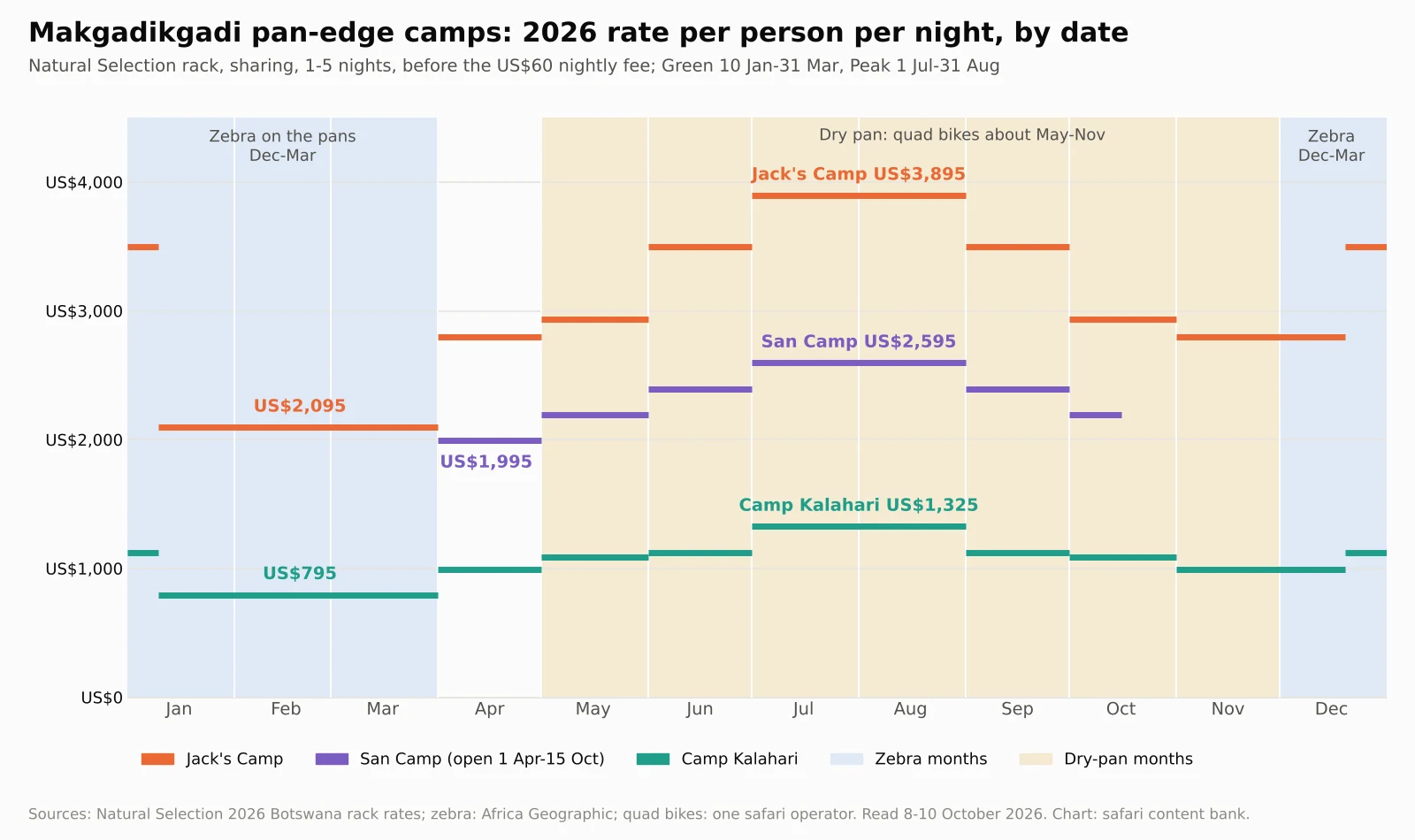 Per person sharing, 1–5 nights, before the US$60 nightly fee. Sources: Natural Selection 2026 Botswana rate card; zebra months: Africa Geographic; quad-bike months: one operator’s salt pans page. Read 8–10 October 2026. Chart: safari content bank.
- The zebra months are the cheapest at the pan camps: Green rates run from 10 January to 31 March, when more than 20,000 zebra from the Chobe and about 15,000 from the Okavango are on the pans. Routes, camps and timing are on Botswana’s zebra migration; for wet-season travel generally, see green-season safaris.
- The pans are usually an add-on: trips that include them add 3–5 days before Maun (our review of 124 Botswana trips on sale, 9 September 2026). Budgets: Botswana safari cost.
- In the Central Kalahari, game is best from December to May; in the Kgalagadi most rain falls from January to April (Central Kalahari; Kgalagadi).
Are meerkats endangered? IUCN status
No: the meerkat is Least Concern on the IUCN Red List. We checked the category against the GBIF copy of the Red List checklist on 9 October 2026; that copy gives no assessment year and no population figure, and no source we hold has a meerkat count.
| Measure | Figure | Source |
|---|---|---|
| IUCN Red List category | Least Concern (Suricata suricatta) | IUCN Red List, as in the GBIF copy of the checklist, checked 9 October 2026 |
| Assessment year | Not in our sources | – |
| Wild population | Not in our sources | – |
Read 9 October 2026.
The official fee lines, with the date each took effect and the authority’s own source:
| Fee | Amount | In force from | Source |
|---|---|---|---|
| Other DWNP parks and reserves (Central Kalahari Game Reserve, Khutse, Nxai Pan, Makgadikgadi Pans), non-resident adult, per person per day | BWP 190 (SADC residents BWP 145; Botswana citizens and residents BWP 20) | Last published DWNP schedule, 1 April 2022 (via Tourism Update). In Feb 2026 the government news agency BOPA called the existing non-resident fee P380; a P500 rise was announced, then reported postponed. No official current tariff: confirm with DWNP or your operator | Tourism Update, 23 Feb 2022 (DWNP fee schedule) |
| Kgalagadi Transfrontier Park daily conservation fee (South African side), international adult (12+), per day | ZAR 576 | 1 Nov 2025 to 31 Oct 2026 (SANParks 2025/26 schedule) | SANParks daily conservation fees 2025/26 |
| Kgalagadi Transfrontier Park daily conservation fee (South African side), international adult (12+), per day | ZAR 662 | 1 Nov 2026 to 31 Oct 2027 (SANParks 2026/27 schedule, already published) | SANParks daily conservation fees 2026/27 |
Before paying an agent, check the operator’s licence.
Common mistakes about seeing meerkats
| What you’ll often read | What is correct |
|---|---|
| “You’ll see meerkats anywhere in Botswana” | 48% of one operator’s Botswana groups saw them; 81% on the salt pans, 10% in the Central Kalahari and 0% in the Okavango Panhandle. |
| “Meerkat sightings are guaranteed on the pans” | 81%, not 100%: about one group in five did not see them. |
| “The meerkats are tame” | They are wild animals habituated to people; ask your camp how its group was habituated. |
| “Meerkats are endangered” | Least Concern on the IUCN Red List. |
| “Go in the dry season for meerkats” | No source we hold gives meerkat months; the dry season is for quad bikes, the wet season for zebra. |
| “Meerkat National Park in South Africa is where to see them” | Our sources hold only its size (about 1,350 km²) and year (2020) from the World Database on Protected Areas, and nothing on meerkats or visitor access there. |
| “The Kgalagadi costs R576 a day” | That was the 2025/26 rate, which ended on 31 October 2026. Since 1 November 2026: R662 per international adult per day. |
Frequently asked questions
Where is the best place to see meerkats in Africa? On published figures, Botswana’s Makgadikgadi Pans: 81% of one operator’s traveller groups to the salt pans saw meerkats, against 48% across Botswana (read September 2026). The pan-edge camps, Jack’s Camp, San Camp and Camp Kalahari, take guests to habituated groups. In South Africa, Tswalu Kalahari includes habituated meerkat colonies in its rate.
Are the Makgadikgadi meerkats wild? Yes, but habituated to people: Natural Selection, which runs the pan-edge camps, calls them “our habituated meerkat”. Our sources do not describe how each group was habituated, so ask your camp how its visits work.
How much does a meerkat safari cost? At the pan-edge camps the meerkat outing is part of an all-inclusive rate: Camp Kalahari US$795–1,325, San Camp US$1,995–2,595 and Jack’s Camp US$2,095–3,895 per person a night in 2026, plus US$60 a night (Natural Selection). Tswalu’s Motse costs R46,400 per adult sharing a night in 2026, meerkat colonies included.
When is the best time to see meerkats? No source we hold gives meerkat-specific months. Camp Kalahari and Jack’s Camp sell every season, San Camp opens 1 April to 15 October. Choose by the rest of the trip: zebra on the pans from December to March, quad bikes on the dry crust from about May to November.
Can I combine meerkats with the Botswana zebra migration? Yes: the zebra are on the Makgadikgadi and Nxai Pan from December to March, and the pan camps’ Green rates run from 10 January to 31 March (Camp Kalahari US$795, Jack’s Camp US$2,095). San Camp is closed then. See Botswana’s zebra migration.
Will I see meerkats in the Okavango Delta? Unlikely. They are desert animals: the same operator’s travellers saw none in the Okavango Panhandle, and a trip that wants Delta water and Kalahari species needs both regions (Botswana safari questions).
Can I see meerkats on a self-drive? Possibly, by chance. A safari booking site lists meerkat among the Kgalagadi’s smaller species, and 10% of one operator’s Central Kalahari groups saw them. Our sources do not say whether the Makgadikgadi camps sell meerkat outings to visitors not staying with them.
Are meerkats endangered? No. The meerkat is Least Concern on the IUCN Red List (category checked 9 October 2026 against the GBIF copy of the checklist). No source we hold gives a population count.
Sources
- Status: IUCN Red List, Suricata suricatta, category as in the GBIF copy of the Red List checklist (checked 9 Oct 2026); Meerkat National Park size and year: World Database on Protected Areas (UNEP-WCMC, queried 9 Oct 2026)
- Sighting rates: one operator’s pages on Botswana wildlife, the salt pans, the Central Kalahari and the Okavango Panhandle (read September 2026); a safari booking site’s Kgalagadi page; a booking site’s and a Namibian listing site’s Kalahari lodge pages (names and links kept in our editor notes)
- Camps and lodges (own rates and descriptions): Natural Selection 2026 Botswana rate card (PDF) and Jack’s Camp (read 8 Oct 2026); Tswalu rates (read 8 Oct 2026); Kwando 2024 rate card, as on our Central Kalahari page
- Parks and activities: Botswana Tourism, Makgadikgadi; SANParks, Kgalagadi; Mack Air; Africa Geographic, zebra migrations (20 Nov 2025), as on our Makgadikgadi and Botswana zebra migration pages
- Fees: DWNP schedule effective 1 April 2022 via Tourism Update, 23 Feb 2022; SANParks daily conservation fees 2025/26 and 2026/27
More on where to see the other animals: zebras, cheetahs, lions, hippos and flamingos.
Figures, rates and fees checked 10 October 2026; SANParks fees checked 1 November 2026. We will update this page when the IUCN Red List publishes a new meerkat assessment, when the operator’s sighting rates change, when Natural Selection or Tswalu publish 2027 rates, when SANParks’ 2026/27 fees take effect on 1 November 2026, and when DWNP publishes an official current tariff.