 Experience

Last verified · Next check due
On this page
- Liuwa Plain wildebeest migration at a glance (2026)
- When to go: Liuwa month by month
- What you see besides the wildebeest
- What it costs: the African Parks fees
- Where to stay
- Getting there: road, charter or helicopter
- Liuwa Camp or self-drive: which way to see it
- Combining Liuwa with other November trips
- Common mistakes about the Liuwa migration
- Frequently asked questions
- Sources
Short answer: Go to Liuwa Plain National Park in western Zambia from late October to December, when “over 47,000” blue wildebeest (African Parks) mass and calve on the plains with the first rains. Camps close from January to April, when the plain floods. The park fee is US$40 per international adult a day plus US$15 per foreign-registered vehicle (African Parks’ 2025 tariff, the latest published). Liuwa Camp charged US$540 per person a night, full board, in 2025.
Key facts
- Liuwa Plain holds “over 47,000” blue wildebeest, which African Parks calls Africa’s second-largest wildebeest migration (African Parks, Liuwa Plain, read October 2026). One safari operator calls it a “gathering” rather than a true migration: the herds move within the plain and its edges, not across countries.
- The herds mass on the southern and central plains and calve from late October to December, with the first rains (one safari operator’s Liuwa month-by-month guide). That is the opposite of the Serengeti’s dry-season river crossings.
- Camps close from January to April, when the plain floods (same guide).
- The park fee is US$40 per international adult a day, plus US$15 a day for a non-Zambian-registered vehicle (Liuwa Camp Rates 2025, African Parks (PDF)). This is African Parks’ own tariff, not the DNPW national park fee table. No 2026/27 sheet had been published when we checked in October 2026.
- Hyenas, not lions, are the main predators. The lion population was rebuilt from a single surviving lioness, Lady Liuwa, through translocations (African Parks).
- African Parks has managed Liuwa with Zambia’s Department of National Parks and Wildlife (DNPW) and the Barotse Royal Establishment since 2003 (African Parks).
Liuwa Plain wildebeest migration at a glance (2026)
Liuwa is a remote, flat, open plain where you come for the wildebeest, the hyenas and the storm-season light, not for the Big Five. The table collects what our sources say about the season.
| What | Detail | Source |
|---|---|---|
| Species | Blue wildebeest | African Parks |
| Numbers | “Over 47,000” | African Parks, Liuwa Plain |
| Season | Late October to December: herds mass on the southern and central plains and calve | One safari operator’s month-by-month guide |
| Closed | January to April: the plain floods and camps close | Same |
| Park | Liuwa Plain National Park, Western Province, Zambia; 3,660 km², about 70 km by 30 km | Visit Liuwa |
| Who runs it | African Parks, with DNPW and the Barotse Royal Establishment, since 2003 | African Parks |
| Park fee | US$40 per international adult a day; US$15 per non-Zambian-registered vehicle a day | African Parks’ Liuwa Camp Rates 2025 (PDF) |
| Gate | Reception 12 km from Kalabo town; open sunrise to sunset | Visit Liuwa, day visitors |
Read 8 October 2026. The 2025 rate sheet is the latest African Parks has published for Liuwa.
When to go: Liuwa month by month
Go from late October to December; early November is the time one safari operator singles out for the wildebeest. Before that the herds are still drifting back south, and from January the plain floods. Our Zambia safari questions page gives the same window.
| Period | On the plain | Herds |
|---|---|---|
| January–April | Flooded; camps closed; access by canoe or on foot only | Not stated in our sources |
| May–July | Drying out; cold nights, in single figures | Drifting north (March–July) |
| August–September | Dry and hazy | Starting back south from August |
| October | Hottest month, above 40 °C | Moving south; animals at the remaining water |
| Late October–December | First rains, storms, flowers | Massed on the southern and central plains; calving |
Source: one safari operator’s Liuwa month-by-month guide, read October 2026. Months shift with the rains.
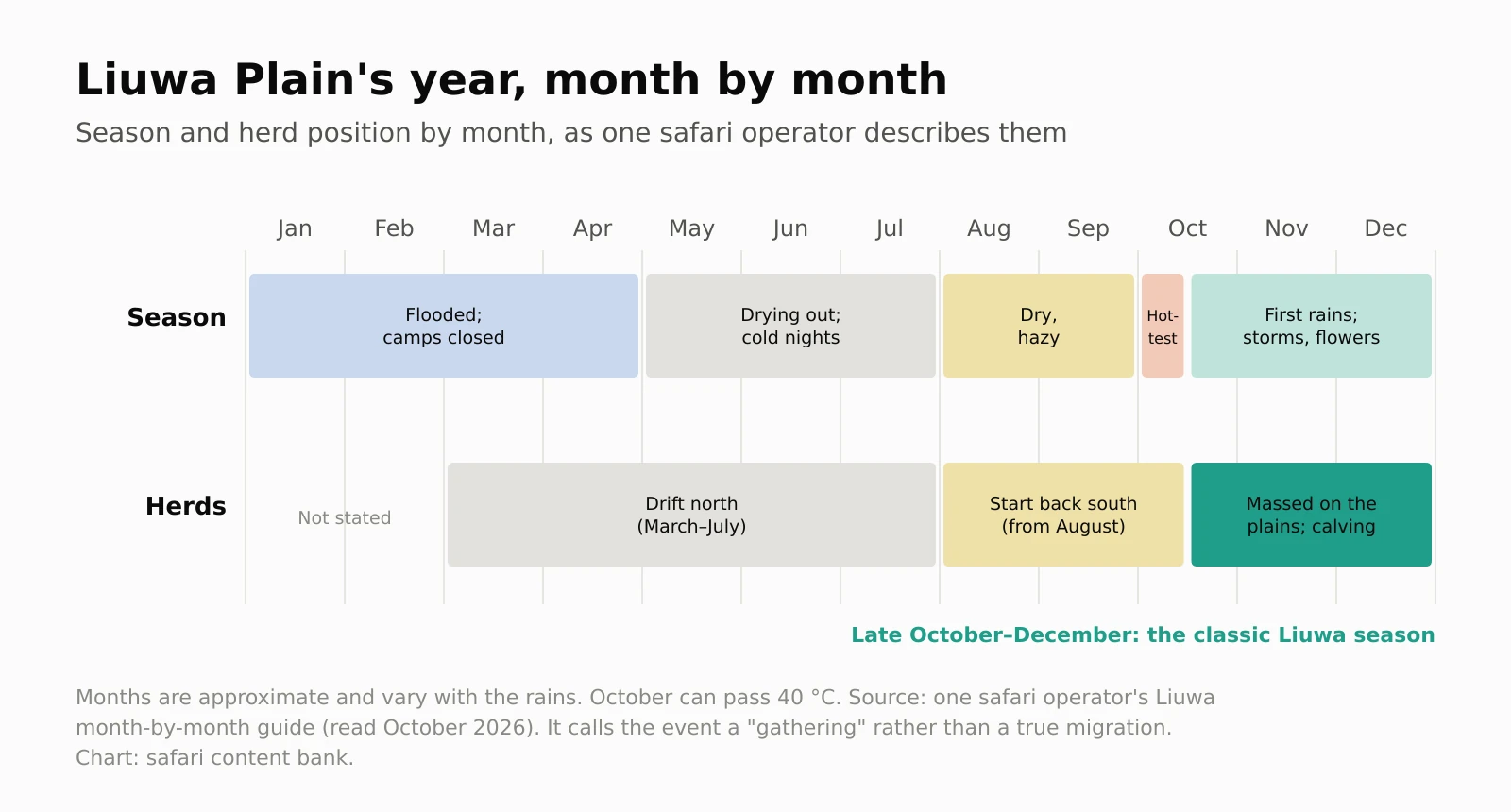 Liuwa’s year as one safari operator describes it. Read October 2026. Chart: safari content bank.
Smoke haze can spoil photographs from August to October, which one safari operator notes for Liuwa. What else is on in Zambia in the same weeks: safari in October and safari in November.
What you see besides the wildebeest
Liuwa’s predator story is the spotted hyena, which lives in clans of dozens and is the dominant hunter on the plain. African Parks describes wild dog and cheetah as present, and lions as breeding again.
| Animal | What our sources say | Source |
|---|---|---|
| Spotted hyena | The dominant predator, in clans of dozens; studied in peer-reviewed work | M’soka et al. 2016; Martens et al. 2025 |
| Lion | Rebuilt from one surviving lioness, Lady Liuwa, through translocations; now breeding (no count published) | African Parks |
| Wild dog | The Greater Liuwa pack held 12 adults and yearlings in 2023 | Zambian Carnivore Programme, 2023 annual report (PDF) |
| Cheetah | Present; African Parks calls them “thriving” | African Parks |
| Lichtenstein’s hartebeest | Returned in 2025 after more than 30 years’ absence | African Parks |
| Other grazers | Tsessebe and zebra (8,000 and 1,000 in the 1991 census); buffalo reintroduced | One safari operator’s Liuwa page |
The Zambian Carnivore Programme collared 41 wildebeest and made 837 herd counts in Liuwa in 2023 (its 2023 annual report). More on the predators: where to see wild dogs and where to see lions. For the hartebeest and other antelope: where to see rare antelope. For birds: birding safari.
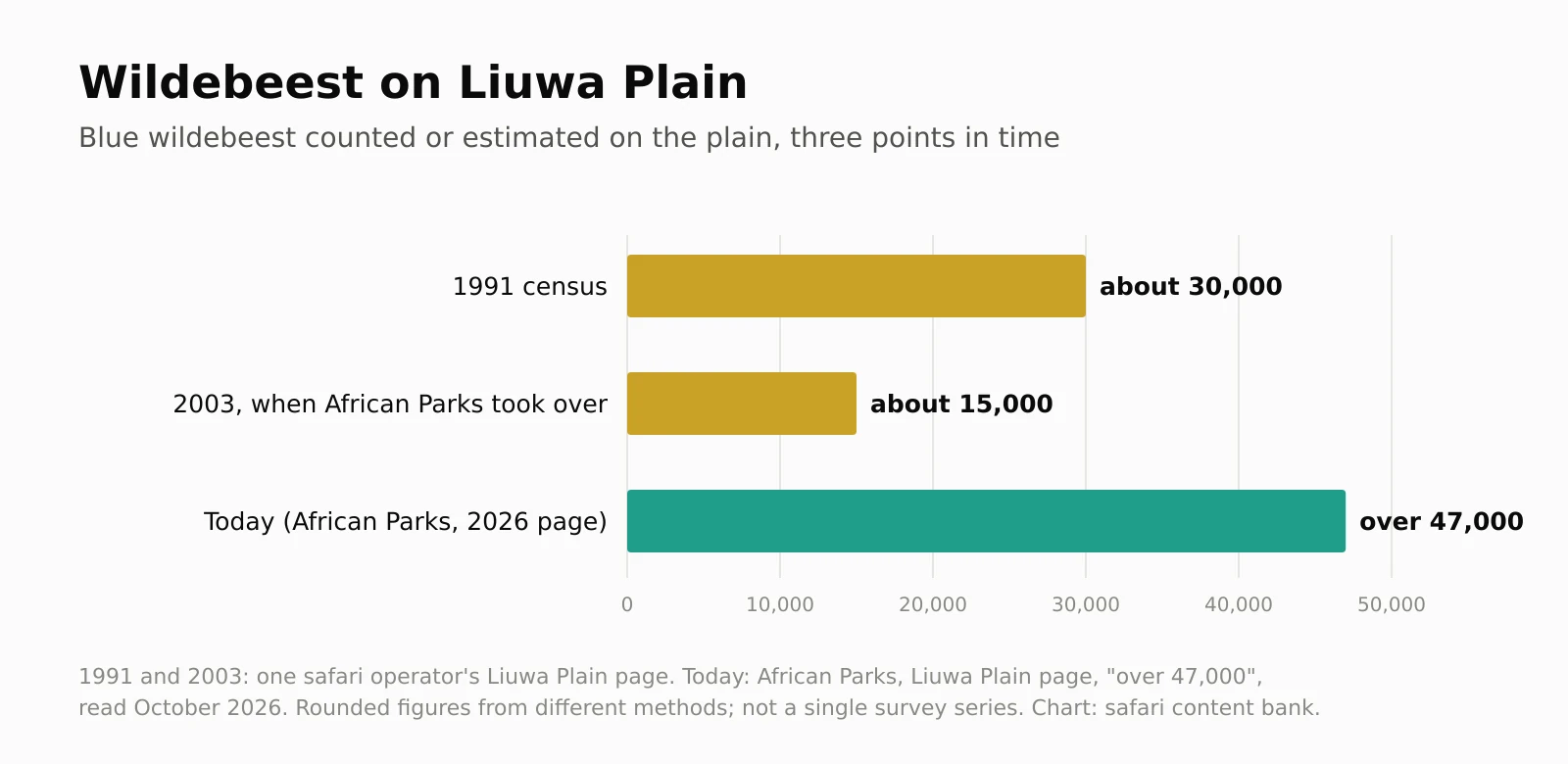 1991 and 2003: one safari operator’s Liuwa Plain page. Today: African Parks, read October 2026. Rounded figures from different methods.
What it costs: the African Parks fees
Liuwa charges its own African Parks tariff: US$40 per international adult a day, plus US$15 a day for a vehicle not registered in Zambia. The DNPW fee table on our Zambia safari cost page does not apply to Liuwa, which is run by African Parks.
| Item | International | Africa citizens and residents | Zambian citizens |
|---|---|---|---|
| Park fee, adult, per day | US$40 | US$20 | ZMW 30 |
| Park fee, child 7–12, per day | US$10 | US$7 | ZMW 10 |
| Children under 7 | Free | Free | Free |
| Vehicle entry, per day | US$15 (non-Zambian registered) | US$15 | ZMW 30 |
| Community scout in your own vehicle, per day | US$35 | US$25 | Shown as 15; currency unclear on the sheet |
| Vehicle recovery | Up to US$250 per incident |
Source: Liuwa Camp Rates 2025, African Parks (PDF), on African Parks’ Visit Liuwa site (file posted June 2024). The sheet labels citizen rates “ZMK”. Read 8 October 2026; no 2026/27 sheet had been published. Not the DNPW schedule.
Our sums: two international adults self-driving for three days pay US$255 in African Parks fees (2 × 3 × US$40, plus 3 × US$15 for the car), before campsite fees, which our sources do not hold.
Our sums: two international adults spending three nights at Liuwa Camp pay US$3,240 in camp rates (2 × 3 × US$540), plus the park fee, which the camp rate does not include.
Other published prices: one specialist operator’s 11-day fly-in Zambia itinerary that includes Liuwa costs from US$19,670 per person (2026). At the other end, our Zambia cost page lists a published group camping trip, “8 days Liuwa and Kafue US$1,870” (read 8 Oct 2026; inclusions not itemised).
Where to stay
Liuwa Camp is the only lodge with a published rate; King Lewanika Lodge and Sishekanu House publish none, and the five campsites are on a 2025 sheet we have not read. Book early: beds are few.
| Place | What it is | Rate | Source |
|---|---|---|---|
| Liuwa Camp | African Parks; 7 raised en-suite tents and 1 family unit, 18 beds; full board, two activities a day, Kalabo transfers | US$540 per person a night, international (2025); Africa residents US$300; Zambian citizens US$180; children 7–12 half. Park fee extra | Liuwa Camp Rates 2025 (PDF); Visit Liuwa, Liuwa Camp |
| King Lewanika Lodge | 6 open-fronted villas on the Munde Stream, opened 2017; guests transfer by helicopter from Kalabo | Not published. Our sources disagree on which company now sells it | Visit Liuwa; one safari operator |
| Sishekanu House | Independent guesthouse, 5 en-suite rooms, in the south-east corner | Not published | Sishekanu House |
| Campsites: Kwale, Katoyana, Mukalabumbu, Sibika, Sikale | 5 pitches each with reed shelters; flush toilets and hot showers at Kwale, Katoyana and Mukalabumbu; Sikale is wilderness with no facilities; 2 self-catering chalets at Kwale and Katoyana | On African Parks’ 2025 campsite sheet, which we have not read | Visit Liuwa, campsites |
Read 8 October 2026. Driving time from reception: Kwale 40 minutes, Katoyana 2 hours, Mukalabumbu 3–4 hours, Sikale 4.5–5 hours (Visit Liuwa).
Getting there: road, charter or helicopter
Liuwa is about 10 hours by road from Lusaka or 8 hours from Livingstone to Kalabo, and a high-clearance 4x4 is mandatory; the alternative is a charter flight to Kalabo (Visit Liuwa). Reception is 12 km from Kalabo.
| Way in | What it involves | Source |
|---|---|---|
| Self-drive | About 10 hours from Lusaka or 8 from Livingstone to Kalabo; high-clearance 4x4 mandatory. Water and firewood are sold only at reception | Visit Liuwa; African Parks’ 2025 rate sheet |
| Self-drive with a community scout | Book ahead; US$35 a day for international visitors | Visit Liuwa; Liuwa Camp Rates 2025 |
| Charter flight to Kalabo | Liuwa Camp’s rate includes the Kalabo transfer | Liuwa Camp Rates 2025 |
| Helicopter | King Lewanika Lodge guests transfer from Kalabo by helicopter | One safari operator’s Liuwa page |
Our sources hold no checked scheduled-flight timetable to Kalabo or Mongu. Visa rules: Zambia visa; British and US passports need no visa (UK FCDO).
Liuwa Camp or self-drive: which way to see it
Self-drive and camping is the cheapest way in; Liuwa Camp is the simplest; King Lewanika suits travellers who want a helicopter transfer and a villa and will ask for a quote.
| If you want… | Choose | Why | Watch out for |
|---|---|---|---|
| The lowest cost | Self-drive and camp | Park fee US$40 a day, car US$15 a day | Carry all fuel, water and food; recovery up to US$250 an incident |
| No driving and a known price | Liuwa Camp | US$540 a night full board with two activities and Kalabo transfers (2025) | Park fee extra; only 18 beds |
| Top-end comfort | King Lewanika Lodge | Villas on the Munde Stream; helicopter from Kalabo | No published rate |
| A guide without a lodge | Self-drive with a community scout | US$35 a day; book ahead | Still needs a 4x4 and full self-sufficiency |
Combining Liuwa with other November trips
Liuwa pairs with South Luangwa, Kasanka or Victoria Falls in November, but check which camps are still open: several Zambian bush camps close in mid-November.
- Kasanka’s fruit bats roost from late October to mid-December, peaking in mid-November, so both events fit one trip; Kasanka is in central Zambia, reached by road from Lusaka, while Liuwa is in the far west. See Kasanka bat migration.
- South Luangwa: Chinzombo opens all year and Flatdogs Camp until 15 January, but Time + Tide’s bush camps close on 15 November (Zambia safari questions).
- Kafue: the Busanga Plains camps are open only from June to the end of October, so a Liuwa trip in November misses them (safari in December).
- Victoria Falls: Livingstone is about 8 hours by road from Kalabo (Visit Liuwa), but the Zambian side of the Falls can run dry in October and November.
- Botswana in the same months: the zebra reach Nxai Pan and the Makgadikgadi from December; see Botswana zebra migration.
Common mistakes about the Liuwa migration
| What you’ll often read | What is correct |
|---|---|
| “Liuwa uses the DNPW park fee table” | African Parks sets its own tariff: US$40 per international adult a day plus US$15 per foreign vehicle (2025). |
| “Liuwa’s migration is in the dry season, like the Serengeti’s” | The herds mass with the first rains, late October to December. |
| “Go in July to September” | The herds are drifting north or only starting back south; the plain is dry and hazy. |
| “You can visit any time” | Camps close January to April, when the plain floods. |
| “A normal car will do” | A high-clearance 4x4 is mandatory (Visit Liuwa). |
| “Lions are the top predator” | Spotted hyenas are; the lions were rebuilt from a single lioness. |
Frequently asked questions
When is the Liuwa wildebeest migration? From late October to December, when the herds mass on the southern and central plains and calve with the first rains (one safari operator’s guide). Early November is the time that operator singles out. Camps close from January to April.
How many wildebeest are on Liuwa Plain? “Over 47,000”, according to African Parks. One safari operator puts the 1991 census at about 30,000 and the 2003 figure at about 15,000, so the herd has more than recovered under African Parks.
How much is the Liuwa park fee? US$40 per international adult a day, plus US$15 a day for a vehicle not registered in Zambia, on African Parks’ 2025 tariff, the latest published. Children aged 7–12 pay US$10 and under-7s are free. This is not the DNPW fee table.
Can I self-drive Liuwa Plain? Yes, with a high-clearance 4x4, which is mandatory, and full self-sufficiency: water and firewood are sold only at reception. A community scout can ride in your vehicle for US$35 a day if you book ahead (African Parks, 2025).
Where do you stay at Liuwa? Liuwa Camp (US$540 per person a night, full board, 2025), King Lewanika Lodge (rate not published), Sishekanu House (rate not published) or one of five campsites. Liuwa Camp’s rate excludes the park fee.
How do you get to Liuwa Plain? By road, about 10 hours from Lusaka or 8 from Livingstone to Kalabo, then 12 km to reception (Visit Liuwa). Or by charter flight to Kalabo; Liuwa Camp includes the transfer, and King Lewanika guests go on by helicopter.
Is Liuwa a real migration? African Parks calls it Africa’s second-largest wildebeest migration. One safari operator calls it a “gathering”, because the herds move around the plain rather than travel between countries, as they do between the Serengeti and the Masai Mara (great migration month by month).
Do I need a visa for Zambia? Not with a British or US passport (UK FCDO); British tourists may stay 90 days in any 12 months. Other nationalities: see Zambia visa.
Sources
- African Parks, Liuwa Plain: wildebeest numbers, management since 2003, lions, cheetah, Lichtenstein’s hartebeest; read October 2026
- Liuwa Camp Rates 2025, African Parks (PDF): park, vehicle, scout and recovery fees and Liuwa Camp rates; file posted June 2024, read 8 October 2026; the latest sheet published
- Visit Liuwa, day visitors, Liuwa Camp and campsites: size, access, gate, camps and drive times; read 8 October 2026
- Sishekanu House: rooms; read October 2026
- Science: Zambian Carnivore Programme, 2023 annual report (PDF); M’soka et al. 2016; Martens et al. 2025
- One safari operator’s Liuwa Plain page and month-by-month guide, and its 2026 Zambia itineraries (read October 2026; names and links kept in our editor notes)
- Camp seasons and the published group trip: as on our Zambia safari questions, Zambia safari cost and safari in December pages
- UK FCDO, Zambia entry requirements, as on our Zambia visa page
More on Zambia: Zambia, Zambia safari questions, Zambia safari cost and Kasanka bat migration.
Facts checked 8 October 2026. We will update this page when African Parks publishes a Liuwa rate sheet after 2025.