 Experience

Last verified · Next check due
On this page
- Botswana’s zebra migration at a glance (2026–27)
- When the zebra migrate, month by month
- The two routes: Chobe–Nxai Pan and Okavango–Makgadikgadi
- Where to stay: Nxai Pan and Makgadikgadi camps and their own rates
- Getting there: Maun, fly-in or self-drive
- Park fees for Nxai Pan and Makgadikgadi
- Botswana’s zebra migration or the East African wildebeest migration?
- What a zebra-migration trip costs (our sums)
- Common mistakes about Botswana’s zebra migration
- Frequently asked questions
- Sources
Short answer: Two zebra herds leave their dry-season water for the rain-fed grass of Botswana’s pans: more than 20,000 from the Chobe floodplains to Nxai Pan, and about 15,000 from the Okavango to the Makgadikgadi (Africa Geographic). They are on the pans from December to March, massing in March. Camps there publish US$625–2,095 per person a night at green-season rates (2024–2026 rate cards). The last published park fee is P190 per non-resident adult per day (DWNP, 1 April 2022).
Key facts
- There are two zebra migrations, not one. The Chobe herd moves between the Chobe and Zambezi floodplains and Nxai Pan; the Okavango herd moves between the south-eastern Okavango Delta and the Makgadikgadi grasslands (Africa Geographic, 20 November 2025; Makgadikgadi).
- The Chobe route was measured with satellite collars. Eight collared zebras crossed the Chobe River in December 2012, moved south and spent a mean of 10 weeks at Nxai Pan; the round trip is 500 km in a straight line (Naidoo et al., Oryx, 2016), and the zebras actually walked a mean of 955 km (the authors’ reply, Oryx).
- The Okavango route came back when a fence came down. A veterinary cordon fence cut it from 1968 to 2004; the zebras re-established the route within four years, and 55% of 11 collared animals made the 588 km round trip (Bartlam-Brooks, Bonyongo and Harris, Oryx, 2011).
- It happens in the green season. Botswana’s rains fall from about November to March (two camp operators’ seasonal guides), the months when most Botswana camps charge their lowest rates (green-season safari).
- “Africa’s longest” is contested. The 2016 paper called the Chobe migration the longest recorded large-mammal migration in Africa; Africa Geographic now calls it the second-longest, after the Great Nile Migration.
Botswana’s zebra migration at a glance (2026–27)
Go between December and March, stay at Nxai Pan or on the Makgadikgadi, and expect herds of tens of thousands, not millions, with very few other vehicles.
| Chobe → Nxai Pan | Okavango → Makgadikgadi | Source | |
|---|---|---|---|
| Zebra | More than 20,000 | About 15,000; only about 55% migrate | Africa Geographic |
| Dry-season range | Chobe and Zambezi floodplains, on the Namibia–Botswana border, June to early November | South-eastern Okavango Delta, until November or December | Africa Geographic; Naidoo et al. 2016 |
| Wet-season range | Nxai Pan National Park, December–February | Makgadikgadi grasslands, December or January to February or March | Africa Geographic |
| Distance | 500 km round trip in a straight line; 955 km walked (mean of collared zebras); “over 1,000 km each year” | 588 km round trip (2011 study); “500 km return” (Africa Geographic) | Oryx 2016; Oryx 2011; Africa Geographic |
| Journey south | Early December, two to three weeks | November or December | Africa Geographic |
| Return | March to May; some travel over 800 km | Around March, after the herds mass | Africa Geographic |
| Park and fee | Nxai Pan NP: P190 per non-resident adult a day (last published, 1 April 2022) | Makgadikgadi Pans NP: P190 (same) | Botswana park fees |
| Camps | Nxai Pan Camp, inside the park: US$800 in every season (Kwando 2024) | Boteti River and pan-edge camps: US$625–2,095 at green rates | Own rate cards |
| Nearest airport | Maun | Maun | Bush flights |
Read 10 October 2026; Oryx abstracts re-read 24 October 2026. Rates per person sharing per night, park fees included on each rate card; levies extra (US$20 Kwando, US$60 Natural Selection). Park fee: DWNP schedule of 1 April 2022 via Tourism Update, the last published; confirm it with DWNP or your operator.
When the zebra migrate, month by month
The herds reach the pans in December, graze them through January and February, mass in March and head back from March to May. The table is a typical year from Africa Geographic and the collar studies, not a forecast: the zebra follow the rain and the grass.
| Month | Chobe herd | Okavango herd | On the pans | Camp Kalahari (Natural Selection 2026) | Verdict |
|---|---|---|---|---|---|
| June–October | On the Chobe and Zambezi floodplains | In the Okavango Delta | Dry crust; quad bikes from about May; Boteti River game best July–October | US$1,085–1,325; Peak 1 July–31 August | No migration on the pans; zebra are on the Chobe riverfront |
| November | Floodplains until early November | Still in the Delta; some start south | Rains begin; quad bikes until about November | US$995 from 1 November | Too early |
| December | South from early December, two to three weeks | Arriving from December or January | Herds arrive; San Camp closed | US$995 to 19 December, US$1,125 from 20 December | Arrivals; holiday rates from 20 December |
| January | At Nxai Pan | On the Makgadikgadi | Zebra on both pans; Leroo La Tau closed 15 January–1 February (2024 card) | US$795 Green from 10 January | Good |
| February | At Nxai Pan (mean stay 10 weeks for collared zebras) | On the Makgadikgadi | Both herds on the pans | US$795 | Both herds on the pans |
| March | Return north begins | Massing, then turning back | “March being when zebras are massing” | US$795 to 31 March | The massing; last green-rate month |
| April–May | Heading north, March to May | Back toward the Delta | Nxai Pan’s herds can stay into April; San Camp opens 1 April | US$995 (April), US$1,085 (May) | Edge of the window |
Herds: Africa Geographic, 20 November 2025; Naidoo et al., Oryx 2016; Wikipedia, Nxai Pan (April). Quad bikes and the Boteti: one safari operator’s salt pans page. Rates: Natural Selection 2026 (PDF), per person sharing, 1–5 nights, plus US$60 a night; its 2027 card is not yet in our sources, so January–March 2027 rates may differ. Read 10 October 2026.
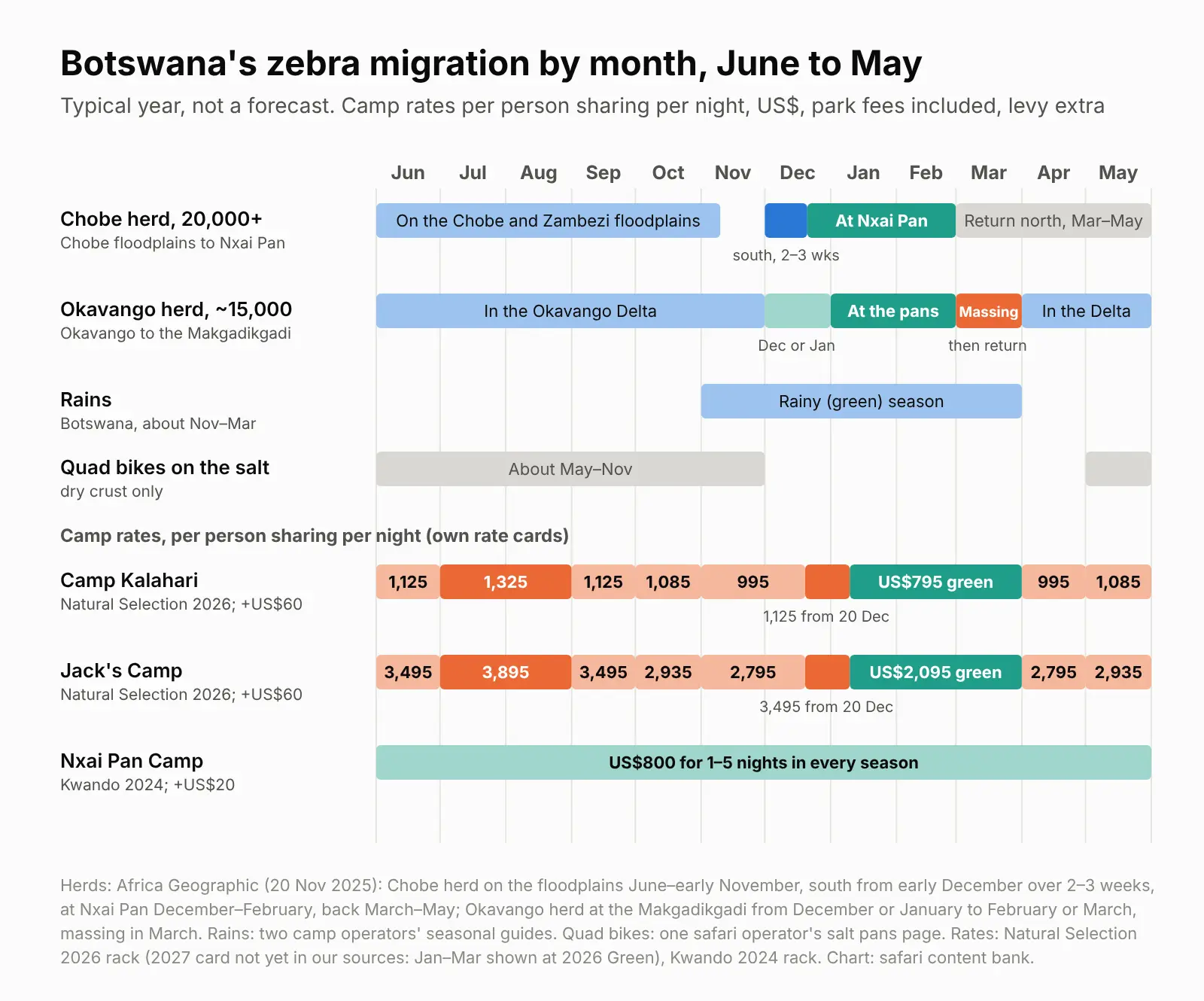 Typical year, not a forecast. Sources: Africa Geographic; Naidoo et al. 2016; two camp operators’ seasonal guides; one safari operator’s salt pans page; Natural Selection 2026 and Kwando 2024 rate cards. Chart: safari content bank.
- March is the month to aim for if you can choose only one: the Okavango herd is massing before it turns back (Africa Geographic), Natural Selection’s green rates run to 31 March, and early arrivals at Nxai Pan may already be heading north. Pick February if Nxai Pan is your main stop.
- The migration months and the quad-bike months are opposites. Quad bikes run from about May to November, when “the salt flats are firm and dry”; the same operator warns that “pan surfaces are lethal when wet” (one safari operator’s salt pans page).
- The rest of the year the Chobe herd is on the riverfront. More than 20,000 zebra spend June to early November on the Chobe and Zambezi floodplains, which suits a dry-season Chobe trip.
- Month pages: safari in December, February and March.
The two routes: Chobe–Nxai Pan and Okavango–Makgadikgadi
The two herds are different populations on different routes; the commonest mistake in Botswana zebra copy is to treat them as one.
Chobe floodplains to Nxai Pan
- Where it starts: the Chobe River floodplains on the Namibia–Botswana border, the herd’s dry-season range (Naidoo et al., Oryx, 2016). Africa Geographic calls them the Chobe and Zambezi floodplains.
- The route: “due south” to Nxai Pan National Park, about 250 km in a straight line each way; the collared zebras came back “less directly” (Oryx 2016). Some travel almost in a straight line, others stop at the Seloko Plain (Africa Geographic).
- How it was found: eight adult female zebras were fitted with satellite GPS collars; the migration was confirmed in 2012 and repeated in 2013 (Oryx 2016).
- The Linyanti: Botswana Tourism says the permanent waters of the Kwando and Linyanti rivers are “essential migration points” for wildlife, zebra among them, in the dry season (Botswana Tourism). Our sources do not put the collared Nxai Pan herd on the Linyanti. Zebra also gather on the Mababe Depression near Savuti when it holds water (Botswana Tourism), a separate movement.
Okavango Delta to the Makgadikgadi
- Where it goes: from the south-eastern edge of the Delta to the Makgadikgadi grasslands, a 588 km round trip (Bartlam-Brooks et al., Oryx, 2011). Africa Geographic gives about 15,000 zebra and a 500 km return route.
- Not every zebra goes: about 55% migrate (Africa Geographic); in the 2011 study, 55% of the 11 zebras collared in the south-eastern Delta made the journey.
- The fence story: a veterinary cordon fence blocked the route from 1968 to 2004, and the zebras re-established it within four years of its removal (Oryx 2011). Africa Geographic dates the fences to the late 1960s and their removal to the mid-2000s.
- The Boteti River is “one of the only permanent water sources” on the corridor (Africa Geographic). Our sources give no month for zebra at the river itself; Boteti River game is best from July to October (Makgadikgadi).
Where to stay: Nxai Pan and Makgadikgadi camps and their own rates
Stay inside Nxai Pan for the Chobe herd and the shortest drives to it; stay on the Boteti River or the pan edge for the Okavango herd. Every rate below is from the camp group’s own rate card and includes park fees.
| Camp | Where | Zebra-season rate, per person sharing | Rest of the year | Added | Source |
|---|---|---|---|---|---|
| Nxai Pan Camp (Kwando) | Inside Nxai Pan NP; 9 tents | US$800 for every stay, 15 November–31 March | US$800 for 1–5 nights; US$760 for 6–7 and US$720 for 8+ nights, April to mid-November | US$20 levy | Kwando 2024 (PDF) |
| Meno a Kwena (Natural Selection) | Boteti River | US$625 (Green, 10 Jan–31 Mar); US$875 (1–19 Dec); US$1,080 (20 Dec–9 Jan) | Up to US$1,275 (Peak, July–August) | US$60 fee | Natural Selection 2026 (PDF) |
| Leroo La Tau (Desert & Delta) | Boteti River, Makgadikgadi Pans NP frontage | US$645 (Green, January–March and December, 1–4 nights); closed 15 Jan–1 Feb | US$895 Shoulder; US$1,160 Peak (June–October) | Levies included | Desert & Delta 2024 (PDF) |
| Camp Kalahari (Natural Selection) | Makgadikgadi pan edge | US$795 (Green); US$995 (1–19 Dec); US$1,125 (20 Dec–9 Jan) | Up to US$1,325 | US$60 fee | Natural Selection 2026 |
| Jack’s Camp (Natural Selection) | Makgadikgadi pan edge | US$2,095 (Green); US$2,795 (1–19 Dec); US$3,495 (20 Dec–9 Jan) | Up to US$3,895 | US$60 fee | Natural Selection 2026 |
| San Camp (Natural Selection) | Makgadikgadi pan edge | Closed (open 1 April–15 October) | US$1,995–2,595 | US$60 fee | Natural Selection 2026 |
| South Camp (Xomae Group), self-drive | Nxai Pan NP; 10 sites | BWP 400 per person a night, camping only | Same | P10 levy; park fee | Campsite sheet, undated (see below) |
| Baines’ Baobabs (Xomae Group), self-drive | Nxai Pan NP, Kudiakam Pan; 3 sites | BWP 700 | Same | P10 levy; park fee | Campsite sheet, undated |
Rates per person sharing per night, read 10 October 2026: Natural Selection 2026 rack card (issued 29 July 2025); Kwando 2024 and Desert & Delta 2024 cards, each group’s latest in our sources. Campsites: an operator’s published campsite sheet, undated, the last published rates; confirm with the concessionaire.
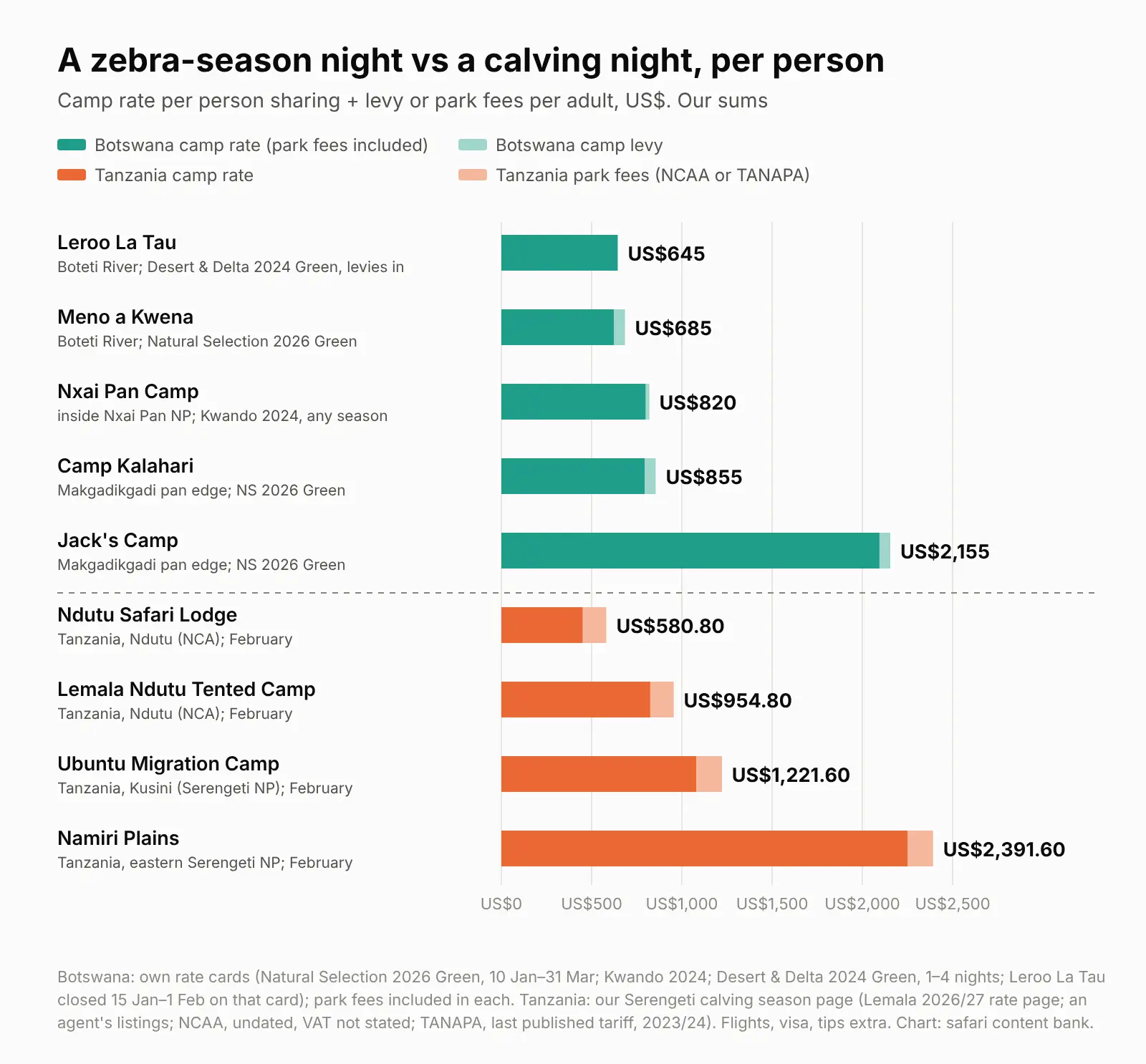 Our sums. Botswana: the rate cards above, park fees included. Tanzania: our Serengeti calving season page (Lemala 2026/27 rate page; an agent’s listings; NCAA, undated, VAT not stated; TANAPA, last published tariff, 2023/24). Chart: safari content bank.
- Nxai Pan Camp is the only permanent camp inside Nxai Pan National Park (one safari operator’s camp page), and Kwando prices it the same in every season, the zebra months included. An agent’s listing shows US$900 for 16 April 2026–15 April 2027; that is not the camp’s own sheet, so ask Kwando for its current rate.
- Ask a pan-edge camp how far the herds are that week. The zebra graze the Makgadikgadi grasslands; our sources do not say how far Camp Kalahari or Jack’s Camp drive to reach them on a given day.
- Green rates are not the cheapest at Christmas. Natural Selection charges High rates from 20 December to 9 January (Camp Kalahari US$1,125, Jack’s US$3,495), then Green from 10 January.
- Natural Selection’s camps take all ages: under-6s stay free and 6–18s pay half; families with children aged 9 or younger must book a private vehicle at US$725–935 per vehicle a night (Makgadikgadi).
- No night drives in the national parks: see night drives and walking.
Getting there: Maun, fly-in or self-drive
Fly to Maun, then take a light aircraft to Nxai Pan or a pan-edge airstrip, or drive the A3 tar road towards Nata and turn off for the parks. Kwando’s 2024 card prices the Maun–Nxai Pan seat at US$220 one way.
| Fly-in | Self-drive | |
|---|---|---|
| From Maun | Light aircraft, 30–60 minutes by charter (one safari operator’s salt pans page) | About 250 km, 3–4 hours to the pans (same source) |
| Airstrips or road | Mack Air flies to the Nxai Pan and Tsigaro (Jack’s and San Camp) airstrips (Mack Air) | The A3 runs 300 km from Maun to Nata via Gweta (Wikipedia, A3); the Makgadikgadi Pans to Nxai Pan is 50–80 km, 1.5–2.5 hours (a published travel-times table) |
| Cost | Moremi Air Maun → Nxai Pan US$220 one way, plus US$20–25 departure tax per leg from Maun (Kwando 2024) | 4x4 from Maun operators about US$170–300 a day (Botswana self-drive) |
| Park fee | Included in the camp rate | P190 per non-resident adult per day (last published, 1 April 2022), paid to DWNP after your campsite |
| In the rains | Light aircraft do not fly at night | One safari operator warns that wet-season roads can flood; the pan surface is “lethal when wet” |
| Transfer option | Kwando collects guests at the Nxai Pan gate for US$100 per person each way, minimum two (Kwando 2024) | Leave your vehicle at the gate and take that transfer |
Sources as linked; read 9–10 October 2026. Fares: Kwando 2024 rate card, the latest in our sources.
- Maun’s international links in our sources: Ethiopian Airlines from Addis Ababa, Proflight Zambia from Livingstone and Lusaka, and FlyNamibia from Windhoek four days a week until 30 November 2026; no airline flies non-stop from Europe (Botswana bush flights).
- Self-drivers need a high-clearance 4x4. Forum regulars say Baines’ Baobabs needs strong 4x4 skills (TripAdvisor forum).
- Buy meat after Maun, not before. Raw meat may not be taken from Maun towards Nxai Pan, the Makgadikgadi or Nata (Tracks4Africa). Fill up with fuel in Maun: SKL Camps lists no fuel or phone signal at its sites, Kumaga included (SKL Camps).
- Book campsites first, then pay DWNP. Park fees can only be paid once every campsite is settled; the whole booking order is on Botswana self-drive.
Park fees for Nxai Pan and Makgadikgadi
Both parks charge P190 per non-resident adult per day in the last published DWNP schedule (1 April 2022, via Tourism Update); Chobe, where the Chobe herd spends the dry season, charges P270. In February 2026 the government news agency BOPA called the existing non-resident fee P380; a P500 rise was announced, then reported postponed. Confirm the fee with DWNP or your operator.
| Park (DWNP) | Non-resident adult, per day | SADC residents | Botswana citizens and residents |
|---|---|---|---|
| Nxai Pan National Park | P190 | P145 | P20 |
| Makgadikgadi Pans National Park | P190 | P145 | P20 |
| Chobe National Park (dry-season range of the Chobe herd) | P270 | P205 | P30 |
Source: Tourism Update, 23 Feb 2022 (DWNP schedule effective 1 April 2022, the last published). Checked 10 October 2026.
| Fee | Amount | In force from | Source |
|---|---|---|---|
| Other DWNP parks and reserves (Central Kalahari Game Reserve, Khutse, Nxai Pan, Makgadikgadi Pans), non-resident adult, per person per day | BWP 190 (SADC residents BWP 145; Botswana citizens and residents BWP 20) | Last published DWNP schedule, 1 April 2022 (via Tourism Update). In Feb 2026 the government news agency BOPA called the existing non-resident fee P380; a P500 rise was announced, then reported postponed. No official current tariff: confirm with DWNP or your operator | Tourism Update, 23 Feb 2022 (DWNP fee schedule) |
| Chobe National Park and Moremi Game Reserve (DWNP), non-resident adult, per person per day | BWP 270 (SADC residents BWP 205; Botswana citizens and residents BWP 30) | Last published DWNP schedule, 1 April 2022 (via Tourism Update). In Feb 2026 the government news agency BOPA called the existing non-resident fee P380; a P500 rise was announced, then reported postponed. No official current tariff: confirm with DWNP or your operator | Tourism Update, 23 Feb 2022 (DWNP fee schedule) |
| National Road Safety Fund levy, foreign-registered vehicle entering Botswana | BWP 40, valid to 31 December of the year paid | Last published on the BURS motor-vehicle clearance page (undated) | Botswana Unified Revenue Service (BURS) |
| Serengeti and Nyerere National Parks, non-East African adult, entry per day, 16 May–14 Mar | USD 70 + 18% VAT = USD 82.60 | 1 Jul 2023 (2023/24 tariff, last published) | TANAPA Tariffs 2023/24 |
| Serengeti and Nyerere, concession fee per person per night inside the park | Jul–Sep USD 60 + VAT = USD 70.80; Oct–Jun USD 50 + VAT = USD 59 | 1 Jul 2023 (2023/24 tariff, last published) | TANAPA Tariffs 2023/24 |
| Ngorongoro Conservation Area, non-East African adult, entry per 24 h (single entry) | USD 70.80 (NCAA's page does not say whether VAT is included) | Undated official page, read 9 Oct 2026 | NCAA |
| Ngorongoro concession fee, rim and Ndutu lodges, per person per night | USD 59 (NCAA's page does not say whether VAT is included) | Undated official page, read 9 Oct 2026 | NCAA |
| Maasai Mara National Reserve, non-resident adult, per day (12-hour ticket, 06:00–18:00), 1 Jul–31 Dec | USD 200 | Since 1 Jul 2024; Narok County FY2025/26 schedule, the last published (no 2026/27 schedule as of 9 Oct 2026) | Narok County fee schedule FY2025/26 |
- Camp guests pay nothing extra at the gate: Natural Selection, Kwando (at Nxai Pan) and Desert & Delta include park fees in their rates (Botswana safari cost).
- Children under 8 enter free and older children pay half; sources give the half-price band as 8–15, 8–17 or 8–18, so check with your operator.
- DWNP also charges a vehicle fee per day, arrival and departure days included; no official source gives the current amount. A foreign-registered car also pays BWP 40 at the border (BURS).
- Self-drive arithmetic: two non-resident adults, three days at Nxai Pan and two nights at South Camp, pay P2,780 in park, camping and levy fees, plus the vehicle fee (our arithmetic, as on our Makgadikgadi page). Every fee and rule: Botswana park fees.
Botswana’s zebra migration or the East African wildebeest migration?
Choose Botswana for a quiet green-season trip with zebra herds in the tens of thousands; choose the Serengeti and Masai Mara for wildebeest in the hundreds of thousands to over a million, and for river crossings. In the January–March window both run at once, so you cannot see both on one short trip.
| Botswana zebra migration | East African wildebeest migration | |
|---|---|---|
| Animals | Plains zebra: more than 20,000 (Chobe herd) and about 15,000 (Okavango herd) | 1,366,109 wildebeest (TAWIRI aerial count, end of March 2023, ± 231,741 SE), with about 300,000 zebra (UNESCO) |
| When | On the pans December–March; massing in March | Calving at Ndutu late January–mid-March; Mara River crossings July–October |
| Countries | Botswana and Namibia: the Chobe herd’s dry-season range is on the border | Tanzania and Kenya |
| River crossings | The Chobe herd crosses the Chobe River in December (Oryx 2016); no source describes it as a viewing event | Mara River crossings, “difficult to predict” (Mara Conservancy) |
| Season | Rainy season; Botswana’s lowest camp rates | Calving: wet season at peak rates; crossings: dry season, peak rates |
| Park fees per adult | P190 a day, last published (2022); included in camp rates | Serengeti US$141.60 a night to 14 March (last published tariff, 2023/24); Mara reserve US$200 a day July–December |
| A night with fees, per person (our sums) | US$645–2,155 at green rates | February calving US$580.80–2,391.60; Ubuntu at Kusini US$1,221.60 |
| Beds near the herds | Nxai Pan Camp, 9 tents; South Camp 10 sites; Baines’ Baobabs 3 sites | Many camps; “15–20 vehicles at a single sighting” at Ndutu (traveller report, March 2026) |
Sources: Africa Geographic; Naidoo et al. 2016; TAWIRI 2023 census (PDF); UNESCO, Serengeti National Park; Great Migration month by month; Serengeti calving season; fees: DWNP 2022 via Tourism Update (last published); TANAPA, last published tariff, 2023/24; Narok County FY2025/26 schedule, the last published. Read 9–10 October 2026.
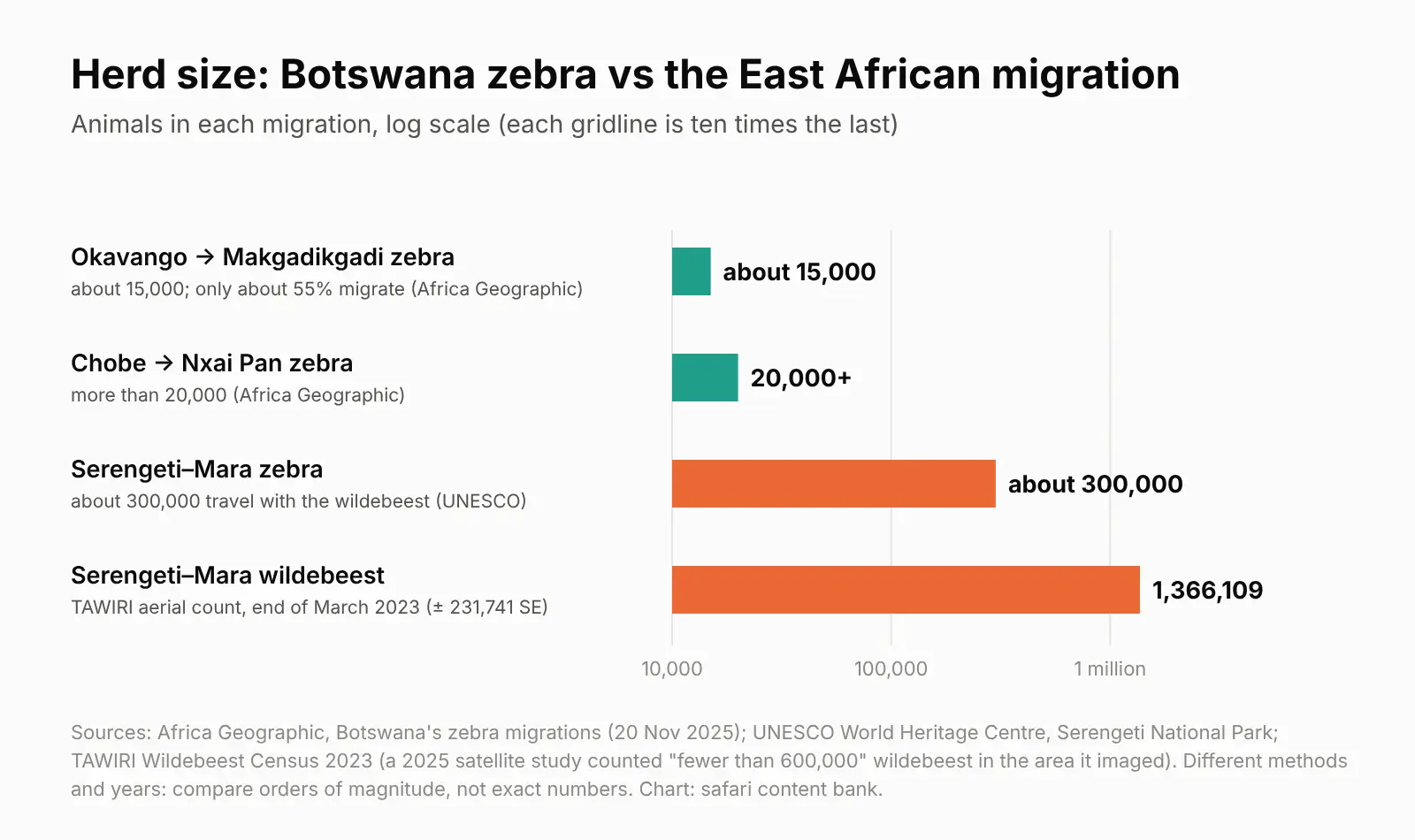 Different methods and years: compare orders of magnitude, not exact numbers. A 2025 satellite study counted “fewer than 600,000” wildebeest in the area it imaged. Chart: safari content bank.
- Botswana’s migration is not in the Delta. The wildebeest herds are in the Serengeti and the Masai Mara; Botswana’s migration is zebra, on the Kalahari pans (Okavango Delta vs Serengeti).
- A Botswana green-season trip can add the Delta. The zebra months fall in the Okavango Delta’s low season, when Delta water is low and camps charge their lowest rates (Botswana).
- The whole wildebeest year is on Great Migration month by month; the February calving costs are on Serengeti calving season.
What a zebra-migration trip costs (our sums)
Three nights cost US$1,935–6,465 per person at green rates in the pan and Boteti camps, and US$2,925 at Nxai Pan Camp with return flights from Maun; two self-drivers pay P2,780 in fees for three days at Nxai Pan.
| Per person, two sharing, 3 nights | Arithmetic | Total |
|---|---|---|
| Leroo La Tau, Green (2024), by road | 3 × US$645, levies included | US$1,935 |
| Meno a Kwena, Green (2026) | 3 × (US$625 + 60) | US$2,055 |
| Camp Kalahari, Green (2026) | 3 × (US$795 + 60) | US$2,565 |
| Camp Kalahari, 20 December–9 January (2026) | 3 × (US$1,125 + 60) | US$3,555 |
| Nxai Pan Camp, Moremi Air from and to Maun (2024) | 3 × (US$800 + 20) + 2 × US$220 + US$25 departure tax | US$2,925, before other air taxes |
| Jack’s Camp, Green (2026) | 3 × (US$2,095 + 60) | US$6,465 |
| Self-drive, 2 adults, 3 days, 2 nights at South Camp | Park 2 × 3 × P190; camping 2 × 2 × BWP 400; levy 2 × 2 × P10 | P2,780 for two, plus vehicle fee and a 4x4 at about US$170–300 a day |
Our sums. Rates: Natural Selection 2026, Kwando 2024 and Desert & Delta 2024 rate cards, park fees included; Moremi Air fare and Maun departure tax from the Kwando 2024 card. Self-drive: the last published DWNP fee (1 April 2022) and an operator’s campsite sheet (undated). Not included: flights to the Natural Selection and Desert & Delta camps (no fare in our sources), international flights, tips. Read 10 October 2026.
- The same three nights in February at Ubuntu Migration Camp in the Serengeti cost US$3,664.80 with park fees, game drives included (our sums on Serengeti calving season), against US$2,565 at Camp Kalahari.
- Botswana’s green season is the cheap season; the Serengeti’s calving season is not. Camp Kalahari is 40% below its Peak rate in January–March (US$795 against US$1,325, our sum), while February calving camps charge their peak rates.
- Packages: one operator publishes a 6-night mobile camping trip through the Central Kalahari and Makgadikgadi from US$1,590 (basis not stated); the full price ladder is on Botswana safari cost. Pairing the pans with the Central Kalahari, whose best game also runs in the rains, is covered on our Botswana hub.
Common mistakes about Botswana’s zebra migration
| What you’ll often read | What is correct |
|---|---|
| “Botswana’s migration happens in the Okavango Delta” | The Chobe herd goes from the Chobe floodplains to Nxai Pan; only the second herd leaves from the Delta, for the Makgadikgadi. |
| “It is one migration” | Two herds, two routes: more than 20,000 Chobe → Nxai Pan; about 15,000 Okavango → Makgadikgadi (Africa Geographic). |
| “Africa’s longest land migration”, stated flatly | The 2016 Oryx paper called it the longest recorded large-mammal migration in Africa; Africa Geographic now calls it the second-longest. |
| “500 km” vs “1,000 km” | Both: 500 km is the straight-line round trip; collared zebras walked a mean of 955 km (Oryx). |
| “All the zebra migrate” | About 55% of the Okavango herd go (Africa Geographic); 55% of 11 collared zebras in the 2011 study. |
| “Go in the dry season, like the rest of Botswana” | The zebra are on the pans December to March; from June they are back on the Chobe floodplains and in the Delta. |
| “Quad bike the pans and see the zebra on the same trip” | Quad bikes run from about May to November, on the dry crust; the zebra come in the rains. |
| “The park fee is P500 from April 2026” | Announced, then reported postponed; the last published fee is P190 at Nxai Pan and the Makgadikgadi. |
Frequently asked questions
When is the best time to see Botswana’s zebra migration? From December to March, when the herds are on Nxai Pan and the Makgadikgadi. February has both herds on the pans; March is when the Okavango herd masses before turning back (Africa Geographic), and the last month of Natural Selection’s green rates.
Where does the zebra migration go? Two herds move. More than 20,000 zebra go from the Chobe and Zambezi floodplains to Nxai Pan National Park, about 250 km in a straight line each way; about 15,000 go from the south-eastern Okavango Delta to the Makgadikgadi grasslands (Africa Geographic; Oryx 2016 and 2011).
Is it the longest migration in Africa? It is the longest zebra migration on record. The 2016 Oryx paper called it the longest recorded large-mammal migration in Africa; Africa Geographic now ranks it second, after the Great Nile Migration in South Sudan.
Where should I stay to see it? Nxai Pan Camp, the only permanent camp inside Nxai Pan National Park, for the Chobe herd (US$800 a night in every season, Kwando 2024). For the Okavango herd, the Boteti River camps (Meno a Kwena US$625, Leroo La Tau US$645 at green rates) or the pan-edge camps (Camp Kalahari US$795, Jack’s Camp US$2,095).
How do I get to Nxai Pan? Fly from Maun (Moremi Air US$220 one way, plus departure tax, Kwando 2024) or drive the A3 tar road from Maun towards Nata in a high-clearance 4x4; the pans are about 250 km and 3–4 hours from Maun. Kwando collects guests at the Nxai Pan gate for US$100 per person each way.
How much are the park fees? The last published DWNP schedule (1 April 2022) charges non-residents P190 per person per day at Nxai Pan and the Makgadikgadi. In February 2026 the government news agency called the existing fee P380; a P500 rise was reported postponed, so confirm with DWNP or your operator. Camp rates include park fees.
Is it as impressive as the Serengeti migration? It is smaller: tens of thousands of zebra against TAWIRI’s count of 1,366,109 wildebeest in 2023. It is also quieter and cheaper in the green season, with no river crossings to wait for, and it falls in the Okavango Delta’s low season, so the two combine at low-season rates.
Can I self-drive to see the zebra migration? Yes, in a high-clearance 4x4 from Maun, camping at South Camp (BWP 400) or Baines’ Baobabs (BWP 700) inside Nxai Pan. Book the campsite first, then pay DWNP; wet-season roads can flood, and forum regulars say Baines’ Baobabs needs strong 4x4 skills.
Sources
- Zebra research: Naidoo, Chase, Beytell, Du Preez, Landen, Stuart-Hill and Taylor, A newly discovered wildlife migration in Namibia and Botswana is the longest in Africa, Oryx 50(1), 2016 (first published online 2014); the authors’ reply to Schapira et al. (PDF), Oryx, 2016; Bartlam-Brooks, Bonyongo and Harris, Will reconnecting ecosystems allow long-distance mammal migrations to resume?, Oryx, 2011; abstracts re-read 24 October 2026
- Herds and timing: Africa Geographic, Botswana’s zebra migrations, 20 November 2025, read 10 October 2026; Wikipedia, Nxai Pan; Botswana Tourism, Savuti and Linyanti; two camp operators’ seasonal guides and one safari operator’s salt pans and camp pages (names and links in our editor notes)
- Rates: Natural Selection 2026 (PDF); Kwando 2024 (PDF); Desert & Delta 2024 (PDF); an operator’s campsite sheet (undated) and an agent’s listing (names in our editor notes); read 10 October 2026
- Fees: Tourism Update, 23 Feb 2022 (DWNP schedule, the last published); BOPA, 24 Feb 2026; Gabz FM; TANAPA, last published tariff, 2023/24; NCAA tariffs (undated); Narok County FY2025/26 schedule, the last published
- Travel: Mack Air; Wikipedia, A3; Tracks4Africa; SKL Camps; TripAdvisor forum (traveller reports); a published travel-times table
- East Africa: TAWIRI 2023 census (PDF); UNESCO, Serengeti National Park; Mongabay, 3 Oct 2025
- Our pages: Botswana, Makgadikgadi and Nxai Pan, Chobe, Botswana park fees, Botswana safari cost, Botswana self-drive, bush flights, green-season safari, Great Migration month by month, Okavango Delta vs Serengeti, Serengeti calving season
Fees and rates checked 10 October 2026. We will update this page when DWNP publishes a new fee schedule or an official current tariff, when Natural Selection publishes its 2027 rates and Kwando and Desert & Delta newer cards, and after the 2027 season (March 2027) if the herds’ timing departs from this pattern.