 Experience

Last verified · Next check due
On this page
- Where to see rare antelope: species, places and odds (2026)
- Sable and roan: Chobe, the Linyanti and Hwange
- Sitatunga: the swamp antelope
- Lichtenstein’s hartebeest and tsessebe
- Gemsbok, Beisa oryx and gerenuk: the dry-country antelope
- Eland and the lechwes
- How to read the sighting odds
- Which trip for which antelope
- Common mistakes about rare antelope
- Frequently asked questions
- Sources
Short answer: For sable and roan, go to Botswana’s Chobe National Park or the Kwando–Linyanti, where 40–49% of one safari operator’s traveller groups saw each, or to Hwange, Kafue and Namibia’s Zambezi Region. For sitatunga, go to the Okavango Panhandle (31%), the Delta’s water camps or Zambia’s Kasanka. Gerenuk and Beisa oryx are Samburu specials; gemsbok are surest in the Central Kalahari (93%). Lichtenstein’s hartebeest returned to Liuwa Plain in 2025.
Key facts
- Chobe has Botswana’s best sable and roan rates in one safari operator’s traveller reports: 49% of groups saw sable and 40% saw roan, against 35% and 30% across Botswana (Botswana pages read 10 September 2026).
- The Kwando–Linyanti is the only Botswana region in those reports with both sable and roan at 40% or more and top-tier predators: sable 42%, roan 40%.
- Sitatunga, a swamp antelope, were seen by 31% of the operator’s groups in the Okavango Panhandle, 25% in the Delta’s private reserves and 6% in Chobe. Kasanka in Zambia has 500–1,000 sitatunga and a tree hide over the swamp (Wikipedia, as on our Kasanka bat migration page).
- Gerenuk and Beisa oryx are two of the “Samburu Five” that Samburu County lists for Samburu National Reserve in Kenya (Samburu). We hold no current count for either.
- Lichtenstein’s hartebeest returned to Liuwa Plain in 2025 after more than 30 years’ absence (African Parks, Liuwa Plain).
- These are traveller reports, not a census: the share of one operator’s groups who saw a species at least once in their stay. Longer stays raise the rate, and per-area sample sizes are not published.
Where to see rare antelope: species, places and odds (2026)
Northern Botswana has the only published sighting rates for these antelope; elsewhere our sources say only where each lives. Percentages are one safari operator’s traveller reports.
| Antelope | Best places in our sources | Published odds | Source |
|---|---|---|---|
| Sable | Chobe; Kwando–Linyanti; Hwange; Kafue; Namibia’s Bwabwata and Mudumu; Waterberg Plateau | Chobe 49%; Kwando–Linyanti 42%; Botswana-wide 35% | One safari operator’s traveller reports; Hwange; a safari listing site; a Namibian travel guide site |
| Roan | Chobe; Kwando–Linyanti; Hwange; Kafue’s Busanga Plains; Bwabwata; Waterberg Plateau | Chobe 40%; Kwando–Linyanti 40%; Botswana-wide 30% | Same; Kafue |
| Sitatunga | Okavango Panhandle; Okavango Delta water areas; Kasanka; Bangweulu; Bwabwata; Mudumu; Nkasa Rupara | Panhandle 31%; Delta reserves 25%; Chobe 6% | Same; Wikipedia; African Parks |
| Lichtenstein’s hartebeest | Liuwa Plain (back in 2025); Kafue | None published | African Parks; one safari operator |
| Gemsbok (oryx) | Central Kalahari; Kgalagadi; Hwange’s Kalahari south | Central Kalahari 93%; Botswana-wide 60%; salt pans 27%; Delta 0% | One safari operator’s traveller reports; Wikipedia |
| Beisa oryx and gerenuk | Samburu | None published | Samburu County; Wikipedia |
| Eland | Central Kalahari; Chobe; Okavango Delta | Central Kalahari 38%; Chobe 26%; Delta reserves 20%; Botswana-wide 29% | One safari operator’s traveller reports |
| Red lechwe, black lechwe, puku | Red lechwe: Kafue’s Busanga Plains, Bwabwata, Mudumu, Nkasa Rupara. Black lechwe: Bangweulu only. Puku: Chobe riverfront, Busanga | None published | Kafue; a safari listing site; one safari operator |
Odds: the share of one safari operator’s traveller groups who saw the species at least once during their stay, Botswana pages read 10 September 2026. Not a census; per-area sample sizes unpublished.
Sable and roan: Chobe, the Linyanti and Hwange
Book Chobe or a Kwando–Linyanti concession camp for the best published odds on both: 40–49% of one safari operator’s traveller groups saw each. The Delta’s private reserves score lower, 29% for sable and 26% for roan, because they are wetter country.
| Area | Sable | Roan | What else the area gives |
|---|---|---|---|
| Chobe National Park | 49% | 40% | Elephant 99%; the riverfront also has puku |
| Kwando–Linyanti | 42% | 40% | Lion 94%, leopard 70%, wild dog 49% |
| Botswana-wide | 35% | 30% | Baseline |
| Okavango Delta private reserves | 29% | 26% | Wild dog 61%, cheetah 56% |
One safari operator’s traveller reports, Botswana pages read 10 September 2026. More on these areas: Chobe, Moremi or Chobe and Chobe or Hwange.
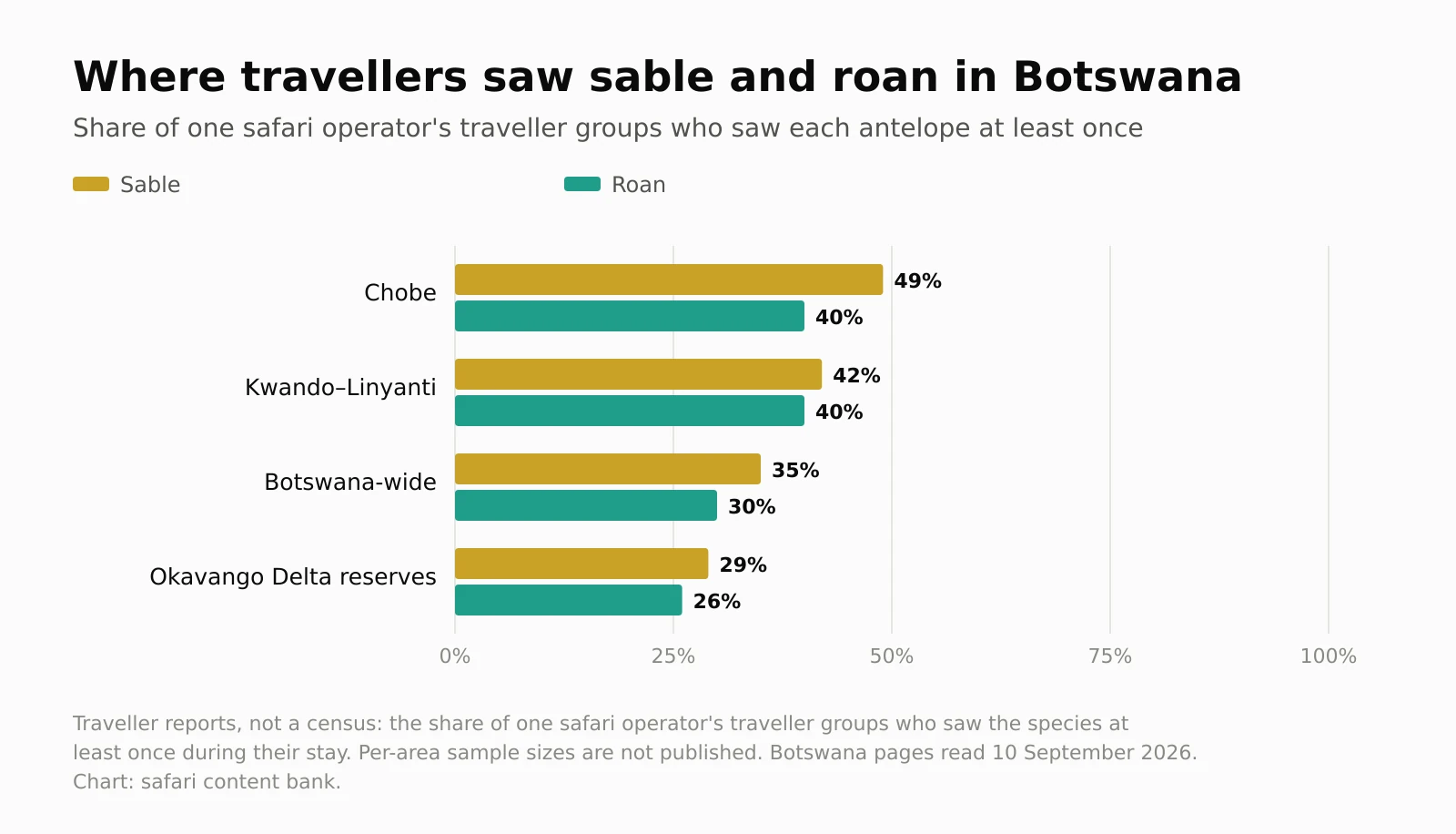 Traveller reports, not a census. One safari operator’s Botswana pages, read 10 September 2026.
- Hwange (Zimbabwe): sable and roan are Hwange specialities, according to one safari operator (Hwange). No percentage is published in our sources.
- Khwai, beside Moremi: an Okavango travel information site notes roan in the Khwai community concession.
- Kafue (Zambia): one safari operator lists sable and roan across the park; roan are among the Busanga Plains species on our Kafue page. African Parks counts 21 antelope species among Kafue’s 158 mammals.
- Namibia: a safari listing site names roan and sable in Bwabwata National Park and sable in Mudumu, both in the Zambezi Region; a Namibian travel guide site says the Waterberg Plateau was used to establish populations of roan, sable and tsessebe.
Sitatunga: the swamp antelope
The Okavango Panhandle gives the best published sitatunga odds in Botswana, 31% of one safari operator’s groups; the Delta’s private reserves give 25%. Sitatunga live in papyrus swamps, so water camps and boats beat game drives.
- Okavango Panhandle: the 100 km channel above the Delta, boat country with few big predators (the operator’s Panhandle page).
- Okavango Delta: water camps on permanent lagoons, reached by boat or mokoro: Okavango water or land camps and mokoro safari.
- Kasanka (Zambia): 500–1,000 sitatunga, watched from the Fibwe hide, an 18-metre platform in a mululu tree over Kapabi Swamp, best at dawn (Wikipedia, as on our Kasanka bat migration page).
- Bangweulu (Zambia): African Parks says sitatunga have “recovered well”; see where to see a shoebill.
- Namibia’s Zambezi Region: a safari listing site names sitatunga in Bwabwata, Mudumu and Nkasa Rupara.
- Chobe: only 6% of the operator’s groups saw one.
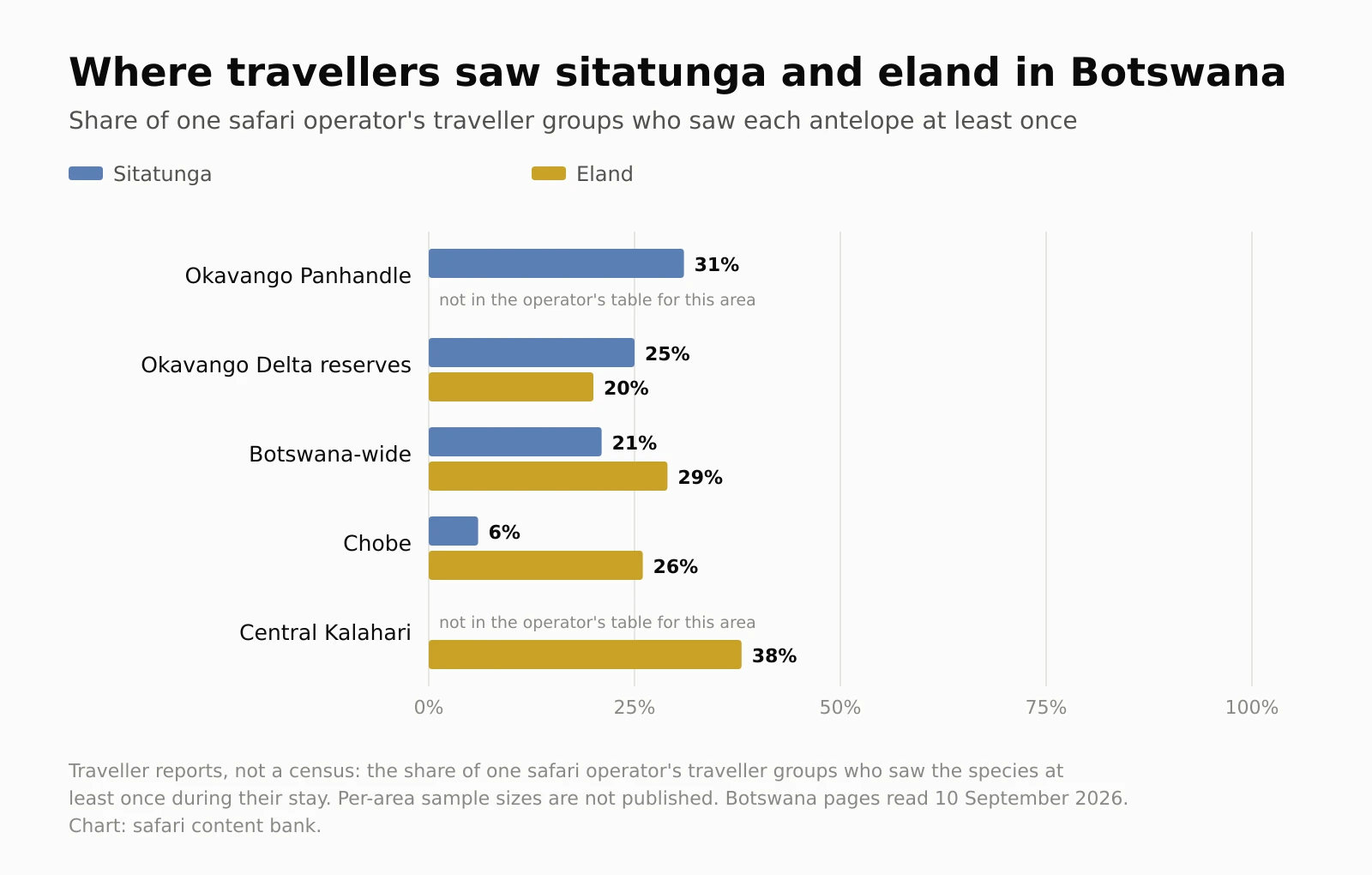 Traveller reports, not a census. One safari operator’s Botswana pages, read 10 September 2026.
Lichtenstein’s hartebeest and tsessebe
Liuwa Plain in western Zambia has had Lichtenstein’s hartebeest again since 2025, after more than 30 years’ absence (African Parks). One safari operator also lists the species across Kafue.
- Liuwa is better known for its wildebeest, which mass on the plain from late October to December: Liuwa Plain wildebeest migration. One safari operator gives a 1991 census of 8,000 tsessebe there.
- Bangweulu: African Parks says tsessebe have “recovered well”. The wetland is also the only home of the black lechwe, which one safari operator puts at “tens of thousands”.
Gemsbok, Beisa oryx and gerenuk: the dry-country antelope
Go to the Central Kalahari for gemsbok, where 93% of one safari operator’s groups saw them, and to Samburu for Beisa oryx and gerenuk.
- Gemsbok (southern oryx): Central Kalahari 93%, Botswana-wide 60%, Makgadikgadi and Nxai Pan 27%, Okavango Delta 0%: it is a Kalahari animal (the operator’s traveller reports). Hwange is the only Zimbabwean park with gemsbok, in small numbers in the Kalahari south (Wikipedia). More: Central Kalahari, Kgalagadi and where to see meerkats.
- Beisa oryx and gerenuk: Samburu County and Wikipedia list the “Samburu Five” as Grevy’s zebra, reticulated giraffe, Beisa oryx, gerenuk and Somali ostrich. We hold no current count for the Beisa oryx or the gerenuk (Samburu).
Eland and the lechwes
Eland, Africa’s largest antelope, are seen by 38% of one safari operator’s groups in the Central Kalahari, 26% in Chobe and 20% in the Delta’s private reserves.
- Red lechwe: in herds on Kafue’s Busanga Plains (Kafue), and in Bwabwata, Mudumu and Nkasa Rupara in Namibia (a safari listing site).
- Black lechwe: only in Bangweulu; herds gather from February to April (Visit Bangweulu).
- Puku: on the Chobe riverfront, “a species rarely found south of Zambia” (one safari operator), and in Busanga’s herds.
How to read the sighting odds
Treat the percentages as best-case odds for a stay of several nights, not as the chance on one drive.
| Caveat | What it means for you |
|---|---|
| Per trip, not per drive | 49% sable means 49% of groups saw one at least once in their whole stay; a two-night stay will do worse |
| One operator’s own clients | Its travellers skew to longer, guided, dry-season trips in good areas |
| Sample sizes per area are unpublished | Small areas such as the Panhandle may rest on few groups; the Botswana-wide figures rest on 11,679 sightings from 1,356 groups since May 2018 |
| No East African rates | Our sources hold no published antelope odds for Kenya, Tanzania, Rwanda or Uganda |
Source: the operator’s Botswana wildlife page, read 10 September 2026, and our review of its method.
Which trip for which antelope
| If you want… | Go to | Why | Watch out for |
|---|---|---|---|
| Sable and roan together | Chobe or a Kwando–Linyanti camp | 40–49% of the operator’s groups saw each | Not certain; longer stays help |
| Sitatunga | Okavango Panhandle or a Delta water camp; Kasanka’s Fibwe hide | 31% Panhandle; 500–1,000 at Kasanka | Few big predators in the Panhandle |
| Gemsbok | Central Kalahari, December–May | 93% of the operator’s groups | Remote; see Central Kalahari |
| Gerenuk and Beisa oryx | Samburu | Two of the “Samburu Five” | No published odds |
| Lichtenstein’s hartebeest | Liuwa Plain, late October–December | Back since 2025, with the wildebeest season | No published odds; camps close January–April |
| Black lechwe | Bangweulu | Found nowhere else | Herds gather February–April |
Common mistakes about rare antelope
| What you’ll often read | What is correct |
|---|---|
| “You’ll see sable in the Okavango Delta” | 29% of one operator’s groups did; Chobe (49%) and the Kwando–Linyanti (42%) are better. |
| “Sable and roan are guaranteed in Chobe” | 40–49% of groups saw them across a whole stay. |
| “Sitatunga are seen on game drives” | They are swamp antelope: the Panhandle (31%) and water camps beat Chobe (6%). |
| “Gemsbok live in the Delta” | 0% in the Delta; 93% in the Central Kalahari. |
| “Lichtenstein’s hartebeest have always been at Liuwa” | They returned in 2025 after more than 30 years (African Parks). |
| “There are published odds for East Africa” | Not in our sources; Samburu’s specials have no published rates. |
Frequently asked questions
Where is the best place to see sable antelope? In Botswana’s Chobe National Park, where 49% of one safari operator’s traveller groups saw sable, and the Kwando–Linyanti (42%). Botswana-wide the figure is 35%. Hwange and Kafue also have sable, without published odds.
What is the best area for sable and roan antelope? Chobe or the Kwando–Linyanti in northern Botswana: 40% of the operator’s groups saw roan in both, and 49% and 42% saw sable. The Linyanti adds the stronger predator record (lion 94%, leopard 70%).
Where can I see sitatunga? In the Okavango Panhandle, where 31% of one operator’s groups saw them, in the Delta’s water areas (25%), or from the Fibwe hide at Kasanka in Zambia, which has 500–1,000 sitatunga (Wikipedia).
Where can I see gerenuk? In Samburu National Reserve, Kenya, where Samburu County lists the gerenuk among the “Samburu Five”. Our sources hold no count or sighting rate.
Where do you see gemsbok? In the Central Kalahari, where 93% of one operator’s groups saw them, and the Kgalagadi. They are absent from the Okavango Delta (0%).
Where can I see Lichtenstein’s hartebeest? On Liuwa Plain, Zambia, where African Parks says the species returned in 2025 after more than 30 years. One safari operator also lists it in Kafue.
Are these sighting odds reliable? They are traveller reports from one operator’s own clients, counted per trip, not per drive. Per-area sample sizes are not published, so read small areas as a guide only.
Sources
- Sighting rates: one safari operator’s Botswana wildlife page and its Chobe, Kwando–Linyanti, Okavango Delta reserves, Okavango Panhandle, Central Kalahari and salt pans pages (read 10 September 2026); Kafue, Hwange, Liuwa and Bangweulu pages (read October 2026) (names and links kept in our editor notes)
- Parks and reintroductions: African Parks, Liuwa Plain, Kafue and Bangweulu; Visit Bangweulu; read October 2026
- Namibia: a safari listing site’s Bwabwata, Mudumu and Nkasa Rupara wildlife pages and a Namibian travel guide site’s Waterberg page (names and links kept in our editor notes); read October 2026
- Kenya: Samburu County and Wikipedia, as on our Samburu page
- Kasanka: Wikipedia, Kasanka National Park, as on our Kasanka bat migration page; Hwange: Wikipedia, Hwange National Park
- Khwai: an Okavango travel information site’s Khwai community concession page (name and link kept in our editor notes)
More on where to see the other animals: lions, wild dogs, zebras, giraffes and meerkats.
Figures checked 10 September–10 October 2026. We will update this page when the operator’s sighting rates change and when we find sources for East Africa’s sable and roan.