 Experience

Last verified · Next check due
On this page
Short answer: A mokoro is a shallow canoe that a guide poles from the stern. In the Okavango, take one at a water camp on permanent water (all year), a seasonal camp (about late May to September), some camps inside Moremi, or on a guided trip from Maun (about US$214–307 per person per day, our sums). Camp rates include it. Minimum ages run 8–13. Expect birds and silence, not big cats.
Key facts
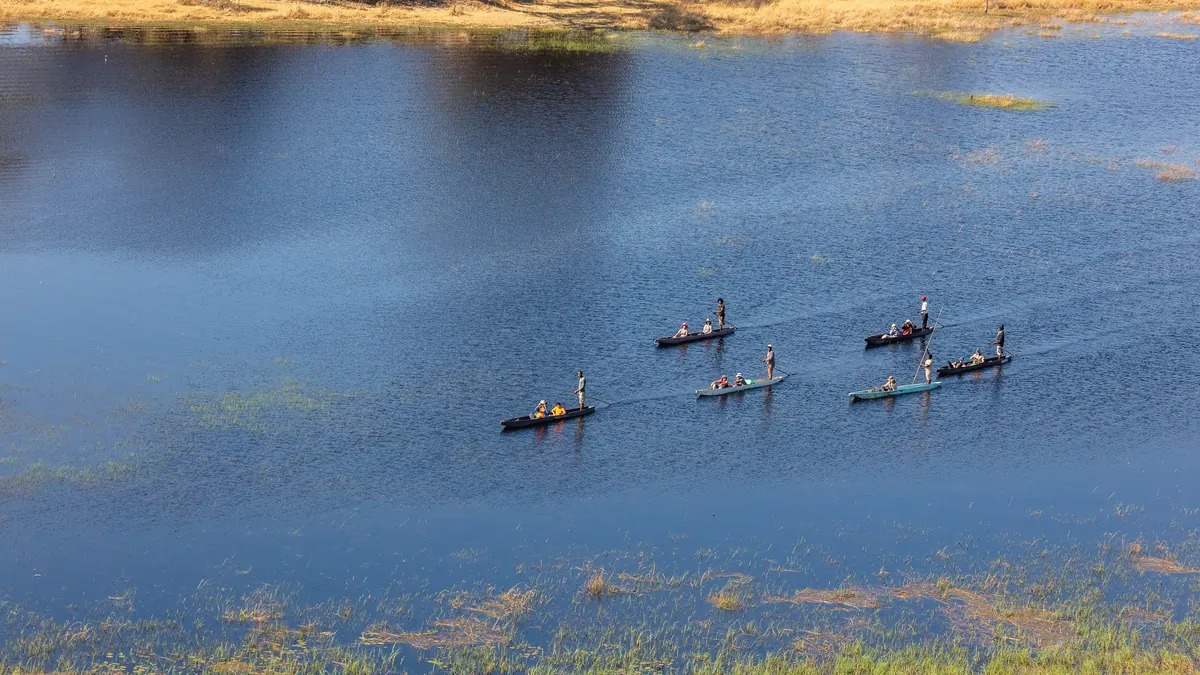
- A mokoro is poled, not paddled. Guests sit amidships in a low seat while a poler stands at the back (one operator’s canoeing guide). Paddled Zambezi canoes are a different trip: see canoe safaris.
- It needs water. On the seasonal floodplains boats run from about late May to September, with none in January and February; on permanent water they run all year, because the level there moves about 0.2 m a year against more than 1.5 m in the seasonal swamp (a Botswana camp operator’s seasonal guide; IntechOpen review). Month by month: Okavango flood calendar.
- Three main ways in: a fly-in water camp, where the mokoro is in the rate; a camp inside Moremi Game Reserve that runs one, such as Xigera Safari Lodge; or a guided 2–3-day trip by road from Maun into the eastern Delta, camping on islands, which does not enter Moremi (Okavango Delta safari cost).
- The cheapest way onto Delta water is a guided mokoro trip from Maun: published 2- and 3-day trips cost US$557–664 per person, about US$214–307 a day (operators’ listings, our sums).
- It is a quiet trip, not a big-game one: mokoro trips focus on “silence and birdlife rather than large animals”, one forum regular says (TripAdvisor forum, traveller report).
- Every mokoro trip in our sources goes with a guide. Hippo and elephant share the channels: after a 2025 elephant incident on a mokoro trip, a Maun-based forum contributor reported no serious injuries and said trips would continue (traveller report).
Where you can take a mokoro in the Okavango (2026)
Our sources point to five places to board a mokoro: water-first camps, seasonal mokoro camps, land-and-water camps on the private concessions, some camps inside Moremi, and guided trips by road from Maun. The Khwai community area next to Moremi also offers mokoro. Which months each one works depends on its water, not on the camp’s activity list.
| Where | What it is | Example camps or trips | When the mokoro runs | Source |
|---|---|---|---|---|
| Water-first camp (private concession) | The mokoro and the boat are the camp’s main activities; few game drives | Xugana Island Lodge; Sitatunga Private Island; Jacana, Pelo, Setari | All year on permanent water; ask a seasonal camp | A UK safari operator’s Okavango pages; Desert & Delta 2024; Great Plains 2025 |
| Seasonal mokoro camp (central Delta) | Mokoro on the seasonal floodplains, plus drives | Pom Pom (Kwando) | About late May to September | Kwando 2024; a Botswana camp operator’s seasonal guide |
| Land-and-water camp (private concession) | Drives on dry ground, mokoro and boats on the water | Kwara, Splash (Kwando); Okavango Explorers (Great Plains) | Seasonal floodplains: about late May to September | Okavango water vs land camps |
| Camp inside Moremi Game Reserve | Moremi’s rules apply: daytime drives on the tracks only | Xigera Safari Lodge (mokoro in its all-inclusive rate); Chief’s Camp, on Chief’s Island (mokoro at peak flood) | Depends on the camp’s water | Xigera’s own pages (captured 9 Sep 2026); a UK safari operator’s camp notes |
| Khwai concessions (next to Moremi’s North Gate) | Community and private concessions where a safari agent’s guide lists mokoro among the activities | Khwai community area; Khwai Private Reserve camps | Ask the camp | A safari agent’s guide to Khwai, read September 2026 |
| Guided trip from Maun (eastern Delta) | By road to the water, then by mokoro, camping on islands; walking and mokoro are the activities; not in Moremi | 2-day and 3-day trips; one 5-day trip adds camping in Moremi | Seasonal: needs the flood | Operators’ published prices, as on Okavango Delta safari cost |
Camp types as one UK safari operator describes each camp on its Okavango Delta pages (read September 2026; name in our editor notes). Rates and terms: Desert & Delta 2024, Kwando 2024 and Great Plains 2025 rate cards; Xigera’s own site, captured 9 September 2026. Read 10 October 2026.
- Most activity lists are not a promise. One UK safari operator says mokoro is “reduced or stopped” at most camps when levels drop; confirm the mokoro for your exact dates (Okavango water vs land camps).
- Some trips from Maun are run by a community trust. One traveller’s 2023 account describes booking at a community mokoro trust’s office in Maun, at prices the trust sets and paid in cash in pula, with the road transfer arranged separately with a private 4x4 operator, and guests bringing their own tent, food and water (traveller report; we print no prices from it).
- Jacana, Pelo and Setari publish no rate in our sources; Wilderness sells Jacana and Pelo on quotation (Botswana safari cost).
When the water allows a mokoro
On permanent water a mokoro runs all year; on the seasonal floodplains it runs from about late May to September, and not at all in January and February. The flood comes from rain in Angola, so the Delta is fullest in the dry winter months and lowest in Botswana’s own rainy season.
| Months | Camps on permanent water | Camps on seasonal floodplains and trips from Maun | Delta water (seasonal guides) |
|---|---|---|---|
| January–February | Mokoro runs | No boats at seasonal camps | Low |
| March–April | Mokoro runs | Water rising; boats not yet running | Rising |
| May | Mokoro runs | Boating resumes late May | Rising fast; red lechwe rut |
| June–August | Mokoro runs | Mokoro runs | Near peak, peak in July, receding from August |
| September | Mokoro runs | Runs, but “boating often stops” as levels fall | Receding |
| October | Mokoro runs | “Some water activities may no longer be possible”, depending on the area | Low and falling; the hottest month, above 40°C at times |
| November–December | Mokoro runs | No reliable mokoro | Lowest in November |
Typical timing, not a forecast. Sources: two camp operators’ seasonal guides; Africa Geographic; IntechOpen review; as on our Okavango flood calendar and Okavango water vs land camps pages. Read 10 October 2026.
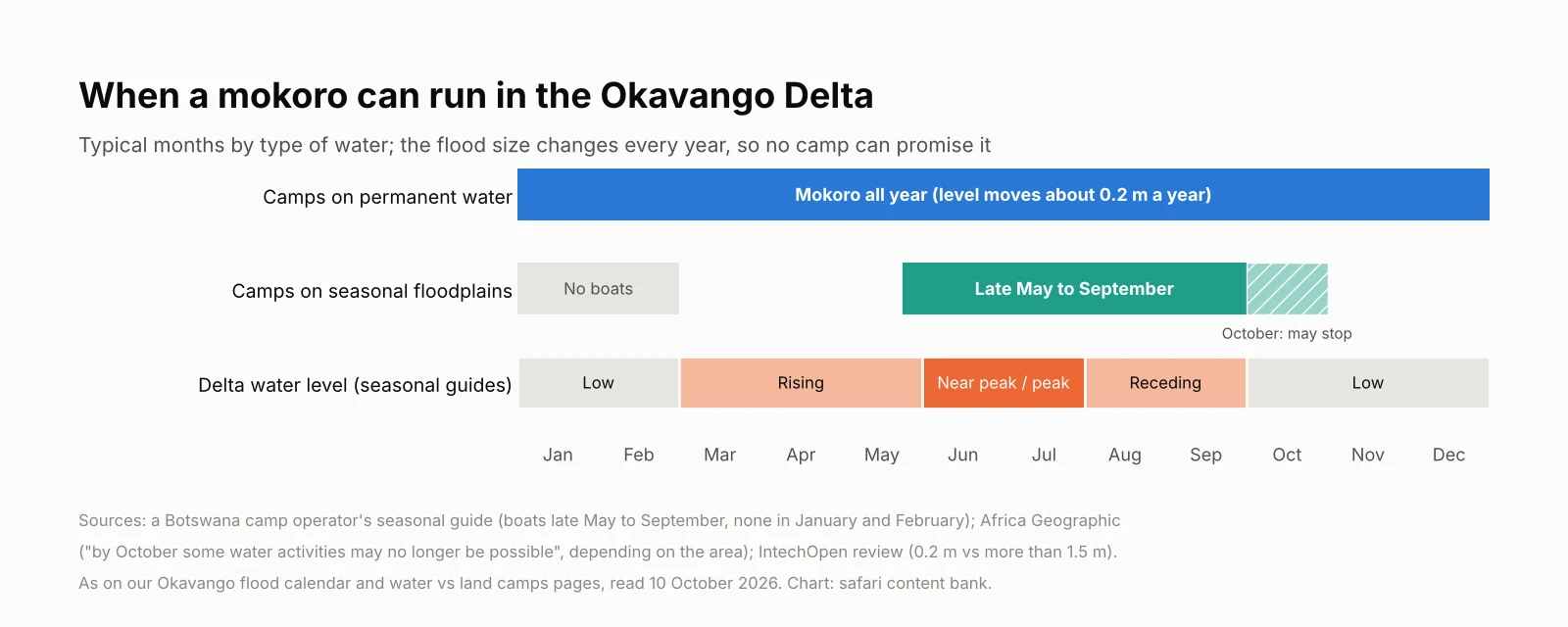 Typical months; the flood size changes every year. Sources: a Botswana camp operator’s seasonal guide; Africa Geographic; IntechOpen review. Read 10 October 2026. Chart: safari content bank.
- The flood is not the same every year. One Botswana camp group described 2026 as a high-water year, with water “reconnecting floodplains by mid-May”; one of its guides said channels “that normally close late in the dry season are going to stay open for certain” (that group’s 2026 high-water update).
- A big flood helps the mokoro and hurts the drives. The same update says “rising water levels reduce traversing areas”; a forum contributor reported under 5,000 hectares of driveable ground at Kwando’s 4 Rivers over three nights in 2026 (traveller report, via Okavango water vs land camps).
- Green season is low water in the Delta. On one German forum thread, a destination expert gave February to April as the high-water months for a mokoro; the flood calendar puts the high water from about May to August (traveller report; Okavango flood calendar).
What a mokoro safari costs
From about US$214 per person a day on a guided trip from Maun to US$645–2,935 a night at a fly-in water camp, where the mokoro is in the rate. The mokoro itself is rarely a separate line: you pay for the trip or the camp.
| Option | Price per person | Per day or night | What is in it | Source |
|---|---|---|---|---|
| Guided mokoro trip from Maun, 2–3 days | 3-day private overnight US$641–664; 2-day trip US$557–613 | US$214–307 a day (our sums) | Transport from Maun, mokoro and island camping; ask what else is included | Operators’ published 2026 prices (2 listings) |
| Mokoro and Moremi camping, 5 days | US$1,350 | US$270 a day | Transport from Maun and park fees included | One operator’s published price |
| Xugana Island Lodge (Desert & Delta), water-first | Fully inclusive | US$645–1,160 a night (1–4 nights) | Meals, drinks, activities, park fees, levies and 14% VAT | Desert & Delta 2024 |
| Pom Pom (Kwando), seasonal mokoro camp | Fully inclusive | US$690–1,750 a night, plus US$20 levy | Meals and activities | Kwando 2024 |
| Okavango Explorers (Great Plains), land and water | Fully inclusive | US$1,105–1,915 a night, plus US$100 levy | Scheduled air from Maun or Kasane on stays of 2+ nights | Great Plains 2025 |
| Sitatunga Private Island (Great Plains), water-first | Fully inclusive | US$1,550–2,935 a night, plus US$100 levy | As above | Great Plains 2025 |
| Xigera Safari Lodge, inside Moremi | No published rate: quotation only | – | All activities including mokoro; park fees | Xigera’s own pages, captured 9 Sep 2026 |
Per person sharing, lowest to highest season. Trips: operators’ listings captured 9 September 2026, divided by days (our sums); names in our editor notes. Camps: Desert & Delta and Kwando 2024, Great Plains 2025, the latest from those groups in our sources; Great Plains also charges a separate conservation levy. Read 10 October 2026.
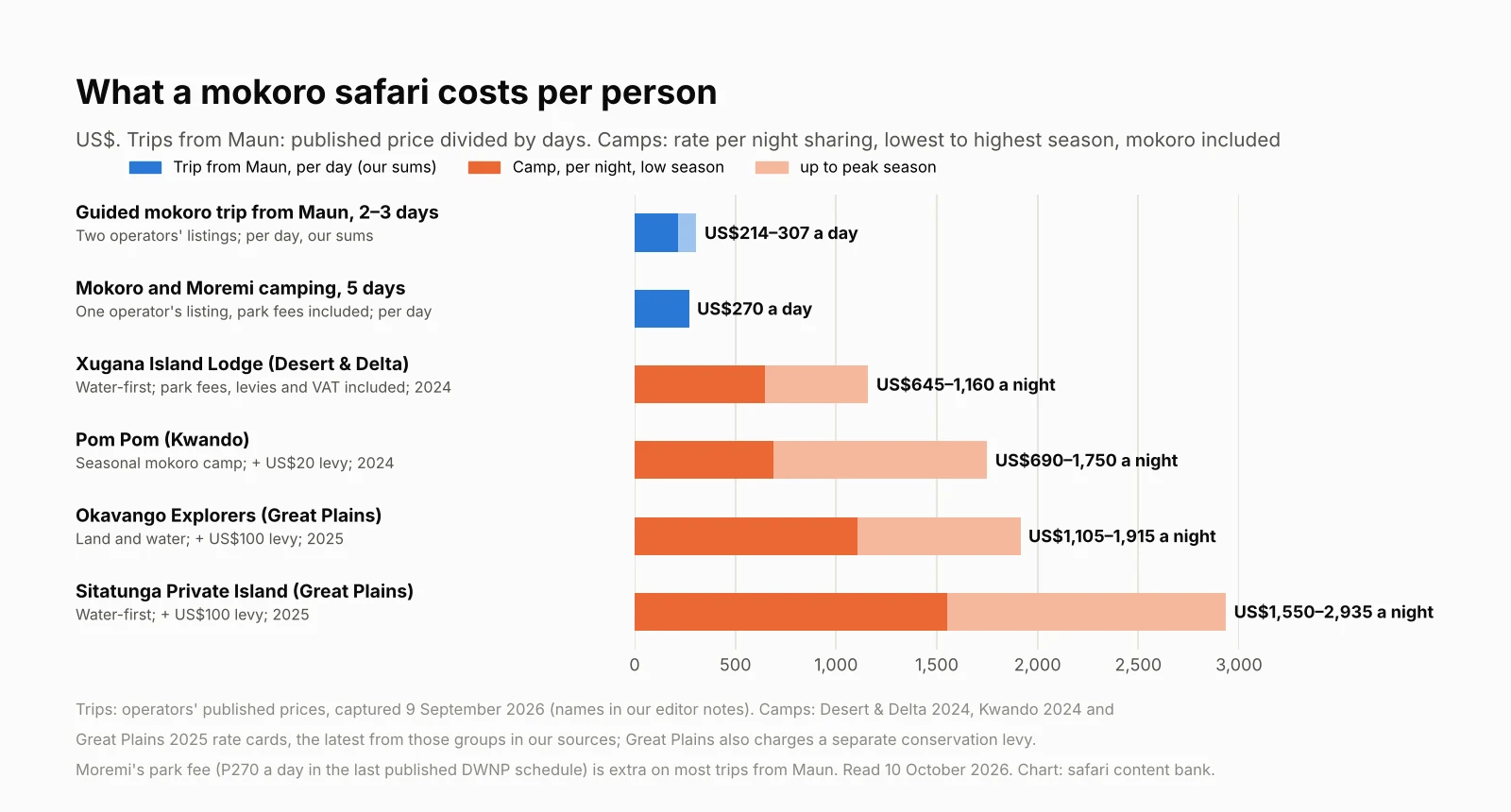 Packages divided by days (our sums); camp rates as published, before most flights and tips. Read 10 October 2026. Chart: safari content bank.
- Tip the poler: one Botswana safari operator suggests US$7 per guest per day for a mokoro poler; other operators’ guidance runs from about US$5 per person per activity to US$10 per guest per day (safari tipping).
- Flights are extra at most fly-in camps: a light-aircraft seat costs US$250–594 one way before tax (on Kwando’s and Desert & Delta’s 2024 rate cards); Great Plains includes scheduled air on stays of 2+ nights. See bush flights from Maun and Kasane.
- A water camp plus a land camp is the usual pairing; six nights cost US$3,870–6,960 per person inside Desert & Delta and US$4,650–11,670 inside Kwando, rate plus levy (our sums, on Okavango water vs land camps).
- Before paying a deposit to a Maun operator, check the operator’s licence.
Park fees on a mokoro trip
A mokoro trip from Maun does not enter Moremi, so Moremi’s fee applies only if your trip adds days in the reserve; camps inside Moremi include it in their rates. The last published DWNP schedule charges non-residents P270 per person per day in Moremi Game Reserve; no official current tariff is published. In February 2026 the government news agency BOPA described the existing non-resident fee as P380 and reported a rise to P500 from 1 April 2026 (Botswana Daily News, 24 Feb 2026); the rise was then reported postponed (Gabz FM). Confirm the fee with DWNP or your operator before you travel.
The fee line with its date and source:
| Fee | Amount | In force from | Source |
|---|---|---|---|
| Chobe National Park and Moremi Game Reserve (DWNP), non-resident adult, per person per day | BWP 270 (SADC residents BWP 205; Botswana citizens and residents BWP 30) | Last published DWNP schedule, 1 April 2022 (via Tourism Update). In Feb 2026 the government news agency BOPA called the existing non-resident fee P380; a P500 rise was announced, then reported postponed. No official current tariff: confirm with DWNP or your operator | Tourism Update, 23 Feb 2022 (DWNP fee schedule) |
- Community areas set their own fees: Khwai community camping is BWP 300 per person per night; Moremi’s fee is extra inside the reserve (Botswana park fees).
- On a private concession the fee is usually bundled into the rate, plus a camp levy: US$20 per person per night at Kwando (2024) and US$100 at Great Plains (2025).
What you see from a mokoro
Birds, water and the reed channels at eye level; big game only at a distance, if at all. The mokoro moves slowly and silently through shallow water, which is why travellers rate it for quiet rather than for sightings.
| What | From a mokoro | Source |
|---|---|---|
| Birds | The main event: the Delta has 482 recorded bird species; Pel’s fishing owl and African skimmer live in the Panhandle | UNESCO; one safari operator, as on birding safaris |
| Antelope of the floodplain | Red lechwe on the floodplains; they rut in May, as the flood arrives | A Botswana camp operator’s seasonal guide |
| Sitatunga | Seen on 31% of one UK operator’s travellers’ trips in the Panhandle, its best rate in Botswana | That operator’s sighting statistics |
| Hippo and elephant | Present in the channels; the guide keeps clear of them (see safety below) | Traveller reports; where to see hippos |
| Big cats | Rarely: in the Panhandle that operator’s travellers saw leopard on 0% of trips, against 73% across the Delta’s reserves | That operator’s sighting statistics |
| The channels themselves | Hippos and elephants open new channels; papyrus and a fig, Ficus verruculosa, close them by trapping sand | IntechOpen review |
Sighting statistics: one UK safari operator’s travellers’ reports (name in our editor notes). Read 10 October 2026.
- Travellers who skip the mokoro say they missed the place. A Swiss reviewer of Moremi said one “cannot experience the serenity of Okavango” from a motorboat and a 4x4 alone (traveller review on a safari listing site).
- For big cats, add a land camp. One UK safari operator describes the water-first camps as trading big game for mokoro and birding, and its dry-land camps as suiting predator viewing (Okavango water vs land camps).
Safety and rules on a mokoro
Every mokoro trip in our sources goes with a guide; camps set their own minimum ages, from 8 to 13; and Moremi’s rules limit drives and walks, not the mokoro. Our sources hold no official DWNP rule for mokoro trips and no incident statistics.
| Topic | What our sources say | What to ask |
|---|---|---|
| Guide | Every trip in our sources is guided; the poler stands at the stern and steers | Who poles, and how long they have guided in this area |
| Minimum age | 8 at Great Plains camps, 12 at Kwando (no minimum with the camp booked exclusively), 13 at Xigera Safari Lodge | The camp’s own rule; see safari age limits |
| Life vests | Xigera requires them on boats and mokoro (Xigera’s own terms) | Whether the camp provides them |
| Elephant | A 2025 incident on a mokoro trip in the Kazinkini area involved a cow with a calf, with no serious injuries; a Maun-based contributor said guides were under review and blamed clients and tour leaders pressing guides to get closer for social-media pictures | Do not ask the poler to get closer |
| Hippo | A German forum expert said she avoids boat trips because hippos disturbed by heavy boat traffic have overturned some; this is one forum view | Whether channels are scouted by motorboat before poling, as forum contributors say is done at some stations |
| Moremi’s rules | Botswana Tourism says “off-roading and night driving [are] prohibited” in the national parks and reserves, including Moremi; one UK safari operator says walking safaris are not permitted within the reserve | Which activities your Moremi camp runs |
Sources: Great Plains 2025 and Kwando 2024 rate cards; Xigera’s own site (captured 9 September 2026); TripAdvisor forum, mokoro trips and German forum thread (traveller reports, not fact); Botswana Tourism. Read 10 October 2026.
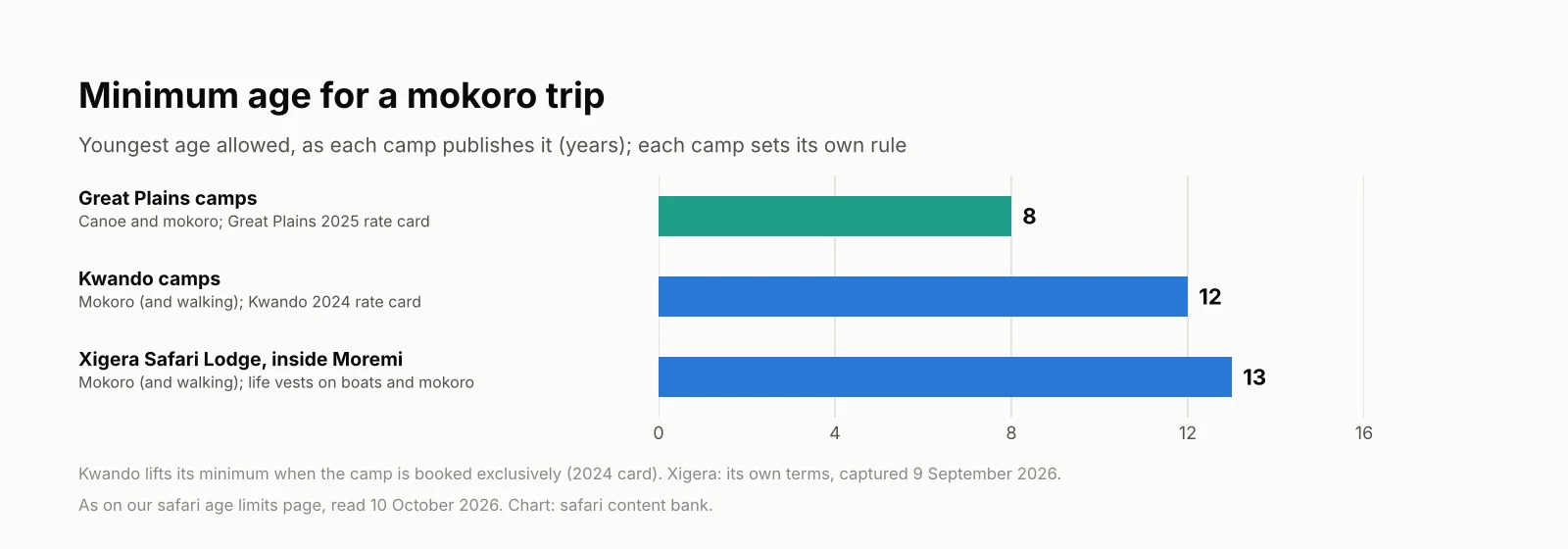 Each camp sets its own rule. Sources: Great Plains 2025; Kwando 2024; Xigera’s own terms, captured 9 September 2026. Read 10 October 2026. Chart: safari content bank.
- The guide’s word is the rule: hippo and crocodile are the real risk in any canoe, one safari operator’s guide says (canoe safaris).
- Which areas allow night drives, walking and off-road driving is set out area by area on night drives and walking in Botswana.
- Insurance: check that your policy covers water activities; see safari travel insurance.
Mokoro, motorboat or game drive
A mokoro is the slow, silent, shallow-water option; a motorboat covers distance on deeper channels; a game drive is how you find big cats. Forum regulars usually mix them by pairing a water camp with a land camp.
| Mokoro | Motorboat | Game drive | |
|---|---|---|---|
| How it moves | Poled by a guide standing at the stern | Engine, with a guide | 4x4 vehicle |
| Water it needs | Shallow floodplain or channel | Deeper channels and lagoons | Dry ground; a big flood shrinks it |
| Months, seasonal floodplain | About late May to September | Viable as water rises from May; some water activities may stop by October | Best June–September (Africa Geographic) |
| Months, permanent water | All year | All year | Limited land at water-first camps |
| Best for | Quiet, birds, the reed channels | Birds, sitatunga, covering distance | Lion, leopard, wild dog |
| In Moremi | At some camps (Xigera) | Boats reach the Xakanaxa area | Yes, by day on the tracks; no night drives (Botswana Tourism) |
| Minimum age | 8–13, by camp | Set by each camp | Set by each camp |
| Budget route | Guided trip from Maun, US$214–307 a day | In camp rates | Self-drive or mobile safari in Moremi |
Sources: a Botswana camp operator’s seasonal guide; Africa Geographic; one UK safari operator’s camp descriptions; Kwando 2024 (boat transfer to Xakanaxa); Botswana Tourism; camps’ rate cards. More on boats: boat safaris. Read 10 October 2026.
- Forum regulars on a “mokoro or boat” thread describe the mokoro as slow and silent with one or two guests per poler, and the motorboat as the way to cover distance and reach hippo pools and lagoons; those who did both were glad to have done both (TripAdvisor forum, traveller reports).
- Walking is offered on the concessions and on the island stops of trips from Maun, not inside Moremi (one UK safari operator; walking safaris).
Which mokoro trip to choose
Choose by budget and by month: a trip from Maun for the cheapest water, a camp on permanent water for any month, and a water camp plus a land camp for big game too.
| If you want… | Choose | Why |
|---|---|---|
| The cheapest mokoro in the Delta | A guided 2–3-day trip from Maun | About US$214–307 per person per day (operators’ listings, our sums) |
| A mokoro in January to April | A camp on permanent water | Seasonal camps run no boats in January and February; boating resumes there in late May |
| A mokoro and big cats on one trip | A water camp plus a land camp, June to September | Land activities are best June–September; seasonal floodplains have boats until about September |
| A mokoro inside Moremi | A Moremi camp that runs one, such as Xigera | Xigera includes mokoro and park fees in its rate; Moremi allows no night drives |
| A family with children under 12 | A Great Plains camp | Great Plains allows mokoro from 8; Kwando sets 12 and Xigera 13 |
| Water, birds and quiet above all | A water-first camp | One UK safari operator says these camps trade big game for mokoro and birding |
Sources as in the sections above. Read 10 October 2026.
Common mistakes about mokoro safaris
| What you’ll often read | What is correct |
|---|---|
| “A mokoro is a canoe you paddle yourself” | A guide poles it, standing at the stern; you sit in the middle (one operator’s canoeing guide). |
| “Every Okavango camp offers a mokoro all year” | Seasonal camps run no boats in January and February, and mokoro is “reduced or stopped” at most camps when levels drop. Only camps on permanent water run it all year. |
| “The rainy season is the high-water season” | The flood comes from Angola and peaks in Botswana’s dry winter; the Delta is lowest from November to February (Okavango flood calendar). |
| “A mokoro is a good way to see big cats” | Mokoro trips focus on “silence and birdlife rather than large animals” (traveller report); in the Panhandle one operator’s travellers saw leopard on 0% of trips. |
| “A mokoro trip from Maun goes into Moremi” | The 2–3-day trips from Maun stay in the eastern Delta, outside Moremi; one 5-day trip adds Moremi camping, park fees included. |
| “No mokoro is allowed in Moremi” | Our sources hold no such rule; Botswana Tourism bans off-roading and night driving in the reserves, and Xigera, inside Moremi, runs mokoro trips. |
| “Botswana park fees are now P500” | The P500 rise was announced, then reported postponed. The last published DWNP schedule (1 April 2022) gives P270 for Moremi; no official current tariff is published. |
Frequently asked questions
What is a mokoro safari? A guided trip in a mokoro, a shallow canoe that a poler pushes along with a pole while standing at the stern; guests sit low in the middle. In the Okavango Delta it is either an activity at a water camp, included in the rate, or a 2–3-day trip by road and mokoro from Maun, camping on islands.
Where can I do a mokoro trip in the Okavango Delta? At water-first camps such as Xugana Island Lodge and Sitatunga Private Island, at seasonal mokoro camps such as Pom Pom, at land-and-water camps such as Kwara, Splash and Okavango Explorers, at some camps inside Moremi such as Xigera, in the Khwai concessions, and on guided trips from Maun into the eastern Delta.
When is the best time for a mokoro trip? From about late May to September, when the flood fills the seasonal floodplains; camps on permanent water run mokoro trips all year. Seasonal camps run no boats in January and February, and by October some water activities may no longer be possible, depending on the area (Africa Geographic).
How much does a mokoro safari cost? Published 2- and 3-day trips from Maun cost US$557–664 per person, about US$214–307 a day (our sums). At fly-in camps the mokoro is in the rate: US$645–1,160 a night at Xugana Island Lodge (2024), US$690–1,750 at Pom Pom (2024) and US$1,550–2,935 at Sitatunga Private Island (2025), plus levies at the last two.
Can you take a mokoro in Moremi Game Reserve? Yes, at some camps: Xigera Safari Lodge, inside Moremi, includes mokoro trips in its rate and requires life vests. The guided trips from Maun stay outside Moremi. Moremi’s last published park fee is P270 per non-resident adult per day (DWNP, 1 April 2022); no official current tariff is published, so confirm it with DWNP or your operator.
Is a mokoro safe? Every trip in our sources goes with a guide, and incidents are reported but not routine. After a 2025 elephant incident on a mokoro trip, with no serious injuries, a Maun-based forum contributor said trips would continue. Do not press the poler to get closer to animals, use a life vest where the camp offers one, and ask whether channels are scouted before poling.
What is the minimum age for a mokoro trip? Each camp sets its own: 8 at Great Plains camps, 12 at Kwando (no minimum with the camp booked exclusively) and 13 at Xigera Safari Lodge. More ages on safari age limits.
Should I choose a mokoro, a motorboat or a game drive? For quiet and birds, a mokoro; to cover distance on deeper water, a motorboat; for lion, leopard and wild dog, a game drive at a land camp. Travellers who skipped the mokoro say they missed the Delta’s serenity, so most itineraries pair a water camp with a land camp (Okavango water vs land camps).
Sources
- Mokoro, water and seasons: one operator’s canoeing guide; a UK safari operator’s Okavango Delta reserves, Moremi and Panhandle pages, camp notes and sighting statistics; two camp operators’ seasonal guides (names and links kept in our editor notes); IntechOpen review; Africa Geographic, understanding the Okavango Delta and a safari agent’s guide to Khwai; one Botswana camp group’s 2026 high-water update; UNESCO, as on our birding safaris page; read 8–10 October 2026
- Rules: Botswana Tourism, game viewing, read 10 October 2026
- Camps and rates: Desert & Delta 2024; Kwando 2024; Great Plains 2025 (PDF); Xigera Safari Lodge, captured 9 September 2026; as on our Okavango water vs land camps, Botswana safari cost and safari age limits pages
- Trips from Maun: operators’ published prices for mokoro and camping trips, captured 9 September 2026 (names and links kept in our editor notes), as on Okavango Delta safari cost; one traveller’s 2023 account of a community mokoro trust in Maun
- Park fees: Tourism Update, 23 Feb 2022 (last published DWNP schedule); Botswana Daily News (BOPA), 24 Feb 2026; Gabz FM, 5 May 2026; Botswana park fees
- Tips: one Botswana safari operator’s published advice and other operators’ guidance, as on safari tipping
- Traveller reports (forum posts and reviews, not fact): TripAdvisor, mokoro trips; TripAdvisor, mokoro or boat safari; TripAdvisor, 2026 rain and flood; TripAdvisor Germany, best time for the Delta; a traveller review of Moremi on a safari listing site
More: the Okavango Delta hub, Moremi, the Okavango flood calendar, Okavango water vs land camps, canoe safaris, boat safaris, night drives and walking in Botswana and the Okavango Delta safari cost page.
Seasons, rates and fees checked 10 October 2026. We will update this page when Kwando, Desert & Delta and Great Plains publish newer rate cards, when DWNP publishes a new fee schedule or an official current tariff, and when we find an official rule or safety data for mokoro trips.
What visitors say
Tripadvisor travel forums · read
What visitors praise
- Silent, peaceful gliding through reeds and water lilies, a relaxing change from bumpy game drives
- Superb eye-level birding and bird photography
- Skilled polers who spot and explain small details such as day and night lilies
- Hippos watched calmly from a safe distance
- Often combined with a bush walk on an island
What visitors criticise
- Few large mammals, so some found the ride itself dull
- The island walk afterwards can feel too long
- Hippos in a channel sometimes force a turn back
- Low water can mean little or no mokoro time at some camps
Tips visitors repeat
- Treat it as a nature and birding outing, not a game drive
- Take your camera, as polers keep well away from hippos and no poster reported capsizing
- If water activities matter, choose a camp on permanent water, especially around March or in dry years
- Polers help you in and out, so stiff joints are not a problem
- Nervous travellers can choose a motorboat where offered
What surprised visitors
- A sitatunga turned up for one birder
- The sound of an unseen buffalo herd plunging into the water
- Several noticed polers kept them in water too shallow for hippos
May to October trips went well; late March can be low-water and patchy for water activities, and water reaches the Maun side later in the season.