 Experience

Last verified · Next check due
On this page
- What do photographers and travellers actually take?
- Phone or camera?
- Which lens, and the one you won’t use
- Dust: why two bodies beat lens changes
- Supports in the vehicle: bean bags, platforms, a monopod
- Binoculars
- Batteries, cards and charging
- Weight: fitting the kit into a bush-flight bag
- Rules that affect your kit
- Which set-up for which traveller
- Common mistakes with safari camera gear
- Frequently asked questions
- Sources
Short answer: One long zoom, kept on the camera. Traveller forums settle on a 100–400 mm zoom for mammals and at least 400 mm for birds, and travellers report leaving the 24–105 or 70–200 unused. A second body beats changing lenses in the dust. Everything, cameras included, must fit the bush-flight limit: 15 kg per person in Kenya and Uganda, 20 kg in Botswana and on Auric Air in Tanzania. A big lens may need an extra seat. Checked 10 October 2026.
Key facts
- The usual forum answer is a 100–400 mm zoom. TripAdvisor’s Kenya forum puts 300 mm as the minimum and 400 mm as the minimum for birds; on its Botswana forum, 100–400 mm is “plenty of reach” on a private concession and a 150–600 mm is called overkill for large animals (traveller reports).
- Lens changes in the open are the risk forums name most. Botswana and Namibia threads advise a second body instead of a third lens, and one Namibia poster still got dust on the sensor despite care (traveller reports).
- Your camera bag counts inside the bush-flight allowance: 15 kg including hand luggage in Kenya and Uganda, 20 kg on Auric Air (Tanzania) and in Botswana, 10 kg on Skeleton Coast fly-ins (carriers’ baggage pages and an agent’s reference page, read 9–10 October 2026).
- Camera bags ride behind a mesh at the back of a Cessna, not on your lap, a Botswana forum thread reports; for a 500–600 mm lens plus a second body, travellers there often book an extra seat.
- Some camps lend gear. Great Plains Conservation’s Duba Plains camp in the Okavango puts a professional camera and lens in each tent and downloads your images when you leave (a safari operator’s guide; the camp group’s own rates page did not load).
- There is no charging on multi-day canoe trails, so spare batteries and a waterproof case go with you (a safari operator’s canoeing guide).
- We hold no current prices for cameras, lenses, binoculars or rentals, and we do not estimate them.
What do photographers and travellers actually take?
Most advice in our sources comes down to one long zoom for wildlife, something wide for landscapes, and no lens changes in the field. The table gives each source’s own words; none of it is a test, and the forum lines are traveller reports, not facts.
| Kit | What the source says | Who says it | Where |
|---|---|---|---|
| Long zoom | 300 mm minimum; 100–400 mm ideal; 400 mm the bare minimum for birds; one long zoom beats changing lenses in dust | Forum consensus | TripAdvisor Kenya forum, “Photography on Safari… which lens?!” |
| Long zoom on a private concession | 100–400 mm is plenty unless you photograph birds; 150–600 mm “too big” for larger animals because you get close | Forum consensus | TripAdvisor Botswana forum, “SLR lenses for private concessions” |
| Two bodies | Telephoto (200–500 mm or 150–600 mm) permanently on a crop body, mid or wide zoom on a second body; carry a sensor-cleaning kit | Forum advice | TripAdvisor Namibia forum, “General camera-lens combination strategy” |
| Bridge camera | 70–300 mm at least; a 55–210 mm is “un peu juste” (a bit short); a bridge camera avoids “le risque de poussière” when changing lenses | French forum posters | Routard forum, “Demande conseil appareil photo pour safari” |
| Lens set from a head guide | 70–200 mm f/2.8 and 200–500 mm, plus a macro and a very wide lens; learn manual exposure before the trip | Sipps Maswanganyi, head guide, Cheetah Plains (Sabi Sand) | Afar, 7 Mar 2023 |
| One versatile lens | One versatile lens beats a heavy telephoto for most travellers: “Bigger is not always better”; carry a spare battery and adaptor | Henk Venter, South African professional photographer | A safari operator’s blog (updated 9 May 2024) |
| Gear in general | Gear matters less than people think; light, background and behaviour decide the picture | Greg du Toit, wildlife photographer | Africa Freak interview (2011, updated 4 Jul 2024) |
| Binoculars | On the packing list, with a torch and a spare battery and charger | Forum answer (German-language) | TripAdvisor.de Botswana forum, “Was sollte man für eine Safarireise einpacken?” |
Forum threads as summarised in our source bank from pages read 8–9 October 2026; the photographers’ advice from the articles linked, read 9 October 2026. Traveller reports, not tested advice.
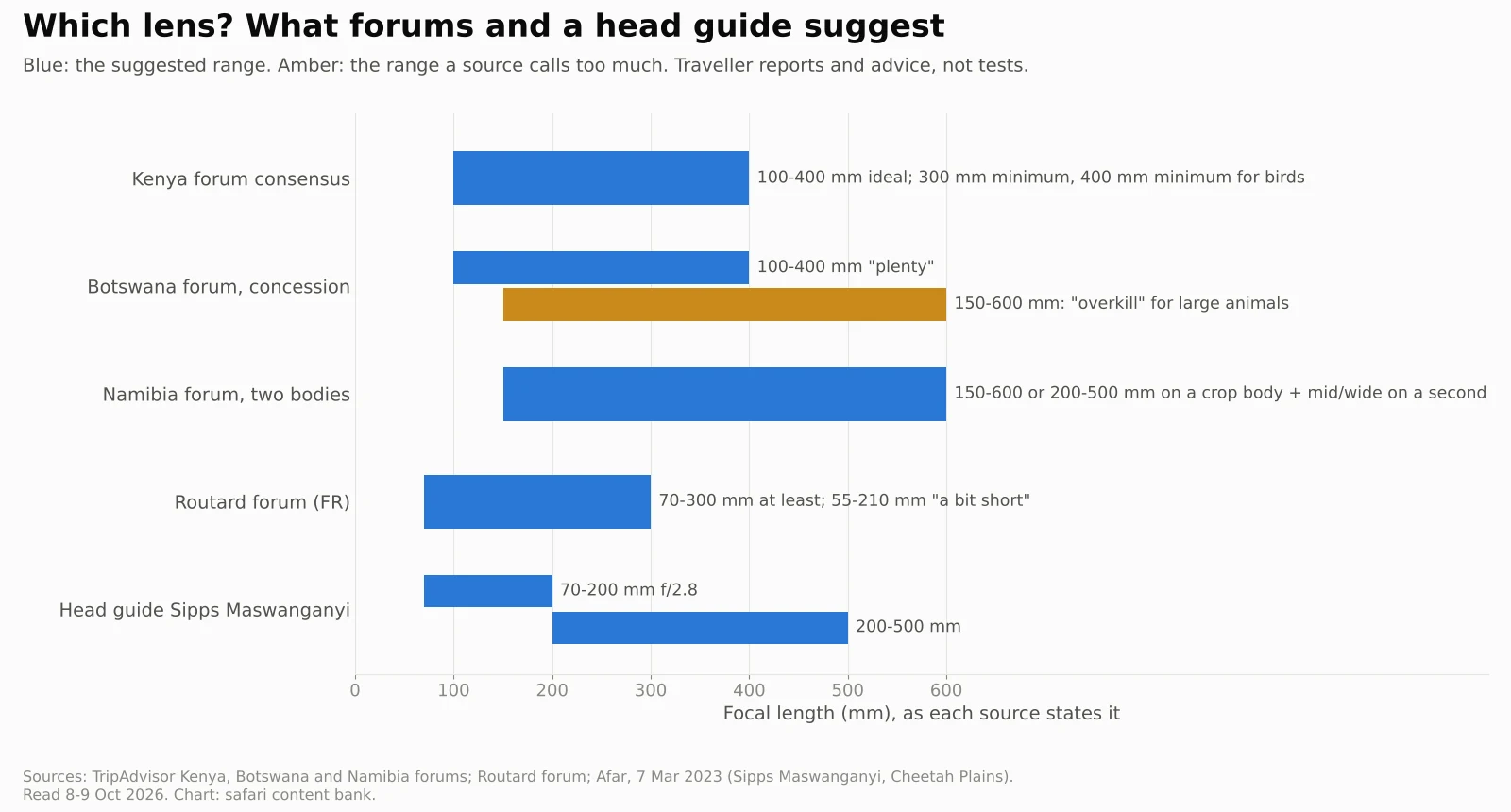 Focal lengths as each source states them (TripAdvisor Kenya, Botswana and Namibia forums; Routard; Afar, 7 Mar 2023). Read 8–9 October 2026. Chart: safari content bank.
Phone or camera?
No forum answer we have read settles “Is an iPhone enough?”, but every lens thread we did read puts the floor for wildlife at 300 mm or more. The Serengeti forum’s “Is an IPhone enough for pictures?” thread drew 35 replies by May 2026, one of the busiest of the year there; we hold the question, not the answers.
- The reach figures are about distance. The 300–400 mm floors in the threads are for cats, birds and animals far from the track; none of the threads we read says anything against a phone for landscapes or camp life.
- A bridge camera is the French forums’ middle answer: a long zoom with no lens to change, which keeps dust off the sensor (Routard forum posters).
- The camp may solve it for you. At Great Plains’ Duba Plains a professional camera and lens is in each tent (a safari operator’s guide). Ask your camp whether it lends gear before you buy any.
- Hiring in Nairobi is a live question: a TripAdvisor Kenya thread in October 2026 asks for a rental shop for binoculars and a camera. We have not read an answer and hold no rental prices.
Which lens, and the one you won’t use
For mammals, 100–400 mm is the forum consensus; for birds, posters want at least 400 mm, and 150–600 mm is the bird photographer’s lens. On private concessions, where vehicles may drive off-road to approach, posters say shorter is enough because you get closer (private concession vs national park).
| Your trip | Lens length the sources point to | Why | Source |
|---|---|---|---|
| Private concession (Botswana, Kenya’s conservancies) | 100–400 mm | Vehicles get close; 150–600 mm “overkill” for large animals | TripAdvisor Botswana forum |
| National park with road rules (Kenya, Tanzania) | 300 mm minimum, 100–400 mm ideal | Vehicles stay on tracks; see our photography safari page for off-road rules | TripAdvisor Kenya forum |
| Birds | 400 mm minimum; 150–600 mm | Small subjects at distance | TripAdvisor Kenya and Botswana forums |
| Namibia’s dunes and Etosha | Telephoto on one body, mid or wide on the other | Reach for wildlife, wide for dunes; dust “above all” | TripAdvisor Namibia forum |
| Gorillas and chimpanzees | No forum lens advice in our sources | — | See gorilla trekking day for photo distance rules |
Forum threads read 8–9 October 2026. Traveller reports.
- The mid zoom is the lens that stays in the bag. In the Botswana lens thread, posters reported leaving the 24–105 at home, and one wrote that they “hadn’t once used the 70-200”. The counter-argument in the same thread: zooming in too far loses the setting that makes a picture look like the place.
- Focal length replaces driving closer. Photographer Patrick Bentley tells guests to stay on tracks and use the lens rather than leave the road (TravelAwaits, 20 Aug 2021).
- Settings to start with, from guides at Sausage Tree in Olifants West (Greater Kruger): 1/1000 s or faster at f/5.6–8 with continuous autofocus for action; 1/500–1/1000 s at f/4–5.6 on the eye for still subjects (Sausage Tree, 12 Jan 2026).
Dust: why two bodies beat lens changes
Changing lenses in an open vehicle is how dust gets onto the sensor, so the sources keep the long lens on one body and the short one on another. If you own one body, the forums’ answer is a single long zoom or a bridge camera.
- Botswana in July: dust makes field lens changes “a bad idea”; bring a second body instead of a third lens (TripAdvisor Botswana forum).
- Namibia: “dust management above all”, and the main risk is changing lenses in the open; one poster got sensor dust despite care, so bring a sensor-cleaning kit (TripAdvisor Namibia forum).
- Dust or rain: do not change lenses in either, says Henk Venter (a safari operator’s blog, updated 9 May 2024).
- Dust is also a picture. Patrick Bentley counts dust, rain and shadow among the things that add mood (TravelAwaits, 20 Aug 2021).
Supports in the vehicle: bean bags, platforms, a monopod
The supports our sources name for vehicles are bean bags, lens platforms and a monopod; none of them recommends a tripod in a game-drive vehicle. Photographic vehicles often supply the support for you.
| Support | Where our sources mention it | Source |
|---|---|---|
| Bean bags, lens platforms, padded floors, side doors removed | Kicheche’s Mara camps, vehicles bookable exclusively | A safari operator’s photographic-safari guide |
| Bean-bag or clamp mounts | Photographic vehicles of 3–4 guests in Kenya, Tanzania, South Africa and Botswana | Our safari vehicles and photography safari pages |
| Monopod lowered beside the seat | For eye-level frames from a vehicle: “low is always better” | Sipps Maswanganyi, Afar, 7 Mar 2023 |
| Hides at water or eye level | Mashatu, Kaingo, Camp Hwange, Ol Donyo | See photography safari |
Read 8–9 October 2026.
- Tell the guide the angle before the action. The vehicle is placed before the moment and cannot be moved during it, say the Sausage Tree guides; “Tell them what angle you want” (photographer Mike Dexter, Sausage Tree, 12 Jan 2026).
- A shared vehicle will not be repositioned for one guest. That control is what a private vehicle buys; prices are on private vs group safari cost.
Binoculars
Take a pair each. A German-language Botswana forum packing answer lists binoculars next to a torch and a spare battery, and some camps supply them: Duba Plains puts binoculars as well as camera kit in each tent (our camp-group notes; agent-published).
- We do not recommend a magnification. Our sources hold no tested advice on 8×42 against 10×42 or any other size, so we leave it out.
- Rental: the October 2026 Kenya forum thread on renting binoculars and a camera in Nairobi has no answer we have read.
- Birders carry more glass: see birding safari.
Batteries, cards and charging
Carry enough batteries and memory cards for a day without power, and more for canoe trails, where there is no charging. Camp power and plugs by country are on safari Wi-Fi and charging.
| Situation | What to carry | Source |
|---|---|---|
| Every drive | Cards and batteries packed the night before | Sipps Maswanganyi, Afar, 7 Mar 2023 |
| Every trip | A spare battery and a plug adaptor | Henk Venter, a safari operator’s blog (updated 9 May 2024) |
| Multi-day canoe trail | Spare batteries; a waterproof camera or case; no charging on the trail | A safari operator’s canoeing guide; see canoe safari |
| Camps on solar | Charge when the camp’s power is on | Safari Wi-Fi and charging |
| Power banks on bush flights | We hold no airline’s rule; ask your airline | Safari Wi-Fi and charging |
Read 8–10 October 2026.
Weight: fitting the kit into a bush-flight bag
The smallest plane sets the limit: 15 kg per person including hand luggage in Kenya and Uganda, 20 kg in Botswana and on Auric Air in Tanzania, and 10 kg on Skeleton Coast fly-ins, with cameras inside the allowance on most carriers. The full carrier-by-carrier table, with excess-weight prices, is on photography safari and the safari packing list.
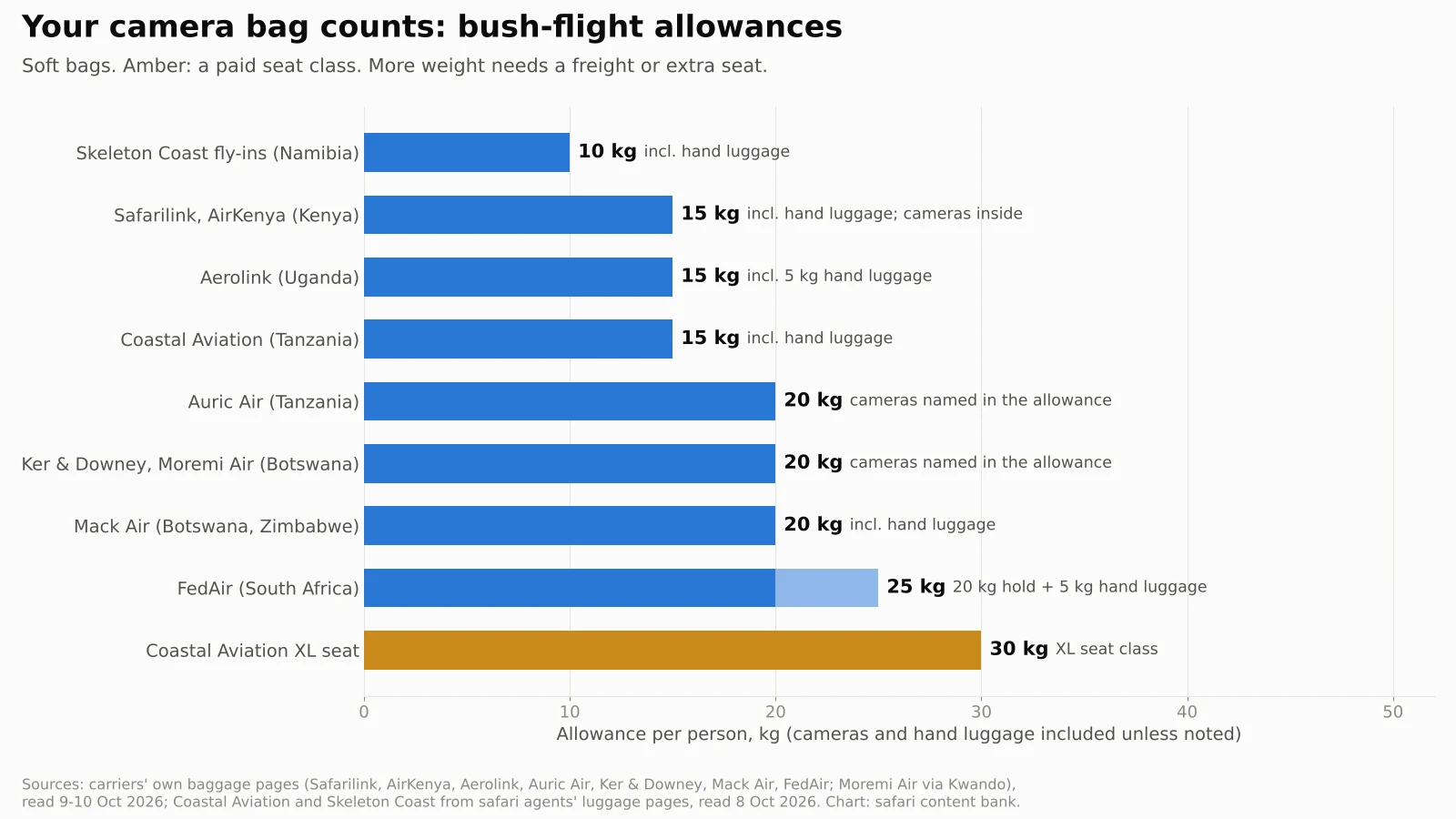 Carriers’ own baggage pages, read 9–10 October 2026, as on our photography-safari and packing-list pages; Coastal Aviation’s 15 kg and XL-seat 30 kg and the Skeleton Coast 10 kg from safari agents’ luggage pages. Chart: safari content bank.
- Cameras go at the back, not on your lap. A Botswana forum thread reports there is no overhead locker on a Cessna; camera bags travel behind a mesh at the back of the cabin, and if your gear cannot travel that way, buy an extra seat (traveller report).
- A 500–600 mm lens plus a second body often means an extra seat, say Botswana forum travellers; confirm the weight and the bag dimensions with the charter company, not the camp. The alternative they name is leaving gear in storage in Maun.
- The published ways to carry more: a freight seat with up to 75 kg on Safarilink’s safari routes at the adult fare; Kwando charges 50% of the seat rate for up to 15 kg extra; FedAir’s freight seat is R2,000 (photography safari, carriers’ pages read 9–10 October 2026). Coastal Aviation’s XL seat class raises the limit to 30 kg (safari agents’ luggage pages).
- Soft bags only on many carriers. Moremi Air refuses hard cases; Ker & Downey asks for a duffel with “no wheels or frames” (photography safari).
Rules that affect your kit
The rules that change what you pack are about drones, light at night and where you post rhino pictures.
- Drones need permits arranged before you travel in Kenya, Tanzania and Namibia, and SANParks bans them in and over its parks: see photography safari and safari etiquette.
- No flash; red or filtered light at night, never into the eyes (guides at Sausage Tree; Patrick Bentley in TravelAwaits). Do not whistle, clap or play calls to make an animal look up (Bentley).
- Strip GPS, EXIF data and geotags before posting rhino photos (Bentley); see where to see rhino.
- Photographing people needs consent: see safari etiquette.
Which set-up for which traveller
| If you are… | Take | Leave at home | Read next |
|---|---|---|---|
| A first-timer with a phone | The phone, binoculars, a power bank (check your airline) | Nothing extra; ask whether the camp lends a camera | First safari |
| A keen amateur with one body | One long zoom (100–400 mm class) or a bridge camera | The mid zoom posters report not using | Photography safari |
| A serious photographer | Two bodies: long zoom on one, wide or mid on the other; sensor-cleaning kit | Hard cases | Private vs group safari cost |
| A bird photographer | 400 mm or longer (150–600 mm class); possibly an extra seat for the weight | — | Birding safari |
| On a canoe trail | Waterproof case, spare batteries | Anything you cannot keep dry | Canoe safari |
| On a fly-in safari | A soft bag inside 15–20 kg, cameras included | Hard cases, a third lens | Fly-in safari cost |
From the sources in the tables above. Traveller reports and photographers’ advice, not tests.
Common mistakes with safari camera gear
| What you’ll often read | What our sources say |
|---|---|
| “You need the longest lens you can carry” | Not on a private concession. Botswana forum travellers call 150–600 mm overkill for large animals there; 100–400 mm is the consensus. Bird photographers are the exception. |
| “Bring a lens for every situation” | Travellers report the mid zoom stays in the bag: the 24–105 left at home, a 70–200 “not once used” (TripAdvisor Botswana forum). |
| “Change lenses as the sighting changes” | That is how dust reaches the sensor. Botswana and Namibia threads advise a second body instead. |
| “Hand luggage doesn’t count on bush flights” | It does on most carriers: 15 kg in Kenya and Uganda and 20 kg in Botswana include hand luggage and cameras. |
| “Bring a tripod for the vehicle” | None of our sources recommends one in a vehicle; they name bean bags, lens platforms and a monopod. |
| “Camp Wi-Fi will back up my pictures” | Don’t plan on it. Many camps run on solar with little or no connection; see safari Wi-Fi and charging. |
Frequently asked questions
What lens should I bring on safari? A 100–400 mm zoom is the forum consensus for mammals, with 300 mm called the minimum on TripAdvisor’s Kenya forum. For birds, posters want 400 mm or more, and the 150–600 mm class is the bird photographer’s lens. On a private concession, where vehicles get closer, Botswana forum travellers say 100–400 mm is plenty.
Is an iPhone enough for a safari? For distant cats and birds, every lens thread we read puts the floor at 300 mm or more, which is the case against a phone alone; none says anything against a phone for landscapes or camp life. The Serengeti forum’s “Is an iPhone enough?” thread drew 35 replies by May 2026, but we have not read the answers. Ask whether your camp lends a camera: Duba Plains does.
Should I bring two camera bodies? If you shoot seriously, yes: Botswana and Namibia forum posters keep a long zoom on one body and a wide or mid zoom on another, so they never change lenses in the dust. With one body, the forums’ alternative is a single long zoom or a bridge camera.
Do I need binoculars on safari? Yes, one pair each if you can. Binoculars are on forum packing lists, and some camps, such as Duba Plains, supply them in the tent. Our sources hold no tested advice on magnification, so we don’t recommend a size.
Can I take my camera gear on a bush flight? Yes, but inside the allowance: 15 kg per person including hand luggage in Kenya and Uganda, 20 kg in Botswana and on Auric Air in Tanzania, and 10 kg on Skeleton Coast fly-ins. Camera bags go behind a mesh at the back of the cabin, not on your lap. For a big lens and a second body, travellers book an extra seat; carrier rules are on our photography safari page.
Can I rent a camera or lens in Africa? Travellers ask about rental shops in Nairobi, but we hold no answer we have read and no rental prices. The surest option in our sources is a camp that lends gear: Great Plains’ Duba Plains puts a professional camera and lens in each tent and downloads your images when you leave.
How much does safari camera gear cost? We hold no current prices for cameras, lenses, binoculars or rentals, and we don’t estimate them. The only figures in our sources are Greg du Toit’s own from 2011: about ZAR 60,000 for a body and ZAR 100,000 for a lens, given to make the point that gear matters less than people think (Africa Freak).
Should I bring a tripod on a game drive? None of our sources recommends one in a vehicle. Photographic vehicles supply bean bags or clamp mounts and lens platforms, and head guide Sipps Maswanganyi suggests a monopod lowered beside the seat for eye-level frames.
Sources
- Traveller forums, traveller reports not facts: TripAdvisor Kenya, Photography on Safari… which lens?! and binoculars and camera for safari, rental shop in Nairobi; TripAdvisor Botswana, SLR lenses for private concessions, Botswana safari luggage, luggage for small flight transfers; TripAdvisor.de Botswana, Was sollte man für eine Safarireise einpacken?; TripAdvisor Namibia, general camera-lens combination strategy, advice on camera, camera question; TripAdvisor Serengeti, Is an IPhone enough for pictures? (question only); Routard, Demande conseil appareil photo pour safari; all as summarised in our source bank, read 8–9 October 2026
- Photographers and guides: Afar, 7 Mar 2023 (Sipps Maswanganyi); TravelAwaits, 20 Aug 2021 (Patrick Bentley); Africa Freak, Greg du Toit (2011, updated 4 Jul 2024); Sausage Tree, 12 Jan 2026; Henk Venter on a safari operator’s blog (updated 9 May 2024); all read 9 October 2026
- Camps and vehicles: a safari operator’s photographic-safari guide (Duba Plains loan cameras, Kicheche vehicles) and canoeing guide (charging on canoe trails), read 8 October 2026; Great Plains Conservation camp notes in our source bank (agent-published, the camp group’s rates page did not load)
- Luggage: carriers’ baggage pages as cited on our photography safari page, read 9–10 October 2026; safari agents’ luggage pages (Coastal Aviation, Skeleton Coast), read 8 October 2026
- More: photography safari, safari packing list, safari Wi-Fi and charging, safari vehicles, fly-in safari cost, Botswana bush flights
Checked 8–10 October 2026. We will update this page when we have read the open forum threads (iPhone, Nairobi rental) or a carrier changes its baggage rules.