 Experience

Last verified · Next check due
On this page
- Phones, SIMs, signal and plugs in each safari country (2026)
- Wi-Fi at lodges and camps
- Mobile signal in the main parks
- Local SIM or eSIM: country by country
- Plugs and voltage
- Charging in tented and mobile camps
- Camera batteries and CPAP machines
- Which set-up to plan for
- Common mistakes about Wi-Fi and power on safari
- Frequently asked questions
- Sources
Short answer: Expect camp Wi-Fi, not phone signal. Many camps in our sources include Wi-Fi in the rate, some by Starlink in every tent, while public campsites in Botswana, the Central Kalahari and one South Luangwa camp have no signal. Buy a local SIM with your passport; eSIMs are patchy in Tanzania and Namibia (traveller reports). All nine countries run on 220–240 V: Type G in East Africa, Type M in South Africa and Namibia. Solar camps may limit charging.
Key facts
- Wi-Fi is in the published rate at camps in Tanzania, Botswana, Namibia, South Africa and Zambia: Lemala’s Serengeti and Ndutu camps and Singita in Tanzania, Natural Selection and Xigera in Botswana, Wolwedans in Namibia, Sabi Sabi and Thornybush lodges in South Africa, and The Bushcamp Company in Zambia (their 2026 rate sheets). Kicheche advertises Starlink in every tent at its Mara camps (2026 rates).
- No phone signal at all, in our sources: Botswana’s SKL public campsites (Khwai, Savuti, Linyanti, Kumaga), the Central Kalahari, Kgalagadi outside Twee Rivieren, and Nsefu Camp in South Luangwa. Guides on a travel forum say no carrier works at Ndutu.
- A local SIM needs your passport: Kenya’s SIM registration rules (LN 163/2015) and Tanzania’s 2020 regulations require it. Safaricom’s Jambo tourist bundle costs KES 2,000 for 12 GB plus calls, or 22 GB data only.
- eSIMs are the weak link: travellers found an eSIM on Vodacom “very unstable” in Tanzania, eSIM packages for Namibia go in and out of stock, and Namibia’s main network, MTC, sells physical SIMs only (traveller reports).
- Plugs: Type G (UK-style) in Kenya and Uganda and among the types in Tanzania, Rwanda, Botswana, Zambia and Zimbabwe; Type M (large round pin) in Namibia and South Africa. All nine run at 220–240 V and 50 Hz (Wikipedia).
- Power in the bush is often solar: Ker & Downey says all its Botswana camps run on solar; &Beyond’s new Under Canvas camps list in-room power packs, USB ports and vehicle charging. There is no charging on multi-day canoe trails and no power in Kruger’s overnight hides.
Phones, SIMs, signal and plugs in each safari country (2026)
Plan on a local SIM for towns and transfers, camp Wi-Fi in the bush, and a Type G or Type M adaptor. The table gives the plug and voltage for each country (Wikipedia, as on our packing list), what our sources say about buying a SIM, and what they say about signal in the parks.
| Country | Plugs, voltage | Buying a SIM or eSIM | Signal in the parks | More |
|---|---|---|---|---|
| Kenya | G; 240 V, 50 Hz | Passport registration (LN 163/2015); Safaricom Jambo bundle KES 2,000; Safaricom and Airtel counters at Nairobi airport (traveller reports) | Limited in remote safari areas whatever the provider (traveller reports) | Kenya safari questions |
| Tanzania | D, G; 230 V, 50 Hz | Biometric registration with passport (2020 regulations); buy in an official shop; eSIM on Vodacom “very unstable” (traveller reports) | Airtel best in the northern parks; no carrier at Ndutu (guides on a travel forum) | Tanzania safari questions |
| Uganda | G; 240 V, 50 Hz | Not in our sources | Remote park offices may have no signal (traveller reports, Sep 2026) | Uganda safari questions |
| Rwanda | C, E, G (G official); 230 V, 50 Hz | Not in our sources; MTN mobile money is the local standard (traveller reports) | Not in our sources | Rwanda safari questions |
| Botswana | D, G, M; 230 V, 50 Hz | Passport registration; sold in towns, not small border posts (traveller reports) | None at SKL public campsites or in the Central Kalahari | Botswana safari questions |
| Namibia | D, M; 220 V, 50 Hz | MTC sells physical SIMs only, at Windhoek airport; eSIM stock intermittent (traveller reports) | Mainly in towns; patchy to absent in Etosha (traveller reports) | Namibia safari questions |
| South Africa | C, M, N; 230 V, 50 Hz | Unlocked phone and proof of address; dearer at the airport (traveller reports, older thread) | Kruger: phones only in camps, at gates or in emergencies; Kgalagadi: reception only at Twee Rivieren (SANParks) | South Africa safari questions |
| Zambia | C, D, G; 230 V, 50 Hz | Not in our sources | Nsefu Camp, South Luangwa: no mobile reception (the camp) | Zambia safari questions |
| Zimbabwe | D, G; 220 V, 50 Hz | Not in our sources | Victoria Falls: eSIM data too weak to rely on (one traveller, Aug 2026) | Zimbabwe safari questions |
Plug and voltage data: Wikipedia, Mains electricity by country, read 8 October 2026; the page warns that its data may be out of date, and we hold no IEC or national-standards list. “Not in our sources” means we hold no checked source, not that none exists: ask your camp or operator, or the network’s own shop on arrival.
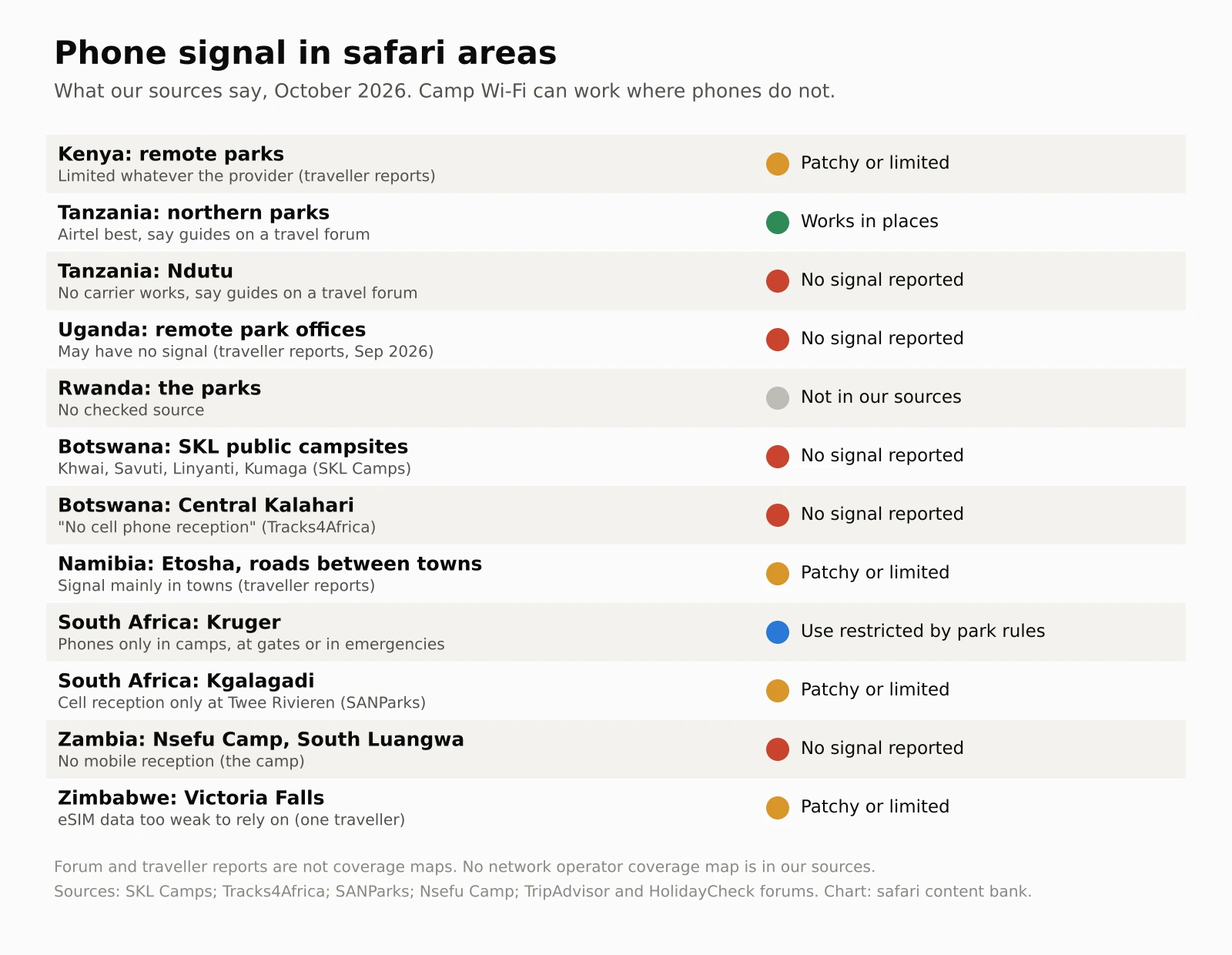 Forum and traveller reports are not coverage maps, and we hold no network operator’s coverage map. Sources: SKL Camps; Tracks4Africa; SANParks; Nsefu Camp; TripAdvisor and HolidayCheck forums. Chart: safari content bank.
Wi-Fi at lodges and camps
Wi-Fi is now part of the rate at many camps, but where you can use it, and whether it reaches your tent, varies camp by camp. Ask each camp before you rely on it for work.
- Included in the rate (camps’ own 2026 rate sheets): Lemala’s camps in Tanzania include “house drinks, Wi-Fi and laundry”, its seasonal Ndutu and Mara River camps included (Lemala rates); Singita’s Grumeti and Serengeti lodges and camps list WiFi (Singita rates); Natural Selection lists “Wi-Fi, guest laundry” in Botswana (2026 rack, PDF); Xigera includes in-suite Wi-Fi (Xigera); Wolwedans includes WiFi (2026 rates, PDF); Sabi Sabi (rates) and the Thornybush lodges (2026 rack, PDF) in the Greater Kruger; The Bushcamp Company in South Luangwa (2026 rates, PDF).
- Great Plains lists Wi-Fi in all its Botswana camps, with a note that it is limited to guests’ accommodation (2025 published rates, PDF).
- Satellite internet has reached the smallest camps. &Beyond’s Sandibe and Nxabega Under Canvas camps, opened in June 2026 with three tents each, have Starlink Wi-Fi (Tourism Update, 2 Jun 2026), and Kicheche advertises Starlink in every tent at its Mara camps (Kicheche 2026 rates, PDF).
- Camp Wi-Fi can work where phones do not. Lemala’s Ndutu camp includes Wi-Fi, while guides on the TripAdvisor Tanzania forum say no mobile carrier works at Ndutu (TripAdvisor). A traveller buying a SIM in Arusha was told that camp Wi-Fi is usually enough for email (TripAdvisor, traveller reports).
- In Etosha’s park camps, Wi-Fi is limited and often paid, travellers on the TripAdvisor Etosha forum report (Etosha).
Camps with little or no connection
Some places have no connection at all, and some camps keep Wi-Fi out of the tents. Check before you book if you must stay reachable; if you want to switch off, these are the places to look.
- Botswana’s public campsites: SKL Camps lists no fuel, no phone signal and no internet at its sites in Khwai, Savuti, Linyanti and Kumaga (SKL Camps; Savuti). The Central Kalahari has “no firewood, no fuel, no cell phone reception and no shops” (Tracks4Africa; Central Kalahari).
- Kgalagadi: Twee Rivieren is the only camp with 24-hour electricity and cell reception (SANParks; Kgalagadi).
- South Luangwa: Nsefu Camp has no mobile reception, according to its operator’s own information (Nsefu Camp; South Luangwa).
- High-end camps without in-room Wi-Fi: guest reviews of a high-end Linyanti camp on an agent’s site list the lack of Wi-Fi in the rooms among their complaints. TripAdvisor Botswana forum regulars say Wi-Fi is increasingly available in the main area, rarely in tents, and that some camps switch it off on purpose (TripAdvisor, traveller reports).
Mobile signal in the main parks
Assume no signal on game drives, and tell people at home you may be out of contact for a day at a time. Our sources hold no network operator’s coverage map for any park; what follows is what parks, camps and travellers report.
- Masai Mara and Kenya’s parks: coverage in remote safari areas is limited whatever the eSIM provider, German forum members say (HolidayCheck, “eSIM Kauf”). One forum member found Safaricom’s coverage better than Airtel’s, and its bundles dearer (HolidayCheck, 2024, a traveller report). See Masai Mara.
- Serengeti and northern Tanzania: guides say Airtel is best in the northern parks and no carrier works at Ndutu; travellers advise avoiding Halotel for the parks. One traveller found coverage “wasn’t 100% but surprisingly good” across Tarangire, the Serengeti, Ndutu and Ngorongoro with an eSIM that switches between Vodacom, Airtel and Yas (TripAdvisor, a single report). See Serengeti.
- Uganda: remote park offices may have no phone signal or reliable card payment, travellers on the TripAdvisor Uganda forum warned in September 2026 (TripAdvisor).
- Rwanda: we hold no checked source on signal in Volcanoes, Nyungwe or Akagera. Ask your lodge.
- Okavango, Moremi, Chobe and Savuti: none at SKL’s public campsites (above); our sources hold no coverage data for the private concessions, where camps provide Wi-Fi. See Okavango Delta.
- Etosha and Namibia’s roads: expect signal mainly in towns and none between them; download offline maps before you leave (Namibia safari questions).
- Kruger: SANParks allows mobile phones only in camps, at gates or in emergencies (SANParks rules; Kruger).
- Victoria Falls: an August 2026 trip report found eSIM data too weak to rely on (TripAdvisor, a traveller report; Victoria Falls).
Local SIM or eSIM: country by country
Where our sources cover it, a physical SIM bought in an official shop, with your passport, beats an eSIM bought at home. Uganda, Rwanda, Zambia and Zimbabwe are gaps in what we hold.
Kenya: Safaricom with your passport
- A foreigner registers a SIM with “an original and valid passport or an original alien card” (SIM-Card Registration Regulations, LN 163/2015).
- Safaricom’s Jambo tourist bundles cost KES 2,000 for 12 GB plus 400 local and 100 international minutes, or 22 GB data only, for tourists in their first 90 days on the network; buy them by dialling *444# (Safaricom FAQ).
- Safaricom and Airtel have counters in the arrivals hall at Nairobi’s airport, and the Safaricom shop sets up M-Pesa with your passport, travellers report (TripAdvisor; safari money).
Tanzania: official shops only
- SIM registration is biometric, with categories for visitors and foreigners, under regulations published on 7 February 2020 (FB Attorneys, 14 Feb 2020, a law firm’s summary). TCRA’s own visitor guidelines could not be read.
- Buy from an official shop with your passport: two SIMs bought from unauthorised sellers both failed (TripAdvisor, traveller reports).
- eSIMs: travellers found an eSIM on Vodacom “very unstable”, and an August 2026 report says you cannot buy an eSIM directly in Tanzania; a physical SIM was converted in an official store (TripAdvisor, traveller reports).
- Kenya’s M-Pesa does not work in Tanzania (Tanzania safari questions).
Namibia: a physical MTC SIM
- MTC, the main network, sells physical SIM cards only, available at Windhoek airport; international eSIM packages for Namibia go in and out of stock, and one poster found eSIMs work “just in towns” (TripAdvisor; TripAdvisor, traveller reports).
Botswana and South Africa: registration rules differ
- Botswana: SIMs from Mascom, Orange and BTC need passport registration and are sold in towns such as Kasane, Maun and Gaborone rather than at border posts; no single SIM covers Botswana and South Africa at local rates (TripAdvisor.de, traveller reports).
- South Africa: a local SIM needs an unlocked phone and proof of address, and costs more at the airport (TripAdvisor, posts from about 2014). Check current rules with the network on arrival (South Africa safari questions).
Uganda, Rwanda, Zambia and Zimbabwe: what we hold
- We hold no checked source on buying a SIM or eSIM in these four countries. Travellers keep asking (threads on SIM cards at Kigali and Victoria Falls airports, and on eSIMs for Zimbabwe, went unanswered in our research). Ask your operator, or the network’s shop on arrival.
- Rwanda: MTN mobile money is the local standard, TripAdvisor forum members report (Rwanda safari questions).
Plugs and voltage
Every one of the nine countries runs at 220–240 V and 50 Hz, so a charger made only for 110–120 V will not work there. Most phone, laptop and camera chargers are marked for a range of voltages; check the label.
- Which adaptor: a Type G (UK-style) adaptor for Kenya and Uganda; Type M (large three-round-pin) for Namibia and South Africa; Botswana uses D, G and M. The full table and a chart are on our safari packing list.
- Sockets vary by building: in Rwanda, Type E persists in older buildings although G is the official standard (Wikipedia). Lodges may fit other sockets, so check with your camp.
- Namibia: travellers on the TripAdvisor Namibia forum flag the large round-pin plug as the type most visitors do not own (Namibia safari questions).
We hold no IEC or national-standards list for plug types; the data above is Wikipedia’s, which warns it may be out of date.
Charging in tented and mobile camps
Bush camps run on solar more and more, and solar often means scheduled charging, or charging in the main area rather than your tent. Ask your camp where and when you can charge before you pack.
- Solar camps: Ker & Downey says all its Botswana camps “have been successfully converted to solar power” (Ker & Downey FAQ); Porini Lion Camp in Olare Motorogi is solar powered (fact sheet 2026, PDF); Kicheche’s camps are solar powered (its website). An agent describes one three-tent Mara camp as having limited electricity.
- In-room and vehicle charging: &Beyond’s Sandibe and Nxabega Under Canvas camps list solar power with in-room power packs, USB ports and vehicle charging (Tourism Update, 2 Jun 2026). Whether a vehicle has charging is one of the questions to put to your operator (safari vehicles).
- Inverters and medical devices: one safari operator’s accessibility checklist tells travellers to ask about power for medical devices overnight, because many camps run on solar power and inverters (accessible safari).
- Where to charge: solar power often means charging in the main area, not in the tent (safari lodge vs tented camp). For mobile and fly-camps, see mobile safaris.
- No power at all: there is no charging on multi-day canoe trails (canoe safaris); Kruger’s Sable Dam and Shipandani overnight hides supply bedding but no power (SANParks tariffs 2024/25, PDF).
- Self-drive campsites in Namibia: Gondwana’s Palmwag, Namib Desert and Etosha Safari campsites have power at each pitch (Gondwana Collection); Okonjima’s Omboroko campsites have 220 V electricity (Okonjima 2026 rates, PDF); NWR’s Waterberg has “camping with power points” and Spitzkoppe’s community rest camp has no power (two booking sites’ listings). More on campsites: camping safaris.
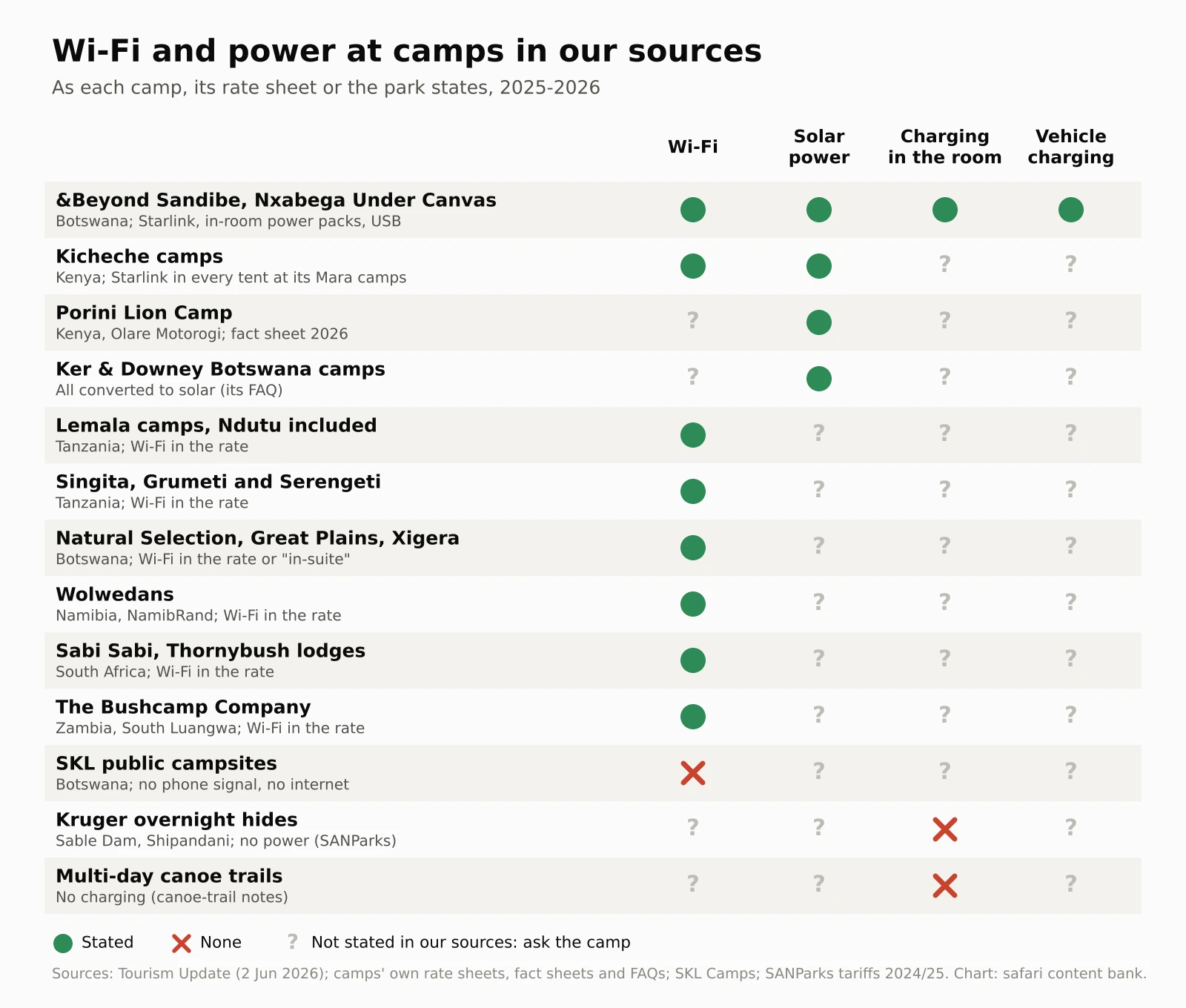 A question mark means the camp’s material in our sources does not say, not that the camp lacks it. Sources: Tourism Update (2 Jun 2026); the camps’ own rate sheets, fact sheets and FAQs; SKL Camps; SANParks tariffs 2024/25. Chart: safari content bank.
Camera batteries and CPAP machines
Bring enough batteries to get through a day with no charging, and agree overnight power for any medical device with the camp in writing before you book.
- Camera batteries: carry spare batteries and memory cards, and charge whenever the camp’s power is on; on canoe trails carry spares and a waterproof case, because there is no charging (safari packing list). Camera gear counts inside the 15–20 kg bush-flight bag limits on the same page. More on kit: photography safaris.
- CPAP and other medical devices: our sources hold no camp’s published rule on CPAP machines. The one line we have is the accessibility checklist above: ask about power for medical devices overnight, because many camps run on solar and inverters. Ask the camp whether power in your room runs all night, at what voltage and socket, and whether you need your own battery; ask your airline and device maker about carrying the device and any spare battery. See also safaris for seniors.
- Power banks: we hold no airline’s rule on carrying them on bush flights; check with your airline before you fly.
Which set-up to plan for
Match your phone and power plan to how you travel: fly-in camps provide Wi-Fi and charging; self-drive campsites may provide neither.
| If you are… | Plan for | Why |
|---|---|---|
| On a lodge or camp safari in Kenya or Tanzania | A Safaricom or official-shop Tanzanian SIM; camp Wi-Fi in the bush | Passport registration is required; signal is limited in remote parks |
| On a fly-in camp safari in Botswana or Zambia | Camp Wi-Fi; spare batteries; little use for a SIM in camp | Many camps include Wi-Fi; Nsefu Camp has no mobile reception; camps run on solar |
| Self-driving in Namibia | A physical MTC SIM; offline maps; a Type M adaptor | eSIM stock is intermittent and signal is mainly in towns |
| Self-driving in Botswana’s parks | A satellite phone or communicator; a 12 V charging set-up in the car | No phone signal or internet at SKL campsites or in the Central Kalahari |
| In Kruger | A local SIM for camps; phones away on drives | SANParks allows phones only in camps, at gates or in emergencies |
| On a canoe trail or in a Kruger hide | Fully charged spares for every device | No charging on multi-day canoe trails; no power in the hides |
| Travelling with a CPAP machine | Written confirmation of overnight power; your own battery if unsure | Many camps run on solar and inverters |
Rules and reports as in the sections above, checked 8–10 October 2026. Some Maun 4x4 rental firms include a satellite phone (Botswana self-drive); the 12 V set-up is our advice, not a sourced rule.
Common mistakes about Wi-Fi and power on safari
| What you’ll often read | What is correct |
|---|---|
| “Buy an eSIM before you fly and you’re covered” | Travellers found an eSIM on Vodacom “very unstable” in Tanzania; Namibia’s MTC sells physical SIMs only, and eSIM stock comes and goes. |
| “Luxury camps have Wi-Fi in every tent” | Some do, such as Kicheche’s Mara camps with Starlink; guests at a high-end Linyanti camp found none in the rooms. |
| “No phone signal means no internet” | Camp Wi-Fi can work where phones do not: Lemala’s Ndutu camp includes Wi-Fi where guides say no carrier works. |
| “Any SIM seller at the airport will do” | Buy in an official shop with your passport; two Tanzanian SIMs from unauthorised sellers both failed. |
| “A US charger works with an adaptor” | Only if it is rated for 220–240 V; all nine countries run at 220–240 V and 50 Hz. |
| “One European adaptor covers the trip” | East Africa uses Type G; Namibia and South Africa use Type M. |
| “You can use your phone anywhere in Kruger” | SANParks allows phones only in camps, at gates or in emergencies. |
| “You can charge in your tent” | At solar camps, charging is often in the main area; canoe trails and Kruger’s hides have no power at all. |
Frequently asked questions
Is there Wi-Fi on safari? At many camps, yes. Lemala, Singita, Natural Selection, Xigera, Wolwedans, Sabi Sabi, Thornybush and The Bushcamp Company include Wi-Fi in their 2026 rates, and some camps now use Starlink. It may be limited to the main area, and public campsites in Botswana have no internet.
Will my phone work on game drives? Usually not reliably. Coverage in remote Kenyan parks is limited whatever the provider; no carrier works at Ndutu, say guides; Botswana’s SKL campsites and the Central Kalahari have no signal (traveller reports and SKL Camps). In Kruger, SANParks allows phones only in camps, at gates or in emergencies.
Should I buy a local SIM or an eSIM? Where our sources cover it, a local SIM. Kenya and Tanzania register SIMs with your passport; Safaricom’s tourist bundle costs KES 2,000. Travellers report eSIMs unstable in Tanzania and Namibia, and Namibia’s MTC sells physical SIMs only.
What plug adaptor do I need for a safari? Type G (UK-style) for Kenya and Uganda, and among the types in Tanzania, Rwanda, Botswana, Zambia and Zimbabwe; Type M for Namibia and South Africa. All nine countries run at 220–240 V and 50 Hz, so check that your chargers accept that range.
Can I charge camera batteries in a tented camp? Usually, but often on solar power and sometimes only in the main area. Ker & Downey’s Botswana camps run on solar; &Beyond’s Under Canvas camps have in-room power packs and vehicle charging. There is no charging on multi-day canoe trails, so carry spares.
Can I use a CPAP machine on safari? Our sources hold no camp rule on CPAP machines. Many camps run on solar power and inverters, so ask the camp in writing whether your room has power all night, and bring your own battery if it cannot confirm it.
Are there safari camps without Wi-Fi? Yes. Botswana’s SKL public campsites list no internet or phone signal, the Central Kalahari has no cell reception, and Nsefu Camp in South Luangwa has no mobile reception. Forum regulars say some Botswana camps switch Wi-Fi off on purpose.
Do I need a satellite phone for self-drive? In Botswana’s parks it is wise: SKL Camps lists no phone signal at its campsites, and some Maun rental firms include a satellite phone with the car. In Namibia, signal is mainly in towns (traveller reports), so download offline maps and tell someone your route.
Sources
- Plugs and voltage: Wikipedia, Mains electricity by country, read 8 Oct 2026 (no IEC list held)
- Kenya: SIM-Card Registration Regulations, LN 163/2015; Safaricom, Jambo tourist bundles FAQ; Kicheche 2026 rates (PDF); Porini Lion Camp fact sheet 2026 (PDF); read 8–9 Oct 2026
- Tanzania: FB Attorneys, SIM card registration regulations, 14 Feb 2020; Lemala rates; Singita rates; read 8–9 Oct 2026
- Botswana: SKL Camps; Tracks4Africa, Central Kalahari; Ker & Downey Botswana FAQ; Natural Selection 2026 rack (PDF); Great Plains 2025 published rates (PDF); Xigera; Tourism Update, 2 Jun 2026; read 8–10 Oct 2026
- Namibia: Wolwedans 2026 rates (PDF); Gondwana Collection campsites; Okonjima 2026 rates (PDF); NWR Waterberg and Spitzkoppe via two booking sites’ listings; read 8–10 Oct 2026
- South Africa: SANParks rules; SANParks, Kgalagadi; SANParks tariffs 2024/25 (PDF); Sabi Sabi rates; Thornybush 2026 rack (PDF); read 9–17 Oct 2026
- Zambia: Nsefu Camp; The Bushcamp Company 2026 rates (PDF); read 8 Oct 2026
- Traveller reports (forum posts, not fact): TripAdvisor threads on eSIMs in Tanzania, an eSIM that worked on safari, buying a SIM in Arusha, SIMs at Nairobi airport, a Namibia eSIM, Airalo in Namibia, Wi-Fi in Botswana camps, Botswana and South Africa SIMs, South Africa first-timers, a Uganda primate itinerary, Victoria Falls, and the Namibia and Etosha forums; HolidayCheck Kenya threads on eSIMs and SIM cards; read June–October 2026
- Operators and agents (names and links kept in our editor notes): a safari operator’s accessibility checklist; an agent’s guest reviews of a Linyanti camp; an agent’s description of a Mara camp; a safari agent’s canoe-trail notes
More practical guides: safari packing list, safari money, photography safaris and safari lodge vs tented camp.
Connectivity and power details checked 8–17 October 2026. We will update this page when we can read TCRA’s visitor SIM guidelines, a network operator’s coverage map for the main parks, SIM rules for Uganda, Rwanda, Zambia and Zimbabwe, or an IEC or national plug standard for the nine countries.