 Experience

Last verified · Next check due
On this page
- Where to see flamingos: places, species and fees (2026)
- Which flamingo place fits your safari?
- Kenya: Lake Nakuru, Bogoria and Elementaita
- Tanzania: Lake Natron, Lake Manyara and Ngorongoro
- Botswana: Sua Pan and Nata Bird Sanctuary
- Namibia: Walvis Bay and Etosha Pan
- What it costs to see flamingos
- Common mistakes about flamingos on safari
- Frequently asked questions
- Sources
Short answer: In East Africa, try Kenya’s Lake Bogoria, Lake Nakuru and Lake Elementaita and Tanzania’s Lake Natron, East Africa’s only regular lesser flamingo breeding site. Numbers rise and fall with the water: Lake Nakuru grew 91% in area between 2009 and 2022 and the algae flamingos eat halved. In southern Africa, Walvis Bay lagoon holds lesser and greater flamingos; Sua Pan and Etosha Pan draw them only after good rains, typically February–April in Etosha.
Key facts
- East Africa holds more than three quarters of the world’s lesser flamingos, according to a 2024 study of 22 soda lakes in Ethiopia, Kenya and Tanzania (Natural History Museum, on Byrne et al. 2024).
- Rising water, not drought, is the problem in East Africa. The lakes that expanded most, Bogoria, Nakuru and Elementaita in Kenya and the northern Tanzanian lakes, lost the most flamingo food, and bird numbers fell as lake area grew (same study).
- The lesser flamingo is Near Threatened (BirdLife, 2018), because it is declining and breeds at very few sites: Lake Natron, Etosha Pan, the Makgadikgadi and Kamfers Dam in South Africa (Wikipedia, secondary).
- Lake Nakuru once held more than a million birds at a time (Natural History Museum). Its flocks left between 2014 and 2018, began returning in 2020 and were short of food in 2023.
- No source we can cite gives a current total for any lake. UNESCO’s own page on the Kenya Lake System gives two different figures for the lesser flamingos moving between its three lakes, so we print neither.
- Southern Africa’s flamingos follow the rain. Etosha Pan holds water only after exceptional rain, and Nata Bird Sanctuary’s flamingos arrive after the rains; in a dry year they may not come at all.
Where to see flamingos: places, species and fees (2026)
Kenya’s Rift Valley lakes and Lake Natron are the lesser flamingo’s East African home; in southern Africa, Walvis Bay lagoon on the coast does not depend on a pan flooding, while Sua Pan and Etosha Pan need rain. No place below can promise a flock on a given day.
| Place | Country | Flamingos (our sources) | When | Fee to be there, per adult | Source |
|---|---|---|---|---|---|
| Lake Nakuru | Kenya | Once more than a million at a time; flocks left 2014–2018, back from 2020, short of food in 2023 | Any month; depends on the lake level | US$90 per non-resident adult per 24 hours (KWS) | Natural History Museum; Kenya News Agency; Nation |
| Lake Bogoria | Kenya | Part of the Kenya Lake System; among the lakes that lost the most flamingo food | Any month; depends on the lake level | No verified fee in our sources | UNESCO; Natural History Museum |
| Lake Elementaita | Kenya | Part of the Kenya Lake System; among the lakes that lost the most flamingo food | Any month; depends on the lake level | US$50 per non-resident adult per 24 hours (KWS) | UNESCO; Natural History Museum; KWS fees |
| Lake Natron | Tanzania | East Africa’s only regular lesser flamingo breeding site | No month published in our sources | No official fee schedule found | Natural History Museum |
| Lake Manyara | Tanzania | About 1.9 million lesser and 40,000 greater flamingos in a 1991 survey, the last count we can cite | Birds best March–May (one safari operator) | US$59 a day (US$53.10, 15 March–15 May) (last published tariff, 2023/24) | Wikipedia (secondary); TANAPA 2023/24 |
| Lake Magadi, Ngorongoro Crater | Tanzania | A soda lake on the crater floor; no count or season in our sources | Not published | US$70.80 entry + US$295 per vehicle per descent (NCAA’s page does not say whether VAT is included) | NCAA tariffs |
| Sua Pan and Nata Bird Sanctuary, Makgadikgadi | Botswana | Sua Pan holds one of southern Africa’s two greater flamingo breeding populations | After the rains, if the pan floods | Park fee P190 a day (last published DWNP schedule, 1 April 2022); Nata’s fee not in our sources | Wikipedia, Makgadikgadi Pan; Wikipedia, Nata Bird Sanctuary |
| Walvis Bay lagoon | Namibia | Lesser and greater flamingos; a Ramsar wetland | All year; Namibia’s birding peak is November–April | No park fee for the lagoon in our sources; Sandwich Harbour N$150 | Ramsar; a safari booking site; Government Notice 115 of 2026 |
| Etosha Pan, Etosha | Namibia | The other southern African greater flamingo breeding population; birds only when the pan floods | February–April, in wet years only | N$280 per foreign adult + N$60 per car | A safari agent’s Etosha guide; Government Notice 115 of 2026 |
Read 8–10 October 2026. Fees per non-resident or foreign adult, copied from our Kenya, Tanzania, Ngorongoro, Botswana and Namibia fee pages. Botswana’s fee line is the last published DWNP schedule; no official current tariff is published. Uganda’s Queen Elizabeth National Park also has flamingos, on Lake Munyanyange from August to November (UWA brochure; see Queen Elizabeth).
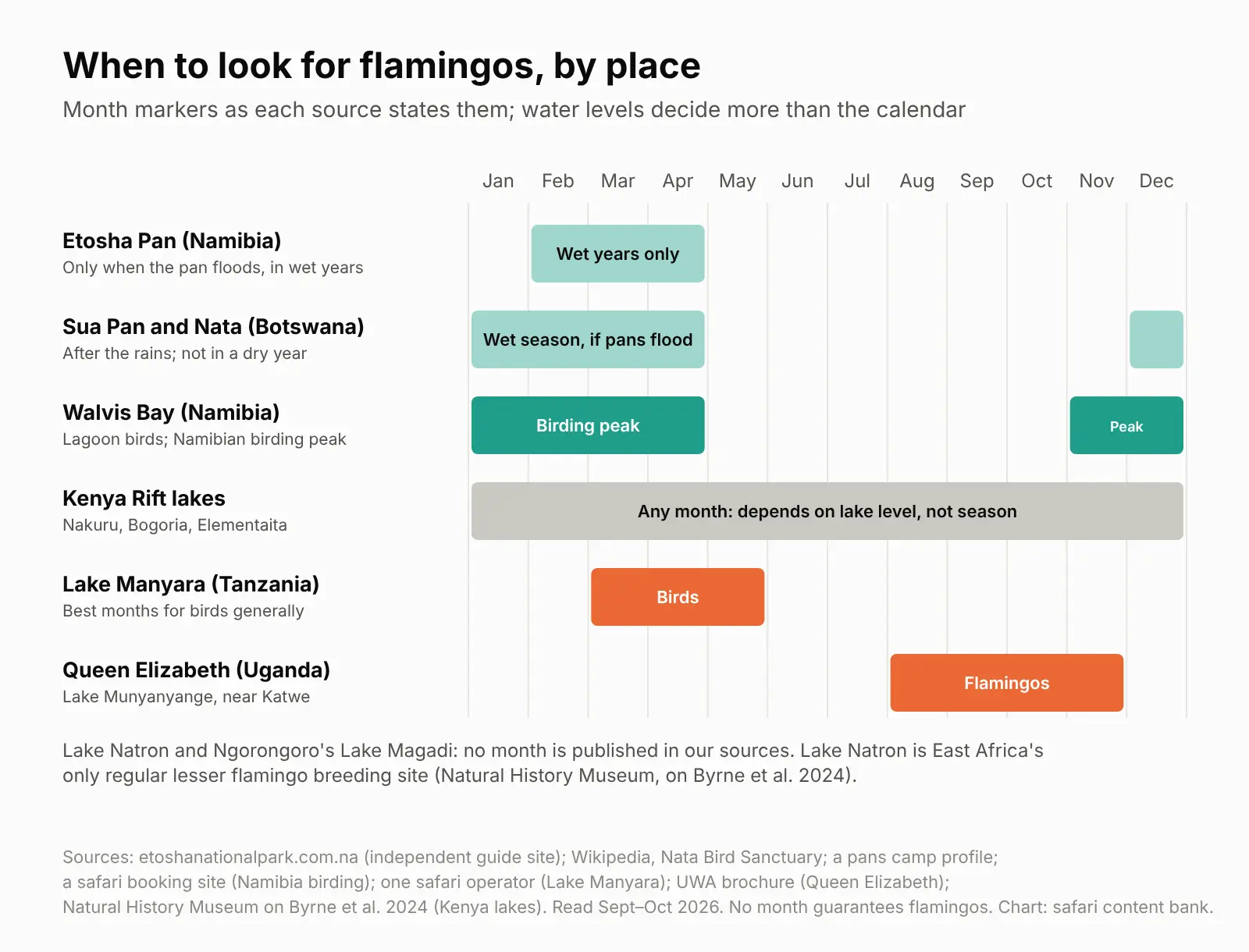 Month markers as each source states them; water levels decide more than the calendar. Sources: a safari agent’s Etosha guide; Wikipedia, Nata Bird Sanctuary; a pans camp profile; a safari booking site (Namibia birding); one safari operator (Lake Manyara); UWA brochure (Queen Elizabeth); Natural History Museum on Byrne et al. 2024. Chart: safari content bank.
Which flamingo place fits your safari?
Match the flamingo stop to the safari you are already planning: a Kenya Rift Valley lake on a Kenya road trip, Lake Manyara or the crater on Tanzania’s northern circuit, Lake Natron as a detour, and Walvis Bay, Etosha or the Makgadikgadi in southern Africa.
| If your safari is… | Add | Why | Watch out for |
|---|---|---|---|
| Kenya by road (Nairobi, Naivasha, the Mara) | Lake Nakuru | 156 km from Nairobi, about 3.5 hours; about 450 bird species (KWS) | Flamingos are a bonus, not a promise |
| Kenya, keen birder with time | Lake Bogoria or Elementaita | The other two Kenya Lake System lakes | A Routard regular calls Bogoria very far; no verified Bogoria fee |
| Tanzania’s northern circuit | Lake Manyara, then Ngorongoro Crater | Both on the road from Arusha to the Serengeti | The last Manyara count we can cite is from 1991 |
| Tanzania, between Manyara and the northern Serengeti | Lake Natron | The breeding lake; 110 km from Mto wa Mbu | Rough roads; no official fee schedule found |
| Namibia self-drive | Walvis Bay and Etosha | The coast holds flamingos; Etosha’s pan only in wet years | Etosha’s pan is bone dry in most years |
| Botswana, Maun to Nata | Sua Pan and Nata Bird Sanctuary | One of southern Africa’s two greater flamingo breeding populations | Wet pans are dangerous to drive; birds may not come in a dry year |
Distances and times from our Lake Nakuru, Lake Manyara, Mara to Serengeti and Makgadikgadi pages, read 8–10 October 2026.
Kenya: Lake Nakuru, Bogoria and Elementaita
Lake Nakuru, Lake Elementaita and Lake Bogoria have formed the Kenya Lake System World Heritage Site since 2011, and all three lost flamingo food as their water rose (UNESCO; Natural History Museum). Treat flamingos on any of them as a bonus.
- Lake Nakuru’s surface grew by 91% between 2009 and 2022, and the algae flamingos eat halved (Natural History Museum). The flamingos “started flying away in 2014 before leaving the park in 2018” and were flocking back in 2020, when the main gate was fully submerged (Kenya News Agency, 9 Nov 2020); in July 2023 they were present but short of food (Nation, 26 Jul 2023).
- Come to Nakuru for its birds, with flamingos as a bonus. KWS lists about 450 bird species, and UNESCO names the three lakes a major great white pelican nesting ground with 13 globally threatened bird species. Choosing between Nakuru’s birds and Amboseli’s elephants: Lake Nakuru vs Amboseli.
- Lake Nakuru charges US$90 per non-resident adult per 24 hours (child under 18, 5 and under free, US$45), and Lake Elementaita US$50 (KWS, Legal Notice 160 of 2025, in force 1 October 2025). We have no verified fee for Lake Bogoria.
- Getting there: Lake Nakuru is 156 km from Nairobi, about 3.5 hours by road, and about an hour from Lake Naivasha (our Lake Nakuru page). Asked in October 2026, a TripAdvisor destination expert suggested two nights at Naivasha with a drive to Nakuru, and said flamingo numbers depend on lake levels (TripAdvisor).
- Ask before you go. Routard forum travellers reported few flamingos in late June and a park reduced by rising water in October 2025 (traveller reports). Gates have moved with the lake, so ask which is open.
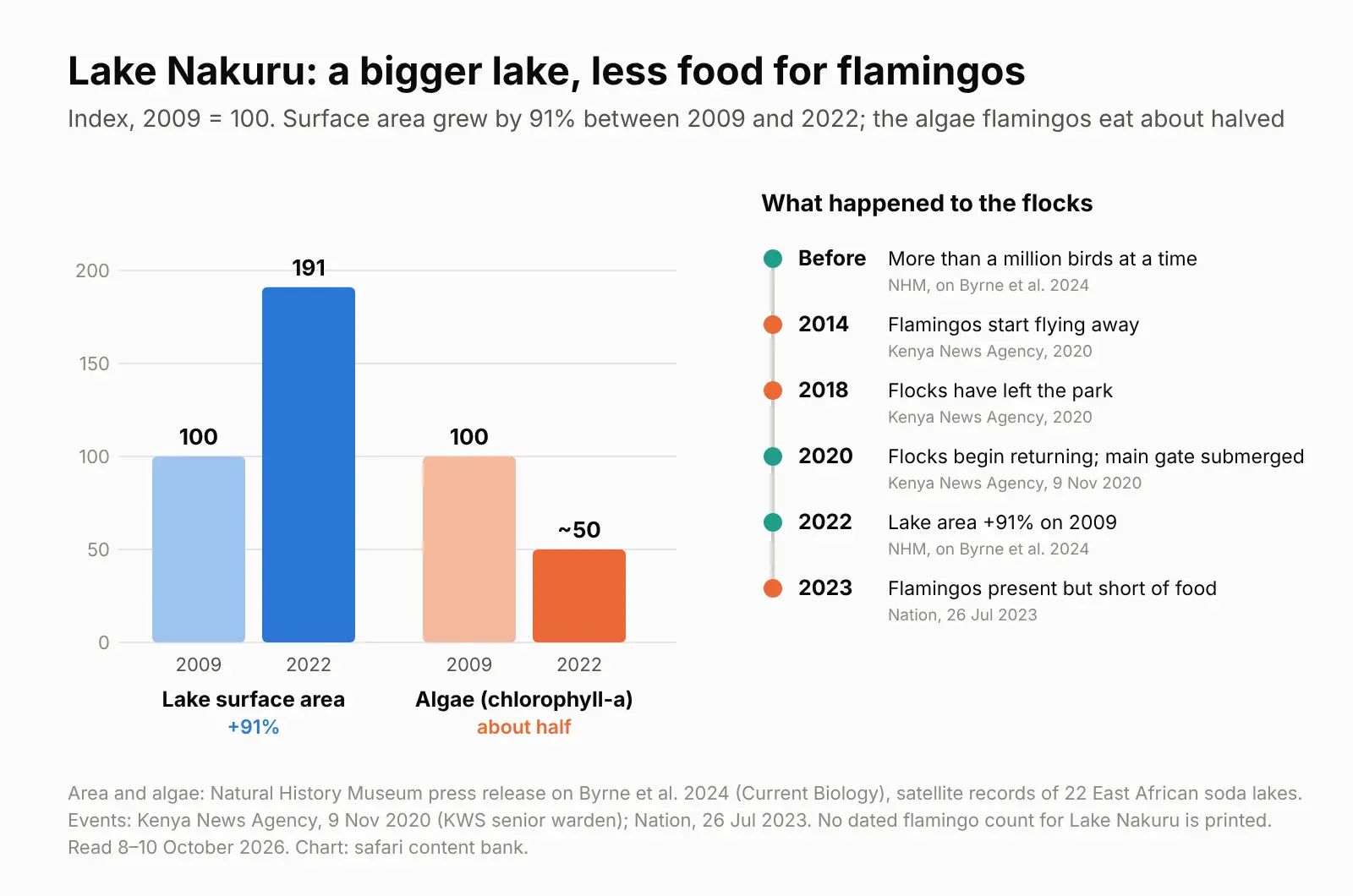 Area and algae: Natural History Museum press release on Byrne et al. 2024 (Current Biology). Events: Kenya News Agency, 9 Nov 2020; Nation, 26 Jul 2023. No dated flamingo count for Lake Nakuru is printed. Chart: safari content bank.
Tanzania: Lake Natron, Lake Manyara and Ngorongoro
Lake Natron is where East Africa’s lesser flamingos breed; Lake Manyara and Ngorongoro Crater are the flamingo stops already on the northern circuit, but neither publishes a current count.
- Lake Natron is the only regular lesser flamingo breeding site in East Africa, and its productivity has also fallen as the water rose (Natural History Museum, on Byrne et al. 2024). A proposed soda-ash plant there has been a long-running threat (Wikipedia, secondary).
- Natron is a detour: 110 km from Mto wa Mbu, about 2.5 hours, with a rough final section, and 159 km, about 5 hours, on to the northern Serengeti (our Mara to Serengeti guide). We found no official 2026 fee schedule for Lake Natron (our Tanzania park fees page); ask your operator what the village and area fees are.
- Lake Manyara’s last flamingo count we can cite is from 1991: about 1.9 million lesser and 40,000 greater flamingos (Wikipedia, secondary). The lake overflowed in May 2026, partly submerging more than 400 households (IPP Media, 29 May 2026). One safari operator rates March–May best for birds.
- Manyara costs US$59 per adult per day with VAT (US$53.10 from 15 March to 15 May), plus US$47.20 a night if you sleep inside (last published tariff, 2023/24). It is 120 km, about 2 h 15, from Arusha on the way to Ngorongoro. Half a day there or a full day in Tarangire: Tarangire vs Lake Manyara.
- Ngorongoro Crater’s soda lake, Lake Magadi, lies on the crater floor, so you see it on a normal crater descent. Our sources hold no count or season for its flamingos. Do not confuse it with Kenya’s Lake Magadi, a different lake.
- The crater costs US$70.80 per adult per 24 hours in the Conservation Area plus US$295 per vehicle per descent (NCAA’s page does not say whether VAT is included; read 9 October 2026), as on our Ngorongoro park fees page.
Botswana: Sua Pan and Nata Bird Sanctuary
Sua Pan, in the Makgadikgadi, holds one of only two greater flamingo breeding populations in southern Africa, the other being Etosha (Wikipedia, secondary). The birds need the pan to flood.
- Nata Bird Sanctuary, 230 km² and community-managed, takes in part of Sua Pan; its flamingos arrive after the rains (Wikipedia, secondary). In a dry year they may not come at all.
- Do not drive onto the pans for a closer look. Off-road tourist vehicles threaten Sua Pan’s flamingo colonies, and one safari operator warns that “pan surfaces are lethal when wet” (our Makgadikgadi page).
- Getting there: the A3 tar road runs 300 km from Nata to Maun via Gweta; a charter from Maun takes 30–60 minutes (Makgadikgadi page).
- Fees: Makgadikgadi Pans and Nxai Pan charge P190 per non-resident adult per day in the last published DWNP schedule (1 April 2022, via Tourism Update). In February 2026 the government news agency BOPA called the existing non-resident fee P380; a P500 rise was announced, then reported postponed. Confirm with DWNP or your operator (Botswana park fees). Nata Bird Sanctuary’s own fee is not in our sources.
Namibia: Walvis Bay and Etosha Pan
Walvis Bay lagoon, on the coast, is Namibia’s flamingo stop that does not wait for rain; Etosha Pan draws flamingos only when it floods, typically February to April and only in a wet year.
- Walvis Bay lagoon holds lesser and greater flamingos and is a Ramsar wetland of international importance (Ramsar Sites Information Service). A safari booking site names Walvis Bay and Sandwich Harbour for waders and flamingos, with Namibia’s birding at its best from November to April. We print no flamingo count for the lagoon: we found no dated survey we could open.
- Walvis Bay is easy to add: it has daily Airlink flights from Johannesburg, and the B2 runs 320 km on tar from Windhoek (Skeleton Coast; Namibia self-drive distances). Sandwich Harbour, in the Namib-Naukluft south of town, costs N$150 per foreign adult (Government Notice 115 of 2026) and needs a licensed guide with a 4x4.
- Etosha Pan is a 4,760 km² salt flat that holds water only after exceptional rain, typically February to April, and only then draws flamingos (our Etosha page; a safari agent’s Etosha guide, read September 2026). The game is at the waterholes along its edge, not on the pan. February is Namibia’s wettest month and the cheapest: safari in February.
- Etosha charges N$280 per foreign adult plus N$60 per car (Government Notice 115 of 2026), up from N$150 under the 2021 schedule (Etosha park fees).
What it costs to see flamingos
Park fees for a day at a flamingo site run from US$50 at Lake Elementaita to US$90 at Lake Nakuru in Kenya, US$59 at Lake Manyara, and N$280 plus N$60 per car in Etosha. The Ngorongoro descent adds US$295 per vehicle.
| Place | Fee per adult | Basis | Source |
|---|---|---|---|
| Lake Nakuru | US$90 (child US$45) | Per non-resident adult per 24 hours; in force 1 Oct 2025 | KWS, Legal Notice 160 of 2025 |
| Lake Elementaita | US$50 (child US$25) | Per non-resident adult per 24 hours | same |
| Lake Bogoria | Not printed | No verified fee in our sources | — |
| Lake Manyara | US$59 (US$53.10, 15 March–15 May); US$47.20 a night inside | Per non-East African adult per day, with VAT (last published tariff, 2023/24) | TANAPA 2023/24 |
| Ngorongoro Crater (Lake Magadi) | US$70.80 entry + US$295 per vehicle per descent | Per 24 h; NCAA’s page does not say whether VAT is included | NCAA, read 9 Oct 2026 |
| Lake Natron | Not printed | No official fee schedule found (checked 9 Oct 2026) | — |
| Makgadikgadi (Sua Pan) | P190 a day | Last published DWNP schedule, 1 April 2022; no official current tariff | Tourism Update (DWNP) |
| Etosha | N$280 + N$60 per car | Per foreign adult, from 1 April 2026 | Government Notice 115 of 2026 |
| Sandwich Harbour (near Walvis Bay) | N$150 | Per foreign adult, from 1 April 2026 | same |
Copied from our Kenya, Tanzania, Ngorongoro, Botswana, Etosha and Namibia fee pages, read 8–10 October 2026.
The official fee lines, with the date each took effect and the authority’s own source:
| Fee | Amount | In force from | Source |
|---|---|---|---|
| Amboseli and Lake Nakuru National Parks (KWS), non-resident adult, per 24 hours | USD 90 (child under 18, 5 and under free, USD 45) | Legal Notice 160 of 2025, gazetted 22 Sep 2025, which states no start date; in force 1 Oct 2025 per the KWS press release of 29 Sep 2025 | KWS Fees Regulations 2025 (LN 160/2025) |
| Hell's Gate, Mt Longonot, Mt Elgon and Ol Donyo Sabuk National Parks, Lake Elementaita, Shimba Hills and Kakamega (KWS), non-resident adult, per 24 hours | USD 50 (child under 18, 5 and under free, USD 25) | Legal Notice 160 of 2025, gazetted 22 Sep 2025, which states no start date; in force 1 Oct 2025 per the KWS press release of 29 Sep 2025 | KWS Fees Regulations 2025 (LN 160/2025) |
| Tarangire, Lake Manyara and Arusha National Parks, non-East African adult, entry per day | Peak USD 50 + VAT = USD 59; low USD 45 + VAT = USD 53.10 | 1 Jul 2023 (2023/24 tariff, last published) | TANAPA Tariffs 2023/24 |
| Tarangire, Lake Manyara, Arusha and Kilimanjaro, concession fee per person per night inside the park | USD 40 + 18% VAT = USD 47.20 | 1 Jul 2023 (2023/24 tariff, last published) | TANAPA Tariffs 2023/24 |
| Ngorongoro Conservation Area, non-East African adult, entry per 24 h (single entry) | USD 70.80 (NCAA's page does not say whether VAT is included) | Undated official page, read 9 Oct 2026 | NCAA |
| Ngorongoro Crater descent (crater service fee), per vehicle | USD 295 (NCAA's page does not say whether VAT is included) | Undated official page, read 9 Oct 2026 | NCAA |
| Other DWNP parks and reserves (Central Kalahari Game Reserve, Khutse, Nxai Pan, Makgadikgadi Pans), non-resident adult, per person per day | BWP 190 (SADC residents BWP 145; Botswana citizens and residents BWP 20) | Last published DWNP schedule, 1 April 2022 (via Tourism Update). In Feb 2026 the government news agency BOPA called the existing non-resident fee P380; a P500 rise was announced, then reported postponed. No official current tariff: confirm with DWNP or your operator | Tourism Update, 23 Feb 2022 (DWNP fee schedule) |
| Tier 1 parks (Etosha, Namib-Naukluft including Sossusvlei, Skeleton Coast, Ai-Ais/Fish River Canyon, Waterberg Plateau, Cape Cross, Dorob, Tsau //Khaeb), foreign adult 16+, per person | NAD 280 (NAD 140 park entrance + NAD 140 conservation fee) | 1 Apr 2026 (Government Notice 115 of 2026; the notice prices fees per person with no period; MEFT's 2021 schedule made fees valid for 24 hours from entry); was NAD 150 under the 2021 schedule | Government Gazette 8877 (Government Notice 115 of 2026), hosted by the Legal Assistance Centre |
| Vehicle up to 10 seats, most national parks (N$50 at Sandwich Harbour), per vehicle | NAD 60 | 1 Apr 2026 (Government Notice 115 of 2026; the notice states no period; MEFT's 2021 schedule made fees valid for 24 hours from entry); was NAD 50 | Government Gazette 8877 (Government Notice 115 of 2026), hosted by the Legal Assistance Centre |
| Sandwich Harbour section of Namib-Naukluft, foreign adult, per person | NAD 150 | 1 Apr 2026 (Government Notice 115 of 2026; the notice prices fees per person with no period; MEFT's 2021 schedule made fees valid for 24 hours from entry); unchanged from the 2021 schedule | Government Gazette 8877 (Government Notice 115 of 2026), hosted by the Legal Assistance Centre |
Common mistakes about flamingos on safari
| What you’ll often read | What is correct |
|---|---|
| “Lake Nakuru is pink with millions of flamingos” | Not reliably. The lake grew 91% in area between 2009 and 2022 and the algae flamingos eat halved; the flocks left in 2014–2018 and were short of food in 2023. |
| “Flamingos are disappearing because the lakes are drying up” | In East Africa the lakes are rising. Bird numbers fell as lake area grew (Natural History Museum, on Byrne et al. 2024). |
| “Lake Manyara has two million flamingos” | That was a 1991 survey: about 1.9 million lesser and 40,000 greater. We can cite no later count. |
| “Etosha Pan is full of flamingos” | Only after exceptional rain, typically February–April; in most years the pan is bone dry. |
| “Kenya has 4 million flamingos” (or 1.5 million) | UNESCO’s own page gives both figures, so we print neither. Flamingos move between lakes. |
| “Drive out onto the Makgadikgadi to get close to the flocks” | Off-road tourist vehicles threaten Sua Pan’s colonies, and wet pan surfaces are dangerous. |
Frequently asked questions
Where is the best place to see flamingos in Africa? For lesser flamingos, Kenya’s Rift Valley lakes (Bogoria, Nakuru, Elementaita) and Tanzania’s Lake Natron; East Africa holds more than three quarters of the world’s lesser flamingos (Natural History Museum, on Byrne et al. 2024). In southern Africa, Walvis Bay lagoon on the coast, and Sua Pan and Etosha Pan after good rains.
Are there still flamingos at Lake Nakuru? Sometimes, but not in the numbers of the past. The lake’s surface grew by 91% between 2009 and 2022 and the algae flamingos eat halved. The flocks left between 2014 and 2018, began returning in 2020 and were short of food in 2023. Treat them as a bonus to Nakuru’s other birds and game.
When is the best time to see flamingos? In East Africa, water level matters more than the month, so ask a local guide or lodge before you go. In Namibia, Etosha Pan holds flamingos only in wet years, typically February–April, and Namibia’s birding peaks November–April. In Botswana, Nata Bird Sanctuary’s flamingos arrive after the rains.
What is the difference between lesser and greater flamingos? They are two species. The lesser flamingo filter-feeds on Arthrospira (“spirulina”) that blooms in very alkaline water, and is Near Threatened (BirdLife, 2018). Sua Pan and Etosha hold southern Africa’s two greater flamingo breeding populations; Lake Manyara’s 1991 survey counted both species.
Where do flamingos breed in Africa? Lake Natron in Tanzania is East Africa’s only regular lesser flamingo breeding site. The lesser flamingo’s other breeding sites are Etosha Pan, the Makgadikgadi and Kamfers Dam in South Africa (Wikipedia, secondary). Sua Pan and Etosha hold southern Africa’s two greater flamingo breeding populations.
Can I see flamingos in Ngorongoro Crater? Ngorongoro’s soda lake, Lake Magadi, is on the crater floor, so a normal crater descent passes it; our sources hold no count or season for its flamingos. The descent costs US$295 per vehicle plus US$70.80 per adult for 24 hours’ entry (NCAA’s page does not say whether VAT is included).
Is Lake Manyara good for flamingos? It was: a 1991 survey counted about 1.9 million lesser and 40,000 greater flamingos, but that is the last count we can cite, and the lake overflowed in May 2026. Visit for its forest, birds and the canopy walkway, and treat flamingos as possible, not promised.
Sources
- Flamingo science: Natural History Museum, on Byrne et al. 2024 (Current Biology), read 8 Oct 2026; UNESCO, Kenya Lake System in the Great Rift Valley; Wikipedia (secondary), Lesser flamingo, Lake Manyara National Park, Makgadikgadi Pan and Nata Bird Sanctuary
- Lake Nakuru: Kenya News Agency, 9 Nov 2020; Nation, 26 Jul 2023; KWS, Lake Nakuru; traveller reports on TripAdvisor and Routard (October 2025–October 2026)
- Tanzania: IPP Media, 29 May 2026; one safari operator (Lake Manyara birding months); a self-drive operator’s guide and a Tanzanian operator’s travel-times table (Lake Natron distances) (names and links kept in our editor notes)
- Namibia and Botswana: a safari agent’s Etosha guide; Ramsar Sites Information Service, Walvis Bay; a safari booking site (Namibia birding); a pans camp profile; one safari operator’s salt pans page (names and links kept in our editor notes); UWA brochure (Queen Elizabeth)
- Fees: KWS, Fees Regulations 2025, Legal Notice 160 of 2025 (PDF); TANAPA Tariffs 2023/24 (PDF), the last published tariff; NCAA tariffs, read 9 Oct 2026; DWNP schedule effective 1 April 2022 via Tourism Update, 23 Feb 2022; Botswana Daily News (BOPA), 24 Feb 2026; Gabz FM, 5 May 2026; Government Gazette 8877, Government Notice 115 of 2026 (PDF)
More on birds and the other animals: birding safaris, where to see wild dogs, elephants and the Big Five.
Figures and fees checked 10 October 2026. We will update this page when a dated flamingo count is published for any of these lakes, when TANAPA publishes a new tariff, when DWNP publishes an official Botswana tariff and when Tanzania publishes a Lake Natron fee schedule.