 Experience

Last verified · Next check due
On this page
- February country by country
- Tanzania: the calving peak at Ndutu
- Kenya: resident game, the Loita calving and half the Mara fee
- Uganda and Rwanda: gorillas in the short dry spell
- Botswana: green rates, zebra on the pans, a low Delta
- South Africa: Kruger at R692, the end of the rate year
- Namibia: the wettest month, the cheapest desert rates
- Zambia and Zimbabwe: peak rains, the Falls’ flood begins
- February park fees
- What changes on 1 March, camp by camp
- Which camps are closed in February
- Package prices in February
- Worked examples: what February costs against March and August (our sums)
- Malaria and rain in February
- Common mistakes about a February safari
- Frequently asked questions
- Sources
Short answer: Go to Ndutu and the southern Serengeti in Tanzania, where wildebeest calving peaks in February, or to Uganda or Rwanda for gorillas in the short dry spell between East Africa’s rains. Southern Africa is in green season: Botswana’s camps charge their lowest rates, but South Luangwa’s bush camps and most Mana Pools camps are closed. Many East African lodge rates fall on 1 March. Kruger costs R692 a day in February 2027.
Key facts
- Calving peaks in February on the southern plains around Ndutu, compressed into two to three weeks; a camp operator counts about 500,000 calves in that window, and one safari operator’s guide says most are born “in a short window around February” (a camp operator’s migration guide; Great Migration month by month). No source dates the peak for a given year, and there are no river crossings in February. Where to stay: Serengeti calving season.
- February is a drier spell in East Africa, not a dry month: the Masai Mara averages 100 mm of rain in February against 145 mm in March, Zanzibar 55 mm against 150 mm (Climates to Travel, an aggregator), and a camp operator calls February “the driest month of the wet season” on the southern Serengeti plains. Rwanda is in its short dry season, and Uganda’s drier months run about December–February (one operator’s guide).
- Many East African rates fall on 1 March: Ubuntu Migration Camp goes from US$1,080 to US$780 a night, Lemala Ngorongoro from US$720 to US$370, Bwindi Lodge from US$1,370 to US$820 and Rwanda’s park-run lodges to their low season (2026–2027 rates). Lemala Ndutu keeps US$825 until 31 March 2027.
- Southern Africa is in green season: Botswana’s green rates run to 31 March, South Luangwa’s bush camps and most Mana Pools camps are closed, and Gonarezhou is closed to visitors from 10 January to 1 March (green-season safari; Zimbabwe safari questions).
- Kruger’s fee is R692 (R602 until 31 October 2026), so February 2027 costs R692 per international adult a day (SANParks 2026/27, PDF).
- Gorilla permits are at their standard price in February: US$800 in Uganda and US$1,500 in Rwanda, or US$1,050 in Rwanda with two nights in Akagera or Nyungwe (November–May; our sum) (gorilla permit prices).
February country by country
February suits the southern Serengeti and Ndutu, the gorilla parks and Botswana’s Kalahari pans; Kenya’s Mara has resident game and the Loita herd’s calving; Zambia’s and Zimbabwe’s remote bush camps are mostly closed. The whole year is on best time for a safari, the month before on safari in January and the dry-season peak on safari in July and safari in August; this table covers February only.
| Country | Weather in February | Wildlife in February | Rates in February (example) | Main park fee in February, per adult |
|---|---|---|---|---|
| Kenya (Masai Mara, Amboseli) | Between the short and the long rains: Mara 100 mm, Amboseli 60 mm | Resident game; the Loita herd calves in Ol Kinyei, February–March | Kicheche Mara North US$730 to 28 February, US$625 in March (2026 card) | Mara reserve US$100 a day on the last published schedule; Amboseli US$90 per 24 h |
| Tanzania (Serengeti, Ndutu) | “The driest month of the wet season” on the southern plains | Calving peak around Ndutu | Lemala Ndutu US$825 to 31 March; Ubuntu US$1,080 to 28 February | Serengeti US$141.60 a night inside; Ndutu (NCA) US$70.80 entry + US$59 a night |
| South Africa (Kruger) | Wet season, October–March | Summer; “hot and green” | SANParks low season from 16 January (2024/25 tariff); Sabi Sabi’s rate year ends 28 February 2027 | R692 a day (from 1 November 2026) |
| Botswana (Okavango, Chobe, pans) | Rains, November–March | Zebra at Nxai Pan and the Makgadikgadi; Delta water low | Green rates to 31 March; Chobe Princess R10,896 to 28 February 2027 | Chobe, Moremi P270 a day (last published, 2022); P380 and P500 reported since |
| Namibia (Etosha, Sossusvlei) | Wettest month: Tsumeb, near Etosha, 140 mm | Etosha’s game disperses; the pan may hold water | NWR low season (November–June); Kwessi Dunes green rate to 31 March | N$280 per foreign adult, no seasons |
| Zambia (South Luangwa) | Peak rains, January–March | Wild dog sightings increase from February | Most bush camps closed; Nsefu Camp opens in February at US$735 | South Luangwa US$25 a day |
| Zimbabwe (Hwange, Mana Pools, Victoria Falls) | Rains, November–March | Hwange game disperses; the Falls’ flood begins | Camp Hwange US$550 (January–March 2026); Mana Pools camps closed | Hwange US$24 a day visitor, US$12 staying inside; Falls US$58 |
| Uganda (Bwindi) | Drier months, about December–February | Gorilla trekking, rated “Excellent” in February | Buhoma Lodge US$535, US$455 in March (2026) | Gorilla permit US$800 (US$600 only April, May, November) |
| Rwanda (Volcanoes) | Short dry season | Gorilla trekking | Park-run lodges high to 28 February, low from 1 March | Permit US$1,500; US$1,050 with an Akagera or Nyungwe stay |
Typical year, not a forecast; camp rates per person sharing per night, 2024–2027 cards and agent listings, read 8–10 October 2026 (most 2027 cards were not yet published). Rain: Climates to Travel (Masai Mara, Amboseli; Namibia, Tsumeb), an aggregator. Herds: a camp operator’s migration guide. Fees: Narok County FY2025/26, the last published; TANAPA, last published tariff, 2023/24; NCAA; KWS LN 160/2025; SANParks 2026/27; DWNP via Tourism Update (1 April 2022); Government Notice 115 of 2026; DNPW 2025 schedule; ZimParks Tariff 2026; UWA; RDB. Each rate card is linked in the sections below.
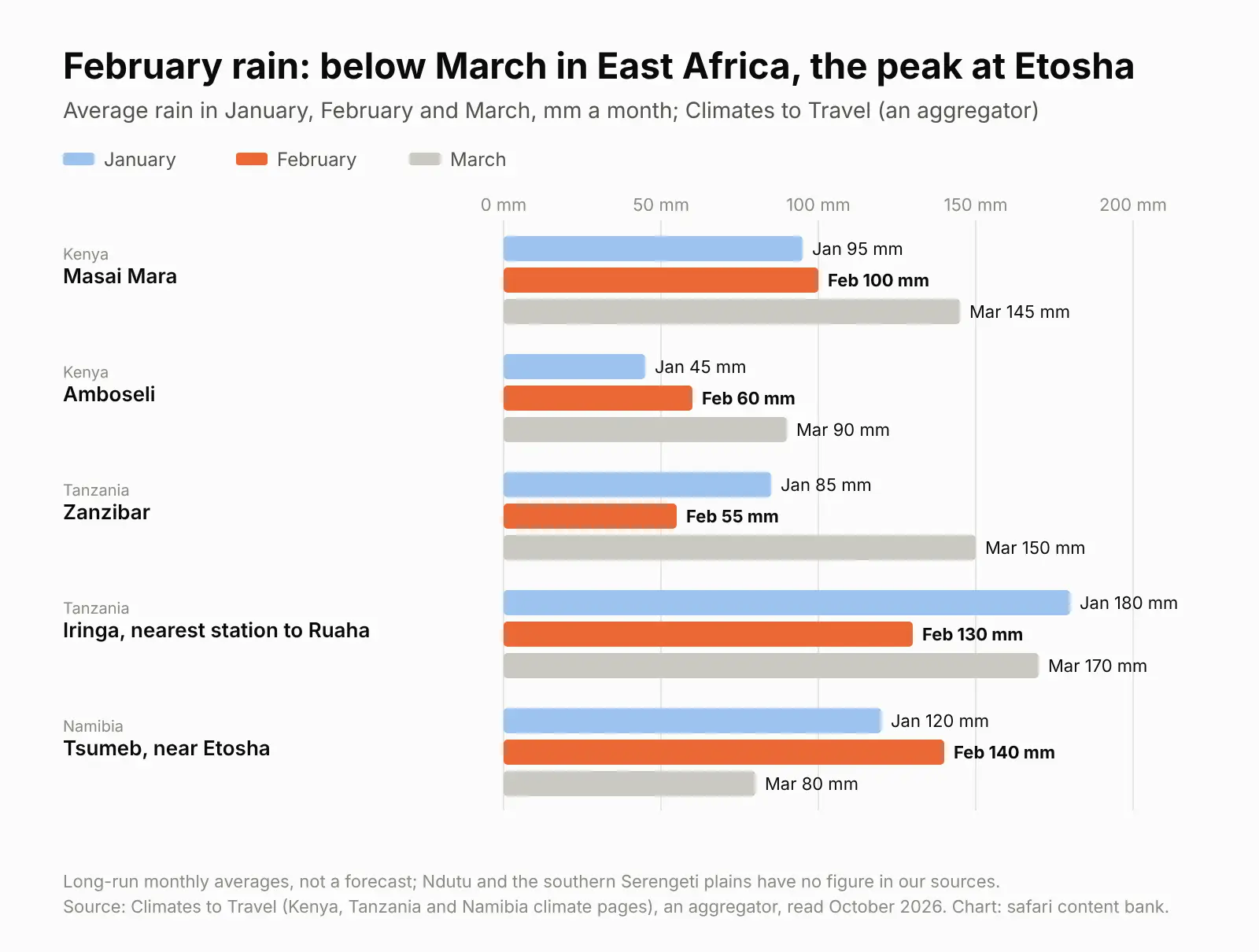 Long-run monthly averages from Climates to Travel (Kenya, Tanzania and Namibia pages), an aggregator, read October 2026. No figure for Ndutu or the southern Serengeti plains is in our sources. Chart: safari content bank.
Tanzania: the calving peak at Ndutu
Tanzania is the migration country in February: calving peaks on the short-grass plains around Ndutu, predators follow the herds, and the calving camps hold their peak rates until the end of February or March.
- Where the herds are: Ndutu–Kusini, toward the Ngorongoro highlands, with lions, cheetahs and hyenas on the plains (Great Migration month by month). Calving runs from late January to mid-March. Late February is still calving: experienced forum posters say the herds “usually stay till the middle of March” (TripAdvisor Serengeti forum, traveller forum). The Tanzania Wildlife Research Institute found the lowest wildebeest density on the south-east Ndutu plains at the end of March 2023 (TAWIRI 2023 census, PDF).
- Ndutu is in the Ngorongoro Conservation Area, not the Serengeti, so NCAA fees apply there: US$70.80 entry per 24 hours, single entry, and US$59 concession per person per night at Ndutu lodges, with no low season (NCAA, read 9 October 2026). Forum regulars tell February travellers to “make sure the camp is in the Ngorongoro Conservation Area (NCA) and not in Serengeti NP” (Tanzania safari questions). Inside the Serengeti a February night costs US$141.60 per adult: entry US$82.60 plus concession US$59 (last published tariff, 2023/24), until 14 March. Detail: Serengeti park fees, Ngorongoro and Ndutu fees.
- February is peak price at the calving camps: Lemala Ndutu Tented Camp charges US$825 per person a night from 20 December 2026 to 31 March 2027, guide and vehicle extra (Lemala rates); Ndutu Safari Lodge US$451 to 31 March; Ubuntu Migration Camp US$1,080 and Olakira US$1,490 from 20 December to 28 February, then US$780 and US$1,100 from 1 to 14 March 2027; Camp Zebra US$445 in January–February and US$325 in March (a safari agent’s listing; Great Migration safari cost). Namiri Plains charges its US$2,250 peak rate from 20 December 2026 to 28 February 2027 (Serengeti safari cost).
- It is busy: in March 2026 a traveller at Ndutu saw “15–20 vehicles at a single sighting” (TripAdvisor, traveller report), and forum posters call the drive from Arusha to Ndutu “an awfully long day”, so several fly in. We found no published vehicle cap for TANAPA or the NCAA.
- Elsewhere in the north: Lemala Ngorongoro on the crater rim charges US$720 to the end of February and US$370 in March 2027 (Ngorongoro). A forum reply suggested Tarangire might be one to skip in February; Lemala Mpingo Ridge there charges US$869 in January–February 2027 and US$585 from 1 March (Tarangire; Tarangire safari cost). Singita’s Serengeti low season runs 6 January–15 May on its 2026 sheet, and its Mara River Tented Camp in the far north is closed from 15 January to 31 May (Singita Serengeti 2026, PDF).
- Further south: Iringa, the nearest station to Ruaha, averages 130 mm in February (Ruaha); Sand Rivers in Nyerere charges its lower US$625 from November to February (Nyerere).
- Beach extension: Zanzibar averages 55 mm in February, a month our Tanzania safari and Zanzibar page rates good but hot.
- Entry: a tourist visa costs US$50 (US citizens US$100), and mainland Tanzania’s government travel insurance costs US$44 per adult as of October 2026, for foreign visitors except EAC and SADC residents (Tanzania visitor insurance).
Full costs: Tanzania safari cost, Great Migration safari cost; hubs: Tanzania, Serengeti, Ngorongoro.
Kenya: resident game, the Loita calving and half the Mara fee
Kenya in February means resident Mara game, a second, smaller calving in the conservancies, and, on the last published schedule, the Mara reserve fee at US$100 a day instead of US$200. The Serengeti’s herds are in Tanzania.
- The Loita herd calves in the conservancies: the resident Loita herd moves into Ol Kinyei Conservancy “usually by January” and calves there in February–March, before moving through Naboisho into Olare Motorogi (Masai Mara; Mara reserve vs conservancies). It is a separate herd, not the Serengeti migration. Conservancy fees are US$130 per adult per night.
- The Mara fee on the last published schedule: US$100 per non-resident adult per day from 1 January to 30 June (Narok County FY2025/26). That schedule expired on 30 June 2026, and no schedule covering February 2027 had been published by 9 October 2026. Check the fee before you book. Detail: Masai Mara park fees.
- Rates: Kicheche Mara North charges US$730 from 3 January to 28 February and US$625 in March, and Governors’ Camp US$623 from January to March, falling to US$453 only in April (Kicheche 2026, PDF; Governors’ 2026, PDF). These are the 2026 cards; the 2027 sheets were not published when we checked. Destination experts on the TripAdvisor Kenya forum call January–February “uncrowded on sightings” (traveller forum).
- Rain and Amboseli: the Mara averages 100 mm in February and 145 mm in March; Amboseli 60 mm, with highs of 30 °C and lows of 16 °C, and Ol Tukai Lodge charges US$290 in January–March (Amboseli). Kilimanjaro is often in cloud: reviewers on a safari booking site missed it in February 2026. KWS parks charge US$90 per non-resident adult per 24 hours, US$45 for a child under 18, 5 and under free, with no seasons (KWS Legal Notice 160 of 2025).
- A February road safari costs less in fees than an August one: two non-resident adults pay US$1,140 in park fees on a 6-day Amboseli, Lake Nakuru and Masai Mara route in February, against US$1,740 in August (our sums; Kenya park fees).
- Entry: the eTA costs US$30, and since 5 October 2026 (U.S. Embassy Nairobi) arrivals have needed a government health policy, up to US$44 (eCitizen) (Kenya visitor insurance).
Full costs: Kenya safari cost, Masai Mara safari cost; the country hub: Kenya.
Uganda and Rwanda: gorillas in the short dry spell
February is one of the better gorilla months in both countries: a safari booking site rates Bwindi “Excellent” in February, and Rwanda is in its short dry season. Permits are at their standard price, and several lodges switch to lower rates on 1 March.
- Trekking conditions: the drier months in Bwindi are about June–September and December–February (one operator’s guide), and Bwindi averages 7 to 20 °C (UWA). Treks go ahead in rain, with no refund for weather in Bwindi (a safari booking site), and Rwanda’s official kit list is built around mud, stinging nettles and rain: solid boots with gaiters, long clothing, gloves and a light rain jacket (Visit Rwanda). More on the day itself: gorilla trekking day.
- Uganda’s permit is US$800 in February; the US$600 low-season permit applies only in April, May and November and cannot be rescheduled (UWA letter TDO 93/04, PDF). From 1 January 2027 Kibale chimpanzee tracking costs US$300 (it was US$250) and the gorilla habituation experience US$1,800; the same safari booking site rates Kibale “Excellent” in February (chimpanzee trekking permits).
- Uganda’s lodges are at their high rate to the end of February: Buhoma Lodge US$535 (US$455 in March), Bwindi Lodge US$1,370 from 15 December to 28 February (US$820 from 1 March) and Clouds Mountain Gorilla Lodge US$1,620 (US$970 in March), 2026 agent listings (Bwindi gorilla sectors; a safari agent’s listing).
- Rwanda: January–February is the short dry season (Volcanoes). The gorilla permit is US$1,500, or US$1,050 (30% off, our sum) from November to May with two nights in Akagera or Nyungwe (RDB). Two nights’ Akagera entry costs an international adult US$150, so the discounted permit plus the Akagera entry comes to US$1,200 (our sum).
- Lodges: Rwanda’s park-run lodges stay in high season from 15 December to 28 February and drop to low season on 1 March; Ruzizi Tented Lodge in Akagera goes from US$258 to US$227 (Ruzizi 2026–2027, PDF). Singita Kwitonda charges US$2,720 per adult a night from 6 January on its 2026 sheet (Singita 2026, PDF; Volcanoes).
- Malaria: the WHO lists malaria risk all year in the whole of Rwanda; we have read no official malaria source for Uganda (Rwanda safari questions, Uganda safari questions).
Full costs: Uganda safari cost, Rwanda safari cost, gorilla permit prices, Uganda or Rwanda for gorillas.
Botswana: green rates, zebra on the pans, a low Delta
Botswana in February is mid-green season: the rain falls, the zebra are on the Kalahari pans, the Okavango’s water is low, and camp rates stay at their lowest until 31 March.
- Green rates run through February: Natural Selection’s Green season runs 10 January–31 March, with Jack’s Camp at US$2,095 per person a night and Camp Kalahari at US$795 (NS 2026, PDF); Great Plains’ Green season runs 11 January–31 March (Duba Plains US$2,150, Selinda Explorers US$1,105, 2025 card, PDF); Machaba Camp charges its “Secret” US$718 from 11 January to 31 March (Machaba 2026), and Wilderness’s Vumbura Plains US$2,018 for January–March 2027 (Wilderness, Vumbura Plains). Natural Selection waives its single supplement from 10 January to 31 March (single supplements and child rates).
- Chobe’s houseboat price jumps on 1 March: the Chobe Princess charges R10,896 per person a night from 1 December 2026 to 28 February 2027 and R14,641 from 1 March to 30 November 2027, plus a community levy (Zambezi Queen Collection; Chobe). Chobe Safari Lodge in Kasane charges US$500 from January to March 2026 against US$550 from April, park fees included.
- Zebra on the pans: zebra are at Nxai Pan from December to February and on the Makgadikgadi from December or January to February or March (Makgadikgadi). Natural Selection’s San Camp there is closed until 31 March (open 1 April–15 October).
- The Delta is low: seasonal camps run no boats in January and February (two camp operators’ seasonal guides). The first flood pulse, from the Cubango, typically reaches Mohembo, where the river enters Botswana, in February–March, but the flood only reaches most of the Delta from about May (Okavango flood calendar). Desert & Delta’s 2024 card closed Camp Xakanaxa from 31 January to 14 February and Camp Moremi and Xugana from 15 February to 1 March (Okavango: water or land camps).
- Park rules bind every camp in Moremi Game Reserve. Mombo is on Chief’s Island, inside the reserve, where Botswana Tourism says night driving is prohibited (Moremi).
- Park fees: no official current tariff. The last published DWNP schedule (1 April 2022) charges P270 per non-resident adult a day in Chobe and Moremi and P190 in Nxai Pan, the Makgadikgadi and the Central Kalahari; in February 2026 the government news agency called the existing fee P380, and a P500 rise was announced, then reported postponed (Botswana park fees). Fly-in camp rates usually include park fees.
- Malaria: TravelHealthPro rates northern Botswana, including the Okavango, high from October to May (TravelHealthPro, Botswana).
Full costs: Botswana safari cost, Okavango Delta safari cost; hubs: Botswana, Okavango Delta, Chobe.
South Africa: Kruger at R692, the end of the rate year
Kruger in February is wet, hot and green; the fee is R692 per international adult in February 2027, and several private-reserve rate years end on 28 February.
- The fee: Kruger’s daily conservation fee for an international adult is R692 (R602 until 31 October 2026); children aged 2–11 pay R345 (R300 until 31 October 2026) (SANParks 2025/26, PDF; 2026/27, PDF). In February 2027 the R692 rate applies: the 2026/27 schedule runs to 31 October 2027. Detail: Kruger park fees.
- Season: October to March is Kruger’s wet season, “hot and green”; April to September is the dry season and the easiest time to see animals (SANParks climate).
- Long days: entrance gates open 05:30–18:30 from November to February, about 13 hours; camp gates open at 04:30 only from November to January (SANParks gates; Kruger self-drive).
- SANParks’ cheaper months: the low season ran from 16 January to 19 March in the 2024/25 tariff, when a Skukuza campsite cost R368 a night against R480 in high season, and wilderness trails cost less from 1 November to 28 February: R11,162 per hut on the Mathikithi trail against R12,502 (SANParks Tariffs 2024/25, PDF; walking safari cost). SANParks had not published its 2026/27 accommodation tariff when we checked on 1 November 2026, so confirm the price when you book. Those are the latest tariff dates we hold.
- Private reserves change on 1 March: Sabi Sabi’s rate year runs 1 March 2026–28 February 2027, at R29,600 per person a night at Bush Lodge, and its conservation levy goes from R450 to R495 on 1 March 2027 (Sabi Sabi). In the malaria-free Eastern Cape, Amakhala’s levy goes from R425 to R460 per adult a night on 1 March 2027 (Amakhala levy), and Kwandwe charges its high-season R26,180 from 1 October 2026 to 30 April 2027 (Kwandwe 2026–27, PDF).
- Malaria: SANParks puts Kruger’s highest risk in November–April and calls it “generally low, even in summer” (SANParks malaria). Reserves outside the malaria area: malaria-free safaris in South Africa.
Full costs: South Africa safari cost, Kruger safari cost; hubs: South Africa, Kruger.
Namibia: the wettest month, the cheapest desert rates
February is Namibia’s wettest month: game disperses at Etosha, Sossusvlei can be green and cloudy, park fees stay the same, and the desert lodges charge their green rates.
- Rain and game: Tsumeb, near Etosha, averages 140 mm in February, its wettest month (Climates to Travel, Namibia, an aggregator), and one safari operator’s climate guide puts the national average at 80 mm, also the wettest month. January to March are Etosha’s poorest months for game, as animals spread out to temporary pans (Namibia safari questions). The Etosha Pan holds water only after exceptional rain, typically February to April, and only then draws flamingos (Etosha; a safari agent’s Etosha guide, read September 2026). Okaukuejo’s gates are open about 06:50–19:35 in February (the same site).
- Sossusvlei: forum regulars say February brings dramatic cloud, the highest chance of water in the pan and the highest chance of a road closure; no balloon flights run from 15 January to 15 February (a Namibia travel-booking site’s ballooning page; Sossusvlei).
- Rates: NWR’s low season runs November–June: Okaukuejo N$1,900 bed and breakfast and Sossus Dune Lodge N$4,030 dinner, bed and breakfast, per person (NWR rates from a booking agent’s listing, read September 2026). Natural Selection’s Kwessi Dunes charges its green rate, N$10,845, from 10 January to 31 March (2026 card); from 11 January 2027 Wolwedans Desert Lodge and Dune Camp cost N$14,900 per person sharing, plus a N$1,680 levy per adult (Wolwedans 2027, PDF); Wilderness’s Kulala Desert Lodge charges R7,402 and Damaraland Camp N$9,131 in January–March (agents’ listings; Namibia safari cost, Sossusvlei safari cost).
- Closures and roads: Natural Selection’s Hoanib Elephant Camp and Nkasa Linyanti close in green season (green-season safari), and Nkasa Rupara and Khaudum roads can be impassable from November to April (a safari booking site).
- Fees: N$280 per foreign adult at Etosha, Sossusvlei and the other Tier 1 parks, with no seasons (Government Notice 115 of 2026; Namibia park fees).
- Malaria: northern Namibia, including Etosha and the Zambezi region, has its malaria season in the rains, November–April (a safari booking site).
Full costs: Namibia safari cost; hubs: Namibia, Etosha, Sossusvlei.
Zambia and Zimbabwe: peak rains, the Falls’ flood begins
Zambia and Zimbabwe are weak February choices for a classic bush-camp safari: South Luangwa’s bush camps and most Mana Pools camps are closed, Gonarezhou is shut to visitors, and Hwange’s game disperses. Victoria Falls starts its high-water months in February.
- South Luangwa: the rains peak from January to March; most lodges and bush camps are closed and walking is impractical, while a few Mfuwe-area lodges run boat trips on the swollen river (South Luangwa). Robin Pope Safaris opens Nsefu Camp in February and March at its Emerald rate, US$735 per person a night (page undated); Flatdogs Camp is closed from 16 January to 14 March and Time + Tide’s bush camps open only from 20 May to 15 November. Chinzombo stays open at its green rate, US$1,330, from January to June on Time + Tide’s 2027 card (Time + Tide). One safari operator says wild dog sightings in South Luangwa increase from February to May (where to see wild dogs).
- Elsewhere in Zambia: Lower Zambezi’s Chiawa and Old Mondoro close from mid-November to April, and Kafue’s Busanga Plains camps open only from June to the end of October. Fees: South Luangwa US$25 per international adult a day (DNPW 2025 schedule, the last published). Nationalities that need a visa pay US$50 for a single entry since 1 January 2026; UK, US, Canadian, Australian and EU passport holders need none (Zambia safari cost).
- Zimbabwe: most Mana Pools camps close from December to March, when the black-cotton soil becomes impassable (one operator’s Mana Pools guide), and the ZimParks side of the park closes from about mid-December to the end of February; Gonarezhou is closed to visitors from 10 January to 1 March (Zimbabwe safari questions). Hwange’s camps stay open at their lowest rates: Camp Hwange US$550 a night in January–March 2026 against US$1,080 in July–October, and Bomani Tented Lodge US$445 (agents’ listings), but game disperses in the rains and one safari operator advises avoiding January to March (Hwange). Hwange’s conservation fee is US$24 a day for a day visitor and US$12 staying inside the park (ZimParks Tariff 2026; Zimbabwe safari cost).
- Victoria Falls in February: the flood runs from February to May, peaking about April; in February–March the spray soaks the viewpoints and often whites out the view from the ground, rafting is restricted or closed at very high water, and Devil’s Pool is closed (Victoria Falls; Victoria Falls: Zimbabwe or Zambia side). A lunar rainbow forms at full moon: ZimParks charges US$116 for moonlight viewing and US$58 for the Rainforest’s main gate per international adult (ZimParks Tariff 2026). Zimbabwe has charged 15.5% VAT on tourism services for foreign visitors since 1 January 2026 (Tourism Update, 6 October 2026, a single press source).
- Malaria: one UK safari operator says malaria is present across Zambia and all year in the valleys; a Zimbabwe travel site names Victoria Falls, Kariba and the Zambezi Valley, with the highest risk from November to May. We have read no official source for either country (Zambia safari questions, Zimbabwe safari questions).
February park fees
No government park fee changes in February; Kruger’s February 2027 fee is R692, and the Serengeti’s lower entry fee starts only on 15 March. The Masai Mara is at its lower rate on the last published schedule, and Uganda’s chimp and habituation prices rose on 1 January 2027.
| Park or permit | Fee per adult in February | Changes around February | Status and source |
|---|---|---|---|
| Maasai Mara National Reserve (Kenya), per day | US$100 (1 January–30 June) | US$200 from 1 July | Narok County FY2025/26, the last published; expired 30 June 2026, no schedule for February 2027 published by 9 October 2026 |
| Amboseli, Lake Nakuru (KWS), per 24 h | US$90; child under 18, 5 and under free, US$45 | No seasons | KWS Legal Notice 160 of 2025 |
| Serengeti (Tanzania), a night inside the park | US$141.60 (entry US$82.60 + concession US$59) | Entry US$70.80 from 15 March to 15 May | Last published tariff, 2023/24 |
| Ndutu and the Ngorongoro Conservation Area | US$70.80 entry per 24 h + US$59 a night at Ndutu lodges | No seasons | NCAA tariffs page, undated, read 9 October 2026 |
| Tarangire, Lake Manyara, Arusha (Tanzania), per day | US$59 | Low fee (US$53.10) only 15 March–15 May | Last published tariff, 2023/24 |
| Kruger National Park (South Africa), per day | R692 | R692 (R602 until 31 October 2026) | SANParks 2025/26 and 2026/27 schedules |
| Chobe, Moremi (Botswana), per day | P270 (last published, 2022) | P380 called existing by BOPA; P500 reported postponed | DWNP via Tourism Update; no official current tariff |
| Nxai Pan, Makgadikgadi, Central Kalahari (Botswana), per day | P190 (last published, 2022) | As above | DWNP via Tourism Update; no official current tariff |
| Etosha, Sossusvlei (Namibia) | N$280 | No seasons | Government Notice 115 of 2026 |
| South Luangwa (Zambia), per day | US$25 | No seasons | DNPW 2025 schedule, the last published |
| Hwange; Mana Pools (Zimbabwe), per day | Hwange US$24 day visitor, US$12 staying inside; Mana Pools US$24 | No seasons | ZimParks Tariff 2026 |
| Victoria Falls Rainforest (Zimbabwe) | US$58 main gate; moonlight viewing US$116 | No seasons | ZimParks Tariff 2026 |
| Uganda gorilla permit | US$800 | US$600 only in April, May and November | UWA letter TDO 93/04, 26 February 2026 |
| Kibale chimpanzee tracking (Uganda) | US$300 (from 1 January 2027) | US$250 until 31 December 2026 | UWA letter TDO 93/04 |
| Rwanda gorilla permit | US$1,500; US$1,050 with an Akagera or Nyungwe stay (our sum) | Discount runs November–May | RDB, checked 9 October 2026 |
Fees copied from our Kenya, Tanzania, Botswana, Namibia, South Africa, Zambia, Zimbabwe, Uganda and Rwanda cost pages, read 17 October 2026. Botswana resident bands in the last published schedule: Chobe and Moremi, SADC residents P205; Botswana citizens and residents P30; other DWNP parks P145 and P20. The whole year’s fee seasons are on green-season safari and Great Migration month by month.
The official fee lines, with the date each took effect and the authority’s own source:
| Fee | Amount | In force from | Source |
|---|---|---|---|
| Maasai Mara National Reserve, non-resident adult, per day (12-hour ticket, 06:00–18:00), 1 Jan–30 Jun | USD 100 | Since 1 Jan 2024; Narok County FY2025/26 schedule, the last published | Narok County fee schedule FY2025/26 |
| Amboseli and Lake Nakuru National Parks (KWS), non-resident adult, per 24 hours | USD 90 (child under 18, 5 and under free, USD 45) | Legal Notice 160 of 2025, gazetted 22 Sep 2025, which states no start date; in force 1 Oct 2025 per the KWS press release of 29 Sep 2025 | KWS Fees Regulations 2025 (LN 160/2025) |
| Serengeti and Nyerere National Parks, non-East African adult, entry per day, 16 May–14 Mar | USD 70 + 18% VAT = USD 82.60 | 1 Jul 2023 (2023/24 tariff, last published) | TANAPA Tariffs 2023/24 |
| Serengeti and Nyerere, concession fee per person per night inside the park | Jul–Sep USD 60 + VAT = USD 70.80; Oct–Jun USD 50 + VAT = USD 59 | 1 Jul 2023 (2023/24 tariff, last published) | TANAPA Tariffs 2023/24 |
| Tarangire, Lake Manyara and Arusha National Parks, non-East African adult, entry per day | Peak USD 50 + VAT = USD 59; low USD 45 + VAT = USD 53.10 | 1 Jul 2023 (2023/24 tariff, last published) | TANAPA Tariffs 2023/24 |
| Ngorongoro Conservation Area, non-East African adult, entry per 24 h (single entry) | USD 70.80 (NCAA's page does not say whether VAT is included) | Undated official page, read 9 Oct 2026 | NCAA |
| Ngorongoro concession fee, rim and Ndutu lodges, per person per night | USD 59 (NCAA's page does not say whether VAT is included) | Undated official page, read 9 Oct 2026 | NCAA |
| Chobe National Park and Moremi Game Reserve (DWNP), non-resident adult, per person per day | BWP 270 (SADC residents BWP 205; Botswana citizens and residents BWP 30) | Last published DWNP schedule, 1 April 2022 (via Tourism Update). In Feb 2026 the government news agency BOPA called the existing non-resident fee P380; a P500 rise was announced, then reported postponed. No official current tariff: confirm with DWNP or your operator | Tourism Update, 23 Feb 2022 (DWNP fee schedule) |
| Other DWNP parks and reserves (Central Kalahari Game Reserve, Khutse, Nxai Pan, Makgadikgadi Pans), non-resident adult, per person per day | BWP 190 (SADC residents BWP 145; Botswana citizens and residents BWP 20) | Last published DWNP schedule, 1 April 2022 (via Tourism Update). In Feb 2026 the government news agency BOPA called the existing non-resident fee P380; a P500 rise was announced, then reported postponed. No official current tariff: confirm with DWNP or your operator | Tourism Update, 23 Feb 2022 (DWNP fee schedule) |
| Tier 1 parks (Etosha, Namib-Naukluft including Sossusvlei, Skeleton Coast, Ai-Ais/Fish River Canyon, Waterberg Plateau, Cape Cross, Dorob, Tsau //Khaeb), foreign adult 16+, per person | NAD 280 (NAD 140 park entrance + NAD 140 conservation fee) | 1 Apr 2026 (Government Notice 115 of 2026; the notice prices fees per person with no period; MEFT's 2021 schedule made fees valid for 24 hours from entry); was NAD 150 under the 2021 schedule | Government Gazette 8877 (Government Notice 115 of 2026), hosted by the Legal Assistance Centre |
| Kruger National Park daily conservation fee, international adult (12+), per day | ZAR 602 | 1 Nov 2025 to 31 Oct 2026 (SANParks 2025/26 schedule) | SANParks daily conservation fees 2025/26 |
| Kruger National Park daily conservation fee, international adult (12+), per day | ZAR 692 | 1 Nov 2026 to 31 Oct 2027 (SANParks 2026/27 schedule, already published) | SANParks daily conservation fees 2026/27 |
| South Luangwa and Lower Zambezi National Parks (DNPW Category A), international adult, entry per day (06:00–18:00) | USD 25 (SADC and resident USD 20; Zambian citizen ZMW 55.60); child 5–13 half price, under 5 free | DNPW 2025 schedule ("official 2025 rates"), the last published; page last modified 8 May 2025, still shown 9 Oct 2026 | DNPW 2025 fee schedule, as shown on a Zambia travel portal |
| Hwange National Park, Main Camp (row as labelled in the ZimParks 2026 tariff), international adult, conservation fee per day | USD 24 day visitor; USD 12 if staying overnight in the park (SADC USD 18 / 10; local USD 5 / 3) | ZimParks Tariff 2026 (tariff year 2026, published February 2026); the conservation-fee table does not say whether VAT is included; Robins, Sinamatella and Kazuma Pan are not listed separately in our sources | ZimParks De-Gazetted Tariff 2026 |
| Mana Pools National Park, Sapi and Chewore, international adult, conservation fee per day | USD 24, day visitor or staying overnight (SADC USD 18; local USD 8) | ZimParks Tariff 2026 (tariff year 2026, published February 2026); the conservation-fee table does not say whether VAT is included | ZimParks De-Gazetted Tariff 2026 |
| Victoria Falls Rainforest (Zimbabwe), main gate, international adult, per entry | USD 58 (SADC USD 35; local USD 7) | ZimParks Tariff 2026 (tariff year 2026, published February 2026); the fee table does not say whether VAT is included | ZimParks De-Gazetted Tariff 2026 |
| Victoria Falls Rainforest (Zimbabwe), VIP gate and moonlight (lunar rainbow) viewing, international adult | VIP gate USD 174 (SADC USD 87; local USD 30); moonlight viewing USD 116 (SADC USD 81; local USD 15) | ZimParks Tariff 2026 (tariff year 2026, published February 2026) | ZimParks De-Gazetted Tariff 2026 |
| Uganda: gorilla tracking permit, Bwindi Impenetrable and Mgahinga Gorilla NPs, foreign non-resident, per person per trek (guide and that day's park entry included) | USD 800 (foreign resident USD 700; rest of Africa USD 500; East African citizens UGX 300,000) | Since 1 Jul 2024 (UWA tariff 2024–26); confirmed unchanged from 1 Jan 2027 by UWA letter TDO 93/04 of 26 Feb 2026 | UWA letter TDO 93/04, 26 Feb 2026 |
| Uganda: chimpanzee tracking, Kibale NP, foreign non-resident (park entry included) | USD 250; USD 200 in April, May and November; USD 300 from 1 Jan 2027 | Tariff July 2024–June 2026; low-season rate from 26 Feb 2026; new rate 1 Jan 2027 | UWA letter TDO 93/04, 26 Feb 2026, and UWA tariff 2024–26 |
| Rwanda: mountain gorilla tracking permit, Volcanoes NP, international visitor, per person per day | USD 1,500 | Current RDB price, checked 9 Oct 2026 | Visit Rwanda (Rwanda Development Board) |
| Akagera National Park, international adult, park entry per person | USD 100 for one night or day; USD 150 for two nights; USD 200 for three (child 6–12: USD 50 / 75 / 100; under 6 free) | 2025 price list, the latest we found (checked 8 Oct 2026) | African Parks, Akagera NP price list 2024 |
What changes on 1 March, camp by camp
At many East African camps and lodges, February is the last month of the high rate: Ubuntu, Olakira, Lemala Ngorongoro, Uganda’s Bwindi lodges and Rwanda’s park lodges all charge less from 1 March. Lemala Ndutu, Governors’ Camp and Botswana’s green-season camps keep the same rate to 31 March, and the Chobe Princess houseboat costs more from 1 March. Check the night your stay starts: a trip that runs from late February into March is priced night by night.
| Camp or lodge (country) | February rate | March rate | Switch date | Rate card |
|---|---|---|---|---|
| Lemala Ngorongoro, crater rim (Tanzania) | US$720 | US$370 (March 2027) | 1 March | Lemala |
| Tarangire Ndovu Tented Lodge (Tanzania) | US$485 (2027) | US$265 (2027) | 1 March | A safari agent’s listing |
| Lemala Mpingo Ridge, Tarangire (Tanzania) | US$869 (January–February 2027) | US$585 (1 March–31 May 2027) | 1 March | Lemala |
| Ubuntu Migration Camp (Tanzania) | US$1,080 (20 December–28 February) | US$780 (1–14 March 2027) | 1 March | A safari agent’s listing |
| Olakira Migration Camp (Tanzania) | US$1,490 (20 December–28 February) | US$1,100 (1–14 March 2027) | 1 March | A safari agent’s listing |
| Camp Zebra (Tanzania) | US$445 (January–February) | US$325 | 1 March | A safari agent’s listing |
| Lemala Ndutu Tented Camp (Tanzania) | US$825 | US$825, no change | To 31 March 2027 | Lemala |
| Kicheche Mara North (Kenya) | US$730 (3 January–28 February) | US$625 | 1 March (2026 card) | Kicheche 2026 (PDF) |
| Governors’ Camp, Masai Mara (Kenya) | US$623 | US$623, no change | US$453 from April (2026 card) | Governors’ 2026 (PDF) |
| Bwindi Lodge (Uganda) | US$1,370 (15 December–28 February) | US$820 | 1 March (2026) | A safari agent’s listing |
| Clouds Mountain Gorilla Lodge (Uganda) | US$1,620 | US$970 | March (2026) | A safari agent’s listing |
| Buhoma Lodge, Bwindi (Uganda) | US$535 | US$455 | March (2026) | A safari agent’s listing |
| Ruzizi Tented Lodge, Akagera (Rwanda) | US$258 (15 December–28 February) | US$227 | 1 March | Ruzizi 2026–2027 (PDF) |
| Machaba Camp, Khwai (Botswana) | US$718 (Secret, 11 January–31 March) | US$718, no change | April (2026 card) | Machaba 2026 |
| Chobe Princess houseboat (Botswana) | R10,896 (1 December 2026–28 February 2027) | R14,641 (1 March–30 November 2027) | 1 March | Zambezi Queen Collection |
| Sabi Sabi, Sabi Sand (South Africa) | Levy R450 (rate year 1 March 2026–28 February 2027) | Levy R495 | 1 March 2027 | Sabi Sabi |
Per person sharing per night unless marked. What a rate includes differs: Kenyan rates exclude park and conservancy fees; Lemala’s exclude guide and vehicle; Botswana’s fly-in rates include park fees; the Chobe Princess adds a community levy. Read 8–10 October 2026. Where no 2027 rate was published (Kicheche, Governors’, Machaba, the Bwindi lodges), the 2026 February and March rates are shown.
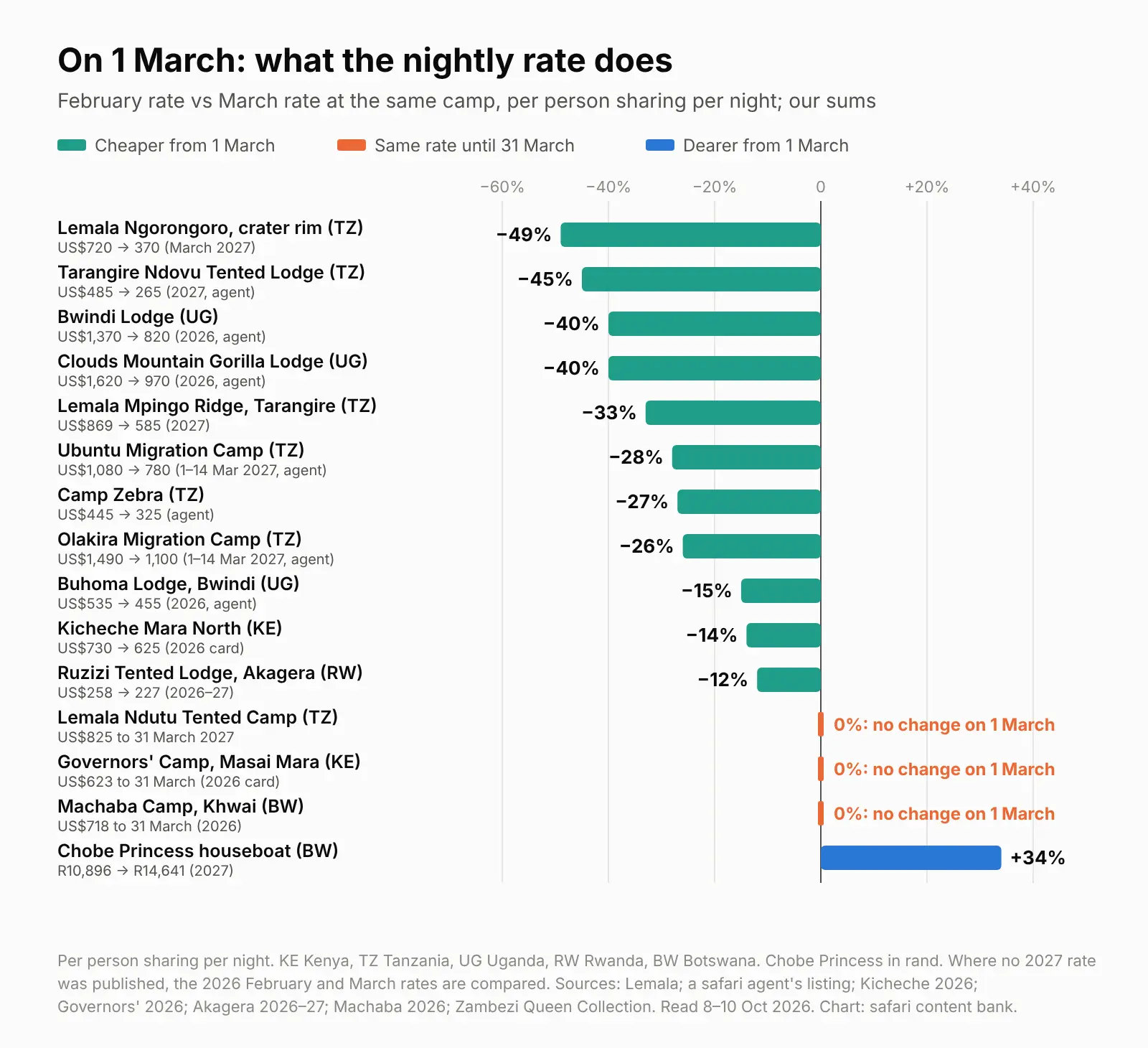 Our sums from each camp’s rate card or agent listing (2026–2027), read 8–10 October 2026. Chart: safari content bank.
Which camps are closed in February
Closures in February are a southern African matter: South Luangwa, the Lower Zambezi, Mana Pools and Gonarezhou lose most or all of their camps, and a few Okavango and Namibian camps close for the rains. We found no Kenyan or Tanzanian calving-area camp closed in February; Kenya’s closures fall in April–May.
| Area (country) | Closed in February | Dates | Source |
|---|---|---|---|
| South Luangwa (Zambia) | Time + Tide bush camps; Flatdogs Camp | Time + Tide open 20 May–15 November; Flatdogs closed 16 January–14 March. Nsefu Camp opens in February | South Luangwa |
| Lower Zambezi and Kafue (Zambia) | Chiawa, Old Mondoro; Busanga Plains camps | Mid-November–April; Busanga open June–end of October | Zambia safari cost |
| Mana Pools (Zimbabwe) | Most camps; the ZimParks side of the park | Camps December–March; park about mid-December to the end of February | One operator’s Mana Pools guide; Zimbabwe safari questions |
| Gonarezhou (Zimbabwe) | Closed to visitors | 10 January–1 March | Zimbabwe safari questions |
| Northern Serengeti (Tanzania) | Singita Mara River Tented Camp | 15 January–31 May (2026 sheet) | Singita Serengeti 2026 (PDF) |
| Makgadikgadi (Botswana) | Natural Selection’s San Camp | Open only 1 April–15 October | NS 2026 (PDF) |
| Okavango Delta (Botswana) | Boat trips at seasonal-floodplain camps; Natural Selection’s Skybeds; some Desert & Delta camps | No boats January–February; Skybeds open 1 April–31 October; Camp Xakanaxa 31 January–14 February, Camp Moremi and Xugana 15 February–1 March (2024 card) | Two camp operators’ seasonal guides; green-season safari; Okavango: water or land camps |
| NamibRand and the north (Namibia) | Wolwedans Desert Lodge; Natural Selection’s Hoanib Elephant Camp and Nkasa Linyanti | Wolwedans Desert Lodge closed 11 January–31 March 2026 (its 2027 card prices it in green season); the Natural Selection camps close in green season | green-season safari |
| Sossusvlei (Namibia) | Balloon flights | 15 January–15 February | A Namibia travel-booking site’s ballooning page |
Read 8–10 October 2026. Closure dates for 2027 were not published for every camp; ask your camp before you book.
Package prices in February
One Kenya safari company’s published fly-in packages cost about a quarter less in February 2027 than in July–September 2027 (our sum). Operators are not named here; the ranges are their published prices.
| Package type | February 2027 | July–September 2027 | Source |
|---|---|---|---|
| Kenya fly-in conservancy safaris, 10–11 nights, internal flights and park and conservancy fees included | US$7,400–7,915 per person sharing (January–March 2027 prices) | US$10,455 per person sharing (11 nights); the 11-night package 24% less in February, our sum | One Kenya safari company’s 2026–27 published prices, read 8 October 2026 |
Package prices per person, read 8 October 2026; names and links in our editor notes. Compare inclusions line by line: what each covers differs.
- Entry costs come on top of every package: Kenya’s eTA is US$30 plus a government health policy of up to US$44 (eCitizen) (Kenya visitor insurance); Tanzania’s visa is US$50 plus US$44 government insurance per adult as of October 2026 (Tanzania visitor insurance).
- No February package for the Tanzanian calving season is in our sources; the camp rates above are the guide. Southern Africa’s cheaper February is in the camp rate, not the fee: see green-season safari.
Worked examples: what February costs against March and August (our sums)
Seven nights at Ubuntu Migration Camp cost US$2,100 less per person in early March than in February, three nights at Lemala Ndutu cost the same, and a Kenya fly-in stay costs about a third less than in August (our sums from the rates and fees above). Tips and drinks are left out.
| Trip | February | Comparison | Difference |
|---|---|---|---|
| One adult, 7 nights at Ubuntu Migration Camp, Kusini, with Serengeti entry and concession | February 2027: 7 × (US$1,080 + US$82.60 + US$59) = US$8,551.20 | 1–7 March 2027: 7 × (US$780 + US$82.60 + US$59) = US$6,451.20 | US$2,100 less in March |
| Couple, 3 nights at Lemala Ndutu, with NCAA entry and concession (US$129.80 a night) | 2 × 3 × (US$825 + US$129.80) = US$5,728.80 | March 2027: the same, US$5,728.80 | US$0 |
| One adult, 3 nights at Governors’ Camp with reserve and community fees and return flights from Nairobi | February 2027: US$1,869 + US$450 + US$410 = US$2,729, if the 2026 rate and the last published fee carry over | August 2026: US$2,994 + US$750 + US$410 = US$4,154 | US$1,425 less in February |
| Two adults, 6-day road safari, park fees only: Amboseli, Lake Nakuru, Masai Mara reserve | US$1,140 | August: US$1,740 | US$600 less in February |
| Two adults, 3 days in Kruger, park fee only | February 2027: 2 × 3 × R692 = R4,152 | February 2026 at R602: R3,612 | R540 more than a year earlier |
| One gorilla permit in Rwanda with the low-season discount | US$1,050 + US$150 two nights’ Akagera entry = US$1,200 | Without the Akagera or Nyungwe stay: US$1,500 | US$300 |
Ubuntu’s rates exclude park and concession fees; Lemala’s exclude guide and vehicle; Governors’ rates exclude park and community fees. Mara fee: Narok County FY2025/26, the last published schedule. Serengeti fees: last published tariff, 2023/24. NCAA fees from the undated NCAA tariffs page, read 9 October 2026. Worked examples also on Great Migration safari cost, Masai Mara safari cost and Kenya park fees.
Malaria and rain in February
February falls in the rains and the malaria peak across southern Africa, and in the short dry spell between East Africa’s rains, where malaria risk runs all year. Take medical advice for your dates and route; this page gives no tablet advice.
| Area | February rain | Malaria in February | Source |
|---|---|---|---|
| Masai Mara (Kenya) | 100 mm (March 145 mm) | Risk all year in the entire country; low only in Nairobi and above 2,500 m | Climates to Travel (aggregator); WHO ITH country list 2022 (PDF) |
| Amboseli (Kenya) | 60 mm | As above | Climates to Travel; WHO |
| Serengeti and Ndutu (Tanzania) | “The driest month of the wet season”; no February figure in our sources | Risk all year below 1,800 m | A camp operator’s migration guide; WHO |
| Zanzibar (Tanzania) | 55 mm (March 150 mm) | As above | Tanzania safari and Zanzibar |
| Ruaha (Tanzania) | Iringa 130 mm | As above | Ruaha |
| Kruger (South Africa) | Wet season; Skukuza 635 mm a year | Highest risk November–April, “generally low, even in summer” | SANParks malaria |
| Okavango and Chobe (Botswana) | Rains November–March; no monthly figure in our sources | High October–May | TravelHealthPro |
| Etosha (Namibia) | Tsumeb 140 mm, the wettest month | Rainy-season risk, November–April | Climates to Travel; a safari booking site |
| South Luangwa (Zambia) | Peak rains, January–March; no monthly figure | Present across Zambia, all year in the valleys (one UK operator; no official source read) | South Luangwa |
| Hwange, Victoria Falls (Zimbabwe) | Rains November–March | Highest November–May in the Zambezi Valley and Victoria Falls (a Zimbabwe travel site; no official source read) | Zimbabwe safari questions |
| Bwindi (Uganda) | Drier months, about December–February; 7–20 °C | No official source read | One operator’s guide; UWA |
| Volcanoes (Rwanda) | Short dry season | Risk all year in the whole country | WHO |
Read 8–10 October 2026. No national weather service’s monthly normals are in our sources.
- Wet-season roads can be slow. A traveller in the southern Serengeti in March 2026 wrote “We were stuck 11 times in 7 days” (TripAdvisor forum, traveller report); our sources hold no February road reports for the southern plains.
- More on the rainy months, and what they save: green-season safari.
Common mistakes about a February safari
| What you’ll often read | What is correct |
|---|---|
| “February is the dry season in East Africa” | It is a drier spell, not a dry season. The Masai Mara averages 100 mm in February and Amboseli 60 mm; a camp operator calls February the driest month of the wet season on the southern Serengeti plains. |
| “Calving season is the cheap way to see the migration” | Not in February. Lemala Ndutu charges US$825 a night to 31 March 2027, and Ubuntu US$1,080 to 28 February, the same as in the crossing season. Early March is cheaper at Ubuntu, Olakira and Camp Zebra. |
| “Ndutu is in the Serengeti” | Ndutu is in the Ngorongoro Conservation Area, so NCAA fees apply: US$70.80 entry per 24 hours and US$59 a night at Ndutu lodges. |
| “The wildebeest calve in the Masai Mara” | The Serengeti herds calve only in Tanzania. The Mara’s smaller, separate Loita herd calves in Ol Kinyei in February–March. |
| “Kruger’s fee is R602” | Kruger’s fee is R692 (R602 until 31 October 2026), so February 2027 costs R692 per international adult a day. |
| “The Okavango floods in February” | The Delta’s water is low in February; seasonal camps run no boats in January and February. The first pulse reaches Mohembo, at the border, in February–March; the flood fills most of the Delta from about May. |
| “Gorilla permits are cheaper in February” | Uganda’s is US$800; the US$600 rate is only for April, May and November. Rwanda’s US$1,050 rate needs a stay in Akagera or Nyungwe. |
| “February is a good month to see Victoria Falls” | The flood starts in February, and spray often whites out the view from the ground until May; June to August gives the best balance of water and view. |
Frequently asked questions
Is February a good month for a safari? Yes, for calving at Ndutu, gorilla trekking and Botswana’s Kalahari pans. Calving camps charge peak rates in February, while Botswana’s camps are at their lowest; South Luangwa’s bush camps and most Mana Pools camps are closed. For a first safari aimed at waterhole game, the dry season is the better choice: see best time for a safari.
Where is the Great Migration in February? On the short-grass plains around Ndutu and Kusini in the southern Serengeti, where calving peaks in two to three weeks in February (a camp operator’s migration guide). Ndutu is in the Ngorongoro Conservation Area, not the national park. There are no river crossings in February; see Great Migration month by month.
Is late February too late for the calving? No. Experienced forum posters say the herds usually stay until the middle of March, and calving runs from late January to mid-March. By the end of March the herds start to leave the Ndutu plains, as TAWIRI’s 2023 census found.
Is February dry in East Africa? Drier, not dry. February falls between the short and the long rains: the Masai Mara averages 100 mm and Zanzibar 55 mm, against 145 mm and 150 mm in March (Climates to Travel, an aggregator). Rwanda is in its short dry season, and Uganda’s drier months run about December–February.
Is it cheaper to go in early March than in February? At many East African camps, yes. Ubuntu Migration Camp falls from US$1,080 to US$780 a night on 1 March 2027, Lemala Ngorongoro from US$720 to US$370, and Rwanda’s park lodges drop to low season. Lemala Ndutu and Botswana’s green-season camps keep the same rate until 31 March, and the Chobe Princess houseboat costs more from 1 March.
What is the Kruger park fee in February 2027? R692 per international adult per day. Kruger’s fee is R692 (R602 until 31 October 2026), and the 2026/27 schedule runs to 31 October 2027. Two adults spending 3 days pay R4,152 in fees (our sum).
Can you go gorilla trekking in February? Yes: a safari booking site rates Bwindi “Excellent” in February, and Rwanda is in its short dry season. Uganda’s permit costs US$800, and Rwanda’s US$1,500, or US$1,050 with two nights in Akagera or Nyungwe. Treks go ahead in rain.
Which safari camps are closed in February? Time + Tide’s South Luangwa bush camps and Flatdogs; Lower Zambezi’s Chiawa and Old Mondoro; most Mana Pools camps; all of Gonarezhou until 1 March; Singita’s Mara River Tented Camp; and Natural Selection’s San Camp in the Makgadikgadi. Robin Pope Safaris’ Nsefu Camp opens in February.
Sources
- Seasons and herds: a camp operator’s migration guide; TAWIRI 2023 wildebeest census (PDF); a camp operator’s best-time guide for Botswana; a Botswana camp operator’s seasonal guide (PDF); safari operators’ guides (Serengeti migration, Hwange, Mana Pools, Uganda and Rwanda gorillas, South Luangwa wild dogs, Zambia malaria, Namibia climate, Okavango flood); a safari booking site (Bwindi and Kibale ratings, Namibia malaria, Nkasa Rupara, Khaudum); a Namibia travel-booking site (ballooning); a safari agent’s Etosha guide (Etosha Pan, gate times); names and links kept in our editor notes
- Climate and health: Climates to Travel (Kenya, Tanzania, Namibia; an aggregator); SANParks climate, gates and malaria; TravelHealthPro, Botswana; WHO ITH country list 2022 (PDF); Visit Rwanda (gorilla kit list)
- Fees and permits: Narok County, Maasai Mara fee schedule FY2025/26 (PDF), the last published; KWS, Legal Notice 160 of 2025 (PDF); TANAPA, Tariffs 2023/24 (PDF), the last published tariff; NCAA tariffs; SANParks daily conservation fees 2025/26 (PDF), 2026/27 (PDF) and Tariffs 2024/25 (PDF); Tourism Update, DWNP fees (1 April 2022); Government Gazette 8877 (Government Notice 115 of 2026); a safari agent’s guide to DNPW fees, read 9 October 2026; ZimParks Tariff 2026 (PDF); UWA letter TDO 93/04 (PDF); Visit Rwanda; RDB low-season discount; African Parks, Akagera price list 2024 (PDF)
- Rate cards: as linked in the 1 March table and sections (Lemala, Kicheche, Governors’, Singita, Ruzizi, Wilderness, Natural Selection, Great Plains, Machaba, Zambezi Queen Collection, Sabi Sabi, Amakhala, Kwandwe, Wolwedans, Time + Tide, NWR rates from a booking agent’s listing, read September 2026; a safari agent’s listings)
- Package prices: one Kenya safari company’s 2026–27 fly-in packages (name and links kept in our editor notes)
- Traveller reports: TripAdvisor Kenya, Tanzania, Serengeti and Namibia forums; safari booking site reviews (Amboseli), linked in the text or on the pages linked
- More on this site: safari in January, safari in March, safari in April, safari in May, safari in June, safari in July, safari in August, safari in September, safari in October, safari in November, safari in December, Great Migration month by month, green-season safari, best time for a safari, Okavango flood calendar, Great Migration safari cost, safari cost per day by country
Rates, fees and seasons checked 8–10 October 2026, fee lines copied from the cost pages on 17 October 2026; SANParks fees checked 1 November 2026. We will update this page by 30 November 2026, and again when camps publish their 2027 rate cards and when Narok County, TANAPA, SANParks or DWNP publish a new fee schedule.