 Experience
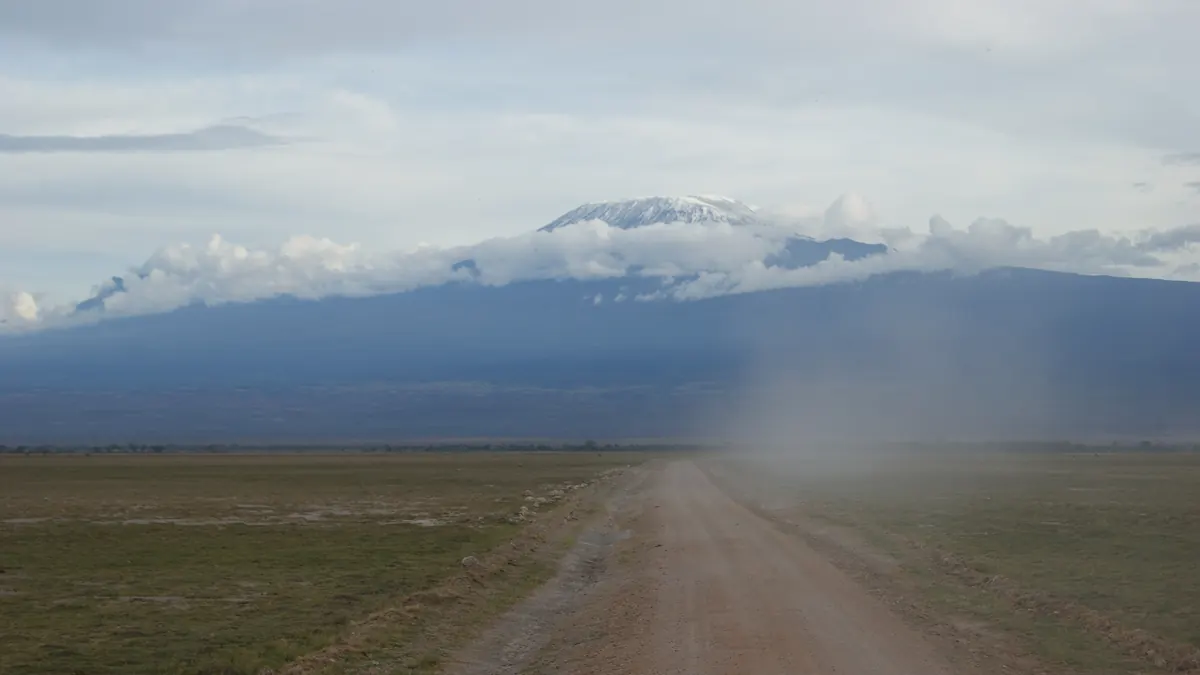

Last verified · Next check due
On this page
- Amboseli vs the Serengeti at a glance (2026)
- Wildlife: elephants and Kilimanjaro, or the migration and predators
- Size and crowds
- Best months for each park
- Getting there: Nairobi or Arusha
- Combining Amboseli and the Serengeti across Namanga
- Park fees: KWS against TANAPA
- Cost per day, fees included
- Visas and compulsory insurance
- Which should you choose?
- Common mistakes in Amboseli vs Serengeti comparisons
- Frequently asked questions
- Sources
Short answer: Choose Amboseli National Park (Kenya) for elephants, 2,065 at the end of 2025, a chance of Kilimanjaro behind them and a short trip: about 4 hours by road from Nairobi. Choose Serengeti National Park (Tanzania), about 38 times larger, for the wildebeest herds and predators. Amboseli charges US$90 per adult per 24 hours all year; a night inside the Serengeti costs US$129.80–153.40 in fees (last published tariff, 2023/24). The Namanga border links them.
Key facts
- Amboseli is an elephant park; the Serengeti is a migration park. Amboseli had 2,065 elephants at the end of 2025, according to the Amboseli Trust for Elephants (Born Free, 23 May 2026). The Serengeti has the wildebeest herds for most of the year, calving around Ndutu in February and crossing the Mara River from July to October.
- The Serengeti covers 14,763 km² (a safari agent’s guide, read 10 October 2026); Amboseli 392 km², about 38 times smaller (our arithmetic).
- Amboseli is busier for its size: 295,000 visitors in 2025 against 491,398 in the Serengeti in 2024/25, about 750 per km² against about 33 (Kenya Economic Survey 2026 via Business Daily; The Citizen, 18 Dec 2025; our arithmetic, different 12-month periods).
- Three nights cost an adult US$270 in Amboseli park fees and US$389.40–460.20 inside the Serengeti, plus US$141.60 for the Ngorongoro road there and back if you drive from Arusha (our sums from KWS Legal Notice 160 of 2025, TANAPA’s last published tariff, 2023/24, and NCAA).
- Two countries, two sets of papers. Kenya needs an eTA (US$30) and a health policy of up to US$44 (eCitizen); Tanzania a visa (US$50, US$100 for US citizens) and US$44 insurance, plus a yellow fever certificate when you arrive from Kenya.
- Your vehicle and guide do not cross the border. Every road trip changes vehicle at Namanga (Kenya–Tanzania border crossings).
Amboseli vs the Serengeti at a glance (2026)
Amboseli is a small, busy Kenyan park built around elephants and a mountain view; the Serengeti is a vast Tanzanian park built around the herds and the predators that follow them. The country-level choice, with beaches and other parks, is on Kenya vs Tanzania.
| Amboseli National Park (Kenya) | Serengeti National Park (Tanzania) | Source | |
|---|---|---|---|
| Known for | Elephants, 2,065 at the end of 2025, followed family by family since 1972; Kilimanjaro behind the plains when the cloud lifts | Wildebeest herds most of the year; calving in February; Mara River crossings July–October; a 1,000-plus lion stronghold in 2012 | Born Free; Great Migration month by month; PBS, Craig Packer |
| Area | 392 km² | 14,763 km² | Wikipedia; a safari agent’s guide, read 10 October 2026 |
| Visitors | 295,000 in 2025 | 491,398 in the 2024/25 financial year | Kenya Economic Survey 2026 via Business Daily; The Citizen |
| Run by | Kenya Wildlife Service (KWS) | Tanzania National Parks (TANAPA) | – |
| Adult park fee | US$90 per 24 hours, every month | US$82.60 entry per 24 h (US$70.80 15 Mar–15 May) + US$59–70.80 concession per night inside: US$129.80–153.40 a night (last published tariff, 2023/24) | Amboseli safari cost; Serengeti park fees |
| Child fee | Under 18: US$45 per 24 h; 5 and under free | 5–15: US$23.60 entry + US$11.80 concession a night; under 5 free | Same |
| Gateway | Nairobi | Arusha or Kilimanjaro Airport (JRO) | – |
| By road | Nairobi → Iremito Gate 204 km, about 4 h, tarmac | Arusha → Seronera 7–7.5 h, gravel after the Ngorongoro gate | KWS; one operator’s getting-there page |
| By air | Wilson → Amboseli 35 min, US$190 + US$20 fuel surcharge one way | Arusha or Kilimanjaro → Serengeti airstrips 1–2 h; no fare printed (our sources disagree) | Mombasa Air Safari 2026; a tour operator’s guide |
| Driest months | June–September, 5–15 mm of rain a month | June–September, 15–55 mm a month | Climates to Travel (aggregator) |
| Entry papers | Kenya eTA US$30 + health policy of up to US$44 (eCitizen) | Tanzania visa US$50 (US citizens US$100) + US$44 insurance | Kenya visa; Tanzania visa |
| Off-road, walks, night drives | Off-road driving “strictly prohibited”; not on KWS’s list of walking-safari parks; night drives not stated in our sources | No night drives inside the park; night drives and walks sold in private concessions on its edge | Amboseli; Serengeti |
Non-resident (Kenya) or non-East African (Tanzania) adult. Amboseli fees: KWS Legal Notice 160 of 2025, in force 1 October 2025. Serengeti fees: TANAPA’s last published tariff, 2023/24, with 18% VAT. Rain: Climates to Travel, Amboseli station (1,100 m) and Serengeti station (1,400 m). Checked 9–10 October 2026.
Wildlife: elephants and Kilimanjaro, or the migration and predators
Go to Amboseli for elephant families on open ground, with Kilimanjaro behind them when the cloud lifts; go to the Serengeti for the wildebeest herds and the lions, cheetahs and hyenas that follow them.
| Amboseli | Serengeti | Source | |
|---|---|---|---|
| Elephants | 2,065 at the end of 2025; over 220 born that year; more than 3,200 followed in 68 families since 1972 | No current count in our sources | Born Free, 23 May 2026 (Amboseli Trust for Elephants) |
| Big tuskers | About 9–10 in the Amboseli ecosystem | Not in our sources | Tsavo Trust, 3 Apr 2026 |
| Wildebeest herds | Not on the migration route | Most of the year; about 500,000 calves born in two to three weeks around February | Serengeti (a camp operator’s figures) |
| Lions | No density or count in our sources; travellers on a Mara forum rated its cat viewing “good”, against the Mara’s “great” | A 1,000-plus lion stronghold in Craig Packer’s 2012 list; no dated count | TripAdvisor (traveller reports, Aug 2026); PBS |
| Lion or elephant sighting rate | Not published | Not published | Where to see lions; where to see elephants |
| Birds | Over 400 species, 40 of them birds of prey (KWS) | Not compared in our sources | Amboseli |
| Kilimanjaro | Across the border in Tanzania, behind the plains; often in cloud | Not visible | Traveller reviews on a safari booking site |
Read 9–10 October 2026. No source we hold ranks the two parks for any species.
- Kilimanjaro is a morning-and-luck view. Two reviewers on a safari booking site in 2025–26 wrote that it “was in clouds, so missed the main goal of our visit” (traveller reports, as on our Kenya safari questions page). The elephants do not depend on the weather.
- The Serengeti’s predator season follows the herds. At calving, around February, lions, cheetahs and hyenas are on the southern plains (where to see lions); the calving plains around Ndutu are in the Ngorongoro Conservation Area, not the national park (Serengeti calving season).
- Our sources disagree on the herd’s size. TAWIRI’s aerial count put it at 1,366,109 at the end of March 2023; a satellite study counted fewer than 600,000 in August 2022 and 2023 (both as on our Serengeti page). We print both, not a single number.
Size and crowds
The Serengeti is about 38 times Amboseli’s area with about 1.7 times its visitors, so Amboseli carries about 23 times as many visitors per km² (our arithmetic). Neither authority publishes vehicle counts at sightings.
| Amboseli | Serengeti | Source | |
|---|---|---|---|
| Area | 392 km² | 14,763 km² | Wikipedia; a safari agent’s guide, read 9–10 October 2026 |
| Visitors a year | 295,000 (2025), up from 222,000 in 2023 | 491,398 (2024/25), up from 430,219 | Kenya Economic Survey 2026; The Citizen |
| Visitors per km² (our arithmetic) | about 750 | about 33 | Our sums; the two counts cover different years |
| Vehicles at one sighting | No published cap; wildlife viewed from at least 20 m; 40 km/h | No published limit found | KWS park page; Serengeti vs Masai Mara |
| What travellers report | “Surchargé de véhicules” (overloaded with vehicles), October 2025 | Seronera “always busy”; “fifty or more trucks” at a river crossing; 15–20 vehicles at a sighting at Ndutu, March 2026 | Routard; a UK safari operator’s guide; TripAdvisor; TripAdvisor |
| Outside or away from the busy areas | Conservancies outside the park, Selenkay and Kitirua, with their own fees | The east (Namiri, Nanyukie, Lobo), described as quieter; private concessions on the edge | Amboseli; Serengeti |
Read 9–10 October 2026. Traveller reports are not counts.
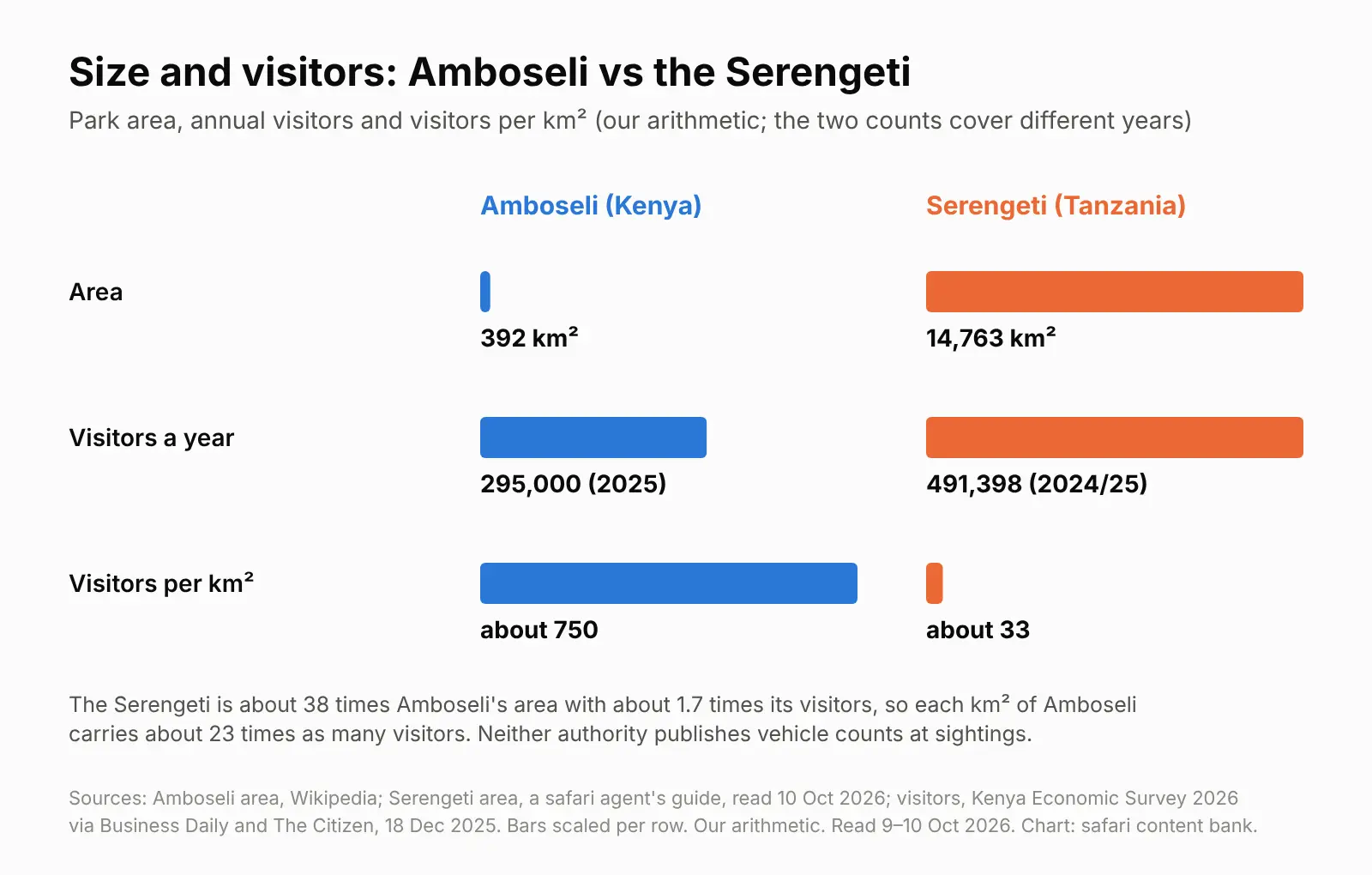 Sources: Wikipedia (Amboseli area); a safari agent’s guide (Serengeti area); Kenya Economic Survey 2026 via Business Daily; The Citizen, 18 Dec 2025. Our arithmetic; the two visitor counts cover different 12-month periods. Read 9–10 October 2026. Chart: safari content bank.
- In Amboseli every vehicle shares 392 km². Visitors rose from 222,000 in 2023 to 295,000 in 2025, more than the Masai Mara that year (Masai Mara vs Amboseli). Sleeping in a conservancy outside the park means you pay the park fee only on the days you drive in (Amboseli).
- In the Serengeti the crowds follow the herds. The busy places in our traveller reports are Ndutu at calving, the Mara River crossings in July–October and Seronera all year; the east is the quieter area on our Serengeti page.
Best months for each park
Both are driest from June to September. That is Amboseli’s best season and the Serengeti’s river-crossing season, when its concession fee is at its highest; January–February is Serengeti calving time.
| Month | Amboseli rain | Serengeti rain | Where the Serengeti herds usually are | Serengeti fees a night | Amboseli fee |
|---|---|---|---|---|---|
| Jan | 45 mm | 80 mm | South, Ndutu; calving begins | US$141.60 | US$90 |
| Feb | 60 mm | 100 mm | South, Ndutu; calving peaks | US$141.60 | US$90 |
| Mar | 90 mm | 130 mm | South; long rains begin | US$141.60; US$129.80 from 15 Mar | US$90 |
| Apr | 155 mm | 155 mm | Centre (Seronera, Moru); long rains | US$129.80 | US$90 |
| May | 70 mm | 90 mm | Moving west | US$129.80 to 15 May; then US$141.60 | US$90 |
| Jun | 15 mm | 35 mm | Western Corridor, Grumeti crossings | US$141.60 | US$90 |
| Jul | 5 mm | 15 mm | North, Kogatende; lead herds | US$153.40 | US$90 |
| Aug | 10 mm | 30 mm | Mara River, both banks | US$153.40 | US$90 |
| Sep | 10 mm | 55 mm | Mara River, both banks | US$153.40 | US$90 |
| Oct | 35 mm | 70 mm | North early, Lobo later | US$141.60 | US$90 |
| Nov | 115 mm | 115 mm | East and centre; short rains | US$141.60 | US$90 |
| Dec | 85 mm | 105 mm | Spreading south towards Ndutu | US$141.60 | US$90 |
Rain: Climates to Travel (aggregator), Amboseli station (1,100 m) and Serengeti station (1,400 m), as on our hubs. Herds: typical pattern from camp operators’ calendars, “timing all depends on the rains” (a camp operator’s migration guide); every month on the Great Migration month by month. Serengeti fees: entry + concession per adult per night inside the park, TANAPA’s last published tariff, 2023/24. Amboseli: per adult per 24 hours, KWS LN 160/2025. Read 9–10 October 2026.
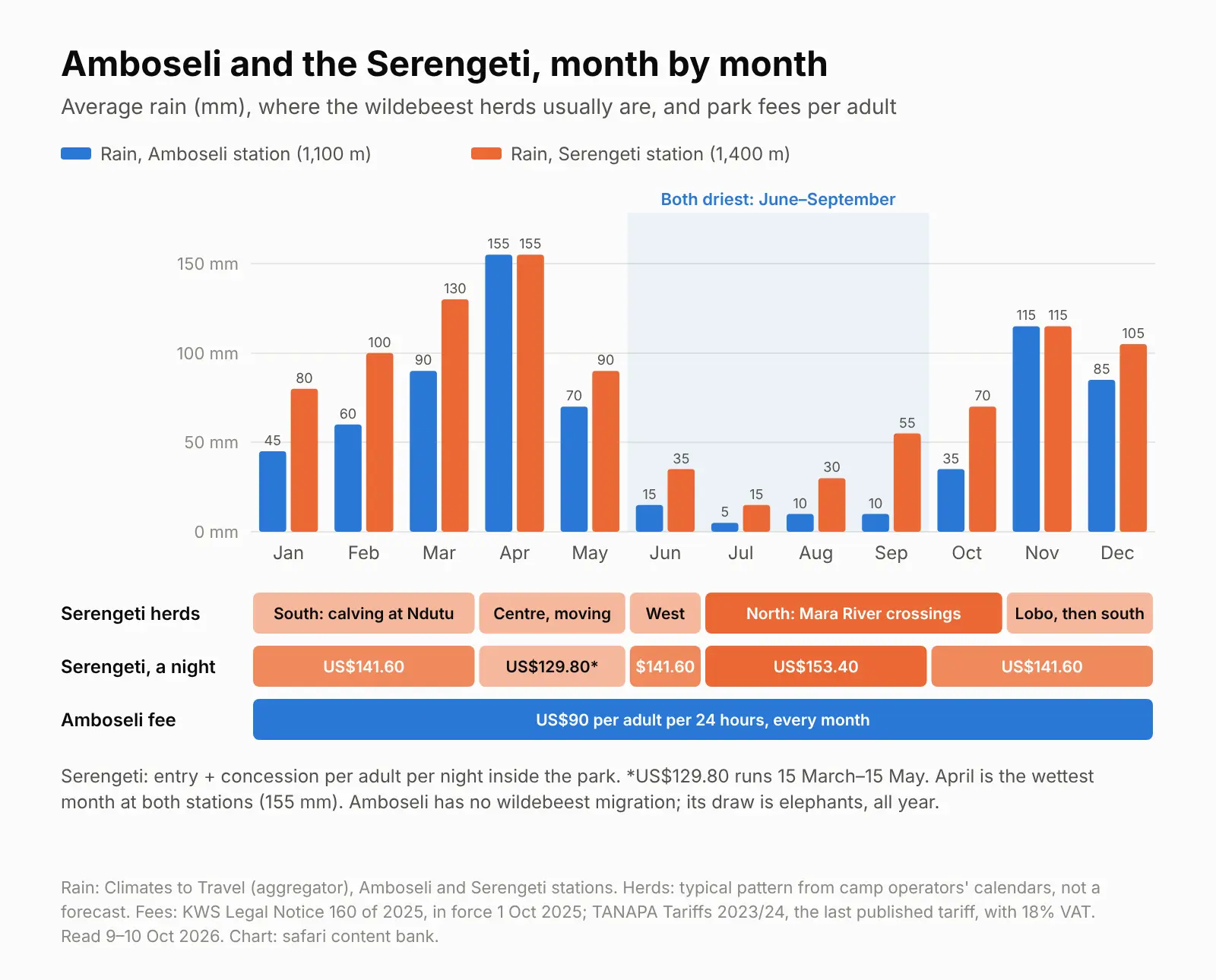 Typical pattern, not a forecast. Sources as under the table; read 9–10 October 2026. Chart: safari content bank.
- April–May is cheapest and wettest at both. Ol Tukai Lodge in Amboseli drops to US$190 per person (US$325 in June–October), and Serengeti entry drops to US$70.80 from 15 March to 15 May (last published tariff, 2023/24). Porini Amboseli was closed from 16 April to 31 May 2026 (Amboseli).
- Amboseli’s fee never changes; the Serengeti’s peaks in July–September, when the concession fee rises to US$70.80 a night.
- For both in one trip, June–September works best: Amboseli is driest and the Serengeti herds are in the west or north. Calving in January–February falls between Amboseli’s two rainy seasons (March–May and November–December), with 45–60 mm a month.
Getting there: Nairobi or Arusha
Amboseli is a Nairobi park: about 4 hours by road or 35 minutes by air. The Serengeti is reached from Arusha or Kilimanjaro: 7–7.5 hours by road to Seronera, or 1–2 hours by light aircraft.
| Route | Time | Fare or fee on the way | Source |
|---|---|---|---|
| Nairobi → Amboseli, Iremito Gate, via Emali, tarmac | 204 km, about 4 h | No fee on the way | KWS |
| Nairobi Wilson → Amboseli, scheduled flight | 35 min, leaves 07:30 | US$190 + US$20 fuel surcharge one way; minimum 2 passengers | Mombasa Air Safari 2026 |
| Kilimanjaro Airport (JRO) → Arusha | 55 km, 1 h 20 | Tarmac | A Tanzanian operator’s travel-times table |
| Arusha → Seronera (central Serengeti), by road | 7–7.5 h | Ngorongoro entry US$70.80 per adult each way, single entry | One operator’s getting-there page; NCAA |
| Arusha or Kilimanjaro → Serengeti airstrips, by air | 1–2 h | No fare printed: our sources disagree | A tour operator’s guide |
| Nairobi → Arusha, shuttle via Namanga | 5–6 h, border included | US$20–35 per seat | A self-drive operator’s guide; seat61 |
| Nairobi Wilson → Arusha, flight | About 1 h (website sample 10:30 → 11:30) | From US$225 one way | Flightlink |
Times as published by each source, read 9–10 October 2026. Flightlink’s times are website samples. Every Serengeti road time: Serengeti safari cost; every Amboseli option: Amboseli safari cost.
- Tourists are not driven outside towns after dark in Tanzania, so a same-day transfer into the Serengeti needs a flight landing at Kilimanjaro or Arusha before 13:00 (a Tanzanian operator’s travel-times table).
- Amboseli is not a day trip. Iremito Gate is about 4 hours from Nairobi each way; stay at least one night (Amboseli).
- The Serengeti road has its own fee: the drive from Arusha crosses the Ngorongoro Conservation Area, US$141.60 per adult there and back (Serengeti safari cost).
Combining Amboseli and the Serengeti across Namanga
Amboseli and the Serengeti fit one trip: cross at Namanga, sleep in Arusha, then drive or fly into the Serengeti the next day. Namanga is a One Stop Border Post listed as open 24 hours a day (Kenya–Tanzania border crossings).
| Leg | What the sources say | Source |
|---|---|---|
| Amboseli → Namanga | Meshanani Gate is Amboseli’s Namanga-side gate: Nairobi → Meshanani via Namanga is 220 km, “tarmacked up to Namanga and murramed from Namanga to Meshanani Gate”. A self-drive operator’s guide calls the Namanga road (C103) “very bad” | KWS; a self-drive operator’s guide |
| At Namanga | Kenya exit, Tanzania entry: visa on arrival or e-visa; change vehicle and guide, because Tanzanian-plated safari cars are “currently banned” in Kenyan parks and Kenyan vehicles cannot enter Tanzanian parks | Kenya–Tanzania border crossings; a self-drive operator’s guide |
| Namanga → Arusha | Same road as the Nairobi–Arusha shuttle (5–6 h in all, border included); we found no verified time for this leg alone | A self-drive operator’s guide; seat61 |
| Arusha → Serengeti | 7–7.5 h by road to Seronera via Ngorongoro, or 1–2 h by air | One operator’s getting-there page; a tour operator’s guide |
| The other way: Amboseli → Moshi | Taveta–Holili, also open 24 hours, is the shortest crossing to Moshi, the base for a Kilimanjaro climb | Kilimanjaro and safari |
Read 9–10 October 2026. We found no verified door-to-door time from Amboseli to Arusha; ask your two operators for theirs and for the hand-over point at the border.
- Plan the crossing as a travel day. With no driving after dark in Tanzania and 7–7.5 hours from Arusha to Seronera, Amboseli → Arusha one day and Arusha → Serengeti the next is the safe pattern; flying from Arusha saves most of the second day.
- Book two operators, or one that hands over at the border. The Kenyan vehicle and guide stop at Namanga.
- Kenya and Tanzania together need about two weeks: the Kenya and Tanzania itineraries in our dataset run 10–24 days, median 14 (multi-country safari).
- Herds at both ends? Amboseli has none. For the herds on both sides of the border, pair the Serengeti with the Masai Mara instead: Serengeti vs Masai Mara. The Mara–Serengeti road crossing has been closed since 1977.
Park fees: KWS against TANAPA
Amboseli charges one flat ticket per 24 hours; the Serengeti charges entry per 24 hours plus a concession fee for each night inside, and the road there crosses Ngorongoro. Three nights cost an adult US$270 in Amboseli and US$389.40–460.20 inside the Serengeti (our sums).
| Fee rule | Amboseli (KWS) | Serengeti (TANAPA) |
|---|---|---|
| Adult entry | US$90 per 24 hours, every month | US$82.60 per 24 hours; US$70.80 from 15 March to 15 May |
| Sleeping inside adds | Nothing beyond the 24-hour ticket; public campsite US$30 a night if you camp | Concession fee US$59 a night; US$70.80 in July–September |
| A night inside, adult | US$90 | US$129.80–153.40 |
| Children | Under 18: US$45 per 24 hours; 5 and under free | 5–15: US$23.60 entry + US$11.80 concession a night; under 5 free; 16 and over pay the adult rate |
| On the road there | No fee | Ngorongoro entry US$70.80 per adult each way, single entry (NCAA’s page does not say whether VAT is included) |
| Ticket length | “Valid for a period not exceeding twenty-four hours” | Day permit 12 daylight hours; sleep-over permit 24 hours |
| Last change | Legal Notice 160 of 2025, in force 1 October 2025 | TANAPA’s last published tariff, 2023/24; no newer tariff by 9 October 2026 |
Non-resident (Kenya) or non-East African (Tanzania) rates. Sources: KWS LN 160/2025 (PDF); TANAPA Tariffs 2023/24 (PDF), the last published tariff, with 18% VAT; NCAA. Read 9–10 October 2026.
| 3 nights, per person (our sums) | 15 Mar–15 May | Oct–14 Mar, 16 May–Jun | Jul–Sep |
|---|---|---|---|
| Amboseli, adult: 3 × US$90 | US$270 | US$270 | US$270 |
| Amboseli, child under 18 | US$135 | US$135 | US$135 |
| Serengeti, adult, lodge or camp inside: 3 × (entry + concession) | US$389.40 | US$424.80 | US$460.20 |
| Serengeti, adult, by road from Arusha: + Ngorongoro US$141.60 there and back | US$531 | US$566.40 | US$601.80 |
| Serengeti, child 5–15: 3 × (US$23.60 + US$11.80) | US$106.20 | US$106.20 | US$106.20 |
Our sums from the fee lines above. Amboseli: three tickets assume you leave within 72 hours of entering. Fees only: beds, vehicle and flights are extra.
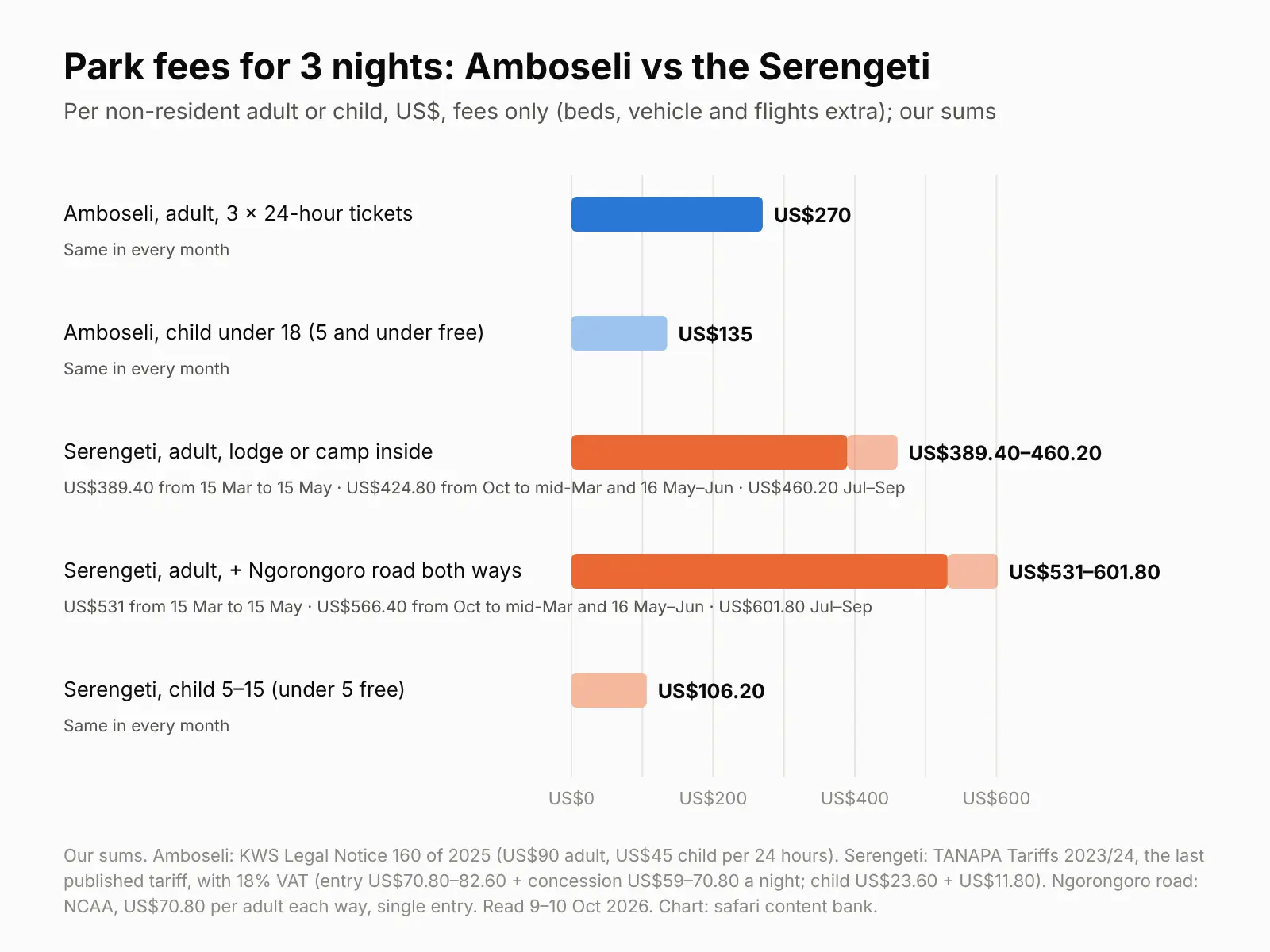 Our sums. Sources: KWS Legal Notice 160 of 2025; TANAPA Tariffs 2023/24, the last published tariff; NCAA tariffs page. Read 9–10 October 2026. Chart: safari content bank.
- KWS takes no cash. Amboseli fees are paid through KWSPay by M-Pesa, card or bank transfer, “in addition to facilitation charges” (Kenyans.co.ke, 1 Nov 2025), so you may pay more than the gazetted fee.
- Operators still bill the Serengeti’s 2023/24 amounts: Singita’s 2026 rate sheet lists a park fee of US$153.40 per adult per night for its Mara River camp (Serengeti park fees).
- Teenagers cost less in Amboseli. A 16- or 17-year-old pays Amboseli’s child rate, US$45, but the Serengeti’s adult rate; a child aged 5–15 pays less in the Serengeti, US$35.40 a night against US$45 (our sums).
Every fee line for each park: Amboseli safari cost, Kenya park fees, Serengeti park fees and Tanzania park fees.
The official fee lines, with the date each took effect and the source:
| Fee | Amount | In force from | Source |
|---|---|---|---|
| Amboseli and Lake Nakuru National Parks (KWS), non-resident adult, per 24 hours | USD 90 (child under 18, 5 and under free, USD 45) | Legal Notice 160 of 2025, gazetted 22 Sep 2025, which states no start date; in force 1 Oct 2025 per the KWS press release of 29 Sep 2025 | KWS Fees Regulations 2025 (LN 160/2025) |
| Public campsite, Amboseli and Lake Nakuru (KWS), non-resident adult, per night | USD 30 (child USD 25) | Legal Notice 160 of 2025, gazetted 22 Sep 2025, which states no start date; in force 1 Oct 2025 per the KWS press release of 29 Sep 2025 | KWS Fees Regulations 2025 (LN 160/2025) |
| Serengeti and Nyerere National Parks, non-East African adult, entry per day, 16 May–14 Mar | USD 70 + 18% VAT = USD 82.60 | 1 Jul 2023 (2023/24 tariff, last published) | TANAPA Tariffs 2023/24 |
| Serengeti and Nyerere National Parks, non-East African adult, entry per day, 15 Mar–15 May | USD 60 + 18% VAT = USD 70.80 | 1 Jul 2023 (2023/24 tariff, last published) | TANAPA Tariffs 2023/24 |
| Serengeti and Nyerere, concession fee per person per night inside the park | Jul–Sep USD 60 + VAT = USD 70.80; Oct–Jun USD 50 + VAT = USD 59 | 1 Jul 2023 (2023/24 tariff, last published) | TANAPA Tariffs 2023/24 |
| Serengeti, non-East African child 5–15, entry per day (under 5 free) | USD 20 + 18% VAT = USD 23.60 | 1 Jul 2023 (2023/24 tariff, last published) | TANAPA Tariffs 2023/24 |
| Serengeti, concession fee per child 5–15 per night inside the park | USD 10 + 18% VAT = USD 11.80 | 1 Jul 2023 (2023/24 tariff, last published) | TANAPA Tariffs 2023/24 |
| Ngorongoro Conservation Area, non-East African adult, entry per 24 h (single entry) | USD 70.80 (NCAA's page does not say whether VAT is included) | Undated official page, read 9 Oct 2026 | NCAA |
Cost per day, fees included
At every level a Serengeti day costs more than an Amboseli day: about US$183–225 against US$300 on a budget group trip, and US$340–505 against US$479.80–898.40 at a mid-range lodge or camp with half a private vehicle (our sums, as on our cost pages).
| Per person per day, with park fees (2026) | Amboseli | Serengeti |
|---|---|---|
| Budget group safari, fees included | about US$183–225 (a 6-day Masai Mara, Lake Nakuru and Amboseli group safari; one operator’s published price, divided by six) | US$300 (a 3-day group camping safari from Arusha with Ngorongoro; one operator’s published price); group lodge about US$407–425 |
| Mid-range lodge or camp + half a private vehicle | US$340–505: Ol Tukai Lodge, full board, + park fee + US$60–90 | US$479.80–898.40: Serengeti Wilderness Camp to Lemala Ewanjan, + fees + half a US$200–300 vehicle |
| Upper range | US$651–870: Porini Amboseli, game drives included, + US$100 Selenkay fee if not in the rate | US$869.80–2,403.40: Namiri Plains or Sayari, + fees |
| Top end | US$1,590–2,555: ol Donyo Lodge, Chyulu Hills (ask what the rate includes) | US$2,387–3,397: Singita Sabora or Faru Faru, Grumeti, + US$177 wildlife fee |
| Private vehicle with driver-guide | US$120–180 per vehicle per day, before fuel (market range) | US$200–300 per vehicle per day (one operator’s published cost guide) |
Low to peak season, per person sharing, before international flights and tips. Our sums of published 2026 prices, as on Amboseli safari cost and Serengeti safari cost, read 9–10 October 2026. The Amboseli budget figure is for a circuit that spends only part of its six days in Amboseli. Sources disagree on whether Porini’s rate includes the Selenkay fee; ask in writing.
- The vehicle costs more in Tanzania: US$200–300 a day against US$120–180 in Kenya, before fuel, on the price ranges our cost pages use.
- Season moves Serengeti prices more. Amboseli’s fee never changes and Ol Tukai rises from US$190 to US$325; in the Serengeti both the concession fee and camp rates peak in July–September. Whole-country costs: Kenya safari cost and Tanzania safari cost.
Visas and compulsory insurance
Each park needs its own country’s papers: Kenya’s eTA and health policy for Amboseli, Tanzania’s visa and insurance for the Serengeti. A UK or EU traveller doing both pays about US$176 per person in compulsory entry costs, a US traveller about US$226 (our sums, before card charges, as on Kenya–Tanzania border crossings).
| Kenya (Amboseli) | Tanzania (Serengeti) | |
|---|---|---|
| Entry document | eTA, US$30 plus card charges, at etakenya.go.ke; 3 working days; no visa on arrival, at airports or land borders | Visa, US$50 single entry; US citizens US$100 multiple entry; e-visa or visa on arrival |
| Compulsory insurance | Government health policy required for arrivals since 5 October 2026, up to US$44 (eCitizen); valid 90 days | US$44 per adult, valid 92 days, under Government Notice 256 of 2026; needed “even if” you have your own policy (UK FCDO, 20 Oct 2026) |
| Yellow fever certificate | Only if you arrive from a risk country | Needed when you arrive from Kenya, by road or air, aged 1 and over |
| Exempt | EAC citizens; African nationals except Somalia and Libya | EAC citizens need no visa; EAC and SADC residents are exempt from the insurance |
| Back into Kenya after Tanzania | A single-entry eTA stays valid for re-entry after a temporary trip to an EAC state such as Tanzania | – |
Sources as on our Kenya visa, Kenya visitor insurance, Tanzania visa and Tanzania visitor insurance pages: KCAA AIC 14/25 (PDF); Tanzania e-visa guidelines; UK FCDO, updated 6 Oct 2026; Clyde & Co, 16 Sep 2026; U.S. Embassy Nairobi; eCitizen insurance portal; WHO country list (PDF). Checked 10–11 October 2026.
- The East African Tourist Visa does not cover Tanzania: it covers Kenya, Uganda and Rwanda only (Tanzania visa).
- Neither insurance covers the other country, and your own travel insurance is not accepted in place of either. Buy Tanzania’s policy online before you reach Namanga: no source says whether it is sold at the border.
- Kenya’s insurance rule is new and contested. The High Court suspended it on 24 August 2026; the challenge was reported dismissed on 6–7 October, but no published ruling has been seen (Kenya visitor insurance). Check the eTA portal the week you apply.
Which should you choose?
Choose Amboseli for elephants, Kilimanjaro, a short trip from Nairobi and a flat fee; choose the Serengeti for the herds, the predators and space. With 10 days or more, do both across Namanga.
| If you… | Pick | Why |
|---|---|---|
| Want elephants above all | Amboseli | 2,065 at the end of 2025, families followed since 1972 |
| Want a photo with Kilimanjaro | Amboseli | The mountain stands behind the plains, but is often in cloud |
| Want the wildebeest herds | Serengeti | Herds most of the year; Amboseli has none |
| Travel January–February | Serengeti (south, Ndutu) | Calving peaks in February, with predators on the plains |
| Travel July–October | Serengeti (north) and, for a dry extra, Amboseli | Mara River crossings; Amboseli’s driest months |
| Have 3 nights or fewer from Nairobi | Amboseli | About 4 hours by road or 35 minutes by air; the Serengeti is 7–7.5 hours from Arusha |
| Count park fees | Amboseli | US$90 per 24 hours against US$129.80–153.40 a night (last published tariff, 2023/24) |
| Travel with teenagers aged 16–17 | Amboseli | Child rate under 18; the Serengeti’s child rate stops at 15 |
| Want space and fewer vehicles per km² | Serengeti | About 33 visitors per km² against about 750 (our arithmetic) |
| Plan a Kilimanjaro climb as well | Either: Amboseli → Taveta–Holili → Moshi, or the Serengeti from Arusha | See Kilimanjaro and safari |
Choosing between the countries rather than the parks: Kenya vs Tanzania. Two-country routes and days: multi-country safari. Whichever you choose, check that your operator is licensed.
See also: Masai Mara vs Amboseli, Amboseli vs Tsavo, Serengeti vs Masai Mara and Serengeti vs Ngorongoro.
Common mistakes in Amboseli vs Serengeti comparisons
| What you’ll often read | What is correct |
|---|---|
| “You can see Kilimanjaro from the Serengeti” | The classic view is from Amboseli, in Kenya, and even there the mountain is often in cloud. |
| “Amboseli is on the migration route” | It is not. The herds move between the Serengeti and the Masai Mara; Amboseli’s draw is elephants. |
| “Calving is in Serengeti National Park” | The calving plains around Ndutu are in the Ngorongoro Conservation Area, with NCA fees (US$70.80 entry per 24 hours). |
| “Serengeti entry is US$70” | US$70 is before VAT; the visitor pays US$82.60, plus a concession fee each night inside, from the last published tariff, 2023/24. |
| “Drive from Amboseli to the Serengeti in a day” | Plan two days: Namanga and Arusha, then 7–7.5 h to Seronera; tourists are not driven after dark in Tanzania. |
| “The same vehicle and guide continue into Tanzania” | They do not. You change vehicle at the border. |
| “The East African Tourist Visa covers both” | It covers Kenya, Uganda and Rwanda only, not Tanzania. |
| “Your own travel insurance is enough” | Neither country accepts it in place of its own government policy (Kenya up to US$44; Tanzania US$44). |
Frequently asked questions
Which is better, Amboseli or the Serengeti? It depends on what you want to see. Amboseli is the better elephant park, with 2,065 at the end of 2025 and Kilimanjaro behind them when the cloud lifts. The Serengeti has the wildebeest herds most of the year and is about 38 times larger. Amboseli is the shorter trip, about 4 hours by road from Nairobi.
Can you combine Amboseli and the Serengeti on one trip? Yes. Cross at Namanga, change vehicle and guide at the border, spend a night in Arusha and drive 7–7.5 hours or fly 1–2 hours into the Serengeti. You need Kenya’s eTA and health policy, Tanzania’s visa and insurance, and a yellow fever certificate for Tanzania when you arrive from Kenya. See Kenya–Tanzania border crossings.
Is Amboseli cheaper than the Serengeti? Yes, in park fees and on published prices. Amboseli is US$90 per adult per 24 hours all year; a night inside the Serengeti is US$129.80–153.40 (last published tariff, 2023/24). Budget group trips run about US$183–225 a day with Amboseli against US$300 in the Serengeti, and mid-range days US$340–505 against US$479.80–898.40 (our sums).
When is the best time to visit both? June to September. Amboseli is driest then, with 5–15 mm of rain a month, and the Serengeti herds are in the Western Corridor in June and on the Mara River from July. The Serengeti’s concession fee is highest in July–September; Amboseli’s fee is the same all year.
Can you see Kilimanjaro from Amboseli? Often not. The mountain stands across the border in Tanzania and is regularly in cloud; reviewers on a safari booking site missed it in July 2025 and February 2026. Plan early mornings and more than one night.
Do I need a visa for Amboseli and the Serengeti? You need two documents. Kenya: an eTA at US$30 plus card charges, approved before travel, plus a government health policy of up to US$44 (eCitizen). Tanzania: a visa at US$50, or US$100 for US citizens, plus US$44 insurance. The East African Tourist Visa does not cover Tanzania.
How long does it take to get from Amboseli to the Serengeti? Plan two days by road. We found no verified door-to-door time from Amboseli to Arusha via Namanga; Nairobi to Arusha alone is 5–6 hours by shuttle, border included, and Arusha to Seronera 7–7.5 hours. Tourists are not driven after dark in Tanzania, so most trips sleep in Arusha.
Is Amboseli more crowded than the Serengeti? For its size, yes. Amboseli had 295,000 visitors in 2025 on 392 km², about 750 per km²; the Serengeti had 491,398 in 2024/25 on 14,763 km², about 33 per km² (our arithmetic). Neither authority counts vehicles at sightings; travellers report busy sightings in both.
Sources
- Fees: KWS, Fees Regulations 2025, Legal Notice 160 of 2025 (PDF) and press release, 29 Sep 2025; TANAPA, Tariffs 2023/24 (PDF), the last published tariff; NCAA, tariffs, undated, read 9 Oct 2026; KWSPay: Kenyans.co.ke, 1 Nov 2025
- Parks and wildlife: KWS, Amboseli; Wikipedia, Amboseli National Park; a safari agent’s guide to Serengeti, read 10 October 2026; Born Free, 23 May 2026 (Amboseli Trust for Elephants); Tsavo Trust, 3 Apr 2026; PBS, Craig Packer, 6 Sep 2012; herd counts as on our Serengeti page
- Visitors: Kenya Economic Survey 2026 via Business Daily; The Citizen, 18 Dec 2025
- Climate: Climates to Travel, Kenya and Tanzania (aggregator)
- Migration: a camp operator’s migration guide; a UK safari operator’s guide; as on our Great Migration month by month page
- Travel: Mombasa Air Safari 2026 schedule; Flightlink; seat61, Kenya; WFP Logistics Cluster, Namanga; a self-drive operator’s guide; a Tanzanian operator’s travel-times table, modified 1 Jul 2026; one operator’s getting-there page; a tour operator’s guide, revised 26 May 2026
- Prices: lodge and camp rates and operators’ published 2026 prices as on our Amboseli safari cost and Serengeti safari cost pages (operators unnamed there and here)
- Entry: KCAA AIC 14/25 (PDF); Tanzania e-visa guidelines; UK FCDO, Tanzania, updated 6 Oct 2026; Clyde & Co, 16 Sep 2026; U.S. Embassy Nairobi; eCitizen insurance portal; WHO country list (PDF)
- Traveller reports: reviews on a safari booking site; Routard, October 2025; TripAdvisor threads as linked in the text, read 9 Oct 2026
- Our own pages for the detail: Amboseli, Amboseli safari cost, Serengeti, Serengeti park fees, Serengeti safari cost, Kenya vs Tanzania, Kenya–Tanzania border crossings, Kilimanjaro and safari, multi-country safari
Fees, rates and times checked 9–10 October 2026; entry rules 10–11 October 2026. We will update this page when TANAPA publishes a new tariff, when KWS changes its fees and when Kenya publishes an official price for its visitor health policy.
Ask for a quote
Tell us your dates and we send you a priced itinerary. Free, no obligation.
- Free quote, no obligation
- Trips run by licensed local operators