 Experience

Last verified · Next check due
On this page
- Etosha vs Masai Mara at a glance (2026)
- Self-drive waterholes or a guided migration safari?
- Park fees: a car and two adults in Etosha, a 12-hour ticket in the Mara
- Cost per day: what each park costs per person
- Getting there: Windhoek road or Nairobi flights
- When to go: dry-season waterholes or the migration months
- Wildlife: what each park shows, and what nobody publishes
- Crowds: which park is busier?
- Malaria: neither park is malaria-free
- Families: Etosha or the Masai Mara with children?
- Which should you choose?
- Common mistakes in Etosha vs Masai Mara comparisons
- Frequently asked questions
- Sources
Short answer: Choose Etosha (Namibia) to drive yourself in an ordinary car and watch game gather at waterholes from May to October; it charges N$280 per foreign adult plus N$60 per car since 1 April 2026. Choose the Masai Mara (Kenya) for the wildebeest herds, usually there from July to October, seen from an operator’s vehicle with a driver-guide; the reserve charges US$100 per adult a day from January to June and US$200 from July to December.
Key facts
- Etosha is a self-drive park; the Masai Mara reserve is guided only. A 2WD car is fine on Etosha’s main gravel roads in the dry season; Narok County banned private vehicles from game drives in the Mara reserve by a memo of 3 June 2024 (Kenyans.co.ke).
- Two adults pay N$620 a park day at Etosha with their car, and US$200 (January–June) or US$400 (July–December) a day in the Mara reserve (our sums). We count one Etosha fee per park day, as MEFT’s 2021 schedule did; Government Notice 115 of 2026 states no time period.
- Etosha is reached by road, the Mara by air or road. Windhoek to Okaukuejo is 414–435 km on tar, 4–6 hours; Nairobi Wilson to the Mara is about 1 hour by scheduled flight (US$200 + US$20 one way) or 275 km and 5.5–6.5 hours by road.
- July to October is high season in both: the herds are in the Mara and the Mara fee is US$200; Etosha’s game is at the waterholes and NWR’s camps charge high-season rates. September and October are Etosha’s peak.
- Neither park is malaria-free. WHO lists risk all year in the whole of Kenya; Swiss TPH says not to treat Etosha as malaria-free and extended its 2026 advice to June–August.
- Neither park publishes a sighting rate in our sources. Etosha has no Cape buffalo; the Mara’s lions, leopards and cheetahs are resident all year.
Etosha vs Masai Mara at a glance (2026)
Etosha is a fenced waterhole park you drive yourself, at the end of a long tarred road from Windhoek; the Masai Mara is an open-plains reserve visited with a guide, an hour’s flight from Nairobi, with the wildebeest herds from about July to October. This page compares the two parks. The two countries, with entry rules, Sossusvlei, the coast and the rest of Kenya, are compared on Kenya or Namibia for a safari?.
| Etosha National Park (Namibia) | Maasai Mara National Reserve (Kenya) | Source | |
|---|---|---|---|
| Run by | Ministry of Environment, Forestry and Tourism (MEFT); camps by Namibia Wildlife Resorts (NWR), the state company | Narok County; the western Mara Triangle by the not-for-profit Mara Conservancy | Etosha; Mara Conservancy |
| Adult fee | N$280 per foreign adult since 1 Apr 2026, plus N$60 per car; no time period stated | US$100 per day 1 Jan–30 Jun; US$200 1 Jul–31 Dec | Etosha park fees; Masai Mara park fees |
| Child fee | Ages 9–15: N$180; under 9 free | Ages 9–17 or student: US$50; under 9 free | same |
| How you see game | Your own car; park at a waterhole and wait | An operator’s or camp’s vehicle with a driver-guide | Etosha; Kenyans.co.ke |
| Main draw | Game gathered at waterholes, most perennial ones fed by boreholes | Wildebeest herds about July–October; resident big cats | Etosha; Great Migration month by month |
| Daylight limits | Gates open at sunrise and close at sunset; be in a camp or out of the park by sunset | Ticket valid 06:00–18:00, one calendar day | A safari agent’s guide, read 9 October 2026; Mara Conservancy |
| Night drives and walks | NWR guided night drives only; no walking; both on private reserves on the boundary | Not sold in the reserve; sold in the conservancies around it | Etosha; Mara reserve vs conservancies |
| Cheapest bed | NWR camping inside, N$460–560 per person a night | Oldarpoi Mara Camp outside Sekenani Gate, US$115 per person (an agent listing) | Etosha; Masai Mara |
| Gateway | Windhoek → Okaukuejo 414–435 km, tar, 4–6 h | Wilson → Mara about 1 h by air; Nairobi → reserve 5.5–6.5 h by road | Namibia self-drive distances; Nairobi to the Masai Mara |
| Best months | May–October; peak September–October | July–October for the herds; January–June at half the fee | Etosha; Masai Mara |
| Malaria | Not malaria-free (Swiss TPH) | Risk all year in the whole of Kenya (WHO) | Safari malaria risk |
| Rhino in the country, end of 2024 | Namibia 3,598 | Kenya 2,102 | IUCN SSC African Rhino Specialist Group report to CITES, 2025 |
Foreign (Etosha) or non-resident (Mara) adult. Etosha fees: Government Notice 115 of 2026, re-read 9 October 2026. Mara fees: Narok County’s last published schedule, FY2025/26, which expired on 30 June 2026; for July–December 2026, The Kenya Times (6 Aug 2026, a secondary source) reports US$200 still applies. NWR rates are published by booking agents, not by NWR itself. We print each price in its own currency; our sources hold no dated exchange rate, so we convert neither. We publish national rhino counts only.
Self-drive waterholes or a guided migration safari?
In Etosha you are the driver and the guide: you choose a waterhole and wait for the game to come. In the Mara reserve a driver-guide finds the animals for you on open plains, and you cannot take your own car on a game drive.
| Etosha | Masai Mara reserve | Private land next door (Etosha’s boundary reserves; Mara conservancies) | |
|---|---|---|---|
| Your own car | Yes: 2WD on the main gravel roads in the dry season; 4x4 recommended in the wet season and needed for Dolomite Camp | No game drives in private vehicles since 3 June 2024; we found no 2026 statement on how the memo is applied | No: lodge or camp vehicles |
| Speed and rules | 60 km/h on main roads, 40 km/h near waterholes; stay in your vehicle except in camps and at marked stops | Off-road driving prohibited, except to approach big cats on nearby open ground, no closer than 25 m | Off-road driving practised in the conservancies |
| Vehicles at a sighting | No published limit in our sources | Five; others wait at least 100 m away | No published cap |
| Night drives | NWR guided night drives, about N$620 per person; floodlit waterholes at Okaukuejo and Halali for camp guests | Not sold | Sold on Etosha’s boundary reserves and at some Mara conservancy camps |
| Walking | Not allowed inside the park | None sold, as far as we found | Guided walks on both |
| Guided alternative | Onguma’s 4-hour game drive into Etosha N$1,750 per person on its 2026 rate sheet, which ran to 31 October 2026; 3-day unguided shuttle safari from Windhoek US$615–633 per person (one operator’s published price) | The guided safari is the standard product | — |
Sources: a safari agent’s Etosha self-drive guide and night drives (a safari agent’s guide, read September 2026); Onguma 2026 activities (PDF); Kenyans.co.ke, 4 Jun 2024 (Narok memo); Narok County’s management plan as reported by Business Daily. As on our Etosha, Masai Mara and Kenya or Namibia pages, read 8–10 October 2026.
- In Etosha, wait rather than drive loops. Wildlife typically arrives at a waterhole after 20–40 minutes (one tour seller’s waterhole guide). Okaukuejo to Halali is about 70 km and 1 h 45 at game-viewing pace (Etosha).
- In the Mara the guide is most of what you pay for. Travellers who booked a cheap driver say a driver is not the same as a guide; a private vehicle with driver-guide from Nairobi runs US$120–180 per vehicle per day before fuel, on a safari price aggregator’s 2026 market range (Masai Mara safari cost).
- The rules differ on private land. Night drives, walks and off-road driving are what the Mara conservancies sell: see Mara reserve vs conservancies. Self-drive Etosha against other self-drive parks: Etosha vs Kruger and Etosha vs Chobe.
Park fees: a car and two adults in Etosha, a 12-hour ticket in the Mara
Etosha charges per person and per car, the same all year; the Mara charges per person per calendar day and doubles its fee on 1 July. For two adults over 3 days, Etosha costs N$1,860 with their car and the Mara reserve US$600 from January to June or US$1,200 from July to December (our sums).
| Etosha (MEFT, Government Notice 115 of 2026) | Masai Mara reserve (Narok County) | |
|---|---|---|
| Foreign adult | N$280 (N$140 park entrance + N$140 conservation fee), since 1 Apr 2026; was N$150 | US$100 per day (1 Jan–30 Jun); US$200 (1 Jul–31 Dec) |
| Child | N$180 aged 9–15; under 9 free | US$50 aged 9–17 or student; under 9 free |
| Car | N$60 per vehicle up to 10 seats | No car fee in our sources; private vehicles may not go on game drives |
| Period | The notice prices fees per person and states no period; MEFT’s 2021 schedule charged per park day | 12 hours, 06:00–18:00; “will not carry overnight” |
| Sleeping outside | Day visitors pay the same N$280 and N$60 at the gate | The rate is the same inside and outside; a camp outside saves it only on days you do not drive in |
| Private land next door | Etosha Heights: N$650 per person a night; Onguma: N$350 levy per person a night (2027 sheet, valid 1 November 2026 to 31 October 2027; N$275 before) | Conservancies charge US$130 per adult per night on camps’ 2026 rate sheets, instead of the reserve fee |
| Status | In force from 1 April 2026 | Last published schedule (FY2025/26) expired 30 June 2026; no 2026/27 schedule as of 9 October 2026 |
| 2 adults, 3 days (our sums) | N$1,860 with one car | US$600 Jan–Jun; US$1,200 Jul–Dec |
Sources: Government Gazette 8877 (Government Notice 115 of 2026), PDF, hosted by the Legal Assistance Centre; MEFT, 2021 schedule (PDF); Narok County fee schedule FY2025/26 (PDF), with The Kenya Times, 6 Aug 2026 (secondary) for July–December 2026; Mara Conservancy; Natural Selection 2026 (PDF); Onguma 2027 (PDF), read 1 November 2026; conservancy fee from the Kicheche 2026 (PDF) sheet. Read 9–10 October 2026.
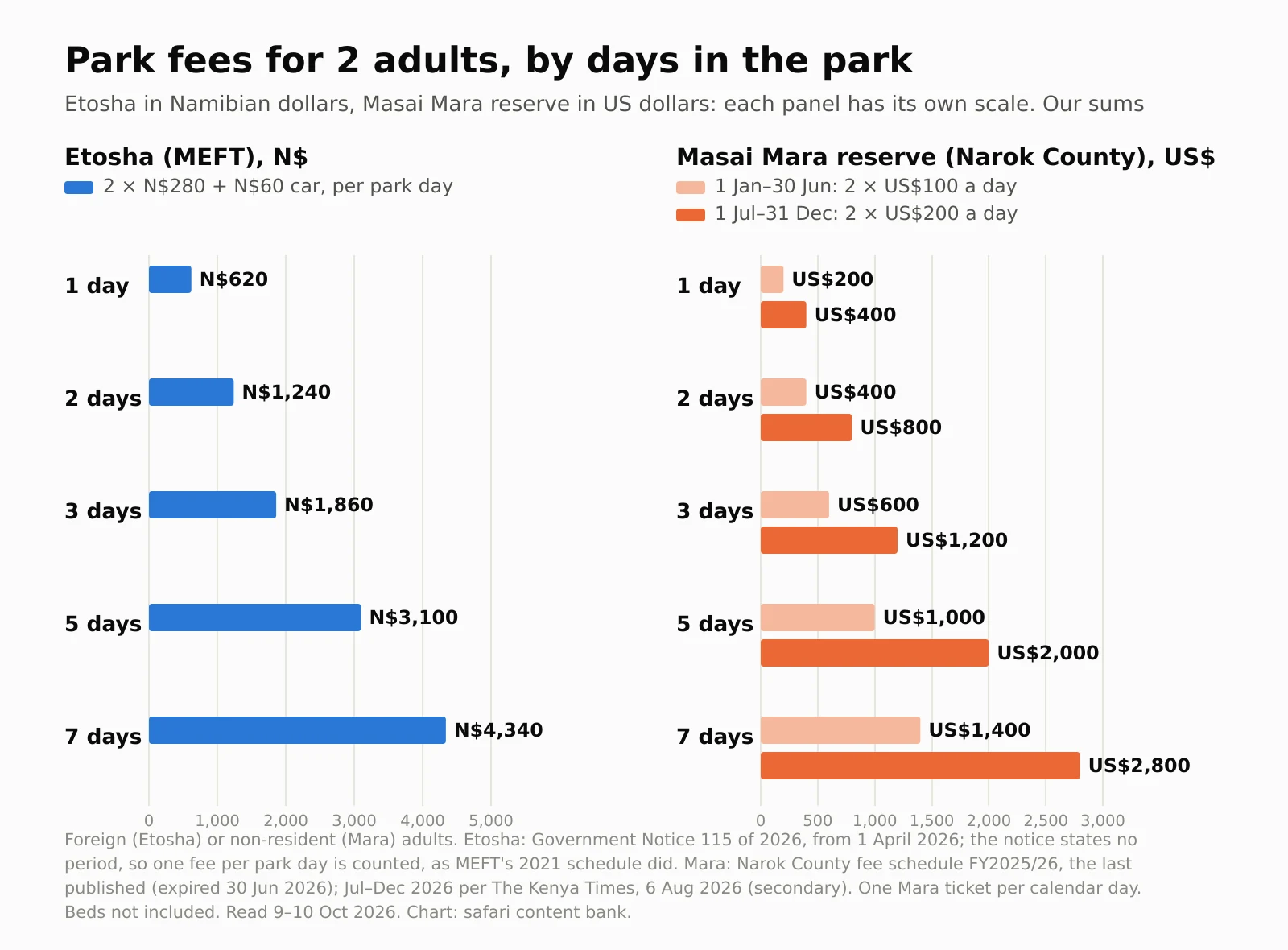 Our sums. Sources: Government Notice 115 of 2026 (Etosha, from 1 April 2026; one fee per park day, as MEFT’s 2021 schedule did); Narok County fee schedule FY2025/26, the last published (July–December 2026 per The Kenya Times, 6 Aug 2026, secondary). Read 9–10 October 2026. Chart: safari content bank.
- In the Mara, count tickets, not nights. A 2-night stay inside the reserve spans 3 calendar days and up to 3 tickets, and a game drive on the day you leave needs that day’s ticket (how many days for a safari).
- Etosha’s fee is a small share of the day. At July–October prices, park fees are 6–11% of a self-driver’s Etosha day (Etosha safari cost). In the Mara, the reserve fee is US$600 of a US$1,185–1,305 three-night budget trip by road in August, 46–51% (Masai Mara safari cost).
- Budget Mara prices usually leave out the fee. One operator’s 3-day group safari costs US$170–180 per person and says “park fees NOT included”; NWR’s Etosha camp rates also exclude park fees, which you pay at the gate.
- Some Mara reserve camps add a community fee: Governors’ charges US$50 per guest per night, payable to Narok County (Governors’ Camp).
The official fee lines, with the date each took effect and the source:
| Fee | Amount | In force from | Source |
|---|---|---|---|
| Tier 1 parks (Etosha, Namib-Naukluft including Sossusvlei, Skeleton Coast, Ai-Ais/Fish River Canyon, Waterberg Plateau, Cape Cross, Dorob, Tsau //Khaeb), foreign adult 16+, per person | NAD 280 (NAD 140 park entrance + NAD 140 conservation fee) | 1 Apr 2026 (Government Notice 115 of 2026; the notice prices fees per person with no period; MEFT's 2021 schedule made fees valid for 24 hours from entry); was NAD 150 under the 2021 schedule | Government Gazette 8877 (Government Notice 115 of 2026), hosted by the Legal Assistance Centre |
| Tier 1 parks, foreign child 9–15, per person (under 9 free) | NAD 180 | 1 Apr 2026 (Government Notice 115 of 2026; the notice prices fees per person with no period; MEFT's 2021 schedule made fees valid for 24 hours from entry); was NAD 100 for foreign children up to 16 under the 2021 schedule | Government Gazette 8877 (Government Notice 115 of 2026), hosted by the Legal Assistance Centre |
| Vehicle up to 10 seats, most national parks (N$50 at Sandwich Harbour), per vehicle | NAD 60 | 1 Apr 2026 (Government Notice 115 of 2026; the notice states no period; MEFT's 2021 schedule made fees valid for 24 hours from entry); was NAD 50 | Government Gazette 8877 (Government Notice 115 of 2026), hosted by the Legal Assistance Centre |
| Maasai Mara National Reserve, non-resident adult, per day (12-hour ticket, 06:00–18:00), 1 Jan–30 Jun | USD 100 | Since 1 Jan 2024; Narok County FY2025/26 schedule, the last published | Narok County fee schedule FY2025/26 |
| Maasai Mara National Reserve, non-resident adult, per day (12-hour ticket, 06:00–18:00), 1 Jul–31 Dec | USD 200 | Since 1 Jul 2024; Narok County FY2025/26 schedule, the last published, expired 30 Jun 2026 (no 2026/27 schedule as of 9 Oct 2026); The Kenya Times (6 Aug 2026, secondary) reports US$200 still applies for Jul–Dec 2026 | Narok County fee schedule FY2025/26 |
| Maasai Mara National Reserve, non-resident child 9–17 or student, per day (under 9 free) | USD 50, all year | Narok County FY2025/26 schedule, the last published | Narok County fee schedule FY2025/26 |
Cost per day: what each park costs per person
A self-driver camping inside Etosha spends about N$2,225–2,810 per person a day with the car and park fees; a budget Mara group safari costs about US$157–160 a day from January to June and US$257–260 from July to December with the reserve fee. At camp level, Governors’ Camp in the Mara reserve costs US$603–1,248 a day with fees, and Etosha Mountain Lodge on Etosha’s boundary N$7,975–11,445 plus the car (our sums, as printed on our cost pages).
| Style, per person sharing | Etosha | Masai Mara |
|---|---|---|
| Self-drive, camping | N$2,225–2,810 a day: half a rooftop-tent 4x4 + NWR camping + park fees | Not possible: no game drives in private vehicles |
| Self-drive, room | N$2,948–3,790 a day with an NWR room at Okaukuejo; N$4,431–4,793 at Gondwana’s Etosha Safari Lodge outside | Not possible |
| Budget package | 3-day unguided shuttle safari from Windhoek US$615–633, about US$205–211 a day (one operator’s published price) | 3-day group safari from Nairobi US$170–180 before fees; about US$157–160 (Jan–Jun) or US$257–260 (Jul–Dec) a day with the reserve fee |
| Classic camp or lodge | Etosha Mountain Lodge, fully inclusive with park entry: N$7,975–11,445 with the N$650 reserve fee, plus the car | Governors’ Camp, in the reserve: US$603–1,248 with reserve and community fees |
| Conservancy or private reserve | Onguma Bush Camp from N$3,060 dinner, bed and breakfast, plus the N$350 levy; activities extra; 2027 sheet, valid 1 November 2026 to 31 October 2027 | Kicheche Mara North US$755–1,125; Hemingways Ol Seki US$945–1,440, with conservancy fees |
| Top end | Ongava Lodge N$17,300, fully inclusive (an agent rate), plus the car | Wilderness Mara US$1,324–2,028, “Conservation levy and government taxes are included” |
| Fly-in | Fly-in safaris that include Etosha about US$1,407–1,590 a night, land only (operators’ published prices, 3 listings) | Wilson → Mara US$200 + US$20 one way |
Our sums of 2026 published prices, low to peak season, as printed on our Etosha safari cost and Masai Mara safari cost pages. Etosha: Namibia2Go 2026; NWR 2026–27 rates via a booking agent’s listing; Gondwana; Natural Selection 2026 (PDF); Onguma 2027 (PDF), read 1 November 2026; Ongava via an agent. Mara: Governors’ 2026 (PDF), Kicheche 2026 (PDF), Hemingways 2026 (PDF), Wilderness, Mombasa Air Safari 2026. Read 3 September–10 October 2026. Tour prices are operators’ “from” prices; ask what each includes.
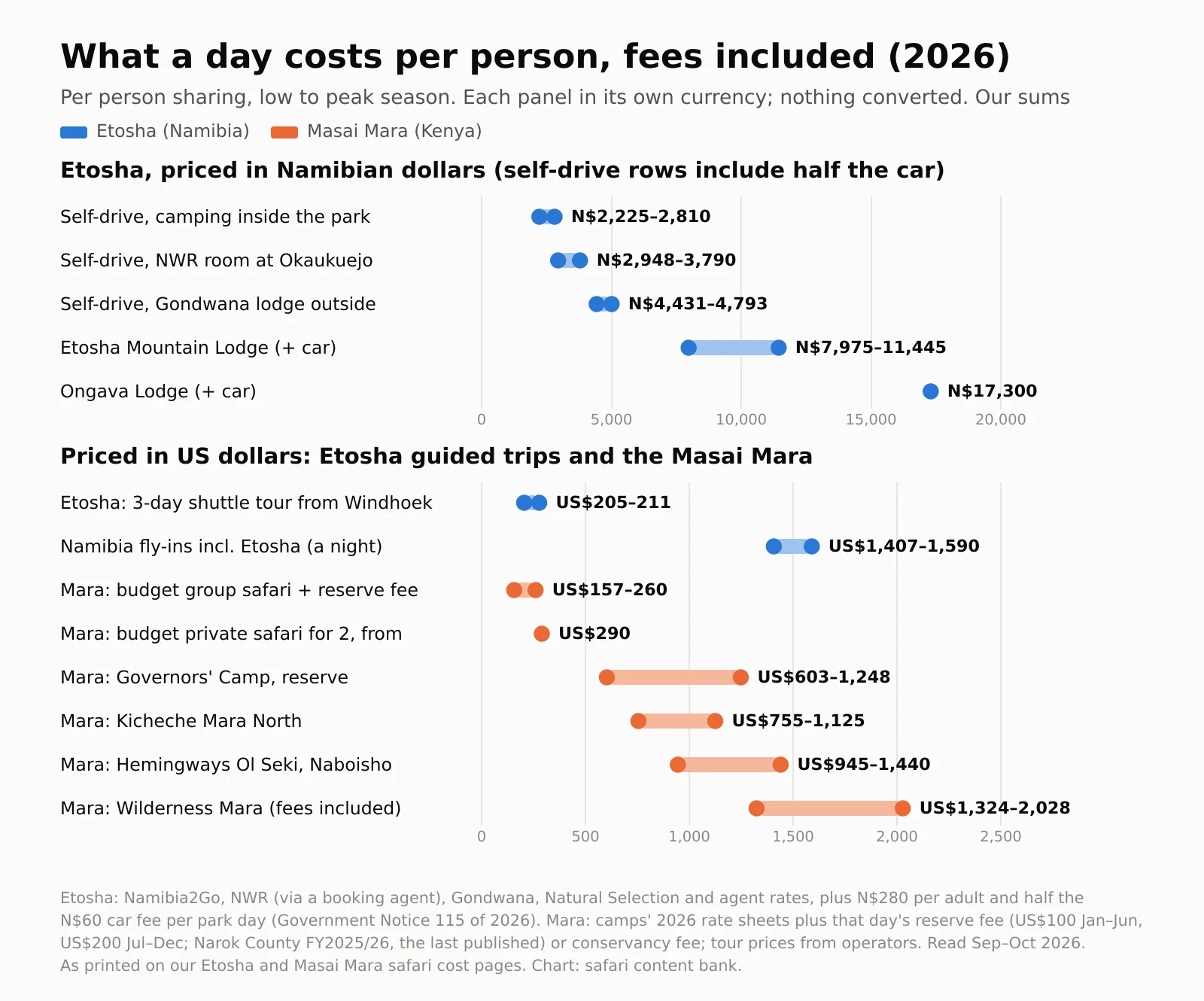 Our sums, as printed on our Etosha and Masai Mara safari cost pages. Sources: Namibia2Go, NWR (via a booking agent), Gondwana, Natural Selection and agent rates; camps’ 2026 rate sheets; operators’ published prices; Government Notice 115 of 2026; Narok County FY2025/26 schedule. Read 3 September–10 October 2026. Chart: safari content bank.
- The closest comparison in one currency is a budget package. Etosha’s 3-day unguided shuttle safari (titled “unguided” by its seller) lists at about US$205–211 a day; a guided budget Mara group safari comes to about US$157–160 a day with the January–June fee and about US$257–260 with the July–December fee (our sums).
- On an Etosha self-drive the car is the biggest line: Namibia2Go’s camping 4x4 costs N$2,910 a day in low season and N$3,880 from July to October (2026, zero excess included). Two people share it, so a couple pays half each.
- Three high-season nights for two inside Etosha cost N$5,220 camping at Okaukuejo or N$16,140 in an Okaukuejo room, park fees included, before the car and fuel (Etosha). Three August nights at Governors’ Camp with return flights from Nairobi cost one adult US$4,154 (Masai Mara safari cost).
- Every Namibia and Kenya day cost, country-wide: safari cost per day by country.
Getting there: Windhoek road or Nairobi flights
Etosha starts with a 414–435 km drive on tar from Windhoek, 4–6 hours; the Mara is about an hour by scheduled light aircraft from Nairobi’s Wilson Airport, or 5.5–6.5 hours by road.
| Etosha | Masai Mara | Source | |
|---|---|---|---|
| International airport | Windhoek Hosea Kutako, 40–45 km east of Windhoek; Discover Airlines flies non-stop from Frankfurt daily, about 10 h 15 | Nairobi; light aircraft from Wilson Airport | Etosha; Nairobi to the Masai Mara |
| By road | Windhoek → Okaukuejo (Andersson Gate) 414–435 km, tar, 4–6 h; Windhoek → Namutoni (east) 533 km | Nairobi → reserve 275 km, 5.5–6.5 h by gate, tarmac to Sekenani Gate | Namibia self-drive distances; The Kenya Times, 20 Aug 2026 |
| By air | Fly Namibia Safari serves the Ongava and Mokuti airstrips; no fare published in our sources | Mombasa Air Safari, Wilson → Mara about 1 h, US$200 + US$20 fuel surcharge one way; US$370 + US$40 return | Fly Namibia Safari schedule (PDF); Mombasa Air Safari 2026 |
| Luggage on light aircraft | Not stated for Etosha’s airstrips in our sources | 15 kg per person including hand luggage, soft bags | Masai Mara |
| Driving inside | Okaukuejo → Namutoni about 140 km, about 3 h 15 at game-viewing pace | Driven by your guide | A safari agent’s Etosha map |
| Fuel | Diesel N$27.86 a litre at Walvis Bay from 2 Sep 2026; Windhoek → Okaukuejo about N$1,269–1,333 one way (our sum) | In the vehicle or flight price | The Brief; Etosha safari cost |
Read 3 September–10 October 2026. Airline schedules change by season; check the live timetable before you book.
- A short Mara trip works by air: with about an hour each way from Wilson, two or three nights leave most of the time for game drives. By road, stay at least two nights; one night leaves two half-days in a vehicle (Nairobi to the Masai Mara).
- Etosha is usually one stop on a longer Namibian road trip. Published Namibia self-drive packages run a median 15 days, against 4 days for the Masai Mara alone (our count of operators’ itineraries, on how many days for a safari). Etosha’s next stop on that loop: Etosha vs Sossusvlei.
- Entry costs are on the country page: Namibia charges UK, US and German visitors N$1,600 for a visa on arrival, and Kenya’s eTA costs US$30 (Kenya or Namibia; Namibia visa; Kenya eTA).
When to go: dry-season waterholes or the migration months
Both parks peak from July to October. Etosha’s game gathers at the waterholes from May, with September and October the peak; the Mara’s herds usually arrive from mid or late July and leave in October. Outside those months Etosha’s game disperses from November to April, while the Mara keeps its resident cats at half the reserve fee from January to June.
| Months | Etosha: game | Etosha: rain at Tsumeb, NWR season | Masai Mara: herds (usual pattern) | Masai Mara: fee, rain |
|---|---|---|---|---|
| January–March | Poorest; game disperses, the pan may hold water | 80–140 mm a month; low season | Southern Serengeti; the resident Loita herd calves in the conservancies, February–March | US$100; 95–145 mm |
| April–June | Game returning to the waterholes; good from May | 40 mm in April, 0–5 mm May–June; low season | Long rains in April (210 mm); herds moving towards the Western Corridor, usually not in the Mara yet in June | US$100; Governors’ Camp’s lowest rate in April–May |
| July–August | Very good; game at the waterholes | 0 mm; high season | In the Mara from mid or late July; Mara full in August, crossings mostly south to north | US$200; 60–80 mm |
| September–October | Peak; October averages 33 °C highs at Tsumeb | 0–20 mm; high season | Most animals in the Mara in September; the tail crosses back into Tanzania in October | US$200; 95–100 mm |
| November–December | Game disperses as the rain starts | 55–95 mm a month; low season | Central Serengeti, then south towards Ndutu | US$200; 115–155 mm |
Typical year, not a forecast. Etosha: a safari agent’s guide, a safari booking site’s ratings and NWR 2026–27 rates via a booking agent, as on our Etosha page. Mara herds: a camp operator’s migration guide, whose timing “all depends on the rains”, and a Kenyan camp operator’s Loita migration page, as on our Masai Mara page. Rain: Climates to Travel (Tsumeb, near Etosha; Kenya, Masai Mara station), an aggregator. Mara fee: Narok County FY2025/26, the last published (July–December 2026 per The Kenya Times, secondary). Read September–October 2026.
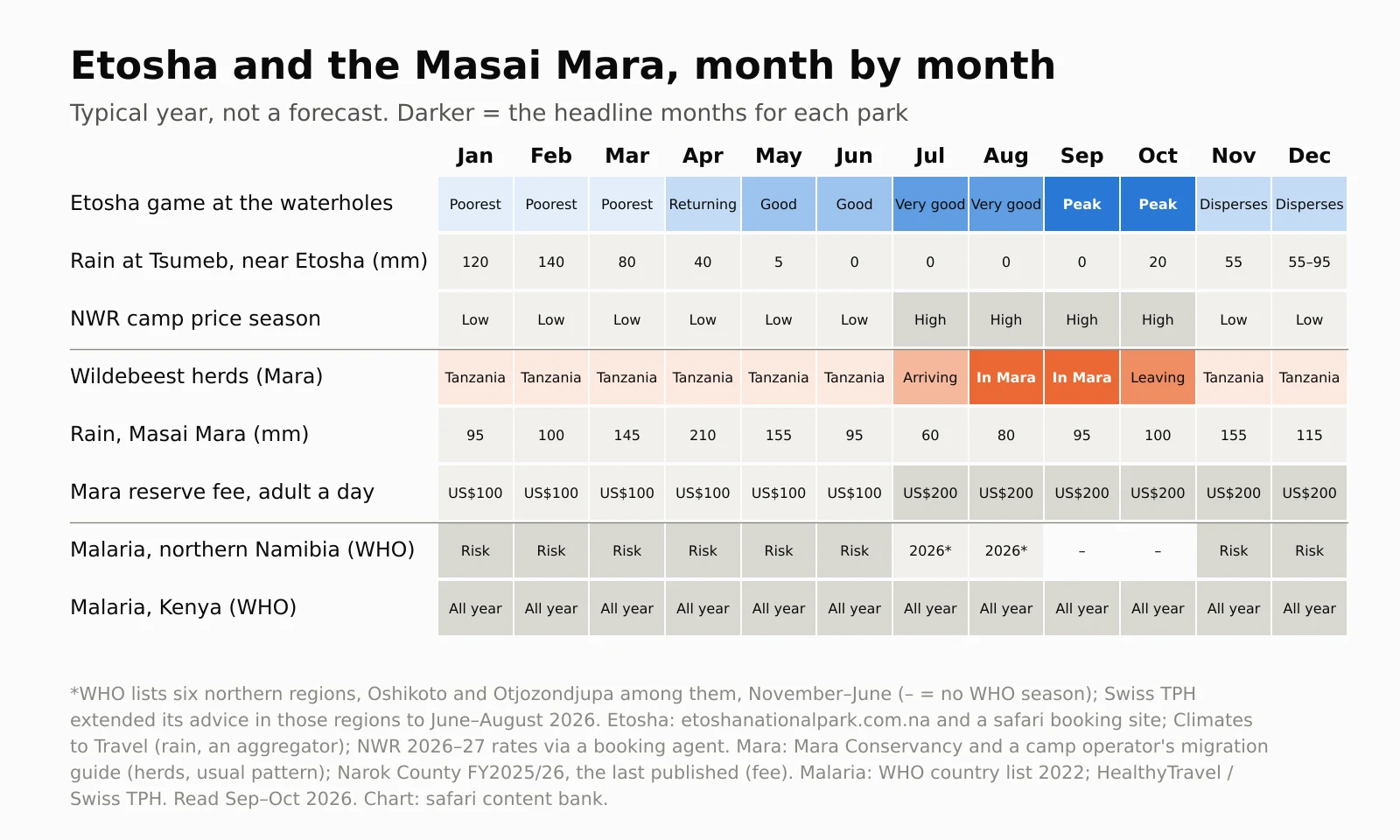 Typical year. Sources: a safari agent’s guide and a safari booking site (Etosha); Climates to Travel (rain, an aggregator); NWR 2026–27 rates via a booking agent; Mara Conservancy and a camp operator’s migration guide (herds); Narok County FY2025/26 schedule (fee); WHO country list 2022 and HealthyTravel / Swiss TPH (malaria). Read September–October 2026. Chart: safari content bank.
- No one can book a river crossing. The Mara Conservancy says crossings “happen frequently during the migration but are difficult to predict” (where and when the river crossings happen).
- May and June are Etosha’s value months: NWR and the rental firms are still on low-season rates, and game is already returning to the waterholes (Etosha safari cost).
- January and February are the Mara’s quiet value months: the fee is US$100, and TripAdvisor destination experts call those months “uncrowded on sightings” (Masai Mara).
- Book early for July to September in both. Forum regulars advise booking NWR’s Etosha camps 6–12 months ahead; Mara travellers report reserve camps near the river booking up to a year ahead for mid-July to early September (traveller reports).
Wildlife: what each park shows, and what nobody publishes
Etosha shows elephant, zebra and wildebeest at its waterholes but no Cape buffalo; the Mara has the wildebeest herds from about July to October and big cats resident all year. Neither park publishes a sighting rate in our sources, so the two cannot be ranked on odds.
| Etosha | Masai Mara | Source | |
|---|---|---|---|
| Sighting data | Ratings, not rates: elephant, zebra and wildebeest “abundant”; giraffe “common”; lion and hyena “occasional”; leopard and cheetah “very rare” (a safari booking site’s ratings) | No sighting rate or rating published in our sources | Etosha; where to see lions |
| Big Five | Never all five: Cape buffalo are kept out by veterinary policy | Lion, leopard, elephant and buffalo; for rhino see our national counts | A safari agent’s guide, read September 2026; where to see the Big Five |
| Big herd movement | None: the park is fully fenced and has no migration | Wildebeest herds about July–October; the smaller Loita herd calves in the conservancies in February–March | A safari agent’s guide, read September 2026; Great Migration month by month |
| Big cats | Lion occasional; leopard and cheetah very rare (same ratings) | Lions, leopards and cheetahs resident all year | Etosha; Kenya safari questions |
| Local specials | Black-faced impala, Damara dik-dik and, in the west, Hartmann’s mountain zebra; flamingos on the pan only after good rains, typically February–April | The resident Loita herd in the conservancies | Etosha; Masai Mara |
| Rhino in the country, end of 2024 | Namibia 3,598 (2,098 black, 1,500 white) | Kenya 2,102 (1,059 black, 1,043 white) | IUCN SSC African Rhino Specialist Group report to CITES, 2025 |
Etosha ratings read September 2026 from one safari booking site’s Etosha wildlife page. We publish national rhino counts only, never where in a park rhino are found; more on where to see rhino.
- The published sighting rates on our species pages come from one operator’s travellers in other parks (a best-case figure from its own clients); none covers Etosha or the Mara. A park without a published rate is not a park with fewer animals (where to see cheetahs).
- Etosha’s waterholes are named by camp: Okondeka, Nebrownii and Olifantsbad near Okaukuejo; Goas and Salvadora near Halali; Chudob and Klein Namutoni near Namutoni (a safari agent’s Etosha map).
Crowds: which park is busier?
The Mara has the published crowd figures and the complaints; Etosha has neither a current visitor count nor a vehicle limit in our sources, so we cannot rank them.
- Masai Mara: the reserve had 213,000 visitors in 2025, down from 420,000 in 2023 (Kenya Economic Survey 2026, via Business Daily). Reviews on a safari booking site from 2019 to 2026 still describe 20 to 40 vehicles at a single sighting, and forum travellers found the Mara Triangle and the Keekorok area quieter (traveller reports, as on our Masai Mara page). The reserve’s rule is five vehicles at a sighting.
- Etosha: the last visitor figure in our sources is over 155,000 in FY2003/4, from MEFT’s Etosha Management Plan, 2007 (PDF); we found no current count. No vehicle limit at a sighting is published for Etosha.
- For fewer vehicles in the Mara, stay in a conservancy: Mara reserve vs conservancies.
Malaria: neither park is malaria-free
Kenya has malaria risk all year in the whole country; Etosha lies in Namibia’s seasonal-risk north, and in 2026 the advice ran into the dry season.
| Area | What the health source says | Source (read 8–10 Oct 2026) |
|---|---|---|
| Masai Mara and the rest of Kenya | Risk all year in the entire country; low risk only in Nairobi and highlands above 2,500 m | WHO country list (PDF) |
| Etosha | At the edge of the seasonal zone; do not treat it as malaria-free. In 2026 advice was extended to cover June–August in Namibia’s seasonal-risk regions | HealthyTravel / Swiss TPH, Namibia |
| Northern Namibia | Six regions, Oshikoto and Otjozondjupa among them, November–June; along the Kunene, Zambezi and Okavango rivers all year | WHO country list (PDF) |
| Malaria-free alternative | Namibia: no risk listed for the coast, Sossusvlei or the south (WHO). Kenya: none in the safari areas | Safari malaria risk |
This is what the sources say, not medical advice: whether you need tablets, and which, is a question for a travel clinic.
- A dry-season Etosha trip in 2026 was not outside the advice, because Swiss TPH extended its seasonal advice to June–August 2026.
- Yellow fever: Namibia asks for a certificate from travellers aged 9 months and over arriving from a risk country, and Kenya is one (yellow fever and safaris).
Families: Etosha or the Masai Mara with children?
Etosha suits families who want their own car, their own pace and cheap park fees; the Mara suits families who want a guide and a camp that takes young children, at a higher daily cost. For two adults and children aged 7 and 10, one day of park fees costs N$800 in Etosha with a car and US$250 (January–June) or US$450 (July–December) in the Mara reserve (our sums, as on our family safari cost page).
| Etosha | Masai Mara | |
|---|---|---|
| Child park fee | N$180 aged 9–15; under 9 free | US$50 aged 9–17 or student; under 9 free |
| Fees for 2 adults + children 7 and 10, a day | N$800 with one car | US$250 Jan–Jun; US$450 Jul–Dec |
| Child rates in camps | NWR: under 6 free; 6–12 pay 50% when sharing with two adults | Governors’ Camp: under 16 at 65%, under 3 free; takes all ages |
| One family day, with fees (our sums) | Okaukuejo room N$5,700–7,140 + N$800 fees = N$6,500–7,940, before the car | Governors’ Camp US$1,744 (April–May) to US$3,744 (July–October), before the community fee |
| Minimum ages | No park minimum age in our sources; NWR charges nothing for under-6s | Kicheche Bush and Valley from 7; Governors’ Il Moran from 8; Mara balloon flights from 8 |
| Malaria and children | Not malaria-free (Swiss TPH) | Risk all year; UK TravelHealthPro’s Kenya page says doxycycline is not for children under 12 |
| Entry paperwork | Visa N$800 for ages 6–11, free under 6; a full (unabridged) birth certificate | Every child, including infants, needs their own eTA at US$30; no child discount |
Sources: Government Notice 115 of 2026; Narok County FY2025/26 schedule (the last published); NWR rates via a booking agent’s listing; Governors’ 2026 (PDF); Kicheche 2026 (PDF); TravelHealthPro, Kenya. As on our family safari cost, safari age limits, family safari and Kenya or Namibia pages, read 8–10 October 2026.
- In Etosha the family stays in the car, except in camps and at marked stops; Okaukuejo and Halali’s floodlit waterholes are open to guests sleeping inside after dark.
- Child rates by park and camp: single supplements and child rates.
Which should you choose?
Choose Etosha to drive yourself, watch at waterholes, keep park fees low and add it to a Namibian road trip; choose the Masai Mara for the herds from July to October, a guide, big cats on open plains and a short trip by air from Nairobi.
| If you… | Pick | Why |
|---|---|---|
| Want to drive yourself | Etosha | A 2WD car on the main roads in the dry season; the Mara reserve bans private vehicles from game drives |
| Want the wildebeest herds or a river crossing | Masai Mara, July–October | Herds about July–October; Etosha has no migration |
| Want a guide to find the animals | Masai Mara | Driver-guides and camp vehicles are the standard product |
| Have 3 nights or fewer from the capital | Masai Mara, by air | About 1 hour from Wilson; Okaukuejo is 4–6 hours from Windhoek by road |
| Are a couple watching park fees | Etosha | N$620 a park day for two and a car, against US$200–400 a day for two in the Mara reserve |
| Travel January–June | The Mara at half the fee, or Etosha from May | Mara US$100 a day; Etosha’s game returns to the waterholes from April–May |
| Travel November–December | The Mara, for resident game | The herds are in Tanzania, but the cats are resident; Etosha’s game disperses as the rain starts |
| Want night drives and walks | Private land next to either park | Mara conservancies; Etosha’s boundary reserves |
| Must avoid malaria areas | Neither | Namibia’s coast, Sossusvlei and south have none listed; see safari malaria risk |
Choosing between the two countries rather than the two parks: Kenya or Namibia for a safari?. The Mara against a self-drive park in South Africa: Kruger vs Masai Mara; against its Tanzanian neighbour: Serengeti vs Masai Mara. Whichever you choose, check that the company you book with is licensed: how to check a safari operator’s licence.
Common mistakes in Etosha vs Masai Mara comparisons
| What you’ll often read | What is correct |
|---|---|
| “Etosha costs N$150 a day” | N$280 per foreign adult since 1 April 2026, plus N$60 per car. Government Notice 115 of 2026 states no time period. |
| “The Masai Mara costs US$200 a day all year” | US$100 from January to June, US$200 from July to December, per non-resident adult, under Narok County’s last published schedule. |
| “You can self-drive the Mara like Etosha” | Narok County banned private vehicles from game drives in the reserve on 3 June 2024. |
| “Etosha has the Big Five” | Four at most. Cape buffalo are kept out of Etosha by veterinary policy. |
| “Etosha has a migration too” | No. The park is fully fenced; game gathers at waterholes in the dry season. |
| “You need a 4x4 for Etosha” | Not on the main gravel roads in the dry season. A 4x4 is recommended in the wet season and needed for Dolomite Camp. |
| “Etosha is malaria-free in the dry season” | Not in 2026: Swiss TPH says not to treat Etosha as malaria-free and extended its advice to June–August 2026. |
| “A Mara ticket lasts 24 hours” | 12 hours, 06:00–18:00; it does not carry overnight. |
| “The park fee is in my camp price” | NWR rates exclude Etosha’s fees, and many Mara camps charge reserve, community or conservancy fees on top; Wilderness Mara includes them. |
Frequently asked questions
Is Etosha or the Masai Mara better for a first safari? It depends on whether you want to drive. Etosha suits a first safari you drive yourself: a 2WD car is fine on the main roads in the dry season, and from May to October game gathers at waterholes. The Masai Mara suits a first safari with a guide: the wildebeest herds are there about July to October, and the reserve is about an hour by air from Nairobi.
Which is cheaper, Etosha or the Masai Mara? Etosha, on park fees and for self-drivers: two adults and a car pay N$620 a park day, and a couple camping inside spends about N$2,225–2,810 per person a day with the car (our sums). The cheapest packages are close in US dollars: about US$205–211 a day on a 3-day unguided Etosha shuttle safari, against about US$157–160 (January–June) or US$257–260 (July–December) on a guided budget Mara group safari with the reserve fee.
What are the Etosha and Masai Mara park fees in 2026? Etosha charges N$280 per foreign adult and N$60 per car since 1 April 2026 (Government Notice 115 of 2026); children aged 9–15 pay N$180, under-9s nothing, and the notice states no time period. The Mara reserve charges US$100 per non-resident adult per day from January to June and US$200 from July to December; children 9–17 pay US$50 (Narok County’s last published schedule, FY2025/26).
Can I self-drive the Masai Mara like Etosha? No. Narok County banned private vehicles from game drives in the Mara reserve by a memo of 3 June 2024, so game drives are on camps’ and operators’ vehicles. Etosha is driven in your own car, at 60 km/h on main roads and 40 km/h near waterholes, between sunrise and sunset.
When is the best time to visit Etosha and the Masai Mara? July to October suits both: the herds are in the Mara, and Etosha’s game is at the waterholes, peaking in September and October. Both are in high season then. May and June are Etosha’s value months; January and February are the Mara’s quiet months at the US$100 fee.
Is Etosha or the Masai Mara better with children? Etosha keeps fees low: N$800 a day for two adults, children aged 7 and 10 and a car, against US$250–450 a day in the Mara reserve. The Mara offers guides and camps that take all ages, such as Governors’ Camp. Neither park is malaria-free, and UK TravelHealthPro’s Kenya page says doxycycline is not for under-12s.
Do I need malaria tablets for Etosha or the Masai Mara? Neither park is malaria-free, so ask a travel clinic. WHO lists risk all year across Kenya, the Mara included. For Etosha, Swiss TPH says not to treat it as malaria-free and extended its 2026 advice to June–August; WHO lists the surrounding northern regions from November to June.
Can I combine Etosha and the Masai Mara on one trip? Yes, but our sources hold no direct flight between Nairobi and Windhoek, so plan a connection and check the live timetable. Carry a yellow fever certificate: Kenya is a risk country, and Namibia asks for one from travellers aged 9 months and over arriving from one. Details are on Kenya or Namibia.
Sources
- Fees: Government Gazette 8877 (Government Notice 115 of 2026), PDF, hosted by the Legal Assistance Centre; MEFT, Park Entrance and Conservation Fees, 2021 schedule (PDF); Narok County, Maasai Mara fee schedule FY2025/26 (PDF), the last published, expired 30 June 2026; The Kenya Times, 6 Aug 2026 (press, secondary); Mara Conservancy, conservation fees. Read 9 October 2026
- Parks and rules: a safari agent’s guide, read 10 October 2026: park guide, gate times, self-drive guide, map, wildlife, night drives; MEFT, Etosha Management Plan, 2007 (PDF); Mara Conservancy, history; Narok County management plan via Business Daily; Kenyans.co.ke, 4 Jun 2024 (Narok memo)
- Camps and rates, 2026: NWR 2026–27 rates via a booking agent’s listing, read 10 October 2026; Gondwana; Onguma 2027 rates and 2026 activities (PDF; the 2026 sheet ran to 31 October 2026); Natural Selection (PDF); Governors’ (PDF) and its community fee; Kicheche (PDF); Hemingways (PDF); Wilderness Mara; Namibia2Go 2026 rack rates
- Access: Mombasa Air Safari 2026 schedule; The Kenya Times, 20 Aug 2026; Fly Namibia Safari schedule, May–June 2026 (PDF); Discover Airlines; The Brief, fuel prices from 2 Sep 2026; distances as on our Namibia self-drive distances page
- Health: WHO country list, 2022 rev. Jan 2023 (PDF); HealthyTravel / Swiss TPH, Namibia; TravelHealthPro, Kenya; yellow fever rule as on our yellow fever and safaris page. Read 8–10 October 2026
- Wildlife, seasons and visitors: IUCN SSC African Rhino Specialist Group report to CITES, 2025, as on our rhino page; Kenya Economic Survey 2026 via Business Daily; Climates to Travel (Kenya), an aggregator
- Tour operators’ and listing sites’ published 2026 prices, a safari price aggregator’s market range, a safari booking site’s Etosha ratings and Mara reviews, one tour seller’s waterhole guide, a camp operator’s migration guide, a Kenyan camp operator’s Loita migration page and the itinerary datasets behind our day counts (names and links kept in our editor notes)
- Traveller reports: TripAdvisor Etosha forum and Masai Mara threads on crowds and booking
More: Etosha, Etosha park fees, Etosha safari cost, Masai Mara, Masai Mara park fees, Masai Mara safari cost, Kenya or Namibia, Etosha vs Kruger, Etosha vs Chobe, Kruger vs Masai Mara and Mara reserve vs conservancies.
Fees, rates and times checked 9–10 October 2026 against MEFT, Narok County and the camps’ own rate sheets, as printed on our Etosha and Masai Mara pages; this page was compiled on 24 October 2026. We will update it when Narok County publishes a 2026/27 Mara fee schedule, when MEFT changes Namibia’s park fees, and when NWR and the Mara camps publish 2027 rates.
Ask for a quote
Tell us your dates and we send you a priced itinerary. Free, no obligation.
- Free quote, no obligation
- Trips run by licensed local operators