 Experience

Last verified · Next check due
On this page
Short answer: A Maasai village (manyatta or boma) visit on safari is a paid, arranged visit. Published prices run from US$20 to US$40 per person in Kenya and US$30–200 in Tanzania (one operator’s guide), and Ngorongoro’s cultural bomas add an NCAA fee of US$20 per vehicle. We found no published split of the visit fee. Ask who receives it, agree any photo payment first, and say no at booking if you would rather skip it.
Key facts
- The visit is sold as an extra or bundled into a package. Governors’ Camp in the Masai Mara lists a village visit at US$40 per person for 2026; a budget Kenya group safari lists it at US$20 as an extra; one camp group’s 12-day fly-in package includes it.
- Tanzanian prices vary widely. One Tanzanian operator’s cost guide quotes US$30–50 per person in one place and US$50–200 in another on the same page.
- Inside the Ngorongoro Conservation Area, the NCAA charges US$20 per vehicle to enter a cultural boma, and photographing residents is prohibited except in designated cultural bomas (NCAA tariffs; NCAA visitor guidelines).
- No operator, community or authority in our sources publishes how a village-visit fee is divided. Travellers on the TripAdvisor Tanzania forum say guides earn commission on village and curio stops (September 2026).
- Community income from tourism is published elsewhere: the Maasai Mara Wildlife Conservancies Association (MMWCA) says its conservancies pay lease fees to Maasai landowners, and conservancy fees appear on camp bills.
- Photographing people has its own rules; they are on our safari etiquette page, not repeated here.
What a Maasai village visit costs (2026)
The published prices we hold run from US$20 to US$40 per person in Kenya and from US$30 to US$200 in Tanzania; in the Ngorongoro Conservation Area the NCAA adds US$20 per vehicle. None of these sources says what the price includes beyond the visit itself.
| Where | Price | Basis | Source |
|---|---|---|---|
| Masai Mara, Kenya (Governors’ Camp) | US$40 per person | Listed extra, 2026 | Governors’ 2026 rate sheet, read 9 Oct 2026 |
| Masai Mara and Amboseli, Kenya (budget group-joining safari) | US$20 per person | Listed as excluded from the trip price | One safari operator’s 2026 trip page, read 8 Oct 2026 |
| Kenya, fly-in package (Porini camps) | Included in a 12-day package of US$7,580–10,455 per person sharing (2026–27) | “Maasai village and chimpanzee sanctuary visits” listed as included | Porini Signature Safari (PDF), read 8 Oct 2026 |
| Tanzania | US$30–50 and US$50–200 per person | Two quotes on one page | One Tanzanian operator’s cost guide, read 8 Oct 2026 |
| Ngorongoro Conservation Area, Tanzania | US$20 per vehicle (bush lunch permit US$23.60 per vehicle) | NCAA cultural boma entry; NCAA’s page does not say whether VAT is included | NCAA tariffs (undated; read 9 Oct 2026) |
Prices as published; we have not checked them with the communities. The Governors’ figure is also on our Kenya safari cost page and the NCAA figure on our Ngorongoro park fees page.
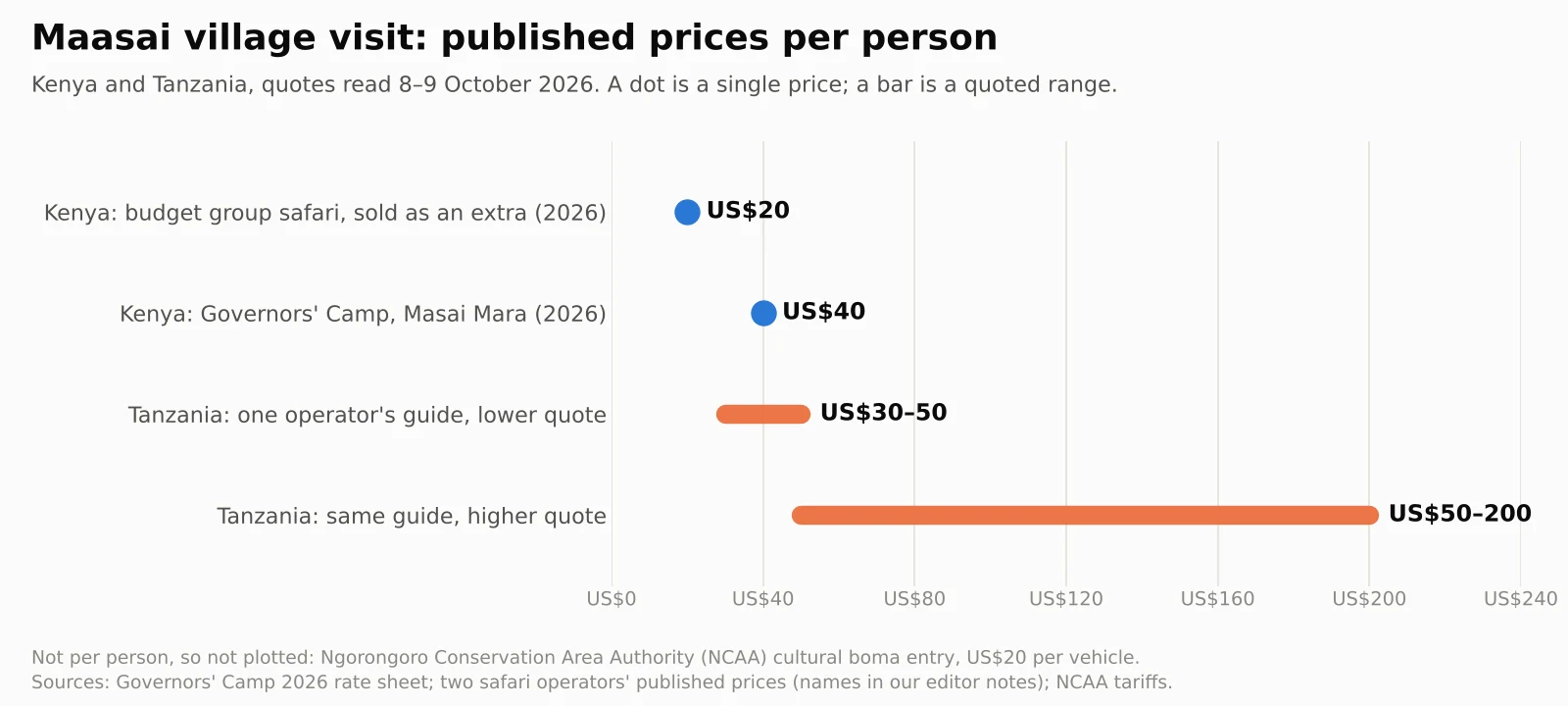 Sources: Governors’ Camp 2026 rate sheet; two safari operators’ published prices (names in our editor notes); NCAA tariffs. Chart: safari content bank.
- Check whether the visit is already in your price. Packages that include it are common in the Kenya itineraries we hold: in 153 Kenya safari itineraries captured on 8 October 2026, 16 (10%) included a stop in the Loita Hills or at Maji Moto, both Maasai areas outside the reserve (our count).
- A village visit is separate from community fees on your bill. Governors’ charges a US$50 community fee per guest per night, payable to Narok County (Mara reserve vs conservancies); that is not a village visit.
- Pay in a currency the visit accepts. Our sources do not say whether villages take cards or mobile money; bring small notes (see safari money).
Where the money goes: what is published
We found no published breakdown of how a village-visit fee is shared, from any operator, community or authority in our sources. What is published is how other community payments work.
| Payment | Who receives it, as stated | Source |
|---|---|---|
| Village visit fee (US$20–200 per person) | Not published. Travellers report that guides earn commission on village and curio-shop stops in Tanzania | TripAdvisor Tanzania forum, Sep 2026 |
| NCAA cultural boma entry (US$20 per vehicle) | Charged by the Ngorongoro Conservation Area Authority on its tariff | NCAA tariffs |
| Mara conservancy fee (US$130 per adult per night on camps’ 2026 rate sheets) | Paid with the camp bill in the conservancies, which are Maasai-owned land leased to camps | Mara reserve vs conservancies |
| Conservancy lease fees | MMWCA: a “direct guaranteed benefit in the form of lease fees each landowner gets tied to the lease agreement” | MMWCA |
| Governors’ community fee (US$50 per guest per night) | Payable to Narok County | Governors’ Camp |
- The Mara conservancies are the best-documented community model in our sources. MMWCA lists 24 conservancies leased from over 15,000 Maasai landowners (MMWCA, read 9 Oct 2026). Staying in a conservancy camp pays into that model whether or not you visit a village.
- Ask before you go, not at the gate. Who receives the fee: the village as a whole, one household, or the driver-guide? Is there a fixed price, and is it the same for every visitor? Is any craft-shopping part of the visit optional? An operator that cannot answer is telling you something.
Community-run or staged: how to tell
Travellers in our sources say most villages near park gates are run as commercial stops, and suggest asking for one further from the park. None of the signs below proves a visit is community-run; together they tell you what to ask.
| Sign | What our sources say | Source |
|---|---|---|
| Village beside a park gate, on the tourist route | Replies to an August 2026 question about Amboseli say most villages near the gates are commercial; ask the driver-guide to go further from the park | TripAdvisor Kenya forum, Aug 2026 |
| Pressure to buy at a high price | A September 2026 traveller in Tanzania found village and curio stops pushed “at very high prices”; a July 2026 reviewer on a safari booking site wrote “They may then try to sell you something which becomes trying” | TripAdvisor Tanzania forum; a safari booking site’s reviews |
| A performance on arrival, then the shop | One traveller called a Tanzanian village visit “very staged and cringe-y” (Sep 2026) | TripAdvisor Tanzania forum |
| Dancing brought to the lodge | Some lodges bring Maasai groups in for dancing, replies on a Serengeti thread say; that is a performance, not a village visit | TripAdvisor Serengeti forum |
| A designated cultural boma in the NCA | An official category with an NCAA entry fee; the NCAA does not publish who runs each boma | NCAA tariffs |
| A camp or ranch that the community owns or leases out | Mara conservancies are Maasai-owned land leased to camps | MMWCA |
- One village “looked quite real” to an Amboseli traveller: the one next to Kilima Safari Camp, in replies to the August 2026 thread. That is one report, not a check.
- “Staged” and “community-run” are not opposites. A visit can be a planned performance that the community runs and is paid for. What matters is whether you know what you are paying for and who receives it.
Being a respectful visitor, and photography
Treat the visit as entering someone’s home and workplace: go when invited and expected, ask before photographing anyone, and agree any payment for photos before you take them.
- Photography rules are on our safari etiquette page, including Kenya’s Data Protection Act, under which an identifiable person’s photo is personal data, and the consent rule for drone images. We do not repeat them here.
- In the Ngorongoro Conservation Area, photographing residents is prohibited except in designated cultural bomas (NCAA visitor guidelines; Ngorongoro).
- Know the setting in the NCA. It is a multiple-use area where 93,136 Maasai lived in 2017; since 2021 residents have been moved to Msomera under a scheme the government calls voluntary, and Human Rights Watch has documented concerns about coercion (Ngorongoro).
- Cultural visits are paid visits. Our etiquette page carries the same advice: agree the price, including for photographs, before you start.
- Buying crafts is optional. If you do buy, our sources give no fair price for beadwork; agree the price before you take the item.
- Tips for your guide are separate from the visit fee; amounts are on our safari tipping page.
Where visits are offered on a Kenya or Tanzania safari
Visits are sold around the Masai Mara and Amboseli in Kenya and around Ngorongoro, Karatu and Manyara in Tanzania; there are none in the northern Serengeti.
| Area | Country | What our sources say | Source |
|---|---|---|---|
| Masai Mara and conservancies | Kenya | Governors’ Camp sells a visit at US$40 per person (2026); conservancy land is Maasai-owned and leased to camps | Governors’ 2026; MMWCA |
| Loita Hills and Maji Moto | Kenya | A stop or night in 16 of 153 Kenya itineraries we hold (our count, 8 Oct 2026) | Operators’ itinerary pages |
| Amboseli | Kenya | Most villages near the gates are commercial, travellers say; ask for one further out | TripAdvisor, Aug 2026 |
| Ngorongoro, Karatu, Lake Manyara | Tanzania | Boma visits offered; NCAA charges US$20 per vehicle at cultural bomas inside the NCA | NCAA; TripAdvisor |
| Northern Serengeti | Tanzania | None: it is inside the park with no residents, and the people living outside it there are Kuria, not Maasai | TripAdvisor Serengeti forum |
Should you go? Which choice fits
| If you… | Then | Why |
|---|---|---|
| Want the visit and want the money to reach the community | Ask your operator, before booking, who receives the fee and whether the price is fixed | No source we hold publishes the split |
| Are staying in a Mara conservancy | Ask the camp whether it arranges visits with its landowners | Conservancies are Maasai-owned land leased to camps (Mara reserve vs conservancies) |
| Are on a budget group safari in Kenya | Check whether the visit is an extra (US$20 in one operator’s listing) | Extras are easy to add on the day |
| Are crossing the Ngorongoro Conservation Area | Expect the US$20 per vehicle NCAA fee on top of the visit price | Ngorongoro park fees |
| Would rather not go | Say so at booking and again at the start of each day | Travellers report guides pushing stops in Tanzania (Tanzania safari questions) |
| Want to photograph people | Read the rules first and agree any payment before you shoot | Safari etiquette |
Common mistakes
| Mistake | Reality |
|---|---|
| “The village visit price goes to the village” | We found no published split. Travellers report guides earn commission on these stops in Tanzania; ask who receives the fee. |
| “A Maasai village is a free stop on the drive” | It is a paid visit: US$20–40 per person in the Kenyan prices we hold, US$30–200 in one Tanzanian operator’s guide. |
| “Paying the visit fee covers photos” | Agree photo payments separately, before you shoot; in the NCA, photographing residents is allowed only in designated cultural bomas. |
| “I can visit a boma from a northern Serengeti camp” | No: the northern Serengeti is inside the park with no residents; visits are around Ngorongoro, Karatu and Manyara. |
| “The community fee on my Mara bill is the village visit” | No: Governors’ US$50 community fee is payable to Narok County; the US$40 visit is a separate extra. |
| “Lodge dancing is a village visit” | It is a performance brought to the lodge, travellers on the Serengeti forum say. |
Frequently asked questions
How much does a Maasai village visit cost? In Kenya, US$40 per person at Governors’ Camp in the Masai Mara (2026) and US$20 as an extra on one budget group safari. In Tanzania, one operator’s guide quotes US$30–50 in one place and US$50–200 in another. Inside the Ngorongoro Conservation Area, the NCAA adds US$20 per vehicle to enter a cultural boma.
Who gets the money from a village visit? We found no published breakdown from any operator, community or authority. Travellers on the TripAdvisor Tanzania forum say guides earn commission on village and curio stops. Ask your operator who receives the fee before you book.
Is a Maasai village visit staged? Some are. A September 2026 traveller called one Tanzanian visit “very staged and cringe-y”, and replies on an Amboseli thread say most villages near the gates are commercial. A visit can still be run by and paid to the community; ask how it is organised.
Can I take photos in a Maasai village? Ask each person first and agree any payment before you shoot. In the Ngorongoro Conservation Area, photographing residents is prohibited except in designated cultural bomas. Kenya’s photo-consent rules are on our safari etiquette page.
Can I skip the village and curio-shop stops? Yes. Say so at booking and again at the start of each day; travellers on the TripAdvisor Tanzania forum advise complaining to the operator if the stops continue (Tanzania safari questions).
Is the village visit included in my safari price? Sometimes. One camp group’s 12-day Kenya fly-in package lists “Maasai village and chimpanzee sanctuary visits” as included; Governors’ Camp and one budget operator sell it as an extra. Check your itinerary’s inclusions.
Can I visit a Maasai village from the Serengeti? Not in the northern Serengeti, which is inside the park with no residents. Boma visits are offered around Ngorongoro, Karatu and Manyara, usually on the way to or from the Serengeti.
Does a Mara conservancy stay help Maasai landowners? The conservancies are Maasai-owned land leased to camps, and MMWCA says each landowner gets lease fees tied to the lease agreement. Camps add a conservancy fee of US$130 per adult per night on their 2026 rate sheets (Mara reserve vs conservancies).
Sources
- Official: Ngorongoro Conservation Area Authority, tariffs (undated; read 9 Oct 2026) and visitor guidelines, as on our Ngorongoro pages; Maasai Mara Wildlife Conservancies Association, home and about us (read 9 Oct 2026)
- Camps’ own prices: Governors’ Camp 2026 rate sheet (PDF), read 9 Oct 2026, and Governors’ Camp, Masai Mara community fee; Porini Signature Safari 2026–27 (PDF), read 8 Oct 2026
- Ngorongoro residents and relocation: Wikipedia, Ngorongoro Conservation Area, citing Human Rights Watch, as on our Ngorongoro page
- Traveller reports (forum posts and reviews, not fact): TripAdvisor threads Avoiding visiting artisan markets and Maasai villages (Sep 2026), Authentic Masai village near Amboseli (Aug 2026) and Maasai Boma visit, Serengeti; a safari booking site’s traveller reviews (Jul 2026); read July–October 2026
- Operators and agents (names and links kept in our editor notes): a budget Kenya safari operator’s trip page (read 8 Oct 2026); a Tanzanian operator’s cost guide (read 8 Oct 2026); 153 Kenya itineraries from 29 operators, captured 8 Oct 2026 (our count)
More on the same subject: safari etiquette, ethical wildlife activities, Mara reserve vs conservancies, safari tipping and cultural visits beyond the Maasai.
Prices and rules checked 8–10 October 2026. We will update this page when an operator, community or authority publishes how a village-visit fee is shared.