 Experience

Last verified · Next check due
On this page
Short answer: Beyond a Maasai village, safaris add visits with the Hadzabe at Lake Eyasi (Tanzania), San communities in Namibia and Botswana, the Himba around Opuwo (Namibia) and Batwa-guided walks at Bwindi and Mgahinga (Uganda). Few prices are published: one travel blog gives US$110 per car plus a US$20 office fee at Lake Eyasi (June 2026). No source we hold says how any visit fee is shared. Ask who runs the visit, and who is paid, before you book.
Key facts
- Maasai village visits have their own page: prices, who gets paid and staged visits are on Maasai village visit. This page covers the other four.
- At Lake Eyasi, one travel blog lists US$20 per car at the tourist office near Mangola and US$110 per car for Hadza visits, with guide and community payments on top (Cycloscope, updated 11 June 2026, secondary). We found no official fee schedule for Lake Eyasi (Tanzania park fees).
- For a Himba visit, a travel writer’s guide gives about N$300 per person for a day and N$600 overnight, negotiable (Explore Travel Oasis, undated; as on our Skeleton Coast page).
- Some San-guided walks come with the room: Wolwedans, in Namibia’s NamibRand, includes a 3-hour guided walk in its rate (activity sheet 2025–27, PDF).
- We found no published price for either Batwa walk in Uganda, Nkuringo’s Buniga Forest walk or Mgahinga’s Batwa Trail (Bwindi).
- No operator, lodge, community or authority in our sources publishes how a visit fee is divided for any of these visits.
The visits at a glance
Four communities run or guide the visits most often added to a safari in our sources; only the Hadzabe and Himba visits have a published price, and neither comes from the community itself.
| Community | Where | Country | What is offered, as our sources describe it | Published price | Source |
|---|---|---|---|---|---|
| Hadzabe (also written Hadza) | Lake Eyasi, near Mangola, on the northern circuit | Tanzania | Hadza visits arranged through the tourist office near Mangola | US$20 per car office fee + US$110 per car; guide and community payments extra | Cycloscope, 11 Jun 2026 (secondary) |
| San: Ju/’hoansi | Nyae Nyae Conservancy, around Tsumkwe | Namibia | Tracking and gathering walks with Ju/’hoansi guides | None in our sources | NACSO; This Is Namibia |
| San guides at lodges | NamibRand (Wolwedans) | Namibia | A 2–3-hour walk in the dunes that the lodge calls its “Bushman Walk” | Included in the Wolwedans rate (sheet valid 11 Jan 2026–31 Mar 2027) | Wolwedans activity sheet |
| San guides at camps | Makgadikgadi (Jack’s Camp, Camp Kalahari), the Central Kalahari edge, the Tsodilo Hills | Botswana | San-guided walks | Not priced separately in our sources; Natural Selection’s 2026 rates include daily activities | Natural Selection 2026 (PDF); agent camp pages |
| Himba (OvaHimba) | Around Opuwo, Kunene Region (the trade still says “Kaokoland”) | Namibia | Day or overnight visits to Himba homesteads | About N$300 per person a day, N$600 overnight, negotiable | Explore Travel Oasis (undated) |
| Batwa | Nkuringo sector of Bwindi; Mgahinga Gorilla National Park, near Kisoro | Uganda | Buniga Forest walk with Batwa guides; the Batwa-led Batwa Trail, ending at Garama Cave | None in our sources | UWA Mgahinga brochure (PDF); UWA Bwindi brochure |
Read 3 September–10 October 2026. Agent pages are named in our editor notes. “None in our sources” means we found no published figure, not that the visit is free.
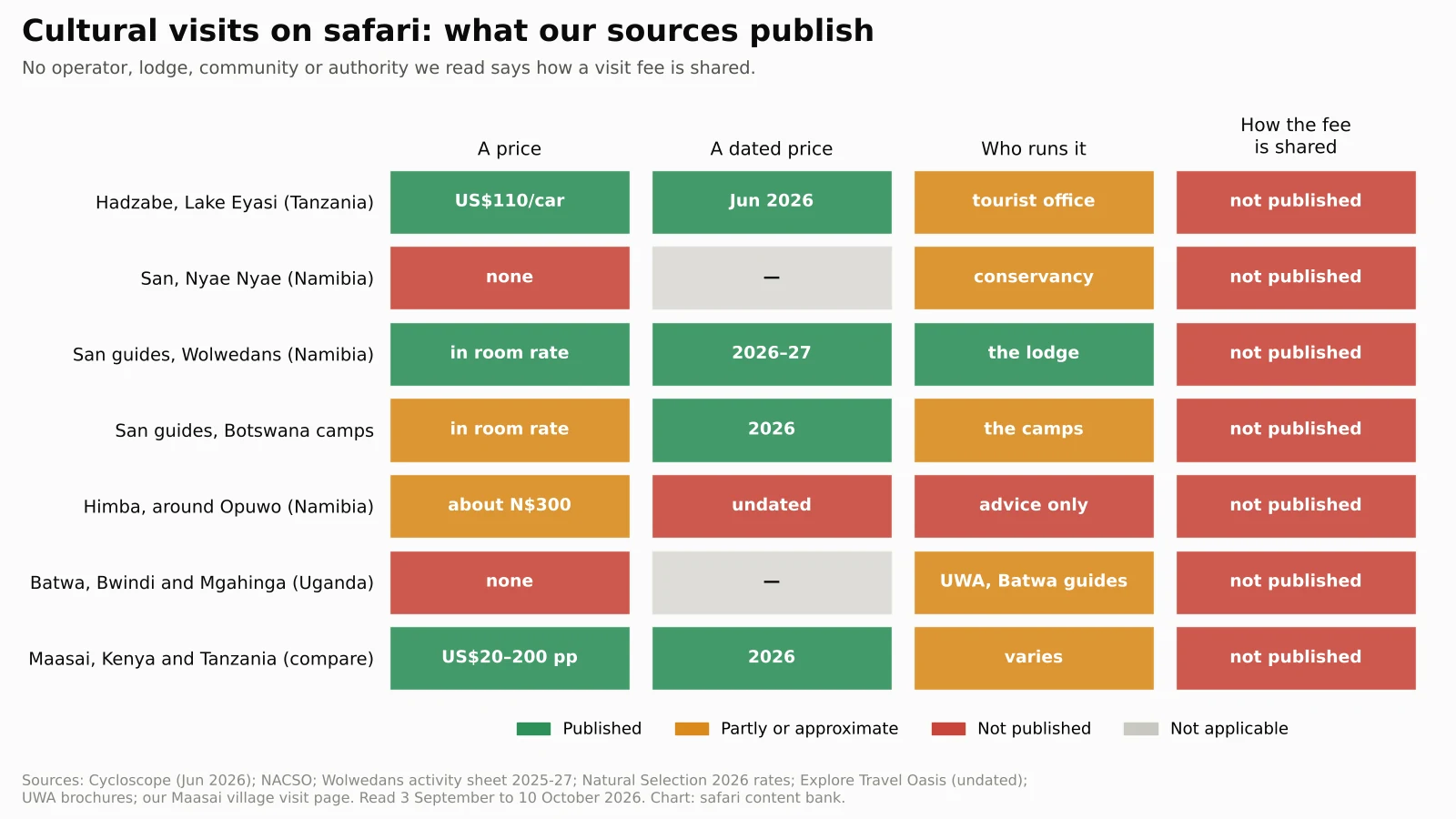 Sources: as in the table above and on our Maasai village visit page. Chart: safari content bank.
What a visit costs, and what else it adds
The only per-visit prices we hold are per car at Lake Eyasi and approximate per-person figures for the Himba; the other visits are inside a lodge rate or unpriced.
| Visit | Price | Basis and date | Source |
|---|---|---|---|
| Lake Eyasi tourist office | US$20 per car | Office fee near Mangola; updated 11 Jun 2026 | Cycloscope (secondary) |
| Hadza visit, Lake Eyasi | US$110 per car | “Cultural activities”; guide and community payments extra; updated 11 Jun 2026 | Cycloscope (secondary) |
| Himba visit, Kunene | About N$300 per person (day), N$600 (overnight) | Negotiable; the guide carries no date | Explore Travel Oasis |
| Wolwedans guided walk, NamibRand | Included in N$13,550–14,900 per person sharing a night at Dune Camp, plus N$1,600 levy | 2026 rack rates; activity sheet valid 11 Jan 2026–31 Mar 2027 | Namibia safari cost |
| San-guided walks, Makgadikgadi camps | Camp rates US$795–3,895 per person a night (Camp Kalahari to Jack’s Camp), plus US$60 | Natural Selection 2026; rates include daily activities | Makgadikgadi |
| Batwa walks, Bwindi and Mgahinga | No published price | UWA brochures name the walks but not a fee | Bwindi |
| Nyae Nyae walks | No published price | — | — |
Prices as published; we have not checked them with the communities.
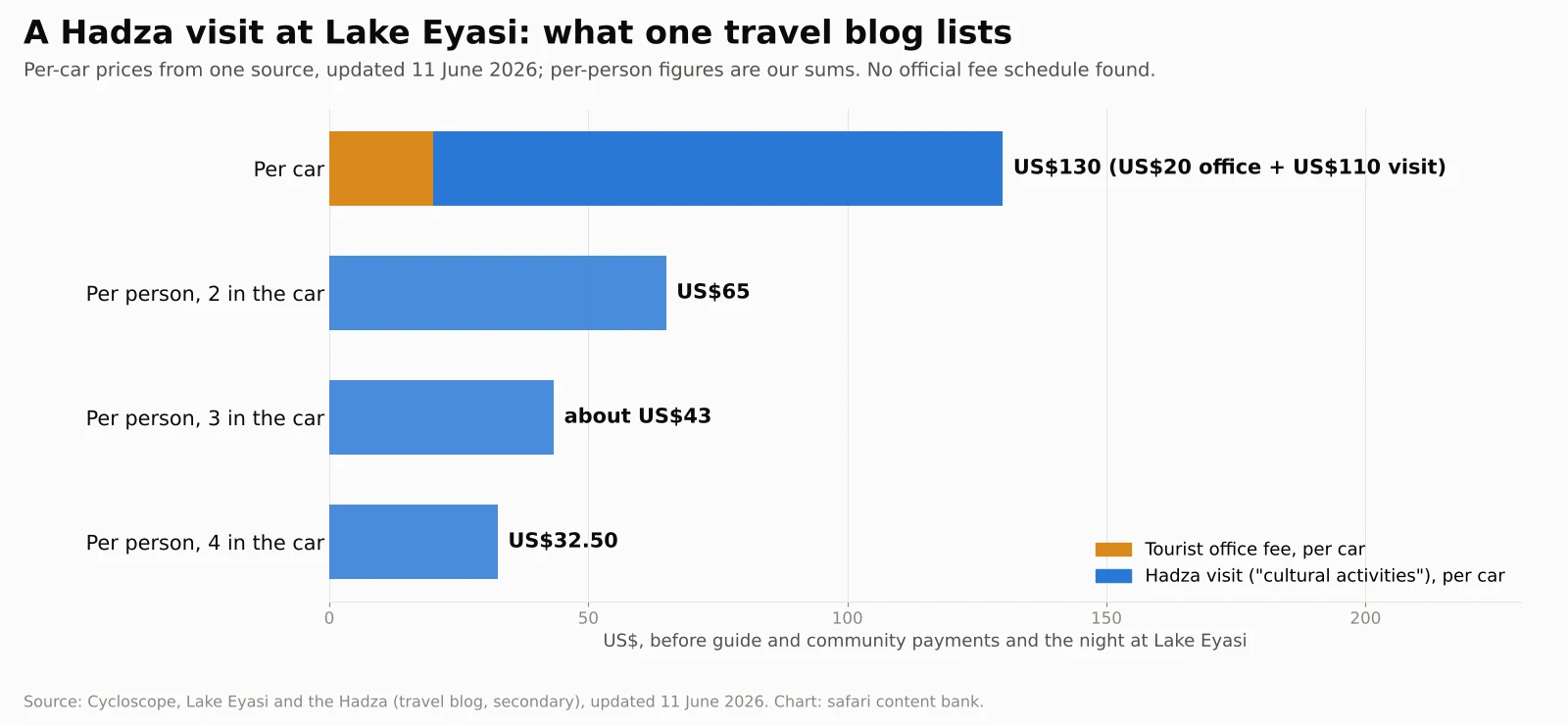 Source: Cycloscope, Lake Eyasi and the Hadza, updated 11 June 2026 (secondary). Per-person figures are our sums. Chart: safari content bank.
- Lake Eyasi usually means a night there. Kisima Ngeda Camp on the lake shore lists US$589–700 per person a night in 2026, with a private guide and vehicle included and park fees excluded (an agent’s listing). Lake Eyasi or the Hadzabe appear in 5 of 157 Tanzania itineraries we captured on 8 October 2026 (our count).
- Opuwo is the practical base for Himba visits and the last tarred town in the north-west (Skeleton Coast). Villages 40–50 km out see far fewer visitors, the travel writer’s guide says.
- Mgahinga is a separate park from Bwindi, near Kisoro; the Batwa Trail is a half or full day (UWA Mgahinga brochure).
- Tips are separate from any visit fee; amounts are on safari tipping.
Who runs the visit, and where the money goes
For none of these visits does a source we hold publish how the fee is divided; what is published is who organises the visit and, in Namibia, how conservancies earn.
| Visit | Who organises it, as published | Where the money goes, as published | Source |
|---|---|---|---|
| Hadzabe, Lake Eyasi | A tourist office near Mangola collects the office fee | Not published; guide and community payments are separate | Cycloscope |
| San, Nyae Nyae | Nyae Nyae Conservancy, Namibia’s first registered communal conservancy; Ju/’hoansi guides | Not published for walks. Namibia’s conservancies earned N$111,167,250 from tourism in 2023 | NACSO; conservation safari |
| San guides, Wolwedans | The lodge, as part of its rate | Not published for the walk | Wolwedans activity sheet |
| San guides, Botswana camps | The camps | Not published | Agent camp pages |
| Himba, Kunene | Varies; the travel writer’s guide advises a community-run arrangement over commercial guesthouse tours | Not published | Explore Travel Oasis |
| Batwa, Bwindi and Mgahinga | Uganda Wildlife Authority brochures list the walks with Batwa guides; the Batwa Trail is described as Batwa-led | Not published | UWA Mgahinga brochure |
- Ask the same questions as for a Maasai visit: who receives the fee, whether the price is fixed, and whether any shopping is optional. The full checklist is on Maasai village visit.
- One travel writer names a community-run starting point for Himba visits: the Kaoko Info Centre in Opuwo, which the guide describes as run by Himba people. That is one source’s description; we have not checked it.
- Conservancy stays pay communities whether or not you visit a village. How that works, with Namibia’s 2023 figures, is on conservation safari.
Community-run or staged: what our sources say
Our sources separate guided walks led by community members from roadside “village” stops, and they say a staged visit can still be honest if it says what it is.
| Sign | What our sources say | Source |
|---|---|---|
| A walk led by community guides, on their land | Nyae Nyae’s walks are described as bush-skills demonstrations with Ju/’hoansi guides, not staged village visits | This Is Namibia |
| A “living museum” | Our Namibia notes describe the Ju/’hoansi Living Museum at Grashoek as a reconstruction that presents itself as one | Bank notes; not checked with the museum |
| A roadside village on a main route | On a 2026 thread about the Swakopmund–Etosha drive, nobody could vouch for a Himba visit, and “others felt it was a bit staged for tourists” | TripAdvisor Namibia forum |
| A cultural dinner brought to camp | A June 2026 traveller in Zambia: “The boma cultural dinner was not worth it though for us.” | TripAdvisor Zambia forum |
| Distance from the tourist hub | Himba villages 40–50 km from Opuwo see far fewer visitors | Explore Travel Oasis |
- “Staged” and “community-run” are not opposites. A performance the community runs, prices and is paid for can be a fair transaction; what matters is that you know what you are paying for and who receives it.
- Be wary of marketing that calls any people “untouched”, “primitive” or “unchanged”. Our sources call those words inaccurate and demeaning; a seller who uses them is selling a spectacle.
Names, photographs and the history behind the visit
Use the name each community uses for itself, ask before every photograph, and know the land history before you go.
| Topic | What to know | Source |
|---|---|---|
| San or Basarwa | No term is neutral. “San” is the widely used international term; Basarwa is the Setswana term in Botswana’s court papers; many people use their own group’s name, such as Ju/’hoansi, ‡Khomani, Naro, G/wi or G//ana. Some lodges still use an older English term in product names; we do not | Our Botswana and Namibia bank notes; Central Kalahari |
| Hadzabe or Hadza | Both forms are used in our sources | — |
| Himba and “Kaokoland” | OvaHimba people are closely related to the Herero. Kaokoland and Damaraland are pre-independence names still used by the travel trade; the region is Kunene | Our Namibia bank notes; Skeleton Coast |
| Batwa | The Batwa were evicted without compensation when Bwindi became a national park in 1991 | Bwindi (Wikipedia) |
| Photographs | Never photograph anyone without asking (the Himba guide’s advice); agree any payment first; ask a parent before photographing a child. The full rules are on safari etiquette | Explore Travel Oasis |
| Gifts | For Himba visits, the travel writer’s guide suggests food such as maize meal, sugar and cooking oil, about N$500 worth for two, rather than money or sweets | Skeleton Coast |
- The Central Kalahari’s San residents were removed from the reserve and won court cases in 2006 and 2011. The history is on our Central Kalahari page; read it before booking a San walk in Botswana.
- Moremi was made a game reserve, not a national park, in 1963 so that the BaSarwa living there could stay (Moremi).
- On the Kgalagadi’s South African side, 580 km² was restored to the ‡Khomani San and Mier communities in 2002 (Wikipedia; Kgalagadi).
When to skip a visit
| If… | Then | Why |
|---|---|---|
| Nobody can tell you who runs the visit or who is paid | Skip it, or ask for another | No source publishes the split for any of these visits |
| The visit is a roadside stop on a main driving route | Ask for a community-run arrangement further out | Travellers on the Namibia forum could not vouch for one on the Swakopmund–Etosha road |
| You are asked to pay to photograph and did not agree a price first | Stop and agree it, or put the camera away | Safari etiquette |
| Children are presented for photos or gifts | Do not hand out sweets or money to children | Our Namibia bank notes and the Himba guide advise against it |
| You have only one night near Lake Eyasi or Opuwo | Weigh the drive against the time | Lake Eyasi usually takes a night; Opuwo is the last tar in the north-west |
| You would rather not go | Say so at booking | Travellers report guides pushing village stops in Tanzania (Tanzania safari questions) |
Which visit fits
| If you… | Then | Why |
|---|---|---|
| Are on a northern Tanzania circuit | Lake Eyasi (Hadzabe), with a night there | US$20 + US$110 per car (blog, June 2026); in 5 of 157 itineraries we hold |
| Want a walk led by San guides on their own land | Nyae Nyae, Namibia | Ju/’hoansi guides on a community conservancy; no published price |
| Want a San-guided walk without a detour | A lodge that includes one: Wolwedans (NamibRand) or the Makgadikgadi camps | In the room rate |
| Are driving north-west Namibia | Himba visit from Opuwo, through a community-run arrangement | About N$300 per person a day (undated guide) |
| Are trekking gorillas in Uganda | Buniga Forest walk (Nkuringo) or the Batwa Trail (Mgahinga) | Batwa-guided; ask UWA or your lodge for the price |
| Are in Kenya or around Ngorongoro | A Maasai visit | Maasai village visit |
Common mistakes
| Mistake | Reality |
|---|---|
| “Lake Eyasi has an official visit fee schedule” | We found none; the US$20 and US$110 per car come from a travel blog (June 2026). |
| “The Himba price is fixed” | The only figure we hold is about N$300 per person a day, negotiable, from an undated guide. |
| “The Batwa walks cost the same as other UWA walks” | No published price for either Batwa walk in our sources; ask before you go. |
| “San walks are always an extra” | Some are in the room rate, at Wolwedans and at camps whose rates include daily activities. |
| “Kaokoland is the official name” | The region is Kunene; Kaokoland is a pre-independence name still used by the trade. |
| “The fee goes to the community” | No source we hold publishes the split for any of these visits. |
Frequently asked questions
How much does a Hadzabe visit at Lake Eyasi cost? One travel blog, updated 11 June 2026, lists US$20 per car at the tourist office near Mangola and US$110 per car for Hadza visits, with guide and community payments extra. We found no official fee schedule for Lake Eyasi. A night on the lake, such as Kisima Ngeda Camp at US$589–700 per person (agent listing, 2026), is extra.
How much does it cost to visit the Himba? A travel writer’s guide gives about N$300 per person for a day visit and N$600 overnight, negotiable; it carries no date. It advises a community-run arrangement and food rather than money as a gift.
Where can I go on a San-guided walk? In Namibia, with Ju/’hoansi guides in Nyae Nyae Conservancy, and at Wolwedans in the NamibRand, where a walk is in the rate. In Botswana, at Makgadikgadi camps such as Jack’s Camp and Camp Kalahari, near the Central Kalahari and at the Tsodilo Hills.
What is the Batwa Trail, and what does it cost? A Batwa-led half or full day in Mgahinga Gorilla National Park, near Kisoro, ending at Garama Cave (UWA brochure). Bwindi’s Nkuringo sector has the Buniga Forest walk with Batwa guides. We found no published price for either.
Is it “San” or “Basarwa”? Neither is neutral. San is the common international term; Basarwa is the Setswana term used in Botswana’s court papers. Where you can, use the group’s own name, such as Ju/’hoansi in Nyae Nyae.
Who gets the money from a cultural visit? No operator, lodge, community or authority in our sources publishes the split for any of these visits. Ask before you book, and prefer an arrangement the community runs.
Can I take photographs? Ask each person first, agree any payment before you shoot, and ask a parent before photographing a child. The full rules are on our safari etiquette page.
Sources
- Prices: Cycloscope, Lake Eyasi and the Hadza (travel blog, updated 11 June 2026; secondary); Explore Travel Oasis, visiting the Himba (travel writer’s guide, undated), as on our Skeleton Coast page; Wolwedans activity sheet 2025–27 (PDF) and 2026 rack rates (PDF), read 3 September 2026; Natural Selection 2026 Botswana rack rates (PDF), read 8 October 2026
- Official and community bodies: Uganda Wildlife Authority, Mgahinga brochure (PDF) and Bwindi brochure, as on our Bwindi page; NACSO, Nyae Nyae Conservancy; NACSO and MEFT, State of Community Conservation 2023, as on conservation safari
- History: as on our Central Kalahari, Moremi, Bwindi and Kgalagadi pages (court judgments, Wikipedia)
- Tourism and travel sites: This Is Namibia
- Traveller reports (forum posts, not fact): TripAdvisor threads Where to break the Swakopmund–Etosha drive (2026) and Our first safari trip report, Zambia, June 2026
- Agents and operators (names and links in our editor notes): an agent’s listing for Kisima Ngeda Camp; agents’ camp pages for San-guided walks in Botswana; 157 Tanzania itineraries from 29 operators, captured 8 October 2026 (our count)
More on the same subject: Maasai village visit, safari etiquette, ethical wildlife activities, conservation safari and safari tipping.
Prices checked 3 September–10 October 2026. We will update this page when a community, lodge or authority publishes a visit price or how a visit fee is shared.