 Experience

Last verified · Next check due
On this page
- Sabi Sand vs the Masai Mara at a glance (2026)
- Big cats: what each area can and cannot promise
- Fees: a Sabi Sand entry against a Mara night
- Where to stay and what a night costs (2026)
- When to go: Sabi Sand month by month against the Mara
- Getting there and pairing with the rest of the trip
- Doing both on one trip
- Which should you choose?
- Common mistakes in Sabi Sand vs Masai Mara comparisons
- Frequently asked questions
- Sources
Short answer: Choose Sabi Sand (Greater Kruger, South Africa) for leopard-focused lodge drives, off-road and after dark, in any month; lodges publish R7,300–44,000 per person sharing a night for 2026, plus an R170 gate fee. Choose a Masai Mara conservancy (Kenya) for open plains, resident lions and cheetahs, and the wildebeest herds from about July to October; camps publish US$625–1,305, plus US$130 a night in conservancy fees. Neither area publishes sighting rates.
Key facts
- Neither area publishes a sighting rate for leopard, lion or cheetah in our sources, so we print no odds. Operators credit Sabi Sand with leopard viewing; the Mara’s lions, leopards and cheetahs are resident all year (where to see big cats).
- Neither publishes a cap on vehicles at a sighting. The only written cap in either area is the Mara reserve’s: five vehicles, others waiting at least 100 m away (where to see leopards). Ask your lodge or camp.
- Off-road and night drives are part of the stay in both, on lodge or camp vehicles: in Sabi Sand on lodge vehicles (Sabi Sabi includes day and night drives), in the Mara at conservancy camps such as Kicheche Valley and Porini Lion Camp. The Mara reserve itself sells no night drives.
- The fees are small next to the beds. Sabi Sand charges R170 per person and R370 per light vehicle per entry (2026); Mara conservancies charge US$130 per adult per night on camps’ 2026 sheets, and the reserve US$100 a day from January to June and US$200 from July to December.
- Sabi Sand’s best months are April or May to September; the Mara’s herds are there about July to October. The two overlap in July–September.
- Both are malaria areas: WHO lists risk all year across Kenya; SANParks puts the Kruger area’s highest risk in November–April and exempts no month.
Sabi Sand vs the Masai Mara at a glance (2026)
Sabi Sand is a private reserve of about 65,000 ha in the bushveld, open to Kruger and to lodge guests only; the Mara’s conservancies are Maasai-owned land on open plains around a public reserve where the herds arrive in July. The park-level comparison, with Kruger’s self-drive side, is on Kruger or the Masai Mara; this page compares the private, guided side of each.
| Sabi Sand Game Reserve (South Africa) | Masai Mara conservancies (and the reserve) (Kenya) | Source | |
|---|---|---|---|
| What it is | Private reserve run by a landowners’ association; no fence with Kruger since 1993 | Maasai-owned land leased to camps, around Narok County’s public reserve (about 1,500 km²) | Sabi Sand; Mara reserve vs conservancies |
| Who can enter | Lodge guests only; no day visitors, no self-drive game viewing | Conservancies: camp guests. Reserve: anyone with a day ticket, on operators’ vehicles | same |
| Fee per adult | R170 per entry + R370 per light vehicle (2026); some lodges add a levy (R450 a night at Sabi Sabi) | Conservancy US$130 a night (camps’ sheets); reserve US$100 a day Jan–Jun, US$200 Jul–Dec | Sabi Sand access page; camps’ 2026 sheets; Narok County FY2025/26 |
| Landscape | Bushveld between the Sabie and Sand rivers | Open grass plains and the Mara and Sand rivers | Sabi Sand; Masai Mara |
| Big cats | All of the Big Five, plus cheetah and wild dog; operators credit its leopard viewing; no rates | Lions, leopards and cheetahs resident all year; reserve plan: 21.5 lions and 0.66–1.39 adult cheetahs per 100 km²; no rates | Where to see big cats |
| Off-road and night drives | Part of the lodge stay | In the conservancies; the reserve allows neither, except off-track to big cats on open ground, no closer than 25 m | same |
| Vehicles at a sighting | No published cap | Conservancies: no published cap. Reserve: five | Where to see leopards |
| Wildebeest herds | None in our sources | About July–October; crossings in the reserve | Great Migration month by month |
| Lodge rate, per person sharing, 2026 | R7,300–44,000 (Singita Ebony R51,665–60,470, page undated) | Conservancy camps US$625–1,305; reserve camps US$453–1,592; Wilderness Mara US$1,324–2,028, fees included | Lodges’ and camps’ own rate sheets |
| Flight from the city | FedAir from Johannesburg O.R. Tambo to lodge strips, 1–1.5 h | Mombasa Air Safari, Nairobi Wilson → Mara, about 1 h, US$200 + US$20 fuel one way | FedAir 2026; Mombasa Air Safari 2026 |
| Malaria | Risk area; highest November–April | Risk all year across Kenya | SANParks; WHO |
Read 8–10 October 2026. Mara reserve fee: Narok County’s last published schedule (FY2025/26), which expired on 30 June 2026; for July–December 2026 The Kenya Times (6 Aug 2026, secondary) reports US$200 still applies. We print rand and US dollars as published and convert neither.
Big cats: what each area can and cannot promise
Both areas hold lion, leopard and cheetah; neither publishes how often visitors see them. Sabi Sand’s case rests on leopards viewed off-road and at night; the Mara’s on resident prides and cheetah on open plains, and on the herds from July.
| Sabi Sand | Masai Mara | Source | |
|---|---|---|---|
| Leopard | Operators credit it with leopard viewing; descriptions, not counts or rates | Resident; the reserve plan gives no leopard figure | Where to see big cats; Where to see leopards |
| Lion | Present | Resident; 21.5 lions per 100 km² in the reserve plan | Narok County GMME management plan |
| Cheetah | On its species list | Resident; 0.66–1.39 adult cheetahs per 100 km² | Wikipedia (secondary); Narok County plan |
| Night drives | Part of the lodge stay; leopards make most kills between sunset and sunrise | Conservancy camps such as Kicheche Valley and Porini Lion Camp; not in the reserve | Sabi Sand; Mara reserve vs conservancies |
| Off-road to a sighting | Yes, on lodge vehicles | Conservancies: practised. Reserve: only to big cats on nearby open ground, no closer than 25 m | same |
| Traversing area | Set per lodge, some shared with neighbours; travellers compared 650 ha with 10,000 ha | Set per conservancy; forum regulars split four or more nights between two conservancies to see different prides | TripAdvisor (traveller reports) |
| Sighting rate published | No | No | Where to see cheetahs; where to see big cats |
Read 8–10 October 2026. “Not published” is not “absent”: both areas hold all three cats. For published rates elsewhere (northern Botswana, Zambia), see where to see big cats.
- Ask about the traversing area, not only the price. On a 73-reply TripAdvisor thread about Sabi Sand, travellers advised checking how much land each lodge’s vehicles drive (Sabi Sand, traveller reports). One poster framed the choice as “exclusivity vs probability”.
- In the Mara, the herds bring the crossings, and the crowds. Reviews on a safari booking site from 2019 to 2026 describe 20 to 40 vehicles at a single sighting in the reserve (traveller reports, as on our Masai Mara page). Conservancy guests drive into the reserve for a crossing day and pay that day’s ticket (Great Migration river crossings).
- Cheetah need open ground: see where to see cheetahs, which also finds no published cheetah rate for either area.
Fees: a Sabi Sand entry against a Mara night
Sabi Sand charges per entry, not per night: R170 per person and R370 per light vehicle in 2026, plus any lodge levy. A Mara conservancy charges US$130 per adult per night; the reserve charges per calendar day you enter.
| Fee per adult (2026) | Sabi Sand | Masai Mara conservancy | Masai Mara reserve |
|---|---|---|---|
| Basis | Per person per entry, VAT included, plus R370 per light vehicle | Per night of your stay | Per calendar day, 06:00–18:00 |
| Amount | R170 (R180 from 1 Jan 2027) | US$130 on Kicheche, Porini and Hemingways sheets | US$100 Jan–Jun; US$200 Jul–Dec |
| Lodge levy on top | Sabi Sabi R450 a night; Simbambili R850 a day; others not shown | Hemingways adds US$5 to a reserve fund | Governors’ camps add a US$50 community fee |
| Fly-in guests | The gate fee still applies | – | – |
| Child | Not stated on the access page | US$65 a night on Kicheche’s sheet | 9–17 US$50; under 9 free |
| 3 nights, one adult (our sums) | R1,520 at Sabi Sabi (R170 + 3 × R450) | US$390 (3 × US$130) | US$600–800 in July–December (3 or 4 tickets) |
Sources: Sabi Sand access; Sabi Sabi rates; Thornybush 2026 (PDF) for Simbambili; Kicheche 2026 (PDF); Porini 2026 (PDF); Hemingways 2026 (PDF); Governors’ community fee; Narok County FY2025/26 (PDF). Read 8–10 October 2026.
The official fee lines, with the date each took effect and the authority’s own source:
| Fee | Amount | In force from | Source |
|---|---|---|---|
| Sabi Sand Nature Reserve gate fee, per person, per entry (VAT included) | ZAR 170 (ZAR 180 in 2027) | 1 Jan to 31 Dec 2026 | Sabi Sand Nature Reserve, access and gate fees |
| Sabi Sand Nature Reserve gate fee, light vehicle under 3,500 kg, per entry (VAT included) | ZAR 370 (ZAR 390 in 2027) | 1 Jan to 31 Dec 2026 | Sabi Sand Nature Reserve, access and gate fees |
| Maasai Mara National Reserve, non-resident adult, per day (12-hour ticket, 06:00–18:00), 1 Jan–30 Jun | USD 100 | Since 1 Jan 2024; Narok County FY2025/26 schedule, the last published | Narok County fee schedule FY2025/26 |
| Maasai Mara National Reserve, non-resident adult, per day (12-hour ticket, 06:00–18:00), 1 Jul–31 Dec | USD 200 | Since 1 Jul 2024; Narok County FY2025/26 schedule, the last published, expired 30 Jun 2026 (no 2026/27 schedule as of 9 Oct 2026); The Kenya Times (6 Aug 2026, secondary) reports US$200 still applies for Jul–Dec 2026 | Narok County fee schedule FY2025/26 |
- Kruger’s own fee is separate. Days inside Kruger National Park cost R692 (R602 until 31 Oct 2026), per international adult per day; the SANParks Wild Card does not cover private reserves (Kruger park fees).
- From July to December a conservancy night (US$130) costs less in fees than a reserve day (US$200); from January to June the reserve day is cheaper (Mara reserve vs conservancies).
- Ask each lodge how its levy is counted: Simbambili’s is per day, Sabi Sabi’s per night (Sabi Sand).
Where to stay and what a night costs (2026)
At the top end the two are close; at the bottom, Sabi Sand starts at R7,300 per person at Elephant Plains and the Mara conservancies at US$625 at Kicheche Mara North in its low months. Full lodge lists: Sabi Sand and Masai Mara.
| Tier | Sabi Sand, per person sharing a night | Masai Mara, per person sharing a night |
|---|---|---|
| Entry tier | Elephant Plains: rondavel R7,300, luxury suite R9,300 (2026) | Governors’ Camp, in the reserve: US$453 Apr–May to US$998 Jul–Oct |
| Conservancy or classic camp | – | Kicheche Mara North US$625–995; Hemingways Ol Seki, Naboisho US$810–1,305 |
| Top luxury | Simbambili R27,000; Sabi Sabi Bush Lodge R29,600, Earth Lodge R44,000 (1 Mar 2026–28 Feb 2027) | Governors’ Il Moran US$667–1,592 |
| Ultra luxury | Singita Ebony R51,665–60,470 (page undated) | Wilderness Mara US$1,324–2,028, levy and taxes included |
| Usually in the rate | Meals, two game drives (Sabi Sabi: day and night drives and walks) | Full board and game drives; walks and night drives at conservancy camps such as Kicheche |
| Not in the rate | Gate fee; levies at Sabi Sabi and Simbambili | Reserve or conservancy fee, except at Wilderness Mara |
Lodge and camp rate sheets, read 8–9 October 2026: Elephant Plains, Thornybush (PDF), Sabi Sabi, Singita; Governors’ 2026 (PDF), Kicheche 2026 (PDF), Hemingways 2026 (PDF), Wilderness. Rates for Londolozi, MalaMala, Lion Sands and Ulusaba are not in our sources.
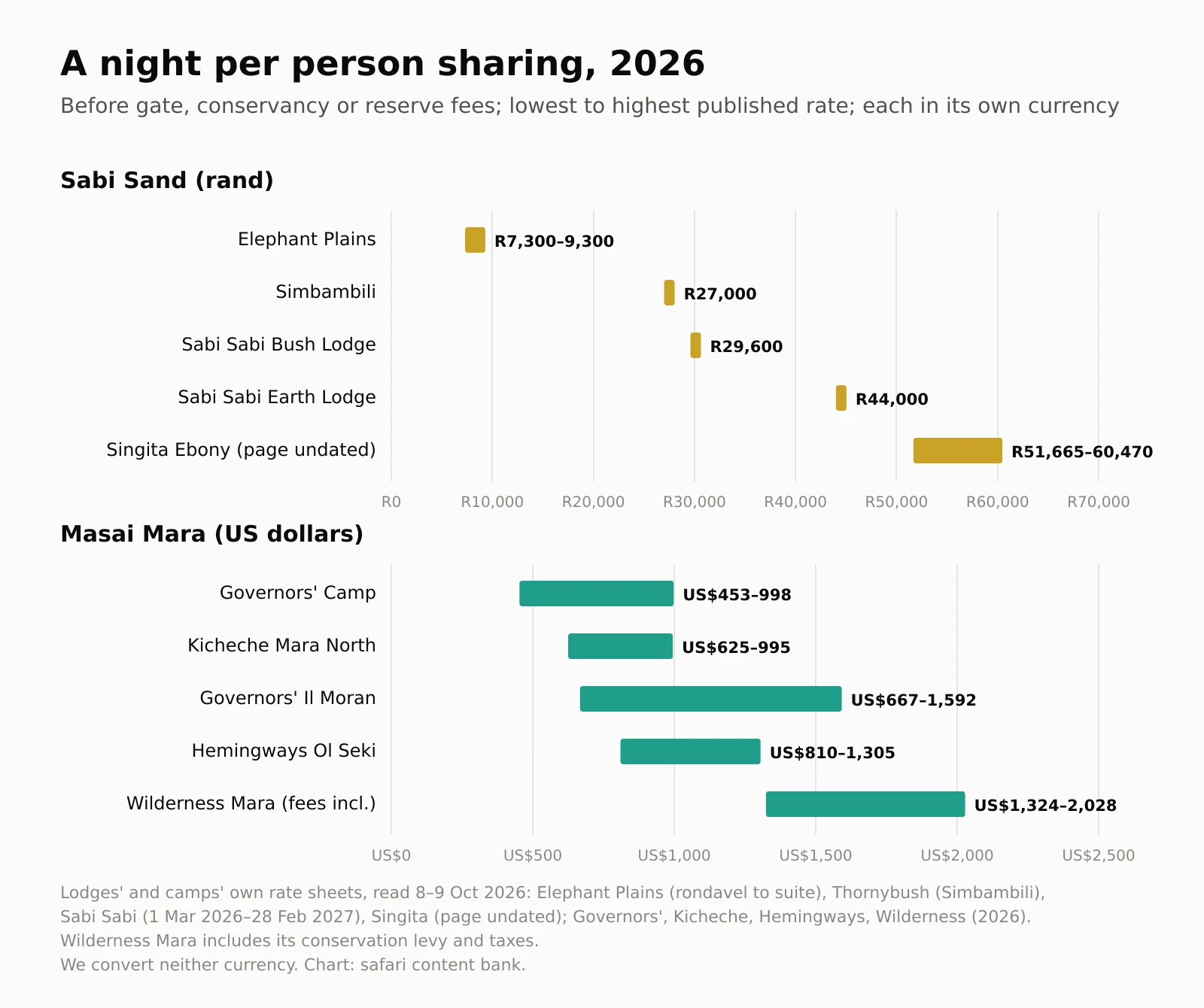 Lodges’ and camps’ own 2026 rate sheets, read 8–9 October 2026. We convert neither currency. Chart: safari content bank.
Three nights, one adult sharing, with fees (our sums): Sabi Sabi Bush Lodge R90,320 (3 × R29,600 + R170 gate fee + 3 × R450 levy); Elephant Plains rondavel R22,070 (3 × R7,300 + R170), before its unpriced conservation contribution. Kicheche Mara North in August US$3,375 (3 × US$995 + 3 × US$130); Hemingways Ol Seki in August US$4,320 (3 × US$1,305 + 3 × US$135).
When to go: Sabi Sand month by month against the Mara
Go to Sabi Sand from April or May to September, its dry season; go to the Mara from July to October for the herds, or in January–February at the lower reserve fee. Many Mara conservancy camps close in April and May; Sabi Sand’s lodges in our sources do not.
| Month | Sabi Sand season | Sabi Sand malaria (SANParks, Kruger area) | Mara herds (usual pattern) | Mara reserve fee per adult | Mara camps |
|---|---|---|---|---|---|
| Jan | Wet | Highest | Southern Serengeti; Loita herd in Ol Kinyei | US$100 | Open |
| Feb | Wet | Highest | Southern Serengeti; Loita herd calves | US$100 | Open |
| Mar | Wet | Highest | Southern Serengeti | US$100 | Open |
| Apr | Dry season starts in April or May | Highest | Long rains | US$100 | Kicheche Mara North closed from 1 Apr; Hemingways Ol Seki from 13 Apr |
| May | Dry | Lower | Moving towards the Western Corridor | US$100 | Both closed to 22 May |
| Jun | Dry | Lower | Western Corridor | US$100 | Open |
| Jul | Dry | Lower | In the Mara from mid or late month | US$200 | Peak rates |
| Aug | Dry | Lower | Mara full; crossings | US$200 | Peak rates |
| Sep | Dry | Lower | Most animals in the Mara | US$200 | Peak rates |
| Oct | Wet from October | Lower | The tail crosses back into Tanzania | US$200 | Peak rates |
| Nov | Wet | Highest | Central Serengeti | US$200 | Open |
| Dec | Wet | Highest | Spreading south | US$200 | Holiday rates from about 18–21 Dec |
Typical year, not a forecast. Sabi Sand: SANParks climate and malaria pages for the Kruger area, as on our Sabi Sand page. Mara herds: a camp operator’s migration guide, as on Kruger or the Masai Mara; fees and closures: Narok County FY2025/26 (last published) and the camps’ 2026 sheets. Read 8–10 October 2026.
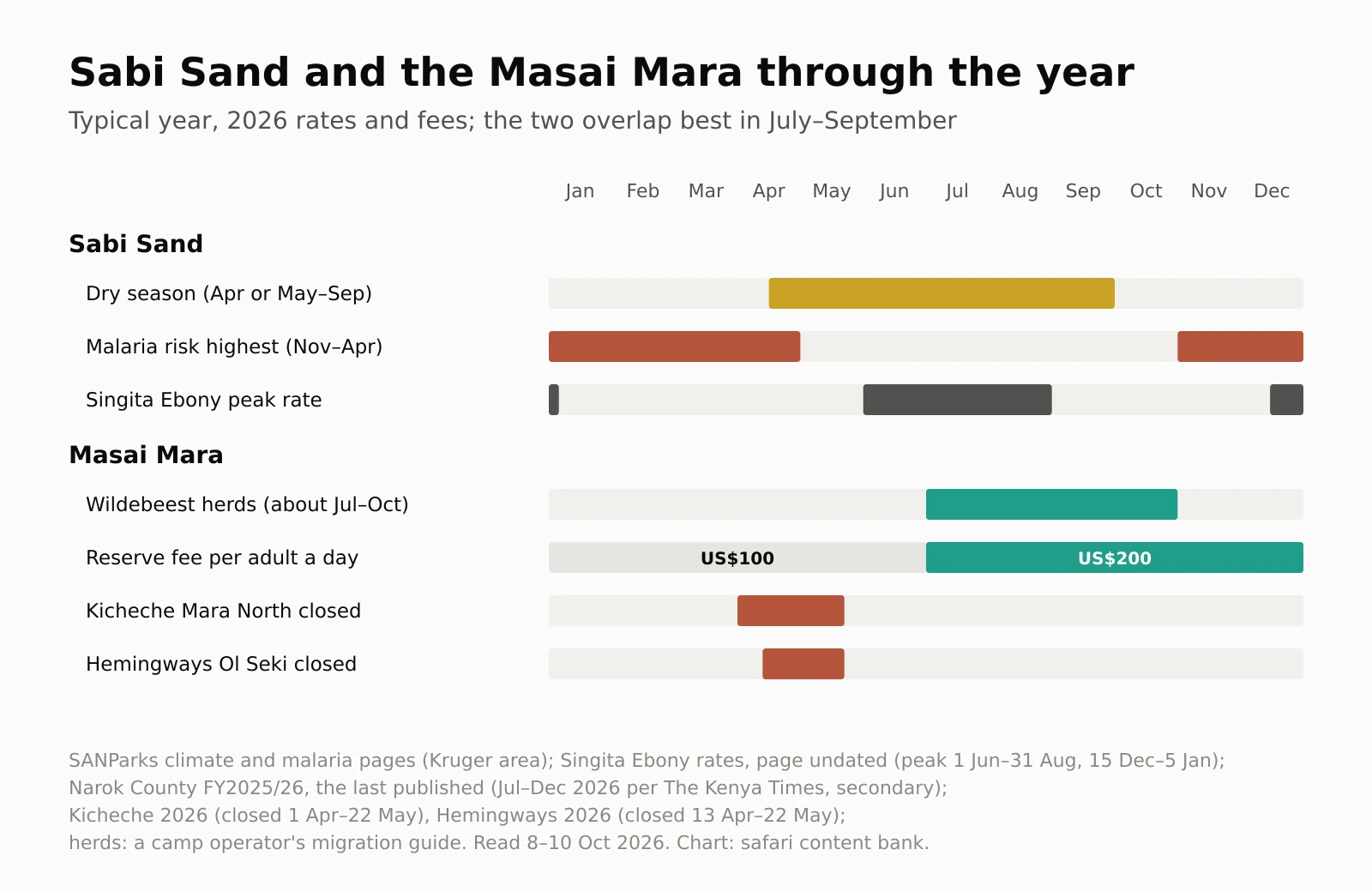 SANParks climate and malaria pages; Singita Ebony rates (page undated); Narok County FY2025/26; Kicheche and Hemingways 2026 sheets; a camp operator’s migration guide. Read 8–10 October 2026. Chart: safari content bank.
- July to September works for both, so a trip that does both can go then; see “Doing both” below.
- Sabi Sand’s prices barely move with the season: Elephant Plains and Simbambili charge one rate all year; Singita Ebony’s peak is June–August and the Christmas weeks; Sabi Sabi adds 15% for arrivals 20 December–5 January (Sabi Sand).
- The Mara’s quiet value months are January and February: the reserve fee is US$100 and the Loita herd calves in the conservancies (Masai Mara).
Getting there and pairing with the rest of the trip
Both are about an hour by light aircraft from the capital’s airport: FedAir from Johannesburg O.R. Tambo to Sabi Sand’s lodge strips, Mombasa Air Safari from Nairobi Wilson to the Mara.
| Sabi Sand | Masai Mara | Source | |
|---|---|---|---|
| By air | FedAir daily from Johannesburg O.R. Tambo or Kruger Mpumalanga International to Ulusaba, Arathusa, Londolozi, Singita and other strips, 1–1.5 h; fares not in the manual | Mombasa Air Safari, Wilson → Mara, about 1 h, US$200 + US$20 fuel one way; Safarilink and AirKenya publish no fare | FedAir 2026 (PDF); Mombasa Air Safari 2026 |
| Luggage | 20 kg in the hold plus 5 kg hand luggage | 15 kg including hand luggage, soft bags | FedAir; Safarilink and AirKenya |
| By road | To the gate your lodge names; no checked Johannesburg drive time in our sources | Nairobi → Sekenani Gate 5.5–6 h, tarmac | Sabi Sand; Nairobi to the Masai Mara |
| Usual pairing | Cape Town; most published Cape Town-and-safari packages run 8–10 days | Kenya’s coast: Mara → Ukunda (Diani), Mombasa or Malindi, 11:30 → 13:45, US$420 + US$35 one way | Cape Town and safari; Kenya safari and beach |
| Entry | UK and US passport holders need no visa for up to 90 days | eTA and, since 5 October 2026, a government health policy for arrivals | South Africa visa; Kenya eTA |
Read 8–10 October 2026. Airline schedules change by season.
- We found no airline source for a Cape Town–Kruger timetable; published packages fly Cape Town to the Lowveld, so the route exists (Cape Town and safari).
- Cape Town’s best months (November–March) are Sabi Sand’s wet season. Pair a summer Cape Town trip with a malaria-free reserve, or go April–September for the bushveld’s dry season (Cape Town and safari).
- For Zanzibar after the Mara, see Zanzibar beaches after a safari.
Doing both on one trip
Possible, but it means two countries, two light-aircraft systems and a yellow fever certificate if you fly from Kenya to South Africa. South Africa asks for one from travellers arriving from a risk country, which includes Kenya, and requires the vaccination at least 10 days before arrival (yellow fever and safaris). Our sources hold no Nairobi–Johannesburg timetable or fare, so check the live schedule. Do the Mara first in July–September and Sabi Sand second, and you see both in their best months.
Which should you choose?
Choose Sabi Sand for leopard-focused, off-road and night drives in any month and a South Africa trip with Cape Town; choose a Mara conservancy for open plains, resident lions and cheetah, and the herds in July–October.
| If you… | Pick | Why |
|---|---|---|
| Want leopard above all | Sabi Sand | Operators credit it with leopard viewing; off-road and night drives on lodge vehicles. No published rate either way |
| Want the wildebeest herds and crossings | Masai Mara, July–October | No migration in Sabi Sand in our sources |
| Want cheetah on open plains | Masai Mara | Resident; 0.66–1.39 adults per 100 km² in the reserve plan |
| Travel April–June | Sabi Sand | Dry season from April or May; several Mara conservancy camps close in April–May |
| Travel in January–February | Masai Mara, at the US$100 reserve fee | Quiet months; Loita herd calves in the conservancies. Sabi Sand is in its wet season |
| Want fewer vehicles at a sighting | Ask the lodge or camp | Neither Sabi Sand nor any Mara conservancy publishes a cap; only the Mara reserve does (five) |
| Want the lowest luxury bed | Sabi Sand (Elephant Plains, R7,300) or a Mara reserve camp (Governors’, US$453 in April–May) | Different currencies; we convert neither |
| Want Cape Town on the same trip | Sabi Sand | FedAir from Johannesburg to the lodge strips |
| Want a beach on the same trip | Masai Mara | Daily Mara–coast flight, US$420 + US$35 |
| Must avoid malaria areas | Neither | See malaria-free safaris, including Sabi Sand vs Madikwe |
More on choosing a top-end trip: luxury safari. Sabi Sand against its neighbours: Sabi Sand vs Timbavati and Kruger vs private reserves. The Mara’s two halves: Mara reserve vs conservancies. Before paying a deposit, check the operator’s licence.
Common mistakes in Sabi Sand vs Masai Mara comparisons
| What you’ll often read | What is correct |
|---|---|
| “Sabi Sand guarantees leopard” | No published sighting rate exists for Sabi Sand, or for the Mara, in our sources. |
| “Private reserves allow only two or three vehicles at a sighting” | No cap is published for Sabi Sand or any Mara conservancy. Only the Mara reserve publishes one: five. |
| “Sabi Sand’s fee is per night” | Per entry: R170 per person and R370 per light vehicle (2026); some lodges add their own nightly or daily levy. |
| “The Mara costs US$200 a day all year” | Reserve: US$100 January–June, US$200 July–December. Conservancies charge US$130 a night instead, on camps’ sheets. |
| “Flying in to Sabi Sand avoids the gate fee” | The gate fee applies to fly-in guests too. |
| “The Wild Card covers Sabi Sand” | It does not cover private reserves. |
| “The Mara has no malaria in the dry season” | WHO lists risk all year across Kenya. Sabi Sand’s risk is highest November–April and is not zero in winter. |
| “Sabi Sand is self-drive like Kruger” | Lodge guests only, on lodge vehicles; you drive only to your lodge. |
Frequently asked questions
Is Sabi Sand or the Masai Mara better for big cats? Neither publishes sighting rates, so no honest answer ranks them. Sabi Sand is credited by operators with leopard viewing, off-road and at night on lodge vehicles. The Mara has resident lions, leopards and cheetahs on open plains, with 21.5 lions and 0.66–1.39 adult cheetahs per 100 km² in the reserve’s management plan, and the herds from about July to October.
Is Sabi Sand more expensive than the Masai Mara? At the top they are close and priced in different currencies: Sabi Sand lodges publish R7,300–44,000 per person sharing a night for 2026 (Singita Ebony R51,665–60,470, page undated), and Mara camps US$453–2,028. Fees are smaller in Sabi Sand: R170 per entry against US$130 a night in a Mara conservancy.
What are the Sabi Sand and Masai Mara fees in 2026? Sabi Sand charges R170 per person and R370 per light vehicle per entry, VAT included, rising to R180 and R390 on 1 January 2027; some lodges add a levy. The Mara reserve charges US$100 per non-resident adult per day from January to June and US$200 from July to December (Narok County’s last published schedule); conservancies charge US$130 a night on camps’ 2026 sheets.
When is the best time for Sabi Sand and the Masai Mara? Sabi Sand’s dry season, April or May to September, is best for game. The Mara’s herds are usually there from July to October, when the reserve fee is US$200. July to September suits both.
Do Sabi Sand or the Mara conservancies limit vehicles at a sighting? Neither publishes a limit in our sources. The Masai Mara reserve does: five vehicles, with others waiting at least 100 m away. Ask your lodge or camp how many vehicles it allows.
Can you do night drives in Sabi Sand and the Masai Mara? In Sabi Sand, yes, on lodge vehicles; Sabi Sabi’s rate includes day and night drives. In the Mara, only in the conservancies, at camps such as Kicheche Valley and Porini Lion Camp; the reserve sells none.
Is either malaria-free? No. WHO lists malaria risk all year across Kenya, the Mara included. SANParks rates the Kruger area’s risk “generally low, even in summer”, highest from November to April. For malaria-free Big Five, look at Madikwe.
How do I get to Sabi Sand and the Masai Mara? Sabi Sand: FedAir’s daily shuttle from Johannesburg O.R. Tambo or Kruger Mpumalanga International to the lodge strips, 1–1.5 hours, or by road to the gate your lodge names. The Mara: Mombasa Air Safari from Nairobi Wilson in about an hour, US$200 + US$20 fuel one way, or 5.5–6 hours by road to Sekenani Gate.
Sources
- Fees: Sabi Sand Nature Reserve, access and gate fees; Narok County, Maasai Mara fee schedule FY2025/26 (PDF), the last published, with The Kenya Times, 6 Aug 2026 (secondary); SANParks daily conservation fees 2025/26 (PDF) and 2026/27 (PDF); SANParks Wild Card. Read 8–10 October 2026
- Rules and wildlife: Narok County GMME management plan (PDF) and its sighting rules via Business Daily; Sabi Sand, about; Wikipedia, Sabi Sand Game Reserve (secondary); a camp operator’s migration guide (name in our editor notes)
- Health: SANParks malaria and climate; WHO country list (PDF); yellow fever rule as on our yellow fever and safaris page
- Lodge and camp rate sheets, 2026: Elephant Plains, Thornybush (PDF), Sabi Sabi, Singita Ebony; Governors’ (PDF), Kicheche (PDF), Hemingways (PDF), Porini (PDF), Wilderness Mara
- Access: FedAir 2026 agent manual (PDF) and baggage; Mombasa Air Safari 2026 schedule
- Traveller reports (opinion and experience, not official findings): TripAdvisor, Kruger and Sabi Sands trip planning; TripAdvisor Mara forum and a safari booking site’s reviews, as cited on our Masai Mara page
- Our own pages for the detail: Sabi Sand, Masai Mara, Masai Mara park fees, Mara reserve vs conservancies, Kruger or the Masai Mara, where to see big cats, where to see leopards
Fees, rates and times as on our Sabi Sand and Masai Mara pages, read 8–10 October 2026; SANParks fees checked 1 November 2026. We will update this page when Narok County publishes a 2026/27 Mara fee schedule, when Sabi Sand’s 2027 gate fee takes effect on 1 January 2027, when either area publishes a sighting rate or a vehicle cap, and when lodges issue 2027 rates.
Ask for a quote
Tell us your dates and we send you a priced itinerary. Free, no obligation.
- Free quote, no obligation
- Trips run by licensed local operators