 Experience

Last verified · Next check due
On this page
- Where to see lion, leopard and cheetah on one trip: odds by area (2026)
- Which area to choose for all three cats
- Botswana: the concessions beat the parks for the full set
- Zambia and Zimbabwe: lion and leopard, little or no cheetah
- East Africa: the Mara and the Serengeti hold all three, without published odds
- South Africa and Namibia: Kruger, Sabi Sand and Etosha
- When to go for all three cats
- How many nights do you need for all three?
- What a big-cat safari costs per day
- Common mistakes about seeing the big cats
- Frequently asked questions
- Sources
Short answer: For all three cats on one trip, northern Botswana’s private concessions have the best published odds: in the Okavango Delta reserves 93% of one operator’s traveller groups saw lion, 73% leopard and 56% cheetah, and in Kwando-Linyanti 94%, 70% and 44% (read September 2026; best-case figures). Zambia’s Lower Zambezi and South Luangwa score higher for lion and leopard but have no cheetah. The Masai Mara, the Serengeti and Kruger hold all three but publish no sighting rate.
Key facts
- In every area where our pages print all three rates, the cheetah is the cat you are most likely to miss: 56% in the Okavango Delta reserves, 44% in Kwando-Linyanti, 43% across Botswana, 29% in the Central Kalahari and 14% in Chobe (one operator’s traveller groups, per trip, read September 2026). Zimbabwe’s Mana Pools is lower still at 3%.
- Zambia’s best lion and leopard parks are not cheetah parks: 96% saw lion and 88% leopard in Lower Zambezi, whose page from the same operator lists cheetah as absent; in South Luangwa 86% and 83%, and no cheetah has been seen there for decades (read 8 October 2026).
- The Masai Mara’s lions, leopards and cheetahs are resident all year (Kenya safari questions), but no sighting rate is published for the Mara, the Serengeti, Ndutu, Kruger, Sabi Sand or Etosha in the sources we hold.
- The three cats keep different hours: leopards do most of their hunting between sunset and sunrise, cheetahs hunt mainly by day (Wikipedia, Wikipedia; secondary). A camp where night drives and off-road driving are both allowed covers both.
- Cheetahs are the fewest of the three that have been counted: about 7,100 adults and adolescents survive (Durant et al. 2017), against about 23,000 wild lions in Africa (CITES, PDF); no credible estimate of Africa’s leopards exists (Panthera).
- Plan a whole trip, not a drive: the sighting rates count the share of groups who saw the cat at least once on their trip. Published Okavango Delta and Chobe itineraries have a median of 10 days (how many days).
Where to see lion, leopard and cheetah on one trip: odds by area (2026)
The Okavango Delta reserves are the one area in our sources where more than half of one operator’s traveller groups saw each of the three cats; Kwando-Linyanti comes next. Each species page gives the full picture: lions, leopards and cheetahs.
| Area | Country | Lion | Leopard | Cheetah | Fee to be there, per adult | Source |
|---|---|---|---|---|---|---|
| Okavango Delta reserves (private concessions) | Botswana | 93% | 73% | 56% | In the camp rate at many camps; levies US$20–100 a night | one operator’s Okavango Delta page; Okavango Delta |
| Kwando-Linyanti (concessions next to Chobe) | Botswana | 94% | 70% | 44% | Camp rate plus levy | one operator’s Kwando-Linyanti page |
| Botswana, all areas | Botswana | 91% | 66% | 43% | — | one operator’s Botswana wildlife page |
| Moremi Game Reserve | Botswana | 91% | 76% | Not published | P270 a day (last published DWNP schedule, 1 April 2022) | one operator’s Moremi page; Moremi |
| Chobe National Park (incl. Savuti) | Botswana | 91% | 59% | 14% | P270 a day (same DWNP line as Moremi) | one operator’s Chobe page; Chobe |
| Central Kalahari Game Reserve | Botswana | 89% | 33% | 29% | P190 a day (last published DWNP schedule, 1 April 2022) | one operator’s Central Kalahari page; Central Kalahari |
| Makgadikgadi and Nxai Pan | Botswana | 61% | Not published | 33% | P190 a day (same DWNP schedule) | one operator’s salt pans page |
| Lower Zambezi National Park | Zambia | 96% | 88% | Absent, per the operator | US$25 a day (DNPW 2025 schedule, the last published) | one operator’s Lower Zambezi page |
| South Luangwa National Park | Zambia | 86% | 83% | None seen for decades | US$25 a day (DNPW 2025, last published) | one operator’s South Luangwa page; Zambia safari questions |
| Kafue National Park | Zambia | 83% | 61% | Not published | US$20 a day (DNPW 2025, last published) | one operator’s Kafue page |
| Mana Pools National Park | Zimbabwe | 90% | 36% | 3% | US$24 a day (ZimParks Tariff 2026) | one operator’s Mana Pools page |
| Masai Mara National Reserve and conservancies | Kenya | Not published | Not published | Not published | Reserve US$100 a day (Jan–Jun), US$200 (Jul–Dec) | Kenya safari questions; Masai Mara |
| Serengeti National Park and Ndutu | Tanzania | Not published | Not published | Not published | US$82.60 a day, 16 May–14 March (last published tariff, 2023/24) | Serengeti |
| Kruger National Park | South Africa | Not published | Not published | Not published | R692 (R602 until 31 Oct 2026) | Kruger |
| Etosha National Park | Namibia | “Occasional” | “Very rare” | “Very rare” | N$280 per foreign adult + N$60 per vehicle (Government Notice 115 of 2026) | a safari booking site’s Etosha ratings; Etosha |
Sighting rates: one operator’s traveller reports, share of groups who saw the cat at least once on their trip; Botswana pages read September 2026, Zambia and Zimbabwe pages read 8 October 2026. Etosha’s words are a booking site’s ratings, not rates. Fees per non-resident or international adult, copied from our Botswana, Zambia, Zimbabwe, Kenya, Tanzania, South Africa and Namibia cost pages, read 8–10 October 2026. Botswana’s fee lines are the last published DWNP schedule; no official current tariff is published.
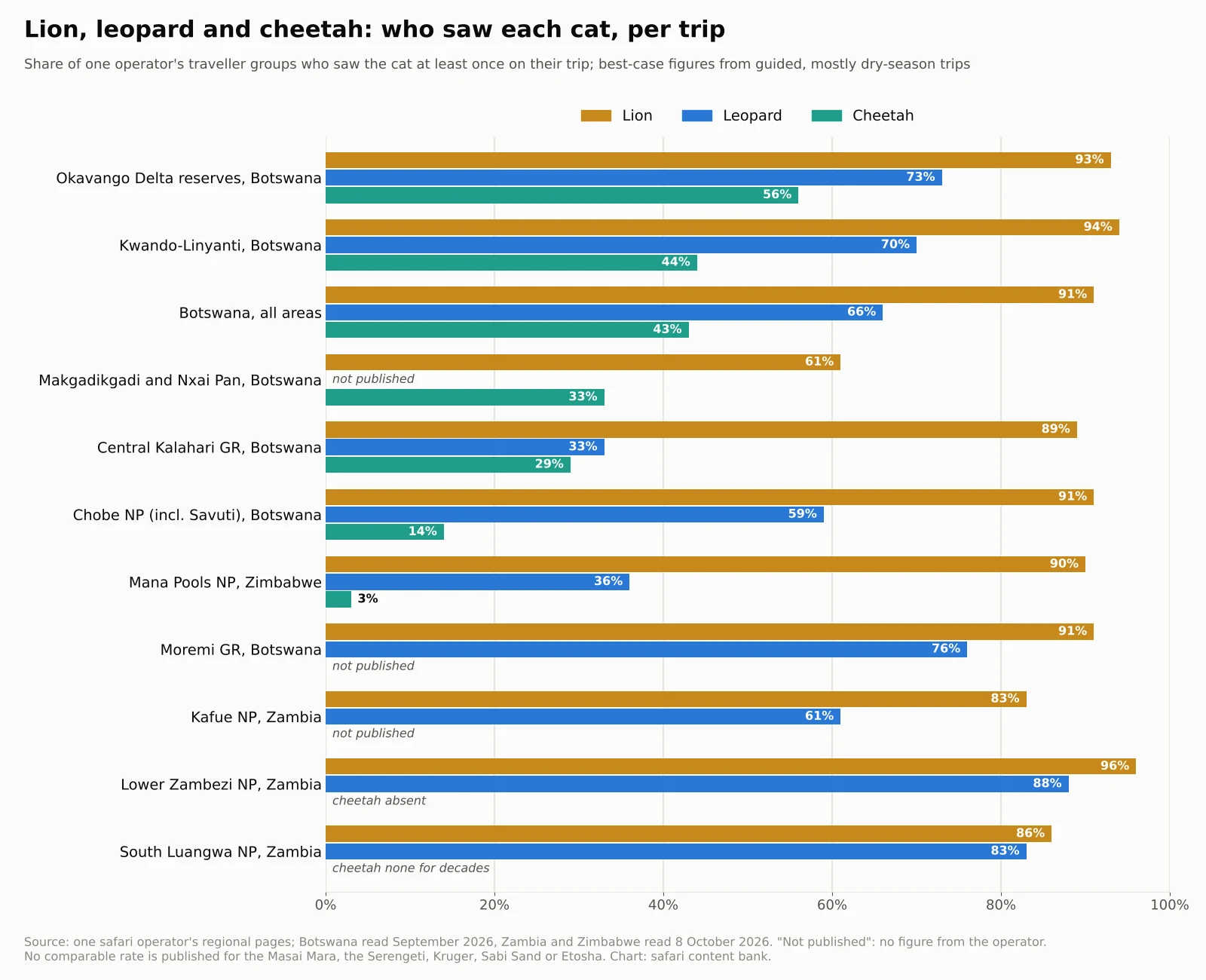 Traveller-reported, per trip, from one operator’s clients; Botswana dataset 11,679 sightings from 1,356 groups since May 2018. Sources: one operator’s regional pages, Botswana read September 2026, Zambia and Zimbabwe read 8 October 2026. Chart: safari content bank.
- Read these as best-case numbers. They come from one operator’s own clients, who tend to take longer, guided, dry-season trips, and the operator does not publish how many groups each regional figure rests on.
- Do not multiply the three rates to get a chance of seeing all three: the operator publishes each cat separately, not how many groups saw all three on the same trip.
- “Not published” is not “absent”. The Mara, the Serengeti and Kruger hold all three cats; what is missing is a comparable rate, not the animals.
Which area to choose for all three cats
Pick by the cat you care about most and by what the land allows: the Delta and Linyanti concessions for the best published balance, Zambia for lion and leopard, East Africa’s plains for cheetah in open country without published odds.
| If you want | Go to | Why |
|---|---|---|
| The best published odds for all three | Okavango Delta reserves or Kwando-Linyanti | 93/73/56% and 94/70/44% of one operator’s groups (lion/leopard/cheetah) |
| The highest leopard rate in Botswana | Moremi, then a concession for cheetah | Leopard 76%; the operator publishes no Moremi cheetah figure |
| Lion and leopard, cheetah not needed | Lower Zambezi or South Luangwa | Lion 96% and 86%, leopard 88% and 83%; no cheetah in either |
| All three on open plains in East Africa | Masai Mara conservancies or Ndutu in calving season | Cats resident in the Mara; operators’ guides name lions and cheetahs at Ndutu in February. No rates published |
| All three on a self-drive | Kruger | All three present; private cars may not drive off-road or at night |
| A rainy-season trip | Central Kalahari (December–May) | Lion 89%, but leopard 33% and cheetah 29% |
| Wild dogs too | See where to see wild dogs | Moremi and the Delta concessions also lead for dogs |
| Elephant, buffalo and rhino too | See where to see the Big Five | Rhino decides which parks hold all five |
Rates as in the table above; read September–October 2026.
Botswana: the concessions beat the parks for the full set
Botswana’s private concessions combine the three things the cats need from a visitor: high published rates, night drives for leopard and off-road driving for cheetah. Botswana Tourism states that in the national parks and reserves “off-roading and night driving [are] prohibited”, while private concessions outside them allow both “in moderation” (Botswana Tourism).
- Delta and Linyanti concessions: the highest three-cat figures in our sources (Delta 93/73/56%, Linyanti 94/70/44%). Water camps are a poor leopard bet: in the Okavango Panhandle the same operator’s travellers saw leopard on 0% of trips, on a small sample (water or land camps).
- Moremi and Chobe are a reserve and a park, so park rules apply to every camp inside them. Moremi leads Botswana for leopard (76%) but has no published cheetah figure; Chobe is at 59% for leopard and 14% for cheetah (Moremi or Chobe?).
- The Kalahari parks run the other way round: the Central Kalahari’s best months are December–May, and its rates are 89% lion, 33% leopard and 29% cheetah (one operator’s Central Kalahari page).
- Fees: Chobe and Moremi charge P270 per non-resident adult per day, and the Central Kalahari, Nxai Pan and Makgadikgadi Pans P190, in the last published DWNP schedule (1 April 2022, via Tourism Update). In February 2026 the government news agency BOPA called the existing non-resident fee P380; a P500 rise was announced, then reported postponed. No official current tariff is published; confirm with DWNP or your operator (Botswana park fees).
More: night drives, walking and off-road driving in Botswana, Okavango Delta, Botswana safari questions.
Zambia and Zimbabwe: lion and leopard, little or no cheetah
Zambia has the highest lion and leopard rates in our sources, but its two best parks have no cheetah, so a three-cat trip pairs Zambia with Botswana or East Africa. Lower Zambezi and South Luangwa charge US$25 per international adult per day and Kafue US$20 (DNPW 2025 schedule, the last published).
- Lower Zambezi: 96% lion and 88% leopard; the operator’s page lists cheetah as absent. Camps run night drives in the dry season (one operator’s Lower Zambezi guide).
- South Luangwa: 86% lion and 83% leopard, with night drives inside the park; no cheetah has been seen there for decades (South Luangwa). Full-board camps add US$90–110 per person a night in park fees and levies (South Luangwa safari cost).
- Kafue: 83% lion and 61% leopard; the operator publishes no cheetah figure. Its lions are seen on the Busanga Plains, where most camps open in June and close at the end of October (Zambia safari questions).
- Mana Pools (Zimbabwe): 90% lion, 36% leopard and 3% cheetah; ZimParks charges US$24 per international adult per day (ZimParks Tariff 2026).
Zambia against Botswana: Botswana vs Zambia; the two Zambian parks: South Luangwa vs Lower Zambezi.
East Africa: the Mara and the Serengeti hold all three, without published odds
The Masai Mara and the Serengeti ecosystem hold resident lions, leopards and cheetahs, but no sighting rate for any of them is published in our sources, so we cannot rank them against Botswana. What exists is densities, research and traveller reports.
- Masai Mara: Narok County’s management plan gives 21.5 lions and 0.66–1.39 adult cheetahs per 100 km² (GMME plan, PDF); no leopard figure. The reserve costs US$100 per adult per day from 1 January to 30 June and US$200 from 1 July to 31 December (Narok County FY2025/26 schedule, the last published; Masai Mara park fees).
- Reserve or conservancy: in the reserve, vehicles may leave the track only to approach big cats on nearby open ground, no closer than 25 m, with no more than five at a sighting; the conservancies drive off-road and sell night drives at some camps. Forum regulars suggest splitting four or more nights between two conservancies to see different lion prides, leopards and cheetahs (Mara reserve vs conservancies).
- Serengeti: sellers name the Seronera valley for leopard, and forum replies point to the eastern and central Serengeti for lions and cheetahs (traveller reports). No night drives are allowed in the park. Entry is US$82.60 per non-East African adult per day (US$70.80 from 15 March to 15 May), plus a concession fee of US$59 a night (US$70.80 in July–September) inside the park (last published tariff, 2023/24; Serengeti park fees).
- Ndutu, in calving season: two tour operators’ migration guides describe lions, cheetahs and hyenas on the plains when calving peaks in February (Great Migration month by month). Ndutu is in the Ngorongoro Conservation Area: US$70.80 entry per adult per 24 hours plus US$59 a night at its lodges (NCAA’s page does not say whether VAT is included; Ngorongoro park fees). A traveller counted 15–20 vehicles at single sightings there in March 2026 (TripAdvisor).
Mara or Serengeti for cats: Serengeti vs Masai Mara.
South Africa and Namibia: Kruger, Sabi Sand and Etosha
Kruger holds all three cats and you can drive it yourself, but its counts are old and no sighting rate is published; Etosha has all three, rated from “occasional” to “very rare”.
| Park | Lion | Leopard | Cheetah | What the figure is | Source |
|---|---|---|---|---|---|
| Kruger National Park | 1,620–1,720 (2011) | About 1,000 (2010 and 2011) | About 120 (2009–2011) | SANParks counts tabulated on Wikipedia; about 15 years old | Wikipedia (secondary) |
| Sabi Sand (Greater Kruger) | Present | Operators credit it with leopard viewing | On its species list | Descriptions, not counts or rates | Sabi Sand vs Timbavati; Wikipedia (secondary) |
| Etosha National Park | “Occasional” | “Very rare” | “Very rare” | A safari booking site’s ratings | Etosha |
Read 8–10 October 2026. No dated count or sighting rate for Sabi Sand or Etosha is in our sources.
- Kruger charges R692 per international adult per day from 1 November 2026 (R602 until 31 October 2026) (Kruger park fees). Private cars may not drive off-road or at night; for a night drive, book one with SANParks (SANParks rules; Kruger self-drive).
- Sabi Sand admits lodge guests only and charges R170 per person plus R370 per car per entry in 2026; a Cape Town tour operator says off-road and night drives are allowed in the private reserves (Kruger vs private reserves). Its cheapest published 2026 bed is R7,300 per person sharing at Elephant Plains (Elephant Plains).
- Etosha charges N$280 per foreign adult plus N$60 per vehicle since 1 April 2026 (Government Notice 115 of 2026). A safari agent’s Etosha guide names Fischer’s Pan and the Andoni plains in the east for cheetah; only NWR’s guided night drives run after dark (Etosha).
When to go for all three cats
No source in our bank gives big-cat-specific months, except operators’ calving-season guides for Ndutu; elsewhere the best months below are general game-viewing seasons, mostly the dry season, when the cats are easiest to find near water. The Kalahari parks are the exception: their best months are the rains.
| Area | Best months in our sources | What the source says | Source |
|---|---|---|---|
| Okavango Delta, Moremi, Linyanti | June–October | Best game viewing “because animals gather at the remaining water” | A camp operator’s best-time guide for Botswana |
| Central Kalahari, Makgadikgadi, Nxai Pan | December–May | Springbok and gemsbok gather on the short-grass plains | one operator’s Central Kalahari page; best time for a safari |
| South Luangwa | September for game | Most bush camps open late May to mid-November | one operator’s South Luangwa guide, via South Luangwa |
| Lower Zambezi | Mid-August to mid-October for peak game | Camps open about April to mid-November | Lower Zambezi |
| Kafue (Busanga Plains) | June to end October | When most Busanga camps are open | Zambia safari questions |
| Mana Pools | June–October | Most camps closed December–March | Mana Pools |
| Ndutu and the southern Serengeti plains | Late January to mid-March; calving peaks in February | Lions, cheetahs and hyenas on the plains in calving season | Great Migration month by month |
| Serengeti | June–October | Dry season | Best time for a safari |
| Masai Mara | All year | The cats are resident; reserve fee US$100 a day January–June, US$200 July–December | Kenya safari questions |
| Kruger and the Greater Kruger reserves | April–September | Dry season, best for game viewing | Kruger |
| Etosha | May–October | Water is limited to a few waterholes and the grass is short | Etosha |
Read 8–10 October 2026. Only the Ndutu row names the cats; the rest are general game-viewing seasons.
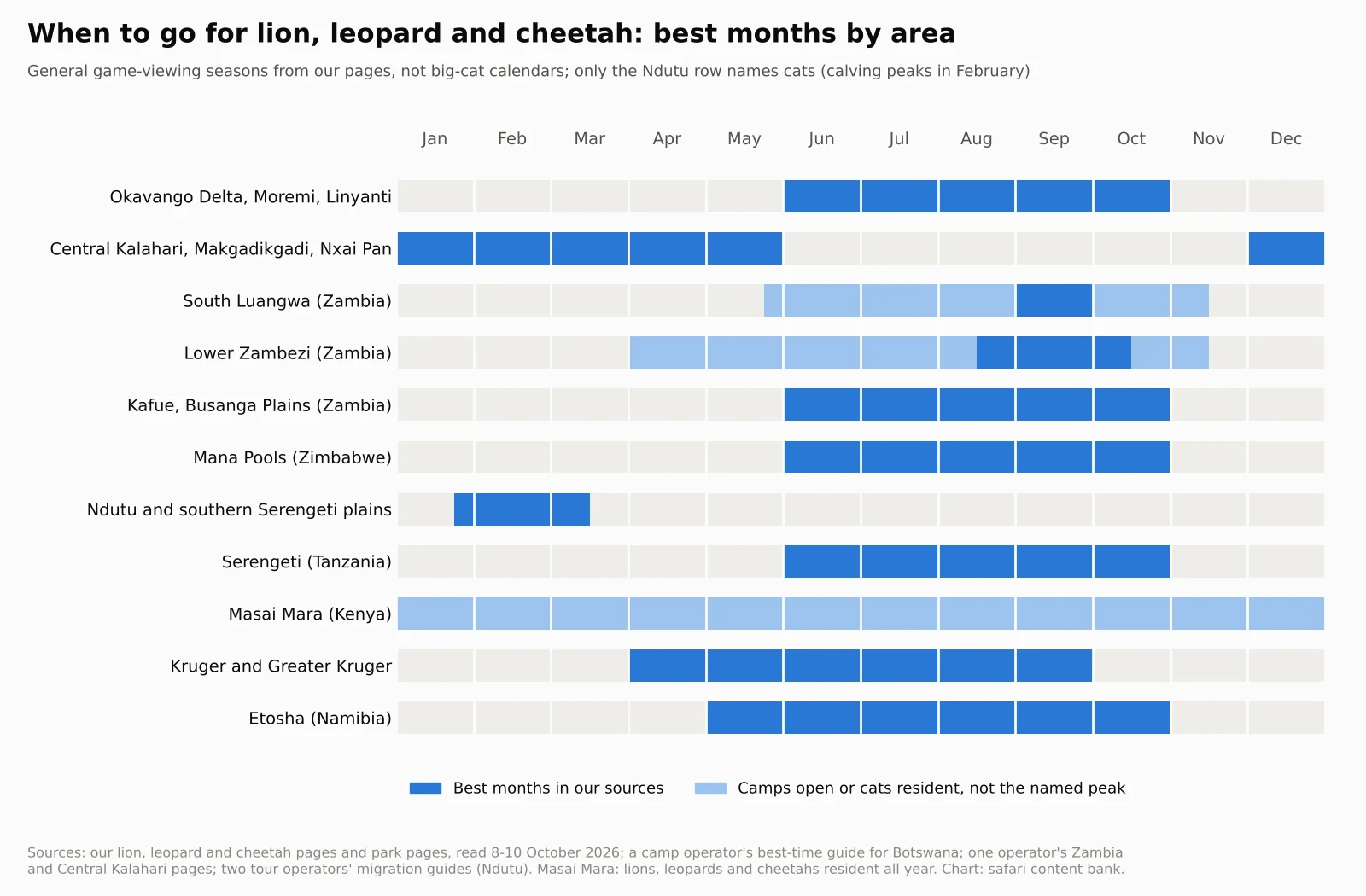 Sources: our lion, leopard and cheetah pages and park pages, read 8–10 October 2026; a camp operator’s best-time guide for Botswana; one operator’s Zambia and Central Kalahari pages; two tour operators’ migration guides (Ndutu). General seasons, not big-cat calendars. Chart: safari content bank.
- The dry months are the peak-price months. July to September is peak price at every South Luangwa camp whose rate seasons we have, and Botswana’s top rates begin in June (best time for a safari).
- In the Mara, January to June halves the reserve fee (US$100 against US$200 a day), and the cats are there all year.
- Calving season is also the crowded season at Ndutu, and its lodges charge peak rates from mid-December to March (Serengeti safari cost).
How many nights do you need for all three?
Give it a week or more in one region, or two regions if one of them lacks cheetah: the published rates count a whole trip, and Botswana-only itineraries combining the Delta and Chobe have a median of 10 days. No source in our bank gives a night count that guarantees all three cats.
| Plan | Nights in our sources | Source |
|---|---|---|
| Botswana, Okavango Delta + Chobe | Itineraries run 7–14 days, median 10; 3 nights per camp | How many days; Botswana safari questions |
| Masai Mara | Mara-only itineraries median 4 days; forum regulars suggest 4+ nights split between two conservancies for different prides, leopards and cheetahs | How many days; Mara reserve vs conservancies |
| Tanzania northern circuit | Median 7–8 days; 2–3 nights per Serengeti area | How many days; Serengeti |
| Kruger and Greater Kruger | Itineraries run 3–7 days, median 4 | How many days |
| Any camp with a minimum stay | Usually 2 nights | How many days |
Itinerary counts are ours, from operators’ published trips captured September–October 2026.
- Split the nights by habitat. In Botswana, a concession camp for cheetah and night drives plus a Moremi or Delta camp for leopard covers more ground than three nights in Chobe, where 14% saw a cheetah.
- To pair Zambia’s lion and leopard odds with Botswana’s cheetah, see multi-country safaris, which lists Botswana with Zambia or Zimbabwe via Victoria Falls among the pairings that work.
What a big-cat safari costs per day
Published prices run from about US$157 per person per day on a budget Masai Mara safari to US$3,220–4,989 a day on a top-tier Okavango fly-in package, the area with the best published three-cat odds. Package prices below are other operators’ published prices, shown without their names; camp and lodge rates are named.
| Where | Option | Price per person | Basis | Source |
|---|---|---|---|---|
| Okavango and Moremi | Guided mokoro or camping trip from Maun | US$214–307 a day | Operators’ published prices, captured Sept 2026; our per-day sums | Okavango Delta safari cost |
| Okavango and Moremi | Mobile safari through Moremi | US$450–593 a day | As above | same |
| Okavango and Moremi | 7-day fly-in package with flights; top-tier fly-in package | US$1,290–1,630; US$3,220–4,989 a day | As above | same |
| South Luangwa | 7-day group camping trip | US$275–306 a day | Published 2026 prices, read 8 Oct 2026 | South Luangwa safari cost |
| Masai Mara | Budget; mid-range; luxury camp | US$157–290; US$352–1,248; US$730–2,028 a day | Reserve or conservancy fee counted; our sums of 2026 published prices, read 9–10 Oct 2026 | Masai Mara safari cost |
| Serengeti | 3-day group camping trip from Arusha | About US$300 a day | Park fees included; checked 10 Oct 2026 | Serengeti safari cost |
| Kruger | Shared Kruger tour; private safari; luxury fly-in | US$214–242; US$579–652; US$1,792–1,980 a day | Operators’ published “from” prices, read 8 Oct 2026 | Kruger safari cost |
| Sabi Sand | Elephant Plains | R7,300 a night | 2026, per person sharing; plus R170 per person + R370 per car at the gate | Elephant Plains |
| Etosha | Self-drive, camping inside the park, two sharing | N$2,225–2,810 a day | Rooftop-tent 4x4 and park fees included; our sums | Etosha safari cost |
Per person sharing unless stated. Package figures are copied from our cost pages, which keep the operators’ names and links; listing prices are usually based on two travellers, so ask what each includes. Every country side by side: safari cost per day by country. Before paying an agent, check the operator’s licence.
Park fees per adult per day in the main big-cat areas:
| Area | Fee | Basis | Source |
|---|---|---|---|
| Moremi, Chobe | P270 | Last published DWNP schedule, 1 April 2022; no official current tariff | Botswana safari cost |
| Central Kalahari, Makgadikgadi, Nxai Pan | P190 | Same DWNP schedule | same |
| Lower Zambezi, South Luangwa | US$25 | DNPW 2025 schedule, the last published | Zambia safari cost |
| Kafue | US$20 | Same DNPW schedule | same |
| Mana Pools | US$24 | ZimParks Tariff 2026 | Zimbabwe safari cost |
| Masai Mara reserve | US$100 (Jan–Jun); US$200 (Jul–Dec) | Narok County FY2025/26, the last published | Masai Mara park fees |
| Serengeti | US$82.60 (16 May–14 Mar); US$70.80 (15 Mar–15 May) | Last published tariff, 2023/24 | Serengeti park fees |
| Ndutu (Ngorongoro Conservation Area) | US$70.80 per 24 h + US$59 a night at its lodges | NCAA’s page does not say whether VAT is included | Ngorongoro park fees |
| Kruger | R692 (R602 until 31 Oct 2026) | SANParks 2025/26 and 2026/27 | Kruger park fees |
| Sabi Sand | R170 per person + R370 per car, per entry | 2026 | Kruger park fees |
| Etosha | N$280 per foreign adult + N$60 per vehicle | Government Notice 115 of 2026 | Etosha park fees |
Non-resident or international adult; copied from our cost and park-fee pages, read 8–10 October 2026.
The official fee lines, with the date each took effect and the authority’s own source:
| Fee | Amount | In force from | Source |
|---|---|---|---|
| Chobe National Park and Moremi Game Reserve (DWNP), non-resident adult, per person per day | BWP 270 (SADC residents BWP 205; Botswana citizens and residents BWP 30) | Last published DWNP schedule, 1 April 2022 (via Tourism Update). In Feb 2026 the government news agency BOPA called the existing non-resident fee P380; a P500 rise was announced, then reported postponed. No official current tariff: confirm with DWNP or your operator | Tourism Update, 23 Feb 2022 (DWNP fee schedule) |
| Other DWNP parks and reserves (Central Kalahari Game Reserve, Khutse, Nxai Pan, Makgadikgadi Pans), non-resident adult, per person per day | BWP 190 (SADC residents BWP 145; Botswana citizens and residents BWP 20) | Last published DWNP schedule, 1 April 2022 (via Tourism Update). In Feb 2026 the government news agency BOPA called the existing non-resident fee P380; a P500 rise was announced, then reported postponed. No official current tariff: confirm with DWNP or your operator | Tourism Update, 23 Feb 2022 (DWNP fee schedule) |
| South Luangwa and Lower Zambezi National Parks (DNPW Category A), international adult, entry per day (06:00–18:00) | USD 25 (SADC and resident USD 20; Zambian citizen ZMW 55.60); child 5–13 half price, under 5 free | DNPW 2025 schedule ("official 2025 rates"), the last published; page last modified 8 May 2025, still shown 9 Oct 2026 | DNPW 2025 fee schedule, as shown on a Zambia travel portal |
| Kafue and North Luangwa National Parks, international adult, entry per day | USD 20 (SADC and resident USD 15; Zambian citizen ZMW 44.80) | DNPW 2025 schedule, the last published; page last modified 8 May 2025, still shown 9 Oct 2026 | DNPW 2025 fee schedule, as shown on a Zambia travel portal |
| Mana Pools National Park, Sapi and Chewore, international adult, conservation fee per day | USD 24, day visitor or staying overnight (SADC USD 18; local USD 8) | ZimParks Tariff 2026 (tariff year 2026, published February 2026); the conservation-fee table does not say whether VAT is included | ZimParks De-Gazetted Tariff 2026 |
| Maasai Mara National Reserve, non-resident adult, per day (12-hour ticket, 06:00–18:00), 1 Jan–30 Jun | USD 100 | Since 1 Jan 2024; Narok County FY2025/26 schedule, the last published | Narok County fee schedule FY2025/26 |
| Maasai Mara National Reserve, non-resident adult, per day (12-hour ticket, 06:00–18:00), 1 Jul–31 Dec | USD 200 | Since 1 Jul 2024; Narok County FY2025/26 schedule, the last published, expired 30 Jun 2026 (no 2026/27 schedule as of 9 Oct 2026); The Kenya Times (6 Aug 2026, secondary) reports US$200 still applies for Jul–Dec 2026 | Narok County fee schedule FY2025/26 |
| Serengeti and Nyerere National Parks, non-East African adult, entry per day, 16 May–14 Mar | USD 70 + 18% VAT = USD 82.60 | 1 Jul 2023 (2023/24 tariff, last published) | TANAPA Tariffs 2023/24 |
| Serengeti and Nyerere National Parks, non-East African adult, entry per day, 15 Mar–15 May | USD 60 + 18% VAT = USD 70.80 | 1 Jul 2023 (2023/24 tariff, last published) | TANAPA Tariffs 2023/24 |
| Serengeti and Nyerere, concession fee per person per night inside the park | Jul–Sep USD 60 + VAT = USD 70.80; Oct–Jun USD 50 + VAT = USD 59 | 1 Jul 2023 (2023/24 tariff, last published) | TANAPA Tariffs 2023/24 |
| Ngorongoro Conservation Area, non-East African adult, entry per 24 h (single entry) | USD 70.80 (NCAA's page does not say whether VAT is included) | Undated official page, read 9 Oct 2026 | NCAA |
| Ngorongoro concession fee, rim and Ndutu lodges, per person per night | USD 59 (NCAA's page does not say whether VAT is included) | Undated official page, read 9 Oct 2026 | NCAA |
| Kruger National Park daily conservation fee, international adult (12+), per day | ZAR 602 | 1 Nov 2025 to 31 Oct 2026 (SANParks 2025/26 schedule) | SANParks daily conservation fees 2025/26 |
| Kruger National Park daily conservation fee, international adult (12+), per day | ZAR 692 | 1 Nov 2026 to 31 Oct 2027 (SANParks 2026/27 schedule, already published) | SANParks daily conservation fees 2026/27 |
| Sabi Sand Nature Reserve gate fee, per person, per entry (VAT included) | ZAR 170 (ZAR 180 in 2027) | 1 Jan to 31 Dec 2026 | Sabi Sand Nature Reserve, access and gate fees |
| Sabi Sand Nature Reserve gate fee, light vehicle under 3,500 kg, per entry (VAT included) | ZAR 370 (ZAR 390 in 2027) | 1 Jan to 31 Dec 2026 | Sabi Sand Nature Reserve, access and gate fees |
| Tier 1 parks (Etosha, Namib-Naukluft including Sossusvlei, Skeleton Coast, Ai-Ais/Fish River Canyon, Waterberg Plateau, Cape Cross, Dorob, Tsau //Khaeb), foreign adult 16+, per person | NAD 280 (NAD 140 park entrance + NAD 140 conservation fee) | 1 Apr 2026 (Government Notice 115 of 2026; the notice prices fees per person with no period; MEFT's 2021 schedule made fees valid for 24 hours from entry); was NAD 150 under the 2021 schedule | Government Gazette 8877 (Government Notice 115 of 2026), hosted by the Legal Assistance Centre |
| Vehicle up to 10 seats, most national parks (N$50 at Sandwich Harbour), per vehicle | NAD 60 | 1 Apr 2026 (Government Notice 115 of 2026; the notice states no period; MEFT's 2021 schedule made fees valid for 24 hours from entry); was NAD 50 | Government Gazette 8877 (Government Notice 115 of 2026), hosted by the Legal Assistance Centre |
Common mistakes about seeing the big cats
| What you’ll often read | What is correct |
|---|---|
| “Any big-cat park will show you all three” | Zambia’s Lower Zambezi and South Luangwa have no cheetah, though they have the highest lion and leopard rates in our sources. |
| “93%, 73% and 56% means a 38% chance of all three” | You cannot multiply them. The operator publishes each cat separately, not how many groups saw all three on one trip. |
| “Chobe is as good as the Delta for cats” | Chobe: 59% leopard and 14% cheetah, against 73% and 56% in the Okavango Delta reserves (one operator’s groups). |
| “The Mara or Kruger guarantees all three” | No sighting rate is published for either in our sources. Both hold all three cats. |
| “You need a night drive for every cat” | Leopards hunt mostly at night; cheetahs hunt mainly by day. Night drives help with leopard; off-road access helps with cheetah. |
| “A camp in Moremi or Chobe can follow cats off-road at night” | Off-roading and night driving are prohibited in Botswana’s parks and reserves (Botswana Tourism). The concessions next to them allow both. |
| “Etosha is good for leopard and cheetah” | A safari booking site rates both “very rare” in Etosha; lion is “occasional”. |
| “Kruger costs R602 a day” | That was the 2025/26 rate, which ended on 31 October 2026. Since 1 November 2026: R692 per international adult per day. |
Frequently asked questions
Where is the best place to see lion, leopard and cheetah on one safari? On published figures, northern Botswana’s private concessions: in the Okavango Delta reserves 93% of one operator’s traveller groups saw lion, 73% leopard and 56% cheetah, and in Kwando-Linyanti 94%, 70% and 44% (read September 2026). These are best-case figures from one operator’s clients.
Can you see all three big cats in Zambia? Lion and leopard, yes; cheetah, hardly. Lower Zambezi (96% lion, 88% leopard) and South Luangwa (86% and 83%) have the highest rates in our sources, but the operator lists cheetah as absent in Lower Zambezi and none has been seen in South Luangwa for decades.
Is the Masai Mara or the Serengeti good for big cats? Both hold resident lions, leopards and cheetahs, but no sighting rate is published for either in our sources, so we cannot rank them against Botswana. The Mara reserve costs US$100 a day from January to June and US$200 from July to December; the Serengeti US$82.60 a day for most of the year (last published tariff, 2023/24).
Which big cat is hardest to see? Cheetah, in every area where our pages print all three rates: 56% in the Okavango Delta reserves, 43% across Botswana and 14% in Chobe, against lion at 91–94% in the same areas. About 7,100 adult and adolescent cheetahs survive (Durant et al. 2017).
Is Moremi or a private concession better for big cats? Moremi has Botswana’s highest leopard rate (76%) but no published cheetah figure, and night drives and off-road driving are prohibited there. The Delta and Linyanti concessions allow both and publish cheetah rates of 56% and 44%. Many trips combine a camp of each kind.
How many nights do I need to see lion, leopard and cheetah? No source gives a night count that guarantees all three. The rates count a whole trip; published Botswana trips combining the Delta and Chobe have a median of 10 days, with about 3 nights per camp. In the Mara, forum regulars suggest 4 or more nights split between two conservancies.
When is the best time to see big cats? Mostly the dry season: June–October in northern Botswana, the Serengeti and Mana Pools, April–September in Kruger, May–October in Etosha. The Kalahari parks are best December–May, Ndutu from late January to mid-March, and the Mara’s cats are resident all year.
Can you see lion, leopard and cheetah in Kruger? Yes, all three live there, but no sighting rate is published and the counts are old: 1,620–1,720 lions (2011), about 1,000 leopards (2010 and 2011) and about 120 cheetahs (2009–2011). Kruger charges R692 per international adult per day from 1 November 2026 (R602 until 31 October 2026).
Sources
- Sighting rates: one operator’s pages on Botswana wildlife, the Okavango Delta reserves, Kwando-Linyanti, Moremi, Chobe, the Central Kalahari, the salt pans and the Okavango Panhandle (read September 2026); Lower Zambezi, South Luangwa, Kafue and Mana Pools (read 8 October 2026), as printed on our lion, leopard and cheetah pages (names and links kept in our editor notes)
- Cat numbers and behaviour: Durant et al. 2017, PNAS; CITES, AC33 lion paper (PDF); Panthera, leopard, read 9 Oct 2026; Wikipedia, African leopard, Cheetah, Kruger National Park and Sabi Sand Game Reserve (secondary)
- Botswana: Botswana Tourism, game viewing; DWNP schedule effective 1 April 2022 via Tourism Update, 23 Feb 2022; a camp operator’s best-time guide for Botswana (name and link kept in our editor notes)
- Zambia and Zimbabwe: DNPW 2025 schedule, the last published, from a safari agent’s guide read 9 Oct 2026; ZimParks Tariff 2026 (PDF)
- Kenya: Narok County fee schedule FY2025/26 (PDF), the last published; Narok County GMME Management Plan 2023–2032 (PDF); traveller reports on TripAdvisor, as cited on our Mara pages
- Tanzania: TANAPA Tariffs 2023/24 (PDF), the last published tariff; NCAA tariffs (undated, read 9 Oct 2026); two tour operators’ migration guides and sellers’ Big Five guides (names and links kept in our editor notes); traveller reports on TripAdvisor (Ndutu, March 2026)
- South Africa: SANParks daily conservation fees 2025/26 and 2026/27; SANParks, vital information; Sabi Sand access; Elephant Plains rates; a Cape Town tour operator’s blog (name and link kept in our editor notes)
- Namibia: Government Notice 115 of 2026 (PDF); a safari agent’s Etosha guide; a safari booking site’s Etosha wildlife ratings (name and link kept in our editor notes)
- Itinerary lengths and package prices: our counts and other operators’ published prices as printed on our how many days, Okavango Delta, South Luangwa, Masai Mara, Serengeti, Kruger and Etosha pages (names and links kept there)
More on each cat and the other animals: lions, leopards, cheetahs, wild dogs and the Big Five.
Figures, rates and fees checked 10 October 2026; SANParks fees checked 1 November 2026. We will update this page when the operator’s sighting rates change, when SANParks’ 2026/27 fees take effect on 1 November 2026, when DNPW publishes a 2026 Zambia schedule or DWNP an official Botswana tariff, when TANAPA or Narok County publish new fee schedules, and when any park publishes a big-cat count or sighting rate.