 Experience

Last verified · Next check due
On this page
- Serengeti vs Tarangire at a glance (2026)
- Wildlife: the migration vs Tarangire’s dry-season elephants
- Park fees: a Serengeti night against a Tarangire night
- When to go: the migration calendar against Tarangire’s dry season
- Drive times from Arusha, and from Tarangire to the Serengeti
- Crowds: busier than its reputation
- What each costs per day
- How many nights, and how to combine them
- Which to choose
- Common mistakes in Serengeti vs Tarangire comparisons
- Frequently asked questions
- Sources
Short answer: Choose the Serengeti for the wildebeest migration. Choose Tarangire for elephants and dry-season game at the river, June–October. They are not either/or: Tarangire is 2 hours from Arusha and the usual first stop on the road to the Serengeti, 7–7.5 hours away. A night inside costs US$100.30–106.20 per adult in park fees in Tarangire and US$129.80–153.40 in the Serengeti (last published tariff, 2023/24).
Key facts
- The Serengeti is about five times the size of Tarangire: 14,763 km² against 2,850 km² (a safari agent’s Serengeti and Tarangire guides; our arithmetic).
- Operators pair them more than they choose between them. The Serengeti is in 100 of 119 Tanzania-only itineraries (84%) and Tarangire in 67 (56%), in our sample of operators’ published trips captured on 8 October 2026; the usual order is Arusha → Tarangire → Ngorongoro → Serengeti.
- A night inside Tarangire costs US$29.50–47.20 less per adult in park fees than a night inside the Serengeti (our sums from TANAPA’s last published tariff, 2023/24). Driving to the Serengeti also crosses the Ngorongoro Conservation Area, at US$70.80 per adult each way (NCAA; NCAA’s page does not say whether VAT is included).
- Their best months overlap in June–October: Tarangire’s peak season, and the Serengeti’s Western Corridor (June) and Mara River (July–October) months. Calving in January–March is a Serengeti-and-Ndutu reason to go, not a Tarangire one.
- Only Tarangire sells night game drives, at US$59 per adult (last published tariff, 2023/24). They are not permitted in the Serengeti or the Ngorongoro Conservation Area.
- Tarangire is not the quiet alternative. It had about 372,000 visitors a year on 2,850 km², the Serengeti 491,398 in 2024/25 on 14,763 km²: about four times as many visitors per km² in Tarangire (our arithmetic; the counts cover different periods).
Serengeti vs Tarangire at a glance (2026)
The Serengeti is the far end of the northern circuit and the reason most people come; Tarangire is the smaller, cheaper, seasonal park two hours from Arusha.
| Serengeti National Park | Tarangire National Park | Source | |
|---|---|---|---|
| Run by | TANAPA | TANAPA | TANAPA 2023/24 |
| Area | 14,763 km² | 2,850 km² | A safari agent’s Serengeti and Tarangire guides |
| Known for | The wildebeest herds; calving around February on the southern plains and at Ndutu, Mara River crossings July–October | Elephants and dry-season game at the Tarangire River and swamps | Serengeti; Tarangire |
| Best months | By area: south December–March, Western Corridor May–July, north July–October | June–October | A UK safari operator’s and a camp operator’s migration guides; a safari agent’s park guide |
| Arusha to the park, by road | 7–7.5 h to Seronera, crossing the Ngorongoro Conservation Area | 2 h, 109 km to the north gate | A safari operator’s getting-there page; a Tanzanian operator’s travel-times table |
| Entry, adult per day | US$82.60 (US$70.80, 15 March–15 May) | US$59 (US$53.10, 15 March–15 May) | TANAPA, last published tariff, 2023/24 |
| A night inside, adult | US$129.80–153.40 entry + concession | US$100.30–106.20 entry + concession | TANAPA 2023/24; our sums |
| Night game drive | No | Yes, US$59 per adult | TANAPA 2023/24 |
| Visitors | 491,398 in the 2024/25 financial year; 13.1% of international visitors in 2025 | About 372,000 a year; 9.0% of international visitors in 2025 | The Citizen, 18 Dec 2025; The Citizen, 24 Apr 2026; Bank of Tanzania exit survey 2025 (PDF) |
| Published 2026 camp rates | US$250–3,220 per person per night (the top end is a private reserve outside the park) | US$118–1,650 (the low end is outside the park) | Camps’ own rates and agent listings, read 8–9 Oct 2026 |
| In operators’ Tanzania-only trips | 84% (100 of 119) | 56% (67 of 119) | Our itinerary sample, 8 Oct 2026 |
Fees: TANAPA Tariffs 2023/24 (PDF), effective 1 July 2023, the last published tariff (TANAPA site checked 9 October 2026), with 18% VAT; non-East African adult. Drive times as published, gate stops not included. Other rows as linked. Checked 10 October 2026.
Wildlife: the migration vs Tarangire’s dry-season elephants
Go to the Serengeti to follow the herds, which move with the rains; go to Tarangire for the opposite: animals that gather at the river in the dry season. Neither park publishes a sighting rate.
Serengeti: the herds, wherever the rain has put them
- Two current counts, made with different methods. TAWIRI’s aerial count put the herd at 1,366,109 at the end of March 2023; a satellite study counted fewer than 600,000 in August 2022 and 2023 (Serengeti, where both sources are linked). Quote either with its method and date.
- Calving peaks around February on the southern plains around Ndutu, which is in the Ngorongoro Conservation Area, not the national park: NCAA fees apply there (Serengeti calving season).
- River crossings: the Grumeti in the Western Corridor in the first half of June, and the Mara River at Kogatende and Lamai from July to October. No one can date or guarantee a crossing (river crossings).
- Timing “is entirely dependent upon the rainfall patterns each year”, in a UK safari operator’s words; every month’s herd position is on the Great Migration month by month.
- Big cats: Seronera, in the centre, has big cats all year but is “always busy” (a UK safari operator’s guide). We found no dated lion or cheetah count for the park, so we print none.
Tarangire: elephants and game at the river
- Elephants are the reputation. World Travel Awards named Tarangire “Africa’s Leading Elephant Paradise National Park” in 2025 and 2026. That is an award, not a count: we found no verified elephant count, so we print none (where to see elephants).
- The dry season concentrates the game at the Tarangire River and the swamps; a UK safari operator’s park guide puts the peak in June–October and advises against April.
- Tarangire’s wildebeest are a much smaller population. In the wider Tarangire ecosystem they fell from about 39,000 (1987–94) to about 12,000 by 2011, then stabilised where community Wildlife Management Areas protect their route; zebra in the park increased from 2011 to 2019 (Scientific Reports, 2024).
- Night drives are sold inside the park, at US$59 per adult (last published tariff, 2023/24), so you can see Tarangire after dark; inside the Serengeti you cannot.
Tsetse flies bite in parts of both, by guides’ reports on the TripAdvisor forum: in Tarangire near the north gate and along the river; in the Serengeti at Kusini, in the Western Corridor and towards Lobo, but not at Seronera (TripAdvisor, traveller reports).
Park fees: a Serengeti night against a Tarangire night
A night inside the Serengeti costs an adult US$129.80–153.40 in entry and concession fees; a night inside Tarangire costs US$100.30–106.20 (last published tariff, 2023/24; our sums). The gap is widest in July–September, when the Serengeti concession rises and Tarangire’s does not.
| Fee (non-East African visitor) | Serengeti | Tarangire | Applies |
|---|---|---|---|
| Entry, adult 16+, 16 May–14 Mar | US$82.60 (US$70 + VAT) | US$59 (US$50 + VAT) | per 24 hours |
| Entry, adult 16+, 15 Mar–15 May | US$70.80 (US$60 + VAT) | US$53.10 (US$45 + VAT) | per 24 hours |
| Entry, child 5–15 (under 5 free) | US$23.60 | US$17.70 (US$15 + VAT) | per 24 hours |
| Concession fee, lodge or camp inside the park | US$59 Oct–Jun; US$70.80 Jul–Sep | US$47.20 (US$40 + VAT), all year | per adult per night |
| Public campsite, adult | US$35.40 | US$35.40 (US$30 + VAT) | per night |
| Night game drive, adult / child | Not permitted | US$59 / US$29.50 | per person |
| Balloon operation fee | US$59 | US$47.20 | per person per flight (the balloon flight itself is extra) |
| Ngorongoro Conservation Area entry, crossed on the road from Arusha | US$70.80 (NCAA’s page does not say whether VAT is included) | Not on the way | per adult per 24 hours, single entry |
Sources: TANAPA Tariffs 2023/24 (PDF), the last published tariff, as on our Serengeti safari cost and Tarangire safari cost pages; on 9 October 2026 no newer tariff was on TANAPA’s site. NCAA tariffs, undated, read 9 October 2026.
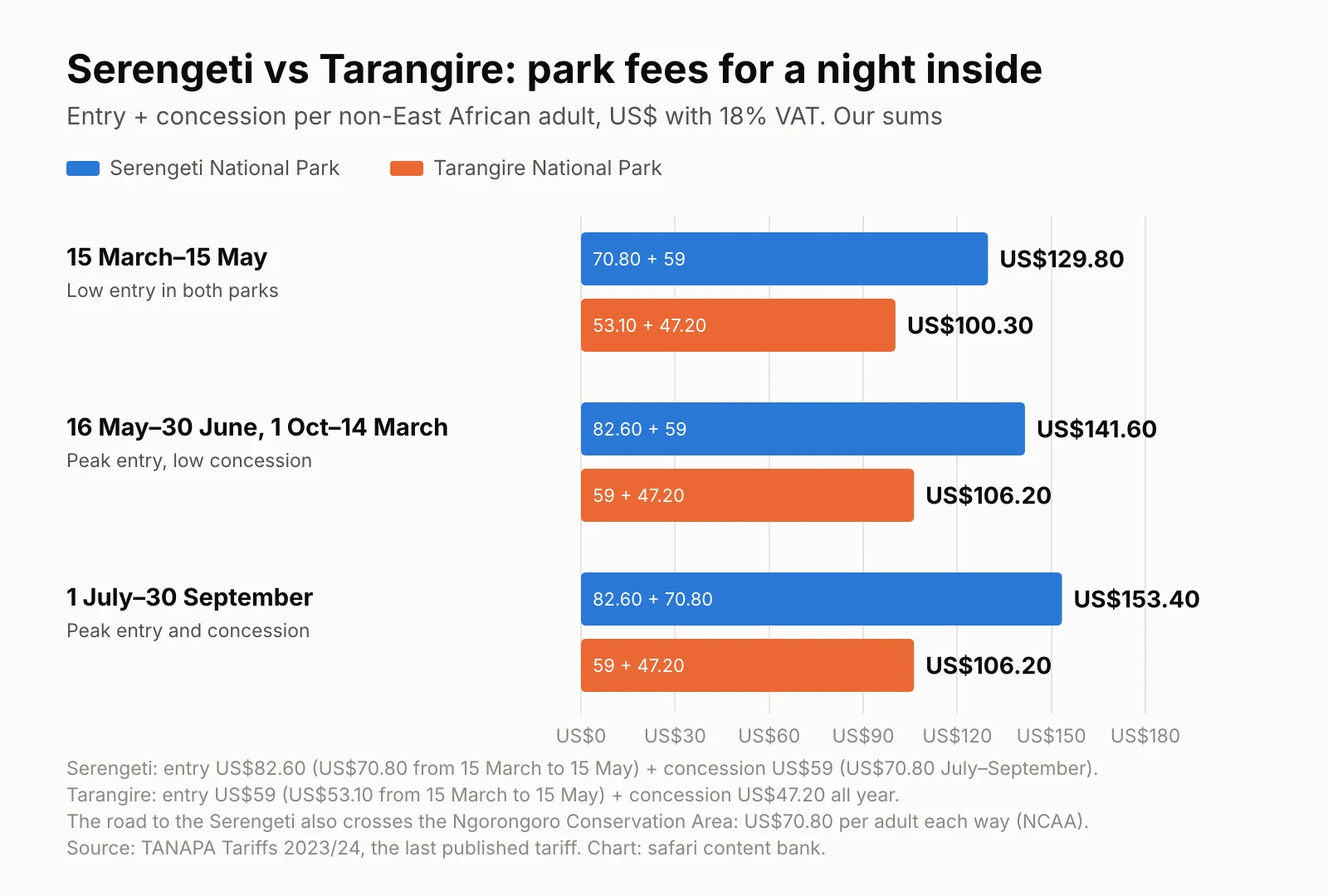 Our sums. Source: TANAPA Tariffs 2023/24, the last published tariff, with 18% VAT; NCAA tariff page, read 9 October 2026. Vehicle, guide and bed not included. Chart: safari content bank.
- The difference per night is US$29.50 from 15 March to 15 May, US$35.40 from 16 May to 30 June and 1 October to 14 March, and US$47.20 in July–September (our sums).
- Getting to the Serengeti by road adds Ngorongoro entry twice, US$141.60 per adult there and back (our sum), because the NCA permit is single entry (Ngorongoro park fees). Tarangire has no fee on the way.
- A short visit pays the full day in both. A day permit is valid for 12 daylight hours, so a few hours in Tarangire cost the same US$59 per adult as a full day (Tanzania safari questions).
- Sleeping outside saves the concession, not the entry. Outside Tarangire, in the Burunge or Randilen Wildlife Management Areas (WMAs), you pay entry on each park day plus WMA fees, for which we found no 2026 schedule. Outside the Serengeti, Ndutu lodges pay Ngorongoro fees of US$129.80 a night instead.
- Every fee line: Serengeti park fees and Tanzania park fees.
The official fee lines, with the date each took effect and the authority’s own source:
| Fee | Amount | In force from | Source |
|---|---|---|---|
| Serengeti and Nyerere National Parks, non-East African adult, entry per day, 16 May–14 Mar | USD 70 + 18% VAT = USD 82.60 | 1 Jul 2023 (2023/24 tariff, last published) | TANAPA Tariffs 2023/24 |
| Serengeti and Nyerere National Parks, non-East African adult, entry per day, 15 Mar–15 May | USD 60 + 18% VAT = USD 70.80 | 1 Jul 2023 (2023/24 tariff, last published) | TANAPA Tariffs 2023/24 |
| Serengeti and Nyerere, concession fee per person per night inside the park | Jul–Sep USD 60 + VAT = USD 70.80; Oct–Jun USD 50 + VAT = USD 59 | 1 Jul 2023 (2023/24 tariff, last published) | TANAPA Tariffs 2023/24 |
| Tarangire, Lake Manyara and Arusha National Parks, non-East African adult, entry per day | Peak USD 50 + VAT = USD 59; low USD 45 + VAT = USD 53.10 | 1 Jul 2023 (2023/24 tariff, last published) | TANAPA Tariffs 2023/24 |
| Tarangire, Lake Manyara and Arusha, concession fee per person per night inside the park | USD 40 + 18% VAT = USD 47.20 | 1 Jul 2023 (2023/24 tariff, last published) | TANAPA Tariffs 2023/24 |
| Night game drive (Katavi, Ruaha, Mikumi, Tarangire, Lake Manyara, Nyerere, Burigi-Chato, Ibanda-Kyerwa), per person | Adult USD 50 + VAT = USD 59; child USD 25 + VAT = USD 29.50 | 1 Jul 2023 (2023/24 tariff, last published) | TANAPA Tariffs 2023/24 |
| Ngorongoro Conservation Area, non-East African adult, entry per 24 h (single entry) | USD 70.80 (NCAA's page does not say whether VAT is included) | Undated official page, read 9 Oct 2026 | NCAA |
When to go: the migration calendar against Tarangire’s dry season
June–October suits both parks; January–March is Serengeti-only (calving), and March–May is the cheap, wet window in both.
| Months | Serengeti: where the herds usually are | Tarangire | Fees a night inside, adult: Serengeti / Tarangire |
|---|---|---|---|
| January–February | Southern plains and Ndutu (NCA); calving around February | Between seasons; a forum regular suggested skipping Tarangire in February | US$141.60 / US$106.20 |
| March–May | South, then passing Seronera; long rains, April the wettest month (155 mm at the Serengeti station) | Long rains: the game disperses; Oliver’s Camp closes 16 March–15 May, Sanctuary Swala in April–May | US$129.80 / US$100.30 from 15 March to 15 May |
| June | Western Corridor; Grumeti crossings in the first half of the month | Peak season begins | US$141.60 / US$106.20 |
| July–September | North: Kogatende, Lamai and the Mara River | Peak; forum regulars rate August–October best | US$153.40 / US$106.20 |
| October | North early in the month, Lobo later | Peak | US$141.60 / US$106.20 |
| November–December | East and centre, then back south; short rains | Between seasons; “Nov. might be the start of the short rains” | US$141.60 / US$106.20 |
Typical year, not a forecast. Serengeti herds: a UK safari operator’s and a camp operator’s migration guides, read 9 October 2026; rain: Climates to Travel, Serengeti station. Tarangire: a safari agent’s Tarangire guide; TripAdvisor forum threads (best months, February, November), traveller reports; camp closures as listed by a safari agent, read 8–9 October 2026. Fees: TANAPA, last published tariff, 2023/24; our sums.
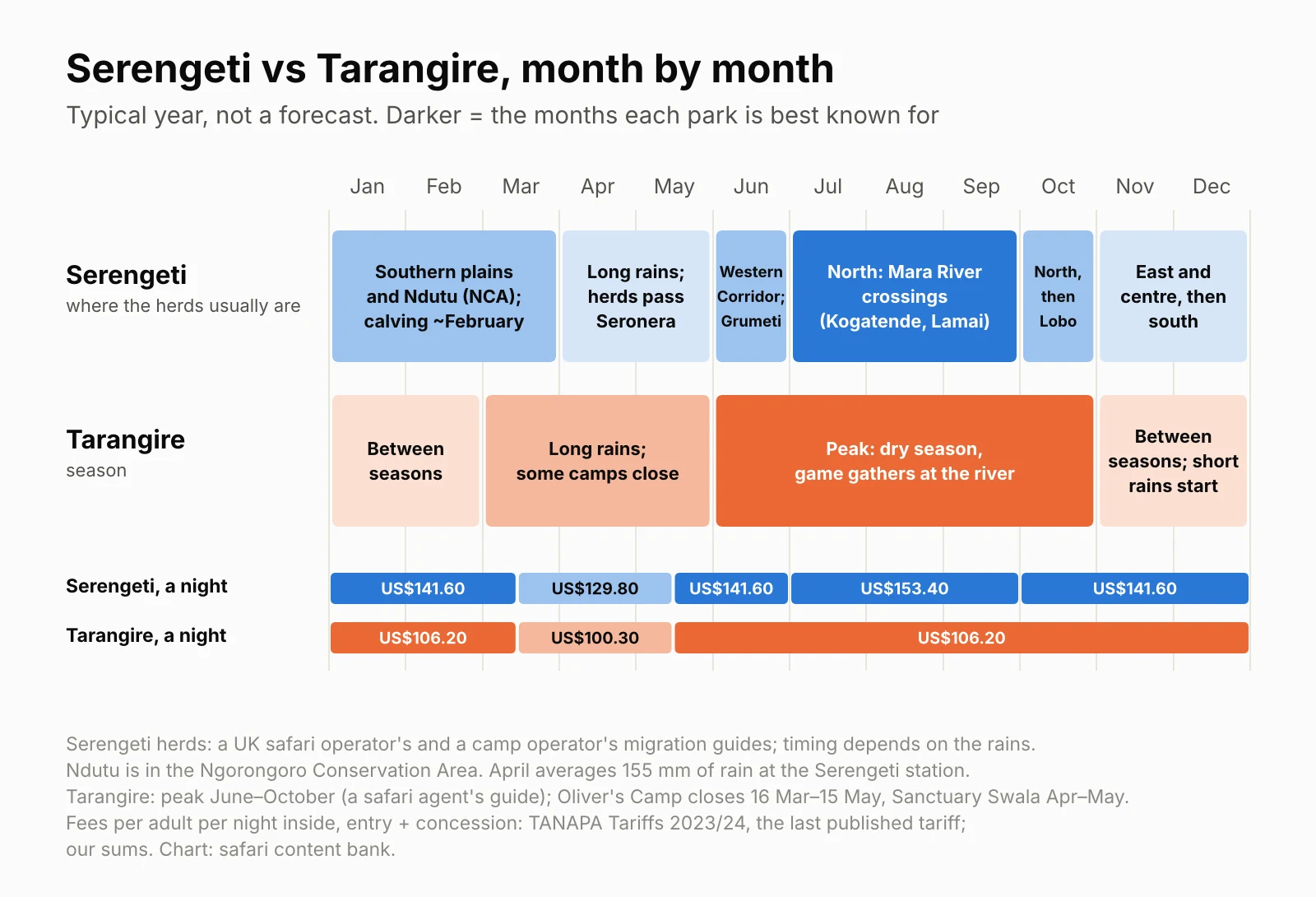 Typical year, not a forecast. Sources: a UK safari operator’s and a camp operator’s migration guides; a safari agent’s park guide; Climates to Travel; camp listings; TANAPA Tariffs 2023/24, the last published tariff (our sums). Chart: safari content bank.
- For a combined trip, June–October is the overlap. Tarangire is at its peak and the Serengeti herds are in the Western Corridor or the north. Camps in both parks charge their highest rates then.
- In January–February, put the nights in the south of the Serengeti or at Ndutu, and keep Tarangire short or skip it.
- 15 March–15 May is the cheapest window in both parks and the wettest; several Tarangire camps close. Month by month across Africa: best time for a safari.
Drive times from Arusha, and from Tarangire to the Serengeti
Tarangire is 2 hours from Arusha; the central Serengeti is 7–7.5 hours, and the road crosses the Ngorongoro Conservation Area. Tarangire sits on the way, so adding it costs a day, not a detour.
| Leg | Distance | Published driving time | Source |
|---|---|---|---|
| Kilimanjaro airport (JRO) → Arusha | 55 km | 1 h 20 | A Tanzanian operator’s travel-times table |
| Arusha → Tarangire north gate | 109 km | 2 h | Same |
| Southern Tarangire → Ngorongoro Crater | 148 km | 2 h 30 | Same |
| Ngorongoro Crater → Seronera (central Serengeti) | 135 km | 3 h 30 | Same |
| Arusha → Seronera (central Serengeti) | – | 7–7.5 h | A safari operator’s getting-there page |
| Arusha → Ndutu (calving area, NCA) | – | About 5.5–6 h | Same |
| Seronera → Kogatende via Lobo (Mara River) | 154 km | 5 h, as a game drive | A Tanzanian operator’s travel-times table |
Times as published, read 9 October 2026; the travel-times table was modified 1 July 2026. Gate stops come on top.
- Southern Tarangire to Seronera via the crater is 283 km and 6 hours of driving (our sum: 2 h 30 + 3 h 30), before gate stops and game drives. The usual route stops at Ngorongoro (the crater or Karatu) in between, as in our itinerary sample.
- Forum times run longer: Tarangire to the Ngorongoro rim “3 to 4 hours including park entrance” (TripAdvisor, Sep 2026), and the crater to Seronera 4 h 30–5 h with a stop at Naabi Hill Gate (TripAdvisor), traveller reports.
- No driving after dark: tourists are not driven outside towns at night, so going straight to Tarangire on arrival day needs a flight landing at Kilimanjaro or Arusha before about 13:00 (a Tanzanian operator’s travel-times table).
- Flying: Flightlink and Regional Air fly to Serengeti airstrips, and Auric Air lists Tarangire. We print no fare: the Arusha–Serengeti fares in our sources disagree, and Auric publishes its fares only in a rack-rate sheet we have not read (Serengeti safari cost; Tarangire safari cost). Forum regulars’ usual fix is to drive one way and fly the other.
Crowds: busier than its reputation
Neither TANAPA park publishes vehicle counts or a per-sighting limit in our sources, so the crowd evidence is visitor totals and traveller reports. On those, Tarangire is not the empty alternative it is often sold as.
| Serengeti | Tarangire | |
|---|---|---|
| Visitors | 491,398 (2024/25 financial year) | About 372,000 a year |
| Visitors per km² per year (our arithmetic) | About 33 | About 131 |
| Share of international visitors, 2025 | 13.1% | 9.0% |
| Busier areas (traveller reports; a UK safari operator’s guides) | Seronera; Ndutu in calving season; Mara River crossing points | The north of the park, where most camps are |
| Quieter, by a UK safari operator’s guides | The east (Namiri, Nanyukie, Lobo) | The south |
Visitors: The Citizen, 18 Dec 2025 and 24 Apr 2026; the two counts cover different periods. Shares: Bank of Tanzania exit survey 2025 (PDF). Areas: a safari agent’s park guide.
What travellers report (traveller reports, not counts):
- Central Serengeti: “we were always there with easily 70 other cars, all moving continuously” (a reviewer on a safari booking site, June 2024).
- Serengeti river crossings: “it is not uncommon for fifty or more trucks to be parked” at a crossing point, according to a forum regular (TripAdvisor).
- Ndutu in calving season: it “was common to see 15–20 vehicles at a single sighting” in March 2026 (TripAdvisor).
- Tarangire: “It was a small park with so many vehicles, it felt like being in a safari zoo” (July 2025), and “Tarangire is creeping up towards the realm of losing its quiet charm” (September 2026), both reviewers on a safari booking site.
- Size works for the Serengeti. With about five times the area, a camp in the east or a fly-in to the north spreads people out; Tarangire’s quieter option is its south.
What each costs per day
At the same style, a day in Tarangire costs less than a day in the Serengeti, mostly because of fees and camp rates: US$450.30–716.20 against US$479.80–898.40 per person at a mid-range camp with a private vehicle for two (our sums).
| Style, per person per day | Serengeti | Tarangire |
|---|---|---|
| Group camping trip, park fees included | About US$300 (3 days, Serengeti and Ngorongoro) | About US$248 (4 days, also visits the Serengeti and Ngorongoro) |
| Group lodge trip, park fees included | About US$407–425 (3 days) | US$380 (4 days, same parks as the camping trip) |
| Self-drive camping, park fees only | US$118 per adult (our sum) | US$94.40 per adult (our sum) |
| Mid-range camp inside + private vehicle for two | US$479.80–898.40 (our sum) | US$450.30–716.20 (our sum) |
| Luxury camp or lodge inside | US$869.80–2,403.40 (our sum; game drives included) | US$785.30–1,714.20 (our sum; + private vehicle) |
As on our Serengeti safari cost and Tarangire safari cost pages: operators’ published 2026 prices, and our sums of camp rate (low to peak season), park fees for one adult (last published tariff, 2023/24) and half a US$200–300 private vehicle and guide for two (one operator’s published cost guide). Serengeti camps: Serengeti Wilderness Camp to Lemala Ewanjan; Namiri Plains. Tarangire camps: Tarangire Ndovu Tented Lodge; Lemala Mpingo Ridge. Read 9–10 October 2026.
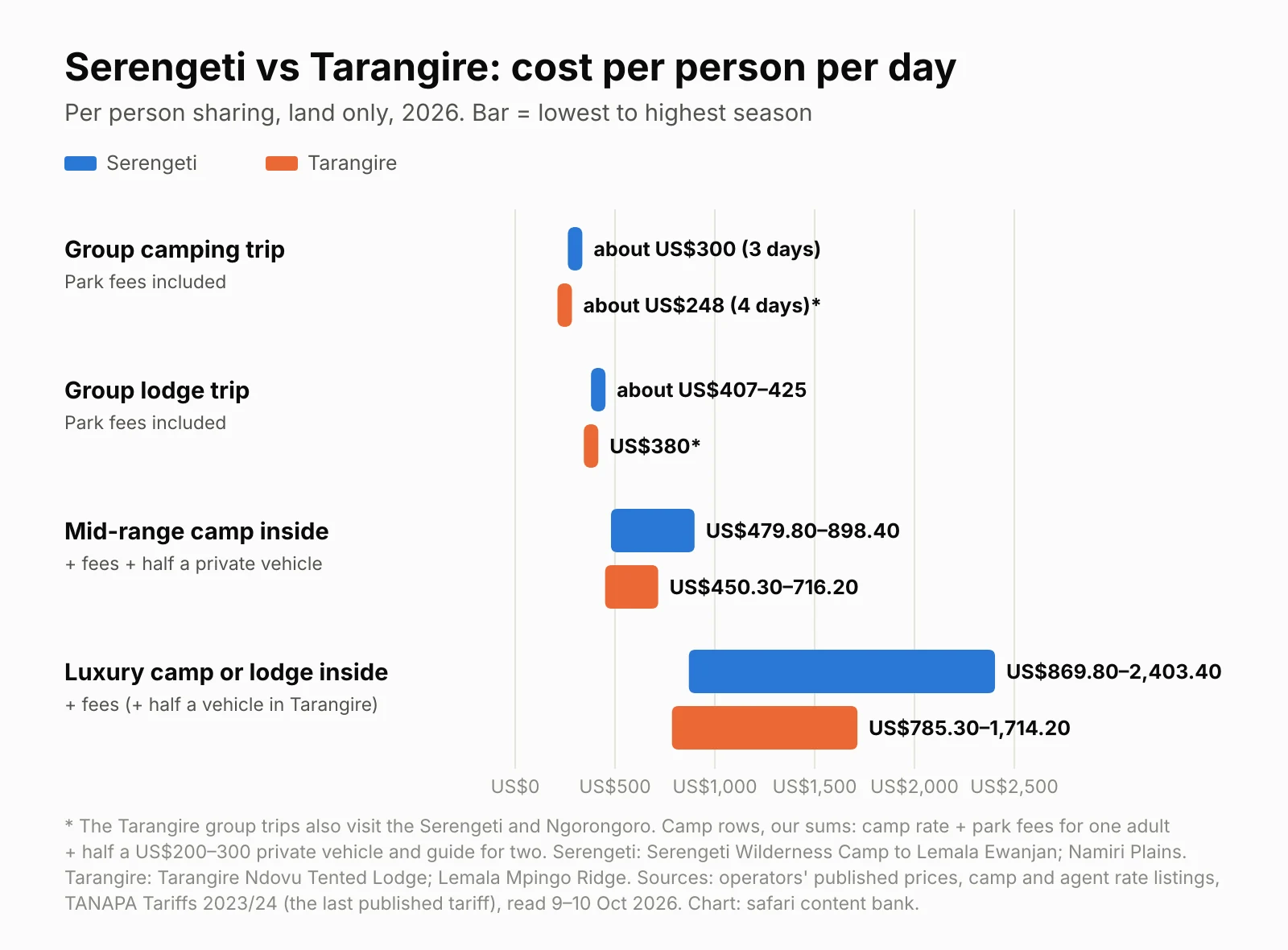 Operators’ published prices and our sums of camp rates, park fees and vehicle, read 9–10 October 2026. Sources: tour operators’ published package prices and vehicle rate; camp and agent rate listings; TANAPA Tariffs 2023/24, the last published tariff. Chart: safari content bank.
- The group prices are not like for like: the cheapest published trips that include Tarangire also visit the Serengeti and Ngorongoro, so their per-day price covers all three.
- Season moves the bill more than the park does. At the luxury end, camp rates more than double between the long rains and June–September in both parks (Namiri Plains US$740 → US$2,250; Lemala Mpingo Ridge US$585 → US$1,458); park fees move least.
- Whole-trip prices, with visa, insurance and flights: Tanzania safari cost.
How many nights, and how to combine them
Give the Serengeti 2–3 nights per area and Tarangire one or two; on a week-long road trip, one or two nights in Tarangire on the way out is the usual way to have both.
| Plan | Nights | Park fees per adult, July–September (15 March–15 May) | Fits when |
|---|---|---|---|
| Serengeti only, flying in and out | 3 in the Serengeti | US$460.20 (US$389.40) | Short trip, migration first |
| Serengeti only, by road from Arusha | 3 in the Serengeti | US$601.80 (US$531) with Ngorongoro entry both ways | You want to drive, no Tarangire |
| Tarangire day trip from Arusha | 0 | US$59 (US$53.10) | One spare day, or a last day before flying home |
| 1 night Tarangire + 3 nights Serengeti, by road | 4 | US$708 (US$631.30) | Week-long trip; the usual way to have both |
| 2 nights Tarangire + 3 nights Serengeti, by road | 5 | US$814.20 (US$731.60) | June–October, elephants a priority |
| Tarangire only, 2 nights inside | 2 | US$212.40 (US$200.60) | Short trip from Arusha; no Serengeti |
Our sums: Serengeti US$153.40 a night in July–September and US$129.80 from 15 March to 15 May; Tarangire US$106.20 and US$100.30; Ngorongoro entry US$70.80 per crossing (NCAA). No crater descent and no night inside the Ngorongoro Conservation Area included. TANAPA, last published tariff, 2023/24. Vehicle, guide and beds extra.
- Serengeti: 2–3 nights per area. Moving between areas takes most of a day: Seronera to Kogatende via Lobo is a 5-hour game drive. A forum destination expert suggests two nights in the centre and “2 or preferably 3 nights Northern Serengeti” (TripAdvisor).
- Tarangire: at least one full day. On the forum: “You need at least 2 days” (TripAdvisor); one regular suggested “3 nights” in October. For an early-November trip, a forum route ran 2 nights Tarangire, 3 central Serengeti and 2 Ngorongoro (TripAdvisor), traveller reports.
- What each trip length buys, in our sample: 4–5-day trips from Arusha cover Tarangire, the Serengeti and Ngorongoro with 1–2 Serengeti nights; 6–8-day trips give the Serengeti 2–3 nights (operators’ published trips, captured 8 October 2026).
- On 5–6 days, do fewer parks. Forum regulars call “7-10 days” ideal and say “5-6 days still works, but it can feel a bit packed”; “You really don’t want to be moving every day” (TripAdvisor). More: how many days a safari needs.
- Put Tarangire first. It is 2 hours from Arusha, so it breaks the long drive; ending there instead means a “3-4 hours” drive to Kilimanjaro airport on departure day, which forum regulars judged too tight for an evening flight (TripAdvisor, traveller reports).
Which to choose
Choose the Serengeti if the herds are the point of the trip; add Tarangire if you travel in June–October and have a spare day or two. Choose Tarangire alone only for a short trip from Arusha.
| If you… | Pick | Why |
|---|---|---|
| Want the wildebeest migration | Serengeti | The herds are in Tanzania from December to June and on both sides of the Mara River from July to October; Tarangire’s wildebeest numbered about 12,000 by 2011 |
| Travel January–March for calving | Serengeti (south) and Ndutu | Calving peaks around February; a forum regular suggested skipping Tarangire in February |
| Travel June–October with a week | Both | Tarangire’s peak; Western Corridor or Mara River in the Serengeti |
| Have only 2–3 days from Arusha | Tarangire | 2 h by road, against 7–7.5 h to the central Serengeti |
| Put elephants first | Tarangire | Named “Africa’s Leading Elephant Paradise National Park” (World Travel Awards, 2025 and 2026); no verified count |
| Want a night drive | Tarangire | US$59 per adult; not permitted in the Serengeti |
| Count park fees | Tarangire | US$100.30–106.20 a night inside, against US$129.80–153.40, and no Ngorongoro crossing |
| Want space | Serengeti, east or north | About 33 visitors per km² a year against about 131 in Tarangire (our arithmetic) |
| Travel 15 March–15 May | Serengeti, by air | Herds in the south and centre; several Tarangire camps close in the long rains |
Fees: TANAPA, last published tariff, 2023/24; our sums. Other rows as sourced above.
Whichever you choose, check that your operator holds a current licence: see how to check a safari operator is licensed.
See also: Tarangire vs Lake Manyara, Serengeti vs Ngorongoro, Serengeti vs Masai Mara and Tanzania’s northern vs southern circuit.
Common mistakes in Serengeti vs Tarangire comparisons
| What you’ll often read | What is correct |
|---|---|
| “Tarangire is a smaller Serengeti” | Different draws. The Serengeti’s herds move with the rains; Tarangire’s game gathers at the river in the dry season, June–October. |
| “The fees are the same in both parks” | Tarangire: US$59 entry + US$47.20 concession. Serengeti: US$82.60 + US$59–70.80 (last published tariff, 2023/24). |
| “Serengeti entry is US$70; Tarangire is US$50” | Both are before VAT. You pay US$82.60 and US$59 (US$70.80 and US$53.10 from 15 March to 15 May). |
| “Tarangire is the quiet park” | About four times as many visitors per km² as the Serengeti (our arithmetic), and reviewers report a “safari zoo”. The south is quieter. |
| “Night drives in both parks” | Tarangire only, at US$59 per adult; they are not permitted in the Serengeti. |
| “Calving is in the Serengeti National Park” | The calving plains around Ndutu are in the Ngorongoro Conservation Area, with NCAA fees. |
| “Drive from Tarangire to the Serengeti in a morning” | Southern Tarangire → crater → Seronera is 6 hours of published driving (our sum), longer in forum reports. |
Frequently asked questions
Is the Serengeti or Tarangire better? For the wildebeest migration, the Serengeti: the herds calve around February in the south and cross the Mara River from July to October. For elephants and a short trip from Arusha, Tarangire, best from June to October. Most northern-circuit itineraries visit both.
Can you combine the Serengeti and Tarangire on one trip? Yes, and most operators do: in our sample of published trips the Serengeti is in 84% of Tanzania-only itineraries and Tarangire in 56%. The usual order is Arusha → Tarangire → Ngorongoro → Serengeti. With one night in Tarangire and three in the Serengeti, park fees come to US$708 per adult in July–September by road (our sum, last published tariff, 2023/24).
How far is Tarangire from the Serengeti? Southern Tarangire to Ngorongoro Crater is 148 km and 2 h 30; the crater to Seronera, in the central Serengeti, is 135 km and 3 h 30 (a Tanzanian operator’s travel-times table, 2026). That is 6 hours of driving (our sum) before gate stops, and the usual route stops at Ngorongoro in between.
Which is cheaper, the Serengeti or Tarangire? Tarangire. A night inside costs US$100.30–106.20 per adult in park fees, against US$129.80–153.40 in the Serengeti (last published tariff, 2023/24; our sums), and reaching it costs no Ngorongoro entry. At a mid-range camp with a private vehicle for two, a day costs US$450.30–716.20 per person in Tarangire and US$479.80–898.40 in the Serengeti (our sums).
When is the best time to visit both? June to October. That is Tarangire’s peak season, when game gathers at the river, and the Serengeti herds are in the Western Corridor in June and in the north at the Mara River from July to October. It is also when camps in both parks charge their highest rates.
How many nights should I spend in each? Two to three per Serengeti area, and one or two in Tarangire. Two nights inside Tarangire cost US$212.40 per adult in park fees and three inside the Serengeti US$389.40–460.20 (our sums, last published tariff, 2023/24). On 5–6 days in total, forum regulars advise fewer parks; see how many days a safari needs.
Is Tarangire worth adding to a Serengeti safari? Yes in June–October if you have a spare day: it is 2 hours from Arusha, breaks the drive, and adds elephants and night drives, which the Serengeti does not sell. In February a forum regular suggested skipping it, and on a 5–6 day trip it can make the itinerary “a bit packed”.
Which is less crowded, the Serengeti or Tarangire? Neither park publishes vehicle counts. On visitor totals, the Serengeti had 491,398 in 2024/25 on 14,763 km² and Tarangire about 372,000 a year on 2,850 km², roughly 33 against 131 per km² (our arithmetic). Reviewers report crowds at Seronera, Ndutu and the crossings, and call Tarangire a “safari zoo”; its south is quieter.
Sources
- TANAPA, Tariffs 2023/24 (PDF), the last published tariff; site checked 9 Oct 2026. NCAA, tariffs, undated, read 9 Oct 2026. Fee figures as on our Serengeti safari cost, Tarangire safari cost, Serengeti park fees and Tanzania park fees pages
- A safari agent’s Serengeti and Tarangire guides, read 8–9 Oct 2026
- Visitors: The Citizen, 18 Dec 2025 and 24 Apr 2026; Bank of Tanzania, The 2025 International Visitors’ Exit Survey Report (PDF)
- Wildlife: World Travel Awards 2025 and 2026; Scientific Reports, 2024; wildebeest counts (TAWIRI 2023; satellite study 2025) as linked on our Serengeti page
- Seasons and migration: a UK safari operator’s park and migration guides and a camp operator’s migration guide, read 9 Oct 2026; Climates to Travel, Serengeti station
- Travel: a Tanzanian operator’s travel-times table (modified 1 Jul 2026) and a safari operator’s getting-there page, read 9 Oct 2026
- Prices: operators’ published 2026 package prices and vehicle rate, camps’ own rates and agent listings, read 8–10 Oct 2026, as on our cost pages
- Itinerary sample: 157 published Tanzania itineraries from 29 operators, captured 8 Oct 2026 (119 Tanzania-only)
- Traveller reports: TripAdvisor forum threads as linked in the text; reviews on a safari booking site (2024–2026)
- Our own pages for the detail: Serengeti, Tarangire, Ngorongoro, Great Migration month by month, Tanzania’s northern vs southern circuit, how many days a safari needs
Fees and prices as read 8–10 October 2026 (TANAPA site checked 9 October 2026). We will update this page when TANAPA publishes a new tariff and when the camps above publish their 2027 peak rates.
Ask for a quote
Tell us your dates and we send you a priced itinerary. Free, no obligation.
- Free quote, no obligation
- Trips run by licensed local operators