 Experience

Last verified · Next check due
On this page
- The 10 questions at a glance (2026)
- 1. Location: start from the wildlife you want
- 2. Inside the park, on private land or outside the gate
- 3. Traversing area: how much land, and who shares it
- 4. What the land allows: night drives, walks and off-road driving
- 5. Vehicles at a sighting: published caps vs what travellers report
- 6. Guides, seats and private vehicles
- 7. Rooms, fences and children
- 8. Room classes and star ratings: does paying more see more?
- 9. What the rate includes, and what goes on top
- Which camp for which priority
- Common mistakes when choosing a safari camp
- Frequently asked questions
- Sources
Short answer: Choose the land before the room. First ask whether the camp is inside the park, on private land or outside the gate: that decides night drives, walks, off-road driving and who else drives there. Botswana bans night and off-road driving in its parks and reserves, whatever the rate. Published sighting caps are five vehicles in the Mara reserve, six at Ol Pejeta and two at Lewa. Then check vehicle sharing, child minimum ages and what the rate leaves out.
Key facts
- The rules follow the land, not the price. Botswana Tourism states that in its national parks and reserves “off-roading and night driving [are] prohibited”, while private concessions “provide opportunities for off-road driving and night drives” (Botswana night drives and walking).
- Only three sighting caps are published in our sources: five vehicles in the Masai Mara reserve (Narok County’s management plan), six at Ol Pejeta for 10 minutes each, and two at Lewa. No Mara conservancy and no Botswana concession publishes one (Mara reserve vs conservancies).
- A dearer tent on the same land buys comfort, not more wildlife. Natural Selection sells Little Sable and Mokolwane at US$660–1,445 and Tuludi at US$1,545–3,545 per person per night on the same Khwai Private Reserve (2026 card; safari camp groups).
- The most common regret travellers report is location: a river camp 50 minutes by boat from the park, camps sold as “in the Mara” far from the river, and small traversing areas at cheaper private lodges (traveller reports, TripAdvisor, read October 2026).
The 10 questions at a glance (2026)
Ask these in writing, camp by camp, before you compare rooms or prices. Each row links to the page that holds the detail.
| # | Ask the camp | Why it matters | Detail |
|---|---|---|---|
| 1 | Is it close to the wildlife I’m coming for, in my month? | A water camp, a flooded plain or a camp far from the river changes what you see | Okavango water vs land camps |
| 2 | Inside the park, on private land or outside the gate? | Decides the activity rules, the fees per night and the drive to the animals | Private concession vs national park |
| 3 | How big is the traversing area, and who else drives it? | Shared land means more vehicles; small land means fewer animals to find | Sabi Sand |
| 4 | Night drives, walks and off-road driving: on this land, at this camp? | Allowed by the land is not the same as sold by the camp | Night drive safaris |
| 5 | How many vehicles are allowed at a sighting? | Only a few land managers publish a cap | Safari vehicles |
| 6 | How many guests per vehicle, and what does a private vehicle cost? | Shared vehicles seat 4 to 9; a private one is priced on top | Luxury safari |
| 7 | How many rooms, and how many beds on the land in total? | Beds on the land set how many vehicles can exist there | Lodge vs tented camp |
| 8 | Fenced or unfenced, and what is the minimum child age? | Unfenced camps escort you after dark; many fly-in camps start at 6 | Safari age limits |
| 9 | Are some rooms or tents priced differently? | Most Botswana camps charge one rate per tent and cannot promise a unit | Honeymoon safari |
| 10 | What is in the rate and what is on top? | Fees, levies, flights, private vehicles and tips differ camp by camp | How to book a safari |
Questions drawn from traveller forums and our own concession, vehicle and camp-group pages, read 8–10 October 2026. Operator checks (licence, payment, bonding) are a separate list: check a safari operator’s licence.
1. Location: start from the wildlife you want
Pick the place that holds your animals in your month, then the camp nearest to them. Room comfort comes last: forum regulars advise choosing the game area over room comfort (TripAdvisor Zambia forum, traveller reports).
| If you want… | The camp needs to be… | Why | More |
|---|---|---|---|
| Big cats and elephant in the Okavango | A land camp with vehicles on dry ground, not a deep-water camp | Forum posters doubted a water-focused camp would deliver a buyer’s “large cats” priority; deep-water camps sell mokoro, boat and birds (traveller reports) | Okavango water vs land camps |
| Game drives in a high-flood year (Delta, from about May) | A camp with dry traversing land in your month | In 2026 one forum contributor reported under 5,000 hectares of driveable ground at Kwando’s 4 Rivers over three nights (traveller report) | Mokoro safari |
| Mara River crossings | On or near the river, in the reserve or the northern Serengeti | Crossings happen in the reserve and the national park, not in the conservancies | Great Migration river crossings |
| Night animals (serval, aardwolf, porcupine) | On private land that runs night drives | Night drives are not sold in the Mara reserve or the Serengeti, and are banned in Botswana’s parks | Night drive safaris |
| Walking | A walking camp in Zambia or Zimbabwe, or on private land | Inside the Serengeti a walk goes only with a TANAPA ranger | Walking safaris |
| Lower Zambezi’s core | Inside the park, not in the Chiawa GMA | Chongwe and Royal Zambezi are just outside the park; lodges near Chirundu can be 2 hours or more from its core | Lower Zambezi |
- “In the area” is a sales phrase. A June 2026 trip report from Zambia disliked a camp about 50 minutes by boat from the park, and a Mara thread warns that some camps sold as “in the Mara” are far from the river (TripAdvisor Zambia forum; TripAdvisor Mara forum; traveller reports). Ask for the drive or boat time to the park boundary, and to where the animals are that month.
- “Okavango Delta” covers very different products. The Panhandle, sold under the same name, is deep permanent water far upstream of the classic Delta, and one safari operator says water-first camps trade big game for mokoro and birding. Compare camp types on Okavango water vs land camps before you choose.
2. Inside the park, on private land or outside the gate
Inside the park puts you among the animals at dawn under the park’s rules; private land adds night drives, walks and off-road driving at a higher rate; outside the gate is cheaper only if the bed is. The fee lines below are copied from our cost pages.
| Where the camp is | What you gain | What you give up | Example from our cost pages |
|---|---|---|---|
| Inside a national park or reserve | No gate queue; at the wildlife at first light | Park rules: tracks only, out of the bush at night in most parks; concession fee per night in Tanzania | Serengeti, Nyerere, Tarangire: see Serengeti safari cost |
| Outside the gate | Sometimes a cheaper bed; no concession fee for the night | Gate time each morning; entry per day you go in | Nyerere: “Sleeping outside saves the concession fee, US$59–70.80 per adult a night, but not the US$82.60 entry on each day you drive into the park (last published tariff, 2023/24)” (Nyerere safari cost) |
| Wildlife management area or community land next to the park | Walks and night drives at some camps | WMA fees with no 2026 schedule in Tanzania | Tarangire: “Outside saves money only if the bed is cheaper” (Tarangire safari cost) |
| Private reserve, conservancy or concession | Night drives, walks, off-road driving, guests only | Higher rates; conservancy fees or levies on top | Mara conservancies: Mara reserve vs conservancies |
Fee lines as on the linked cost pages: TANAPA Tariffs 2023/24, the last published tariff; read 8–10 October 2026.
- Outside can cost more. Tarangire Treetops, outside the park in the Randilen WMA, costs US$600–1,038; Tarangire Ndovu inside costs US$250–460 per person per night (agent listings, read 9 October 2026; Tarangire safari cost).
- Distance matters at Ngorongoro. Karatu is 15 km (30 min) from Loduare Gate, and the rim another 15 km of gravel (about 1 h) (one safari operator’s travel notes); rim lodges give the earliest start on the descent (Ngorongoro safari cost).
- Ndutu is not in Serengeti National Park. It is in the Ngorongoro Conservation Area, so a Ndutu camp does not include Serengeti entry (Serengeti safari cost).
- Greater Kruger lodges cannot drive into Kruger. The fences are gone for animals, not vehicles: lodge drives stay on the reserve’s land (Kruger vs private reserves).
3. Traversing area: how much land, and who shares it
Ask the size of the land the camp’s vehicles may drive and how many camps share it. Few camps publish it, so this is the question that most often goes unasked.
- One reserve, very different sizes. On a 73-reply TripAdvisor thread (c.2025), Sabi Sand planners compared one lodge’s 650 ha with another’s 10,000 ha shared with neighbours, and advised checking the traversing area, not only the price (TripAdvisor Kruger forum; traveller reports; Sabi Sand).
- Mara conservancies publish their size, not their vehicle numbers. The Maasai Mara Wildlife Conservancies Association lists Mara North at 28,487 ha, Naboisho at 22,500 ha and Olare Motorogi at 15,200 ha (maraconservancies.org, read 9 October 2026). Olare Motorogi has five partner camps and “None of these camps is larger than 24 beds” (Olare Motorogi Conservancy).
- On a Botswana concession, only guests of camps on that lease drive the land; in a park, anyone with a ticket does, including self-drivers and mobile safaris (Botswana Tourism; Botswana night drives and walking).
- Ask the total beds on the land, across every camp. Beds on the land, divided by the seats in a vehicle, is the most vehicles you can meet. No Botswana authority publishes a bed cap per concession, so the camp’s answer is the only one you will get.
4. What the land allows: night drives, walks and off-road driving
First check what the land allows, then whether your camp actually sells it on your dates. The full grid by area, with whose rule it is, is on private concession vs national park.
| Area | Night drives | Walking | Off-road to a sighting |
|---|---|---|---|
| Moremi Game Reserve, Chobe National Park (Botswana) | No | No in Moremi | No |
| Botswana private concessions (Khwai Private Reserve, Selinda, Linyanti, Kwara, Vumbura) | Yes | Usually offered | Yes, “in moderation” |
| Masai Mara National Reserve (Kenya) | Not sold | None sold, as far as we found | No, except to approach big cats on nearby open ground, no closer than 25 m |
| Mara conservancies (Kenya) | At some camps | At some camps | Practised |
| Serengeti National Park (Tanzania) | Not permitted | Only with a TANAPA ranger | Tracks only, per operators’ summaries |
| Kruger National Park (South Africa) | SANParks drives only | SANParks walks only | Not in private cars |
| Sabi Sand, Timbavati (Greater Kruger) | Lodge drives | With lodge guides | Lodge vehicles, per operators |
Botswana Tourism; Narok County’s management plan via Business Daily; TANAPA Tariffs 2023/24, the last published tariff; SANParks; camps’ 2026 factsheets and rate sheets. As on our private concession vs national park and luxury safari pages, read 8–10 October 2026.
- Land that allows it is not a camp that sells it. Kicheche lists night drives only at Kicheche Valley in Naboisho, not at Kicheche Mara North (Kicheche 2026 rates, PDF). Ask for the activity list for your dates.
- Four in-park camps in Botswana mean no night drive at all. Make that a decision, not a discovery on day six (Botswana night drives and walking).
- “Walking available” can mean different things. Botswana’s national guiding regulations “don’t require specialist walking qualifications” (one safari operator), so ask who guides, how long the walk is and whether the guide is armed.
- Do not carry Botswana’s rule to other countries. South Luangwa is a national park where afternoon drives continue after dark, per one operator; Grumeti and Klein’s, private land on the Serengeti’s edge, sell night drives (night drive safaris).
5. Vehicles at a sighting: published caps vs what travellers report
Three land managers in our sources publish a cap; everywhere else the number depends on beds, guides and the camp’s own rules. Traveller reports show how far practice can drift from a rule.
| Area | Published cap | Whose rule | What travellers report |
|---|---|---|---|
| Masai Mara National Reserve | 5 vehicles; the next waits at least 100 m away | Narok County’s management plan, via Business Daily | 20 to 40 vehicles at one sighting (reviews on a safari booking site, 2019–2026) |
| Ol Pejeta (Laikipia) | 6 vehicles, 10 minutes each | Ol Pejeta Tariff Guide 2026 | Not in our sources |
| Lewa (Laikipia) | 2 vehicles | Lewa Code of Conduct | Not in our sources |
| Mara conservancies | None published | — | Quieter than the reserve, forum travellers say |
| Botswana concessions | None published | Guests of camps on the lease only | Not in our sources |
| Chobe National Park | None published | — | 7 vehicles around one lion with a kill (a review on a safari booking site) |
| Lower Zambezi | None in our sources | — | 12 vehicles at one lion sighting (TripAdvisor trip report, June 2026) |
Caps as on our Mara reserve vs conservancies page, read 8–10 October 2026. Traveller reports are single accounts, not counts.
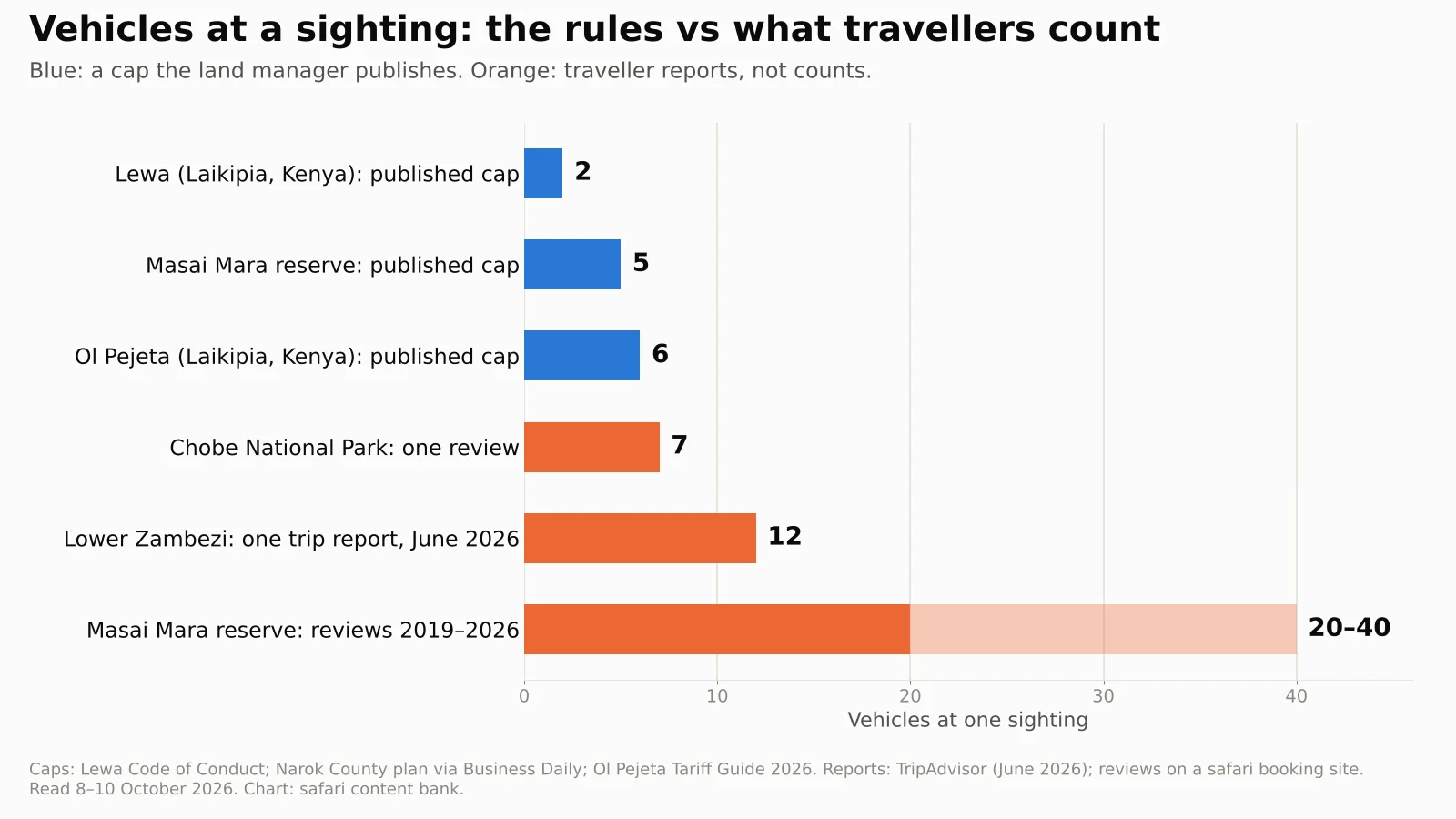 Caps: Lewa Code of Conduct; Narok County’s management plan, via Business Daily; Ol Pejeta Tariff Guide 2026. Reports: TripAdvisor (June 2026); reviews on a safari booking site. Read 8–10 October 2026. Chart: safari content bank.
- A strict camp rule cuts both ways. In May 2026 a guest in Zambia complained that his guide left sightings early under a six-vehicle limit; the camp’s owners replied that they trust their guides (TripAdvisor Zambia forum, traveller report). Photographers should ask how long a vehicle may stay.
- Crossings draw the biggest crowds. One forum thread comparing the northern Serengeti and the Mara for July describes 50 or more vehicles at a crossing (TripAdvisor, traveller report).
6. Guides, seats and private vehicles
At most camps you share a vehicle and a guide with other guests; a vehicle of your own is priced on top. The guide counts as much as the land.
- Seats: Botswana Tourism says its lodges use open-sided 4x4s seating six or nine. Shared safaris in our sources publish a maximum of four to seven guests per vehicle, and only one guarantees a window seat in writing. In a nine-seat vehicle, ask whether the middle seat of each row is sold (safari vehicles).
- Trackers: South African lodge vehicles often carry a tracker on a seat over the front bumper, per operators; Sabi Sand and Timbavati drives use a guide and tracker (Sabi Sand vs Timbavati).
- Shared is not always worse. A long-time Okavango guest on the TripAdvisor forum found shared drives “almost always superior” to a private vehicle (TripAdvisor Okavango forum, traveller report).
- If you don’t get on with your guide, say so on day one. A guest review of a Linyanti camp linked a “dry and reserved” guide with repetitive drive routes (a guest review on a safari operator’s site); camps can reassign a guide if asked early.
| Camp or group | Private vehicle price | Note |
|---|---|---|
| Natural Selection (Botswana) | US$725–935 per vehicle per night | Required for children 9 or younger (2026) |
| Machaba (Botswana) | US$550 a night | Needed for under-6s (2026) |
| Governors’ Camp (Masai Mara reserve) | US$385 a day in low season, US$512 in peak, up to 6 guests | 2026 |
| Thornybush Game Lodge (Greater Kruger) | R17,500 a day | 2026 |
Camps’ own 2026 rate cards, as linked on our luxury safari page, read 8–10 October 2026.
7. Rooms, fences and children
Count the rooms, ask whether the camp is fenced, and check the minimum child age before you fall for a camp. All three are set by the camp, not the country.
- Room count: Porini Lion Camp has 10 tents and two family units in Olare Motorogi (Porini factsheet, 2026); Ngorongoro Explorer Lodge, due on the crater rim in June 2027, has 84 rooms (Tourism Update, 2 Oct 2026). A large lodge inside a park sends more vehicles out of the same gate; on private land, rooms add vehicles to a fixed area.
- Rooms too close together was one Zambia traveller’s complaint, and toilets far from the tent a Botswana mobile-safari guest’s (TripAdvisor, 2026, traveller reports). Ask for a camp plan.
- Fences: at an unfenced camp, animals can be between your tent and the main area at night, so ask whether staff walk you to your tent after dark (lodge vs tented camp). Botswana’s public campsites in Moremi, Chobe and Savuti are unfenced.
| Camp or group | Youngest child accepted | Year |
|---|---|---|
| Natural Selection | 6 at Okavango camps; all ages in the Makgadikgadi and on the Boteti | 2026 |
| Kwando | 6; any age if you book the whole camp | 2024 |
| Great Plains | 6; 8 for canoe and mokoro | 2025 |
| Machaba Camp | All ages; under-6s need a private vehicle, US$550 a night | 2026 |
| Kicheche Bush and Valley (Mara conservancies) | 7 | 2026 |
| Governors’ Camp (Masai Mara) | All ages | 2026 |
| Saseka (Thornybush) | 12 | 2026 |
Camps’ own rate cards, as on our safari camp groups and safari age limits pages, read 8–10 October 2026. Child rates by group: single supplements and child rates.
8. Room classes and star ratings: does paying more see more?
No source we hold shows a dearer room or a higher star rating seeing more wildlife; the land and the guide decide that.
- One rate, any tent. In Botswana most camps charge the same per-person rate for every tent, with exceptions for honeymoon suites, family rooms and satellite units, and travellers report that “it’s nearly impossible to guarantee a specific room” (TripAdvisor Okavango forum). A solo traveller in the same thread reported always getting the tent closest to the main area; ask for a quieter one at booking and again at check-in.
- Same land, cheaper tent. Three Botswana groups run a lower-priced camp on the same land as their dearer one (rates per person sharing per night, lowest to highest season):
| Group and land | Lower-priced camp | Higher-priced camp | Card |
|---|---|---|---|
| Great Plains, Selinda Reserve | Selinda Explorers US$1,105–1,915 | Selinda, Zarafa US$1,935–3,665 | 2025 |
| Natural Selection, Khwai Private Reserve | Little Sable, Mokolwane US$660–1,445 | Sable Alley, Mbamba US$995–1,995; Tuludi US$1,545–3,545 | 2026 |
| Kwando, Kwara concession | 4 Rivers, Splash US$690–1,750 | Kwara US$820–2,100 | 2024 |
Groups’ own rate cards, as on our safari camp groups page. Exception: Great Plains’ Duba Explorers and Duba Plains drive different parts of the Duba concession.
- Stars measure the room. A Botswana forum contributor put it flatly: “5 star lodges offer zero advantage for area and wildlife”; another, on the Okavango forum, warned that “some luxury lodges may not deliver good game viewing” (TripAdvisor, traveller reports). Chobe Holdings’ own report calls Desert & Delta’s camps “four-star” and Ker & Downey’s “five-star” (safari camp groups); compare their land, not their stars.
- Operators’ star tiers overlap. One operator’s 5-star Tanzania tier in low season costs less than its 4-star tier in peak season (budget vs luxury safari cost).
9. What the rate includes, and what goes on top
A full-board or fully inclusive rate normally covers meals, most drinks and two shared activities a day; fees, levies, flights, private vehicles and tips are where camps differ. Get each line in writing.
| Line | Usually in a fully inclusive rate? | Example |
|---|---|---|
| Meals, house drinks, laundry, two shared activities a day | Yes | Kwando, Kwara, Lagoon, Lebala: fully inclusive (2024) |
| Park or conservancy fees | Differs | Kicheche Mara North: conservancy fee US$130 per adult per night, “payable for any free nights”; Wilderness Mara: “Conservation levy and government taxes are included” |
| Conservation or community levy | Usually on top | Great Plains Foundation levy US$100 per person per night, plus a separate mandatory conservation levy |
| Flights between camps | Differs | Great Plains includes scheduled air from Maun or Kasane on 2+ nights |
| Private vehicle | On top | See section 6 |
| Premium drinks, spa, tips | On top | Tips by country: safari tipping |
Camps’ own rate cards, as on our luxury safari page, read 3 September–10 October 2026. “Full board” means meals only; a South African “game package” usually means meals and two drives but not drinks.
- Free-night offers can still charge fees. Kicheche’s conservancy fee is due on free nights (safari camp groups).
- Nights per camp: every move between camps costs time; forum advice for Botswana is at least one three-night stop (how many days on safari).
Which camp for which priority
Rank your priorities, then let the top one choose the land.
| If your priority is… | Look for | Check |
|---|---|---|
| Fewest vehicles | Private land with few beds, or a published cap (Lewa, Ol Pejeta) | Total beds on the land; cap at a sighting |
| Night drives and walks | A private concession or conservancy camp that lists them | The camp’s activity list for your dates |
| The migration’s river crossings | A camp near the Mara River in the reserve or the northern Serengeti | Its distance from the crossing points in your month |
| Lowest price for good land | The cheaper camp on a group’s shared land, or a camp outside the gate with a cheap bed | That it drives the same land; the entry fee per park day |
| Young children | A camp with a low minimum age or a private vehicle option | Minimum age; fences; private-vehicle rule |
| Photography | Private land with off-road rights and a private vehicle | How long a vehicle may stay at a sighting |
| Self-drive | Park rest camps or campsites inside Kruger, Etosha or Botswana’s parks | Fenced or unfenced; gate times |
From the sections above. Self-drive options: self-drive vs guided safari.
Common mistakes when choosing a safari camp
| What you’ll often read | What is correct |
|---|---|
| “A 5-star camp sees more wildlife” | The land and the guide decide the wildlife; stars rate the room (traveller reports). |
| “All Okavango camps offer night drives” | Not inside Moremi: Botswana’s parks and reserves ban night and off-road driving, whatever the rate. |
| “A conservancy guarantees few vehicles” | No Mara conservancy publishes a sighting cap; ask the beds on the land. |
| “The camp is in the Mara, so it’s near the action” | Ask the drive time to the river and to the animals in your month (traveller reports). |
| “Outside the park is always cheaper” | Only if the bed is cheaper: you still pay entry each day you go in. |
| “Book a better tent for a better view of game” | Most Botswana camps charge one rate per tent and cannot guarantee a unit. |
| “A Greater Kruger lodge can drive into Kruger” | Lodge drives stay on the reserve’s land. |
| “Walking available means a proper walking safari” | Ask who guides, for how long, and whether armed; Botswana requires no specialist walking qualification. |
Frequently asked questions
How do I choose a safari camp? Choose the land first: is the camp inside the park, on private land or outside the gate, and is it near the animals you want in your month? Then ask about night drives, walks and off-road rights, vehicles at a sighting, guests per vehicle, child ages and what the rate excludes.
Is a 5-star safari camp better for wildlife than a 4-star one? Not in our sources. Forum veterans say the concession, the traversing area and the guide decide what you see. Several Botswana groups sell a cheaper camp on the same land as a dearer one: Natural Selection’s Little Sable at US$660–1,445 and Tuludi at US$1,545–3,545 drive the same Khwai Private Reserve (2026).
Why can one camp go off-road and another a few kilometres away cannot? Because one is inside a national park or game reserve and the other on a private concession. In Botswana, off-road and night driving are banned in the parks and allowed “in moderation” on concessions, by Botswana Tourism’s statement. It is a land rule, not a service level.
How many vehicles are allowed at a sighting? Five in the Masai Mara reserve, six at Ol Pejeta (10 minutes each) and two at Lewa, by their published rules. No Mara conservancy, Botswana concession or Kruger rule in our sources publishes a number. Travellers report 20 to 40 vehicles at some Mara reserve sightings.
Should I stay inside the park or outside the gate? Inside if you want first light among the animals and no gate queue. Outside saves the concession fee for the night but not the entry fee on each park day, and it is cheaper only if the bed is. See our Serengeti, Tarangire and Ngorongoro cost pages.
Is a private vehicle worth it? For photographers and families with young children, often; some camps require one for small children. It costs US$385–935 a day or night on 2026 camp rate cards. One long-time Okavango guest found shared drives “almost always superior” (traveller report).
Can I choose my tent or room? Usually you can request but not reserve one. Most Botswana camps charge one per-person rate for every tent, except honeymoon suites, family rooms and satellite units, and travellers report that a specific room is “nearly impossible to guarantee”.
Do I need a camp group, or can I mix camps? You can mix. Booking within one group can share land and flights; see safari camp groups for circuits and multi-camp offers.
Sources
- Botswana: Botswana Tourism, game viewing, as on our Botswana night drives and walking page, read 9–10 October 2026
- Kenya: Narok County’s Greater Maasai Mara Ecosystem Management Plan, as reported by Business Daily; Ol Pejeta Tariff Guide 2026 (PDF); Lewa Code of Conduct; Maasai Mara Wildlife Conservancies Association; Olare Motorogi Conservancy; read 8–10 October 2026
- Tanzania: TANAPA Tariffs 2023/24 (PDF), the last published tariff, and bed rates as on our Serengeti, Nyerere, Tarangire and Ngorongoro cost pages, read 8–10 October 2026; Tourism Update, 2 Oct 2026
- South Africa: SANParks, Kruger rules; Sabi Sand, access; read 8–9 October 2026
- Camps’ own rate cards and factsheets (2024–2027): Natural Selection 2026, Great Plains 2025, Kwando 2024, Machaba 2026, Kicheche 2026, Governors’ 2026, Thornybush 2026, Porini Lion Camp 2026, as linked on our luxury safari, safari camp groups and safari age limits pages; read 3 September–10 October 2026
- Traveller reports (forum posts, not fact): TripAdvisor threads on Sabi Sand traversing areas (c.2025), a Zambia trip report, June 2026, a Zambia trip report, May 2026, Mara migration logistics, northern Serengeti or the Mara in July, tent allocation in the Okavango, private vehicles in the Okavango, Okavango safari advice, a Botswana budget and a Botswana mobile vs fly-in itinerary; reviews on a safari booking site (Chobe, Masai Mara, 2019–2026); read September–October 2026
- Operators (names and links kept in our editor notes): one safari operator’s traveller sighting dataset and walking-safari guide, and a guest review on its site; one safari operator’s Ngorongoro travel notes; vehicle details from two safari sellers
More on choosing: private concession vs national park, lodge vs tented camp, safari camp groups, exclusive-use safari houses and first safari.
Rules, caps and rates checked 8–10 October 2026. We will update this page when a Mara conservancy or Botswana’s DWNP publishes a sighting cap or bed limit.