 Experience

Last verified · Next check due
On this page
- Makgadikgadi vs Central Kalahari at a glance (2026)
- Wildlife: meerkats and zebra, or gemsbok and lions
- When to go, month by month
- What you can do: drives, walks, quad bikes and sleep-outs
- Where to stay, and what a night costs (2026)
- Park fees: the same P190 band
- Getting there: fly in, or drive
- Coming from South Africa: the Kgalagadi
- Doing both, and how many nights
- Which should you choose?
- Common mistakes in Makgadikgadi vs Central Kalahari comparisons
- Frequently asked questions
- Sources
Short answer: For 2–3 nights after the Okavango Delta, choose the Makgadikgadi and Nxai Pan for zebra from December to March, meerkats, and quad bikes from about May to November; camps publish US$625–3,895 per person a night. Choose the Central Kalahari for gemsbok and lions, best December–May; Tau Pan costs US$800 per person a night (Kwando 2024 rate card). Both share the last published park fee, P190 per non-resident adult a day (DWNP, 1 April 2022).
Key facts
- Same fee band, same rules. Both are Department of Wildlife and National Parks (DWNP) areas in the lower band: P190 per non-resident adult per day in the last published schedule (1 April 2022, via Tourism Update). Off-road driving and night drives are prohibited in both (Botswana Tourism).
- Different animals. 81% of one safari operator’s traveller groups to the salt pans saw meerkats, against 10% in the Central Kalahari; 93% in the Central Kalahari saw gemsbok, against 27% at the pans (read September 2026).
- Both are best in the rains, the reverse of the Delta. Zebra graze the pans from about December to March (Africa Geographic); the Central Kalahari’s best game runs December–May (one operator’s Central Kalahari page). Only the pans have a dry-season product: quad bikes from about May to November.
- The pans have more beds and more prices. Camps there publish US$625–3,895 per person a night (2024–2026 rate cards); inside the Central Kalahari, Tau Pan is the only permanent camp open, at US$800 for 1–5 nights (Kwando 2024 rate card).
- The Central Kalahari is the harder self-drive. The pans sit off the A3 tar road between Maun and Nata; the Central Kalahari has “no firewood, no fuel, no cell phone reception and no shops” (Tracks4Africa).
- The pans are sold more often: of 124 Botswana trips on sale from 42 tour operators, 14 name the Makgadikgadi or Nxai Pan, 6 the Central Kalahari and 4 both (our count, captured 9 September 2026).
Makgadikgadi vs Central Kalahari at a glance (2026)
The Makgadikgadi is salt pans, a river and two neighbouring parks with camps at every price; the Central Kalahari is one 52,800 km² reserve with one permanent camp inside and campsites without water.
| Makgadikgadi and Nxai Pan | Central Kalahari Game Reserve | Source | |
|---|---|---|---|
| What it is | Two neighbouring parks: Makgadikgadi Pans 3,900 km², Nxai Pan 2,578 km²; the salt pans cover about 16,000 km² | One game reserve of 52,800 km², set aside in 1961 | Botswana Tourism; Wikipedia, Nxai Pan, Makgadikgadi Pan, CKGR |
| Park fee, non-resident adult | P190 a day (last published, 1 April 2022) | P190 a day (same schedule) | Tourism Update |
| Known for | Zebra migration, meerkats, quad bikes, Kubu Island, Baines’ Baobabs | Gemsbok, lion, brown hyena, Deception Valley, empty space | Our Makgadikgadi and Central Kalahari hubs |
| Best months | December–March for zebra; about May–November for quad bikes; the Boteti River best July–October | December–May for game | Africa Geographic; one operator’s salt pans and Central Kalahari pages |
| Permanent camps | Nxai Pan Camp inside Nxai Pan; Leroo La Tau and Meno a Kwena on the Boteti; Camp Kalahari, San Camp and Jack’s Camp on the pan edge | Tau Pan only; private reserves on the edge (Dinaka, Deception Valley Lodge, Gham Dhao Lodge) publish no rate in our sources | Camp groups’ rate cards, as on the hubs |
| A night, per person sharing | US$625–3,895 (2024–2026 rate cards) | US$720–800 at Tau Pan (Kwando 2024) | Natural Selection 2026; Desert & Delta 2024; Kwando 2024 |
| Camping, per person a night | BWP 150–700 (Kubu Island, South Camp, Baines’ Baobabs) | BWP 200 at Bigfoot Tours sites; no current DWNP rate | A safari agent’s campsite sheet, last published rates |
| Flight from Maun | 30–60 minutes; Moremi Air to Nxai Pan US$220 one way | 45–60 minutes; Moremi Air to Tau Pan US$315 one way | One operator’s pages; Kwando 2024 rate card |
| By road | About 250 km, 3–4 hours from Maun; the A3 is tar from Maun to Nata | 4x4 with low range; fuel only outside, at Rakops or Letlhakane | One operator’s salt pans page; Tracks4Africa |
| Night drives, off-road, walks | Not in the parks; San-guided walks and quad bikes on private land at the pan edge | Not in the reserve; night drives and walks on private reserves on the northern boundary | Botswana Tourism; our night drives and walking page |
Rates and fees as on our Makgadikgadi and Central Kalahari hubs, read 10 October 2026. Dollars and pula are not converted: our sources give no dated exchange rate. Operator names are kept in our editor notes.
Wildlife: meerkats and zebra, or gemsbok and lions
Go to the pans for meerkats and zebra; go to the Central Kalahari for gemsbok and a better chance of lion. Cheetah and brown hyena are close in both.
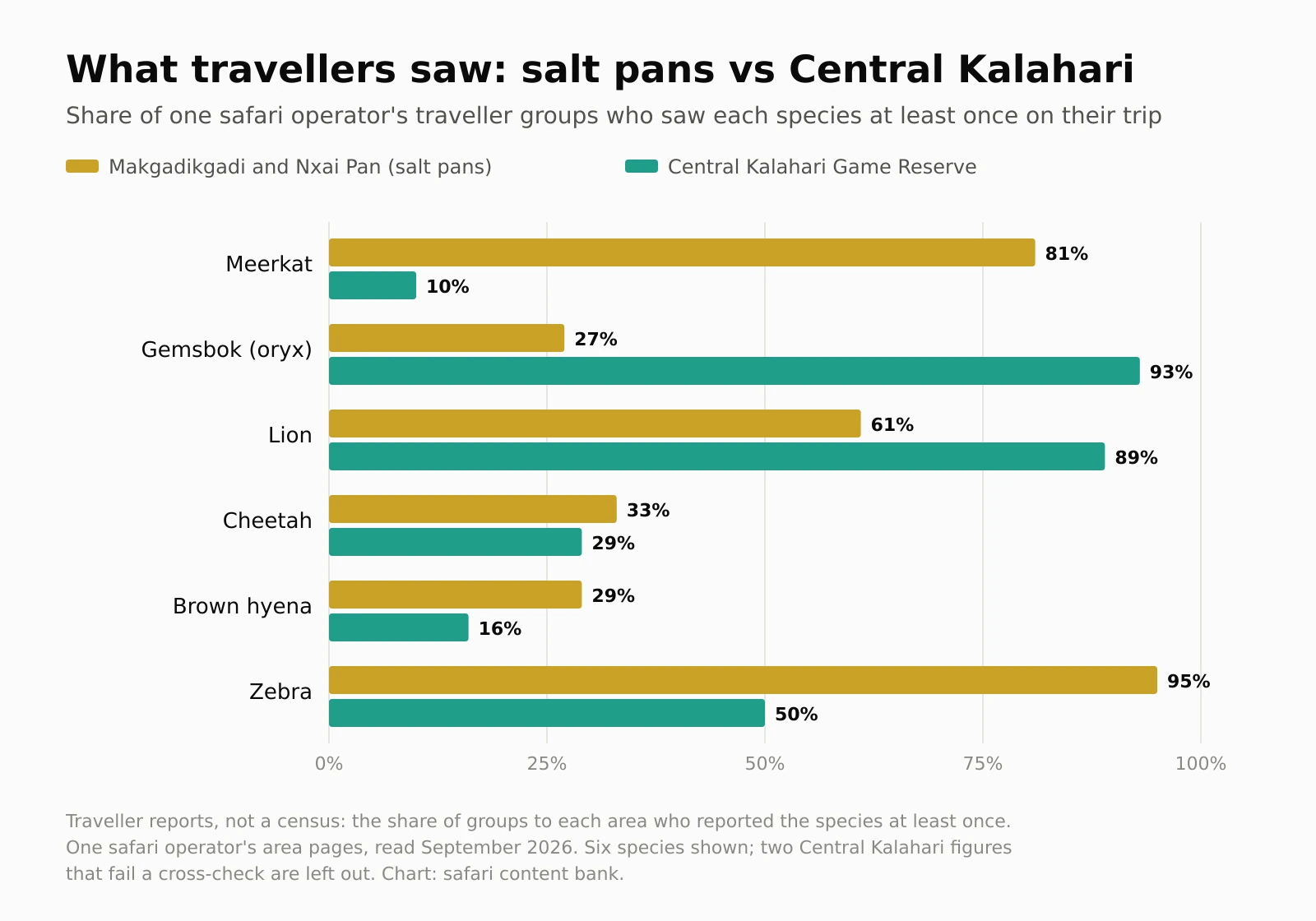 Traveller reports, not a census: the share of each area’s traveller groups who saw the species at least once on their trip. One safari operator’s area pages, read September 2026. Chart: safari content bank.
| Species | Salt pans | Central Kalahari | What it means |
|---|---|---|---|
| Meerkat | 81% | 10% | The pan-edge camps visit habituated groups; Botswana-wide the rate is 48% |
| Gemsbok (oryx) | 27% | 93% | Springbok and gemsbok gather on the Central Kalahari’s short-grass plains December–May (one operator) |
| Lion | 61% | 89% | Tau Pan overlooks a waterhole with resident lions (Kwando fact sheet, PDF) |
| Cheetah | 33% | 29% | Close; compare where to see cheetahs |
| Brown hyena | 29% | 16% | A desert species: 0% in the Okavango Delta on the same reports |
| Zebra | 95% | 50% | The pans’ rainy-season migration, below |
One safari operator’s traveller reports, read September 2026; six species of its lists. Two Central Kalahari figures that fail a cross-check in our sources are left out.
- The zebra migration is two herds: more than 20,000 from the Chobe floodplains to Nxai Pan from December to February, and about 15,000 from the Okavango to the Makgadikgadi from December or January to February or March; only about 55% of the Okavango herd migrates (Africa Geographic, 20 November 2025). More: Botswana zebra migration.
- Black-maned lions: Botswana Tourism names the “black-maned Kalahari lion” for the Kgalagadi (Botswana Tourism); we have no sourced lion count or mane description for the Central Kalahari itself. See where to see lions.
- Meerkats in detail, including Tswalu in South Africa: where to see meerkats.
When to go, month by month
Both are at their best in the rains, December to March; from May the pans switch to quad bikes, sleep-outs and the Boteti River, while the Central Kalahari’s game disperses.
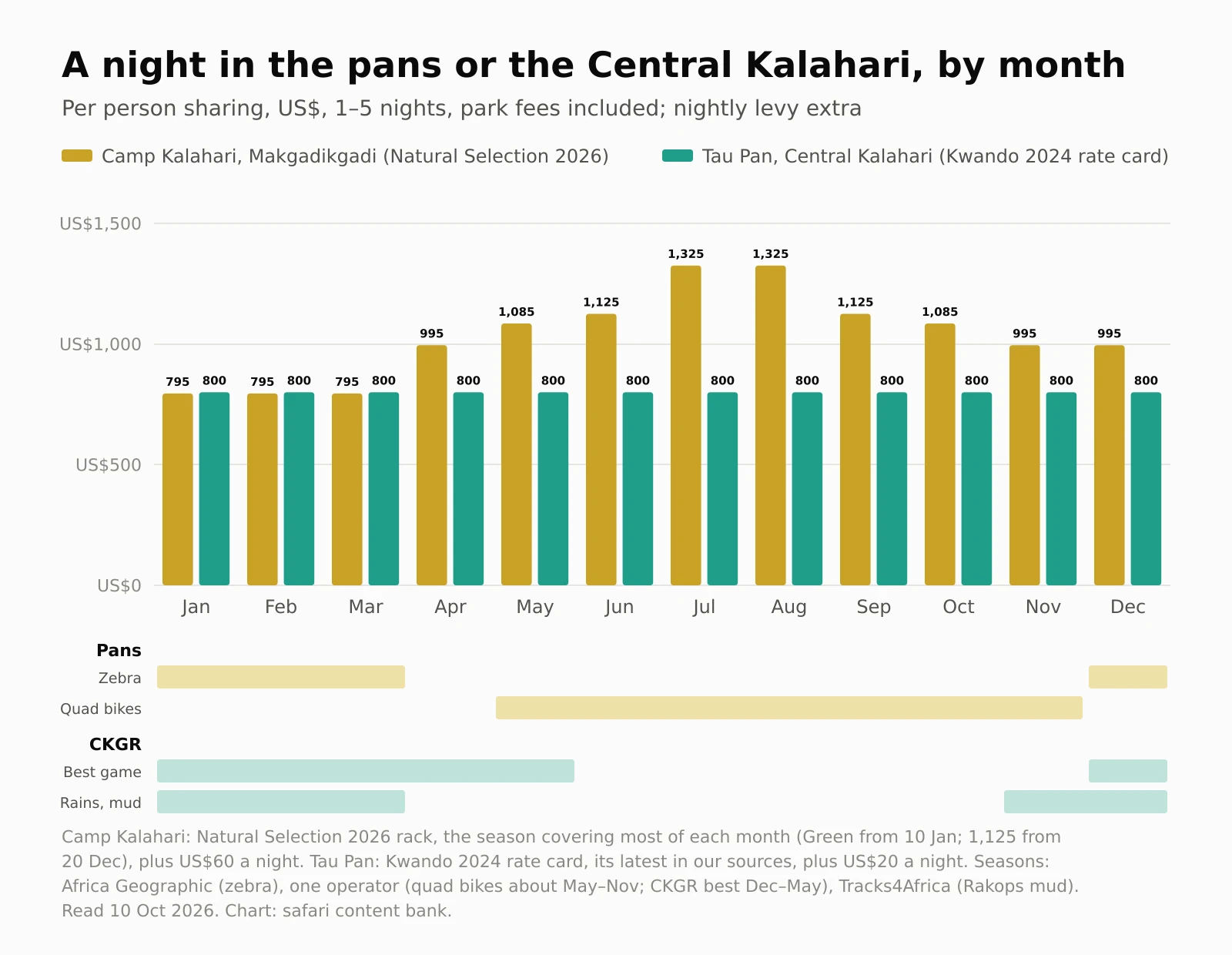 Sources: Natural Selection 2026 rate card; Kwando 2024 rate card; Africa Geographic; one operator’s salt pans and Central Kalahari pages; Tracks4Africa. Read 10 October 2026. Chart: safari content bank.
| Month | Makgadikgadi and Nxai Pan | Camp Kalahari, per person | Central Kalahari | Tau Pan, per person |
|---|---|---|---|---|
| Jan | Zebra on the pans | US$795 from 10 Jan (US$1,125 to 9 Jan) | Best game; rains | US$800 |
| Feb | Zebra on the pans | US$795 | Best game; rains | US$800 |
| Mar | Zebra massing before they turn back | US$795 | Best game; rains | US$800 |
| Apr | Nxai Pan’s herds can stay; San Camp opens 1 April | US$995 | Best game | US$800 |
| May | Quad bikes from about May | US$1,085 | Best game | US$800 |
| Jun | Quad bikes | US$1,125 | Drier, quieter, game dispersed | US$800 |
| Jul | Quad bikes; Boteti River best | US$1,325 | Coldest month; nights can approach freezing | US$800 |
| Aug | Quad bikes; Boteti River best | US$1,325 | Drier, quieter, game dispersed | US$800 |
| Sep | Quad bikes; Boteti River best | US$1,125 | Drier, quieter, game dispersed | US$800 |
| Oct | Quad bikes; Boteti River best; San Camp closes 15 October | US$1,085 | Hottest month; can exceed 40°C | US$800 |
| Nov | Quad bikes to about November; rains begin | US$995 | Rains; mud on the Rakops approach | US$800 |
| Dec | Zebra arrive | US$995 (US$1,125 from 20 Dec) | Best game; rains | US$800 |
Seasons: Africa Geographic; one operator’s salt pans and Central Kalahari pages; two camp operators’ seasonal guides; Tracks4Africa. Camp Kalahari: Natural Selection 2026, 1–5 nights, plus US$60 a night. Tau Pan: Kwando 2024 rate card, 1–5 nights, plus a US$20 levy; from April to mid-November longer stays cost less (US$760 for 6–7 nights, US$720 for 8+). Read 10 October 2026.
- From 10 January to 31 March the two cost about the same: Camp Kalahari’s Green rate is US$795 and Tau Pan’s US$800. From July to August Camp Kalahari’s Peak rate is US$1,325, while Tau Pan stays at US$800.
- The rains cost the Central Kalahari its road access, not its game: Tracks4Africa calls rainy-season travel on the Rakops approach, with its “mudholes lined with black-cotton soil”, inadvisable, so in the green season consider flying in from Maun.
- The pans’ wet crust stops the dry-season activities: one operator warns that “pan surfaces are lethal when wet”. More on the rains: green-season safaris.
What you can do: drives, walks, quad bikes and sleep-outs
Inside both, you game-drive by day on the tracks; the extras are on private land around them, and the pans have more of it.
| Makgadikgadi and Nxai Pan | Central Kalahari | |
|---|---|---|
| Game drives | Day drives on park tracks; Boteti River game best July–October | Day drives; game and birds peak in the Deception and Passarge valleys in the rains (one operator) |
| Night drives and off-road | Prohibited in the parks | Prohibited in the reserve; offered on private reserves on the northern boundary |
| Walks | San-guided walks at the private pan-edge camps (Jack’s Camp, San Camp, Camp Kalahari) | Walks on the private reserves on the northern boundary; not listed as a reserve activity |
| Meerkats | Camp outings to habituated groups; Botswana Tourism lists walking with meerkats | No habituated group in our sources |
| Quad bikes | About May–November, on the pan surface, from the pan-edge camps | None in our sources |
| Sleep-outs | Some pan-edge camps sell a night sleeping out on the pan, in the dry season | None in our sources |
| Landmarks | Kubu Island, a national monument on Sua Pan; Baines’ Baobabs, about 30 km from the Nxai Pan entrance | Deception Valley, one of four fossil river valleys |
Sources: Botswana Tourism, game drives and Makgadikgadi; one operator’s salt pans and Central Kalahari pages; Wikipedia (Kubu Island) and Wikipedia (Deception Valley). As on our night drives and walking page. Read 10 October 2026.
- Quad bikes and flamingos: off-road tourist vehicles threaten Sua Pan’s flamingo colonies (Wikipedia); ask your camp where its quad routes run.
- Kubu Island camping: the Gaing-O Community Trust runs 14 campsites at BWP 150 per person a night, plus P3 entry and a P10 levy; dry season only, and no driving on the pan (a safari agent’s campsite sheet).
- Ask how the meerkat visits work: we have no source on how each camp’s meerkat group was habituated.
Where to stay, and what a night costs (2026)
The pans have six camps from US$625 to US$3,895 per person a night; inside the Central Kalahari, Tau Pan is the only permanent camp open, at US$720–800. Full lists: Makgadikgadi and Central Kalahari.
| Per person per night | Makgadikgadi and Nxai Pan | Central Kalahari |
|---|---|---|
| Camping | Kubu Island BWP 150; South Camp, Nxai Pan, BWP 400; Baines’ Baobabs BWP 700; P10 levy; park fee on top | Bigfoot Tours sites BWP 200 non-resident; DWNP sites no current rate; park fee on top |
| Guided mobile camping | One operator’s 6-night Central Kalahari and Makgadikgadi trip, from US$1,590 (basis not stated) | Same trip: about US$265 a night (our division; the operator doesn’t say if per person) |
| Camp inside the park | Nxai Pan Camp (Kwando), 9 tents: US$800 for 1–5 nights in every season (2024 rate card), plus a US$20 levy | Tau Pan (Kwando), 9 rooms: US$800 for 1–5 nights in every season (2024 rate card), plus a US$20 levy |
| Boteti River | Meno a Kwena (Natural Selection) US$625–1,275; Leroo La Tau (Desert & Delta, 2024, 1–4 nights) US$645–1,160 | No equivalent |
| Pan edge | Camp Kalahari US$795–1,325; San Camp (1 April–15 October) US$1,995–2,595; Jack’s Camp US$2,095–3,895; all Natural Selection, plus US$60 a night | No equivalent |
| Private reserve on the edge | Lodges on the Nata–Maun road, such as Planet Baobab and Gweta Lodge: no published rate in our sources | Dinaka (Ker & Downey Botswana, 40,000 ha); Deception Valley Lodge; Gham Dhao Lodge: no published rate in our sources |
Rate cards: Natural Selection 2026, Desert & Delta 2024, Kwando 2024, each group’s latest in our sources; camp rates include meals, activities and park fees. Campsites: a safari agent’s campsite sheet, undated: last published rates. Guided trip: one operator’s “from” price, read 9 September 2026. An agent lists Tau Pan at US$900 for 2026–27. Read 10 October 2026.
Three nights, per person (our sums):
| Trip | Our arithmetic | Total |
|---|---|---|
| Nxai Pan Camp, fly in and out of Maun (Kwando 2024) | 3 × (US$800 + 20) + 2 × US$220 + US$25 departure tax | US$2,925, before other air taxes |
| Tau Pan, fly in and out of Maun (Kwando 2024) | 3 × (US$800 + 20) + 2 × US$315 + US$25 departure tax | US$3,115, before other air taxes |
| Camp Kalahari, Green → Peak | 3 × (US$795 + 60) → 3 × (US$1,325 + 60) | US$2,565 → 4,155, flights extra |
| Jack’s Camp, Green → Peak | 3 × (US$2,095 + 60) → 3 × (US$3,895 + 60) | US$6,465 → 11,865, flights extra |
| Self-drive, 2 adults, 3 days, 2 nights, South Camp, Nxai Pan | Park 2 × 3 × P190; camping 2 × 2 × BWP 400; levy 2 × 2 × P10 | P2,780 for two, plus vehicle fee |
| Self-drive, 2 adults, 3 days, 2 nights, a Bigfoot Tours site, Central Kalahari | Park 2 × 3 × P190; camping 2 × 2 × BWP 200 | P1,940 for two, plus vehicle fee |
Our arithmetic from the rate cards and campsite sheet above and the last published DWNP fee (1 April 2022). Moremi Air fares and the Maun departure tax from the Kwando 2024 rate card. Pula amounts are not converted: our sources give no dated exchange rate.
- At the low end the pans are cheaper: Meno a Kwena’s Green rate, US$625, is below Tau Pan’s US$800. At the top the pans have no ceiling to match: Jack’s Camp reaches US$3,895 in July and August.
- Children: Natural Selection’s pan and Boteti camps take all ages; Tau Pan takes children of any age 15 April–1 November, otherwise from age 6 (Kwando). The whole Botswana budget: Botswana safari cost.
Park fees: the same P190 band
Both parks charge P190 per non-resident adult per day (P270 in Chobe and Moremi) in the last published DWNP schedule (1 April 2022, via Tourism Update). In February 2026 the government news agency BOPA called the existing non-resident fee P380; a P500 rise was announced, then reported postponed (Gabz FM). Confirm the fee with DWNP or your operator.
The official fee line, with the date it took effect and its source:
| Fee | Amount | In force from | Source |
|---|---|---|---|
| Other DWNP parks and reserves (Central Kalahari Game Reserve, Khutse, Nxai Pan, Makgadikgadi Pans), non-resident adult, per person per day | BWP 190 (SADC residents BWP 145; Botswana citizens and residents BWP 20) | Last published DWNP schedule, 1 April 2022 (via Tourism Update). In Feb 2026 the government news agency BOPA called the existing non-resident fee P380; a P500 rise was announced, then reported postponed. No official current tariff: confirm with DWNP or your operator | Tourism Update, 23 Feb 2022 (DWNP fee schedule) |
- Camp guests pay nothing extra: Natural Selection, Desert & Delta and Kwando include park fees in their rates. Self-drivers and campers pay DWNP separately, plus a daily vehicle fee whose amount no official source gives.
- Children under 8 enter free and older children pay half (a safari agent’s campsite sheet, read 10 October 2026); sources give the half-price band as 8–15, 8–17 or 8–18, so check with your operator.
- Pay campsites first and DWNP last (yourbotswana). Every Botswana fee: Botswana park fees.
Getting there: fly in, or drive
By air the two are equally easy, 30–60 minutes from Maun; by road the pans are a tar-road trip and the Central Kalahari is an expedition.
| Makgadikgadi and Nxai Pan | Central Kalahari | |
|---|---|---|
| Flight from Maun | 30–60 minutes by charter; Moremi Air Maun–Nxai Pan US$220 one way; Mack Air flies to the Nxai Pan and Tsigaro (Jack’s and San Camp) airstrips | 45–60 minutes; Moremi Air Maun–Tau Pan US$315 one way, plus taxes and US$25 Maun departure tax; Mack Air lists Deception Valley and Dinaka airstrips |
| Road from Maun | About 250 km, 3–4 hours (one operator); the A3 runs 300 km of tar from Maun to Nata via Gweta | Via Rakops, one of the two nearest fuel stops; we hold no checked drive time |
| Vehicle | 4x4 for the parks; Baines’ Baobabs needs strong 4x4 skills, forum regulars say | 4x4 with low range: Tracks4Africa drove “deep, rutted and bumpy sand” in first and second gear |
| Two vehicles? | Not in our sources | Advised by Tracks4Africa and TripAdvisor forum travellers; no rule in our sources makes it compulsory |
| Fuel and water | SKL Camps reports no fuel or phone signal at its sites | None inside: carry at least 10 litres of water per person per day plus a 20-litre reserve (Tracks4Africa) |
| Booking campsites | Xomae Group (South Camp, Baines’ Baobabs), the Gaing-O Community Trust (Kubu Island), SKL Camps (Kumaga), DWNP | DWNP (its offices and dwnp@gov.bw) and Bigfoot Tours, separately; book “a year in advance” (Tracks4Africa) |
Sources: one operator’s salt pans and Central Kalahari pages; Kwando 2024 rate card; Mack Air; Wikipedia, A3; Tracks4Africa on the Kalahari, water and booking; SKL Camps; TripAdvisor forum (traveller reports). Read 10 October 2026.
- Raw meat may not be taken from Maun towards Nxai Pan, Makgadikgadi, Nata or Ghanzi; cooked food may cross (Tracks4Africa).
- Driving after dark is prohibited in the parks, so a long leg starts at gate opening. More: self-drive in Botswana and Botswana bush flights.
Coming from South Africa: the Kgalagadi
If you are coming by road from South Africa, the Kgalagadi Transfrontier Park is the Kalahari park with SANParks rest camps; from Maun, the pans and the Central Kalahari are the Kalahari choices with fly-in camps.
| Kgalagadi, South African side | Kgalagadi, Botswana side | |
|---|---|---|
| Fee, international adult | R662 a day (R576 until 31 October 2026; SANParks) | Not confirmed |
| Vehicle rule | No convoy rule in our sources | 4x4 compulsory; at least two vehicles on all routes |
| Where you sleep | SANParks rest camps; a Twee Rivieren family cottage from R2,017 a night (October 2026; SANParks had not published its 2026/27 accommodation tariff when we checked on 1 November 2026, so confirm the price when you book) | DWNP campsites; no current rate in our sources |
| Wildlife | Botswana Tourism names the black-maned Kalahari lion, springbok, gemsbok, hartebeest, eland and brown hyena | Same park: no physical barriers on the international boundary (SANParks) |
Sources: SANParks daily conservation fees 2025/26 (PDF) and 2026/27 (PDF); SANParks border crossings; Botswana Tourism. As on our Kgalagadi hub, read 8–9 October 2026.
Doing both, and how many nights
With 2–3 nights, pick one; with 5–6, a mobile camping trip or a fly-in circuit can do both. Trips that include the pans usually add them before Maun, for 3–5 days (our review of 124 Botswana trips on sale, 9 September 2026).
| Nights | What fits | Source |
|---|---|---|
| 2–3 | One area: Nxai Pan or a pan-edge camp, or Tau Pan, flying from Maun | Our Makgadikgadi and Central Kalahari hubs |
| About 3 | One operator suggests about 3 nights at a permanent camp in the Central Kalahari, 5–8 on a mobile safari | One operator’s Central Kalahari page |
| 6 | One operator’s guided mobile camping trip through the Central Kalahari and the Makgadikgadi, from US$1,590 | One operator’s “from” price, read 9 September 2026 |
| 3–5 days before Maun | The usual Kalahari or pans stretch on published Botswana trips; 4 of 124 trips include both areas | Our count of 124 trips from 42 tour operators, captured 9 September 2026 |
- We hold no checked drive time between the two areas; ask your operator before planning a road transfer.
- The pans and the Delta peak at opposite times, so a December–March trip pairs green pans with low-season Delta rates (Botswana safari itinerary; Okavango Delta).
- How long published trips run: how many days for a safari.
Which should you choose?
Choose the Makgadikgadi and Nxai Pan for zebra, meerkats, quad bikes and the widest choice of camps; choose the Central Kalahari for gemsbok, lions and solitude in the rains.
| If you… | Pick | Why |
|---|---|---|
| Travel December–March and want the zebra migration | Makgadikgadi and Nxai Pan | Zebra are on the pans from about December to March (Africa Geographic) |
| Want meerkats | Makgadikgadi | 81% of one operator’s traveller groups at the pans, 10% in the Central Kalahari |
| Want gemsbok and lion | Central Kalahari | Gemsbok 93% and lion 89% on the same reports, against 27% and 61% at the pans |
| Travel May–October | Makgadikgadi | Quad bikes, sleep-outs and the Boteti River; the Central Kalahari’s game is dispersed then |
| Want the cheapest camp bed | Makgadikgadi | Meno a Kwena from US$625 (Green), against Tau Pan’s US$800 |
| Want one flat price all year | Either Kwando camp | Nxai Pan Camp and Tau Pan both US$800 for 1–5 nights (2024 rate card) |
| Want a first self-drive | Makgadikgadi | Tar road to the pan edge, lodges on the A3; the Central Kalahari has no fuel, water or shops |
| Want empty space and no other vehicles | Central Kalahari | 52,800 km², campsites far apart, each with only a long-drop toilet and a bucket shower |
| Come from South Africa by road | Kgalagadi | South African side with rest camps; two-vehicle rule on the Botswana side |
Before paying a deposit, check the operator’s licence. All of Botswana: the Botswana safari hub, Botswana safari questions and Namibia vs Botswana.
Common mistakes in Makgadikgadi vs Central Kalahari comparisons
| What you’ll often read | What is correct |
|---|---|
| “Go in the dry season, like the rest of Botswana” | Both are best in the rains: zebra on the pans December–March, the Central Kalahari’s best game December–May. |
| “The Central Kalahari is the place for meerkats” | 10% of one operator’s traveller groups there saw meerkats, against 81% at the pans. |
| “Quad bike the pans in January” | Quad bikes run from about May to November, when the crust is dry. |
| “You can do a night drive in the parks” | Prohibited in both; night drives are on the private land around them. |
| “Two vehicles are compulsory in the Central Kalahari” | Advised, not a rule in our sources; the compulsory two-vehicle rule is on the Kgalagadi’s Botswana side. |
| “The park fee is P500 from April 2026” | P500 was announced, then reported postponed; the last published fee is P190 in both. |
| “The Kalahari is malaria-free” | No health authority in our sources says so; TravelHealthPro rates the southern half of Botswana very low risk and the north high risk October–May. |
Frequently asked questions
Which is better as an add-on to the Okavango Delta? It depends on the month and what you want to see. From December to March both are in season: the pans for zebra and meerkats, the Central Kalahari for gemsbok and lions. From May to October the pans are the stronger choice, with quad bikes, sleep-outs and the Boteti River.
Can I see meerkats in the Central Kalahari? Rarely: 10% of one safari operator’s traveller groups there saw them, against 81% at the salt pans, where camps visit habituated groups. Our sources name no habituated group in the Central Kalahari.
Is the green season a good time for either? Yes, for both. Zebra are on the pans from about December to March, and one operator gives December–May as the Central Kalahari’s best game. The cost is access: Tracks4Africa calls rainy-season travel on the Rakops approach inadvisable, so consider flying in.
Can I do both on one trip? Yes, with five or six nights. One operator’s 6-night mobile camping trip covers both, from US$1,590, and 4 of 124 Botswana trips on sale include both areas (our count, September 2026). We hold no checked drive time between them.
Is the Kalahari malaria-free? No health authority in our sources calls the Central Kalahari malaria-free. NaTHNaC rates the northern half of Botswana high risk October–May and low risk June–September, and the southern half very low risk (NaTHNaC). Ask a travel clinic which band your route falls in; more on safari malaria risk.
Is the park fee the same in both? Yes. The last published DWNP schedule (1 April 2022) charges P190 per non-resident adult per day in both; in February 2026 the government news agency called the existing fee P380, so confirm it with DWNP or your operator. Camp rates at Kwando, Natural Selection and Desert & Delta include it.
Can I self-drive either one? Both, with a 4x4. The pans are the easier start: the A3 is tar from Maun to Nata, and lodges sit along it. The Central Kalahari needs low range, all your fuel and water, and every night booked; Tracks4Africa and forum travellers advise two vehicles.
Should I choose the Kgalagadi instead? Only if you are coming by road from South Africa. SANParks charges R662 per international adult per day from 1 November 2026 (R576 until 31 October 2026) on its South African side, which has rest camps; its Botswana side requires a 4x4 and at least two vehicles.
Sources
- Parks and places: Wikipedia, Makgadikgadi Pan, Nxai Pan National Park and Central Kalahari Game Reserve; Botswana Tourism, Makgadikgadi, game viewing and Kgalagadi, read 10 October 2026
- Wildlife and seasons: Africa Geographic, 20 November 2025; one safari operator’s salt pans and Central Kalahari pages and traveller reports, read September 2026 (name and links in our editor notes); Kwando Tau Pan fact sheet (PDF); two camp operators’ seasonal guides
- Rates: Natural Selection 2026 (PDF); Desert & Delta 2024 (PDF); Kwando 2024 (PDF); a safari agent’s campsite sheet, undated; Ker & Downey Botswana; one operator’s mobile camping price and an agent listing (names in our editor notes), read 9 September–10 October 2026
- Fees: Tourism Update, 23 Feb 2022; BOPA, 24 Feb 2026; Gabz FM; SANParks daily conservation fees 2025/26 and 2026/27
- Travel: Tracks4Africa on the Central Kalahari, a Kalahari trip, water, booking and veterinary fences; yourbotswana; Mack Air; SKL Camps; Wikipedia, A3; SANParks border crossings
- Health: UK NaTHNaC, TravelHealthPro Botswana
- Itineraries: our count of 124 Botswana trips on sale from 42 tour operators, captured 9 September 2026 (names in our editor notes)
- Traveller reports (opinion and experience, not official findings): TripAdvisor forum threads on self-drive and Nxai Pan campsites
Prices and fees as on our Makgadikgadi, Central Kalahari and Kgalagadi pages, checked 8–10 October 2026; Kgalagadi fee checked 1 November 2026. We will update this page when DWNP publishes a new fee schedule or an official current tariff, when Kwando publishes a rate card newer than 2024, and when Natural Selection and Desert & Delta publish newer rates.
Ask for a quote
Tell us your dates and we send you a priced itinerary. Free, no obligation.
- Free quote, no obligation
- Trips run by licensed local operators