 Experience

Last verified · Next check due
On this page
- Ngorongoro Crater vs the Masai Mara at a glance (2026)
- Wildlife: a closed crater against open savannah and the migration
- Crater-floor rules and Mara rules: time limits and vehicles
- Crowds: what is published and what travellers report
- Altitude and cold: the crater rim against the Mara plains
- Best months: Ngorongoro and the Masai Mara month by month
- Getting there: Arusha and Karatu against Nairobi and the Mara airstrips
- Park fees per adult: a crater day against a Mara day
- What a day costs per person, all in
- Visas and compulsory insurance: Tanzania against Kenya
- Doing both: Kenya and Tanzania on one trip
- Which to choose, by traveller type
- Common mistakes about Ngorongoro and the Masai Mara
- Frequently asked questions
- Sources
Short answer: Choose the Masai Mara (Kenya) for the wildebeest herds, usually late July to October; choose Ngorongoro Crater (Tanzania) for one day’s drive inside a closed crater, at the same fee every month. A crater day costs US$70.80 entry per adult plus US$295 per vehicle (NCAA’s page does not say whether VAT is included). A Mara reserve day costs US$100 (January–June) or US$200 (July–December). Doing both needs two entry documents and a change of vehicle at the border.
Key facts
- They are in different countries and run by different authorities. The Ngorongoro Conservation Area (NCA, 8,292 km²) is run by Tanzania’s Ngorongoro Conservation Area Authority (NCAA); the crater is one part of it (NCAA). The Maasai Mara National Reserve, about 1,500 km², is run by Narok County, with the western Mara Triangle managed by the not-for-profit Mara Conservancy (Mara Conservancy).
- A crater day costs two people sharing a vehicle US$218.30 each in NCAA entry and crater fees, and six sharing US$119.97 each (our sums from the NCAA tariff page, undated, read 9 October 2026; NCAA’s page does not say whether VAT is included).
- A Masai Mara ticket covers one calendar day, 06:00–18:00, and “will not carry overnight” (Mara Conservancy). The conservancies around the reserve charge US$130 per adult a night on camps’ 2026 rate sheets instead.
- The herds are usually in the Mara from late July to October; they do not pass through the crater. They calve around Ndutu, in the NCA but outside the crater, with most calves born “in a short window around February” (one safari operator’s migration guide).
- The NCAA’s visitor guidelines state no time limit on the crater floor; the descent closes at 16:00 and all driving ends at 18:00. The Mara reserve caps a sighting at five vehicles; we found no published cap for the crater.
- Doing both costs a UK or EU traveller up to US$168 per person in compulsory entry documents and insurance, and a US traveller up to US$218 (our sums on Kenya–Tanzania border crossings). The direct Mara–Serengeti road crossing has been closed since 1977.
Ngorongoro Crater vs the Masai Mara at a glance (2026)
The crater is a single day’s game drive inside a larger conservation area; the Mara is a reserve of open plains where most visitors stay two nights or more.
| Ngorongoro Crater (Tanzania) | Masai Mara (Kenya) | Source | |
|---|---|---|---|
| Run by | Ngorongoro Conservation Area Authority (NCAA) | Narok County; the Mara Triangle by the Mara Conservancy since 12 June 2001 | Ngorongoro; Mara Conservancy |
| Area | 8,292 km² for the whole conservation area; the crater is one part of it | About 1,500 km² for the reserve; the Mara Triangle is 510 km² of it | NCAA; Mara Conservancy |
| What it is | Multiple-use area: wildlife, archaeology and 93,136 Maasai residents (2017) | National reserve, ringed by Maasai-owned conservancies leased to camps | Wikipedia; Masai Mara |
| Wildebeest herds | Not on the crater floor; calving around Ndutu (NCA), peaking about February | Usually late July to October; most animals in August–September | Great Migration month by month |
| Adult fee | US$70.80 entry per 24 h + US$295 per vehicle per descent | US$100 per day 1 Jan–30 Jun, US$200 1 Jul–31 Dec | NCAA tariffs; Narok County FY2025/26 (PDF) |
| Child fee | 5–15: US$23.60; under 5 free | 9–17: US$50; under 9 free | Same |
| Ticket clock | “One entry within 24 hours only” | One 06:00–18:00 ticket per calendar day | NCAA; Mara Conservancy |
| Night drives | No: driving 06:00–18:00 | Not in the reserve; sold in the conservancies | NCAA guidelines; Mara reserve vs conservancies |
| Time most trips give it | One crater day | At least two nights by road; Mara-only trips have a median of 4 days | Serengeti vs Ngorongoro; Multi-country safari |
| Gateway | Arusha or Kilimanjaro, then by road via Karatu to Loduare Gate | Nairobi: about 1 h by air from Wilson Airport, or 5.5–6 h by road to Sekenani Gate | Section “Getting there” |
| Entry document | Tanzania tourist visa US$50 (US citizens US$100) + US$44 government insurance | Kenya eTA US$30 + government health policy, up to US$44 (eCitizen) | Tanzania visa; Kenya visa |
Non-East African (Tanzania) or non-resident (Kenya) adult. NCAA fees: tariff page, undated, read 9 October 2026; NCAA’s page does not say whether VAT is included. Mara fees: Narok County’s last published schedule, FY2025/26, which expired on 30 June 2026; for July–December 2026, The Kenya Times (6 Aug 2026, a secondary source) reports US$200 still applies.
Wildlife: a closed crater against open savannah and the migration
Choose the crater for resident animals on one crater floor in a single day’s drive; choose the Mara for the migration herds from late July to October and for open plains and conservancies the rest of the year. Neither authority publishes a sighting rate.
| Ngorongoro Crater | Masai Mara | |
|---|---|---|
| The setting | A crater floor at about 1,800 m inside walls 610 m high (Wikipedia); one descent per crater fee | Open grass plains on the Kenyan side of the Serengeti–Mara ecosystem, about 25,000 km² in all (Narok County GMME plan, PDF) |
| The migration | Not on the crater floor. The calving plains around Ndutu are NCA land, 106 km (2.5 h) from the crater | Usually from late July to October, with crossings on the Mara River; “move to Kenya between August and October” in Narok County’s plan |
| A herd of its own | None | The resident Loita herd calves in the conservancies in February–March; 122,790 animals in 1977, 23,510 in 2016 (county plan) |
| Lions | Recorded; no current crater count published | No count on our pages |
| Spotted hyena | Territories in the crater are under 40 km², against more than 1,000 km² in the Kalahari (Wikipedia) | No count on our pages |
| Black rhino | We give no locations and no local count; national figures below the table | Our pages do not cover rhino in the Mara |
| Sighting rate published | No | No |
Read 8–10 October 2026. Herd timing: one camp operator’s migration guide, whose timing “all depends on the rains”. Rhino: national counts only. At the end of 2024 Tanzania had 268 rhinos and Kenya 2,102 (IUCN SSC African Rhino Specialist Group report to CITES, 2025, as on where to see rhino).
- The crater’s draw is a day, not a season. The NCAA tariff lists one amount all year, and each US$295 fee buys one descent (Ngorongoro). Travellers rate the crater 4.8 out of 5 on 638 reviews on a safari booking site.
- The Mara’s draw moves with the herds. In July–October no source can date a river crossing: the Mara Conservancy says crossings “happen frequently during the migration but are difficult to predict”. When and where they happen: the Great Migration river crossings.
- Outside the migration months the Mara still has game and half the fee. Destination experts on the TripAdvisor Kenya forum call January–February “uncrowded on sightings”, when the reserve costs US$100 a day (Masai Mara).
Crater-floor rules and Mara rules: time limits and vehicles
The NCAA sets driving hours, a 16:00 descent cut-off and a 4×4 rule but no time limit on the crater floor; the Mara reserve sells a 12-hour ticket and has written rules on off-road driving and vehicles at a sighting. The “six hours on the crater floor” quoted on many pages is not in the NCAA guidelines.
| Rule | Ngorongoro Crater | Masai Mara reserve |
|---|---|---|
| Hours | Driving 06:00–18:00; “beyond these hours, permission must be obtained”. Descent closes at 16:00 | Ticket 06:00–18:00 per calendar day; it “will not carry overnight” |
| Time limit | None stated in the NCAA guidelines; the crater fee covers one descent | None beyond the day ticket |
| Vehicles | “Only 4×4 vehicles up to 3,500 Kgs of tare weight are allowed in the Ngorongoro Crater floor” | Private cars banned from game drives by Narok County’s memo of 3 June 2024 |
| Guide | “A licensed guide or an official NCAA guide must accompany all crater visitors” | Camp or operator vehicles and guides |
| Off-road | Not permitted unless the Conservation Commissioner authorises it | Prohibited, except to approach big cats on nearby open ground, no closer than 25 m |
| Vehicles at one sighting | No published limit | Five; the next vehicle waits at least 100 m away |
| Walking | Only with an NCAA armed ranger, outside the crater floor: US$23.60 per adult for 1–4 hours | Not sold in the reserve; walks are sold by conservancy camps |
Sources: NCAA visitor guidelines and tariffs, read 8–9 October 2026; Mara Conservancy; Business Daily, reporting Narok County’s management plan; Kenyans.co.ke, 4 Jun 2024. We found no 2026 statement on how the private-car memo is applied.
- The crater’s 4×4 rule is the only one our Ngorongoro page found in Tanzania’s park regulations. Flying in does not remove the need for a 4×4 and a guide for the descent (Ngorongoro safari cost).
- A departure-day game drive in the Mara needs that day’s ticket: another US$100 or US$200 per adult (Masai Mara park fees).
- Night drives are sold in neither the crater nor the Mara reserve; in the Mara they are sold by camps in the conservancies (Mara reserve vs conservancies).
Crowds: what is published and what travellers report
Neither authority publishes a count of vehicles at sightings, so the crowd evidence on both sides is traveller reports. The Mara reserve had 213,000 visitors in 2025, down from 420,000 in 2023 (Kenya Economic Survey 2026, via Business Daily). In 2025 Ngorongoro was the attraction most visited by Tanzania’s international visitors, at 14.2% (Bank of Tanzania exit survey, PDF).
- Ngorongoro Crater: on a safari booking site’s reviews, travellers wrote “Too many vehicles no bush vibe” (August 2025) and “it feels like a zoo… If you have been on other safaris, I would recommend skipping it and just do the lookout at the rim” (March 2024). Lower-rated reviews also mention feeling rushed.
- Masai Mara reserve: reviews on the same booking site from 2019 to 2026 describe 20 to 40 vehicles at a single sighting. Forum travellers found the Mara Triangle and the Keekorok area quieter, and advise a conservancy if vehicle numbers bother you (TripAdvisor).
- The Mara has a quieter option inside the same trip; the crater does not. A conservancy camp swaps the reserve ticket for a nightly conservancy fee, and the reserve’s five-vehicle rule applies at sightings. The crater has one floor, one descent cut-off and no published cap.
Traveller reports, not counts; read 9 October 2026.
Altitude and cold: the crater rim against the Mara plains
The crater floor alone, at about 1,800 m, is higher than the Mara’s weather station at 1,600 m, and rim lodges sit at the top of the crater’s 610 m walls. Pack a warm layer for both; for the rim, pack more than one.
| Ngorongoro Crater | Masai Mara | |
|---|---|---|
| Height | Crater floor about 1,800 m; walls 610 m high (Wikipedia) | Weather station at 1,600 m (Climates to Travel) |
| Night temperatures | No station in the crater in our climate source; the nearest, the Serengeti station (1,400 m), has lows of 14–16 °C all year | Lows of 11–13 °C in every month |
| What travellers report | Lower-rated crater reviews mention cold or overcast days in June and August | A fleece for the 06:00 drive (safari packing list) |
| Wettest and driest month | Serengeti station: April 155 mm, July 15 mm | Mara station: April 210 mm, July 60 mm; no month is dry |
Climate: Climates to Travel (Tanzania and Kenya pages), an aggregator, read 9 October 2026. Traveller reports: a safari booking site’s crater reviews. We print no rim temperature, because our sources hold no measured one.
- A rim night adds the US$59 NCAA concession per adult (NCAA’s page does not say whether VAT is included). Karatu, outside Loduare Gate and below the rim, adds no NCA fee for the night but is 30 km by road from the rim, the last 15 km on gravel (Ngorongoro).
Best months: Ngorongoro and the Masai Mara month by month
For the herds, go to the Mara from late July to October; for half the Mara fee, January to June. The crater’s fees are the same every month, so what changes there is the rain, the cold and the lodge rate.
| Month | Masai Mara: herds (usual pattern) | Mara reserve fee, adult | Mara rain | Ngorongoro (NCAA fees unchanged all year) |
|---|---|---|---|---|
| Jan | Southern Serengeti; Loita herd moves into Ol Kinyei | US$100 | 95 mm | Calving herds on the Ndutu plains (NCA); Lemala Ngorongoro, on the rim, US$720 |
| Feb | Southern Serengeti; Loita herd calves | US$100 | 100 mm | Calving peak around Ndutu; Lemala US$720 |
| Mar | Southern Serengeti; Loita calving | US$100 | 145 mm | Lemala US$370 (March 2027); long rains begin |
| Apr | Southern Serengeti, long rains; many conservancy camps closed | US$100 | 210 mm | Wettest month (155 mm at the Serengeti station); Sanctuary Ngorongoro Crater Camp closed; Karatu’s Tloma Lodge US$125 |
| May | Moving towards the Western Corridor; conservancy camps reopen late in the month | US$100 | 155 mm | Sanctuary closed; Tloma US$125; Lemala publishes no April–May rate |
| Jun | Western Corridor; usually not in the Mara yet | US$100 | 95 mm | Lemala US$720; cold or overcast days in reviews |
| Jul | In the Mara from mid or late month | US$200 | 60 mm | Lemala US$720; driest month (15 mm at the Serengeti station) |
| Aug | Mara full; crossings mostly south to north | US$200 | 80 mm | Lemala US$720; cold or overcast days in reviews |
| Sep | Most animals in the Mara; crossings both ways | US$200 | 95 mm | Lemala US$720 |
| Oct | The tail crosses back into Tanzania | US$200 | 100 mm | Lemala US$480 |
| Nov | Central Serengeti; short rains | US$200 | 155 mm | Lemala US$480; short rains; Tloma US$153 from early November |
| Dec | Spreading south towards Ndutu | US$200 | 115 mm | Herds reach Ndutu; Lemala US$720 from 20 December |
Herds: one camp operator’s historical pattern, “timing all depends on the rains”; Loita herd: a Kenyan camp operator’s Loita migration page; calving: one safari operator’s migration guide. Rain: Climates to Travel, Masai Mara station (1,600 m) and Serengeti station (1,400 m); no station in the crater. Lodge rates per person sharing per night, before fees: Lemala 2026/27; Tloma Lodge from an agent listing; Sanctuary closure on the Ngorongoro hub. Mara fee: Narok County FY2025/26 (expired 30 June 2026; July–December 2026 per The Kenya Times, 6 Aug 2026, secondary). Read 9 October 2026.
- Book the river months early. Travellers on the TripAdvisor Mara forum report that reserve camps near the river book up to a year ahead for mid-July to early September (Masai Mara).
- Calving and the crater go together; calving and the Mara do not. From December to March the herds are in Tanzania, 106 km (2.5 h) from the crater at Ndutu. Month by month on both sides of the border: the Great Migration month by month; calving: Serengeti calving season.
Getting there: Arusha and Karatu against Nairobi and the Mara airstrips
The Mara is the easier one to reach: about an hour by air from Nairobi’s Wilson Airport, or 5.5–6 hours by road. The crater is reached by road from Arusha via Karatu and Loduare Gate; the last hour from the gate to the rim is gravel.
| Route | Time | Fare or fee on the way | Source |
|---|---|---|---|
| Nairobi Wilson → Masai Mara airstrips, by air | About 1 h | US$200 + US$20 fuel surcharge one way | Mombasa Air Safari 2026 |
| Nairobi → Mara, Sekenani or Talek Gate, by road | 5.5–6 h; about 6.5 h to Musiara or Oloololo | Tarmac to Sekenani; no fee on the way | The Kenya Times, 20 Aug 2026 |
| Kilimanjaro Airport (JRO) → Arusha | 1 h 20, 55 km | Tarmac | A Tanzanian operator’s travel-times table, modified 1 Jul 2026 |
| Arusha → Karatu or the crater, by road | Not printed: our sources disagree | Tarmac to Loduare Gate | Content bank drive-time table |
| Karatu → Loduare Gate | 15 km, 30 min | NCA entry US$70.80 per adult per 24 h from the gate | A self-drive operator’s guide; NCAA |
| Loduare Gate → crater rim | 15 km, about 1 h, gravel | — | A self-drive operator’s guide |
| By air to the crater area | Lake Manyara airstrip (LKY), which Flightlink labels Ngorongoro/Manyara, serves Karatu and the highland lodges | Fare not printed: Flightlink’s sheet does not say where its Manyara fare departs from | Flightlink (PDF) |
| Crater rim → Serengeti, Naabi Hill Gate | 85 km, 2–3 h | — | A self-drive operator’s guide |
Times as published by each source, read 9 October 2026. Operators are not named; their names and links are in our editor notes. Every Nairobi–Mara gate, fare and airstrip: Nairobi to the Masai Mara: flight or road?.
- Book the Mara airstrip your camp names. AirKenya lists nine Mara strips, and one flight can stop at several (Nairobi to the Masai Mara). Mara flights allow 15 kg per person, hand luggage included, in soft bags.
- Tourists are not driven outside towns after dark in Tanzania, so a same-day transfer from a flight into the NCA needs it to land at Kilimanjaro or Arusha before 13:00 (a Tanzanian operator’s travel-times table).
- By road, stay at least two nights in the Mara; one night leaves two half-days in a vehicle. A crater day from Karatu fits between two nights there.
Park fees per adult: a crater day against a Mara day
In fees, a crater day costs an adult US$119.97–365.80, depending on how many share the vehicle; a Mara reserve day costs US$100 (January–June) or US$200 (July–December), and a conservancy night US$130. Every row is per non-East African or non-resident adult.
| One day, per adult | Fees | Built from |
|---|---|---|
| Crater day from Karatu, 6 in the vehicle | US$119.97 | US$70.80 entry + US$49.17 share of the US$295 crater fee |
| Crater day from Karatu, 2 in the vehicle | US$218.30 | US$70.80 entry + US$147.50 share |
| Crater day + a night on the rim, 2 in the vehicle | US$277.30 | US$218.30 + US$59 concession |
| Crater day from Karatu, alone in the vehicle | US$365.80 | US$70.80 entry + US$295 |
| Masai Mara reserve day, 1 January–30 June | US$100 | 12-hour ticket, the same inside or outside the reserve |
| Masai Mara reserve day, 1 July–31 December | US$200 | Same |
| Mara conservancy night, no day in the reserve | US$130 | Camps’ 2026 rate sheets (US$150 for Mara North on one camp’s sheet) |
Ngorongoro: our sums from the NCAA tariffs page, undated, read 9 October 2026, which does not say whether VAT is included; before the NCA vehicle permit (from TZS 23,600 for a Tanzanian-registered vehicle), guide and vehicle. Mara: Narok County fee schedule FY2025/26, the last published (expired 30 June 2026; July–December 2026 per The Kenya Times, 6 Aug 2026, secondary); conservancy fee from camps’ 2026 rate sheets, as on Masai Mara park fees.
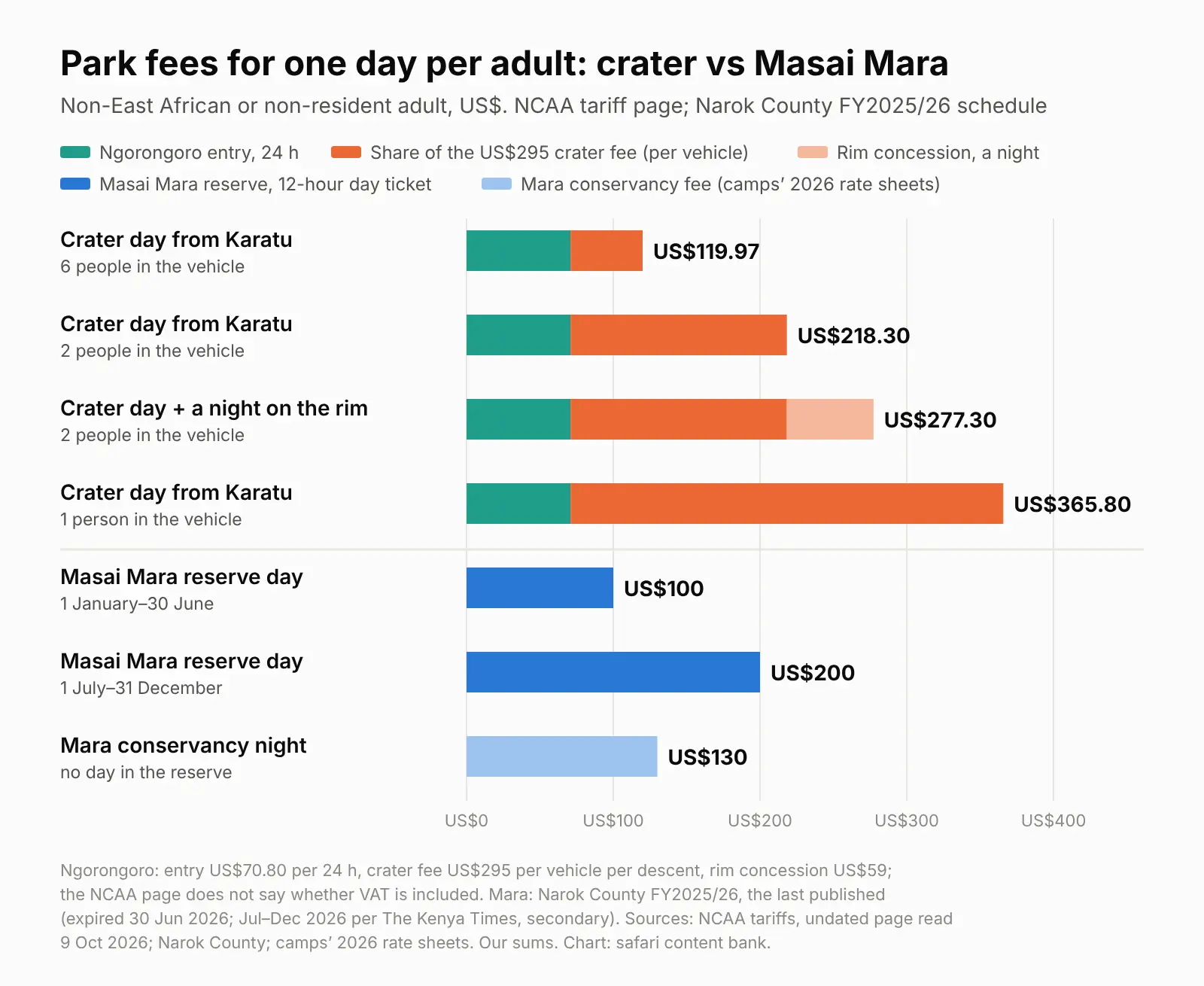 NCA entry plus a share of the US$295 crater fee; Mara reserve day ticket or conservancy fee. Sources: NCAA tariffs, read 9 October 2026; Narok County FY2025/26, the last published; camps’ 2026 rate sheets. Our sums. Chart: safari content bank.
The official fee lines, with the date each took effect and the authority’s own source:
| Fee | Amount | In force from | Source |
|---|---|---|---|
| Ngorongoro Conservation Area, non-East African adult, entry per 24 h (single entry) | USD 70.80 (NCAA's page does not say whether VAT is included) | Undated official page, read 9 Oct 2026 | NCAA |
| Ngorongoro Crater descent (crater service fee), per vehicle | USD 295 (NCAA's page does not say whether VAT is included) | Undated official page, read 9 Oct 2026 | NCAA |
| Ngorongoro concession fee, rim and Ndutu lodges, per person per night | USD 59 (NCAA's page does not say whether VAT is included) | Undated official page, read 9 Oct 2026 | NCAA |
| Ngorongoro Conservation Area, non-East African child 5–15, entry per 24 h (under 5 free) | USD 23.60 | Undated official page, read 9 Oct 2026 | NCAA |
| Maasai Mara National Reserve, non-resident adult, per day (12-hour ticket, 06:00–18:00), 1 Jan–30 Jun | USD 100 | Since 1 Jan 2024; Narok County FY2025/26 schedule, the last published | Narok County fee schedule FY2025/26 |
| Maasai Mara National Reserve, non-resident adult, per day (12-hour ticket, 06:00–18:00), 1 Jul–31 Dec | USD 200 | Since 1 Jul 2024; Narok County FY2025/26 schedule, the last published, expired 30 Jun 2026 (no 2026/27 schedule as of 9 Oct 2026); The Kenya Times (6 Aug 2026, secondary) reports US$200 still applies for Jul–Dec 2026 | Narok County fee schedule FY2025/26 |
| Maasai Mara National Reserve, non-resident child 9–17 or student, per day (under 9 free) | USD 50, all year | Narok County FY2025/26 schedule, the last published | Narok County fee schedule FY2025/26 |
- In fees, one Mara reserve day is cheaper than a crater day for two sharing in every month: US$100 or US$200 against US$218.30 (our sums). A full vehicle of six brings the crater day down to US$119.97, between the two Mara rates.
- But the crater is usually one day, and the Mara several. Three Mara reserve days cost an adult US$300 from January to June and US$600 from July to December (Masai Mara park fees).
- Children cost less at Ngorongoro from 9 to 15 and less in the Mara under 9: the NCA charges US$23.60 from age 5; the Mara reserve is free under 9, then US$50 a day from 9 to 17.
- The NCA permit is single entry. A second crater day from Karatu means another US$70.80 per adult and, if you go down again, another US$295 per vehicle (Ngorongoro park fees).
What a day costs per person, all in
Published Ngorongoro packages cost about US$260–425 per person per day with park fees; two people sharing a private vehicle pay US$443.30–1,667.30 a day from Karatu to a luxury highland camp. A Mara day costs about US$157–290 on a budget trip, US$352–1,248 mid-range and US$730–2,028 at a luxury camp, with that day’s fee counted.
| Style | Ngorongoro, per person per day | Masai Mara, per person per day |
|---|---|---|
| Budget / shared | Published group and shared packages: US$260–425, park fees included | Budget group safari: about US$157–160 (January–June) or US$257–260 (July–December) with the reserve fee; budget private trip for two from about US$290 |
| Mid-range | Karatu budget lodge + private vehicle for two: US$443.30–550.30 | Mara Serena lodge: about US$352–695 plus a vehicle; Governors’ Camp, drives included: US$603–1,248 |
| Upper | Rim tented camp (Lemala Ngorongoro) + private vehicle: US$747.30–1,147.30 | Conservancy camps (Offbeat, Kicheche): US$730–1,125 |
| Top | The Highlands, Olmoti, drives included: US$987.30–1,667.30 | Wilderness Mara, fees included: US$1,324–2,028 |
Our sums as printed on Ngorongoro safari cost and Masai Mara safari cost, read 9–10 October 2026. Ngorongoro private-vehicle figures add the NCA entry, half the US$295 crater fee, the US$59 concession for camps inside the NCA and half a US$200–300 daily vehicle and guide (one operator’s published cost guide). Mara figures add that day’s reserve, conservancy or community fee to the camp’s 2026 rate. Per person sharing, without international flights.
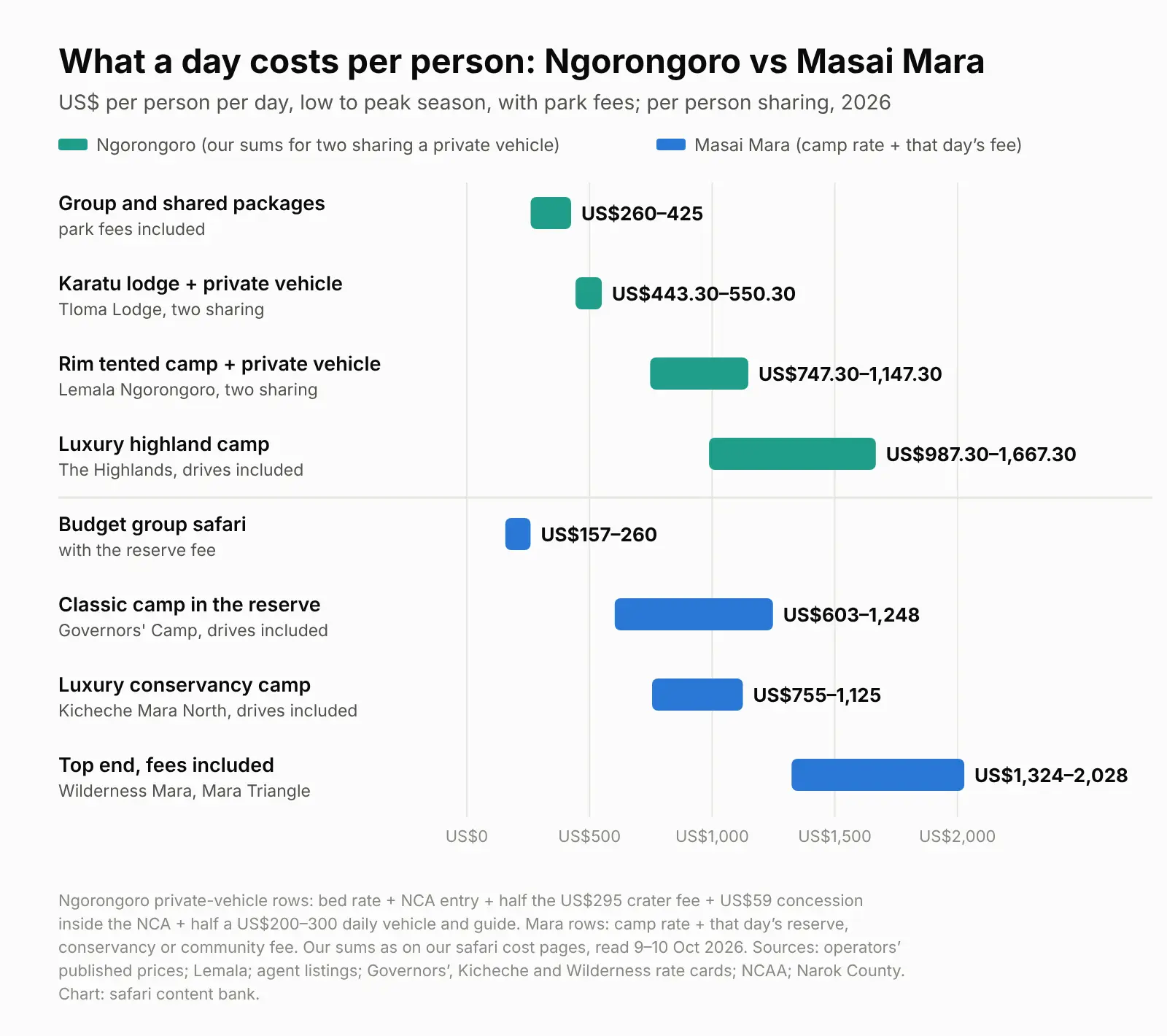 Our sums as printed on our Ngorongoro and Masai Mara safari cost pages: bed rates, park fees and, for Ngorongoro, half a private vehicle. Sources: operators’ published prices; Lemala; agent listings; Governors’, Kicheche and Wilderness 2026 rate cards; NCAA; Narok County. Chart: safari content bank.
- The budget Mara price is mostly the fee. One operator’s 3-day group safari costs US$170–180 per person and says “park fees NOT included”; from July to December the three reserve days cost US$600 (Masai Mara safari cost).
- The cheapest crater trips share the vehicle. Packages split the vehicle and the crater fee across 4–7 people; the private-vehicle sums split them across two (Ngorongoro safari cost).
Visas and compulsory insurance: Tanzania against Kenya
Each country has its own entry document and its own government insurance, and neither covers the other. For the crater you need Tanzania’s visa and inbound insurance; for the Mara, Kenya’s eTA and, since 5 October 2026, its government health policy.
| Tanzania (Ngorongoro) | Kenya (Masai Mara) | |
|---|---|---|
| Entry document | Tourist visa, single entry, US$50; US citizens must buy the US$100 multiple-entry visa. E-visa (“processed within ten days”) or visa on arrival | eTA US$30 plus card charges at etakenya.go.ke, approved before travel; no visa on arrival; takes 3 working days |
| Compulsory insurance | US$44 per adult, valid 92 days, under Government Notice 256 of 2026; needed “even if” you have your own policy (UK FCDO, 20 Oct 2026) | Government health policy required for arrivals since 5 October 2026, up to US$44 (eCitizen); valid 90 days |
| Exempt | EAC citizens need no visa; EAC and SADC residents are exempt from the insurance | EAC citizens and African nationals except Somalia and Libya need no eTA |
| Yellow fever certificate | Needed when you arrive from Kenya, aged 1 and over | Needed only if you arrive from a yellow fever risk country |
| One country only, per person (our sums) | US$94 (UK or EU); US$144 (US) | Up to US$74 |
Sources as on our Tanzania visa, Tanzania visitor insurance, Kenya visa and Kenya visitor insurance pages, checked 9–11 October 2026. Kenya’s insurance price and start date: eCitizen and the U.S. Embassy Nairobi. Yellow fever: WHO country list (PDF). Our sums before card charges.
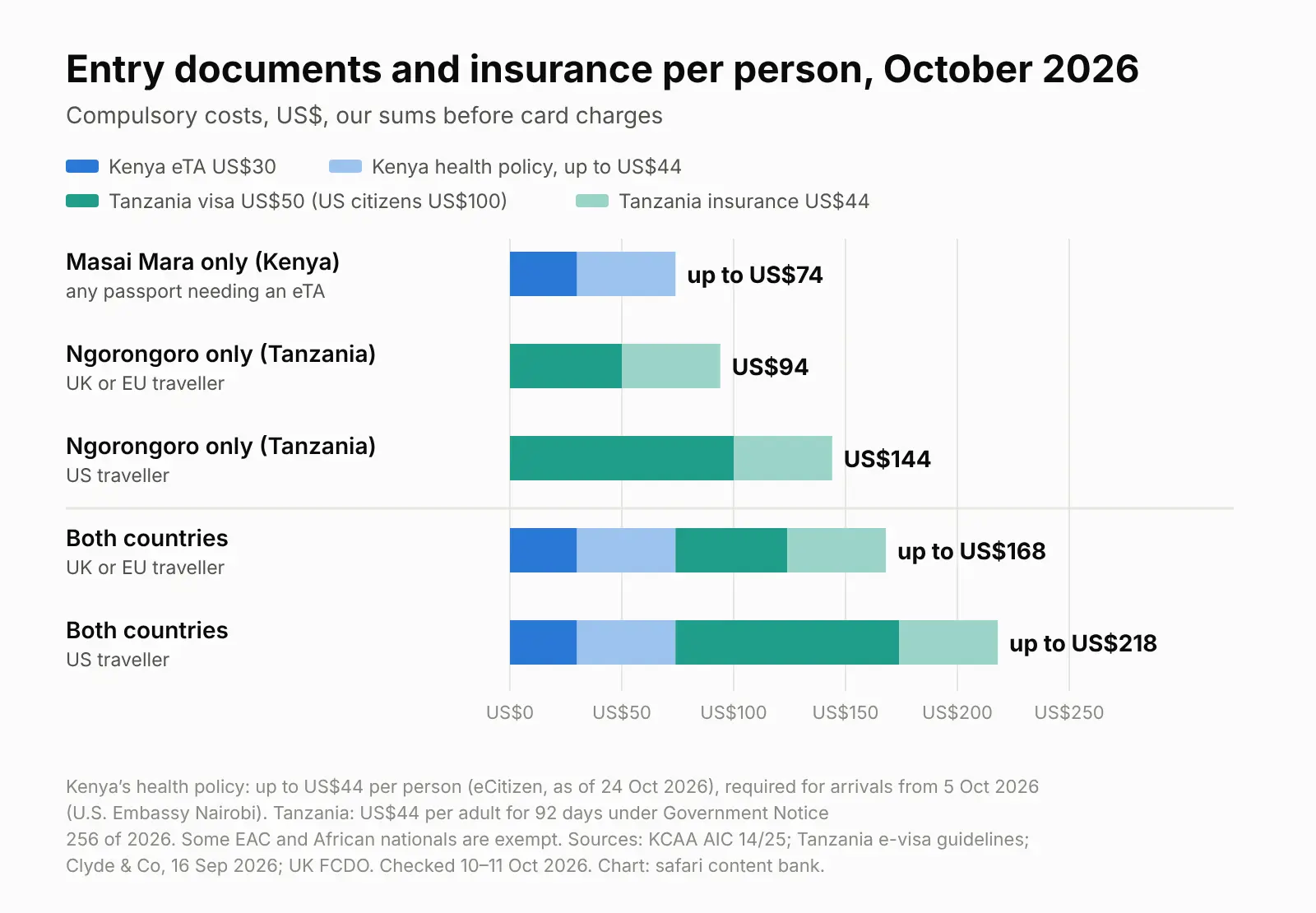 Our sums. Sources: KCAA AIC 14/25; Tanzania e-visa guidelines; eCitizen (Kenya health policy, as of 24 Oct 2026); Clyde & Co, 16 Sep 2026; UK FCDO. Checked 10–11 October 2026. Chart: safari content bank.
- The East African Tourist Visa (US$100) covers Kenya, Uganda and Rwanda, not Tanzania (Tanzania visa).
- Your own travel insurance does not replace either scheme, so a trip with both pays both premiums. Check the official Kenya eTA portal and Tanzania e-visa site the week you travel.
Doing both: Kenya and Tanzania on one trip
Most trips that combine the Mara and the crater fly or drive from Nairobi to Arusha, then go on by road to Karatu; the other way in is the Mara–Serengeti air link via Migori and Tarime, then the road across the NCA to the crater. Published Kenya and Tanzania itineraries run 10–24 days, with a median of 14 (Multi-country safari).
| Leg | How | Time or fare | Source |
|---|---|---|---|
| Mara → Nairobi Wilson | Scheduled flight | About 1 h; US$200 + US$20 one way | Mombasa Air Safari 2026 |
| Nairobi → Arusha, by road | Shuttle via the Namanga border | 5–6 h including the border; US$20–35 a seat | A self-drive operator’s guide; Kenya–Tanzania border crossings |
| Nairobi Wilson → Arusha, by air | Flightlink; AirKenya daily since March 2026 | About 1 h; Flightlink from US$225 one way | Flightlink |
| Mara → Serengeti, by air | Safarilink from the Mara 11:30 to Migori; road across Isebania–Sirari; Coastal Aviation from Tarime 14:00 | Runs 16 Dec–31 Mar and 1 Jul–31 Oct; no fare published | Safarilink |
| Serengeti → crater, by road | Naabi Hill Gate → crater rim | 85 km, 2–3 h | A self-drive operator’s guide |
| Sand River–Bologonja | Closed since 1977 | The EastAfrican, 4 Apr 2017 |
Read 9–10 October 2026. Flightlink’s times are website samples. Every border post and timetable: Kenya–Tanzania border crossings; the Mara–Serengeti routes: Mara to Serengeti.
- Your vehicle and guide do not cross the border. Tanzanian-plated safari cars are “currently banned” in Kenyan parks such as the Mara, and Kenyan-registered vehicles cannot enter Tanzanian parks (a self-drive operator’s guide). Book an operator licensed in each country, or one who partners across the border (how to check a safari operator is licensed).
- Carry the yellow fever card. Tanzania asks for it when you arrive from Kenya, by road or by air (yellow fever and safaris).
- Going through the Serengeti adds its fees. A night inside the Serengeti costs US$129.80–153.40 per adult (last published tariff, 2023/24), and the road from the Serengeti to the crater crosses the NCA; see Serengeti vs Ngorongoro and Serengeti vs Masai Mara.
Worked example: park fees and entry costs for both, per adult
Three reserve days in the Mara and one crater day from Karatu, two sharing the vehicle, cost an adult US$818.30 in fees in August and US$518.30 in February; a UK or EU traveller adds up to US$168 in entry documents and insurance (our sums).
| Per adult, two sharing (our sums) | February | August |
|---|---|---|
| Masai Mara reserve, 3 day tickets | US$300 | US$600 |
| Ngorongoro crater day from Karatu: US$70.80 entry + US$147.50 crater share | US$218.30 | US$218.30 |
| Park fees | US$518.30 | US$818.30 |
| Kenya eTA + health policy, Tanzania visa + insurance (UK or EU) | up to US$168 | up to US$168 |
| Total | about US$694.30 | about US$994.30 |
Our sums from Narok County FY2025/26 (the last published; July–December 2026 per The Kenya Times, secondary), the NCAA tariff page (read 9 October 2026; it does not say whether VAT is included) and Kenya–Tanzania border crossings. A US traveller pays up to US$218 in entry costs instead. Before beds, vehicles, flights, the NCA vehicle permit and a departure-day Mara ticket.
Which to choose, by traveller type
Choose the Mara for the herds from late July to October, a short trip from Nairobi or the conservancies; choose the crater for a single day from Arusha, a calving-season trip or a full vehicle; do both on a trip of about two weeks.
| If you are… | Choose | Why, with the number |
|---|---|---|
| Coming for the migration, late July–October | Masai Mara | Most animals are in the Mara in August–September; the crater floor is not on the route |
| Coming in January–March | Ngorongoro, with Ndutu | Calving around Ndutu (NCA) peaks about February, 106 km (2.5 h) from the crater |
| Short of time from Nairobi | Masai Mara | About 1 hour by air from Wilson, US$200 + US$20 one way |
| Short of time from Arusha | Ngorongoro Crater | Karatu is 15 km (30 min) from Loduare Gate; one crater day covers the floor |
| Counting fees, January–June | Masai Mara | US$100 a reserve day, against US$218.30 each for a crater day for two |
| A group of 6 sharing a vehicle | Ngorongoro Crater | The crater fee falls to US$49.17 each; the crater day costs US$119.97 per adult in fees |
| Travelling with children under 9 | Masai Mara | Free in the reserve under 9; the NCA charges US$23.60 from age 5 |
| Wanting night drives or walks | A Mara conservancy | Neither the crater nor the reserve sells night drives; NCA walks need an armed ranger and stay off the crater floor |
| Put off by crowded sightings | A Mara conservancy; the crater only from the rim | Travellers report 20–40 vehicles at Mara reserve sightings and call the crater floor “a zoo”; no cap is published for the crater |
| Planning both, about two weeks | Both | Kenya and Tanzania itineraries have a median of 14 days; entry costs up to US$168 (UK or EU) or US$218 (US) |
Fees: NCAA (read 9 October 2026; its page does not say whether VAT is included) and Narok County FY2025/26 (the last published); our sums where marked in the sections above. Itinerary median: our count on Multi-country safari, captured 8 October 2026.
The country-level choice, with beaches, other parks and budgets: Kenya vs Tanzania. See also: Serengeti vs Ngorongoro and Serengeti vs Masai Mara.
Common mistakes about Ngorongoro and the Masai Mara
| What you’ll often read | What is correct |
|---|---|
| “The crater fee is per person” | US$295 per vehicle per descent. |
| “You get six hours on the crater floor” | The NCAA guidelines state no time limit; the descent closes at 16:00 and driving ends at 18:00. |
| “Ngorongoro entry is US$82.60” | US$70.80 per adult per 24 h (NCAA). US$82.60 is peak Serengeti entry with VAT (last published tariff, 2023/24). |
| “The migration passes through the crater” | The herds calve around Ndutu, NCA land outside the crater, and reach the Mara usually from late July. |
| “The Mara fee is US$200 all year” | US$100 from 1 January to 30 June, US$200 from 1 July to 31 December. |
| “A Mara ticket lasts 24 hours” | 12 hours, 06:00–18:00, one per calendar day; it does not carry overnight. |
| “Drive from the Mara straight into Tanzania’s parks” | The Sand River–Bologonja crossing has been closed since 1977; cross at Namanga or fly via Migori and Tarime. |
| “One East African visa covers both” | The East African Tourist Visa covers Kenya, Uganda and Rwanda, not Tanzania. |
| “My own travel insurance is enough” | Both countries require their government policy: US$44 per adult in Tanzania; up to US$44 in Kenya (eCitizen). |
| “The same safari vehicle can take you across” | Vehicles and guides change at the border. |
Frequently asked questions
Which is better, Ngorongoro Crater or the Masai Mara? It depends on the month and the trip. The Mara has the wildebeest herds usually from late July to October and open plains all year; the crater is a one-day drive inside a closed crater at the same fee every month. Neither authority publishes a sighting rate.
Can I see the Great Migration in Ngorongoro Crater? Not on the crater floor. The herds calve on the plains around Ndutu, which is in the Ngorongoro Conservation Area, around February, and are usually in the Masai Mara from late July to October. Ndutu is 106 km and 2.5 hours from the crater.
Which is cheaper, Ngorongoro or the Masai Mara? Per day in fees, the Mara reserve: US$100 per adult from January to June and US$200 from July to December, against US$218.30 each for a crater day when two share a vehicle (our sums from the NCAA tariff page, which does not say whether VAT is included). The crater is usually one day and the Mara several, so a trip often costs more in Mara fees.
How long should I spend at each? One day for the crater floor: each US$295 crater fee covers one descent, and the descent closes at 16:00. In the Mara, at least two nights if you come by road; published Mara-only trips have a median of 4 days.
Is it cold at Ngorongoro Crater? Often, early and late in the day. The crater floor is at about 1,800 m and the rim lodges sit above it; lower-rated crater reviews mention cold or overcast days in June and August. Our climate source has no station in the crater, so we print no rim temperature. Mara nights are 11–13 °C in every month.
Can I visit the Masai Mara and Ngorongoro Crater on one trip? Yes, with a border crossing. Fly or drive from Nairobi to Arusha (5–6 hours by shuttle via Namanga, about 1 hour by air) and go on by road to Karatu, or fly from the Mara via Migori and Tarime to the Serengeti and drive on to the crater. Your vehicle and guide change at the border.
Do I need a visa for both Kenya and Tanzania? Yes, two documents: Kenya’s eTA (US$30) and Tanzania’s visa (US$50, or US$100 for US citizens), plus each country’s government insurance. The East African Tourist Visa does not cover Tanzania.
Which is more crowded, the crater or the Mara? No authority publishes vehicle counts for either, so there is no measured answer. Travellers report 20–40 vehicles at Mara reserve sightings and describe the crater floor as “a zoo”; the Mara reserve has a five-vehicle rule at sightings and conservancies as a quieter option.
Sources
- NCAA, tariffs (undated; does not say whether VAT is included; read 9 Oct 2026), visitor guidelines and home page (read 8 Oct 2026); TANAPA, Tariffs 2023/24 (PDF), the last published tariff
- Narok County, Maasai Mara fee schedule FY2025/26 (PDF), the last published, expired 30 June 2026; The Kenya Times, 6 Aug 2026 (press, secondary); GMME Management Plan 2023–2032 (PDF) and its vehicle rules as reported by Business Daily
- Mara Conservancy: history, conservation fees; Kenyans.co.ke, 4 Jun 2024
- Visitors: Kenya Economic Survey 2026 via Business Daily; Bank of Tanzania 2025 exit survey (PDF)
- Wildlife and setting: Wikipedia, Ngorongoro Conservation Area and spotted hyena (secondary); IUCN SSC African Rhino Specialist Group report to CITES, 2025, as on where to see rhino; one safari operator’s and one camp operator’s migration guides; a Kenyan camp operator’s Loita migration page
- Climate: Climates to Travel, Kenya and Tanzania (an aggregator); camp rates: Lemala and agent listings as on the Ngorongoro hub
- Travel: Mombasa Air Safari 2026 schedule; The Kenya Times, 20 Aug 2026; Flightlink and its fares (PDF); Safarilink, Masai Mara to Serengeti; The EastAfrican, 4 Apr 2017; a self-drive operator’s guide; a Tanzanian operator’s travel-times table (modified 1 Jul 2026)
- Entry: KCAA AIC 14/25 (PDF); Tanzania e-visa guidelines; UK FCDO, Tanzania; Clyde & Co, 16 Sep 2026; U.S. Embassy Nairobi; eCitizen insurance portal; WHO country list (PDF)
- Traveller reports: a safari booking site’s Ngorongoro and Masai Mara reviews; TripAdvisor forum threads, read 9 Oct 2026
- Our pages: Ngorongoro, Ngorongoro park fees, Ngorongoro safari cost, Masai Mara, Masai Mara park fees, Masai Mara safari cost, Nairobi to the Masai Mara, Kenya vs Tanzania, Kenya–Tanzania border crossings, Multi-country safari, Serengeti vs Ngorongoro, Serengeti vs Masai Mara
Fees checked 9–10 October 2026; entry rules 9–11 October 2026. We will update this page when the NCAA publishes a dated tariff, when Narok County publishes a 2026/27 Mara fee schedule and when Kenya publishes an official price for its health policy.